RESEARCH
Non-parametric correction of estimated
gene trees using TRACTION
Sarah Christensen , Erin K. Molloy, Pranjal Vachaspati, Ananya Yammanuru and Tandy Warnow
*Abstract
Motivation: Estimated gene trees are often inaccurate, due to insufficient phylogenetic signal in the single gene alignment, among other causes. Gene tree correction aims to improve the accuracy of an estimated gene tree by using computational techniques along with auxiliary information, such as a reference species tree or sequencing data. However, gene trees and species trees can differ as a result of gene duplication and loss (GDL), incomplete lineage sorting (ILS), and other biological processes. Thus gene tree correction methods need to take estimation error as well as gene tree heterogeneity into account. Many prior gene tree correction methods have been developed for the case where GDL is present.
Results: Here, we study the problem of gene tree correction where gene tree heterogeneity is instead due to ILS and/or HGT. We introduce TRACTION, a simple polynomial time method that provably finds an optimal solution to the RF-optimal tree refinement and completion (RF-OTRC) Problem, which seeks a refinement and completion of a singly-labeled gene tree with respect to a given singly-singly-labeled species tree so as to minimize the Robinson−Foulds (RF) distance. Our extensive simulation study on 68,000 estimated gene trees shows that TRACTION matches or improves on the accuracy of well-established methods from the GDL literature when HGT and ILS are both present, and ties for best under the ILS-only conditions. Furthermore, TRACTION ties for fastest on these datasets. We also show that a naive generalization of the RF-OTRC problem to multi-labeled trees is possible, but can produce misleading results where gene tree heterogeneity is due to GDL.
Keywords: Gene tree correction, Horizontal gene transfer, Incomplete lineage sorting
© The Author(s) 2020. This article is licensed under a Creative Commons Attribution 4.0 International License, which permits use, sharing, adaptation, distribution and reproduction in any medium or format, as long as you give appropriate credit to the original author(s) and the source, provide a link to the Creative Commons licence, and indicate if changes were made. The images or other third party material in this article are included in the article’s Creative Commons licence, unless indicated otherwise in a credit line to the material. If material is not included in the article’s Creative Commons licence and your intended use is not permitted by statutory regulation or exceeds the permitted use, you will need to obtain permission directly from the copyright holder. To view a copy of this licence, visit http://creat iveco mmons .org/licen ses/by/4.0/. The Creative Commons Public Domain Dedication waiver (http://creat iveco mmons .org/publi cdoma in/ zero/1.0/) applies to the data made available in this article, unless otherwise stated in a credit line to the data.
Background
Reconstructing the evolutionary history of a gene is a core task in phylogenetics, and our ability to infer these evolutionary relationships accurately can have impor-tant implications for a variety of downstream analyses. For example, estimated gene trees are used in the infer-ence of adaptation, evolutionary event detection (such as gene loss, gene duplication, and horizontal gene transfer), ortholog identification, analysis of functional trait evolu-tion, and species tree estimation. However, unlike spe-cies tree estimation techniques that leverage information
encoded across the entire genome, gene tree estimation based on a single locus may not contain enough signal to determine the correct gene tree topology with high con-fidence [1]. Indeed, many phylogenomic datasets have gene trees with average branch support well below 75%, which is a common lower bound for branches to be con-sidered reliable. For example, the Avian Phylogenomic Project [2] reported average branch support values below 30%, and many other studies (surveyed in [3]) have had similar challenges. Estimating gene and species trees is further complicated by biological processes such as gene duplication/loss (GDL), incomplete lineage sorting (ILS), and horizontal gene transfer (HGT), that create hetero-geneous tree topologies across the genome [4]. HGT has
Open Access
*Correspondence: [email protected]
long been known to cause problems for bacterial phylo-genetics, and ILS by itself has emerged as a major issue in phylogenomics, affecting most, if not all, genome-scale datasets [5].
Because gene trees often have low accuracy, a natural problem is to try to improve gene tree estimation using an estimated or known species tree. An approach from the GDL literature is to modify estimated gene trees with respect to a reference species tree, which may either be an established tree from prior studies or an esti-mated species tree (e.g., based on an assembled multi-locus dataset). Some of these methods use the available sequence data as well as the estimated gene tree and species tree, and are referred to as integrative methods; examples include ProfileNJ [1], TreeFix [6], and Tree-Fix-DTL [7]. Other methods, called gene tree correction methods, use just the topologies of the gene tree and spe-cies tree, and are typically based on parametric models of gene evolution; Notung [8, 9] and ecceTERA [10] are two well-known methods of this type. Integrative methods are generally expected to be more accurate than gene tree correction methods when gene tree heterogeneity is due to GDL, but as a result of using likelihood calculations they are also more computationally intensive. See [10– 16] for an entry into the vast literature on this subject.
Here, we examine gene tree correction where gene tree heterogeneity is due to ILS or HGT, and where each gene tree has at most one copy of each species. We present a new approach to gene tree correction that is based on a very simple non-parametric polynomial-time method, TRACTION. In addition to correcting gene trees, TRACTION is also capable of completing gene trees that do not contain all the species present in the reference species tree, a condition that may occur in a multi-locus study when not all genomes have been sequenced and assembled.
The input to TRACTION is a pair (t, T) of unrooted, singly-labeled phylogenetic trees. The leaf set of t is a subset of the leaf set of T, tree T is binary, and tree t will generally be non-binary. We seek a tree T′ created by refining t and adding any missing leaves so that T′ has the minimum Robinson−Foulds (RF) [17] distance to T. We call this the RF-optimal tree refinement and completion
Problem (RF-OTRC) and show that TRACTION finds an
optimal solution to RF-OTRC in O(n1.5logn) time, where
n is the number of leaves in the species tree T. We also explore an extension of this problem statement to handle multi-labeled genes by using a generalization of the RF distance proposed in [18].
To use TRACTION for gene tree correction in prac-tice, we assume we are given an estimated gene tree with branch support values and an estimated (or known) binary species tree, which may have additional species.
The low support branches in the gene tree are collapsed, forming the (unresolved) tree t. TRACTION first refines the input gene tree t into a binary tree t′ , and then it adds the missing species to t′ . Although the algorithm is quite simple, the proof of correctness is non-trivial.
We present the results of an extensive simulation study (on 68,000 gene trees, each with up to 51 species) in which gene tree heterogeneity is either due to only ILS or to both ILS and HGT. We explore TRACTION for gene tree correction with estimated species trees in compari-son to Notung, ecceTERA, ProfileNJ, TreeFix, and Tree-Fix-DTL. Many methods (including TRACTION) tie for best on the ILS-only data, but TRACTION dominates the other gene tree correction methods with respect to topological accuracy on the HGT + ILS data, while also tying for fastest. Importantly, TRACTION provides good accuracy even when the estimated species tree is far from the true gene tree. The simplicity of the approach and its good accuracy under a range of model conditions indi-cate that non-parametric approaches to gene tree correc-tion may be promising and encourages future research.
TRACTION
Terminology and basics
A phylogenetic tree can be represented as a tree T with leaves labeled by some set of organisms S. If each leaf label is unique, then the phylogenetic tree is singly-labeled. Unless noted otherwise, the phylogenetic trees we describe throughout this paper are singly-labeled and unrooted.
Each edge e in an unrooted, singly-labeled phylogenetic tree defines a bipartitionπe (also sometimes referred to
as a split) on the set of leaf labels induced by the deletion of e from the tree, but not its endpoints. Each bipartition splits the leaf set into two non-empty disjoint parts, A and B, and is denoted by A|B. The set of bipartitions of a tree T is given by C(T) = { πe : e∈E(T) }, where E(T) is the edge set for T. Tree T′ is a refinement of T if T can be obtained from T′ by contracting a set of edges in E(T′) . A tree T is fully resolved (i.e., binary) if there is no tree that refines T other than itself.
A set Y of bipartitions on some leaf set S is compat-ible if there exists an unrooted tree T leaf-labeled by S such that Y⊆C(T). A bipartition π of a set S is said to
compatible. Furthermore, by [21] (and see discussion in [22, 23]), a set C of bipartitions is compatible if and only if
there is a tree T such that C(T)=C.
The Robinson−Foulds (RF) distance [17] between two trees T and T′ on the same set of leaves is defined as the minimum number of edge-contractions and refinements required to transform T into T′ (where each such opera-tion changes the number of edges in the tree by exactly one, so contracting a single edge or refining a polytomy to add a single edge). For singly-labeled trees, the RF dis-tance equals the number of bipartitions present in only one tree (i.e., the symmetric difference). The normalized RF distance is the RF distance divided by 2n−6 , where
n is the number of leaves in each tree; this produces a value between 0 and 1 since the two trees can only disa-gree with respect to internal edges, and n−3 is the
maxi-mum number of internal edges in an unrooted tree with n leaves.
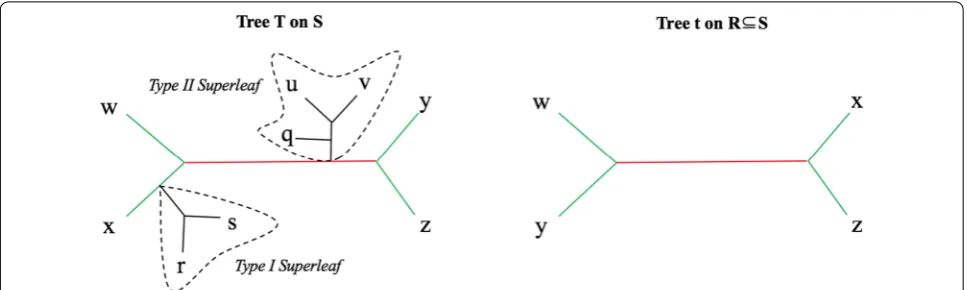
Given a phylogenetic tree T on taxon set S, Trestricted to R⊆S is the minimal subgraph of T connecting ele-ments of R and suppressing nodes of degree two. We denote this as T|R . If T and T′ are two trees with R as
the intersection of their leaf sets, their shared edges are edges whose bipartitions restricted to R are in the set C(T|R)∩C(T′|R) . Correspondingly, their unique edges
are edges whose bipartitions restricted to R are not in the set C(T|R)∩C(T′|R) . See Fig. 1 for a pictorial depiction of unique and shared edges.
RF‑optimal tree refinement and completion (RF‑OTRC) problem
We now turn our attention to the optimization problem of interest to this paper. This section is limited to the con-text of singly-labeled trees; we postpone the extension to cases where the gene tree can have multiple copies
of a species at the leaves, which are referred to as multi-labeled trees (i.e., MUL-trees [24]), until a later section.
The Optimal Tree Refinement and Completion Problem
Input:An unrooted, singly-labeled, binary treeTon leaf setSand an unrooted, singly-labeled treet onR⊆S. Output:An unrooted, singly-labeled, binary treeTonS with two key properties:
1 Tcontains all the leaves ofSand is compatible with t(i.e.,T|Ris a refinement oft) and
2 Tminimizes the RF distance toT among all binary refinements oft.
If the trees t and T have the same set of taxa, then the RF-OTRC problem becomes the RF-optimal tree refine-ment (RF-OTR) problem, while if t is already binary but can be missing taxa, then the RF-OTRC problem becomes the RF-optimal tree completion (RF-OTC) problem. OCTAL, presented in [25], solves the RF-OTC problem in O(n2) time, and an improved approach pre-sented by Bansal [26] solves the RF-OTC problem in linear time. We refer to this faster approach as Bansal’s
algorithm. In this paper we present an algorithm that
solves the RF-OTR problem exactly in polynomial time and show that the combination of this algorithm with Bansal’s algorithm solves the RF-OTRC problem exactly in O(n1.5logn) time, where T has n leaves. We refer to the two steps together as Tree Refinement And Comple-TION (TRACComple-TION).
TRACTION algorithm
The input to TRACTION is a pair of unrooted, singly-labeled trees (t, T), where t is the estimated gene tree on set R of species and T is the binary reference tree on S, with R⊆S . Note that we allow t to not be binary (e.g., if
low support edges have already been collapsed) and to be missing species (i.e., R⊂S is possible).
Step 1: Refine t so as to produce a binary tree t∗ that
maximizes shared bipartitions with T.
Step 2: Add the missing species from T into t∗ ,
mini-mizing the RF distance.
Step 1: Greedy refinement of t
To compute t∗ , we first refine t by adding all biparti-tions from T|R that are compatible with t; this produces
a unique tree t′ . If t′ is not fully resolved, then there are multiple optimal solutions to the RF-OTR problem, as we will later prove. The algorithm selects one of these optimal solution as follows. First, we add edges from t that were previously collapsed (if such edges are avail-able). Next, we randomly refine the tree until we obtain a fully resolved refinement, t∗ . Note that if t′ is not binary, then t∗ is not unique. We now show that the first step of TRACTION solves the RF-OTR problem.
Theorem 1 Let T be an unrooted, singly-labeled tree on leaf set S, and let t be an unrooted, singly-labeled tree on leaf set R⊆S. A fully resolved (i.e. binary) refinement of t
minimizes the RF distance toT|R if and only if it includes
all compatible bipartitions fromT|R.
Proof Let C0 denote the set of bipartitions in T|R that
are compatible with t. By the theoretical properties of compatible bipartitions (see “Terminology and basics” section), this means the set C0∪C(t) is a
compat-ible set of bipartitions that define a unique tree t′ where C(t′)=C
0∪C(t) (since the trees are singly-labeled).
We now prove that for any binary tree B refining t, B minimizes the RF distance to T|R if and only if B refines t′.
Consider a sequence of trees t=t0,t1,t2,. . .,tk , each
on leaf set R, where ti is obtained from ti−1 by adding one edge to ti−1 , and thus adds one bipartition to C(ti−1) . Let
δi=RF(ti,T|R)−RF(ti−1,T|R) , so that δi indicates the
change in RF distance produced by adding a specific edge to ti−1 to get ti . Hence,
A new bipartition πi added to C(ti−1) is in C(T|R) if and
only if πi∈C0 . If this is the case, then the RF distance will
decrease by one (i.e., δi= −1 ). Otherwise, πi ∈C0 , and
the RF distance to T|R will increase by one (i.e., δi=1).
Now suppose B is a binary refinement of t. We can write the bipartitions in C(B)\C(t) into two sets, X and
Y, where X are bipartitions in C0 and Y are bipartitions RF(ti,T|R)=RF(t0,T|R)+
j≤i
δj.
not in C0 . By the argument just provided, it follows that RF(B,T|R)=RF(t,T|R)− |X| + |Y| . Note that |X∪Y|
must be the same for all binary refinements of t, because all binary refinements of t have the same number of edges. Thus, RF(B,T|R) is minimized when |X| is
maxi-mized, so B minimizes the RF distance to T|R if and only
if C(B) contains all the bipartitions in C0 . In other words, RF(B,T|R) is minimized if and only if B refines t′ .
Corollary 1 TRACTION finds an optimal solution to the RF-OTR problem.
Proof Given input gene tree t and reference tree T on the same leaf set, TRACTION produces a tree t′′ that refines t and contains every bipartition in T compatible with t; hence by Theorem 1, TRACTION solves the
RF-OTR problem.
Step 2: Adding in missing species
The second step of TRACTION can be performed using OCTAL or Bansal’s algorithm, each of which finds an optimal solution to the RF-OTC problem in polynomial time. Indeed, we show that any method that optimally solves the RF-OTC problem can be used as an intermedi-ate step to solve the RF-OTRC problem.
To prove this, we first restate several prior theoretical results. In [25] we showed the minimum achievable RF distance between T and T′ is given by:
where m is the number of Type II superleaves in T rela-tive to t, which we define:
Definition 1 Let T be a binary tree on leaf set S and t be a tree on leaf set R⊆S . The superleaves of T with respect
to t are defined as follows (see Fig. 1). The set of edges in T that are on a path between two leaves in R define the
backbone; when this backbone is removed, the
remain-der of T breaks into pieces. The components of this graph that contain vertices from S\R are the superleaves. Each superleaf is rooted at the node that was incident to one of the edges in the backbone, and is one of two types:
• Type I superleaves: the edge e in the backbone to which the superleaf was attached is a shared edge in T|R and t
• Type II superleaves: the edge e in the backbone to which the superleaf was attached is a unique edge in
T|R and t
(1)
Theorem 2 (Restatement of Theorem 9 in [25]) Given unrooted, singly-labeled binary trees t and 7 with the leaf set of t a subset of the leaf set S of T, OCTAL(T, t) solves the RF-OTC problem and runs in O(n2)time, where T has n leaves.
Proof of correctness for TRACTION
Lemma 1 Let T be an unrooted, singly-labeled, binary tree on leaf set S with |S| =n, and let t be an unrooted,
singly-labeled tree on leaf set R⊆S. TRACTION returns
a binary unrooted tree T′on leaf set S such that RF(T′,T)
is minimized subject to T′|Rrefining t.
Proof By construction TRACTION outputs a tree T′
that, when restricted to the leaf set of t, is a refinement of t. Hence, it is clear that T′|
R refines t. Now, it is only
necessary to prove that RF(T′ , T) is minimized by
TRAC-TION. Since the intermediate tree t∗ produced in the
first step of TRACTION is binary, Theorem 2 gives that TRACTION using OCTAL (or any method exactly solv-ing the RF-OTC problem) will add leaves to t∗ in such a
way as to minimize the RF distance to T; hence it suffices to show that t∗ computed by TRACTION has the
small-est RF distance to T among all binary refinements of t. As given in Eq. 1, the optimal RF distance between T′ and T is the sum of two terms: (1) RF(t∗ , T|
R ) and (2) the
number of Type II superleaves in T relative to t∗ .
Theo-rem 1 shows that TRACTION produces a refinement t∗ that minimizes the first term. All that remains to be shown is that t∗ is a binary refinement of t minimizing the
number of Type II superleaves in T relative to t∗.
Consider a superleaf X in T with respect to t. If t were already binary, then every superleaf X is either a Type I or a Type II superleaf. Also, note that every Type I superleaf in T with respect to t will be a Type I superleaf for any refinement of t. However, when t is not binary, it is pos-sible for a superleaf X in T to be a Type II superleaf with respect to t but a Type I superleaf with respect to a refine-ment of t. This happens when the refinement of t intro-duces a new shared edge with T to which the superleaf X is attached in T. Notice that since the set of all possible shared edges that could be created by refining t is com-patible, any refinement that maximizes the number of shared edges with T also minimizes the number of Type II superleaves. Theorem 1 shows that TRACTION produces such a refinement t∗ of t. Thus, TRACTION finds a binary
unrooted tree T′ on leaf set S such that RF(T′ , T) is mini-mized subject to the requirement that T′|
R refine t.
Theorem 3 TRACTION solves the RF-OTRC prob-lem and runs inO(n1.5logn) time if used with Bansal’s
algorithm andO(n2)time if used with OCTAL, where n is
the number of leaves in the species tree.
Proof The above lemma shows that TRACTION solves
the RF-OTRC problem. Let t, T, S, and R be as defined in the RF-OTRC problem statement. What remains to be shown is a running time analysis for the first stage of TRACTION (refining t). We claim this step takes O(|S| + |R|1.5log(|R|)) time.
Constructing T|R takes O(|S|) time. Checking
compat-ibility of a single bipartition with a tree on K leaves, and then adding the bipartition to the tree if compatible, can be performed in only O(|K|0.5log(|K|)) after a fast pre-processing step (see Lemmas 3 and 4 from [27]). Hence, determining the set of edges of T|R that are compatible
with t takes only O(|S| + |R|1.5log(|R|)) time. Therefore, the first stage of TRACTION takes O(|S| + |R|1.5log(|R|)) time. Hence, if used with OCTAL, TRACTION takes O(|S|2) time and if used with Bansal’s algorithm TRAC-TION takes O(|S|1.5log|S|) time.
Extending TRACTION to MUL‑trees
Up to this point, we have formulated gene tree correction problems only in the context where the input trees are each singly-labeled (i.e., have at most one leaf for each species). However, in the context of GDL, a gene tree may have mul-tiple copies of a species at its leaves (i.e., it can be a “MUL-tree”). We now generalize the RF-OTR problem to allow the input unresolved tree t to be a MUL-tree, although we still require the species tree T to be singly-labeled.
Recall that the RF distance between two trees is the minimum number of contractions and refinements that suffice to transform one tree into the other, and that this is equal to the bipartition distance for singly-labeled trees. This definition requires that the two trees have the same number of copies of each species (also referred to as “label-multiplicity”), since otherwise there is no such edit transformation. However, even when the two MUL-trees have the same number of copies of each species, we cannot rely on the use of the bipartition distance, as two MUL-trees can have identical sets of bipartitions but not be isomorphic [28].
In the context we will address, we are given a MUL-tree R (i.e., the gene family tree) and a singly-labeled
Definition 2 Let r and t be given with r a MUL-tree and t a singly-labeled tree, and both with the same set of species labeling the leaves. We construct the MUL-tree Ext(t, r) from t as follows: for each species s and the unique leaf x in t labeled by s, we replace x by a node vs that is attached to k
leaves, each labeled by s, where k is the number of leaves in r that are labeled by s. We refer to Ext(t, r) as the extension
of t relative to r. Note that Ext(t, r) and r have the same number of copies of each species.
The Optimal Tree Refinement Problem for MUL-Trees (RF-OTR-MT)
Input: A MUL-treeR and an unrooted, binary singly-labeled treeT, where both trees have the same setS of species labeling the leaves.
Output:An unrooted binary treeRwith two key prop-erties:
1 RrefinesR, and
2 Rminimizes the RF distance toExt(T,R) among all binary refinements of .
Before we present TRACTION-MT (i.e., TRACTION for MUL-trees), we need one more definition.
Definition 3 Let r1 and r2 be MUL-trees, both
leaf-labeled by the same set of species, with the same number of copies of each species labeling the leaves. We construct r1 from ′ r
1 (and similarly r2 from ′ r2 ) by relabeling the leaves
of r1 so that it is singly-labeled by replacing the k leaves
labeled by s with s1,s2,. . .,sk . Note that r1′ and r2 are now ′
singly-labeled trees and that L(r′
1)=L(r2′) . We say the pair (r′
1,r2′) is a consistent full differentiation of (r1,r2).
We now present TRACTION-MT. The input to TRACTION-MT is a pair (R,T) where R is a
MUL-tree and T is a singly-labeled tree, and they are both leaf-labeled by a set S of species.
• Step 1: Compute Ext(T,R) (i.e., the extended ver-sion of T with respect to R , see Definition 2). • Step 2: Relabel the leaves in T and Ext(T,R) in a
mutually consistent fashion (see Definition 3), thus producing trees T′ and R′.
• Step 3: Apply TRACTION to the pair R′ and T′ , pro-ducing tree R∗ on leafset S′ . For every species s∈S and leaf in R∗ labeled si , replace the label si by s, thus pro-ducing a tree R∗∗ on leaf-set S that is isomorphic to R∗. • Step 4: Return R∗∗.
Theorem 4 TRACTION-MT solves the RF-OTR-MT problem exactly and has running timeO(|R|1.5log|R|).
Proof Let MUL-tree R and singly-labeled tree T be
given, and let R∗∗ be the tree returned by TRACTION-MT for this pair. We will show that R∗∗ is a refinement of R that has minimum RF distance to Ext(T,R) among all binary refinements, thus establishing that TRACTION-MT solves the RF-OTR-TRACTION-MT problem optimally [28].
Steps 1 and 2 together take the input pair R and T and creates two new trees R′ and T′ that form a pair of consistent full differentiations of R and Ext(T,R) . By Theorem 3 in [11], RF(R,Ext(T,R))=RF(R′,T′) . Since R′ and T′ are singly-labeled, Step 2 produces a tree R∗ that is a refinement of R′ and minimizes the RF
distance to T′ . Therefore the tree R∗∗ is a refinement of
R that minimizes the RF distance to Ext(T,R) . Hence,
a Reference treeT b Mul-treeR
a b c d e a a a
b c b
c d e ExtendedT e a1 a2 a3 b1
b2 c1
c1
d
d tree returned by TRACTION
a1 a2 a3 b1 c1 b2 c2 d e c
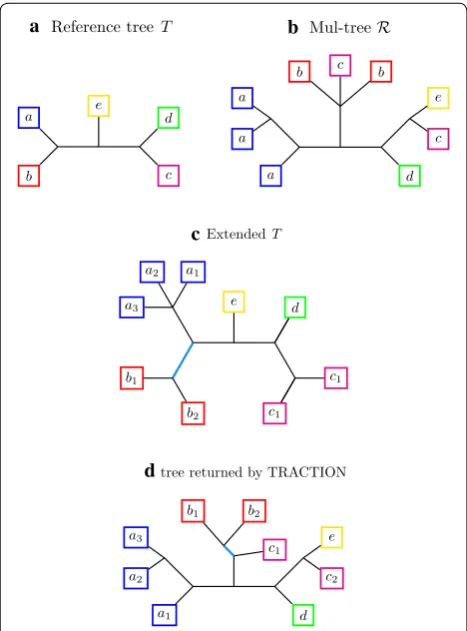
Fig. 2 Example of MUL-tree correction using TRACTION-MT given a reference tree. Given a singly-labeled, binary tree T on leaf set S, we wish to correct a MUL-tree R using TRACTION-MT. First, we build
the extension of T with respect to R , called “Extended T.” Second, we
re-label the leaves so that R and Extended T become consistent full
differentiations. Now we run TRACTION on the pair, producing the singly-labeled tree shown in (d). TRACTION-MT would then relabel the leaves again (i.e., si is relabeled s for all species s), to produce a
TRACTION-MT finds an optimal solution to the RF-OTR-MT problem on this input pair.
Finally, for the running time analysis, the crea-tion of the two trees R′ and T′ takes O(|R|) . Then running TRACTION on this pair takes an additional
O(|R|1.5log|R|) time, as noted in Theorem 3.
Figure 2 provides example of a MUL-tree, an extended species tree, and TRACTION’s solution to the RF-OTR problem for MUL-trees.
Evaluation
TRACTION‑MT under gene duplication and loss: case study There are model conditions under which TRACTION-MT will not accurately modify an input estimated gene
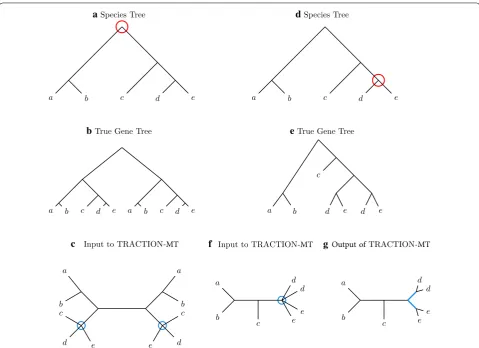
tree, even when given the true species tree as the refer-ence tree and a collapsed version of the true gene tree. For example, if a duplication event takes place at the root of a species tree, then genes of the same species will not be siblings in the true gene tree. Hence, if TRACTION-MT is given the true gene tree (i.e., MUL-tree), it will not be able to add any bipartitions to it from the extended species tree, and will instead return a random refine-ment (see Fig. 3a–c). For a second example, if a duplica-tion event takes place closer to the leaves, then genes of the same species appear somewhat close to each other in the true gene tree. As a result, TRACTION-MT may add edges in the wrong place, resulting in incorrect locations for duplications (see Fig. 3d–g). The key point to both cases is that when TRACTION-MT adds edges from the
a Species Tree d Species Tree
a b c d e a b c d e
b True Gene Tree e True Gene Tree
a b c d e
a b c d e a b
c
d e d e
c InputtoTRACTION-MT f InputtoTRACTION-MT g Output of TRACTION-MT
a
b c
d e
a
b c
d e
a
b
c
d d
e e
d d
e e a
b
c
extended species tree, these imply duplications at the leaves of the species tree, and the edges produced by ran-dom refinements of the MUL-tree have low probability (i.e., never more than 1
3 ) of being in the true species tree.
TRACTION under ILS and HGT: simulations Overview
We evaluated TRACTION in comparison to Notung, ecceTERA, ProfileNJ, TreeFix, and TreeFix-DTL on esti-mated gene trees under two different model conditions (ILS-only and ILS+HGT), using estimated and true spe-cies trees. In total, we analyzed 68,000 genes: 8000 with 26 species under ILS-only models and 60,000 with 51 species under ILS + HGT models. All estimated gene trees that we correct in these experiments were complete (i.e., were not missing species). The motivation for this is twofold. First, the methods we benchmarked against do not provide an option for completing gene trees with missing data. This is understandable since these meth-ods were developed for GDL, where missing species in a gene tree are interpreted as true loss events rather than incomplete sampling. Second, an experimental evalua-tion of OCTAL, the algorithm that performs the comple-tion step of TRACTION, was previously performed in [25].
Datasets
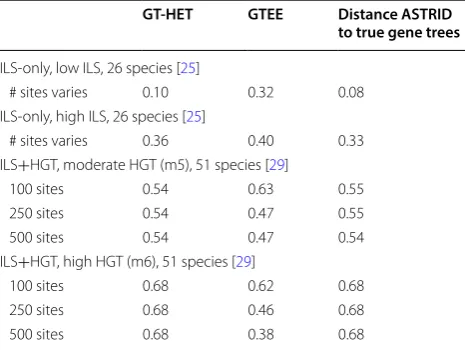
We briefly describe the datasets used in this study; all datasets are from prior studies [25, 29] and available online. The datasets included singly-labeled genes with 26 or 51 species (each with a known outgroup), and were generated under model conditions where true gene trees and true species trees differed due to only ILS (datasets with 26 species had two levels of ILS) or due to both ILS and HGT (datasets with 51 species had the same level of ILS but two different levels of HGT). The true gene tree heterogeneity (GT-HET, the topological distance between true species trees and true gene trees) ranged from 10% (for the ILS-only condition with moderate ILS) to as high as 68% (for the ILS+HGT condition with high HGT). Each model condition has 200 genes, and we explored multiple replicate datasets per model condition with dif-ferent sequence lengths per gene. See Table 1 for details.
Estimated gene trees and estimated reference species trees
For each gene, we used RAxML v8.2.11 [30] under the GTRGAMMA model to produce maximum likelihood gene trees, with branch support computed using boot-strapping. Because sequence lengths varied, this pro-duced estimated gene trees with different levels of gene tree estimation error (GTEE) (defined to be the average RF distance between the true gene tree and the estimated gene tree), ranging from 32 to 63% as defined by the
missing branch rate (see Table 1). We estimated a species tree using ASTRID v1.4 [31] given the RAxML gene trees as input. Because the true outgroup for all species trees and gene trees was known, we rooted the species tree and all gene trees at the outgroup prior to performing gene tree correction.
The gene trees given as input to the different correc-tion methods were computed as follows. Each gene tree estimated by RAxML had branches annotated with its bootstrap support, and we identified all the branches with bootstrap support less than a given threshold. These branches with low support were then collapsed in the gene trees before being given to TRACTION, Notung, and ProfileNJ. When we ran ecceTERA, we gave the binary gene trees with the threshold value (i.e., minimum required bootstrap support value); ecceT-ERA collapses all branches that have support less than the threshold value, and explores the set of refinements. Thus, the protocol we followed ensured that ecceTERA, ProfileNJ, Notung, and TRACTION all used the same set of collapsed gene trees. TreeFix and Treefix-DTL used the uncollapsed gene trees. We ran all methods using a threshold value of 75% (the standard threshold for “low support”). We additionally ran TRACTION and Notung using collapse thresholds of 50%, 85%, and 90% on the ILS-only data.
Table 1 Empirical properties of the simulated datasets used in this study: gene tree heterogeneity, the average normalized RF distance between true gene trees and true species trees (GT-HET); average gene tree estimation error (GTEE); and the average distance of the ASTRID reference tree, to the true gene trees
The publications from which the simulated datasets are taken are also indicated. In total we analyzed 68,000 genes with varying levels and causes of true gene tree heterogeneity (to the true species tree) and gene tree estimation error. The ILS-only conditions each had 20 replicates, and the ILS+HGT conditions each had 50 replicates
GT‑HET GTEE Distance ASTRID to true gene trees
ILS-only, low ILS, 26 species [25]
# sites varies 0.10 0.32 0.08 ILS-only, high ILS, 26 species [25]
# sites varies 0.36 0.40 0.33 ILS+HGT, moderate HGT (m5), 51 species [29]
100 sites 0.54 0.63 0.55 250 sites 0.54 0.47 0.55 500 sites 0.54 0.47 0.54 ILS+HGT, high HGT (m6), 51 species [29]
Gene tree correction and integrative methods
The RAxML gene trees were corrected using TRAC-TION v1.0, Notung v2.9, ecceTERA v1.2.4, ProfileNJ (as retrieved from GitHub after the March 20, 2018 commit with ID 560b8b2) [1], TreeFix v1.1.10 (for the ILS-only datasets), and TreeFix-DTL v1.0.2 (for the HGT + ILS datasets), each with a species tree estimated using ASTRID v1.4 [31] as the reference tree rooted at the out-group. The integrative methods (TreeFix, TreeFix-DTL, and ProfileNJ) also required additional input data related to the gene alignments, which we detail in the commands below. All estimated gene trees were complete (i.e., there were no missing taxa), so TRACTION only refined the estimated gene tree and did not add any taxa. We also explored using the true model species tree as a refer-ence tree for TRACTION and Notung on the ILS-only datasets.
Evaluation criteria
We used RF tree error (the standard criterion in perfor-mance studies evaluating phylogeny estimation methods) to quantify error in estimated and corrected gene trees as compared to the known true gene tree (as defined in the simulation protocol) and the impact of TRACTION, Notung, ecceTERA, and TreeFix-DTL, on these errors. Note that although we used the RF distance within the OTR optimization criterion, in that context, it refers to the distance between the corrected gene tree and the ref-erence tree (which is an estimated species tree); in con-trast, when we used the RF error rate in the evaluation criterion, it refers to the distance between the corrected gene tree and the true gene tree. Since the reference trees used in our experiments are typically very topologically different from the true gene tree (8% RF distance for the moderate ILS condition, 33% for the high ILS condition, 54% to 68% for the ILS+HGT conditions, see Table 1), optimizing the RF distance to the reference tree is quite
different from optimizing the RF distance to the true gene tree. Finally, we also evaluated the methods using the matching distance [32] and the quartet distance [33].
Experiments
We performed two main experiments: one in which we explored performance on ILS-only datasets and the other in which we explored performance on datasets with HGT and ILS. In each case, we directly explored how the GTEE level impacted absolute and relative accu-racy of gene tree correction methods. We also indirectly explored how GT-HET affects relative and absolute accu-racy. Heterogeneity is higher on the HGT + ILS datasets than on the ILS-only datasets, as HGT adds heterogene-ity between gene trees and species trees (see Table 1). In our third experiment, we evaluated how the branch sup-port collapse threshold and how using the true species tree as the reference tree impacted absolute and relative performance among the best performing methods on the ILS-only datasets.
Commands
In the following commands, resolved gene trees refers to the gene trees estimated using RAxML, unresolved gene trees refers to these estimated gene trees with branches having bootstrap support less than the threshold (e.g., 75%) collapsed, and reference species tree refers to the species tree estimated using ASTRID. Rooted means the input tree was rooted at the outgroup.
RAxML v8.2.11 was run as
raxml -f a -m GTRGAMMA -p 12345 -x 12345 -N <# bootstrap replicates> \ -s <alignment file> -n <output name>
ASTRID v1.4 was run as
ASTRID -i <resolved gene trees> -o <output>
Notung v2.9 was run as
java -jar Notung-2.9.jar --resolve -s <rooted reference species tree> \ -g <rooted unresolved gene tree> --speciestag postfix \ --treeoutput newick --nolosses
TRACTION v1.0 was run as
traction.py --refine -r -s 12345 -b <unrooted reference species tree> \ -u <unrooted resolved gene trees> -i <unrooted unresolved gene trees> \ -o <output>
ecceTERA v1.2.4 was run as
eccetera resolve.trees=0 \ collapse.mode=1 \ collapse.threshold=75 \ dated=0 print.newick=true \
species.file=<rooted reference species tree> \ gene.file=<rooted resolved gene tree>
FastME v2.1.6.1 [34], used to compute a distance matrix for ProfileNJ, was run as
fastme -i <input gene alignment> -O <output distance matrix> -dK
ProfileNJ, using the K2P-corrected distance matrix from FastME, was run as
profileNJ \
-g <rooted unresolved gene tree> -s <rooted reference species tree> \ -d <distance matrix> -o <output> -S <name map> -r none \
-c nj --slimit 1 --plimit 1 --firstbest --cost 1 0.99999
TreeFix v1.1.10 was run on the ILS-only datasets as
treefix -s <rooted reference species tree> -S <name map> \
-A <alignment file extension> -o <old tree file extension> \ -n <new tree file extension> <resolved gene tree>
TreeFix-DTL v1.0.2 was run on the HGT + ILS data-sets as
treefixDTL -s <rooted reference species tree> -S <map file> \
-A <alignment file extension> -o <old gene tree file extension> \ -n <new gene tree file extension> <resolved gene tree>
Normalized RF distances were computed using Den-dropy v4.2.0 [35] as
n1 = len(t1.internal_edges(exclude_seed_edge=True)) n2 = len(t2.internal_edges(exclude_seed_edge=True)) [fp, fn] = false_positives_and_negatives(t1, t2) rf = float(fp + fn) / (n1 + n2)
Matching distances were computed using code from [32] and [36] as
matching_distance <tree 1> <tree 2> <number of leaves>
Quartet distances were computed using QDist [33] as
qdist <tree 1> <tree 2>
Results and discussion
Experiment 1: Comparison of methods on ILS‑only datasets
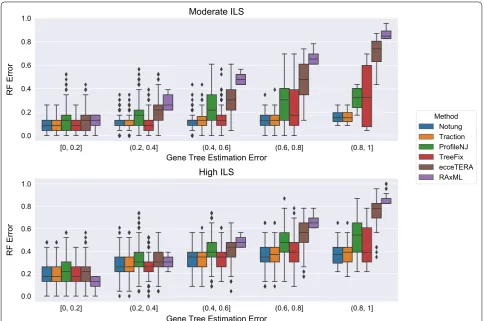
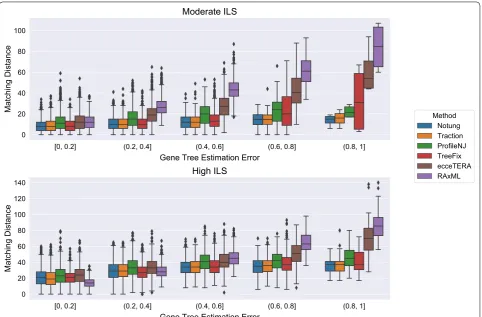
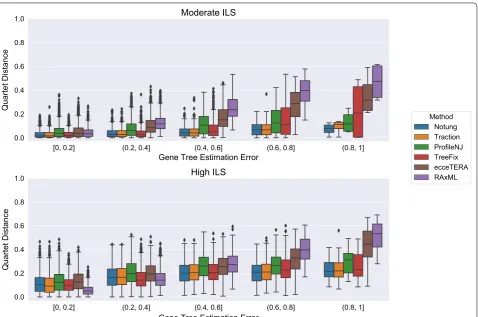
Not all methods completed on all datasets: ecceTERA failed to complete on 67 gene trees, ProfileNJ failed to complete on two gene trees, and all other methods completed on all gene trees. Results shown in Fig. 4 are restricted to those datasets on which all methods com-pleted. For the moderate ILS condition with accuracy evaluated using RF distance (Fig. 4top), all methods were able to improve on RAxML, and the degree of improve-ment increased with GTEE. For the high ILS condition (Fig. 4bottom), methods improved on RAxML only when
GTEE was at least 20%. Thus, GTEE and ILS level both impacted whether methods improved on RAxML. Fur-thermore, the methods grouped into two sets: TRAC-TION, Notung, and TreeFix performing very similarly and ProfileNJ and ecceTERA having somewhat higher error. We found the relative performance of these meth-ods follows the same trends for matching (Fig. 5) and quartet distances (Fig. 6) as for RF distances.
Experiment 2: Comparison of methods on the HGT + ILS datasets
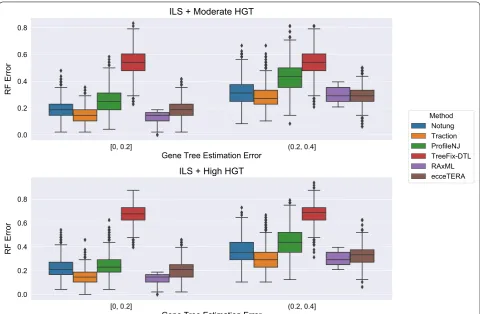
The HGT + ILS datasets have heterogeneity due to both HGT and ILS, with the degree of HGT varying from moderate (m5) to high (m6). Here, ecceTERA failed on 1318 datasets with the failure rates increasing as the gene tree estimation error (GTEE) of the initial RAxML gene tree increased: ecceTERA failed 0% of the time when GTEE was less than 40%, 0.4% of the time when GTEE was 40–60%, 23.6% of the time when GTEE was 60–80%, and 90.8% of the time when GTEE was at least 80%. Because of the high failure rate, we report results for ecceTERA on datasets with GTEE of at most 40%; above
this level, ecceTERA fails frequently, making compari-sons between methods potentially biased. Figure 7 shows that ecceTERA performed well, though not as well as Notung and TRACTION, on these low GTEE datasets.
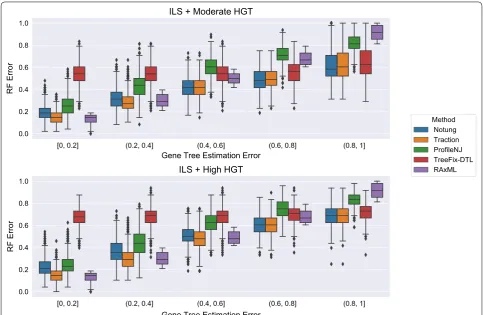
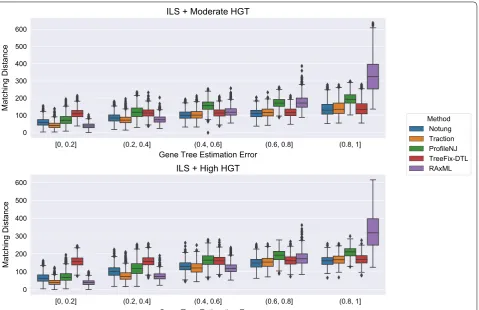
Figure 8 shows the impact of the remaining methods on RAxML gene trees as a function of GTEE as meas-ured by RF distance. Figs. 9 and 10 measure this impact using matching distance and quartet distance, respec-tively. The relative performance between the remaining methods across all evaluation metrics show that TRAC-TION and Notung were more accurate than ProfileNJ and TreeFix-DTL, with the gap between the two groups increasing with GTEE. We also see that TRACTION had an advantage over Notung for the low GTEE con-dition and matched the accuracy on the higher GTEE conditions. Finally, for the lowest GTEE bin, no method improved the RAxML gene tree, some methods made the gene trees much less accurate (e.g., ProfileNJ), and only TRACTION maintained the accuracy of the RAxML gene tree. Overall, on the HGT + ILS datasets, TRAC-TION consistently performed well and provided a clear advantage over the other methods in terms of accuracy.
Experiment 3: Varying collapse threshold and reference tree on the ILS datasets
The collapse threshold is an important hyperparam-eter that may impact the accuracy of gene tree correc-tion methods. We evaluated the effect of this parameter on the two best performing methods from the previ-ous experiments: TRACTION and Notung. Figure 11 shows the results on the ILS-only datasets, stratified by GTEE. Overall, TRACTION and Notung exhibited similar relative performance. Intuitively, increasing the collapse threshold (i.e., collapsing more branches) tends to reduce the error in the moderate ILS condition across all levels of GTEE as well the high ILS condition with sufficiently high GTEE. However, a lower thresh-old (i.e., collapsing fewer branches) improves accuracy for the low GTEE and high ILS condition, where the original gene tree is well-estimated and the reference species tree is more distant from the true gene trees.
The reference tree is also an important input that in practice will often itself be estimated. In Fig. 12, we found that using the true model species tree achieves
similar absolute performance as using the estimated ASTRID tree as reference. Again, TRACTION and Notung had performed similarly with respect to the RF distance between the true and the estimated (and then corrected) gene tree.
Running times
We selected a random sample of the 51-taxon HGT + ILS datasets to evaluate the running time (see Table 2). From fastest to slowest, the average running times were 0.5 s for TRACTION, 0.8 s for Notung, 1.7 s for ProfileNJ, 3.8 s for TreeFix-DTL, and 29 s for ecceTERA. Most of the methods had consistent running times from one gene to another, but ecceTERA had high variability, depend-ing on the size of the largest polytomy. When the largest polytomy was relatively small, it completed in just a few seconds, but it took close to a minute when the largest polytomy had a size at the limit of 12. Results on other HGT + ILS replicates and model conditions gave very similar results.
Overall comments
This simulation study shows that the better methods for gene tree correction (TRACTION, Notung, and TreeFix) produced more accurate gene trees than the initial RAxML gene trees for the ILS-only conditions (except for cases where the initial gene tree was already very accurate), and that the improvement could be very large when the initial gene trees were poorly esti-mated. However, the impact of gene tree correction was reduced for the HGT + ILS scenarios, where
improve-ment over the initial gene tree was only obtained when GTEE is fairly high. As shown in Table 1, the average normalized RF distance between the reference tree (ASTRID) and the true gene trees was never more than 33% for the ILS-only scenarios but very high for the HGT + ILS scenarios (54% for moderate HGT and
68% for high HGT). Since a reference tree (i.e., an esti-mated species tree) was the basis for the correction of the gene trees, it is not surprising that improvements in accuracy were difficult to obtain for the HGT + ILS
scenario. On the other hand, given the large distance between the true species tree and the true gene tree,
the fact that improvements were obtained for several methods (TRACTION, Notung, and TreeFix-DTL) is encouraging.
Conclusions
We presented TRACTION, a method that solves the RF-OTRC problem exactly in O(n1.5logn) time, where n is the number of species in the species tree; the algorithm itself is very simple, but the proof of optimality is non-trivial. TRACTION performs well on singly-labeled gene trees, matching or improving on the accuracy of compet-ing methods on the ILS-only datasets and dominatcompet-ing the other methods on the HGT + ILS datasets. Furthermore, although all the methods are reasonably fast on these datasets, TRACTION is the fastest on the 51-taxon gene trees, with Notung a close second.
The observation that TRACTION performs as well (or better) than the competing methods (ecceTERA, ProfileNJ, Notung, TreeFix, and TreeFix-DTL) on sin-gly-labeled gene trees under ILS and HGT is encourag-ing. However, the competing methods are all based on stochastic models of gene evolution that are inherently
derived from gene duplication and loss (GDL) scenarios (and in one case also allowing for HGT), and thus it is not surprising that GDL-based methods do not provide the best accuracy on the ILS-only or HGT + ILS model conditions we explore (and to our knowledge, all the cur-rent methods for gene tree correction are based on GDL models). Yet, TRACTION has good accuracy under a wide range of scenarios for singly-labeled gene trees. We conjecture that this generally good performance is the result of its non-parametric criterion which can help it to be robust to model mis-specification (of which gene tree estimation error is one aspect).
This study shows that when the reference tree is very far from the true gene trees (e.g., our HGT + ILS data), gene tree correction typically fails to improve the ini-tial gene tree and some methods can make the gene tree worse. This brings into question why the species tree (whether true or estimated) is used as a reference tree. We note that while the GDL-based methods may benefit from the use of a species tree as a reference tree (since the correction is based on GDL scenarios), this type of refer-ence tree may not be optimal for TRACTION, which has no such dependency. Thus, part of our future work will be to explore techniques (such as statistical binning [37,
38]) that might enable the estimation of a better refer-ence tree for TRACTION in the context of a multi-locus phylogenomic analysis.
This study suggests several other directions for future research. The GDL-based methods have variants that may enable them to provide better accuracy (e.g., alter-native techniques for rooting the gene trees, selecting duplication/loss parameter values, etc.), and future work should explore these variants. Most gene tree correction methods have been developed specifically to address the case where genes have multiple copies of species as a result of gene duplication events. We showed that a naive extension of TRACTION to han-dle multi-labeled genes by using a generalization of the RF distance based on an extended species tree, such as proposed in [18], can lead to misleading results. Future work should explore other generalizations of RF dis-tance that do not suffer from these same limitations, and consider other distances between MUL-trees, as discussed in [39]. Recent work has shown how Notung could be extended to address HGT [40]; a comparison between TRACTION and a new version of Notung that addresses HGT will need to be made when Notung is modified to handle HGT (that capability is not yet
available). Finally, the effect of gene tree correction on downstream analyses should be evaluated carefully. Acknowledgements
We thank Mike Steel for encouragement and the members of the Warnow lab for valuable feedback. We also thank the anonymous reviewers of the WABI submission, which led to improvements in the manuscript. This study was performed on the Illinois Campus Cluster and the Blue Waters sustained-petascale computing project, computing resources that are operated and financially supported by UIUC in conjunction with the National Center for Supercomputing Applications. Blue Waters is supported by the National Science Foundation (awards OCI-0725070 and ACI-1238993) and the state of Illinois. This research was supported in part by the US National Science Foun-dation grants CCF-1535977 (to TW), ABI-1458652 (to TW), and IIS-1513629 (to TW), and also by two Ira and Debra Cohen Fellowships (to SAC and EKM).
Authors’ contributions
Conceived of the project: TW. Supervised the research: TW. Established the theory: SC, EKM, PV, AY, TW. Wrote the code: SC, PV. Performed the experi-ments: SC, EKM, PV. Analyzed the data: SC, EKM, PV, TW. Made figures: SC, EKM, and AY. Wrote the paper: SC, EKM, PV, AY, TW. All authors read and approved the final manuscript.
Availability of data and materials
TRACTION is available at [41] and the study datasets are available at [42].
Competing interests
The authors declare that they have no competing interests.
Received: 9 October 2019 Accepted: 18 December 2019
References
1. Noutahi E, Semeria M, Lafond M, Seguin J, Boussau B, Guéguen L, El-Mabrouk N, Tannier E. Efficient gene tree correction guided by genome evolution. PLoS ONE. 2016;11(8):0159559. https ://doi.org/10.1371/journ al.pone.01595 59.
2. Jarvis ED, Mirarab S, Aberer AJ, Li B, Houde P, Li C, Ho S, Faircloth BC, Nab-holz B, Howard JT, et al. Whole-genome analyses resolve early branches in the tree of life of modern birds. Science. 2014;346(6215):1320–31. https ://doi.org/10.1126/scien ce.12534 51.
3. Molloy EK, Warnow T. To include or not to include: the impact of gene fil-tering on species tree estimation methods. Syst Biol. 2018;67(2):285–303. https ://doi.org/10.1093/sysbi o/syx07 7.
4. Maddison W. Gene trees in species trees. Syst Biol. 1997;46(3):523–36. https ://doi.org/10.1093/sysbi o/46.3.523.
Fig. 12 TRACTION and Notung achieve similar RF error rates when using a true species tree as reference. Comparison of using a species tree estimated by ASTRID compared to the true species tree as a reference for gene trees on the ILS-only datasets. TRACTION and Notung completed in all instances, so no gene trees are removed
Table 2 Total time (in s) for each method to correct 50 gene trees with 51 species on one replicate (label
01) of the HGT + ILS dataset with moderate HGT
and sequences of length 100 bp
Method Time (s)
EcceTERA 1470
NOTUNG 43
TRACTION 30
ProfileNJ 87
•fast, convenient online submission •
thorough peer review by experienced researchers in your field • rapid publication on acceptance
• support for research data, including large and complex data types •
gold Open Access which fosters wider collaboration and increased citations maximum visibility for your research: over 100M website views per year •
At BMC, research is always in progress.
Learn more biomedcentral.com/submissions
Ready to submit your research? Choose BMC and benefit from:
5. Edwards SV. Is a new and general theory of molecular systemat-ics emerging? Evolution. 2009;63(1):1–19. https ://doi.org/10.111 1/j.1558-5646.2008.00549 .x.
6. Wu Y-C, Rasmussen MD, Bansal MS, Kellis M. TreeFix: statistically informed gene tree error correction using species trees. Syst Biol. 2012;62(1):110– 20. https ://doi.org/10.1093/sysbi o/sys07 6.
7. Bansal MS, Wu Y-C, Alm EJ, Kellis M. Improved gene tree error cor-rection in the presence of horizontal gene transfer. Bioinformatics. 2015;31(8):1211–8. https ://doi.org/10.1093/bioin forma tics/btu80 6. 8. Chen K, Durand D, Farach-Colton M. NOTUNG: a program for dating gene
duplications and optimizing gene family trees. J Comput Biol. 2000;7(3– 4):429–47. https ://doi.org/10.1089/10665 27007 50050 871.
9. Durand D, Halldórsson BV, Vernot B. A hybrid micro? Macroevolutionary approach to gene tree reconstruction. J Comput Biol. 2006;13(2):320–35. https ://doi.org/10.1089/cmb.2006.13.320.
10. Jacox E, Weller M, Tannier E, Scornavacca C. Resolution and reconciliation of non-binary gene trees with transfers, duplications and losses. Bioinfor-matics. 2017;33(7):980–7. https ://doi.org/10.1093/bioin forma tics/btw77 8. 11. Chaudhary R, Burleigh JG, Eulenstein O. Efficient error correction
algo-rithms for gene tree reconciliation based on duplication, duplication and loss, and deep coalescence. BMC Bioinform. 2012;13(10):11. https ://doi. org/10.1186/1471-2105-13-S10-S11.
12. Nguyen TH, Ranwez V, Pointet S, Chifolleau A-M, Doyon J-P, Berry V. Rec-onciliation and local gene tree rearrangement can be of mutual profit. Algorithms Mol Biol. 2013;8(1):1. https ://doi.org/10.1186/1748-7188-8-12. 13. Szöllősi GJ, Rosikiewicz W, Boussau B, Tannier E, Daubin V. Efficient
explo-ration of the space of reconciled gene trees. Syst Biol. 2013;62(6):901–12. https ://doi.org/10.1093/sysbi o/syt05 4.
14. Lafond M, Chauve C, El-Mabrouk N, Ouangraoua A. Gene tree con-struction and correction using supertree and reconciliation. IEEE/ACM Trans Comput Biol Bioinform TCBB. 2018;15(5):1560–70. https ://doi. org/10.1109/TCBB.2017.27205 81.
15. Jacox E, Chauve C, Szöllősi GJ, Ponty Y, Scornavacca C. ecceTERA: comprehensive gene tree-species tree reconciliation using parsimony. Bioinformatics. 2016;32(13):2056–8. https ://doi.org/10.1093/bioin forma tics/btw10 5.
16. Zheng Y, Zhang L. Reconciliation with non-binary gene trees revisited. In: Sharan R, editor. Research in computational molecular biology. Cham: Springer; 2014. p. 418–32. https ://doi.org/10.1007/978-3-319-05269 -4_33.
17. Robinson DF, Foulds LR. Comparison of phylogenetic trees. Math Biosci. 1981;53(1–2):131–47. https ://doi.org/10.1016/0025-5564(81)90043 -2. 18. Chaudhary R, Burleigh JG, Fernández-Baca D. Inferring species
trees from incongruent multi-copy gene trees using the Robin-son−Foulds distance. Algorithms Mol Biol. 2013;8(1):28. https ://doi. org/10.1186/1748-7188-8-28.
19. Estabrook GF, Johnson C Jr, Mc Morris FR. An idealized concept of the true cladistic character. Math Biosci. 1975;23(3–4):263–72. https ://doi. org/10.1016/0025-5564(75)90040 -1.
20. Estabrook GF, Johnson C Jr, McMorris F. A mathematical founda-tion for the analysis of cladistic character compatibility. Math Biosci. 1976;29(1–2):181–7. https ://doi.org/10.1016/0025-5564(76)90035 -3. 21. Estabrook GF, McMorris F. When is one estimate of evolutionary
rela-tionships a refinement of another? J Math Biol. 1980;10:367–73. 22. Warnow TJ. Tree compatibility and inferring evolutionary history. J
Algorithms. 1994;16(3):388–407.
23. Gusfield D. Efficient algorithms for inferring evolutionary trees. Net-works. 1991;21(1):19–28.
24. Huber K, Moulton V. Phylogenetic networks from multi-labelled trees. J Math Biol. 2006;52(5):613–32.
25. Christensen S, Molloy EK, Vachaspati P, Warnow T. OCTAL: optimal comple-tion of gene trees in polynomial time. Algorithms Mol Biol. 2018;13(1):6. https ://doi.org/10.1186/s1301 5-018-0124-5.
26. Bansal MS. Linear-time algorithms for some phylogenetic tree completion problems under Robinson−Foulds distance. In: Blanchette M, Ouangraoua A, editors. Comp Genomics. Cham: Springer; 2018. p. 209–26. https ://doi. org/10.1007/978-3-030-00834 -5_12.
27. Gawrychowski P, Landau GM, Sung W-K, Weimann O. A faster construction of phylogenetic consensus trees. arXiv preprint; 2017. arXiv :1705.10548 .
28. Ganapathy G, Goodson B, Jansen R, Le H-S, Ramachandran V, Warnow T. Pat-tern identification in biogeography. IEEE/ACM Trans Comput Biol Bioinform TCBB. 2006;3(4):334–46. https ://doi.org/10.1109/TCBB.2006.57.
29. Davidson R, Vachaspati P, Mirarab S, Warnow T. Phylogenomic spe-cies tree estimation in the presence of incomplete lineage sorting and horizontal gene transfer. BMC Genomics. 2015;16:1. https ://doi. org/10.1186/1471-2164-16-S10-S1.
30. Stamatakis A. RAxML version 8: a tool for phylogenetic analysis and post-analysis of large phylogenies. Bioinformatics. 2014;30(9):1312–3. https ://doi. org/10.1093/bioin forma tics/btu03 3.
31. Vachaspati P, Warnow T. ASTRID: accurate species trees from internode distances. BMC Genomics. 2015;16(10):3. https ://doi. org/10.1186/1471-2164-16-S10-S3.
32. Lin Y, Rajan V, Moret BM. A metric for phylogenetic trees based on matching. IEEE/ACM Trans Comput Biol Bioinform TCBB. 2012;9(4):1014–22. https ://doi. org/10.1109/TCBB.2011.157.
33. Mailund T, Pedersen CN. Qdist-quartet distance between evolutionary trees. Bioinformatics. 2004;20(10):1636–7. https ://doi.org/10.1093/bioin forma tics/ bth09 7.
34. Lefort V, Desper R, Gascuel O. FastME 2.0: a comprehensive, accurate, and fast distance-based phylogeny inference program. Mol Biol Evol. 2015;32(10):2798–800.
35. Sukumaran J, Holder MT. Dendropy: a Python library for phylogenetic com-puting. Bioinformatics. 2010;26(12):1569–71. https ://doi.org/10.1093/bioin forma tics/btq22 8.
36. Lin Y, Rajan V, Moret B. Software for the matching distance of Lin, Rajan, and Moret. ; 2018. http://users .cecs.anu.edu.au/~u1024 708/index _files /match ing_dista nce.zip. Accessed 27 Dec 2019.
37. Bayzid MS, Mirarab S, Boussau B, Warnow T. Weighted statistical binning: enabling statistically consistent genome-scale phylogenetic analyses. PLoS ONE. 2015;10(6):0129183. https ://doi.org/10.1371/journ al.pone.01291 83. 38. Mirarab S, Bayzid MS, Boussau B, Warnow T. Statistical binning enables
an accurate coalescent-based estimation of the avian tree. Science. 2014;346(6215):1250463. https ://doi.org/10.1126/scien ce.12504 63. 39. Lafond M, Semeria M, Swenson KM, Tannier E, El-Mabrouk N. Gene tree
correction guided by orthology. BMC Bioinform. 2013;14(15):5. https ://doi. org/10.1186/1471-2105-14-S15-S5.
40. Lai H, Stolzer M, Durand D. Fast heuristics for resolving weakly sup-ported branches using duplication, transfers, and losses. In: Meidanis J, Nakhleh L, editors. Comp Genomics. Cham: Springer; 2017. p. 298–320 10.1007/978-3-319-67979-2\_16.
41. Vachaspati P. Github site for TRACTION. https ://githu b.com/pranj alv12 3/ TRACT ION-RF. Accessed 27 Dec 2019.
42. Christensen S, Molloy EK, Vachaspati P, Warnow T. Datasets for TRACTION at the Illinois Data Bank. https ://doi.org/10.13012 /B2IDB -17476 58_V1.
Publisher’s Note