The excavation of the Athenian Agora, conducted by the Anmerican School of Classical Studies at Athens, was continued in 1939 for the ninth season and covered a period of eighteen weeks from February 20 to June 24. The progress of the work was reported as usual in a series of Weekly Reports, and brief accounts of the season's results have been published by me in the Illulstrated London News (July 22, 1939) anid in A.J.IA. (XLIII, 1939, pp. 577-588). A climax in the history of the project was achieved by the completion of the purchase of the modern houses situated on the area. These purchases have been made anntually by blocks in order to disturb as little as possible the daily life of the district, in view of the large number of parcels of land involved, totaling three hundred and sixty-five. The successful conclusion of the expropriation of this large area in the heart of the city is a triutmph for the tactful and energetic Business Manager of the Agora, A. Adossides. But, although all modern houses in the American Zone have now been purchased, not all have been demolished, since it has been necessary to retain a group of houses for the use of the staff as offices, workrooms, and a temporary museum. These buildings cannot be removed until the construction of the new Agora Museum which, according to present plans, will be erected in the immediate future in the southwestern corner of the Zone. Most of the work of the season was concentrated on the southern border of the Zone which lies on the lower slopes of the Areopagus. The deposit of earth above bedrock was shallow in that area and sonme cellars of modern houses were found to have been cut in the rock, but in contrast to the small amount of earth remaining there the accutnulation was deep in the block in the southwest corner designated for the site of the new museum, so that the total amount of earth removed, 56,000 tons, was greater than in any previous season. Some of this earth was kept in the area, being heaped up on the rocky summit of the Kolonos Agoraios south of the " Theseum," so that it would be available for refilling pits and trenches in connection with the final landscaping of the excavated district. Chiefly because of the great extent of the mnuseum site and of its deep deposit of earth it was necessary to employ a large corps of workmen, averaging 215, throughout the season. The trained and experienced foremen of previous campaigns continued with the work, and the head foreman was the able and efficient veteran, Sophokles Lekkas.
This great project of expropriation and excavation in the heart of a flourishing modern capital, involving delicate business and legal transactions as well as an elabo- rate scientific organization, is being brought to a successful conclusion in spite of obstacles which, from time to time during the past ten years, seemed unsurmountable.
American School of Classical Studies at Athens is collaborating with JSTOR to digitize, preserve, and extend access to
Hesperia
As has been emphasized in my past Reports this happy state of affairs could not have been achieved without the co6peration and constant support of all branches of the which have b with the Agora project. The head of the Government, His Excellency General Metaxas, President of the Council and Minister of Education, took occasion to visit and inspect the site, and the chief of the Archaeological Section of the Ministry of Education during the season, Pro-
,..: : .-s- . . .., ... .. '_ .. . . ..,.. I. I. . . .I-I . I: .. ..:--'-: : -;.." ::: : ,. : : : . :,' .-I% I.. I. . . .I -I - - I I..nz. . : :.: :x %: : . -.::.... :.... . ,',... .,....-:: :.:.:...%.: :%4:..II ..:.I: :.:::!!'!-"::-':!:"::: 7 ':: -?::: ::":. . .: n---: - :!!: .1% : 1:!; . . . .-1...".' . -.. -I :11 11I..,I- :s:-I1.--.r .... . .:::::::;: :: :!,:. :: : :: .,.:::,: .:::..,::.I-. ..' . .. . ,.... . ...:. . :: : .-... . . ._.'-,,: ::%: ::"-. . . . . ..I1.I... I-I:: .-:
,.I ,.. .... . ...,....I..I.I...I..I..I. ...I.'...::-
.'I. . . . .. . . .. .'. .'% ,..%,.I.. . . .. ... ..I....I..I,:;:'.,::: ...,I....,.,.. .... . ...,:::::.,...,.I.. ... :s::e..X;... . . . .: :....::%..::.:.:...:I I...I::. ..''. ... . ...,'...I.. ... ... . .::..,I... :.:II.:I:I.I....I ..,.i.,,.,..,. I. . ..."... . . . . .I,.. ...'...I..:: . . . .I. . . ..II...I.... ...::: .. :..:::.:...
-1. .1 . . .,1i ., i"'Ii i,1:...:----.I...:..1 ....III..,.... . .... . .. . ...e,.. .... I..:;:': :1%-le.::: .:: ,.,:'::%.:'...::::.:::,::::'...,...I.. I%...,I:: ::.I.... . .. . . .. . ..I....I. . . . ...11 . . . . . .I..,.I....I....:I .:::I:-.I .... ... - ,.- -.,.. -: :: : .:: _... ,_ . .I.,-.1. .I1: : :,.- ,: : :e.k ,ii.I.
:: ::. X .: :: : I:: : ". : % :::!: . ... .. .. .I.-.. I... .. ..., . 1, . . -.. .I .. .. .. .I .. ... .. .. ., : : : :1 -'..I... -. -. I. .--. .%: :: ':::::: :. I.
.,: X:: .: .,. . ... , .,I....I- -- 1- 1.1- ... .... .. . . ... . -,. . -%. . ... ,% . ... .I. -. ... .. .1..,. I,. .I .. .. .... . .... .... . .,. ... . ... . . ..1 .. .. ... I.. . -'.. ... ... ... ... ... .. .: :%:' ,..: ...I,.. :: :: : ,:' : ::.. : : :: -:.: : :, : ':-: ., :I. ...%-I. ... .I .. ..1... .. .. ., ...I. . .
.1.-.. ' .,.'. ,.., 1. ..,.,. :... .... I I... . ,. .. ! i i . ij :: i : : %. : :. :'I.. ;:i i: : : :; '.; 11- -.1 .. '. . . 1: :. ...1 1-II". . .-. ..1 ... .: :..1. . .I .I ..1.I .1 ... ...
...'%.-.1. I.. ...I.1 ... ... ..,:: ... .:. .: ::, -::--- -1,,...-- ';::.. ... ... .-1..I ;.... ... . ..--'. ... ..; 1, .' '..:: :: : :: :: X:.: ... .. ... . . . ... ... .. . . .... I I., .: ::::.'. . ,: .. ,:' . :si . I . ., .... .:."... ". 1. ....,,..I..-.
...ii ' ".zx % ....' . .1 I. .... ...I... ... ... , . ... . .: ...': .::...::,:-:::':: .1 .... I:'i i . .: ' , x: .' . .:. . : : , , : %:: ..:,. ::. ;:::. .. .. .:: ,. :. :. ,:. ::::::.,--I.I..:.
1.1- -... I .. ., .::_ ... I..I...I.. ... ....%...,... .1.1 .. .... :: :,.: : . :::... ..II. . .::;X : ": . ... -- 1-,... ... ...,. . '... .... ,... ... .. ..I.I I ., - -:. ."
..'' ... 11 -. ..I'...-::: :.. :.'. .]:;:I-I,- . .. ..11 , .. I I... ... . ,. ...1 .1 . . .. . ... ... I.... .. .... ...I.... .... ,. . ., I I. .. .. ... .1, .'. . ... . . -, ... ... . : :::. :,,::.. .. .: , :. : . , . ..;. .:.. .1. . .I I .. ... ... : ... ... . ... .I....I... ... ... ...I. .I I..
'. . . .. . ....v- I ....;... .1 . ... ,-_'...'-.-,....:::.. 11; :-1: :.,'. -'..,-. .' ,.."-ii:'ii, ; :H! i i .... . I... I :'... .1. - ...' ...I.. . ,.... ...' .. .1I. .... ... .. .. ..-.... .. . . I.... .. I.. ... . I..:- .... ... .. ... : :%. '... .. .. ...I.. ...I. -:.: 1: : ...7.- .. .. ...: : .X ::I'. '. .. .. ...I...%.... ,.. ....-"...1 ... ...1 ....1 . . .I...:-q:1 ....': .. :. . ::,.,.I.. ... ..,.. ... ... ... ... . .. .1
...'... I.. ... ...I... . ... ..-I1. .,.. .... . . -.I.. . . -.%: :., - : ::. . I: :::,. .. I.. . ... . II -I... ... : :.:,:::::::] : :...-.. ... . --. .. . -.. ... I.. ... I". .I.. .'.. I. ,. .I ... ... .. ...I%... ,: .. .. . ..%. !..1 .1 ... 1. .1I. ...;.. : I ,: . -1. .. .. I ...I. .. , ... ..-..: I.. ,-... :,. ... .. ... ...-: . .I. . 1. I .. 1, .. , " ., .. .... .. ..-.: . .' :...: ::: :::: : : :: : : : :: "::: : ...1. :': : .." : : : i;: :: : ::%: : :1:1...: 1.1-1- .. .. 1...I..I.,:. ... .:i.:.:::::: ::: :z:. . .'..:.::%.... -.: .. , ::: .. ... I . -. ... ""-,:I. ..I. .. ... .. . ::.. ::: : 1: :: ::: ;: :: : .:X ::: ..:..'.. X :. ,..:. :' :: :',... : :::..,... ...I.". ... ..IOI. ..
...'-I-..II. .. I... .. ... ... ..'. ... ..' ... ....:.I.., ,. ...I... ... .... ... - ., .,.',... .. ... .1. ...I1'' . . .: : : :::.. : - .: : : : .: : .: : . : : :! : X:: : :, ... ':1. :.:: : . .-1-....-:::]: ::::, : ::::,:: ,-.... .1..,. . . 1. .11 ... . . .. ... ... .. ::: i::...I... ... .. .... .. , ...II .. . ... .. . :: . :.I :;- .: - ; : :: :::: . .. ..I.. ... ... .. I .. ..I
...' I ... ... ....I... ... . :. I ,... .I:: :... . .: ::% : %:, : .::.. .I.. -- ....I... ....,. ... .... .. - .. ... .... .. ... . ,.. ..." .1. , . .1 . : :e :::: .:::::-I:. ::: , : :: : .:. . . ..! :: :::. ' : : ,:: ::.. . : .:,...I...I...-.. ., . . I . ... -...;
.1 ..: : : :-- .: : :-X :': : : X.... . . ...-" ... "- .. .... ...'. ...-... . .: . :. :.::::: .. : . 1, ..: :' .. ..%..11 ... I .. ".1, 1. I :... ..1.I .... .I . . .. : : ::: : :: :: :1: ::: ,:: ::::1: .--II-I-. .. 1. ...I. .... .... . .- ..'.
.... .I . ". .. ...-I...,... . 1%.. ...-,. . I... , ...".'.' , ,. ...I.. .... ... ... ... ...I. .. .. .. I. .. .I .. ...I... ... :::. : ... :,:". .. %. 1. . .' . W... .., ,. . ... ... . ... .... ... .... .. .1-.. ..,...,.,. : ::: : ::.I... .,..,. . ., .... .. ...I.... . I . . ..' .... %. -1 . I. .I .... II.. ... .. . .."I III.I.I. ....I.,.... . ... . . . .,I.. ... ..I . ... .I...- .. ... ..I. I.. ,. I .. . .. :: . .; . :- - .. I. .. ... ::: :. : : . ., -1 .::- . -1". -. . . -. .. ". -. . -.- _... I., . " .:: : - . X::.: .- . .... -.... .-..: ... . -, .._'.. . _'. . _, _ .:.' 1, . 11.1 - . .1 I.. .. -...I1. - I.- I. ...- . ..:--.: :1 : .: :I-%I.. .: . I- -. ..::::I.I. :", 1... .... : ' .. ...- -..., ... .IX .. 1: : '. .... ...I. ' -I ,..:-: . ...1 .:I:1 - 1: - --- -I.. ,,1. .: :. .:. .. : .. :. !: .:: ::: ::: . ,.. ...", ... .. .... , , . .--,. ... .'... ,. .. . ::, , : :.. .::... .:.. .:.I :.: ...: -.I.1 -I 11 I:' I1. .:.. -.--I1 . .. .' .. --. ... ': ."...'I...- ...I.., ..I. .. ::':: ::::: i ... I-III... .. ....I..I.I...II.::: ... .... -... . -...I .1 . ... . ,.... 1, ..' .... .: . I..1 .... ..I... .1... ... .. ... ....:,..1. .. .. .. .1 ....:: ,:,. ::::-1, :: .: I : .,.:: ::: : : .:::: :':: : : : : : : : ,: : :'..::.: .. ..: ...- : .:: .. X:. , ::: .: . 1:%:.. ,. ..: ... -:; . ...: .."'.. . ...I...-... .:.: ..I...II. ::' ,. ., :' -...: ....,... ..I...: :. .I.1 :::' ., ... : :.:... ... .. ... ... . ... I.1.... .. .., 1. ... . .-.... .1 '. , . . ., .. ... .. ... . . ...", . .. . I ".. .I.I. .. ..., .. .. .... .1. . ... ",,. I.. .. .1 . :.. : :II. . ... .. I.. ....,. .. : :.I: ,:.:. : :-: :::. .'... ,. , . ..'I.1, ... ....".... .... ..: -. I. :: :I.... . ... .. ... ,... .1I... .. ::I-: I- I:: :: .:I-:: - -: I. ... . .. .. ... .... . .. ...1 ... I... % . . I.. 111, ;'I..I... ..:..:: ...:::.% : ::. .: : : :; .: , '%. ... .... ... . I. ... .1 ... I .... .. I ... ... ... . .. ... .. .... .... ... . ...11 . .. ... ..I....II.
.. . .... - ... .. .. ... .I. I.. .... , -. . ...1III... .1.I.I...1.11..,.. . ..I ..1.. .. .. ...I. I. .. ..I.... ... ... . .... ... . .. .e: :..,. ... ... -I... .."....I.... .... 1. I..., ... .1.I.I... ....I, I .I.1 .... ... ...%...:.,.I..I... ,....".... ...I...I%.: X. : .:I .: .... 1: ...,I1. .. ...I. ... .... .... . .I .::. : : ::.: .. . , :: :.1II.. ... ....I::: : :: . .. :: :.: .:, -I;...I....: I..I :1 .. . I. .. .. ... "%. 1, . , :: ... . :': ,I ':::' ..'.."..". ..:. ...: . --,-.... ...I:::':::....:.,: ... :: :1.I -.. .. . ... "..' .: ,...I..I... ... I...1 1. ," . I...I ., .1.. .. II I.I.. :.:.: ...I.. . ... :I ... ...I. I... ...I..::: '::I11 '.. I... I.. .1II.1... ..-... I .... ...I....I. III. ... II.I. I....I .. ..1... .. ..I. .. ... ... ,. I1... ....-: ,. .1. .:.... I...11.11 : ::. .. . .1. " . .1 . .1... I...I."1. -II. . .. I. .:::' ..., -.2II. I.., .: 2... . .. .I..I.... I.... ... II.. .. ...I. .1.. .. ..I.. I ... ...-.1-..I... ... ... ... I...I1.... ..::-- ...II.:,::::.. :::: ,-.,:.: ..:.. II..11I. ..1 ... .. . .I.. .:II.. .. ...I... I... .1 .. _.. . ::
I. - I. . . .: .. ." ..: :: : :e ,..:::,,... I,,I.
..: .. ..' 1. . .,... ..I... .. . ._. .-", , .._ . .. . I-. I::.::::: _. : : :: : .: : . . ::-,.:...:: ..:::': :: : ::..,,.. .I... 1, ... . ..I...'II. .. .. .. .. V.I...I..". ..I....II..1. ..1. .. .1-.. . I... ...I.. .. ... .. ... I . .... .. .. ...1I...-... . ..I... ...- .... .1. . .I ... 1.-.. ... .. .: :-I. .. .. . .... . .. ,. . -...:'. '. ... .,. ...I., .. I...1 I.. .. 1..-... 11 .: .:.%, ::...: .:. .. .'. ..,. . I.. .. .I. . 1, 1, .I.: .:-:: :,: ..: . ..: :: ., . ,,. I .I .. ... .,.: . : :.. .... .. . ...I. ..I .. .I ..1 .1 .. I .. .. ".X I,. .'.. ., . .:: ,x : ..-::.I... -I- ..'I-,:-...II...I..-,. ..I.II.... ... .:. :: :.: ..1, ... .... ...1. .. .... ... I. ...:.:,I.. I.. ... .. .. ...I... .. .. ...1...I,..I... .. ... .. .1-..s.II.II.. .. . ... . . ...I....:.. ... ... ... I.. .1. ..'..- ,. ... . ...I.. . I... ,... :.: ..'. .. . - . . .%:' .... .. ... .: ;:.: .I.III...I..I....,... :.I. I.I...I .I. ...,I1.., .. .... , .. .... .. .. . .. ... '. .I.. I.. . .I , .11 .. .. .. .... .. ... .I .. .. ....I ... .I. .... . ...-. ..I.. .I....1. .... .. ... ..1 .1 .1,.':,%, .:.. .:. :5
: XI:I. ':: :.
...:, ....%....I. .,' :: 1: :. ...I... .. 1... ,..: .. ...: - . :'::::..,.,:.,...: ....' ""...1...I.I... :. :::::: .1 ... ...1 .1...I.. ...I...I:....1. ...I.. 1...1 . ....,.I...I.. ..'-I..::., :. .. ... . :: . .:.II.
... _ ,.11 .". ".. ' '- II.- I - ,.. ..1I... ....: :: . I."...I:... 1.1-.. .. ....V.1... ... .I -...1 .. .. I .::- 11: leI...I...11I...:; :... __1 .'.-- ... '% ... ...-....I.. . - , . ...1.:,:: ::::II...-... .. I.... ...I... ... ...I..I.. ..I.. .1-I.1 ... .. ...I...
II.. ..,.... .% -... . ...1 ... I. .1.I...I1. ...I...1..1. :: ... % ,.. . I ....1I.... I.. .. ...I. ...1...' .. .. I... .. .... 1..1 . ...1.I... .. I.. I..II1. .. ...I ....1I.... .,1. .. I .1 1. , ... .II. ..., ..
.. i' :': i! :: ,.III .. . . 1: .. ... .. ... .. .. ... ...I-I I.::: .. . .. : :.:,--...II.... I...:... .... ...,. - :.:...-... . .. .I... ..%, . .. .1. 1. . ' -... ,'. .. . ... .. . .I. . . .I .... .% . .:... .. .. .I.. .. .... .. ....II.. . .. .:. ... ... .1 ... . .... . ... .. ... .I.. .... ... .... I:.. . ... f, .. 1, :: ::.:,.: : :;...I.. 11..II....11I...: '..;N ... ... .. ..I.1.1...I..I1. .. I .. . .. I.... ... .... .. -.... ..I.1 .. I. :..: .I: .. .'. 1"... .. ....-.... ....II.I.. ; . :'-..I... .. .. .-..1I...-...I11 ... ....-.. .. .1 .-..'....I..., .. .. .. .. ... .1...- .. 1. ...i
I.:' .. .... I.-:I .... ... . 1. .1.I...::: ..,, .-.,.:. ,.: : ....-.,..1I'.. .1 .
: I ..:..-.. .. :1 W,.:.: ..,'. .. %e::,e: . III...-... I .. ...II I. ... X X.% .41. "I . . I ,. . . .1 1% :.:. ....I.. I...1I1.... ..I..I... 1....I ,.. II. .I...I...,. .. ... ... .. .. ...I.I... .:::, ....I. .I:. .: ::. .:..I. .. ... ... .... .. .. ... ... . ... .. ... ... ....I,...
,. . I.., .1 ...., :. : ,:,,4...:: : - ::::::::: ::::::. :: ::<': :,.II,..1 .. .. .. .: I.. ... :..-:. :. ....I. . . -I... .- ,.I..II.".. II .II. III..,. .:: .': :: . ,: :....I .I: % .I1, .-1. .1. .1 . . .... %' .. ::.... '..I.. . . . . _ . ...". '..-... ... . ... . ,. .. I I ,.. .I .I..I,I.. I. ...:: ,... . :.I... .. .. . . .. :- .% - ,-.... ... I.... .. ....I.. .1 .. .1 I.. 1.-... .... .... .. .. .. ....
': : ... ....: 4:... . : ,. ..,'. I . ....I.I.. .... ..1 ..:I,.-:: . '.:.:.. :.. . ...,.. - ::1..11-.. I.... I .I ... . . ... - .I...I.., . . . .. '.I... .. ....1. ::I....1. ..% ... . .. .. .. I.... I1. . . .'. . . . ... .. ..I...:... . .I.. . I. 1....1II....1 .. . . ... ....I.. .1... .... ..I...I.. . . ..-.. .... ... ... ...I .1 .... ." . ...1 .. ... ..%-...-.. . I.. . ... III.1... ...I...I... .. .I. .I .. ... .. .1 ....:..:.:.:: ... . I.1..: I.. :. . ': : - ::: , :4 %: .: I, ; ..., ": :. %, :...,. : ... ... .. '. '. .". . .. ... I...II..I-...1...1 .:I...% . . .-...I.. ... ..I: :....,: ..:,%..:: :.: . ::. :: ::: ::.,....I. I ,... .. .. I.... ....-.I. ... 1. 1.I" .... .. .. ... I. . . ..., .I.. ... .I. .. I.I, ,..I...I.. . ... ... ". , . ,... %, . _.. _.I. . .. . , ,. ,.. ... . ..'. ... ..I.. ::: ::::. . .: ...III...1 '::: : : ,: , .:. ...II. ... : . :: :::.I: : :,.I. .I. . I... . .I.. 1...::3 "I . ... I-. .1..,. . -,... ..1I..X.I..1. ,. ... .I ... ... ...I. I.... .I... .. ....III .... : ...: :': :- :1 - :'::': : ::: . ::...:: : :., I-:: .;'.:.z:: 'X .. II:.:::: :: :.: I :;:. ':X %:::" ' : ..:' ::: ' .. ...I .. ....1..1..:.-.. .::: :: :: .. .... .I.. ,e::: : , : :... .. . ....I.1 . .. .:: :: : :-: :- . . .. .. ... ,... --....1...I... ..I1. ... ...1 . ... .. -. ... . .:.:1. .:::::.;::_..1 ...I.. . .. . .. .... ., .. I.."..I .. . . .... ... .. .. . ::'.... ... ',.. .... ,. .,I... -... .. ..:..:II..- %..:1;X. ., i ... 11. I % .,. . - :1...;.: %I . ::: - ... V.,... ... ...-.1. .... .I .- I I.: :: ... .... .:.. -I-.. .. . .:. ... , : ..' :. X:.. ....::--...-.. :: .::.: ... I..1 ., I...I.. .. .... ., .. ..I...- .1...I... .. .. ... .. 1,. .... . . .11 .1.1 ... I , .: :.:..I I...".11 ... ... 1.!-: -, -: :":. : :: ::: .:.:.k,....1 . , . ... ...I..% ,:: ::.:: . : :... .. .1 .,II---' ...: ; ;%' II..I... ...3:.III.- . .. . ., . . . -1 . -... . .. . .... -' I.. ...I.1.1..I1....1 ...I..I..I..,I. .. . .. . ... ... . ... - ... ., . .... ... ....,I1. . .I11 .1.1 ... . . .11. . 1.... II... .. . . .1.I... .1 .::
..:.I'. .1...1...1I.I... .. ... ...:. .... . .. .. ... .. .;-,-.. ... .. .: ., ::'., ,:..:- ::: ::.., .. :: ::. .,.::. . .. .. .. . .. ...: :X: ,:% :' . 'X:: :%::::' ... '- . .-'...'....: :..:. :11.II :. ,. ,...:: :-I.1 :::: I.II.I..., :X:. '.: .I:.: -% : :,-.., I.11 .. '. .... .1 .1 ...I.... .. I...I.... .k:: . . ... _.4 . ... , .... " -1 ..., ... -: :: :::: "I " . "... :. . . . ... ... ..:.. -.. I. : . ... .... . , .:,I :1. ... . I...:-.:. . :..I.: ::...-.1. .:.: .I .. ; .i :J ': :: . : . .] .. .1 .. ... ... . .-I, . '...,..._ .:: I.,I.I . I-::: . ::: .. ...I.1...::.,:' .. . .. .. ... .. :. :.., ].. .... ... . . .,.I .. ., .. ... . I..I..II ...1. .. ".I...II .1 ...I I ..:. ::.. _: . .I .. .:. .. ,.:::,.:.: ...,. . .:.'...
.... ...I ... .. II .I.I.... .I.. %... ... ....III.:::. .- ... __ I.. -'I.I...I..I... .. I.. . ..I...1...1 : .. %' - .1 ..., '. . I ... I::: :I.I- II :''--' ...I... .: - ,: : ::::"!. :::.... ..'-': ::. : %:: 11.:.: : :... ....' . . I .- .. .. I .... .. ...II..11. .. ..-.1... 1. ... . ...- I. ... .I. . ;:%:,.::: . : : ... 1. I .. .... ... ..
::.I....': .:.:.: I.. ". . 11 ::' . ..1. :.... .. . . ... I .1 . . :: .. . ...1 ... .. .. . .... .. I.. :...,-,,.,, ... ... ..I.. 1.,,... I'. -:::-:- :: , : . . .. . .. ... .... ... ,: :::::: ....-.. ::: :: , .. : .'. .1 ... , ..I. .. 1. ... .. ...:::II, ,:: Z. :, .. . : . . I I ...I . . . . . . .. .. ... . . . . .. . . 1. .1 . . I . . . . ... . . . .. .II.. ... ... .. . .: .: ': :::,:.-... 1, 11 .. .1... ..I1.II..:.-: 11 ... .. I -:. ...-... .... ... .. .. ". .' - '. -. - .. ... ....-'::.... ... ... :- :.II%...1 .... .. . ..I . I ... ,. ... .. ... I .... ..'.'.. .I...::. .. .. I... ...I ... :;.. : .:'...I .. .... .. ., I...I... : , :..,.1
.: .1- I.:-' - --:' -::-:,;1 ".., .. :77::..,.I.:
.... .- I .... -.1-11. --1 .. . ...p. 1. 1,I.1... ....:,..: . : ::: i: :i .::;::::...1. ... _.. ... ... .::: : .:
: .:X: :::::':'...4 1. x, . . W11 : :. .. .. ...II. ... ... .I.. ... .. ... ... .. ...
-...X::1.. %'..:. . ..I-I.. :. ::_ ..: .. I .... .. . '..,::: .':': ::: ::- : - :':- - -. ,.. ....-, :.::.. - ,-:, ... ..". .. ., ... ..'I. . ... ... 1. .. : . :. :: .. ':: ::: . ... .1...1 .1 . I. ..1 ... ... 1.I... 1.II 111.I.I. ... .. ...I.. :%: : ;:. ...1.II ...:I ,:,'.I...I ..:. '.. .:. :: ,.".. I... .. I I... ... ... ... ...:.,.. ....:..::: ... :. .. ..1. .'-.. . . .I...
..,. .. .. I .. .. -.. .-.. ..1..I ;I,.. 1... ,... .": ::..: - '.' : ;..I... .. ... .I ::-.:: .II ... I.... ..I.. 11 .. ... ... .. ... ..., .1 . ... ..: .: .... .1 I..-'_ ... ." -, , ,... ' .... -.. 1.... ...1. .. . .1 ...I...-.,
.. -- s'....I., :::::,::: .: ::;1:. ... _ .: ... :.. -- ... .... .. .. . . ... . . ... ..
. ::-::: :1: . s. I ... I--- I I...I.'... ... ... .. ... , -.1,-...II....I.. "..4I. '-. .,.. 1...,..I. "''I...:!i:.... ...I1.I...II...
I... ' .' I.,:.%.. ..1, .1 .. ...:-1. I...". .. .. .. . .. .I.. .1... ... .1 .. ....I.. .1...
...:'..:.: :j: : :::... ..I.. .1%I... .... ... ...I.I I. ... .. 1..1. ... .:, . : , ;-'. '.'..:i, ii iii x: :... .. .. .I..
,.::%:: . ." .I... ::: ... , .' ..: ..:. ... .... ...I... ...I..:: .I..II...I.II....I . .. ..."'.. .1 . ... I .1I.-.. ..1 ... ..I... 1. .. .. .. :%: ::...:'.'. ' - :- ,I : :: '.4 .I .I... .. 1... N::': I..I... ... _. ... I.. ... ..-... : :: . ":::.::.::.: ' ... :':: I1: .. . .:... . ..1. .11--.I..' .. I .. :: . '....' . -I:. .. .. .... ...:-.... - ".. ... ,.'... . ..1 :, :.::... I... ... ... .. .1 1. . .. - I..I...-... .. . 1.I... I... .,.I...1I... .. .. . ... .: ,...:--,.:: . ... ,I.1 ....1.I..
I-... .. I .1 ... ... I... ...-.... 1. , "...I.. .. ...I... ... ... I-:' ::::.. :: ::. ::: .. ., .1I.... ... ... ... ... .. .. I .. I.. .. ... ...1 .1 . ... ... .... .. .. . . ... ... ... ... .. ... ....II. .1. ... -.. ... .'::: ....-.:::. ,, I., -. .. -... .1..I...1.-...I..1. .. "... .'I., ,.: :. : .I. .. . :: : : 1:1 . XC..II 1. ., .1. ...,...,,. lx::::: ;::.: X' 11... .: . ,...' ..-.III..I...I.. .% .:: '.,..:: .... .. - ..._ .. ... .. 1. ..::: .:: ...I... .. ..,. ".I .-..I..1 .1 .. ... ...-1. .. . . .I.. ...I.. .1. .... ::. :.: : :; .::::::: :::. :::..I .. .I .1
- ... .. .. ...,.::-:...I .I. II... ,:..I...-....1
.. 1-1-11 .. ... .." '.... I ....: - ., --. . .I .. I..I; ... -% ". n.. :::..:::, . ::. ':-: ':.:::4.X ... :.--I..II.I .. .1 . . ....I .. 1. .. . ....- I. .. ... ... .. ... .. ,... .1.1- .' ::_-..-- ... .. .1. ---.'11.1:"1..'1.'''-'- .. ... .... .."... .. .. ...,.:. . ''... '..I:::::' .mx ,.' ." .... . I '.. .. ...,...'.. ... . I,:: I:::' . .::::::.. ::..-1..1- . .. .. I, ... ... . ''. , - - -. ".. .. .. ... ., I.. -..I... ... ....%"...."...,V. ... . ... - .. ... .. .. . .. .. -. . .. .. ... ... .1 .1 .. -. .. .1 ... ...I..I...::.;. .1.I..I...I... -.. -, .... ... ... ... .... ...I. .. . . ...I.... ...". ... ...I.1 .. .... .. .. I. .. % - :::: ::. .:::
V ,::.e .. . -.::,:: I:': .... :' ....I.. 1. .1 .11 : :: : :..: :' :: ,:: ::-
,."....1_-.'__ -.-.:-:.---. - ! ---; ': ... ..:'::...I.. ..-...I... .. ..I1.
': ':-:-:1:: ...,I,: :.I.. ...I..%.11: I I. :I.:... 1.-. ... .. ... .. .1 1. .. I. ... .... .I.1 . ..
!.. .... ... .: :::: . : ,:":.:. x .:::.,-:... ..'. '.:-.'.: .11 I---- ..I-, -.... I.. I.. .... ... ... ... ...1.. ., "I.. . -.1. ...-.:::" .. .. .1...':1, : , :::::::. '. ...1 .1 ... .. .. ...
.. ..' .. _. M, 11!il!i::!]!:i,.... .. -... ...,.
,.... ... . ...1,'q -I.. I I... ... 1. ... ,.. .I. 1.... . I::; ::' : -.I,. ...I... .... ...--..1- :::X X,:.: .: .: :...,.. .I I.... .. . .1. ... . . I.. ... I.. ... ...1. I1. ... I...., ... .. ..;
':: .' ... I , .. . 1, ., c ". ..' I I.. 1, ..'..., .. .... . .. .. .... .. .. I... - .1 .. ...II... ...
,. .. ... .. ... .1 ... ... :1 . I:: :.. '" - C', -... ... .% '.I. : : :: %: : : i :: . ... ..: ..: ..I..I... . ..I. .... ... ... ... .... .. I.... . .. .... .. .. .1 .... ...I.: .. .. .. .... .. . I.I.. .I.I...,.. 1, :: ,.. ...%-. -.... - ., I ,...1. I .:-:- : -e: ,. ,.. ... ... .. -.-...1.1. ...- .. I.11 . ...,.. . .. .. 1. .. ... ... ..I- :... .. I - -.. ... .. ... .. . ...: ...., .. . -.4 ei ,....
. ... I.. -i- --- -. I... I. ... ....,..
. I. I. ... ... I I.... . . ...
i -1 1. -11 ...I:11: :::.. ::I- -... .... .. ,% ... ii ..i:]::-.: : .:X .-. ... I... I.1 1. .... .. I.. .'.. 1. ..
"I..,i... .. Ild 1;11!1, ... ,. ... 4 .... ....1.I.. ...I...I.1 ... ... ....
i,: 4 !i.. ...I... I .. ... 1- .1.11. .'. : :-.. . .I1. .1 1. ..-.. .. .. :: ,: .:.... F.. .. .... ...II... .. 1..::: ... :.,::, : ,.::,. :'w-,..1 .. : :- . . ::::.: :' : . .: ,:1 I .1,; .:. :...I. .. .. : :.: , ". :: X:: : . _- '.... '..I.. - I.. ...I..1 .1 '.. 1. .1.... .... .., I ... I... .. "....I II.1II.. ...1 .I
1.11.... .-..' ... ----,I:. .... ... :illill,,,!.,.,l,,,Il,HI .:.: .. :I.. . I.. I I ... ... ... ... . .1 .. ... ...' .. .. .. ... ... ... I... ...,. 1. I..".
..I-:. ....::: ,..I. .1 ..'.. _11-1. . .:::,:::: ... ... .... .. .%.:.. -- ... 1, :-:::: .. ... .1. ... ... .... ... . .. .. ..1. :' ::;I ... .. .. ... . - . . ... . .. ...;' ..:x: .... 11-q. X ... .I... :::; %::::X::::': .. ... ... - ::;::. ..." .. -.,, ., .. ,... .is .... . . .... . ... 1. ... _.. .. .... -; : . .I.... I.. . .... . .... -, . - . .... -'..'.. - . . ... '... ' ... - ..' :::::-:::-_--... 126L:_ 1. I ... . ....I.. .1 .1 . I..1 1. I'1. .... ... . ... ....1 . I.. .. ...I. . .... ., .... . ,", ... - .. ...,..; .A.,. .1 .. .... .-- ...1. ... .1..1. . ..11. ...I ... I. ... ... .
:1..
.1
I I.:I '. :...
. ..1. .. . 11. .:
... -
: .. : . I
I ... 1. ,
.i,!1. ' .. : '
- - . .1. ... 11 1. .. 1. .. i...,
..I.:,:::. .... :: ._V::. .. . -1 _ ,. _;-:' 11.. I I- . - .". . ". II ::: : . ..._...-.. .. I. ... ... .I..". ... :: ..' 1. . . . I--- -. ..1 I ... ... ... ... .-1- . 11 .. . .. .. ...I. .. ... ., ::.... -..;
.. I.. .. .. .. I : -;:'. .1. . .
' ... I.. . .. ...-.': ::..:.:. I.. . .. -- '::_ .; .:":-..'- : :-i:.:..:... ,. ... I.: .. . .... I I.."... ". .. ..'... ::::,,:: ..i::i:::::]ii: 11e.. 1. -_ .. . .. .. ... I.. ... ... . - .111 I.. I I .. .I....' -. .:':': 1::: I.. ... .. I.I.- ... --?:::' ei.:; ,1. .... I---% .: . .... . ".. .. ... .1 . 1 . I1. .I.. I. . - . . .. .. . '.... I-- .. ... I. II ...I... ... .-.: ::-... -.. .... ..,...', . ...'.. .. '.. . . .11 - .l..:::::,:::::;.. ;- ... ... .1 -%. .1.1 I.... I... ... i: - ,..
o",'...,:..'.1l.:...: ,;. .... .- I'. ... .1 :'."'. '-.. ., I... "... ... 11 1. . -.. .. . ::... ... ..I: 1. .. ,i':Z:il:* . .... : .:. .. .1. "!::" , 1. .::: .1 :.'- .- .. . . I . :.::.. .. I. ... ... . .. ... .. '__'.:...,-.- .. .. : ell
,11 11.-:::.::_.'.' _`n... 1. . .1 : .1. '.. .:.::: I., -: " :'.::::.::
:'. I... .II e' ."4 4_!' .!'- .. ... .. .. I .. " '::, . 11 . ,. , ... ,.. . I ... .... I.. 1: '.' .i!""'A ,... .-: :,. .. -.:::.... .-.. .,... ... !J.:'- .. I': ::I .. .. 11...". .. "-...I.1 . ..-'.,..:... .. .. 1. *;4' - ..: ... ::. . .11, -.1... ... I.II'.-...I N'. .1 . .. ... 1.... _'.:::.:::';_1].. .. .. .:-.: ... . .I....:.. ,..I. .i'i,,:-.. .... ..-'.I.. .. .. -..' I. XX-: ,...I .. .- ... . ::: .... ... ... ... . I . .%
. .. .' .1, ,.,..-.1.:i::7'::i.:I
...
:::.J: ii:-...:. ... -... 1. :... .. .. -14, 7 .1 ...I... ... ....I ..-I.. .,.. ....1.... . .. ...I... : ' ..1 1. . ..I.. :: ;.. :. - ....I....I 1. _! .:::,.:i::,:.:. ... , . ,:.:: :: %... ... :: .. .. I.." - .. - .I . :: 11-... :. :'... :'::. . I..I I. .. .. .
-I.I -I.. ..."... .
: . ..'Al.J.I.I , ...I...- .I., . . :.I I.. I ... .. .: ..:
W .-. I.. ."..J _._1: . - 1: 0: -., --:"; -_ --...;-. :;.;;;...;:..;.;. .-. ... Ws ... ... iy::. .. ,:-;
Fig. 1. Northern Part of the Excavated Area .
fessor S. Marinatos, continued to show the deep interest in the work and the readiness to be of service to it which were characteristic of his predecessor, Prof essor G. P. Oikonomos.
During the past nine seasons of excavation ( 1931-1939) 246,000 tons of .earth have been removed from the American Zone. The level which has thus been exposed I
by the two photographs reproduced in Wigs. 1 and 2 which give a panoramic view of the excavated area and of the part of the city situated beyond it to the north and the east, as seen from the roof of the modern observatory. It will be noted that the area is bisected by a street (Asteroskopeiou) which has not yet been removed because on it border the houses used as a temporary museum and as workrooms for the members of the excavating staff. The main topographical landmarks are easily distinguishable
-_i;~~~~~~~~~~~~~~~~~~~~~~~~~~~~~~~~~~~~~~1
I~~~~~~~~~~~~~~~~~~~~~~~~~~~~~~~~~~~~~. .. ..._.
Fig. 2. Southern Part of Excavated Area
in the photographs: on the extreme left of Fig. 1 the temple of Hephaistos, on the right of Fig. 2 the Acropolis and the Areopagus, in the background Mts. Lycabettus and Hymettus.
for use as a doctoral dissertation at Harvard University. Howland's departure left a vacancy on the list of excavators, which was filled by the appointment of Henry Robinson, a Fellow in the American School, who successfully satisfied the require- ments of the high standards set by the Agora staff, and was reappointed for the season of 1940.
Miss Talcott has continued the nmaintenance of the Records Department on the highest plane of efficiency in spite of having been deprived of one of her assistants, Mrs. Louise C. Scranton, who withdrewv from the staff in order to return to America with her husband. Although the vacancy thus created was not filled because of econonmic stringency the lack was partially compensated by the overworking of Miss Talcott and by the efficiency of her assistant, Mrs. Suzanne H. Young. Because of domestic obligations Mrs. Shear was unable to give any time to the Coin Department this season and that onerous branch of the work was entirely managed with skill and competence by Miss Margaret Thompson, assisted by Miss Elisabeth Washburn, who joined the Coin Department in the latter part of the season of 1938, returned this year, and has been reappointed for the next campaign.
It was possible to maintain for another season the valuable research laboratory of the Chemical Department, and the services of Miss Farnsworth were again secured with the help of a grant from the American Philosophical Society which covered half of her expenses. The importance of the services of a chemist to the staff of an archaeological excavation may be best illustrated by giving a brief summary of Miss Farnswvorth's report for the year. Her research was concerned mainly with three categories of investigation: cleaning of excavated objects; analysis and identification of materials; technological study of Greek pottery fronm the Agora. The metal objects which were cleaned include about five hundred lead seals and weights, which were freed fronm grease due to handling, and from any other surface deposit which might cause slow disintegration. The bronzes brought to the laboratory were mostly those which were too fragile to be submitted to electrolytic treatment, and they were, there- fore, gently cleaned in a solution of sodium hexarnetaphosphate. In several cases where the bronze was well preserved the same treatment insured the retention of a handsome blue patina. Iron objects found in the Agora are in bad condition and have usually changed to iron oxide, but occasionally removal of the outer coat of oxide permits recovery of at least the original shape, and thus makes possible the identification of the object.
Somie fifty unrecognized or doubtful materials were investigated in the labora- tory during the season. In some cases identification was made by a few qualitative tests, in others complete qualitative or quantitative analysis was necessary. The many samples of pigment analyzed include red and yellow ochre, green malachite, white
the interesting fact that beeswax had been used as a medium for the application of the color. Other materials studied in the laboratory were ashes, rocks, samples of earth, and various metals. Quite unusual is one of the metal objects, a thin plaque
from a deposit of the fourth century B.C. This was at first assumed to be lead, but
it proved on investigation to be practically pure zinc, with traces only of lead, copper, and silver. The significance of this discovery is in the fact that hitherto it has been the generally accepted view that zinc was unknown to the ancient Greeks. Now it will be necessary to reconsider the instances where ancient objects of zinc have been reported in the past.
Progress has been made with the technological study of Greek pottery in spite of the lack of adequate facilities and equipment for such research at the Agora. The investigation this season has been largely concentrated on a study of the glazes used on the vases. especially the Attic black glaze. This glaze is a rich velvety black which is so durable that vases of the fifth and fourth centuries before Christ are frequently taken from the ground with the surface in as perfect condition as when the glaze was first applied; it has never been imitated with entire success in ancient or modern times. The difficulty experienced by modern chemists in analyzing the glaze and thus imnitating it is due to the fact that they have not been able to separate it in a pure state from the clay to which it was applied. Miss Farnsworth, however, discovered that the glaze is magnetic and thus a satisfactory method of separation is available. She also thus disproves the commonly accepted statement that the black color is caused
by ferrous oxide, since that conmpound is not magnetic. This important and interesting
problem will be further investigated with the laboratory facilities available in America. The Photographic Department of the Agora has been gradually expanding so as to meet ever growing needs, and Mliss Frantz has become increasingly expert in the technical requirements of archaeological photography. With modest equipment, which includes only the most indispensable apparatus, and with two Greek boys to assist, she has done all the immense amount of photographic work of the year. This readjustment was necessary for two reasons, of which one was financial, and the other was the difficulty of securing the services of H. Wagner, the photographer of the German Institute, who in past years has done a considerable share of Agora photography; during the present season he was so constantly occupied by his duties at the Institute as not to be available for work elsewhere. The results, however, pro- duced by the Agora studio are in no way inferior to those of previous years.
covered foundations on the General Ground Plan of the excavated area. But the actual excavators on the staff bore, as always, the heaviest burden of the work, and the results achieved are a constant testimonial to their care, patience, and skill.
TOPOGRAPHY
The topographical discoveries of the year were few, as was to be expected, since most of the area had already been excavated, but it must be emphasized that those which were made confirm the interpretation of the topography of the Agora proposed by the excavators in earlier reports. As the topography in general becomes more
Fig. 3. Boundary Stone of the Agora
clarified by the identification of additional buildings the plan of the area agrees admirably with the description of his route given by Pausanias. All the topographical and architectural remains, including those most recently uncovered, are shown on the Plan, Plate I (facing p. 308).
An interesting discovery, although it has little importance for the topography of the area, is a second boundary stone of the Agora (Fig. 3). Only the upper part is preserved and that was found built into a Turkish tomb beneath the modern floor of the Hephaisteion. It closely resembles the stone found last year standing in its original position east of the Tholos (Hesperia, VIII, 1939, pp. 205 f., fig. 4). Like that stone it is made of white marble, has the surface roughened by chisel marks except for a smoothed band across the top and along the right side, on which was
carved in fine archaic letters the inscription: hopos Etqui Tcg ayopas, but only the letters
The uncovering of another boundary stone of the Kerameikos in its original position is of considerable topographical significance. The shaft, 1.47 m. high, is made of Hymettian marble, with the upper part of the front surface smoothed to receive the inscription (Fig. 4). Below that the surface is decoratively chipped, and still lower the end of the shaft which was buried in the ground was left in a roughly hewn state. The inscription, written with carefully carved letters of the early part of the fourth century, reads: hopos KEpaLELK3_.
The stone was found standing in the extreme northwestern corner of the excavations north of the electric railway (Section Mu Mu); its exact position is indicated on the Plan. It faced north on a contemporaneous street which was the main thoroughfare between the Agora and the Dipylon, and had its outer end at the Dipy- lon marked by similar stones. The importance of the new discovery is due to the fact that it gives the exact course of the street at a point near its inner end.
Two other matters of general topographi- cal interest should be noted. One is the un- covering of the great drain or water-channel
which underlay the road leading from the Agora in a southwest direction. This was traced throughout the entire extent of Sections Nu Nu and Xi Xi, the area in the southwest corner designated for the site of the Museum, and will be described in the report on that area. The second topographical item relates to the hypo- thetical site of the Eleusinion. In this connec- tion the results of the year have been negative since no traces of a public building appeared in Section Beta Beta where it was suggested in last year's Report that the Eleusinion might
be expected to be found (Hesperia, VIII, 1939, p. 211). This does not vitiate the evidence secured previously for the identification of the site of the sanctuary, but rather supports the theory that no temple existed in the precinct.
The main areas of excavation of the past campaign were in the following Sec- tions, for the localization of which the reader is again referred to the city plan of the American Zone published in Hesperia, VI, 1937, p. 335, fig. 2: Beta Beta (BB) in the southeast corner; Delta Delta (AA), Epsilon Epsilon (EE), and Zeta Zeta
(ZZ), narrow blocks bordering the south side; Gamma Gamma (:PT) in the south- west part; and farther west the Museum site, Nu Nu (NN) and Xi Xi ( Besides these new fields of work investigation was also conducted in several areas where earlier excavation had not been completed. In Section Iota the frescoes of the seventeenth century on the walls of the church of Saint Spyridon had been removed during the Autumn under the supervision of Miss Frantz, and are now preserved in the Museum. It was necessary to demolish the church in order to uncover the ancient building beneath it. The interior of the Hephaisteion was thoroughly explored in Section Kappa Kappa, and in Section Mu Mu further investigation was made before the area was refilled with earth and returned to the city to be used as a garden. Exploration was also continued on a small scale on the site of the Odeion, and at the Klepsydra and on the slope of the Acropolis adjoining it. The more important results of the campaign will be presented under the captions of the various Sections and departments of work, and as in past years the reports of the excavators furnish the basis for the accounts here given.
SECTION BETA BETA
This block, excavated under the supervision of Miss Margaret Crosby, is situated in the southeastern part of the Zone, just west of the great Dromos and of the Valerian Wall. It is divided into two main levels by a cutting in bedrock running diagonally across the area in a southwesterly direction; on the lower level at the northwest ancient filling was preserved, but on the higher level at the northeast modern houses rested generally on bedrock. Digging in the area has not been com- pleted, but foundations of large buildings have not so far been revealed, and the region seems to have been a residential district beginning as early as the sixth century before Christ.
The use of this area for a residential district, at least from the beginning of the sixth century B.C., is proved by the presence of streets, water-channels, drains,
wrells, and scattered remains of house walls. The wells have produced, as usual, some significant objects. From one with a deposit dated in the first half of the sixth cen-
IR~~~~~
.
_~~~~~~~~~~~~~~.Fig. 5. Black-figured Oenochoe
tury came a handsome oenochoe with a high curved handle (Fig. 5). This vase of the Attic black-figured style is entirely covered with a black glaze except for a large reserved panel on one side, which is occupied by a swan standing with its wings spread. The feathers of the wings are marked by incisions, and purple and white are freely used as accessory colors.
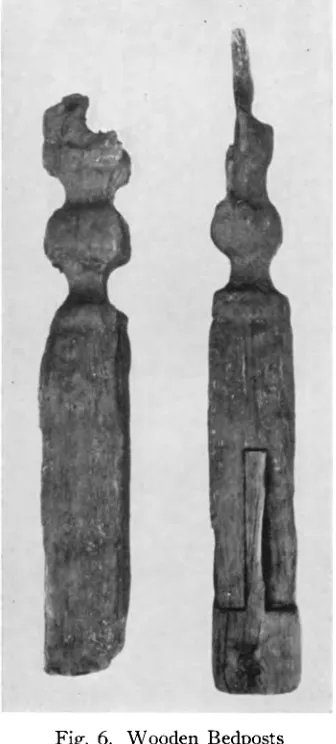
which are preserved in extraordinarily good condition (Fig. 6). Wood rarely sur- vives from antiquity in Greece because of the climatic conditions, but this season several well-preserved specimens were secured from wells where they had been con- tinuously immersed. The bedposts are carefully made and at the top of one of them part of its carved tongue pattern still remains. There has not yet been opportunity
Fig. 6. Wooden Bedposts
to study these posts and to base on them a recon- struction of the entire bed, but since heretofore our knowledge of the Greek couch of the sixth century has been derived almost wholly from vase- paintings, it is obvious that these parts of an actual couch provide important new information. This area was occupied through Hellenistic and Roman times, as is proved by the presence of cisterns and wells of those periods, of which one of the latest produced interesting pottery of post- Roman type, with which was a coin of the Em-
peror Heraclius (610-641 A.D.). No evidence
appeared of occupation of the site between the seventh and fourteenth centuries of our era, al- though a casual discovery was made of one object dated at the end of the eleventh century. This is a lead seal of a known type of Leon Pamphylos, with the head of Saint Theodore on the obverse, and on the reverse the official formula of the Bishop's name written as an iambic trimeter.
SECTION GAMMA GAMMA
This Section, which lies at the west end of the north slope of the Areopagus, was excavated under the supervision of Henry Robinson. The north and west slopes of the Areopagus seem always to have been used for residential purposes, and no remains of public buildings appeared in this area. There were, however, several early graves, walls of houses of various periods, and numerous wells. The earliest remains noted in the area are dated in
the Middle Helladic period (about 1800 B.C.); they consist of fragmentary pottery
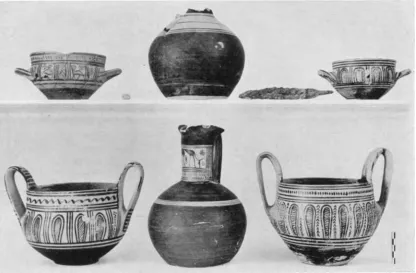
Many remains in the area suggested the general occupation of the site in the late Geometric period, end of the eighth century. Besides scattered sherds and un- disturbed deposits three graves of the period were uncovered. One of these contained the skeleton of a young girl, with whom had been buried a two-handled cup, her two bronze bracelets, and a large glass bead. which lay over the middle of the body, having evidently been suspended from the neck by a string. In an unrifled adult's grave
imotn ofeig wit ' titsv welpesre skltn Th objcts whc r lhw
... ... ..:. :: :..:.. ... .. ... .. .. ... .
| ~ ~ ~ ~ ~ ~ ~~~~ ~ ~ ~~~ ... . ~~~ ... .. ... ... ... ..: .. ... ... . ...
.. . ...
i__t~~~~~~~~~~~~~~~~. ... .. . s...
... ... .. . .. _.:...:..
bowl, a iroblde Fig a. dagger,sand a scarab Gofeblue fraveneThscrbii-
tearetn as ano importnded object in caaGeoetrisic grave, buomtrsinctye itsfae isun marked withe only af deortie motive,n ah thordgaehovr,cnined anmlreebinrniexits nueofun as-
tive borders, which is occupied by a grazing deer. The graceful shape of this vase, the technical excellence of its highly polished surface, and the sureness of the draughts- manship of the decorative design are characteristic of the skilled craftsmen of the period. Not less successful are the bowls and kantharoi from the grave, for they too are graceful in shape and pleasing in decoration although they represent simpler and cheaper types of ware.
Remains of the archaic period, sixth century B.C., prove that this area was a
residential district at that time. The evidence consists of streets, of wells, and of traces of house walls. Two wells produced many objects characteristic of the period such as fragmentary black-figured and early red-figured vases, terracotta lamps, and numerous terracotta figurines. 'The predominant type of figurine was that of the archaic seated woman, but included in the group was also a fine plastic head of a negress. Among the other more interesting objects from the deposit are a black-glazed skyphos which contained seventeen bone counters, an ostrakon of Megakles son of Hippokrates, and a well-preserved blade of an iron mattock which had probably been used by the ancient diggers of the well, near the bottom of which it was found.
The site continued to be occupied by private houses throughout the subsequent Greek and Roman periods, and ample evidence for this continuity of settlement was provided by the contents of a 'series of wells and cisterns. One well with a deposit dated in the latter part of the fifth century produced a great quantity of pottery, which included black-glazed lamps, three squat red-figured askoi, a large oenochoe, the stand for a lebes gamikos, black-glazed vases, and one ribbed jug. One askos is decorated with txvo flying Erotes, and on another are the crudely painted figures of two school- boys wrapped in cloaks, each seated on a bench. The most interesting vase from the deposit is the red-figured oenochoe, which is decorated with a curious scene painted on a panel in front. On the extreme right of the scene is a high furnace, seen from the side, which is topped by a cauldron with a stepped lid. In front of the furnace stand two men of whom the larger figure on the right has an ugly head, with pro- jecting jaw and straggling hair and beard. He faces a smaller figure on the left who offers him a ceremonial tray. Because of the presence of the furnace and of the clumsy figure and ungainly attitude of the larger man, it is possible that this scene should be interpreted as a representation of Hephaistos engaged in some sacrificial rite. But since the hideous faces of the characters suggest that masks are worn, it is also possible that a scene from comedy is here portrayed. The entire contents of this well will be presently published in full detail by Miss Talcott.
central fountain of apsidal shape. Painted stucco is preserved on the walls of several of the rooms, and one of them has a low bench along its wall, partly built of re-used marbles, one of which is a small marble statue of a seated boy. The filling deposit in the house indicates that it had been destroyed in the latter part of the third century after Christ, probably by the Herulians in 267, but the evidence also reveals a partial reconstruction in the early part of the fourth century.
Remains of other houses of the late Roman period were also uncovered, and two wells contemporaneous with them were cleared. One of the wells showed stratified deposits of the third and fourth centuries, producing pottery and datable lamps, with which were a complete bronze pail with an iron handle, a terracotta coin bank in the shape of a narrow-necked vase closed at the top, and a small marble head of a silenos (Fig. 8: Inv. No. S 1180).
SECTION EPSILON EPSILON The south side of the American Zone is bordered by three narrow Sections, Delta Delta, Epsilon Epsilon, and Zeta Zeta, which were partially excavated this season under the supervision of Eugene Vanderpool, and will be investigated fur- ther during the next campaign. The blocks lie on the sloping hillside of the Areopagus, where walls and cellars of modern houses have been cut through ancient deposits and frequently into the bedrock itself. Since nothing of importance has so far been brought to light in Sections Delta Delta and Zeta Zeta, this report will be limited to
the results of the work in Epsilon Epsilon. Fig. 8. Marble Head of a Silenos
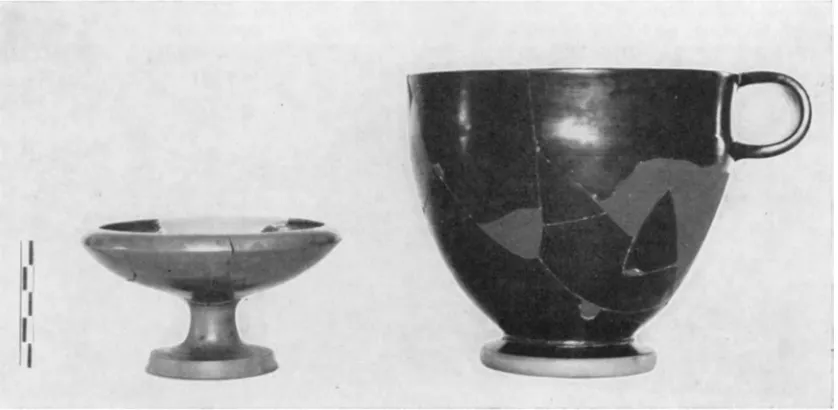
came a few sherds and two handsome vases (Fig. 9). One of these is a one-handled cup of higrhly polished black-glazed ware; its shape is gracef ul and practical, with a low base and a slightly out-flaring rim. The second vase is a shallow bowl of polished red ware set on a f airly high stem. Among the other 'ancient remains in the area were a deposit with objects of the late fif th century and two cisterns with contents of the fourth and third centuries respectively. Among the objects secured from the later cistern were much pottery, many terracotta figurines, of which a specimen is the. bearded man shown in Fig. 10, stamped handles of Rhodian and Thasian am-
Fig. 9. Vases of the Late Sixth Century
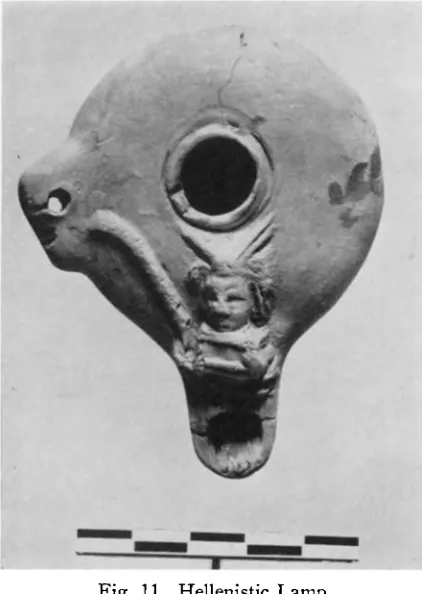
phoras, and numerous lamps, of which one, of third century type, is distinguished by a special ornamental feature, a small relief bust of Pan placed at the base of the nozzle (Fig. 11).
THE MYCENAEAN ToM-NB
12) showing the southern part of the excavated area, taken from the roof of the Hephaisteion; its site in relation to the summit of the Areopagus is shown in Fig. 13, in which also the cutting in bedrock for the back wall of the chamber is dis- cernible above and beyond the doorway of the tomb. The chamber was filled with earth and with large and small pieces of bedrock splintered from the collapsed roof, and the difficulty of handling this mass of debris was no doubt the main reason for the survival of the contents of the tomb. The clearance of the wreckage was slow and difficult, and the task was unusually disagreeable because of the presence of the cesspool of a modern house
wvhich had been placed just above the centre of
the chamber. The depth of the cesspool was not sufficient to disturb the ancient remains, but seep- age from it had penetrated all parts of the filling
deposit. Fig. 10. Hellenistic Figurine
Fig. 1 1. Hellenistic Lamp
Turkish period (Fig. 14). At the south end the corridor terminates at a doorway cut in the rock which was blocked with a wall of carefully packed field stones. It was evident that this doorway, like the passage leading to it, had not been entered since its original use.
After the tomb had been cleared and the dedicated objects in it had been cleaned,
-~ IMdP0 ; D ~ ~ t ~ ~~~L
Fig. 12. View of Southern End of Area Showing Site of Mycenaean Tomb
mended, and replaced, the ground plan and section were drawn by Piet de Jong (Fig.
15). These plans show the long dromos, with the Roman wall cutting its north end, and the narrow passage leading from the dromos to the chamber, which is blocked
by the heavy wall (1.40 m. thick and 1.20 m. wide) filling the doorway. The sec-
tional plan gives a clue to the cause of the collapse of the roof of the chamber, f or
it shows that the stone workers came dangerously close to the upper limit of the rock on the front half of the large chamber. The approximate line of the cutting of the rock above the chamber is derived from the cuttings on each side.
The chamber lies at a slight angle to the dromos; its walls, which measure ap-
their height is not perfectly uniform, the highest point being 2.75 metres. Although the roof had entirely collapsed except for a small bit in the northwest corner the line of the original cutting can be traced and by it the original height of the walls can be determined. The chamber was largely filled with pieces of bedrock broken from the roof, but on the west side some heavy chunks of limestone had been placed near the
~~~~~~~~~~~... . .... .. .... . . . . .... D... .... .... ... . ... ... .7 ... D... .. .... .. f7 W>7f7; - -7y
F...
Fig 13. Entrance of the Mycenaean Tomb; the Areopagus in the Background
I
top of a crude wall built along that side of the room. This extraneous material must have been introduced after the roof had collapsed and the time of the introduction is fixed by a f ew Mycenaean sherds f ound in, the mixed filling. Nothing later came f rom the west side of the chamber, and neither sherds nor other objects appeared in the filling of the east side.
When the chamber had been cleared a rock-cut bench, 75 cm. wide and 60 cm.
of the grave and shoved to one side (Fig. 16). The depth of the cist and the care with which it had been covered suggest the burial of an important person, but the grave contained neither bones nor offerings of any kind, though one small gold disc had filtered into its filling of earth and stones. A clue to the sex of the occupant of the grave was provided by a group of small objects, evidently from the grave, found lying beside the cover; these include a bronze mirror, a small ivory pyxis, and ivory
Fig. 14. The Dromos of the Tomb
hairpins. These objects, the grave, and the west bench lay beneath the rough wall built along that side.
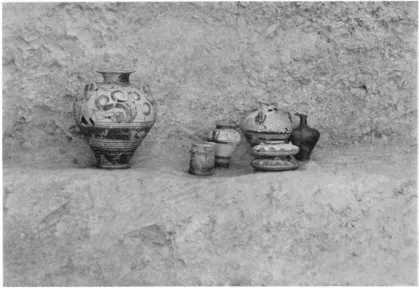
The bench along the east side of the room was covered by masses of fallen bedrock and earth, in which no sherds or other objects were found. On the north end of this bench six vases and a cylin- drical ivory box were uncovered; the vases had been shattered when the roof of the chamber collapsed but the pyxis was still intact although it was evidently in fragile condition. The filling deposit of the chamber wvas heavy and soggy, so that great care was necessary in clearing the objects preparatory to their removal, but eventually it was possible to determine the exact spot where each vase had stood and to collect the broken pieces. After the tomb had been cleared and the vases had been cleaned and mended they were replaced on the bench so that they could be photographed in their original posi- tions (Fig. 17). It will be noticed that a few fragments were missing when the vases were first mended. These are pieces which were not salvaged from the wet earth at the time of excavation, but some of them were later recovered when the earth had dried sufficiently to be put through a sieve.
a mastery of curve and line so as to fill most agreeably the space between each pair of handles. Above each nautilus are two ornaments in the shape of rosettes enclosed by circular bands, while about the handles are neatly painted violin-shaped designs. The vase tapers sharply toward the base, and the lowver part is decorated only by a series of reserved bands. A second amphora in this group is slightly smaller in size but has a similar shape with vertical strap handles and with a body tapering to the
I T/' N
ROCA- V A
Z OA19/A'1f1AL ZJY/%0V A B -
'J~Gt o/ZAN
COPPLAt OiVs
Fig. 15. The Plan of the Tomb. Drawing by Piet cle Jong
base (Fig. 19). It is decorated with a scale pattern on the upper part of the body, and on the lower half has two series of -reserved bands. Still another amphora, snmaller in size but equally graceful in shape, has spirals painted in panels on the shoulder between the pairs of handles, and has broad and narrow bands encircling the lower part of the body (Fig. 20).
l
i
l
-
| ,
|
.
;
_ l
-I-
|__
11
-
! I I
_ | _ | |
s_
_ E _ . .
; | _ l I
. E _ .
. _ . l
__
_
l
l|
_l I
l Il _ l I
i I _ l I
1 I l I
11 I
| . , | I . | , | , l l . l l l . l l
i l I I I
. * . | s I , I I .
_ | I | |