TlIE KNEELING BOY
PLATE X
The finest and most important piece of archaic art that has been found thus far in the
Agora excavations is a terracotta plastic vase in the form of a kneeling youth tying a fillet
around his head.1 The figure represents a victorious athlete and was probably intended
to be dedicated to some divinity by the winner of an athletic contest.
In spite of its small
size (it is 0.255 m. or about 10 inches high including the vase-mouth) and the commonplace
material of which it is made it is a work of art of the first rank, and as we study it we shall
find that in quality it is to be compared not so much with other plastic vases and terracotta
figurines a.s with the finest bronze statuettes and with monumental sculpture; that it is, in
fact, a statue in miniature in which we can observe all the stylistic traits of contemporary
sculpture.
The figure is fully modelled in the round and might be classed as a terracotta statuette
except for the fact that oni the top of the head there is a vase-mouth. The boy's head and
body are hollow, and at the top, through the vase-mouth, there is a small round opening, so
it is obvious that the piece was designed not simply as a statuette but also as a receptacle
to hold some liquid, probably oil. It has been pieced together from many fragments but is
complete in every important respect, only a large part of the boy's back and. right side
being missing.2 The boy, who is nude, kneels in an upright position, his weight resting on
1 Agora Inventory P 1231. Height, including vase-mouth 0.255 im. Found in September 1932 at a
depth of 16.00 to 16.25 m. in a well in section A (the Rectangular Rock-cut Shaft; number- 2 on the plan in Hespcria, IV, 1935, Plate III). I hope to publish the other objects from this well in an early nuimber of Hesperia. Preliminary notices and photographs of this vase have appeared in A.J.A., XXXVII, 19323 pp. 291 ff. and fig. 5; Illustrated London Newvs, August 26, 1933, p. 327; Heslperia, II, 1933, p. 459 and fig. 8;
Art atd Archaeology, 34, 1933, p. 294; Ar-ch. An:., 48, 1933, col. 203 and fig. 5 opposite; J.II.S., LIII, 1933,
p. 266 and Plate XVI; Revue des Etudes Girecqutes, 47, 1934, p. 104 and fig. 20, p. 105 (sketched from the A.J.A. photograplh). Cf. also Kunze's attribution, A.M., LIX, 1934, p. 122. The reference in Altsamische Standbilder, p. 49, end of first paragraplh, is to the Kneeling Boy as Professor BuLsehor kindly writes me. Among my colleagues I am especially indebted to Mrs. Dorothy Burr Thompson for many suLggestions and much helpfuLl criticism.
2 There is no direct join between tlhe riglht upper arm and the shoulder, a small fraginent being missing here. This arm has been fixed in a position corresponding as nearly as possible to that of the left arm. T'his was done in January 1937, the arn having previously been set against the shoulder alnd too far back with the palm almost exactly frontal (so in all earlier photogi-aplis). Tlhele are, of couLrse, numerous minor fractures, especially along the edges of the breaks, which are readily visible in the photographs. There are no restorations. The plaster used to hold tlhe right arm, and that used to strengtheni the body inside are most clearly seen in the back view. On tlhe originial coloring, wlhich lhas largely disappeared, see below.
American School of Classical Studies at Athens is collaborating with JSTOR to digitize, preserve, and extend access to
Hesperia
PLATE X
. .
W%LhVr iirJsA 24 - *8 - S %G9-i8s6
gf M " *...,...
7.
' tEiii . 0 .
%M. M~~~4. .'4 pvi"- -
: D'0 0't' ;; W
',E'S,0.'''~~~~~~~~Nt IRHT
0~~~~~~~~~~~~~~~~~~~~~~~~~~~~~4
fllf. ' * t,' 1 X< . ' ....
. "'t ''i .>...:.li' S " ' '''
., . ^ , . t
Wi~~~~~~~~~~~~~~~~~~~~~~~M
'i .d " ;- '; ' ' - .; ~' '.r>''' , ,, . ... ?_ , ., .42 ' ' 4..
Fig.~~~~
. 2r;i Kneln~I
Boy Lef Side, '?"_:X.:.<.~~~~~~~~~~~~~~~~~~~~~~~~~I
fx: r
~
UmMM .
.;x'.. . . . .:: - _ I Yi V _1!! 1 : i
~~~~~~~~~~~~~~~~~~~?.
. ... ?. ....*
'~~~~~~~~~~~~~~~~~~~.4.
U. . :;;'" " . :'..':'':.': .-.. .. .I. .., .II . I. I..,. I .. .
. .. : ,: -.,-.;,', - , - ; . '. ., .- : .. ,.. . ,4, ';--- -, - ., - .,:..'- ,. " , -, I , - - - - .1"...- : '. p - . - '., .-- - '. - I ," .. . I , : " - -, , : : . . . .., ... . I. . . ..,. . ... .. I .. .. I- :.,.---,!-,,, ..., ,... ...I..:..I.. .. .. .. .... I.. .. . .... ..I....
.;: ...,.,...---" e. - , .::_;-,.V..., .I, ,-:.. :: . . . 1.:...:.. _I.-.. - 1 .. .. ., ., '. , ,. ''. -: - - " .., :,. ... .... .. :.: '.. '. , ,
'. ", ,,- , :
- ,
-- ,1, ; "i '. "" !. -'... .", " ,!, "", ,-...III., ... ..!1 : '. .,. .,'..,.I;,..I1 ,...
I...:., .... ---... , I. ,, ;.. ..i.. .i...I..,.,,,., , :,.:.. .. . ,. ,,, ,.,., :
.,,, . .., ,, ,2 .. ; : I .. " : ", - , . .. .. . . .j , !. " ;:.,'.'.''-. i , " , , , " ."-,: "I,1,... .. . .. ! : , ; ,-., ,I.,.. :--,,:.. , 1,..I.. ... , I.,.. ...- .. ,-"' ';_ ..; , ,. ; , . I - , , 1 ". , ,.-. ,- !.":, ; !, . ,-.,-. . . . . . :.. :,:. .--1:.,..I- : ; ', ,'. " ;- ,f , - ,, -, ,'.,... ,,.. , :,,...:.. I,.1...
...,. . ,-,;'. - .;: i., t,.,,-!,I"-,: i.'-.' - " ;,, ", ,,,, ;I,- -,'! - - , !" -,': `, - -','.--. . - ..'. --,'-.'.- - '.- ;4,. : ",,I,.. .I.. , ..I .:-- . - .", ""'.-I.., 1,--,...
.,....- , , "'. ", , z,',,',.- , "; ,.,!, t-,!;,-k- '. ': ;.,'." ! , Z., in -_,", - , , -,' Z, . ,", :.': ., ;. .' . - , , - : , 1',:. . ...l.-!.,.
.,,,.,.-,,-,., ..
...I-,.. .. - -...,- , "" -- ." --, ' 1 - ----, '. !;, '. '. ,
: '- , - '', e: . ",.- ,.
..,,II-, .,.. ,!',, . ;4 . "" . ; o V " .. ; , '. ," ,- , -, ,,'. " ,,.,. ", '. ,;,-i ,.-:.- !.-'t 5t, ,., -. " ,..; , . :,4 , -,
II .I,;.-, , ,." I i ". l t ,-t , - .. ,.,,: ; ,--.. -, ; , I ,-'-,' ,,,, : '.. , .. - , t,,,,, :, ,,.! . ".,. .,,,, ,-1--, , --,- ,: " ,,-- ,..I.. ...---- '. .-, : . . :- '. "',1,- "- :, -,
.-- ... ,,;7,'-.l.;,,': , ! " z, t ,. ..-,, : , .-.,...
.,, ,1 .,, -,,, " , , .. : .. - - i-- i.; , - -'. ! i ; ;, , ",. I... .. ...,- ,i - --. ." I,- 1. " 1 " '. " , ; : ; - " f ' '..", " -- - -, j j ,: ., , .'-'.:'..",- , ;,.-..-, .,-.-,-- ---. --,:.. ." -, ,-, ,", '-, - '. : I... -,' '; _'-- n ; , Z ". :1, .. . '. ; --.. -. . . '... . ..
: ... ,,,'. ... ,.", , .- -:", ...--,.. ,., , ,4r,-'t %,''. ,- ,-., ,,.,. , 1.., . " , , ,, -! 1 ",-II.I,....m,... ,,,. '. '. ?..; ;:, ... :,i1.I.,I-. ..II. -.Il-..,...I
, -, ,, ..-.1 1.
'. '.
..I.. "I",, ,,,-,
II...
,,,,,, ,-- -II ... ... ..--,..., .. ,, z
,
-- -.. '. ,Z Z" , ,-, , ,_ T, z" '. ;". '. '. " ; '. -, -.,, i " '. : ; , ', ,
-, " '. ,-,-;,, -. ,, , I 1.I.., III I
'I',,-:I---I,..I. ..I, .. -:. '.,,.- . -,:I.1'."'. ,-, -.. - ---,
,-?,,,,- 1 .. ,-. -:,-- ;4 . . .!:. . .l 'O '..-, , " -,-.-,,! ,-, '-;,- ,- - -, '. , - ',", ' '. '. "-, .,.:1" ." '. ,,-
.. ....I...,. .,--., ".,.. ; - I 'f', O " , ,,1 '."..'.,-- ..-1. -,. .. ,...,...
.,,", . f! , ,,. - .- :,- ! ...-.. ,.I-.... . ,,, ,-- --, I -- ",'. z---,f;,,," ', " .", U- , '. .. .. .;. .-,"-1" 1. '-, , '.!" ; '.. - -:. '.,-,,-
...:,f -, .. -, '- , ;, .,. ,.,....t, ... t ., , 1; ,'T ; t ,
" - 1 , ,. .. ', . ".,I'. - ' 1, , 1 ., , .; , - - ! ; I-,- . ; " z " " ..,1. . '.-,::.. ,-- , . -! ,-, -, '..- - - , " "'l; :'. , ,k-,,' ;', L, , -, ,:. . .; ",.-, ," ,'.: " ,-'.:,-- -:--,-.--. ,,:'. ',!.,- -.:;,'--; .. -,' , , '-- ! .t , , , ,,- - "'--. .,,..!,.,; , ;,,, !.,.
1,,,..--!,.- - - -!i ;, t--, ,,,
- ,
,"- - , , . :,.-, .";,.-, :, i ;' i ,.;,;'l. '.I. i
., . .:-. I ., ,- -- ,'i - " ,l -t,, 1 a"'! !- -o ; - '.',. %,.. -;i,!,. ---'---- ",' , ..,1.... ,, ,,. . .... .. ... . .. "I---- -- ,,;, ,.;tf, -.- '. - ", . ",,,,-
.,.,. z . -,. .. . P, , " Z' ". . .;,' ,- ,, ,-. . . . . . .----,,,,,,,,-
,. ..; -- '.. -. - - -, " , .,;,. ; : ,
I - ."--.. .. 'i , -
" " ,,, ", .": .,. -",., -- :,,,. ,...,,- :..,::;- .,.1'. -,-.-,-,- ,.: - :,;,-":.. - ,,-,.,.: "", ''-, i .'. ", 'n; ,--I. ,,-,. , W., --: ;.I ,-,- 't"In , .-I,- 1.,.,,.
".I., , 'l.-,, ---, - , " -,-I..., . .I- ... Z-'U,- - -.; . . .:,,:.. .. . . . . . .. .1..
...I..., .,l-,l'---.','z"!-ZI..I ". ..,,- ,--,,--'-.'-'-'-'. . .j" - .. ,, I '.... .."'. ""' -_ - 7'. _1 ,.'.-P,,',-",''.'.t-..".:k,z,:. . . Z_X-:-,-, ;,!',,I. : -:-:'..' ..I,,. , .-, --:.;.', ::; -.- -:', -_'..'-,;x, - ,---,.t`,,` -'!'.-.- t -.1'."', ,.- .- -!,:- -,-'.,.. ..-11I- - --,t-,.-,-;, -, t,----,..,,,.:.-.,!,
:.-.-..
.. -,!..:, , `-, '- 't,-, , '-,,: ,.I ,.. .V .! ." -.-, , - A " - ,-I , .. , ., , " '... - F" .. - . , -,61 , . r. z - - .1... ,:, ...,. .... , "' ., ,,.! ... , : z , ,- i, ."'. " " .,., , .;,,.
.I ... ! -, --: -n 1-:',; --.;;.,.,,-",-;- ,'. .----
,- I, ,:,- - ., - ,.. , - ,",:.,.
. ... .,..'!,','-,,-.1'0'l.,?... .,, T'o ?", ";-- it.'.' - ,,e.!!' Q. " V --,: z :. -:, . :--,..--,-:-.,.
.-:':-, , -,.,,;;-'- .."...-- -. . .I - -,I ,... ... .. ,.,: ...,._;...
...:., . ?!; f -.; .:-- ,11, . : -, '. - -. ki. , - .i i:-. -, -,-.ra t".1. :-,- ;,, "'.-,u, ,., . 3'; ",--t, !- ." --, k' -".,.. ." 1-1. -, .. 1, - - 1, ! ` I..I... :;.",...%...,."., - 1.'...,...I.,
-, : 1, , -.. n,., , -, ...
I ,.. --:.-'. ,-1;-,-. i,.1,i'. '. , , -,
, , 1 i-, :. , .. I . .I. ", " .'. , , '--' v,; , '. , ; -S,; -- -. - .-.,- - '. -... --`- . ....
. . .,
-e".t- '."'-. I., -. ,
". , '--. ;. - -, , , " , ;.i A - - -.t. ; 1. ," i -. , . 00j, - "!R.-.I .. I..1 I., . -:, I- ., '--" - -'... --, ,,, _!'..' .; ,,, .;-4Z'-, ; z , . t';Z- ,Z!,'-f,-,,' . .,-, . . ,; ; " - , z - :-- -!.. ; .? '. ;'l " -- -. .. .-?....
!,"..,.,.,...
. _ ;. ,:,.,-!-!, -." ,'j,?j-,-'.. ,T!---. ,- .-=--.z-i,--. - ,-..jiI,, ':f,'-... -,--,,"'. ,. ,'Z!---, .. ..;. ,R.,.l 1. :
:'.I... --- ! t,:. i -, " . '.-' " , - I : . , ' -_ -, ,?Z' .L_, "' ,,-,--, -;Z-,-',-- .f--: !.'I., '.-,,,.
,, ".., ,-! : -l .. - --,.-..: ---',9--.Z'.'.---,;,-,-",- ,;----;_, - ,i; .-,-n--. ..-.. .:..:.:.. ...:.-.. I.ax '! M ,.l;:",.".",;!",;,.Z,.,-,.,,i ... :I': I , , . . i,;,,_'- , ,,
,.",,. .,- ,,. ,- , -. : , ; : '. !,.- I ; ! :., ..I.,:.
.f'- ...'.. -',ii"-"-`, ".1", n, - - -- -"! ..;"", - " -', - - -;:., 't--;,,.--:".- .,:.:...,... .
.., ,, - . - , '.. .."', ,).7 ! , ` - - ,.,.... . .. g , . , ,.!;,t?V'.. .
., -, -_ - I.R'.-1-1.",-zz, f ... ., Z' - 'j. -
V. t,z
. I, ,..I ,. ,,--tl , - . . '. .. ; , ; ," '.". 11 "'-t', 5,x i
!,-, 4 n , ,; ." ''n',, . , - 'Iti','.' , . , - - -- j , . . . , :-,.:
:..'7 : ,'. . . . .. . . . .. .,, ,,".. 1 ; ," ,-, -, ..."12-p-ttg.
'. .-,."-,.. - -- I ---,i, ,,... "-, t ,-, .. .- :,. '.... -, '!-', :. --- -11 '. - - - ... I.-, I ;...,., - .,.' ': i .-.1- . . I . , , -k - '-,"",.;,11;:-. . ,- ",,.
., ,-.. -I... I. -- ,.-,. " - t ',' 3" f -" . ; '4 rl'..,, ., ,....
. -..: - ..:: i', ,.'. --" :- -.. -. !,!t" - ,,..,,, : , ,,,,, ,; -, , ,-.. i , - ----;M., --,:! -.,'.'-!';;-,'!,%-I--E,,',-z,;! ...:...-..II.1
.,... I ',`'..'f ! ,- - -. -, . . . . - 1 :j;j3 I %'-;-,;. W I -
--. I: :z: .z-, ,"",-! - !',.l , '. , I `' , ,, " ,-, ,
",, ,-:,.-I..I - ,..:... . . .- -..- - ... - , "
, ., " '! - " : ,.- ... I..
,--,-tF ..,. -.-'!v,n'4' 1.,'- ;, -z-- -,....
..: ::..,.,:, ,.'.,
,
"".. "i,-,!41." --.,,V::,-..l ,:-, -, - ... 11,.1...,.. ...-...
, ;,.-.: :.... .- -- - ,--g,-.i ;,-'.;',,,.'.,.."".;-..,!.,-,::.
- -.t-, .. -, '.'. .-!r - z ,-- -
" . flqv I ,. .,, :! , , ,,.".I, ,... .,:: - --"... t , . , ! . , - . . ", '. . '',-QI,--,." -I%...
.. , ...-'Z,.- ... ... ... .,'z- -,--.%'i;z _ _.,-f:,-.-.-"--
-- -
.-...,,1----.
,,,..:", '.1-., ,:..I.. : 1' ,,,,',%'- . .1i",-l!i. .. , - '-,,. ,-, , :..,..
.; .-. . - ..,'!',-"Ai',l---- '.,, ,1' -,'..---,.--,',',%!' ,'..'-!-`Wl`lkl -:"',!!-- ...
-- ;-- -:, ,,...
..-, !- 1,,,, -,I I.I,, ",.;I....
.,.... ,,.'.-,.,' ,,, ., , .. , , iz "", ..,,.1-1
! ;,, ,:, .. ,,,.,, - :-!.,..: - . - . . ". ", - -. 1 " '- "?I I ., - --....
:.7t.:..- .- ---.-.
.-.,-,4'i--iK ,,,;,'.- ----'-w.- -, ."; ;%. ., ... .. .. -.. ..
,. :..;. . .-,.: ---. I... ... :,, il ;-..,-;,.-i....
. :.:.,,,- , .1 . ... !_--,... ...-,-".I-.--
,.... ... ..
:,, I ,:. ,"' -_1 --:! ,:t!,!,-"-', -. -, i,.--,.---. ",.,.,.,;,,;;.,,.--,.,.,,-,,-
' .z , ... 1.I ... :-, :: "z , ': -,- z':' - ,,- "- -,-"i ,,
-. :.... ,... . .,'..
I.. - , , :I. '! " , '! - - , ; . t : " , . , , I...
!. ",,,." ::,n o ?, , ,I... -. : !: '-,',. . : -,,,. I-,-v, ,---",
'k" , .--,.
..`,,,,-., .,--"-, ...,.,:-'i-.. ., :.. V t- , , ".. '. - ' ; , " , ! ,;,.p -'. "? ... . , , " ,,, "-:, ".. ; l , , ,- ..., - - .R, ,,-- -.,."" . " ,:, ---- :-! :.. . I. I I- - , - - 14 ;. . . . . . . .;t 4" I'. -,.,.,.-., L."',.-....
. - -, ., - -,- -.- ..- -'. ,-.":, -,.I '..", ,:,-',-,,,,.
",,,--. . t -'!!.,-:", J., - ...."-"", '... -'..", ,-,.,.---,-- .. -,-.. ::,,": - ." '.1..
i-,,-... -,-!,:f,,
:, ", ,-- -,
- -V.i.;,--.' ..--r,!,.,. ",. . ...
.-- , '. ,-, , ',..,: " ., . i ... .. ". " .,.., --. -,;,t-, . ; ,,, -, '- -! : -" '. . " , , ,., .. . , . ,:_ ..".. :., -., ,"' " ,., , ; , ' , " , !.`-.,, F " , ',,- , t " '.%'. t , - ? i. I '. , , .. , .. . . , , , , . ,. ,. ,-1..,,'. . ,,,., ,.. . I,. ..I.
.: ... -.-,.,-, :'- -- ?-".." .4 - - - , ,
"-'.'-',-, ,?.;,. . '...,, , -
,-:'-.-:,:, - , -, lnt",.",-"-::,- 1-_ ,,!',-,I
.. , ,.. . -l-i.-:-'-...-;"?-,." .; ". '. ".,,.,
" . .:
-,;..-t'-'---'....I
.rr, ., ,- . z 4-,- ,,;-'-,';Mlj '.,I,,,,,,,,,1":,,,
I.,,,"",,-t .'. ,;--,-T,;,.", ..,'. . :., ,., .,, ,.,.. .... !; '. :
,,,,,,... .I I... - I1, . . . . I . .:.. " - ,-- , . ., . . ,-, , I I " ,
-,., r" ti!'i';' : , t ,
; ! i ,.,. !! . - --... _', ' ,-,,--
--
.. -.. , 1 ,:. . :., . -. ., . .,I I-- .1.-,, ,I11 I I,' ..
, , : f '. -', -,,,,. - --. .. , . -, '. . '.'-, , --.' , " ! , ... ", - - ,---,.
...::". ..-...,.. ..% ; ;-'; - - -- -...
I.. .'-l , : I I ---l ." ...'...,."- 1': "
!, ,", . ... . ... .,-i .:-...
,,,,. :.1.. . .... ... ....- . ,-,-, - , - ... " 1 ,' "", ..,.,. -,I.. I -. . ;. .., , ,-- - -.- .. " " .. , - ! !-.-
-...-:
",:... ... ,.,-.-..I-:
;1- 1, ".. ,;...I... .I.- ---- ,
,,,,-I1,-"
,: 1.,,,
,- ,
,-,,.., ., ,t- 1,: ... -,", t,,'., , 1 " " -, '. , f; " : ,.","',?
.:.. I.I .., " ,i--. 'W" - . .. , - '.,,
,'i,,,,. ...
-,, - . , ,,t',I . 1- , ,. .','-:
.,.,--'... -;; ... : i " I ,, : ,.,,." -,,.,, - , ---
!-,- .,... ..- :t '..I..-. ..-.I
, , I g , .
,, ; :.1, ,.,, '- ': ".,,.'' '. ; '' '',,,,:.-- .. ,
..1 .", -. , ;, - , "., - -" , f". i. , .,t- ,,., -, -.,...: 1, ..; !... '-,'., , !I ? ,
,'-. .4,-" .-,.-l:'!i'.'-'!,!,.-- -,,J;, A-,,-- , '',-:."1..-... .i. ." ''.
,,, '., ,,
i , . , - , .
, .-,- .,, ,,-...
..1. _!.i , " - t " !-,--. , '. " . - -- ;% "t --- '. . ,",'; - - , ". " -i : . ". - - , ' - r. ,-:."i'." - .z :., ..
.,::::..I: :!-
,-.:. .
.I .,.. ; :---- " - ,, "!,I. 1,; ,-. ,., . ..:
, ., ...
.. .- ,, , ,- -,."- --,,, 1,,:,..,
",. .I,, ...,.. .--;, I..: .1.,,.,-. .I.,.,. -: :, ": :, ' ,.. -. I ", , ., .i,z - . , "! . , ,,.'. ; '. . . . . .. . . . . . . .. . .-'- ;',.!.f, ,'. , . , , --, ; .-.. . ". . .,' "-,.;",.' ,.".,Z ,11 '.- ,'.'- -t,',tt , -._ ,"'. '-, .- -i, - ; ' '. - , -:,., Z:"I '. ! " ! ,-, I.- 'I '. " . .,: " . ; . . - ,, :-'. -,. , " -. 1., .t"---... , - , "'. '. : - Z;,. - , 1, '.. '.., .. , .' . " ""-".'' - " -,' ,:.:.,!; ,..., -.". 1. t '. "'i 11 .. - 1, , '-, ; - I I"'..1 , : --.., v - . - .. , -" '. :,., '. ,; . ... I. !,1,- .-.... - ,.: 1., -.,----,-,,,,-. : ,.,:.,' . .f ,, .!.: ... -.
I",, _--!.--,'z- ,Y'J, ...--.,I-,... . ..I
...- ,': .. ,:' - .-- -., ", ...4 . - .'-,. '. ' ,'-'. , '.'.. :. z ; , , ",, , ,
,. -; , -:... 11 , , " ... .. . .. l.,-: .'--i,,,.-'.','.-,--;'.!',.--l..'i.',"-,""!;"',',".'.'.'.''.'..,,.;",'t,',, Wu;'-.", -.-V,- ,_'-!--,'!'.',, . -....
...'..: -- ., ,". .-: -- .,-'.60,,'.','.' -1 ;,. '.i - ".. ... ...
1".'.' - I,....'...,, ...-.- .: - '. -',-' '."-,-!,..-t',--.-;tz.,,.!,",;,..t -.' "! -!--:-: ;;- ,.-.O'- .U-,,,.,. .1 ...
.I;I ' : '. ;,. --, - !I -!"."'.j!n :",,
..;,..Z',' -:-f-"-, , :- , ,.`,- - ', ". ,, - -., '. .. " ,, ..-...-"
! .. " ."A
- --:1 " " ,- -; , , 1, :z
'. " , - -, - .. ". .1; - , .,, : ,'.-,.. .-. d f.- . !
.1 1 .-., 1. " - "' -,- -,,I
...I,,.IZ!
: : '., .", 1 , ,- -,'.,.I.. . .:, ,,
- ! ,,, . jI- -
, , ,
'. , - , -,, ,,,,.."I ::. - i :" :.:. : :.... .... . ,;, . :;,;t . , -:".%','-- -,!' , , - , " ., - ' '. . . , " ", , ,; -, , ,'. !. ."'-.I,-
,.I -,.. ... .:I.,. -Z . "- --,
" , , ,-:',','.;', ., - .'.', . . I -,. -t .,.
..
.. , ",-.,i,-,?.',' .,,,,,.,., '-'-;'- ,:: .:,r,j -,:t ,:...".',,,-'
-.! -',",,:.j .- ,-.. ..1 .1.
..,z, ".-,.-,;.,,-,"',
'-,_- -,I.--... -!". i-i, '. .? . _, .-. F --.
.i.,,--t--,%.,,,.
f .--.,...1
.... ". ,: '.- i-,-4, ,.":,'. "' ,!,, '.."--`."Z ---;-!--l-, ,'-,,,,;Z-:. ,'.-.-,,-'.T'- 1 ,,
tl - ". .." ". ! " : : '. :,:-., 1 ! " '. , .;;c--,. " ...,.- .. .!, -, ,_. '.
, ": : !',,-.:.
-. ...,. . .. -..f,.,:"',,,.,I:"":!"I,:":: .-: :"-, ..;,:,.,.,.-.-.
,.. "
,,, -;nj ' , !'.. -e , " ,,,n ,_-.-;`'.'--.-..
,,, ---.. -.1,",!'.'.. - -.".1-n,".,:.-,
, ..l... ..
.. 4:., -,,.', ,.;,;l',..,. ..:, , -'.,-,- -,-.-., -
.;..,.',','' ... - - .. .. 1. ... .. '. - - .... ,
1... :- ". .... .
I,,,_.1.'',.
- lli. ,.: .
...
... 1, '; : -, --,: )4 . .
.
,.III- .-...
,-- -.v:-- ..""'."'..-1 -:: . - .",
-, : :. ,- " .' , ,: , , -,:... ..,',---
,.', .,. ,,: -,
, , , ,-;. " '.. -'. ,
t-I.- 1. " - - - ,; : ; t' ,,, z , ..
., , ,-;,- - .. ,,,
,, ,, ,, ,. ,
::,,,...: ., ,,'. .., - ; '. ; - ;,, ! ,-! -. - Olzl' " :. -. :. " "I
;-.; .,
;. '. . I . .. 1.. , . .. - I - I - i. . . . I . t, , `
, ". 1
"'. . ; - ',4 - - ,.. : , -, ,. '. "-, -, 1, '. '. '. . .,
., " ,,i
'I, "I - I -: - , -.". '. !, " . ", -: --..
.,: ; :.
.,,-
--.-.. ,.. , . -, , ; , I.. , : - - , - ..., - , '. .", ; ';
.
, .. . ,, -: , '- - -, " 3 4.."', :.",--,!,.-
..-... .'a... .. .!;,: 1 - , . 1 1
"., '.---''
, ; - ;
- ":- , . - ,-,'-." "'.. .,. . :- ,---... . . ..; ,.- ...
I..:, .. .
,
-: , f% ... z i, -, ; - ! : "., , :. .... , , . :.. -;' '-ft '4, - '.'j . ; .7 "'! ." 1 , " , '. - " . ;' '''., : i - . - ,
'. , - '.',, , .", " - -,,- ; , '-.
, - .'. - , , . :, .1 I I. ,,'.,, , ... I .,-,;lt'
,.- -t- -,, -l::' '.,l-1..- .. .. , ;, - "-....
.,
,
:,-. . . . , .I. ... ,,- ":",.."l..'-f".!..,.,.;";.,'.,.- .., " ; . ; -'. .
-
", -, -, ,:! .. "', - ! - , '% -, - "", , " ; - --. . ... ,, ,,,'...
,;--, -
,:...'..
.--,"'!-"... ,
,,,, .. ,'."z---;--,--,-_...-,",;,,.,
...,...,x"', " .-.,n-,,-_
- ,,,, -,I.I
., ,,
.." - - ". :. ,-,- % , ,,,,.. . : - - - - .... ,
.I ..z... ,-;. ;.''.;-,-,.... , ,- j ,- .. - ,,i-;, , , ,. -- . , : ' ,
. - " -, "". '.-I..- -!:...
- -: ..I.- ,, :-`. .' - ..,tI.. .!.... ; . .. .. ,
!.: !' ,
--!.','--.;% '.j-,l',Z-- : -,;; - -.1, - ,..,-..,,,.,.,--.. ...! ... ,. ", ,. : "i j . : ' .,! . 7. '.., ; 1 -.'jj 1 .., - ., -, ,.. ", "',, ... ...-.
-,-, :.,,, ,,.-, - , - ,---, -..--. .. , ; , : :.- ;, '. : . : ,..,
- -,, " ,,., ., ... ". I I - ,... I ". I. .: I, ,-, ,, .... ,,- , ,'.,. . . ;, ,- -.- ! -,- -, - -, ,-.... ...!.-..
., ; -'. '. - -', ,:- i , " : i !2, " '. ,, -, . ,,-;!,--tr.,.-.! -!.,','-' 4 ..i;l---=.- I - - 11 .. - - --,... ....,..,, .1.-I,,'. 1-: '. - -.'-.;-,
"'... .
.:, . I I.. ..,,..,-%---,',-,.,,-.t,,, " 1, -... , -,, -.'! ; 1. , , : - ; . , , " : , , "-,. ,..II, .. ..-- ...:,-,-:.,-: ;l: -: - ,;. :, ... ,-"..,.,.,Z - ,-'- !. ", ". , ",:; . .
.:- ..-!", , -. . , 4 !. I... ",-,- , -: ., ,j"."-,;,.-: ,,, !;'-- --f . ", - -;, ,, -j .,,,- ", t.-,- ,-,., .i.-Il-f! :"z .! .:, - :'..I;,:-.. ..,.. .. -,.. I,,"". .. L_,-- .'.
..,-.,-,
...: .,. ,,,--- i.,-'.',-,:41.', ,.-,,-...f , ".. ,.., -;',!' !.-.---;'z.--,--.,,.-k.-., ..". ,-- _ ... ... -,. ; ;. . - '. -,-.---:!,'--,"".,,,,-. _ ;,, . ..-...,"'.--n,,1; ...;,-,,,II.,:II.I , - ., ,. I..,- .; .. .... '.. , , .:. "', -, '--,',. .. -.':,--Ml...- -, ,!" - , :.:', - ., " ".. : .. .. , -,,.,."-i" "; .." " - : -, - -- - "... z! , - , 1--:,,' - , -.: I . .'. ---"'. ` vx;-!"I1. 4- .,Au- A,-.n;,-,,...- : - - !,.-. ,...,...
"'!, "','. '. I'll "', 'I'll ...:,-' :. :".',",-:.,,.-.,",',,."",'.-,,!..,.-,-".'-. -'x,,--,il,-:- '-n- 1.
....,.. .,I,,,,I.1....I.
... ..I. .I .... .. ... ",..:. ... .:..",-,- .. '. . ,.;,--,.,,,.., -.1 - !.
:I- I.-11
:, .1 .. ...
...-, ,'.'% 7 , -, '. .. - - , Ir.. .. pq Z! .-"..-,
..A.- -; g, 4'-'.'-.,'.',.. ",.. ... .,",4
.- - ,: ' !!,, "t--":".!,".-.".'.,.,L;L.,; 'S,',-,'i-
... ,?..Z.,.,"...,.,.,.-,."tr",.-,,, "..
..: -. . ...:--..,'-" .,,I ., .,, : ,.. -- -, "" -.,-,.-q;,--. ;. ,.'.' 'U -.. --,_Z'-'-- jj '. - --,-,!'.. -! .., "' ". -, " -,-;-! .,-, -. ;.,'.','- . .. : - ' .-. .,.: ... .. ,::, .::.., .,.,
..I
..1..-- --,, -z,----,! , , .
""
"., ,--h,-i,.----l,,.rm
.-l "-`,-'-.-':t'- ,.', .'. -,",'-;-.',-,:: `
-- ,.:---, ",..-1.-. ... .. ..,..,
_ ,I.
., ..., ,,'-' ,-. ","- , .;,-,,..' -
. .'.. ".... .. -... .;,, ---- .,,,..,. . .,...,-i'!,7.,."...;,.2'.i',',---i,..'.,,-.,
_,
....,;,,' .. .1; - ?,,'. '-, .. 4 k,--
!--` -- cu'l - ; % ;.
1.,:,... .... ., ..N!,
11 ""-.
,--,-'!,14 '-'4,,..:..f
, ,:...-. . . .,.;', ... .-. -:
.,,, --"' !..','.. ' I 11II
.--;-t!,.;!-u-''. .- -, ",-z,ll,;,,,,,; ... .... ,- -,-,,-,.::',!----,.,,"- ,I..:
1. ...
., , -,
- , , ,.,.., .1 ..;.:..
.. .,3,r
-,,--- --,!--. .-....:': ', .. ,.,. - -,-.. .-","' - -.:.,:,- .--,-i;.-'z-.;-,..,.,;,.",.,-i, tt'L - ., ',%' -, ilv- " ,..!,! j, ; :- ;
, ,!;,.
.... -,jz...1.--.... ., ,:,. 3'., --n --- . .
.,-,"'. - , ` ",!, -, ."'i' uggp-, ;,i.-
:;,. .7. .: 1:-... :,- ..----,,,,,I.I.I...
..-? -,,- ,,'r`Z','-,.;-;:,-;- -;', 0,--,
I I : '.,- ". .".. ., ., - .. .. ,.-, .Z , - , 1M, ,. ,
,111!'.,,--
...-. ,"',,-.
-,.,R .;P.
. ,,. ...I,-:-:- , .. ---' 5'.,,- ,,
- ,;,_
.: zi . ....-I.
...,A
- F-nq,.-....ii
... .-'-"."
.1,.'. ! 1 , -
H !,,-,!i ; ., .. -.z %, 11. ..,,I
, , I I,, ,I
I;- -.,..
, nN,;11', it? -,'---,- --,-..
.,:. .-.._pl -I...,.
I'. .. , . ;l-, - --'! ,; - --, --. -,'. ... --nV-V,-i4".",n.., -,`--,,x'Afz-,-.l-. I . ..'l.
.. .: '., , ,,,-,,,"'
'...: - !!'-,-,---, ,:. -,.
,...
;,.
.",.!-!----l--l--l 1. ... .. ! 1. -... ,,_1.,.
,..-,-'j"i -.':,- ,-".---',;-,.-:":,."..Pl"".- W-1 I - .. - ,,, ii ." - -, -. ,,;,.----.1...
.--'77.
. - . .. .. . ... :'',. -,,
.--,--
-'... ... -,I. .-"-t,;",i,.-.,j I.j--,,_5 .. ,. . .,...
, ---.. 1-. I...., -,,
. .. :.. "'.,wt
.; :: -. 1. "'. -- II,- t 11,- - , , "N"N'i....I
-- I-,. ,, -'. .1I-1-,-'.,I...
... -. .". i , , '. '. -, - .. 1, ;,. " . " ,,;, Z , : - - ;-, .-' , " .", :. , ,'. . . . . .,I..I.,.
I , 1 ,,- - ;.I:, : ,,
,-'--' -.r. z;;--'-'--n,,,tj;v
', ."-....:.. ,, -- , ; ! ,,: - - , " j..; , . I"', -,.,.,..
.. .:... -.1
...,n '. f5, rarl iI , , : - ". : - , .:-.-
,... . ,... ..,
.... . ..I..I... . .I..
.-.1 '. -.- ": ,11-,. .-,- .-..."-.."I,'-,;.!,*-.,,i',
:
,,,-,.,:,-'' - "... I....I
..-: I ;,. . '. .:,!' - : ". ,,-, : , R, ,-,J -, -'.'.. "I - " '. -.- .,! '... - '. '- I';.... ..,-I... -, - ;.- -.- " ! ';,,,
, , , itu 1.3t-_ ..
I . .I
.I... ..I.. ... ...I....
....,,"."-:;,:7 " -;,V.j .0 , t- .1,,,,,, .. ... ...,
.I.,., - ...I .I , .., .;-,- " . . i-,! ; t, '. , , ,,-.I. -- ---,--...
. -!'. '.L. 1- ..-,
-, - - --.:---....
.- , " . " .,.f '. . , '. . . 1 . . . -.: "
,.1 i. I . . : " Z ;"...
i'.-- -.!"jA .... - -.:,:-'-';-. .I... ... "A...-.;-....I .,Z-.-.-.-,
... i:-
-,.- ..
...
... ; - : 1 '- , 1 , , ',-."-;,-- ,-' , Itli! XI;,,; 1. .I": .I:.,-,
.", ,!,,,,
,;-' J_ -.4 .":,.... ..-:,-... .-., ... .. .';' ,-:'- ... j.,. -,, -'-;`V.'C'.K4 --.!J;,r...I1. gU..".... .-
.: . ,-. ....:
,I.-.l.",--_lt!"'t"i. 'J"-,--r.%.. -1, ..-I,_
.1.-- .".- ..: .-- ..L.". I-- ---.'--- "li. rv,7 -, ., ,.. : L...", T-.'-- tll , "- - - '5,' ., ,-- , .R , . p4l.,.. . --, 1,;, '.."I,.-.-. , , -'...,..:.,. ".." .2 , - " -.. ,. .,.., :.-. ,!-,,. .
I.'... -.r.-'lrt'i-%dv . '. 1 "., .;!. .,
....I; " - - , ,'n. .:.;,.,t .: : "
,.,:"" , - , ;.,- ,, '?.I"..t,'..", : e,' - -`V.:.,...:....
.,,,,-,;,','..,,,,,4'.''J,P-",'l.zx-. ..-. ---t.-..-.,.,; ..,'. ,,n-. ..-z- -',' .'.-" '.. -, --.I.. ..:! :,,..
...-7- -'. '--., ., . ,,-","..., ."t' .1... . ..-.- ---T, -,'-';',---,-n-','...
.---,- -- i ... - ,:- -!.;',-;.,-,,;,f---,- !--"r0.,.;.- ..,'! . O,.,!n ,.,.. ,-,,:,---:'.
..I.M
- - - - -, -, " : --" .,... :.. ":. ,.-,-, ---I
1.. !-.-'- .`,,- ,,.,,.,. .-,t-;7.,.,,'a..,','--,;-.,.,i4...-,itA..-,.-... : ,, ,-
.. .,.-`t!' ...ii -, " ! ';', , .. ; .,.,. ,-!-.,"-,.,,- I , . ", ..,- 7-'---,-.2 ".I,, i :. .;, -,"' Y -.-- - --,- ", M - - - , - .,. 'U.-, I.. .. ..I'._., .I.1..-..,--, !;. ::,-, - -.. li-, ,-.-.!- - ":;, "k ""--,,;-,f-.! ,- .."I"..,.:.-- '. - . -! -" .'.-.,.,. ,,-;-- .... -!' :.-.-.
... .. r,- .1. , - -,6 , '. . , , ,L- . . .,f ,jul ,Tr , - , :
, : ! ,.; '. ,:...:- -.-,I-,...
...---,: . . 1.
I-...., , ".. "": -. , ,'. , , : ' -, " : 'I ,'-, z -z 1, f -1. - - , ,-, , ! , 5'.-aw, ,.-l '.',-
, ; - 1 , - - , t '. ; - - " : " 1,,. .'.... .,.,, -! , , I .!;. 1'."! . I - - " , ", " , . I - - - , . A . - - ", 1. : I .. ::- . ,I 1.;,,,,1,..
...:, . , ; : ; !. .,,I,--, , ,- ,. . ..:.., .,. ..:....% . ". .. ,.". :,-I.
... ..--' .., , I, ., I - ' --.-,--" -4'.'tzt' ", ,.!.--,I U- .,...,".M-t .,I""k. -.:".-.;,.,.,, ,. ...-;,,,',,4 .., . . . . . . . . '-- --.". ..`-. .. ." ..".""', ..'a". ..._,
I-.... .. -- - .,, .,--_;- -,;-`-,-j,-,''-. -- , --. '.."... ,-,-... ,-,-'-,R, "t, ; t', !,..,.,-, '::-,.. ..;",-.-. ....l,,.... .. .',,. -,-".,!,. - ". ---.;z ,,,;
'.." '!:I,.:1... ,, !- , ,". - ; ", - .. ,.!, , .., -,'-'.' -li",',.--o,,, l.---"-"--.-l".,,I...I.... ... . .. ..- . : 'y 1,; ,,., , ,
,, - ,: .,,.. -. ",,,, ,--.. , if, .'i".1, , ,'-.:- , `-,,',".:--!--- .".. t ,.".. - ;... ...,.I.
..:,,:- -, '- - , ," " ,,`.: :-- ,: '.! -, , ..";." I . - .. ..,,-,...
. ,,.,. ,:; zt t- .'.,,.,.'- ---l- ' ,..,...
..1.,- ", , ,, -1 - ,z;7.t...,--!,,,,.-,4-, ..,,-- -L",,....
....,-.,, ',, ::!,. .:..,..
... .. , ,_ ...1- . 'A', .-, '. - ,,--,.'-,---,-,;,-t,' .,'.r' ,..-
, .- ,,:,--'! .,,.
-,',- "' _;',Z',,,t,. ...:...
,- , '-,-'. 1.... ,,,,.,:,,';'.'----".';,"f-,' :.,..1 .:,--.11,. -, .."-_ . ','--,,.,:":.,. -. -:-... .I.. ,.: .,. -:,. ;,--,-.., ,.;.,,.'.. ... ..,.. 1.,- ,."'.,"'-- ,," ,"' ""... ..
:-... -, ., .'. "--'--,,- ,'-'t,"l,---,
.1.,-,- ,,-- -, - - - '. -, .. , , . .!!. .!.' ;--... .,,;..;,. ,.., --!.,,,- ,-',:-,' .,. ,',.". . -, ., f---,. , . .. -. .1"!----.;-i"n,, ...f..:...!..
., "I.,. .: , ., : ... .. ... ;. "'. ,Z, " "" , ".--,- :,,--,,,, ,, ,,.,,.'-', .. "";'..",I".! -Ix -'.' -=, V! .,-, , ,...---,. ... r,!"--....,-.,,,.'.'.:-,,-- ", .-;--,-,--.
.., .,-... ,,. ...,-- ,_,,!-,',," -'n't'. '-' , ,'..j!!t .--':,-:-, . _....,.. .. -,-'- .-_-.",-.-:,--!,'.'...-'-,,-.-.'Z'--,-;.""!Z.,.!','',.-,-, "',,, -, Z' -,--
.. .,--.- - ----,--,v;l'-;;
..--- ..--,-..-,,. f!",-.,;, .. , -,,"... '. ".. .:!!, t ",",-,-. ... !,--- - -- --! , -,,,-,
...-,,, ,..,. -, .. , f ,.. - ", , ; .'- - , ., .,."."'!
,;,-'_n: , '. -- -,'- ,- , -,, , ",
. -!, ', , f'i' . "" :... .,,,,- ,".. I----"--,;,-, .. -,' ... i., 1 ',!-,-Z7'-'- , -, a '. '. ;'. I'. I- . , ..
..,, ...,, ,,...
.I.--,.,,.'. ,... ..:
.-l .. 11'.1 .1 I I.,.ll ..,-.;.--,,-- , .. - " ; '', ! ! " !! " ". ,, , - : - - ", ,,, - '. ;. " " Z ,
!,-, :,. .. '.:..:... ...,-,
"' "',,
.I-;,:.',',.-, - --- ..., '.,--,,_;,
--2,-1.. ." 1-I.,. - ', .." -,, --..,--- %!-- . ... ---'.
,' -,'.. --, ,. .-- ---1-7-
1, - I. ,-. - ",-- --.- .7 :.". ",_ _".n.,; ""r !.tl. -,,,! 't- ""',....
,. .- ...I...I1. ..,.' i,.. .__.,--,
. - -, - 1. ...,.... ....; --`-,. - - :, - -,- -,.. - ,-"'t,"..
I... ----,"- " .. ---
I.: .",. .. -;', ." - - - ,-; -."".,-- '.', - .. ...'.'.-;.t,!i.",,!;,.x- .",-.:t ... z;'-ljjt',' f 1'.','. ',,-....,... . -,
.I.:i,,. "... ,-",.;, ; '. .f: `7 - z : " . : , : ... - ---` . . n ,", .,.,'',', -,-'-':,:,'-?---.;-,:.., ,.:" -,.i. .. ., ,", ,, ,;,, , , , -,..,..
s 1 11
fX~~~~~~~~~~~~~~~~~~~~~~~~~~~~~~~~.
f.t...g :
::~~~~~~~~~~~~~~~~~~~~~~~~~~~~~~...
... ..X ; 1
~~~~~~~~~~~~~~~~~~~~~~~~~~~~~~~~~~~~~~~~~~~~~~~~~~~~..'.'".'.".'...
.X
.. ...
...
... ..., :',,,.:,
X, lG _ ; . . . '....
..~~~~~~~~~~~~~~~~~~~~~~~~.
. _...
...
i '
430
EUGENE VANDERPOOL
his knees and sharply bent back toes. His arms, extended on either side nearly horizontally
from the shoulder, are raised vertically from the elbow, and his hands, with palms turned
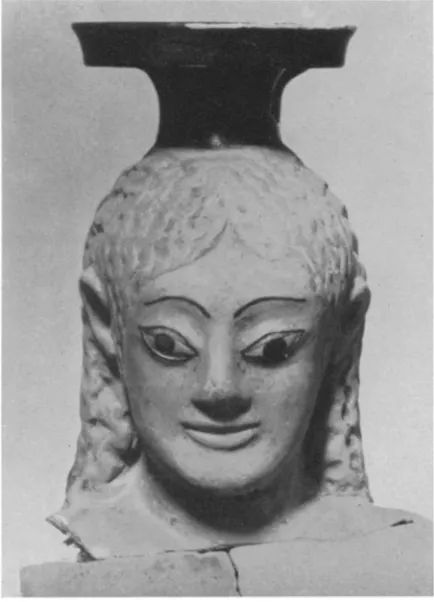
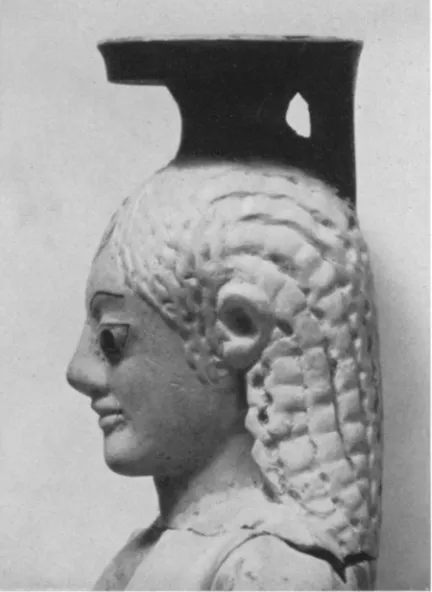
slightly inward from full front, are loosely closed. His wavy hair is parted in the centre
at the front and falls down behind in a mass of conventionalized locks to the bottom of his
shoulder blades. On the top of his head is a vase-mouth of the kind found on aryballoi of
" Corinthian" shape with a small flat vertical handle. This vase-mouth and handle are
Fig. 4. The Kneeling Boy. Detail of Head. Front
covered with black glaze which has an
olive-greenish tinge in places.
Black
glaze has also been used to indicate the
eyebrows, the outlines of the eyes, the
pupils, and the nipples of the breasts.
The other colors that were used were not
as stable as the black and have con-
sequently largely disappeared leaving
only traces. Most striking was the red
which once completely covered the hair
and of which ample traces still reimain.
Red was also used on the lips, where a
very faint trace can be detected, and for
numerous small details, and the eyeballs
were probably white.' The rest of the
1 The red used was the same as the added
red cotnmonly found on contemporary pottery, and the white, of whliih no trace remains, was probably the same as the added white. Besides the hair and lips where it appears as a inass, red was apparently also used in small amounits to pick out details or to emnphasize the modelling by deepeniing the sbadows. For these purposes it was probably used in the following places: on the inner part of the ear, the outer part
being reserved and still r etaining part of its
lasur (clear trace in left ear); in the incised grooves in the eyes (traces in the lower grooves of botlh eyes, cf. below); in the hollows for the niostrils (slight trace in left nostril); on the breasts, for a circle arouniid the black nipple within the incised line, as often on contemporary black-figured vases (no trace); in the navel (no trace); in grooves and hollows around the genitals (traces); in the deep groove between the thighs (clear traces); in the fold of flesh at the elbow and belhind the kniee (clear trace in the fold behind the right knee); in the hollows between the fingers and between the toes, and in the incised lines that outline the nails (traces at a number of points). That the whole figure w^as not red (as were, for example, some East Greek plastic vases-cf. A. Furtwiingler, Aegina, p. 380, no. 67; and Berlin 1292, Fuirtwiingler, Beschreibung der Vasensammlung im Antiquariuni, p. 148-and the flesh parts of the British Museum Dionysos, E 786,
C. V.A., I1, 1, c, pl. 37, 1) is certain, because lasur (see next note but one), which is clearly a finishing
THE KNEELING BOY
431
figure was left in the color of the clay,' a rich buff, and the surface was here covered with
a thin transparent wash
(lasur).2This
lasur
has worn off in many places but where
it
is
still preserved it tends to darken the color of the clay and gives the surface a polished look.
The head of the figure and the body down as far as the knees are mould made, for they
are hollow, and one can see finger marks on the inside. Probably two moulds were used,
one for the front and one for the back, but the parts were so carefully put together and
the joints so skilfully covered up both
inside and out that the line of division
is nowhere visible. The hands and feet,
the arms, and the legs up to the knees
are solid and were made separately by
hand (i.e. not in moulds) and attached,
for on them the marks of the modeller's
knife can be seen whereas the surface of
the body is smooth. The ears were also
added separately, and probably the mo-
delling of the hair was done on the
figure. The vase-mouth was made onl
a potter's wheel and attached.
Certain details of modelling and ana-
tomy should also be noted, for the mo-
delling is remarkably detailed for a terra-
cotta figurine of the period. The forehead
hair is carried up much higher on the
head than is usual, and at the top, just
in front of the vase-mouth, there is a
short, shallow groove evidently designed
to help hold the fillet in place. The eyes
have a pronounced bulge and are sepa-
rated from the brows above by a broad
Fig. 5. The Kneeling Boy. Detail of Head. Left Sidehollow and from the cheeks below by
a lesser one. Within the outline indicated by the glaze there is a second outline done
by incision in the soft clay as can be quite clearly seen in the detail photograph of the
head (Fig. 4). These incised grooves were filled with red and were perhaps intended
to represent the visible edge of the under side of the lid. How the fairly broad space
1 The clay, which is that of contemporary Attic pottery, is firm and of very fine texture. It is definitely
a vase fabric, not a terracotta fabric.
2 On lasur see L. Hussong, Zur Technik der- attischen Gefafikeramik, Heidelberg Dissertation, 1928, p. 55.
It is worth noting that when the vase was found the lasur was preserved on the resting surfaces of both knees. Now, however, although the vase has stood only on soft cloth and has been handled very little, the lasur has worn off under both knees and the resting suirfaces have become slightly flattened. This probably imnplies that the vase was never used in antiquiity, or at least very little used.
432
EUGENE VANDERPOOL
F v .S .; . rS. s - ...
..~~~~~~~~~~~~~~~~~~~~~~~~~~~~~~~~~~~~~~~~~~~~~~~~...
i~~~~~
I~
~
~~~~~~~~~~~~~~~~~~~~~~~~~~~~~~~~~~~~~~~~~~~
n|Us ^ 'ie~~~~~~~~~~~~~~~~~.
. f.. . .R - . . . , 0 0 S - _ R C ls . X i ... .. ?: . . ...
Fi.6-Te Kneln Bo.Deal.,ros
bewe th pe roead h pe lc in a rae ano edtrie.
Th easaevr lmiymdlld hsi rbbvdetocrlsns riettd
on:
teprofteats2alhuhimabeitnetorpeettesolnerote
1 Possibly it was done witli white on which black lines for eyelashes were painted: cf., for exainple,
the Acropolis terracotta no. 623, S. Casson and D. Brooke, Catalogue of the Acropolis Museum, It, p. 405.
2
wr.
Deonna, Les Apollons Archaiques , p. 96, "L'oreille est d'ordinaire une des parties les pltlsTHE KNEELING BOY
433
athlete, a realistic detail which is found as early as the ripe archaic Rayet head in Copen-
hagen.' The nostrils are indicated by narrow slits. On the torso (Fig. 6) the collar bones
are indicated by two straight, slightly raised lines set approximately at right angles to
each other; between them and the neck is a slight hollow. A small, delicately incised
circle marks the outline of the nipples. The space inside this circle around the black dot
was probably filled in with red, as often on black-figured vases. The breasts are slightly
raised above the level of the lower part of the chest, which, in its turn, is slightly raised
above the surface of the abdomen. The line of division between chest and abdomen is an
arching curve which
falls away toward the
sides and carries well
around toward the
back. The median line
is a slig,ht hollow which
runs from the peak of
the above-mientioned :'
curve down to the navel
where it ends with a
short, shallow, lori-
zontal groove. Below
the navel are two
more similar horizontal
grooves. Otherwise the
divisions of the abdo-
men are not indicated.
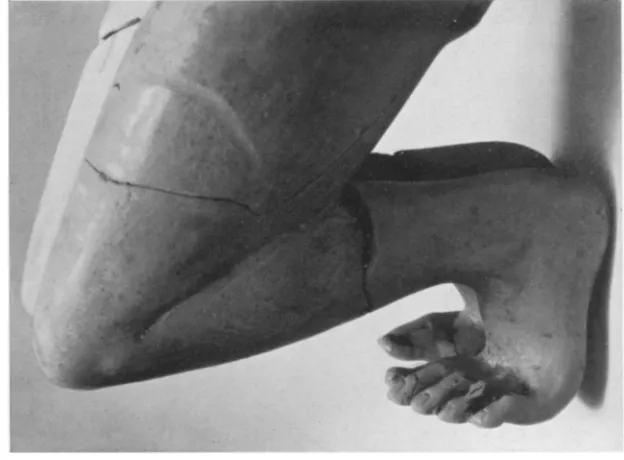
Arms and legs, hands
-and feet, are very
Fig. 7. The Kileeling Boy. Detail of Feetcarefully modelled, in-
cision being used for the outlines of the nails, and the modelling was emphasized by the use
of red. The shin bone is a sharp ridge. In its proportions the figure shows many of the
usual mistakes of archaic art. For example, the head is rather too large in proportion to
the body, and some of the features in proportion to the head; the right eye and ear are
larger than the corresponding members on the left; the toes are enormous. The last, of
course, is partly due to the unusual position of the foot which would increase the difficulty
of getting the proportions correct, and perhaps also to the need for as broad a resting
surface as possible. Finally we may note that the figure is not strictly frontal for the
head is turned slightly to the right and the palms are turned slightly inward.2
1 P. Arndt, La Glyptothieque Ny-Carlsberg, Plate 2. On the swollen ear, W. W. Hyde, Olympic Victor
Monumzents anzd Greek Athletic Art, pp. 167 ff.
2 On such asymmetry cf. H. Payne and G. M. Young, Archaic Marble Sculpture from the Acropolis
434
EUGENE VANDERPOOL
The Kneeling Boy may be dated with some assurance about the year 540
B.C.,or perhaps
slightly later. I will present here a few reasons for this date; others will appear in what
follows. The circumstances of finding give us a good terminus ante quem. The figure was
found in fragments at a depth of 16.00 to 16.25 metres in a well of which the total depth
was twenty metres. The fill in this well did not accumulate all at once, but in two main
periods separated from each other by a considerable interval.
In the earlier- period the
well filled up to about twelve metres from the top. It was then apparently covered over,
for nothing fell in for about a generation. After this it was re-opened and fill accumulated
again until it reached the top. The earlier fill, deep down in which the Kneeling Boy was
found contained no red-figured pottery.'
The latest black-figured pottery in it belongs to
the third quarter of the sixth century but is all clearly pre-red-figured. Closely associated
with the Kneeling Boy were a number of fragmentary " little-master" kylixes which are
neither early nor late of their kind but belong to the full third quarter of the century, the
heyday of this type of vase.2 Thus we get 530
B.C.(the genlerally accepted date for the
beginning of red-figured vase painting) as a terminus ante quem, and we may reasonably
suppose that the fill in which the Kneeling Boy was found accumulated during the decade
540-530
B.C.The observation that the figure was in new condition (above, p. 431, note 2)
just before it went into the well suggests that it had been made not long before. Thus from
external evidence we obtain as an approximate date 540-535
B.C.Various stylistic and other considerations bear this out. Here it will be sufficient to
observe that, in spite of the unusual position of the arms and legs, the figure is clearly
of the " Archaic Apollo " type, a long haired, nude, male figure in an erect, frontal pose.
The outstanding statues of this type have recently been arranged in chronological order
by Miss Richter and given approximate dates.3 By comparing the Kneelino Boy with these
it will be seen that it belongs to about the middle of the series, being rather more developed
than the Volomandra, Tenea, and Melos Youths, but earlier than the Munich Youth.4
The pose of the Kneeling Boy is unique, and I know of no other existing example of
a kneeling figure with raised arms. Plastic vases in the form of kneeling figures are not
at all uncommon in the seventh and sixth centuries
B.C.,but in these the arms are invariably
of one piece with the body and usually either rest on the thighs or are held against the
chest.5 These figures differ markedly from the Kneeling Boy too in that they kneel with
their buttocks resting on their heels, not in an erect position. Figures with arms raised in
1 Red-figtired pottery was found only in the fill of the later period, from 12.00 m. up.
2 Agora Inventory P 1240-1245; lip-cutps and band-cups; cf. J. D. Beazley, J.. S., LII, 1932, pp. 167 ff.
3 Metropolitan Museunm Studies, V, 42 ff. Good pictures of the torsos of the Sounion, Munich and Ptoan
no. 20 Youths (I use Miss Richter's nomenclature) are now puLblished in E. Buschor, Plastik der Griechen, pp. 24, 25, 27.
4 I take Miss Richter's stuggestion, 530-525, for the Mtunich Youth. Payne (A.M. S.A., p. 43, note 2)
dates it " near 540."
5 For example: M. 1. Maxiinova, Les vases plastiques dans l'antiquite, epoque archaique, Paris, 1927,
THE KNEELING BOY
435
the attitude of the Kneeling Boy occur frequently in the sixth and fifth centuries as handles
of paterae and vases of various sorts I but in no case do they actually kneel.
In some of
the oinochoe and hydria handle-figures the hands grasp the tails of lions which lie on the
rimn of the vase, and the body of the figure is bent backwards, the bending being sometimes
largely taken up by the knees so that, although the figure is not kneeling, the position
approximates quite closely that of the Kneeling Boy.2 There is, however, no more than
a superficial connection between the purely functional pose of these handle-youths and the
pose of the Kneeling Boy.
Figures with arms raised also occur occasionally as supports
for
bowls.3This suggests the possibility that the Kneeling Boy may have been inspired
by the colossal kneeling figures which supported the great votive krater dedicated by
Kolaios in the Samian Heraion.4 It seemns unlikely, however, that there was any very close
connection between the two, for, removed from its position as a support for the krater,
the pose of the figure becomes quite unintelligible, the arms are held up in the air for no
apparent reason, and the whole thing lacks unity. And why is no fillet represented when
long-haired male figures of the sixth century are seldom without one
5and when the change
of coiffure between the forehead hair and the hair of the rest of the head absolutely
requires one?
The answer to this last question gives us the correct interpretation of the pose of the
Kneeling Boy. There was a fillet, an actual fillet of wool or metal, which the boy held in
his hands and which passed across the top of his head just along the line of the change of
coiffure. The Kneeling Boy is thus a fillet-binder,6 an
anadoumenos
or
diadounenos,
and
Examples: patera handles; A. de Ridder, Catalogue des Bronzes trouv&s sur l'Acropole d'Athenes, pp. 248 ff., nos. 703 and 707 ff.: vase handles; A. de Ridder, Catalogue des Bronzes du Louvre, no. 2784 and bibliography ad loc.; K. A. Neugebatuer in P.M., 38-39, 1923-4, pp. 343-5.
2 Examples: Paris, Petit Palais, Oinochoe, Neugebauer loc. cit. p. 343 and Plate VIII; Sophia, Bulgarian
National Museum, from Trebenisebte, Bogdan D. Filow, Die archaische Nekropole von TLrebenischte am
Ochrida-See, Oinochoe no. 72, pp. 59 ff. and Plates X and XI (= IX. 'E$p. 1927-8, 76 ff., figs. 35-38);
Berlin 8467, Hydria from Randazzo, Staatliche Museen
zu
Berlin, Fahrer durch das Antiquariumn 1, 1924,Bronzen, p. 68, Plate 26.
3VIon. Line., XIV, 1904, cols. 769ff., fig. 5 and Plate 46. Also the Etruscan bowl, Loivre, C 659, E. Pottier, Vases Antiques du Louvre, I, Plate 27. On figures supporting bowls cf. Payne and Young, A. M. S. A., p. 12 and note 2. The patera handles referred to above (note 1), on the analogy of their female
couLnterparts the mirror handles, may also be thought of as supporting figuLres; W. Lamb, Greek and Boman
Bronzes, pp. 127 if. and p. 131.
' Herodotos, IV, 152. E. Buschor, Altsamische Standbilder, p. 49 seems to suggest this. Cf. also ibid. pp. 6 and 43; and above, p. 426, note 1.
5 W. Deonna, Les << Apollons Archaiques >>, p. 100, cites onily one example of an unfilleted head, his number 25
(Kouros from Boeotia, British Museum B 474, F. N. Pryce, Catalogue of Sculpture, Vol. I, part I, Plate XLII).
6 This interpretation was first proposed by I. A. Thompson shortly after the discovery of the figure,
A.J.A., XXXVII, 1933, p. 296. Payne has quLestioned it, J.IL.S., LIII, 1933, p. 266, note 2, but, as will be
seen in what follows, his objections are not valid. That such a delicate figure with its arms extended was ever meant to be suspended by a string passing through the hands, as Payne suggests, is unthinkable. The obvious way to suspend it is by the solid aryballos handle (cf. C. H. E. Haspels, " How the Aryballos was Suspended," B.S. A., XXIX, 1927-8, p. 216). Perhaps when it was thuis suspended the loose ends of
the string would have been carried around the vase-neck and down through the hands giving the