Madhukar A. et al., J. Sci. Res. Phar. 2014, 3(1), 58-63
J
ournal of
S
cientific
R
esearch in
P
harmacy
Research Article
Available online through
ISSN: 2277-9469
www.jsrponl
ine.com
RP- HPLC Method Development and Validation for the Simultaneous Estimation of Pioglitazone HCl and
Glimepiride in Bulk drug and Pharmaceutical Dosage form
Madhukar A.1
*
, N. Kannappan2, Mahendra Kumar CB.31Department of Pharmacy, BKB Educational Society group of Institutions, Nomula, Ibrahimpatnam, Hyderabad, INDIA.
2Department of Pharmacy, Annamalai University, Annamalai Nagar, Chidambaram, Tamil Nadu, INDIA.
3Department of Pharmacy, St. Mary’s College of Pharmacy, Secunderabad, INDIA.
Received on: 13-01-2014; Revised and Accepted on: 16-02-2014
ABSTRACT
A simple, fast, and precise reverse phase, isocratic HPLC method was developed for the separation and quantification of pioglitazone
and glimepiride in bulk drug and pharmaceutical dosage form. The quantification was carried out using X-Bridge ODS (150 × 4.6 mm, 5μ) column and mobile phase comprised of Acetonitrile and Ammonium Acetate (pH 4.3; 20mM) in proportion of 40:60 (v/v). The flow rate was 1.0 ml/min and the effluent was monitored at 235 nm. The retention time of Pioglitazone and Glimepiride were 2.61 and 3.50 min respectively. The method was validated in terms of linearity, precision, accuracy, and specificity, limit of detection and limit of quantitation. Linearity of pioglitazone and glimepiride were in the range of 1.5-225μg/ml and 0.20-30μg/ml respectively. The percentage recoveries of both the drugs were 98.95-101.22% and 98.46-100.98 for Pioglitazone and Glimepiride respectively from the tablet formulation. The proposed method is suitable for simultaneous determination of Pioglitazone and Glimepiride in pharmaceutical dosage form and bulk drug.Keywords: Pioglitazone, Glimepride, HPLC, Method Validation.
INTRODUCTION
P
ioglitazone (PIO) is the class of thiazolidinedione with hypoglycemic action to treat diabetes. While Pioglitazone does decrease blood sugar levels, studies on the main cardiovascular outcomes have not yielded statistically significant results [1]. It is one of the PPAR-alpha agonist, insulin sensitizer used to reduce insulin resistance .By enhancing insulin action on peripheral tissues [2].Pioglitazone is Chemically (Fig. 1) [(±)-5-[[4-[2-[5-ethyl-2-
pyridinyl)ethoxy]phenyl]-methyl]-2,4]thiazolidinedionemono hydro-chloride.
Fig. 1: Chemical Structure of Pioglitazone
Glimepiride is a medium- to long-acting sulfonylurea derivative. Glimepiride is Chemically it is [[p[2(3ethyl4methyl2oxo 3 – Pyrroline – 1 Oxamide) ethyl] phenyl] sulfonyl] 3 -(Trans4-methylcyclohexyl) urea. It is widely used in type-2 diabetes (Fig. 2). It is an oral Anti Diabetic with prolonged effect and it maintains a more physiological regulation of insulin secretion during physical exercise, which suggests during physical exercise which suggests that there may be less risk of hypoglycemia [3].
Fig. 2: Chemical Structure of Glimepiride
*Corresponding author:
Madhukar A.HOD, Department of Pharmacy,
BKB Educational Society group of Institutions, Nomula, Ibrahimpatnam, Hyderabad, INDIA. Ph. No.: +91-8019889880.
*E-Mail: [email protected]
Literature survey revealed that pioglitazone has been estimated with other drugs using HPLC [4-10] and glimepiride has been determined along with other drugs by UV [11], and HPLC [8-10, 12-14].
Literature survey reveals that few spectrophotometric, HPLC, HPLC-ESI – MS-MS and LCMS methods have been reported for the estimation of glimepiride [15].
The method developed here was validated as per ICH guidelines [16-18] for its accuracy, linearity, precision, specificity, Robustness, limit of detection and limit of quantification by following procedures
MATERIALS AND METHODS
Apparatus:
The analysis was performed using YOUNGLIN High Performance liquid chromatography, analytical balance (Mettler Toledo) UV/Visible-Detector (Standard cell) and data handling system (Autochrome-3000), pH meter (lab India), Sonicator. The column used is X-Bridge C18 (150×4.6mm, packed with 5µm) with the flow rate 0.5ml/min (isocratic).
Reagents and solutions:
Pure sample of Glibenclamide and other reagents such as Methanol, Potassium dihydrogen Phosphate and water used were of HPLC and milli-q grade. All other chemicals like glacial acetic acid used were of AR grade. Optimized chromatographic conditions are listed in Table. 1.
Buffer preparation:
Buffer was prepared by dissolving 2.7218g of Potassium dihydrogen orthophosphate in 1L of water and adjusts the pH 4.3 ± 0.02 with Ortho Phosphoric acid followed by the degassing of the solution.
Diluent Preparation (Mobile Phase):
1L of diluent was prepared by mixing 400ml of Potassium dihydrogen orthophosphate (0.02M) and 600ml of Acetonitrile.
Stock solution preparation:
Madhukar A. et al., J. Sci. Res. Phar. 2014, 3(1), 58-63
completely. Make up to the mark with the methanol and mix. This yielded solution of 1000µg/ml concentration.
Standard solution preparation:
Spiked accurately about 1.5ml and 0.2ml of Pioglitazone Hcl and Glimepiride stock solution and transfer it into a 10ml volumetric flask. Make up to the mark with the mobile phase and mix. This is final concentrations yielded solution of 150µg/ml and 20µg/ml of Pioglitazone Hcl and Glimepiride respectively.
Linearity & range:
The Linearity of detector response is established by plotting a graph to concentration versus area of Pioglitazone Hcl and Glimepiride standards and determining the correlation coefficient. A series of solution of Pioglitazone Hcl and Glimepiride standards solution in the concentration ranging from about 1.5μg/ml to 225μg/ml and 0.20 to 30 levels of Pioglitazone Hcl and Glimepiride target concentrations respectively were prepared and injected into the HPLC system.
Accuracy:
Accuracy for the assay of Pioglitazone Hcl and Glimepiride tablets is determined by applying the method in triplicate samples of mixture of placebo to which known amount of Pioglitazone Hcl and Glimepiride standard is added at different levels (50%, 100%, and 150%).
Precision:
The precision of the analytical method was studied by analysis of multiple sampling of homogeneous sample.
Specificity:
The Specificity indicating study of Pioglitazone Hcl and Glimepiride were undergoes Acid, Alkali and Oxidation degradation Photolysis and Heat condition.
1. Acid hydrolysis:Sample was treated with 5ml of acid (1N HCl) and kept for 1hr. After 1hr the solution was neutralized with 1N NaOH and analyzed using HPLC.
2. Oxidation: Pioglitazone Hcl and Glimepiride solutions of 150, 20μg/ml were mixed with 5mL of 30% aqueous hydrogen peroxide solution.
3. Alkali hydrolysis:Sample was treated with 5ml of alkali (1N NaOH) and kept for 1hr. After 1hr the solution was neutralized with 1N HCl and analyzed using HPLC.
4. Photolysis:Samples were kept under UV light for different time intervals (15mins – 7days) and observed by HPLC.
5. Heat: Samples were heated at 80 0 C for 15mins - 60mins and 220 0 C for 2mins - 5mins and analyzed.
RESULTS AND DISCUSSION
P
ioglitazone Hcl and Glimepiride standards havingconcentrations of 150, 20μg/ml were scanned in UV- region
between 200-400nm. λmax of Pioglitazone Hcl and Glimepiride was found to be at 235nm. Pioglitazone Hcl and Glimepiride Retention times were found to be around 2.61 and 3.50 minutes respectively.
The estimation of Pioglitazone Hcl and Glimepiride tablets were carried out by RP-HPLC using Mobile phase having a composition of 400 volumes of Buffer, 600 volumes of Acetonitrile. The pH was found to be 4.3 adjusted with Orthophosphoric acid. Then finally filtered using 0.45μ nylon membrane filter and degassed in sonicator for 10minutes. The column used was X-Bridge C18 (150 × 4.6mm, packed with 5μm). Flow rate of Mobile phase was 0.8ml/min. And all the Optimized chromatographic conditions are listed in Table.1.
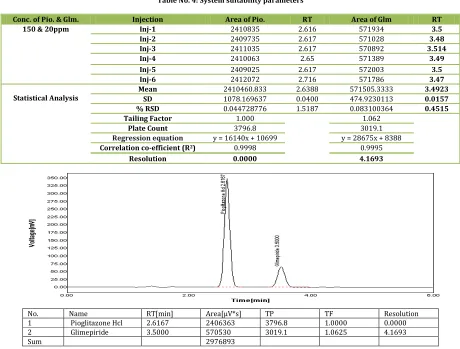
System suitability parameters such as RSD for six replicate injections was found to be less than 2%, theoretical plates - 3796.8 & 3019.1, and tailing factors - 1.00 & 1.06 for Pioglitazone Hcl and Glimepiride respectively. The acceptance criteria of System Suitability is RSD should not more than 2.0% and the method show System Suitability 0.044% and 0.083 for Pioglitazone Hcl and Glimepiride respectively which shows that the method is repeatable. The acceptance criteria of Method Precision and injection Precision %RSD should be not more than 2.0% and the method show Method Precision 0.08% & 0.24 and injection Precision 0.06% which shows that the method is precise.
Table No. 1: Optimized chromatographic conditions
Parameters Method Stationary phase (column) X-Bridge C18 (150 × 4.6 mm,
packed with 5 µm) Mobile Phase 60:40v/v, (0.02M Buffer:
Acetonitrile)
pH 4.3
Flow rate (ml/min) 1.0 Run time (minutes) 6.0 Column temperature (°C) Ambient Volume of injection loop (µµµµl) 20 Detection wavelength (nm) 235 Drugs RT (min) 2.61 & 3.50
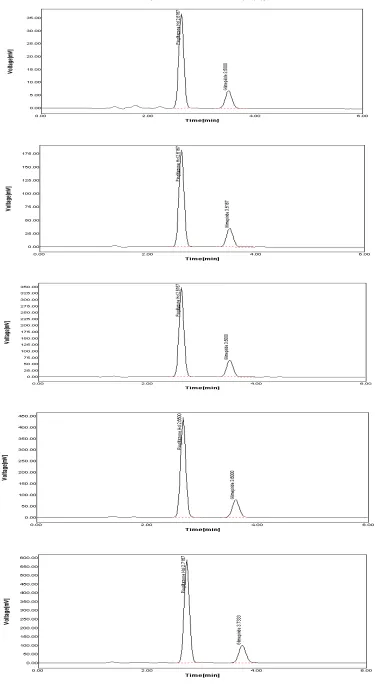
The validation of developed method shows that the drug stability is well within the limits. The linearity of the detector response was found to be linear from 1.5 to 225μg/ml and 0.2 to 30μg/ml of targeted concentrations for Pioglitazone Hcl and Glimepiride standards with a correlation coefficient value is greater than 0.999. The correlation coefficients of Pioglitazone Hcl and Glimepiride (R2) = 0.999 & 0.999 respectively, which shows that the method is capable of producing good response in UV-detector. And the results of Linearity parameters are listed in Table 2 & Fig. 3, 4.
Table No. 2: Summary of results of Linearity parameter for Pioglitazone HCl and Glimepiride
Pioglitazone HCl Conc. (ppm) Average Glimepiride Conc. (ppm) Average
1.5 35765 0.20 23349
15 245855 2.00 58222
75 1230949 10.00 297182
150 2406363 20.00 570530
180 2953893 24.00 697939
Madhukar A. et al., J. Sci. Res. Phar. 2014, 3(1), 58-63
Madhukar A. et al., J. Sci. Res. Phar. 2014, 3(1), 58-63
Fig. 4: Linearity of Pioglitazone Hcl and Glimepiride
Pioglitazone Hcl and Glimepiride Accuracy limit is the % recovery was found in the range of 98.95-101.22% and 98.46-100.98 respectively. The validation of developed method shows that the accuracy is well within the limit, which shows that the method is capable of showing good accuracy. And the results of all Accuracy parameters are listed in Table. 3.
The recovery results indicating that the Pioglitazone Hcl and Glimepiride undergoes Acid, Alkali and Oxidation degradation and drug doesn’t undergoes any significant degradation on Photolysis and Heat condition.
Table No. 3: Summary of results of Accuracy parameter for Pioglitazone HCl and Glimepiride
Pioglitazone HCl
Conc. inj-1 inj-2 inj-3 Mean % Recovery STD % RSD 75pm 50% 1182464 1196743 1192567 1190591 98.95359 7341.655 0.616639 150ppm 100% 2411762 2405783 2410663 2409403 100.1263 3182.521 0.132088 225pm 150% 3654063 3658946 3647835 3653615 101.2209 5569.051 0.152426
Glimepiride
10ppm 50% 280674 281053 280896 280874.3 98.46085 190.4267 0.067798 20ppm 100% 570275 570605 570026 570302 99.96004 290.4428 0.050928 30ppm 150% 864530 863530 864530 864196.7 100.9817 577.3503 0.066808
Table No. 4: System suitability parameters
Conc. of Pio. & Glm. Injection Area of Pio. RT Area of Glm RT
150 & 20ppm Inj-1 2410835 2.616 571934 3.5
Inj-2 2409735 2.617 571028 3.48
Inj-3 2411035 2.617 570892 3.514
Inj-4 2410063 2.65 571389 3.49
Inj-5 2409025 2.617 572003 3.5
Inj-6 2412072 2.716 571786 3.47
Statistical Analysis
Mean 2410460.833 2.6388 571505.3333 3.4923
SD 1078.169637 0.0400 474.9230113 0.0157
% RSD 0.044728776 1.5187 0.083100364 0.4515
Tailing Factor 1.000 1.062
Plate Count 3796.8 3019.1
Regression equation y = 16140x + 10699 y = 28675x + 8388 Correlation co-efficient (R2) 0.9998 0.9995
Resolution 0.0000 4.1693
No. Name RT[min] Area[µV*s] TP TF Resolution
1 Pioglitazone Hcl 2.6167 2406363 3796.8 1.0000 0.0000
2 Glimepiride 3.5000 570530 3019.1 1.0625 4.1693
Sum 2976893
Madhukar A. et al., J. Sci. Res. Phar. 2014, 3(1), 58-63
CONCLUSION
H
PLC is at present one of the most sophisticated tools ofanalysis. The estimation of Pioglitazone Hcl and Glimepiride is done by reverse phase HPLC. The mobile phase consists of buffer (600 volumes buffer, and 400 volumes of Acetonitrile. The ratio pH was found to be 4.3. Then finally filtered using 0.45μ nylon membrane filter and degassed in sonicator for 10minutes). The detection is carried out using UV-Detector set at 235nm. The solutions are chromatographer at the constant flow rate of 0.8ml/min. The Retention time for Pioglitazone Hcl and Glimepiride were around 2.61 & 3.50 minutes, Linearity ranges for Pioglitazone Hcl and Glimepiride is 1.5-225 & 0.20-30μg/ml respectively.
The quantitative estimation was carried out on the tablet by RP-HPLC taking a concentration of 100μg/ml. the quantitative results obtained is subjected to the statistical validation. The values of RSD are less than 2.0% indicating the accuracy and precision of the method. The % recovery 98.95-101.22% and 98.46-100.98 for Pioglitazone Hcl and Glimepiride respectively. The degradation of Pioglitazone Hcl and Glimepiride undergoes Acid, Alkali and Oxidation degradation and there was not any significant degradation observed in Photolysis and Heat condition.
The results obtained on the validation parameter met the requirements. It inferred that the method was found to be Simple, Specific, Precision, and Linearity, Proportional i.e. it follows Lambert-Beer’s law. The method was found to have a suitable application in routine laboratory analysis with a high degree of Accuracy and Precision.
REFERENCE:
1. Scheen, AJ. "Outcomes and lessons from the PROactive
study". Diabetes research and clinical practice,2012; 98(2): 175–86.
2. Ishan I Panchal, B Panigrahi, K M Modh, C N Patel. J. Chem. Pharm. Res., 2010; 2(5): 609-617.
3. Tripathi K.D. Essentials of Medical Pharmacology, 4th
edition, Jaypee Brothers Medical, New Delhi, India, 1999; 276-83.
4. Ravikanth CH, Kumar A.A, Kiran v.U, Prashanth S, madhu b.
and Reddy Y.N.: Sensitive and Rapid Hplc method forthe Determination of Pioglitazone in Rat Serum, International Journal of Pharmaceutical Sciences and Drug Research. 2011, 3(1), 38-41.
5. Srinivasulu D, Sastry b.S. and omprakash G. Development
and validation of New RpHplc method for Determination of Pioglitazone HCl in Pharmaceutical Dosage Forms, Int. J. Chem. Res., 2010: 1(1): 18-20.
6. Lakshmi K.S, Rajesh T. and Sharma S. Determination of
Pioglitazone and Glimepiride in Pharmaceutical
Formulations and Rat Plasma by RP-LC, International Journal of Pharm. Tech. Research, 2009; 1(3): 496-99.
7. Havaldar Fh. and vairal Dl. Simultaneous estimation of
Glimepiride, Rosiglitazone and Pioglitazone Hydrochloride in the Pharmaceutical Dosage Form, E-Journal of Chemistry, 2010; 7(4): 1326-1333.
8. Madhukar A, Naresh K, Kumar CH.N, Sandhya N. and
Prasanna P. Rapid and Sensitive RP-HPLC Analytical method Development and validation of Pioglitazone Hydrochloride, Der. Pharmacia. Lettre, 2011; 3(3): 128-132.
9. Karthik A, Subramanian G, Mallikarjuna Rao C, Bhat K,
Ranjithkumar A, Musmade P, Surulivelrajan m, Karthikeyan K. and Udupa N. Simultaneous Determination of Pioglitazone and Glimepiride In bulk Drug and Pharmaceutical Dosage form by RP-HPLC method, Pak. J. Pharm. Sci., 2008: 21(4); 421-425.
10. M. Aruna Devi, Madhukar. A, Lingeswara Rao. P, CH. Naveen
Kumar, B. Bahugunachary, L. Rajesh Patro. Development and Validation of Simultaneous Chromatographic method for Estimation of Metformin Hcl, Pioglitazone Hcl and Glipizide in a Combined Dosage Form by RP- HPLC, Journal of Pharma Research, 2013; 2(11): 10-14.
11. Khedekar P.b, Dhole S.m. and bhusari K.P. Application of vierodt’s and Absorption Correction Spectrophotometric methods for estimation of Rosiglitazone maleate and Glimepiride in Tablets, Digest Journal of Nanomaterials and Biostructures. 2010, 5(1), 77-84.
12. Samala S, Tatipamula S.R. and veeresham C. Determination
of Glimepiride in Rat Serum by Rp-Hplc method, American Journal of Analytical Chemistry, 2011; 2: 152-157.
13. Khan I.U, Aslam F, Ashfaq M. and Asghar M.N. Determination
of glimepiride in pharmaceutical formulations using HPLC and first-derivative spectrophotometric methods, Journal of Analytical Chemistry, 2009; 64(2): 171-175.
14. Rubina R, bhagya Lakshmi J. and Ravi T.K. Studies on
Formulation and In vitro evaluation of Glimepiride Floating Tablets, C. J. Chem. Pharm. Res., 2011; 3(3): 159-164. 15. Mishra K, Soni H, Nayak G, Patel S.S. and Singhai A.K.
Development and validation of A RP-HPLC method for estimation of Glimepiride in Tablet Dosage Form, IJPI’s Journal of Analytical Chemistry, 2011; 1(3): 1-8.
16. ICH Topic Q 2 (R1) validation of Analytical Procedures: Text
and methodology, note for guidance on validation of
analytical procedures: text and methodology
(CPMP/ICH/381/95), June 1995.
17. International Conference on Harmonization; Draft Guidance
on specifications: Test Procedures and Acceptance Criteria for New Drug Substances and Products: Chemical Substances, Federal Register (Notices). 2000; 65(251): 83041-83063.
18. FDA, Analytical Procedures and methods validation:
Chemistry, manufacturing, and Controls, Federal Register (Notices). 2000; 65(169): 52,776– 52,777.
Conflict of interest: The authors have declared that no conflict of interest exists.
![Fig. 1: Chemical Structure of Pioglitazone derivative. Glimepiride is Chemically it is [[p-[2-(3ethyl-4-methyl-2-oxo - 3 – Pyrroline – 1 - Oxamide) ethyl] phenyl] sulfonyl] 3 -(Trans4-methylcyclohexyl) urea](https://thumb-us.123doks.com/thumbv2/123dok_us/8400333.1686415/1.612.83.290.603.650/chemical-structure-pioglitazone-derivative-glimepiride-chemically-pyrroline-methylcyclohexyl.webp)