Pure Appl. Biol., 7(1): 85-92, March, 2018 http://dx.doi.org/10.19045/bspab.2018.70011
Research Article
Influence of source limitation on
physiological traits of wheat
Shah Khalid
1*, Fazal Munsif
2, Imranuddin
1, Nadia
1, Faisal Nadeem
3,
Shamsher Ali
2, Farman Ghani
2and Muhammad Idrees
21. The University of Agriculture Peshawar-Pakistan
2. The University of Agriculture Peshawar, Amir Muhammad khan campus, Mardan-Pakistan 3. Livestock Research and Development Station, Surezai, Peshawar-Pakistan
*Corresponding author email:[email protected]
Citation
Shah Khalid, Fazal Munsif, Imranuddin, Nadia, Faisal Nadeem, Shamsher Ali, Farman Ghani and Muhammad Idrees. Influence of source limitation on physiological traits of wheat. Pure and Applied Biology. Vol. 7, Issue 1, pp85-92. http://dx.doi.org/10.19045/bspab.2018.70011
Received: 13/09/2017 Revised: 27/12/2017 Accepted: 28/12/2017 Online First: 10/01/2018
Abstract
To investigate the effect of source limitation on physiological traits of wheat crop, a field experiment was conducted in complete randomized block design having three replications, at Amir Muhammad khan campus, Mardan, Khyber Pakhtunkhwa, Pakistan, during winter season, 2015. At anthesis stage eight source reduction treatments (normal plant (N) as control, removal of 2nd + 3rd leaf, removal of 2nd + 3rd + 4th leaf, removal of 2nd+4th+5th leaf, removal of 4th + 5th + 6th leaf, removal of 4th + 5th leaf, removal of flag leaf (FLR), removal of all leaves (ALR) were applied.
The results indicated that all source limitations significantly affected all observed parameters. All the treatments comparison was found significant except ALR vs FLR. ALR vs FLR was found non-significant for all parameters except for awns length. ALR and FLR had significantly decreased productive spikelets spike-1 (5.24, 6.51 %, respectively), florets spikelet-1 (17.0%, 10.4%), grains spike-1, grain/straw ratio (58.8%, 50.0%), while increased non-productive spikelets, respectively (112.9%, 85.1%) and awn length (25.7%, 16.5%) and spike straw weight (10.80%, 15.9%) while in contrast, the removal of 2nd +3rd leaf significantly increased florets spikelet-1 6.38
% and decreased non-productive spikelets spike-1 by 33.3% as compared to normal plants. From the results it is concluded that wheat crop at anthesis stage is source limited.
Keywords: Anthesis; Flag leaf; Source reduction; Wheat crop
Introduction
Wheat (Triticum aestivum L.) is the most important cereal crop throughout the world and is grown on about 200 Million ha worldwide, with production of more than 600 million metric tons/annual [1]. Worldwide wheat production must increase 2 % yearly till 2020 to balance the strain of fast growing population [2]. Worldwide wheat is used is stable food, 35 % of the people used wheat as food, which supplies 29 % of energy needs.
Wheat supplies the largest share to the cereals market [3]. The photosynthate distribution during grain filling considerably affects the grain yield [1]. At anthesis stage, photosynthesis ability of the leaves and storage capacity of the grains is the major reason for reduced yield [4]. Sink-source relationships strongly effect dry matter production in crops [5, 6]. Number of grains spike-1 decreased considerably by removal of
reduction can decrease wheat yield by 30 to 40%,in most conditions grain filling in wheat was more influenced by sink[7, 8].
The carbohydrates that are necessary for grains development are delivered from two sources, leaves and spike [9, 10] and by the remobilization of assimilate to the grains
[11]. The transportation of assimilates from the source to the sink strongly depend upon the production and consumption ability of the source and sink respectively. If they are not in a balance relation the yield will decrease. An appropriate ratio between the source and the sink is a main component to attain promising yields [12]. Effective transport of photosynthate from source (leaves) to growing spikelets (sink) is needed for grain filling and high yield.
Materials and methods
An experiment was conducted on the
influence of source limitation on
physiological traits of wheat, at Amir Muhammad khan Campus, Mardan, Khyber Pakhtunkhwa, Pakistan in 2015. The crop was sown at end of November, 2015. Field was ploughed with a cultivator three times and then with a rotavator to breakdown the clods to prepared a fine seedbed to ensure uniform and good germination. Seeds were sown in lines with a recommended isolation (30 cm row to row). Fertilizers were applied at recommended rate i.e. total phosphorus and half nitrogen was applied at sowing time while remaining half of nitrogen was applied after first irrigation. Weeds were removed manually. Irrigations were applied according to the crop need. The experiment was composed of three replications with RCB design. There were eight subplots per replications. Data were recorded from each
2nd+4th +5th leaf, removal of 4th + 5th + 6th leaf, removal of 4th + 5th leaf, removal of flag leaf (FLR), removal of all leaves (ALR) were applied. Data were recorded on the following parameters, productive spikelet spike-1, non-productive spikelet spike-1, awns length,
florets spikelet-1, spike straw weight and grain to husk ratio.
Data recording and handling Productive spikelets
Productive spikelets spike-1 was recorded by counting productive spikelets spike-1 of ten randomly selected spikes in each treatment, and were then averaged.
Non-productive spikelets spike-1
Data on non-productive spikelets spike-1 was
recorded by counting empty spikelets spike-1 of ten randomly selected spikes in each plot.
Florets spikelet-1
Data were taken by counting florets in each spikelet of ten randomly selected spikes in each plot and the averaged.
Awns length (cm)
Awns length (cm) was calculated by measuring the length of upper, middle and lower awns of ten randomly selected spikes through ruler and then averaged.
Spike straw weight (g)
Straw weight was calculated by the following formula:
Spike straw = spike weight – grain weight
Grain /husk ratio
Grain/ straw ratio was determined by the following formula:
Grain/straw ratio = Grain weight ÷ Spike straw
Statistical Analysis
Pure Appl. Biol., 7(1): 85-92, March, 2018 http://dx.doi.org/10.19045/bspab.2018.70011
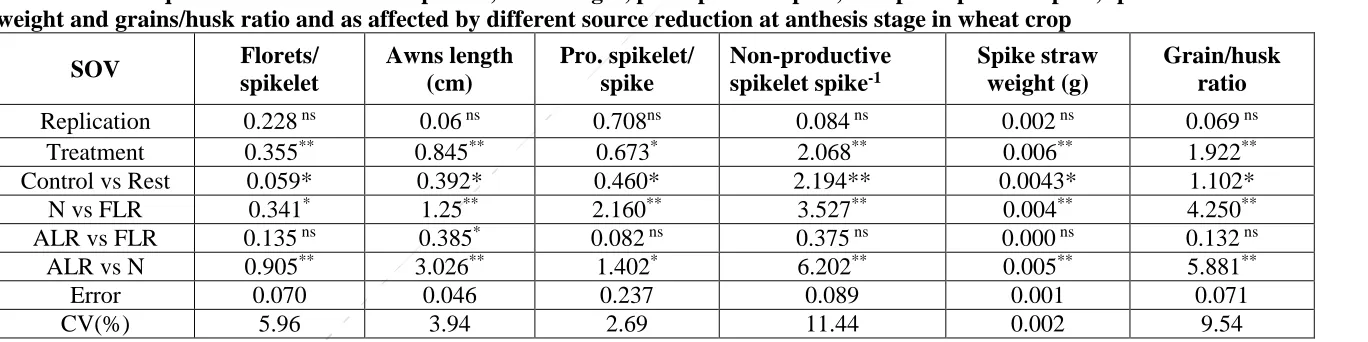
affected florets spikelet-1 (Table 1). Mean square data showed that control vs rest, normal vs flag leaf remove (N vs FLR) and normal vs all leaves remove (N vs ALR) were found significant, while the FLR vs ALR was observed non-significant (Table 2). High number of florets/ spikelet was observed in removal of 2th+3rd leaf, followed by removal of 4th +5th+6th leaf, followed by the all other treatments which was statistically similar except FLR and ALR, in which lower number of florets was observed (Table 1). Percent reduction data (Table 3) showed that most of the treatments considerably reduced florets spikelet-1 especially in case of ALR and FLR, (17.0 and 10.2%) respectively, except removal of 2nd+3rd, 2nd+3rd+4th and 2nd+4th+5th (6.3, 1.9 and 1.6) respectively. The decreased in in the case of ALR and FLR was might be due to the decreased in photosynthetic area, which directly affect
photosynthate production and it
transportation to spikes. In wheat, main photosynthetic organs are leaves; principally the flag leaves. Mostly lower leaves are shaded by the upper ones and maximum solar absorption occurs in flag leaves. Thus, flag leaf and photosynthetic area above flag leaf indicated the importance of these structures to increase grain yields [14]. The flag leaf blade and total photosynthetic area above the flag leaf node have positive correlation with weight of grain plant-1[15]. The increased in
florets spikelets-1, in case of 2th+3rd leaf removal, might be due the decrease of the shaded leaves in lower portion. During anthesis in wheat crop 1st leaves at bottom was almost died due to senescence and have not working anymore only the 2nd and 3rd
leaves are alive which completely shaded by the upper leaves in crop community, so it have no sufficient photosynthate to
compensate respiration, and become
depended upon the upper sunny leaves.
Awns length (cm)
Table 1. Mean data of florets/spikelet, awns length, productive spikelets spike-1, non-pro. spikelets spike-1, spike straw weight
and grains/husk ratio and as affected by different source reduction at anthesis stage in wheat crop
Treatments Description Florets / spikelet Awns
length(cm)
Productive spikelets
Non- productive
spikelets
Spike straw weight (g)
Grains / husk ratio
T1 (control)Normal plant 4.54 ab 5.52 c 18.43 a 1.80 d 0.63 a 3.36 ab
T2 2nd +3th leaf removed 4.83 a 5.52 c 18.60 a 1.20 e 0.63 a 3.33 ab
T3 2nd +3rd +4th leaf removed 4.63 ab 5.63 c 18.26 ab 2.80 c 0.59 b 3.38 a
T4 2nd +4th +5th leaf removed 4.62 ab 5.56 c 18.26 ab 2.60 c 0.63 a 2.91 b
T5 4th +5th +6th leaf removed 4.36 b 5.66 c 18.20 ab 2.36 c 0.58 c 3.24 ab
T6 4th +5th leaf removed 4.46 ab 5.58 c 18.06 ab 2.86 b 0.62 ab 3.07 ab
T7 Flag leaf removed 4.06 c 6.43 b 17.46 b 3.33 ab 0.57 e 1.68 c
T8 All leaves removed 3.76 d 6.94 a 17.23 c 3.83 a 0.57 e 1.38 c
Lsd0.05 0.46 0.37 0.85 0.52 0.05 0.05
Table 2. Mean square data of the florets/spikelet, owns length, pro. Spikelets/spike, non-pro. Spikelets/spike, spike straw weight and grains/husk ratio and as affected by different source reduction at anthesis stage in wheat crop
SOV Florets/
spikelet
Awns length (cm)
Pro. spikelet/ spike
Non-productive spikelet spike-1
Spike straw weight (g)
Grain/husk ratio
Replication 0.228 ns 0.06 ns 0.708ns 0.084 ns 0.002 ns 0.069 ns
Treatment 0.355** 0.845** 0.673* 2.068** 0.006** 1.922**
Control vs Rest 0.059* 0.392* 0.460* 2.194** 0.0043* 1.102*
N vs FLR 0.341* 1.25** 2.160** 3.527** 0.004** 4.250**
ALR vs FLR 0.135 ns 0.385* 0.082 ns 0.375 ns 0.000 ns 0.132 ns
ALR vs N 0.905** 3.026** 1.402* 6.202** 0.005** 5.881**
Pure Appl. Biol., 7(1): 85-92, March, 2018 http://dx.doi.org/10.19045/bspab.2018.70011
Table 3. Percent reduction in florets spikelet-1, awns length, productive and non-productive spikelets spike-1, spike straw
weight (g) and grains/husk ratio and as affected by different source reduction at anthesis stage in wheat crop
Treatments Description Florets
spikelet-1
Awns length(cm)
Productive spikelets
spike-1
Non- productive spikelets spike-1
Spike straw weight (g)
Grains/ husk ratio
T1 (control) Normal plant - - - -
T2 2+3 leaf removed -6.38 -1.92 -0.9 33.33 -1.1 0.99
T3 2+3+4 Leaf removed -1.98 -1.44 0.9 -55.56 10.1 -0.59
T4 2+4+5 leaf removed -1.69 -0.85 1.99 -44.44 -0.5 13.38
T5 4+5+6 leaf removed 3.89 -2.54 1.27 -31.48 18 3.57
T6 4+5 leaf removed 1.69 -1.21 0.9 -59.26 0.5 8.62
T7 Flag leaf removed 10.49 -16.55 6.51 -85.19 8.5 50.05
Productive spikelet spike-1
Statistical analysis of the data showed that source limitation significantly affected productive spikelets spike-1 and significant variation was found in control vs rest, normal vs flag leaf removed (N vs FLR) and normal vs all leaves removed (N vs ALR) respectively, while the contrast between flag leaf removed vs all leaves removed (FLR vs ALR) was observed non-significant (Table 1). Higher number of productive spikelets spike-1 (18.4, 18.6) were observed in case of normal plant and removal of 2nd+3rd leaf,
respectively followed by remaining
treatments, which were statistically similar except FLR and ALR. Percent reduction data (Table 2) revealed that all source reduction treatments ware progressively decreased productive spikelets spike-1, especially in case of ALR and FLR (5.2 and 6.5), respectively except removal of 2nd + 3rd leaf, in which about 1% increase was observed (Table 2). The decrease would be due the deficiency of the photosynthate, on the removal of all leaves or flag leaf, it may cause severe deficiency of assimilate. Similar results were reported by [15] who reported that removal of leaves particularly flag leaf significantly reduced productive spikelets spike-1.
Non-productive spikelets
Statistical analysis revealed that all the
source reductions treatment highly
significantly affected non-productive spikelets spike-1 (Table 1). Highly significant variation ware found in control vs rest, normal vs flag leaf removed (N vs FLR) and all leaves removed vs normal (ALR vs N) while the contrast between flag leaf removed and all leaves removed (FLR vs ALR) was
statistically at par with each other’s except normal plant. Percent reduction showed that most of treatments increased non-spikelets spike-1 as compared to normal, especially by
ALR and FLR (112.9 and 85.2%)
respectively (Table 3) except removal of 2nd+3rd leaf in which 33.3 % reduction was observed. The increased in non- productive spikelet spike-1 might be due to decreased transportation of the photosynthate. These results showed the importance of all leaves particularly flag leaf photosynthesis in grain filling, because flag leaf are the upper most leaf of the wheat crop, which received maximum sunlight and produced higher amount of photosynthate, and also due to nearness to the grains (sink) translocation of the assimilates also quickly occurred. The present results are in line with finding of [15]
who reported that removal of flag leaf significantly increase non-productive spikelets spike-1. Leaves, especially flag leaf as source of photosynthates production and the most powerful factors on the growth and number of the seeds [16].
Grain/ husk ratio
Mean square data revealed that grain/ spike straw ratio highly significantly affected by source reduction, all contrasts i.e., control vs rest, N vs FLR and N vs ALR were found to be highly significant except FLR vs ALR (Table 1). Higher grain/spike straw ratio was observed in case of removal of 2nd+3rd+4th
leaf , followed by normal and 2nd+3rd leaf removal, while the lowest was observed in case of ALR followed by FLA. Percent data revealed that most of the source reduction
treatments were markedly decrease
Pure Appl. Biol., 7(1): 85-92, March, 2018 http://dx.doi.org/10.19045/bspab.2018.70011
accumulation in the sink, due to less photosynthates availability.
Spike straw weight (g)
Statistical analysis of the data showed that source limitation was significant affected spike straw weight, as well as all the contrasts were also found to be highly significant except ALL vs FLR (Table 2). Mean data showed that similar high straw weight was recorded for normal, removal of 2nd +3rd leaf and removal of 2nd+4th+5th leaf (0.6g) while the lowest was observed in case of ALR and FLR, (0.5g) percent reduction revealed that all the treatment decrease straw weight except removal of 2nd +3rd leaf and 2nd+3rd+5th leaf, which showed an increase of
1.1 and 0.5%, respectively. Source limitation increased stem and spike contribution to grains. The decreased in spike straw weight might be due to the decrease in leaf photosynthate, which switch on contribution of the spike photosynthesis to grain during grain filling, reserves contribution to seed filling process. Similar results were reported by [18]whoreported that the demand by the growing kernel is increasing and current assimilation is diminishing due to natural senescence and the effect of various stresses.
Conclusion
This study concludes that wheat yield is more source limited at anthesis stage under irrigated conditions of Pakistan. Substantial reduction occurred with flag leaf removal and leaves near to flag leaf.
Authors’ contributions
Conceived and designed the experiments: F Munsif & S Khalid, Performed the experiments: S Khalid, Analyzed the data: F Munsif & S Khalid, Contributed materials/ analysis/ tools: I Din, Nadia, F Nadeem, S Ali, M Idrees, Wrote the paper: S Khalid.
References
1. Alizadeh O, Hedayati A, Sharafzadeh DH, Abbasi M & Azarpanah A (2013).
Physiological and morphological
responses biodiesel plant (Jatropha
curcas L.) to water stress condition. Inter J Agri and Crop Sci 5(7): 695-703. 2. Singh RP, Huertu-Espino J, Sharma R &
Euphytica (2007). 157:351–363.
3. Food and Agriculture Organization. (2012). Annual Wheat Report. Internet
source: www.fao.org/ world food
situation.
4. Emam Y, Seghatoleslami NJ (2005). Crop Yield. Shiraz University Press. Iran, ISBN: 964-462-362-2 593.
5. Alam MS, Rahman AHMM, Nesa MN,
Khan SK & Siddquie NA (2008). Effect of source and/or sink restriction on the grain yield in wheat. Eur J Applied Sci Res 4: 258-261.
6. Shekoofa A & Emam Y (2008). Effect of nitrogen fertilization and plant growth regulators (PGRs) on yield of wheat (Triticum aestivum L.) CV Shiraz. J Agric Sci Technol 10: 101-108.
7. Singh D & Singh D (2002). Effect of leaf blade and awn on grain yield of rainfed wheat (Triticum estivum L.) at different stages of spike development. Ind J Agric Sci 72: 468-471.
8. Borra L. Slafer GA & Otegui ME (2004). Seed dry weight response to source–sink manipulations in wheat, maize and soybean: a quantitative reappraisal. Field Crops Res 86:131–146.
9. Tambussi EA, Bort J, Guiamet JJ, Nogués S & Araus JL (2007). The photosynthetic role of ears in C3 cereals: metabolism, water use efficiency and contribution to grain yield. Critl Reviews in Plant Sci 26: 1–16.
10. Maydup ML, Antonietta M, Guiamet JJ, Graciano C, Lopez JR & Tambussi EA (2010). The role of spike photosynthesis in grain filling in bread wheat (Triticum aestivum L.). Field Crop Res 119: 48-5. 11. Ehdaie B, Alloush GA & Waines JG
reserves to grain yield in wheat. Field Crop Res 106: 34-43.
12. Falihzade F, Mojadam M & Lack S (2013). The Effect of Source-Sink Restriction and Plant Density Changes
on the Role of Assimilate
Remobilization in Corn Grain Yield. Int J Agri Crp Sci 5(20): 2459-2465.
13. Steel RGD & Torrie JH (1980). Principles and Procedures of Statistics. A biometrical approach. 2nd edition. McGraw-Hill, New York, USA, pp 20-90.
14. Cruz-Aguado JA, Reyes F, Rodes R, Perez I & Dorado M (1999). Effect of source-to-sink ratio on partitioning of dry matter and 14C-photoassimilates in wheat during grain filling. Annuals of Bot 83: 655-665.
15. Abdoli M, Saeidi M, Honarmand SJ, Mansourifar S, Ghobadi ME & Cheghamirza K (2013). Effect of source
and sink limitation on yield and some agronomic characteristics in modern bread wheat cultivars under post anthesis water deficiency. Acta Agriculturae Slovenica 101: 173-182.
16. Birsin (2005). Effects of Removal of Some Photosynthetic Structures on Some Yield Components in Wheat. Arim Bilimleri Dergisi 11(4): 364-367.
17. Feng X, Bin & Gang H (2010). Awn anatomy of common wheat (Triticum aestivum L.) and its relatives. Caryologia 63(4): 391-39.