c
Estimation of Cleaning Efficiency of Clay Removal from Bauxite
Ishaq Ahmad1*, Sajjad Hussain1, Anwar Qadir2, Naseer Muhammad Khan3
1
Department of Mining Engineering, University of Engineering and Technology, Peshawar, Pakistan 2
Department of Geology, University of Haripur, KPK, Pakistan 3
Department of Mining Engineering, BUITEMS, Quetta, Pakistan
*Email: [email protected]
Received: 5 February, 2018 Accepted: 28 June, 2018 Abstract: Bauxite ore is used as the raw material for the production of alumina in the Bayer hydrometallurgical process. Clay agglomerates on the bauxite surface create lot of complications in the Bayer process. Its concentration in the ore is decreased by washing the ore inside trommels or drums followed by classification and screening in which the agglomerates are detached and are removed with the action of water. The aim of bauxite washing is to increase the concentration of alumina i.e. alumina grade and reduce that of silica (clay) grade in the Bayer process plant feed. Therefore, the ratio of alumina grade to that of silica grade (A/S) is one of the deciding parameters for the bauxite ore processing. The cleaning efficiency of the washing process can be characterized by determination of the amount of silica (clay) agglomerates removed from bauxite surfaces. A semi-empirical model has been developed in which the mass and composition of the washed products and tailings streams can be easily estimated. The model developed is a function of material retention (washing) time in the washing trommels or drums and the amount of silica (clay) in the run-of-mine bauxite ore.
Keywords: Bauxite washing, clay, alumina, silica, soil washing, semi-empirical model, correlation.
Introduction
Aluminium is the largest occurring metallic mineral in the earth’s crust and the third most abundant element after oxygen and silicon. Bauxite is the major source of alumina and aluminium metal. Silica is one of the major impurities associated with all sorts of bauxite ores. The presence of silica is in the form of clay (also called reactive silica) causes many problems at the Bayer alumina manufacturing plants. The caustic soda is used as the digestion liquor in Bayer process for the dissolution of alumina. However, the presence of silica minerals e.g. kaolinite also dissolves in caustic, consumes it and therefore irrecoverable losses occurs. Moreover, silica causes scaling on the plant surfaces and contaminates the product as well (Ahmad, 2011). It has been reported (Chatterjee, 2007) that more than one unit of alumina and soda losses occurs in case one unit of silica is present in the ore. Therefore, the concentration of silica is reduced in bauxite by a beneficiation technique before it is sent as a raw material to the Bayer process plant feed.
Beneficiation techniques available for the processing of bauxite are washing, froth flotation, bio processing, magnetic and heavy media separation, which have been reported in literature by many researchers (Mendes et al., 2008; Bhukte, 2007; Rousseaus et al., 2006; Buntenbach, 2007; Richards, 2007; Kahn et al., 2003; Massola et al., 2009; Vector et al., 2003, Gao et al., 2008, Vasan et al., 2001). Ahmad (2011) reviewed the bauxite beneficiation technique and concluded that washing is the most suitable technique for the removal of clay from bauxite surfaces in which gibbsite is the ore mineral and clay is the gangue. The fine clay (silica) agglomerates present on the bauxite surfaces can be easily disintegrated and moved from the solid
phase to liquid phase with the action of water. The bauxite washing is in analogy to soil washing operations. In soil washing the contaminants are removed from soil surfaces with the action of scrubbing/attrition, ultrasonic cleaning and applying water jets (Feng et al., 2001). Özkan (2002) applied ultrasounds for the beneficiation of magnesite slimes. Ahmad et al (2014) washed the bauxite ore for the removal of clay using various techniques and showed that the bauxite washing is the function of material retention time inside the washing drums.
The work on the modeling of mineral processes has been carried out by many researchers (Napier-Munn and Lynch, 1992; Mular, 1989; King, 2001, Austin, 1984). The target of most of the authors was the optimization of comminution circuits in mineral processing. However, no models are available in the literature to represent the washing mechanism of bauxite i.e. the removal of clay from bauxite surfaces. Aim of development of a semi-empirical model for bauxite washing is to estimate the removal of agglomerated fine silica particles, which are in the form of clay from the bauxite surface and hence to estimate the efficiency of bauxite washing process.
Cleaning efficiency approach can be used for determination of the composition of the tailings and product streams of a bauxite washing process. This approach has been applied in soil washing for determination and removal of contaminants from the soil surfaces. The contaminants in soils are metals, organic or inorganic substances and mineral oil contents. The treatment of soil is normally done by various means e.g. with the action of scrubbing and attrition or applying high pressure water jets, which results in the liberation of contaminants from the soil surfaces and
ISSN: 2223-957X
then separation of these contaminants takes place with the help of flotation, gravity separation and/or screening. Bauxite washing with the action of water jets has been carried out by Ahmad et al. (2016). A review of the cleaning of soils regarding physical and chemical separation technologies have been presented (Dermont et al., 2008). The soil washing model presented by Wilichowski and Werther (1995) is available for the disintegration process in soil washing. In the model, a relationship between the mean cleaning efficiency and its parameters was determined. In the current research work, the cleaning efficiency approach was adopted for the estimation of the grade of clay agglomerates detached from the bauxite surfaces.
Materials and Methods
A cleaning efficiency approach can be declared as a semi-empirical process, which works if the mass and the grade of the feed (run-of-mine ore), concentrate (coarse product) and the tailings (fine product) fractions have been determined from laboratory or plant data. The model parameters obtained in this way can be correlated with the process parameters and the cleaning efficiency could be estimated.
Mass Balancing in Bauxite Washing Process
The mechanism of a typical bauxite washing process is
shown in Figure 1.
Fig. 1 Washing mechanism of bauxite for clay removal.
In Figure 1, if the mass (mass flow rate in case of a continuous process) of the feed stream to a washing unit is , concentrate stream is and tailings stream is ; and the grade of the feed, concentrate and tailings streams are , and respectively; then, according to Wills (2006),
Mass balance equation will be:
(1)
and the component (silica or alumina) balance becomes:
(2)
In (2), the terms and represents the mass fraction of any component in the feed, concentrate and
tailings streams, which could be simplified as respectively.
Therefore, the percent recovery (R) of the desired component in the concentrate stream is given in 3.
(3)
Whereas, the percent recovery of that component in the tailings stream is given in 4.
(4)
The component recovery is actually the efficiency of the washing process, which describes the amount of ore (alumina), and gangue (silica) moving towards the concentrate or tailing streams. The aim of bauxite washing is to increase the amount of alumina and reduce that of silica in concentrate stream or in other words to increase the amount of silica and reduce the amount of alumina in the tailing streams of the process. Therefore, the efficiency of the washing process can be characterized as the removal of fine silica agglomerates, which are in the form of fine clay, therefore to recover the entire silica in the tailing streams.
Results and Discussion
Development of Semi-Empirical Models: It was
observed from the ore that the bauxite ore is jacketed in a clayey matrix and the agglomerates attached to the mineral surface need washing so that the clay matrix may be broken and the agglomerates get detached. The mechanism can be interpreted in the Figure 2.
Fig. 2 Agglomerates detachment from bauxite.
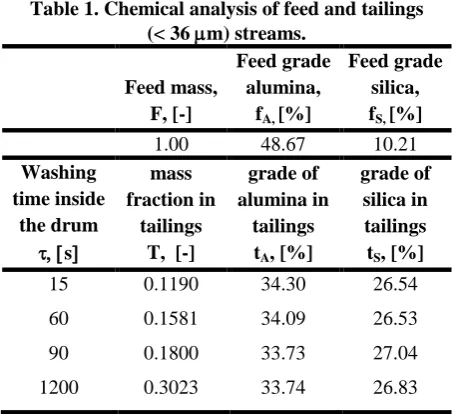
Table 1. Chemical analysis of feed and tailings (< 36 m) streams.
Feed mass, F, [-]
Feed grade alumina,
fA, [%]
Feed grade silica, fS, [%] 1.00 48.67 10.21
Washing time inside
the drum
s
mass fraction in
tailings T, [-]
grade of alumina in
tailings tA, [%]
grade of silica in tailings tS, [%]
15 0.1190 34.30 26.54
60 0.1581 34.09 26.53
90 0.1800 33.73 27.04
1200 0.3023 33.74 26.83
On the analysis of the mass and composition (grade) data given in Table 1 from both the feed and the tailing streams, it has been observed that the cleaning efficiency given in (4) could be correlated with the process parameter i.e. washing time, and material parameter i.e. amount of clay fines attached with the bauxite surfaces, .
Mathematically
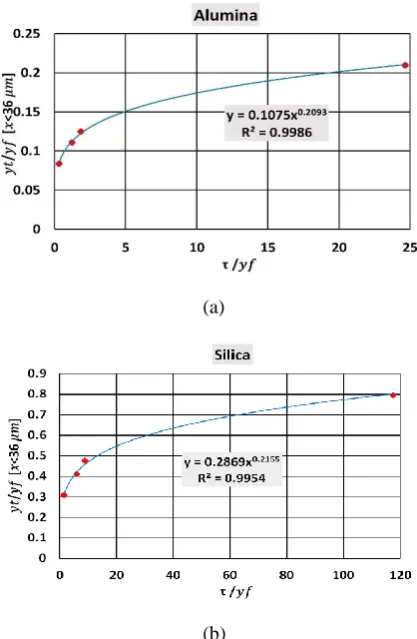
The cleaning efficiency, can be plotted against the
parameters for alumina and silica as shown in
Figure 3a and 3b respectively.
From the Figure 3, the tailings fraction for alumina , and the washed out clay
agglomerates , can be calculated by rearranging the correlations as per (6) and (7) respectively.
(6)
(7)
The generalized form for the determination of mass fraction of alumina or silica (or any other component) in the rejected tailings stream can be obtained by the relation (8).
(8)
In (8), the coefficient and the exponent can be determined from the experimental data, the values of these parameters could be different, as it depends upon the amount of clay agglomerates , attached with the bauxite mineral surface and the washing time inside the trommels or drums.
By knowing the mass of the component from (8), the grade of that fraction can simply be obtained by the relation (9).
(9)
Where is the mass fraction of tailings stream.
(a)
(b)
Fig. 3 Correlation between the cleaning efficiency and the parameters (a) for alumina and (b) for silica.
Conclusion
A technique has been developed to determine the efficiency of the bauxite washing process by estimation of the clay agglomerates detached from the bauxite surfaces. The washing time and the amount of clay agglomerates present are the two required parameters. The correlation coefficients and the power function can be determined for various bauxite ores with variable concentration of clay. The technique developed in the research work could also be used for the estimation of the efficiency of soil washing for the removal of its contaminants. The material retention time inside the washing drum could be related with the energy supplied for the removal of the clay agglomerates from the bauxite surfaces or contaminants from the soil surfaces in case of soil washing
References
Ahmad, I. (2011). Beneficiation of bauxite by washing processes, PhD Thesis, Hamburg University of Technology, Hamburg, Germany.
Ahmad, I., Hartge, E. U., Werther, J., Wischnewski, R. (2014). Bauxite washing for the removal of clay. Int. J. Miner.
Metal and Mater., 21 (11), 1045-1051.
Ahmad, I., Hartge, E.-U., Werther, J., Wischnewski, R., (2016). Ultrasonic processing of bauxite ore to estimate its washing potential. J. Mining Sci., 52 (1), 201-206.
Austin, L. G., Klimpel, R. P., Luckie, P. T. (1984). Process engineering of size reduction: Ball milling. Society of Mining Engineers.
Bhukte, P. G., Puttewar, S. P., Mishra, R. S. (2007). Beneficiation of low grade bauxite/laterite–A comparative study. Mineral processing technology, 176-179.
Buntenbach, S. (2007). Bauxite beneficiation. Aufbereitungs
Technik, 48 (3), 4-17.
Chatterjee, K. (2007). Uses of metals and metallic minerals. New Age International Publishers.
Dermont, G., Bergeron, M., Mercier, G., Richer-Laflèche, M. (2008). Soil washing for metal removal: A review of physical/chemical technologies and field applications. J.
of Hazardous Materials, 152 (1), 1-31.
Feng, D. Lorenze, L. Aldrich C. Mari. P. (2001). Ex-situ diesel contaminated soil washing with mechanical methods. Minerals Engineering, 14 (9) 1093-1100.
Gao, S. I., Li, X. A., Wei, D. Z., Fang, P., Jia, C.Y., Liu, W.G., Han, C. (2008). Beneficiation of low-grade diasporic bauxite with hydrocyclone. Trans. Nonferrous
Met. Soc. China, 18, 444-448.
Kahn, H., Tassinari, M., Ratti, G. (2003). Characterization of bauxite fines aiming to minimize their iron content.
Minerals Engineering, 16, 1313-1315.
King, R. P. (2001). Modeling and simulation of mineral processing systems. Butterworth-Heinemann.
Massola, C., Chaves, A., Lima, J., Andrade, C. (2009). Separation of silica from bauxite via froth flotation.
Minerals Engineering, 22, 315-318.
Mendes, F., Feitosa, D., Sugden, H. Delboni, A. O. da Silva, (2008). Design, simulation and operation of the miltonia beneficiation circuit. Proc. 8th Int. Aluminium Quality Workshop (AQW), 365-370.
Mular, A. L. (1989). Modeling, simulation and optimization of mineral processes circuits. SME, chapter. 19, 323-349.
Napier-Munn, T.J., Lynch, A.J. (1992). The modeling and computer simulation of mineral treatment process - current status and future trends. Minerals Engineering, 5, 143-167.
Özkan Ş.G. (2001). Beneficiation of magnesite slimes with ultrasonic treatment. Minerals Engineering, 15 (1-2) 99-101.
Richards, J. (2007). UMC secures the historic Kalumburu bauxite prospect. ASX Release UMC, United Minerals Corporation NL,
content bauxite from los pijiguaos. In Light Metals, 47-52.
Vasan, S., Modak, J., Natarajan, A. (2001). Some recent advances in the bioprocessing of bauxite. Int. J. Min.
Proc., 62 (1-4) 173-186.
Victor, L., Rayzman, I. Z., Pervzner, V. M., Sizyakov, L. P., Ni, I. K., Filipovich, Aturin, A. V. (2003). Extracting silica and alumina from low-grade bauxite. JOM, 47-50.
Wilichowski, M., Werther, J. (1995). Mathematical modelling of soil washing - a tool for the practical design and evaluation of complex processes for
physical soil treatment. In: Van Den Brink W. J., Bosman R.., Arendt F. (eds.) Contaminated Soil,. Soil &
Environment, 5 Springer, Dordrecht, 775-787