
Diffusion of the ‘Octopus’ Smart Card E-Payment System:
A Business and Technology Alignment Perspective
Louis C.K. Ma
Department of Information Systems City University of Hong Kong, Tat Chee Avenue, Kowloon, Hong Kong
Probir Banerjee*
Department of Information Systems City University of Hong Kong, Tat Chee Avenue, Kowloon, Hong Kong
[email protected] *Corresponding Author
Jean H.Y. Lai
Department of Information Systems City University of Hong Kong, Tat Chee Avenue, Kowloon, Hong Kong
Ronnie H. Shroff
Centre for Learning, Teaching and Technology (LTTC) The Hong Kong Institute of Education
B4-P-04, 10 Lo Ping Road, Tai Po, New Territories, Hong Kong [email protected]
ABSTRACT
The Octopus smart card is the most popular smart card in the Hong Kong Special Administrative Region (HKSAR), China. This case study traces the strategic moves of Octopus Cards Limited (OCL) in building an e-payment system and boosting its growth from limited deployment for transport payment in the initial stages to payments for various alternative forms of business transactions such as parking meters, supermarkets, restaurants, printing services in libraries, etc. The case highlights the importance of business and technology strategies and their alignment in rapid diffusion of the Octopus smart card and its continued dominance of e-payment business in Hong Kong.
1. INTRODUCTION
In 1996, two credit card companies in Hong Kong – MasterCard and VISA International – introduced their Smart cards, Mondex and VISA VisaCash, respectively. But, because these cards were viewed mainly as mechanisms that replaced payment by consumers at retail point-of-sale outlets, they had limited market penetration.
Even as Mondex and VisaCash were struggling to get a foothold in Hong Kong, five major public transportation operators in Hong Kong formed a joint venture company, Creative Star Limited (renamed Octopus Cards Limited (OCL) in January 2002) in order to develop an automated fare collection system based on a rechargeable, contactless smart card. The five operators were the Mass Transit Railway Corporation (MTRC), the Kowloon-Canton Railway Corporation (KCRC) (was merged into the MTRC on 2 December 2007), the Kowloon Motor Bus Company (KMB), Citybus Limited, and the Hong Kong and Yaumatei Ferry (HKF).
Prior to the launch of the Octopus smart card system, the MTRC since its inception in 1979 had its own stored-value magnetic plastic cards for a single journey and stored value tickets for repeated fare payment. In 1984, the KCRC adopted the same system, thereby permitting passengers on both railways to pay for their journeys using the newly re-named Common Stored Value Ticket (CSVT). In 1993, the MTRC decided to revamp their prevalent fare collection system and devised a future development strategy to put them in the lead for the 21st century [5]. The contactless Octopus smart card was deemed a logical replacement for the existing contact-based magnetic card used in the MTRC.
The Octopus system was launched in 1997, and 3 million cards were issued within the first three months. The number increased to 4.6 million by November 1998, to 9 million by January 2002, and to 14 million by March 2007 (compared with 10 million Oyster cards in circulation in London as of March 2007).
By August 2008, about 17 million Octopus cards were in circulation in Hong Kong [3, 16]. With Hong Kong’s population estimated at about 6.5 million, the average was more than two cards per person. As of June 2008, more than 95% of citizens in Hong Kong possessed at least one Octopus card. Revenue of about HK$85 million is collected from daily transactions (Table 1).
Table 1. Octopus Smart Card Operational Statistics (As of August 2008) [3, 16]
Number of Octopus cards in circulation Over 17 million
Number of transactions processed each day Over 10 million
Total value of transactions processed each day Over US$ 10.8 million
Percentage of population aged 16 to 65 who possess an Octopus card
95%
Number of service vendors accepting payment by Octopus card
Over 2,000
Number of Octopus processors in Hong Kong Over 53,511
In this case study, we highlight the importance of alignment of OCL’s business and technology strategies in rapid diffusion of the Octopus smart card and its continued dominance of e-payment business in Hong Kong. The paper is organized as follows. First, in Section 2, we present the case of Octopus in Hong Kong, data for which comes from secondary sources such as the company Web site, Wikipedia, and other related Web sites. In Section 3, we present our analysis of the case in the business and IT alignment perspective, based on the [14]’s Strategic Alignment Model (SAM) model (refer to Figure 3). Finally, we conclude, in Section 4, with some pointers for future research.
2. THE OCTOPUS CARD SYSTEM
In this section, we discuss the Octopus business strategy, its technology strategy, and the clearing and settlement of payments.
2.1. The Business Strategy
payment medium increased substantially, which increased the number of cards in circulation.
The operation of Octopus cards involves pre-payment of funds by the cardholders to the OCL. With the initial purchase of an Octopus Card, HK$50 is included as refundable deposit, and the purchaser has the option of storing up to HK$1,000 at point of time that is debited with the value of the service or goods purchased when the card is used to settle payments [3]. According to the HKMA, approximately HK$416 million (US$53.3 million) remained deposited in the Octopus system at any given time as of 2000. With the present circulation of the card estimated at close to 17 million and the diverse use of the card, the amount available to OCL as value of deposits stored in the card is expected to be several times more than the figure of HK$416 million estimated in 2000.
In a series of strategic moves since its inception, OCL spotted opportunities for diversification of the card’s use to other forms of non-transport payment. The efforts succeeded, and the card is now accepted at more than 16,000 retail stores in the city, most notably 7-Eleven convenience stores and fast food restaurants such as McDonald's and Starbucks coffee shops. A large number of vending machines and self-service kiosks in Hong Kong accept the Octopus card as payment; these range from beverage vending machines to pay phones and photo-booths. The card can even be used to purchase travel insurance (for HK$10 per person, from the Bank of East Asia). Ricoh, Minolta, and Fuji Xerox offer photocopiers that support payment by Octopus. The card is used to collect automobile parking fees. More than 400 car parks in Hong Kong accept Octopus as one payment medium.
Apart from the wide adoption of the Octopus card by private organizations, more than 17,000 on-street parking meters, which are regulated by the HKSAR government, have now been replaced with the Octopus card. MTRC has signed an agreement with the developer of the Shenzhen Metro's automatic fare collection system toward making Octopus cards compatible with the fare collection system in Shenzhen Metro, which would require that the systems automatically convert fares denominated in Renminbi into Hong Kong dollars. Octopus is now accepted at some retail outlets in Shenzhen and Macau. OCL has joined with China UnionPay to introduce the Octopus smart card system in Shenzhen, PRC. The Shenzhen Fairwood fast food restaurants have become the first Octopus-enabled retailer outside of Hong Kong that accepts Octopus.
de Coral, also provide re-charging by cash, as well as some customer service centers at shopping malls and ticketing offices at bus and railway stations.
Cardholders can also sign up for the Octopus Automatic Add-Value Service (AAVS) from 21 financial institutions in Hong Kong [3]. Card readers on buses, and mini-buses or in retail outlets automatically reload the card with the required value. This credit is then reflected on the customer’s next credit card or bank statement issued by his or her financial institution, such as a bank. This form of reloading of the Octopus card is limited to a one-day maximum credit of HK$250 or HK$500 (to be decided by customers upon application).
AAVS users can report the loss of a card to OCL by calling the 24-hour Lost-Card Reporting Hotline. The users are required to bear only the loss arising from unauthorized use of the Octopus for six hours after filing the loss report. This prohibits the loss due to authorized use of the card.
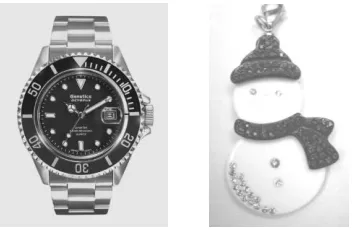
The Octopus card also comes in various formats. To cope with the needs of different users, Octopus collaborates with various business partners to offer a wide variety of products embedded with Octopus transponders [7]. Examples include Octopus watches, Octopus ornaments, and Octopus phone straps, which are all well received in the market (Figure 1).
Figure 1. Examples of Octopus Watches and Octopus Ornaments
2.2. The Technology Strategy
To design, build, operate, and maintain the back-end systems for the card, OCL chose to use the services of AES Prodata (Hong Kong) Limited [2], now known as ERG Transit Systems, a member of the ERG Group based in Perth, Western Australia. The card has a contactless feature, which enables users to swing a purse near the card readers and pay the exact fare. It uses the Sony 13.56 Megahertz (MHz) FeliCa RFID chip. Data is transmitted at 212 kilobits per second (kbps) (the maximum speed for Sony FeliCa chips), much faster than the 9.6 kilobits per second (kbps) data transfer rate for the Mondex and Visa Cash cards that were in use earlier.
standard. The operating range of the reader/writer is between 30mm and 100mm, depending on the type of model being used. It uses encryption for all airborne communication and a two-way authentication based on Public Key Infrastructure (PKI). This means that data is encrypted when transmitting between the reader and the card, and a dedicated processor is responsible for the encryption and decryption processes. Thus, data communication to and from the card is established only when mutually authenticated security handshaking is verified followed by transfer of encrypted data.
2.3. Clearing and Settlement of Payments
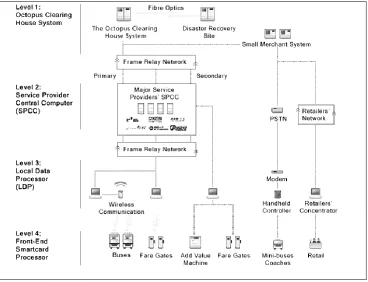
The clearing and settlement of card transactions is based on a store-and- forward basis, without any requirement for card-reader units to have real-time round-trip communications with a central database or computer. The stored transaction data at the card-reader units are either transmitted by network after working hours, or retrieved by a hand-held device such as a Pocket PC. Local Area Networks (LAN) at MTRC stations connect various components of the Octopus card system – turnstiles, add-value machines, customer service terminals, etc.
Transactions from the MTRC stations are relayed to the MTRC's Kowloon Bay headquarters through a frame relay-based wide-area network provided by Pacific Century Cyberworks (PCCW), the main telecommunications service
provider in Hong Kong, and onward to the Central Clearing House System
(CCHS) for clearing. Similar arrangements for clearing and settlement are in place at MTRC stations, at supermarkets, and at convenience chain stores such as Wellcome, Park'N Shop, and 7-Eleven. For mobile units, such as minibuses and regular buses, hand-held devices and wireless systems are used to scan payment data from the offline mobile Octopus card readers used by these modes of transportation.
Figure 2. Octopus Technology Infrastructure and Clearing
OCL planned for a dedicated team of technical personnel who worked on solutions such as device interfaces for capturing stored data and back-end integration with the central server. Thus, when the diversification strategies to other forms of non-transport related payments were formulated, the business executives sat with the technical team to discuss the technical feasibility and the time frames for enacting the business strategies. This information was available from the marketing director of OCL when she was interviewed by the first and second authors of this paper. The business and technology teams at the top levels worked in a form of duopoly, with each trying to appreciate and understand the potential of the other party.
3. CASE ANALYSIS
Figure 3. The Strategic Alignment Model (SAM) [14]
The Strategic Alignment Model (Figure 3) shows the alignment of IT and business in four scenarios. Scenario 1 (Arrow 1) suggests that business strategy drives organizational infrastructure design, as well as the logic of information systems (IS) infrastructure. Top management formulates the business strategy and supports appropriate structuring of the IT infrastructure and business processes for executing the business strategy. IS management supports the business strategy by conceiving and providing the required technical infrastructure and processes with IT resources.
However, in the case of OCL, it was not the business strategy, but the IT vision and IT infrastructure in place that led to formulation of the business strategy (depicted by Arrow 2 of the SAM model). The business strategy was fueled by the growing popularity and acceptance of smart card technology as a fare payment medium worldwide. The business strategy was driven by the formidable consortium of four (formerly five) major public transportation operators in Hong Kong – namely, the Mass Transit Railway Corporation (MTRC), the Kowloon-Canton Railway Corporation (KCRC) (was merged into the MTRC on 2 December 2007), the Kowloon Motor Bus Company (KMB), Citybus Limited, and the Hong Kong and Yaumatei Ferry (HKF) – and the availability of the RFID technology, as well as the excellent clearing and settlement infrastructure
Both scenarios 1 and 2 may be viewed as strategy formulation in the perspective of the resource-based view (RBV) of the firm [1, 15], in that extant resources (the formidable alliance of major transporters and a captive market of smart card users, the payment collection infrastructure at the stations) were the key to formulation of the business strategy of deploying the fast Octopus smart card. The inimitable and non-substitutable assets were used to implement this value-creating strategy, which provided a competitive advantage [1, 10, 9] in the short term.
However, OCL also moved further and enacted strategies for a longer term competitive advantage by being the first movers in using the Octopus-based micro-payment system to other transport domains and other business sectors. Thus, at later stages, the diffusion was a result of business strategy being shaped dynamically with constant scanning of the external environment, the objective being to exploit emerging technology and diversify into other business areas with technology support, which is depicted by Scenario 3 (Arrow 3) in the model. Unlike the alignment scenario depicted by Arrow 2, where the business and technology strategy is viewed to be static, this perspective (Arrow 3) suggests that changes to business strategy may occur from new ways of exploiting technology and changing the scope and definition of business. In contrast to the scenario depicted by Arrow 2, this scenario (Arrow 3) is the strategic view for gaining sustained competitive advantage [6, 8]. The IT management worked as a catalyst, identifying and interpreting trends in the external IT environment, and assisted business managers to understand the potential opportunities and threats from an IT perspective.
Thus, it can be seen that the diffusion trajectory of the Octopus smart card can be viewed as having started with the alignment scenario depicted by Arrow 2, followed by the alignment scenario depicted by Arrow 3, in which the business potential of the Octopus smart card was exploited by enhancing technology- enabled fare payment services in buses and mini-buses, where mobile Octopus card readers could be deployed and hand-held devices such as a Personal Digital Assistant (PDA) could be used to read the data from the card readers on these mobile units. This diversification of use added immense value to the card and propelled its widespread acceptance and diffusion.
scenario 3 of the strategic alignment, which is the realization of competitive potential. This facilitated quick deployment and diffusion through diversification.
Alignment scenario 4 (Arrow 4) of the SAM model suggests that IT strategy could also be the prime mover of business strategy; the role of business strategy being indirect in this scenario. The IT management pro-actively suggests IT strategies, articulates the IT infrastructure, and provides a vision of the required IT-enabled business infrastructure for business strategy execution. The strategies deployed by OCL to provide recharging of the card by partnering with 21 financial institutions and to provide recharging kiosks at MTRC stations and other recharging facilities at several major outlets were aimed at diffusion of the card by using technology to serve the business strategy of fulfilling end-user expectations of easier and more convenient recharging facilities. These strategies may be viewed as conforming to this scenario (Arrow 4). The provision of facilities such as on-loan cards and concession fare deductions on cards for students and elders were further measures toward creating value-added services. These moves contributed to greater acceptance and diffusion of the card.
Scenarios 3 and 4 may thus be analyzed appropriately in the theoretical perspective of the dynamic capabilities of firms, since the ability of RBV to adequately provide competitive advantage in situations of rapid and unpredictable market change in dynamic markets is questionable [11, 12, 17]. In dynamic environments, the mere existence of appropriate bundles of specific resources may not be sufficient to sustain competitive advantage, and firms may have to constantly reconfigure, gain, and dispose of resources to meet the demands of a shifting market [4]. In fast-moving business and technology environments, dynamic capabilities are therefore the organizational and strategic routines by which firms achieve new resource configurations through formation of alliances, strategic decision-making, and knowledge creation as markets emerge, collide, split, evolve, and die. In terms of this view, OCL used the technical resources of the stable POS of supermarkets and the clearing system of the HKBA to configure and deploy its new strategic diversification plans.
4. CONCLUSION
This case is a classic example of technology penetration and diffusion, based on the alignment of business and information technology strategies. A strong interaction of business strategy and IT strategy can be seen as the firm evolved into a formidable player in the micro-payment business scenario (the trajectory of OCL’s strategic moves from one scenario in the SAM to another scenario as it diversified its operations).
dynamic capabilities of the firm (scenarios depicted by arrows 3 and 4 of the alignment model).
The implications of the findings from this research for managers and practitioners are that, in static business and stable technology environments, business strategy may be formulated and achieved with a careful assessment of the business and technology resources available within the firm. In turbulent times, however, when the technology is changing rapidly and there are more players, sustained competitive advantage may be obtained only with constant
re-assessment of the business and technology environments and
reshaping/re-inventing capabilities dynamically to meet the dynamic business and IT environmental challenges.
The seven elements of dynamic capability are:
Vision and strategy
Harnessing the competence base
Organizational intelligence
Creativity and idea management
Organizational structure and systems
Culture and climate
Management of technology
OCL apparently managed these attributes successfully as it moved to alternative forms of payment systems.
An interesting issue for future research is whether further strategic moves in terms of business and technology could lead to further penetration and diffusion of the smart card. Business moves for diversification could also be analyzed in terms of their potential for increased penetration of the card. These business moves might include, for example, enhancing the coverage and penetration of personalized Octopus smart cards for all online purchases, locally as well as in neighboring Shenzhen and Guangzhou provinces of China; extending their use for payment of sundry fees of small amounts charged by universities, schools, kindergartens, etc.; and leveraging the existing successful micro-e-money payment system for other forms of payment, such as employee travel and entertainment cards, and corporate purchase cards for small purchases, which are normally paid through petty cash, etc.
An investigation could also be made of whether the personalized Octopus smart cards may be used to remit small sums of money to destinations with the help of a remittance system such as Western Union, and the impact of regulatory requirements and licensing requirements for such a move.
payment for Wireless Local-Area Network (WLAN) Access through WLAN hotspots around the world.
Another area for future study would be the impact of environmental conditions on diffusion, should OCL wish to penetrate countries such as India, Thailand, Korea, Philippines, and Bangladesh.
In contrast to stable markets where the firm’s resources are adequate to configure stable processes that resemble the traditional concept of routines, in high-velocity markets, fragile processes with unpredictable outcomes may be the trend, where there is little structure or routine for managers to rely on [4] and such processes require constant energy to stay on track because they have little structure [10]. As the rate of change in the market increases, these processes become particularly difficult to sustain; thus, in high-velocity markets, “the threat to competitive advantage comes not only from outside the firm, but insidiously from inside the firm though the collapse of dynamic capabilities” [4]. In this perspective, OCL’s move into alternative mediums of micro-payment, in addition to the Octopus, may need to be sustained with constant vigilance (project management and control) putting a demand on the resources. Thus, OCL may have to carefully consider the dynamism in the IT environment and frame its strategic moves accordingly. This could be an area for future investigation.
Future business strategies at OCL could be entering into alliances with mobile service providers and PDA vendors for developing these mediums as alternative payment systems in addition to the Octopus Smart Card. Such wireless fare payment systems would entail significant capital costs to OCL for wireless receivers, as well as costs to the users for network access and purchase of the telephone or hand-held device. These costs are by no means insignificant and represent a large potential barrier to this form of fare payment, especially in the near future. In terms of technology, too, frame relays used by the Octopus smart card system to forward stored transactions may need to be upgraded. Considering the fact that OCL is a monopoly, whether OCL should continue only with its present mode of operation without any fear of losing its stronghold with the Octopus card or whether it should diversify into other modes of e-payment and gradually enable the transition to wireless e-payment as the next wave of e-payment system is debatable and could be an area for future research.
REFERENCES
[1] Barney, J.B. 1991. Firm resources and sustained competitive advantage, Journal of Management 17(1), 99-120.
[2] Chau, P.K.C., and Poon, S. 2003. Octopus: An e-cash payment system success story, Communications of the ACM 46 (9).
[3] Company website of Octopus:
[4] Eisenhardt, K.M., and Martin, J.A. 2000. Dynamic capabilities: What are they? Strategic Management Journal 21, 1105-1121.
[5] Hong Kong Trade Development Council: http://ict.tdctrade.com/suc-e109.htm
retrieved on 18 August, 2008.
[6] Lawson, B., and Samson, D. 2001. Developing innovation capability in
organisations: a dynamic capabilities approach, International Journal of Innovation Management 5(3), 377-400.
[7] Leong, E. 2000. Octopus extends its reach, FinanceAsia.com, retrieved 18 August 2008.
[8] Porter, M.E. 1979. How competitive forces shape strategy, Harvard Business Review 57(2), 137-145.
[9] Prahalad, C.K., and Hamel, G. 1990. The core competence of the corporation, Harvard Business Review 68(3), 79-91.
[10] Prigogine, I., and Stengers, I. 1984. Order Out of Chaos: Man's New Dialogue with Nature, New York: Bantam Books.
[11] Rindova, V.P., and Kotha, S. 2001. Continuous morphing: Competing through dynamic capabilities, form and function. Academy of Management Journal 44(6), 1263-1280.
[12] Teece, D.J.; Pisano, G.; and Shuen, A. 1997. Dynamic capabilities and strategic management. Strategic Management Journal 18(7), 509-533.
[13] Venkatraman, N. 1994 . IT enabled business transformation: From automation to business scope re-definition, Sloan Management Review 35(2), 73-87.
[14] Venkatraman, N.; Henderson, J.C.; and Oldach, S.H. 1993. Continuous strategic alignment exploiting IT capability for competitive success, European Management Journal 11(2), 139-149
[15] Wernerfelt, B. 1984. A resource based view of the firm, Strategic Management Journal 5(2), 171-180
[16] Wikipedia’s website: http://en.wikipedia.org/wiki/Octopus_card retrieved on 18 August 2008.
[17] Zollo, M., and Winter, S. 1999. From organisational routines to dynamic capabilities, Working Paper WP 99-07, Philadelphia: University of Pennsylvania.
ABOUT THE AUTHORS
Systems, European Journal of Operational Research, Fuzzy Sets and Systems, Information Resource Management Journal, Information Technology and Management, Information Systems Review, and Journal of Global Information Management.
Probir Banerjee has over 20 years of experience in IS development and project management in India, Hong Kong, and Canada in the areas of banking, manufacturing, and retailing systems. He received his Ph.D. in information systems from the City University of Hong Kong in 2004 and his MBA from Fort Hays State University, Kansas, USA. His primary research interests are in IS strategy and IS adoption. He has publications in major information systems journals such as Decision Support Systems, Communications of the Association of Computing Machinery, Journal of Information Technology Management, E-Government and the Journal of Information Technology Cases and Applications Research. His papers have also appeared in several refereed conference proceedings such as the Hawaii International Conference on Systems Sciences (HICSS), Pacific Asia Information Systems Conference (PACIS), America’s Conference on Information Systems (AMCIS), and the International Electronic Commerce Conference.
Jean H.Y. Lai is currently a Ph.D. candidate in the Department of Information Systems at the City University of Hong Kong. She received her master’s degrees in business economics and electronic commerce from the Chinese University of Hong Kong and the Hong Kong Polytechnic University, respectively. Her research interests include decision support systems, e-learning, and information systems strategy.
![Table 1. Octopus Smart Card Operational Statistics (As of August 2008) [3, 16]](https://thumb-us.123doks.com/thumbv2/123dok_us/8391944.1682586/3.504.84.411.108.264/table-octopus-smart-card-operational-statistics-august.webp)
![Figure 3. The Strategic Alignment Model (SAM) [14]](https://thumb-us.123doks.com/thumbv2/123dok_us/8391944.1682586/8.504.73.433.84.251/figure-the-strategic-alignment-model-sam.webp)
