Comparative Study of the Influence Effect of the Zinc Chloride
(ZnCl
2) and the Aluminium Chloride (AlCl
3) on the
1h-azirene Hydrochlorination
Kuevi U.A., Atohoun Y.G. S., Kpotin A.G., Kpota-Houngue A.T., and Mensah J.B.
Laboratoire de Chimie Théorique et de Spectroscopie Moléculaire, Faculté des Sciences et Techniques, Université d’Abomey-Calavi, BENIN
Available online at: www.isca.in
(Received 3rd May 2011, revised 19th May 2011, accepted 9th June 2011)
Abstract
Hydrochlorination of 1H-azirene (C2H3N) is modeled without catalyst and with two catalysts: alumina
chloride (AlCl3) and zinc chloride (ZnCl2) respectively. The product of the reaction performed without
catalyst is 2-chloroethanimine; the same product is obtained when the reaction performed on alumina chloride. With zinc chloride, the product of reaction is 2-chloroaziridine. On the basis of the calculations performed by HF, MP2 and DFT methods in lanl2dz basis set, a mechanism of each reaction has been proposed.
Keywords: hydrochlorination, hydrogen chloride, zinc chloride, alumina chloride, 2-chloroethanimine, 2-chloroaziridine, Hartree-Fock (HF), Möller Plesset of 2nd order (MP2), Density Functional Theory (DFT), lanl2dz basis set.
Introduction
The hydrohalogenation is the addition reaction of hydrogen halide HX on organic unsaturated cyclic or linear molecules. Most of these reactions are carried out in presence of catalysts and give halogenated widely used in organic synthesis to produce pesticides, anesthetics, solvents, refrigerants or dyes1,2.
In the present works, we have carried out a comparative study of 1H-azirene (C2H3N) hydrochlorination without catalyst and in the presence of two catalysts which are zinc chloride (ZnCl2) and aluminum chloride (AlCl3), respectively. It is worth noting that the reaction of the molecule in the presence of aluminum chloride has already been published earlier3.
Material and Methods
Calculation methods and drawings of chemical systemsThe calculations were performed using the program Gaussian-03W, by quantum methods HF,
MP2 and DFT, in the basis Lanl2dz. Data obtained are geometry, multiplicity and charge of studied systems4-9.
The drawings of chemical systems studied were jointly produced with ChemDraw Ultra 6.0, Chem3D Ultra 6.0 and GaussView 3.09; the curves were plotted with Microsoft Office Excel 2003 and 2007.
The work was done in the “Laboratoire de Chimie Théorique et de Spectroscopie Moléculaire (Lacthesmo)” of “Université d’Abomey-Calavi” in Republic of Benin on a HP Pentium 4 microcomputer.
of zinc chloride was modeled in the same way, but in two stages: the 1H-azirène adsorption on the catalyst and the approach of one molecule of hydrogen chloride to the complex (substrate-catalyst) (figure 1b). The reaction parameters are the N1Zn7 distance during the adsorption and C3H10 distance during the hydrochlorination.
Results and discussion
Hydrochlorination in the presence of ZnCl2 From a distance C3H10 of 10 Å, the hydrogen chloride molecule was approached to the complex (substrate-catalyst) obtained by adsorption. The geometrical parameters (interatomic distances and angles), atomic charges and energy of the chemical system varied according to the reaction coordinate C3H10, on the reaction pathway.
The curve of figure 2 shows the variation of the system energy calculated in HF; it shows that the system is more stable at the end of the reaction than at the beginning. By quantum methods HF, MP2 and DFT, the additional reaction enthalpy (∆Hr) and free energy (∆Gr) were calculated (Table 1). The values of reaction enthalpy obtained by the three calculation methods are all negative; this means the reaction is exothermic. Also, negative values of the reaction energy mean that the reaction is thermodynamically favorable (Table1).
Some interatomic distances and bond angles, calculated by HF, at the beginning of the reaction, at the transition state and at the end of reaction, are reported in Table 2. Analysis of these results reveals that:
The bonds N1C3 and N1C4, initially equivalents (1.539 Å), become respectively 1.514 Å and 1.479 Å.
The C3C4distance increases from1.271 Å to 1.473 Å. This shows probably the transformation of C = C double bond between two atoms into a single bond C – C.
The C4Cl11distance changes from 9.050 Å to 1.805 Å, when the H10Cl11distance between atoms of hydrogen chloride molecule increases from 1.289 Å to 2.937 Å. Concurrently, the value of the reaction coordinate C3H10 varied from 10 Å to 1.077 Å. The bond angles N1C3C4 and N1C4C3 almost identical at baseline (65,618° and 65,607 respectively) differ slightly at the end of reaction (59,356° and 61,711° respectively), but the sum of the three angles N1C3C4, N1C4C3 and C3N1C4 remained equal to 180°, which means that the atoms C3, C4 and N1 form a triangular cycle (because N1C3, N1C4 and C3C4 bonds exist) (table 2).
Figure 3 shows drawings of the system at the beginning of reaction, at the transition state and at the reaction end.
From these observations it seems that H10 - Cl11 bond of the molecule of hydrogen chloride was broken during the reaction and atoms H10 and Cl11 have established new chemical bonds with atoms C3 and C4 of the 1H - azirene molecule; then C3 and C4 pass from sp2 hybridization state into sp3 hybridization state after the opening of the π bond existing between them. The reaction product observed is a three-membered nitrogen heterocycle, saturated and chlorinated: this is probably the 2-chloroaziridine. The values of various geometric parameters calculated for this product are close to the standard and experimental values published in the literature10-16.
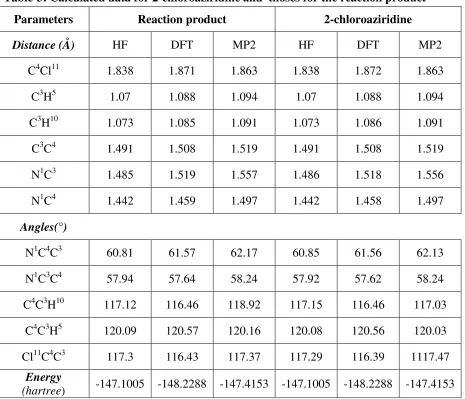
Furthermore, the optimized geometry of a molecule of 2-chloroaziridine has been directly calculated and the parameters were compared with those of the product of the reaction (table 3).
non-isolated molecule contained in a macrosystem. Thus on the basis of these comparisons, the hypothesis of the formation of 2-chloroaziridine at the end of the process, is well confirmed.
In order to determine the mechanism of the reaction that occurred during the addition of hydrogen chloride on the 1H-azirene, we used the population analysis of Mulliken of the system on the reaction pathway (table 4) and the analysis of the vibrational modes in the transition state.
The population analysis of Mulliken of the system reveals that at the transition state, the charges brought by the atoms C3 (-0.260 au), C4 (0.226 au), H10 (0.230 au) and Cl11 (-0.514 au) favor an electrostatic attraction between C3 and H10, on the one hand, between C4 and Cl11, on the other hand. From the initial state to the transition state, the atom C3 was enriched in electronic charge to the detriment of C4 while H10 is impoverished for the benefit of Cl11 (table 4). This means that bonds cleavage between C3 and C4, on the one hand, and between H10 and Cl11, on the other hand, are all heterolytic. Note that the transition state of reaction, determined by the method QST2-QST3 was reached when the value of the reaction coordinate C3H10 is 1.274 Å. The calculation of the IR spectrum of the reaction system in this state has revealed the existence of a single negative vibrational frequency (-1037.9445 cm-1); this is a characteristic of transition state. On the basis of these results, the probable mechanism of the reaction between 1H-azirene and hydrogen chloride in the presence of zinc chloride has been proposed (figure 4).
Comparison of the influence of catalysts ZnCl2 and AlCl3 on the1H-azirene hydrochlorination Hydrochlorination of 1H-azirene in the presence of aluminum chloride (AlCl3), had already been studied in previous works3. In this condition, we observed the opening of the 1H-azirene molecule ring between the nitrogen atom and a carbon atom. The product of
the reaction is the 2-chloroethanimine; the proposed mechanism is shown in figure 5.
In order to have a good basis for comparison, and for a correct appreciation of the influence of the two catalysts on 1H-azirene hydrochlorination, the reaction without catalyst was also modeled. The product obtained in this case is the same as that obtained when operating in the presence of AlCl3 catalyst, it is 2-chloroethanimine. However, it was noticed that the energy barrier reached by the system during the reaction without catalyst is higher and the difference between the two energy barriers is about 37.55 kJ (figure 6): alumina chloride accelerates the 1H-azirene hydrochlorination reaction that provides 2-chloroéthanimine. Indeed, the reaction rate is even larger than its activation energy is lower.
Finally, one notice that the energy of the system obtained at the end of the reaction in the presence of alumina chloride (-147.1443 Hartree) is less than the one obtained in the presence of zinc chloride (-147.1004 Hartree). So alumina chloride leads to the more stable system.
Conclusion
At the end of this study, it appears that the addition reaction of hydrogen chloride on the 1H-azirene leads to the formation of 2-chloroethanimine after opening of the1H-azirene molecule ring. This reaction can be accelerated by alumina chloride acting as a catalyst.
References
1. Potapov V.P., Tataritchik S., Chimie Organique, Edition Mir, Moscou, 34,37,65,66, 74,161, 212 (1988)
2. Freenentle M., Himiya v diéistvié, T. 2, Ed. Mir, Moscou., 440 (1991)
3. Kuevi U.A. , Mensah J.B., N’guessan T.Y., Theoretical study of catalytical hydrohalogenation of 1H-azirene Theoretical Aspect of Catalysis, 45-57 Heron Press Science Series, Sofia, (2009)
4. Chaquin T., Pratique de la chimie Théorique, InterEditions (1995)
5. Melius C.F. and Goddard W.A., Ab initio effective potentials for use in molecular quantum mechanics, Phys. Rev.,A 10, 1528– 1540 (1974)
6. Kahn L.R., Baybutt P. and Truhlar D.G., Ab initio effective core potentials: reduction of all-electron molecular structure calculations to calculations involving only valence electrons, J. Chem. Phys.,65, 3826-3853 (1976)
7. Becke A.D., Density-functional thermochemistry III. The role of exact exchange, J. Chem. Phys., 98(7), 5648–5652 (1993)
8. Lee C.T., Yang W.T., Parr R.G., Development of the Colle-Salvetti correlation-energy formula into a functional of the electron density, Phys. Rev., B 37, 785–789 (1988)
9. Pestman R., Koster R.M., Pieterse J.A.Z. and Ponec V., Reactions of Carboxylic Acids on Oxides 1. Selective Hydrogenation of Acetic Acid to Acetaldehyde, J. Catal., 168, 255 (1997)
10. Mensah J.B., Kuevi U., Atohoun G.Y.S., Etude Hartree-Fock de la denitrogénation catalytique de l’azirène et de l‘aziridine J. Soc., Ouest-Afr.Chim., 024, 35-44 (2007)
11. Bart J.C.J., Ragaini V., Proceedings, Climax third International Conference on the the Chemistry and Uses of Molybdenum ( Barry H.F. and Mithell P.C.H. Eds), Climax Molybdenum Co Ann Arbor, Michigan, 19, (1979)
12. Sieraalta A. and Ruette F., H2 interaction with S atoms of a MoS2 modelled catalytic site : electronic density analysis for S-H formation J. Mol. Catal. A. Chem. 109(3), 227-238 (1996) 13. Bader R.F.W., Atoms in molecules: a Quantum
Theory, Clarendon Press, Oxford (1990)
14. Protos J.; Coutrot P., Egali A., Chloro-2(nitro-3 phényl)-Chloro-2(nitro-3 phényl-1 aziridinecarboxylate-2 de méthyle = Methyl 2-chloro-3(3-nitrophenyl)-1-phenyl-2-azidinecarboxylate Acta Cristallogr., Sect. C, Cryst. Struct. Commun 45(8), 1189-1192 (1989)
(a) (b)
Figure-1: Modeling of the 1H-azirene hydrochlorination (a) without catalyst (b) in the presence of ZnCl2
Initial State Transition State End State
Figure-3: Drawings of the system at the beginning of reaction, at the transition state and at the reaction end.
Zn7 Cl8
Cl9
N1
H2
C4
C3 H6
H5
H10 Cl11
Zn7 Cl8
Cl9
N1
H2
C4
C3 H6
H5
H10 Cl11 (+)
(-)
(-)
(+) +
Zn7 Cl8
Cl9
N1
H2
C4
C3
H6
H5 H10
Cl11
Zn7 Cl8
Cl9
N1
H2
C4
C3
H6
H5 H10
Cl11
2-chloroaziridine
Al7
Cl8
Cl9
Cl10
N1
H2 C3
C4
H5
H6
+H11
-Cl12
Al7
Cl8
Cl9
Cl10
N1
H2 C3
C4
H5
H6
H11
Al7
Cl8
Cl9
Cl10
N1
H2 C3
C4
H6
H11
+
Al7
Cl8
Cl9
Cl10
N1
H2
C3
C4
H5
H6
H11
-Cl12
-Cl12
Cl12
H5
2-Chloroéthanimine
Al7
Cl8
Cl9
Cl10
N1
H2 C3
C4
H5
H6
-Cl12
H11+
Figure-5: Mechanism hydrochloride 1H-azirene in the presence of AlCl3
Table-1: Energy of the1H-azirene hydrochlorination reaction in the presence of ZnCl2
Method Enthalpies
∆HReactants(ua) ∆HProduct(ua) ∆HReaction(ua) ∆HReaction (kJ.mol-1)
HF -240.038 -240.123 -0.085 -222.317
MP2 -240.619 -240.695 -0.076 -198.778
DFT -243.709 -243.793 -0.084 -219.702
Method Gibbs Energies
∆GReactants(ua) ∆GProduct(ua) ∆GReaction(ua) ∆GReaction (kJ.mol-1)
HF -240.103 -240.172 -0.069 -180.469
MP2 -240.684 -240.743 -0.059 -154.314
DFT -243.766 -243.842 -0.076 -198.778
Table-2: Interatomic distances (Å) and bond angles of the system during the hydrochlorination of 1H-azirène in the presence of ZnCl2
Parameters Initial State Transition State End State
Distances (Å)
N1C3 1.539 1.584 1.514
N1C4 1.539 1.415 1.479
C3H10 10 1.274 1.077
C3C4 1.271 1.364 1.473
C4Cl11 9.05 1.805 1.805
H10Cl11 1.289 1.67 2.937
Angles (°)
N1C3C4 65.618 56.785 59.356
N1C4C3 65.607 69.479 61.711
Table-3: Calculated data for 2-chloroaziridine and thoses for the reaction product
Parameters Reaction product 2-chloroaziridine
Distance (Å) HF DFT MP2 HF DFT MP2
C4Cl11 1.838 1.871 1.863 1.838 1.872 1.863
C3H5 1.07 1.088 1.094 1.07 1.088 1.094
C3H10 1.073 1.085 1.091 1.073 1.086 1.091
C3C4 1.491 1.508 1.519 1.491 1.508 1.519
N1C3 1.485 1.519 1.557 1.486 1.518 1.556
N1C4 1.442 1.459 1.497 1.442 1.458 1.497
Angles(°)
N1C4C3 60.81 61.57 62.17 60.85 61.56 62.13
N1C3C4 57.94 57.64 58.24 57.92 57.62 58.24
C4C3H10 117.12 116.46 118.92 117.15 116.46 117.03 C4C3H5 120.09 120.57 120.16 120.08 120.56 120.03 Cl11C4C3 117.3 116.43 117.37 117.29 116.39 1117.47
Energy
(hartree) -147.1005 -148.2288 -147.4153 -147.1005 -148.2288 -147.4153 Table 4: Populations of Mulliken (au) of atoms in the system hydrochloride, 1H-azirène in the presence of ZnCl2
Parameters Initial state Transition state End State
Charges (u.a)
N1 -0.781 -0.751 -0.724
C3 -0.016 -0.26 -0.22
C4 -0.017 0.226 -0.172
H10 0.227 0.23 0.255