(PLATES 13-15)
IN
1969 the Ephorate of the Akropolis began the restoration of the so-called Peripatos, an ancient road or track which in antiquity encircled the foot of the Akropolis and the old sanctuaries that nestled in its folds. In the 4th century B.C. the Athenians inscribed the name of the track and its length on the face of a rock which had become detached and had fallen from the north slope of the Akropolis, coming to rest near the Sanctuary of Eros and Aphrodite.A lack of evidence left much to the imagination in proceeding with the restoration. But as the objective was the reconstitution in the immediate vicinity of the Akropolis of a topo- graphical element of considerable importance it was decided that despite this defect work could and should be undertaken for its restoration, thereby providing a ready approach to this "shadowy", fascinating part of the Akropolis as well as to the numerous old sanctuaries which until then had been hardly accessible.
During the first phase of the work, which lasted until 1972,2 the Ephorate restored the greater part of the northern branch of the Peripatos, starting from the entrance of the fenced archaeological area just west of the Klepsydra and proceeding as far east as the Peripatos inscription. There the work stopped for some years because of the presence, just to the east of the inscription, of a few small houses belonging to the upper part of the district known as Anaphiotika. With respect to the ultimate destiny of this quarter, which in those years was expropriated by the Archaeological Service, the opinion of the Akropolis Ephorate was that the Anaphiotika should be preserved for the sake of its picturesque character, an opinion which was also shared by the central authorities of the Ministry of Culture. It was under- stood, however, that the continuation of the Peripatos necessitated the demolition of just those few small houses which were located east of the Peripatos inscription. But as the expropriation did not proceed without obstacles the renewal of work on that section of the Peripatos wasw not possible until 1980, after the houses had been demolished. In order to save time, work was resumed in the interim beyond the houses, to the east, , at the foot of the northeast corner of the Akropolis and beyond, as far as the large cave which is a prominent feature of the east side of the citadel (PI. 13:a).3
1
J. Travlos, Pictorial Dictionary of Ancient Athens, London 1971, fig. 294.
I wish to express my thanks to K. Pritchett, M. Jameson, and J. Camp for reading the text and correcting my English or calling my attention to some points in it. My gratitude goes in particular to F. Cooper for his willingness to draw up new plans of the area where the stele was found.
In addition to the usual abbreviations, note the following:
Habicht = C. Habicht, Vestigia, 30, Untersuchungen zur politischen Geschichte Athens im 3. Jahrhun- derts v. Chr., Munich 1979
2 G. Dontas, AEAr 25, 1970, B' [1972], pp. 25-26; and idem, AZAr 26, 1971, B' [1974], pp. 27-29.
3 0. Broneer, "The Cave on the East Slope of the Acropolis," Hesperia 5, 1936, pp. 247-272 and I.
T. Hill, The Ancient City of Athens, London 1953, p. 103.
American School of Classical Studies at Athens is collaborating with JSTOR to digitize, preserve, and extend access to
Hesperia
] area
of
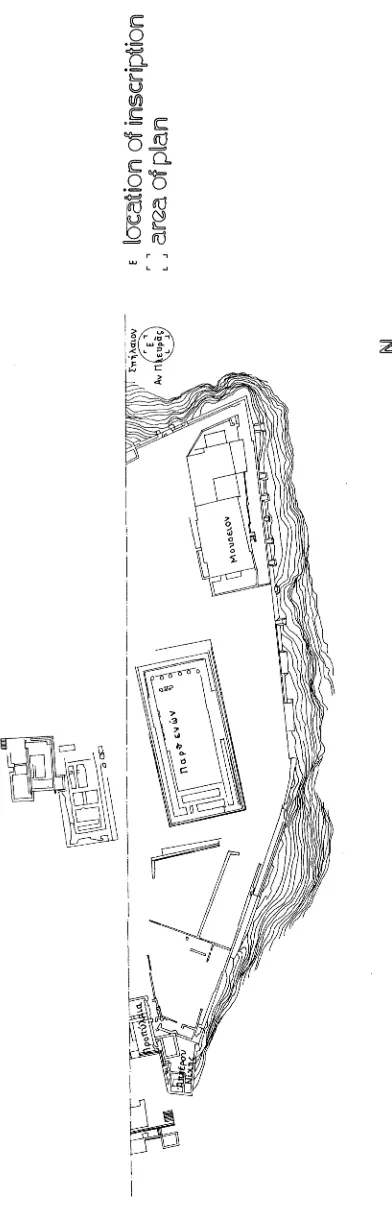
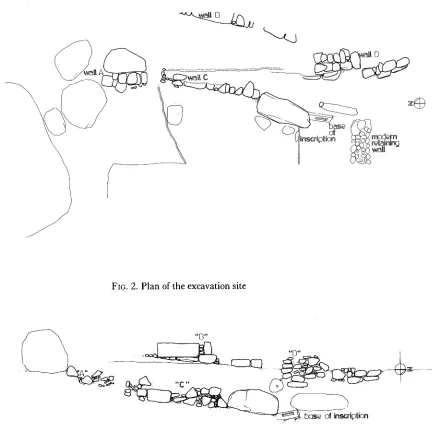
planThe work was carried out in the following way: a retaining wall was first built on the outer side at the desired width, and then earth was poured in between it and the Akropolis rock. For most of the length of the north side this process met with no archaeological ob- stacles since the area had been fully excavated in earlier times; there was no covering over of ancient layers. This was not so, however, with the northeastern and eastern sections. At the former, which until then had been covered by the small houses we demolished, there were layers of various periods extending as late as the 19th century. Further to the east, where previously there had been no houses, not only were there earlier stratified layers but also the dumps of the old excavations of the Akropolis. Normally a systematic excavation would have preceded the restoration of the Peripatos in both these areas. Yet the need to speed up the project and the desire to determine as rapidly as possible the stratigraphy of the layers in these two areas led to a reversal of the normal procedure and the adoption of the same method which had been used along the north, except that now a trench was dug right through the earlier layers in order to allow the construction of the retaining wall. But the digging of this very trench showed that this approach was wrong, and that the only correct procedure, however time-consuming, would be the systematic excavation of the area. The specific reason for this conclusion was that on the 16th of April, 1980 there came to light at the bottom of the newly dug trench under the large cave on the east side of the Akropolis a find so remarkable that we were obliged to review the whole project. The find was an inscribed stele still fastened to its base (Pls. 14, 15:a); the inscription was an unusually informative decree of the Athenian demos, dated in the 3rd century.B.c. The importance of the' information preserved in the decree is greatly enhanced by the fact that the stele and base were found virtually in situ, tilted only slightly out of their original position by a rock which was presumably dislodged in an earth slide. The exact position of the inscription is shown in Figure 2 (represented by the rectangle at E in Figure 1). The base is still at the place where it was found, 3.65 m. below the modern ground level (PI. 13:b). The stele has been moved to the storerooms of the Akropolis Museum, where it has been assigned inven- tory number 13371.
Dimensions of the base: Minimum length 1.21 m. (the base seems to continue under the rock), width 0.25 m., height 0.16 m. The socket for the stele is at a distance of 0.15 m. from the north edge of the base. It still has a lead sheet of 0.01 m. thickness lining all four sides and the bottom surface. The dimensions of the socket without lead sheet are: Length 0.418 m., width 0.096-0.103 m., depth 0.065 m.
It B
D
8 ~od@ern wlning
FIG. 2. Plan of the excavation site
?-culZk.L~Z'
D'XZ
"C ,,~ ,C
. ... ....base of inscription
FIG. 3. Section, excavation site
#OD$'
I n)
0
0,;CP
.41,
Text
247/6 or 246/5 B.C. STOIX. 33
'Em;' I\oAEVKTOV apxovToS!, Erl T7S r EpeXByO Lbos' evrepas 7rpvravrlas nt Xatpcboiv 'A PXeorparov Ke4aXAjOev eypallarever, Me TayEtTLrTylcLo9 VevEKarTE V e'VbeKaret Tr 5 s 7rpvTavELas v
eKKXrOc-La Kvpla Tr& 7rpoaE[p]
WV E7TEn47lC)LeV v KXEi 7/XLo0 DpvIovwvOS (A[v] eVS KaL a0v.Trpdobpol v "Ebooev rTiL povA?.[l] Kal Ti' 87t]pOWL v A7toaro-Tparos 'ApLt'rofa4v[o] v HnaviLevs eL7re YU V avrayyAAepl Yrp TvP 'A 10 ptoL'-rofarv7 o vos rTs LepeLas Tr7j 'AyXavp
ov v7Trp trov lepWv (Ov eOvev TroL EIs TLT7rr)T plols riL 'AyXavpowl Kal r&L "ApEl Kal rTl 'HAl cot Kal raLs "(lpalt Kal r&L 'A,roAAhXoo Kal Tr L? aAAots oE? os OS 7TarpLtov 7v v ayaOeL r
15 vXEL, 8oEoXOat r71l o/30vX rov' TrpoEbpov
9 oiLTL<e>S a eTpOpEv p v l0-V E T/PV 'rv p'T?
% , \' , , Y ,
P EKKAX2oiav XP aT?Larlral Irepl roTrO oP eV ie pols, yvoP/.r/v bE r V.L/3aXAeatOat mjs 3tovirjs ?1s TOP bjp7/cOP JTt ?OK?E T^l T/oV\f/ U TX 20 v ayaOa beXeo6al rTV /3ovXr7v Kal TOv brpLo
v ra yeyovora eV Tois lEpoLS E' VylElal K aL coTrrtlplal TVrs /ovX7js Ka; TOV O?l1OV TOV
'AOrlvalov Kat 7raiobw Kal yvvalcK&v KaL v7 ep TroV taarlAXos 'ATryovov KaL (l\as Trij 25 faaalol'Ofr7s Kat TiWV KyOVWv avTwv v E7T
07 /e ) lepela TrjS 'AyXavpov Ta Tf Eloraywy Eta Ka; Tas OvO-las 'OVO-e 7ra 7Trpoor/KoVora 9, E7TEEIArI/Or b06E Kal T7Sj EvTa$las Trjs ev T7/ L 7ravvvLbXt, EKOOr-71T-cE e Kal T7rV TpaTrECa 30 v, e7ralto-al T7TV lEpEtav Tis 'AyXavpov vv TLMioKpi'rTl IIloXvvPKov 'ALibvalov OvyaT epa Kat a-Trreav(cr-aL avrTlv OaXXov 0rrefda Cot evoeftELas eYt Ka Tr' 7Tpos TOVS OEOVS. a
eKaL 'E' T'O 71O Aa T '
vaypda/at be rb TOr4iLo-r a TOv ypallTarTa TO 35 v KaTa 7rpvravreav ev 0Trr/77X AlOelv Kal
o'T7'iaaL E TO r lepL T7S 'Ayhatpov, S bk rT a7V avaypa(7rlv Trjs 0-7jr/S I/rp ata TOVS ETT l T7jtl OLKfjo'L TO yEvPo/eEvov aavdaXowa.
Translation
In the archonship of Polyeuktos, in the second prytany of Erechtheis, of which Chaire- phon, son of Archestratos of Kephale, was secretary; on Metageitnion 11th, 11th of the prytany; assembly with full power. The chairman of the proedroi, Kleidemos son of Phry- non of Phlya, and his colleagues put the question to a vote. Resolved by the Council and the Demos; Demostratos son of Aristophanes of Paiania made the motion:
Concerning what is reported by Aristophanes the son of the priestess of Aglauros with regard to the sacrifices offered at the eisiteteria to Aglauros and to Ares and to Helios and to the Horai and to Apollo and to the other gods to whom it is a hereditary custom (to offer sacrifice), with good fortune be it resolved by the Council that the proedroi who are chosen by lot to preside in the next assembly deliberate about these matters among other sacred business and submit the resolution of the Council to the Demos that the Council resolves that the Council and the Demos accept the benefits that came to pass in the sacrifices for the health and the security of the Council and the Demos of the Athenians and of their children and wives and of king Antigonos and queen Phila and their descendants. And whereas the priestess of Aglauros has offered the eisagogeia and the befitting sacrifices and has also taken care that there be good order during the pannychis and has prepared the table (of offerings), to praise the priestess of Aglauros, Timokrite daughter of Polynikos of Aphidna, and to crown her with a crown of leaves for the piety she is showing to the gods. The pry- tany-secretary shall inscribe this decree on a marble stele and place it in the sanctuary of Aglauros and the board of administration shall apportion the expenditure incurred for the inscription on the stele.
The Council
The Demos (honor) The Priestess
Timokrite
Commentary
Line 1. Polyeuktos: The archonship of Polyeuktos, whose position in the archon list is cru- cial for both Athenian and Delphic chronology of the 3rd century B.C., has been the subject of long debate. Recent commentators have generally dated Polyeuktos' archonship to 247/6 or 246/5 B.C.4 See, however, below, on line 37.
Lines 2-3. Chairephon the son of Archestratos from the deme of Kephale: Chairephon is known from two other inscriptions: a) the decree IG II2, 680 (SIG3, 408), by which the Athenians accept the invitation of the Aitolians to participate in the Soteria (issued a few months after the decree on our stele) and b) the decree IG II2, 679, in honor of a certain Xenokrates. In the year of Polyeuktos and in that of his successor Hieron the annual
4 Habicht, pp. 133-135, 143 (246/5 B.C.); G. Daux, "Trois remarques de chronologie delphique (IIIe
secretaries of the Boule still served in rotation, following the official order of the tribes;5 the system was suspended two years later, in the archonship of Diomedon.6
Lines 4-5. The eleventh day of Metageitnion = the eleventh day of the (second) prytany: This was the 41st day of the year (the first day of the second prytany was the 31st of the new year). It is obvious from the coincidence of the dates of the religious and civil calen- dars here and in the two previously known decrees of the same year (IG II2, 679 and 680) that the year of Polyeuktos was an ordinary rather than intercalary year. We have in IG II2, 973 (204/3 B.C.) another example of the Demos convening for a regular meeting on this particular day.7
Lines 6-7. Kleidemos the son of Phrynon from the deme of Phlya: An inscribed cippus from the area of the Hephaisteion reads: "Kleidemos (the son) of Phrynion from the deme of Phlya."8
Lines 8-9. A Demostratos son of Aristophanes from the deme of Paiania served as taxiarch of the tribe of Pandionis during the year of Pytharatos (271/0 B.C.), one of the few ar-
chonships of the 3rd century that is securely datreed. In spite of the chronological interval it seems possible that both inscriptions refer to the same individual. A similar case, for instance, is that of the phylarch Agathaios from Prospalta, who had been honored in a decree issued between 286 and 261 B.C. (although probably towards the end of the period)
and who under the archonship of Athenodoros (240/39 B..) helped at the Panathenaia. 10
Lines 10-11. The priestess of Aglauros honored in this decree with praise th iand a crown of (olive) leaves is not mentioned by name until line 31 (even in line 26 she is referred to simply as the priestess of Aglauros); she is Timokrite the daughter of Polynikos from the deme of Aphidna. Neither she nor she nor her father are known from other sources. We know the her name of another priestess of Aglauros from two inscriptions (IG II2, 3458 and 3459): Pheidostrate the daughter of Eteokles from the deme of Aithale, sister of the famous politician Chremonides, who was active in the 3rd century B.C. Pheidostrate presumably
served as priestess only a few years before Timokrite. The priestess of Aglauros, accord- ing to the decree of the Salaminioi of the year 363/2 B.C., served also as priestess of Pan-
drosos and Kourotrophos,11 and according to Bion of Prokonnesos (FGrH IIIb, p. 166),
5 W. S. Ferguson, The Athenian Secretaries, Cornell Studies in Classical Philology, no. 7, New York
1898, pp. 44-63, pp. 44-63, esp. pp. 45, 51.
6 See, e.g., C. Pelekidis, "L'archonte athenien Polyeuktos (247/6)," BCH 85, 1961, pp. 53-68 and
Habicht, pp. 119-121, 143.
7 J. Mikalson, The Sacred and Civil Calendar of the Athenian Year, Princeton 1975, pp. 38, 184, 188. 8 D. Bradeen, The Athenian Agora, XVII, Inscriptions, The Funerary Monuments, Princeton 1974,
no. 345, pl. 29.
9 See the decree from the Agora, W. B. Dinsmoor, "The Archonship of Pytharatos (271/0 B.C.),'
Hesperia 23, 1954, pp. 284-316, esp. p. 289; SEG XIV, 1957, no. 64, lines 42-43. Also J. K. Davies, Athenian Propertied Families, 600-300 B.C., Oxford 1971, p. 105. Two other occurrences of the name Demostratos from Paiania are B. D. Meritt and J. S. Traill, The Athenian Agora, XV, Inscriptions, The Athenian Councillors, Princeton 1974, no. 106, line 8 and no. 47, line 12 with which compare IG II2,
1566, line 27.
10J. Threpsiades and E. Vanderpool, "rIpo TOLt 'EppaLS," AEAr 18, 1963 A' [1964], p. 110, and
Habicht, pp. 139-140.
the cult of Aglauros was practised mainly by women: "AyXavpos, e'7rvv1ov 'A6rlvas Kat
K, , t ,, a , 1 e , I
lA[a Trw KE'KpoTroS OvyarE'pov, v &La rj71s9 eXovo-Lv Kal O1JLVVOVoTlV al yvvalKES' ElS yap Trlv rov Trarpos avr?js KE'KpOTWr T LlVr a7royvLaL rtva yepa rrv eov Tf AyXavpc.
The priestess' son Aristophanes (lines 10-11) is unknown.
Lines 11-12. EllroThrrptla (Lepd) sc. sacrifices; the Attic form of EiOcr-rTpta: The name refers to sacrifices offered at the end of the civil year for the benefit of the new year; they are also sacrifices offered upon the assumption of a new office. The most famous OictT-TI7pLa
were those offered by the archons at the Athenian Agora for Zeus Soter and Athena Soteira in the month Skirophorion (the last of the Athenian year) "for the salvation of the Boule and Demos" during the year that was to start.12 Our inscription proves that similar sacrifices were offered for the same reason in other places and sanctuaries as well.13 Lines 12-14. The gods to whom sacrifices are offered here are first Aglauros, as is natural,
followed by her husband Ares. Next comes Helios who is necessary for the growth of na- ture, as is Apollo who comes fourth after Aglauros. In an inscription from Tenos (IG XIII 5, 893, line 3) Apollo is called "Horomedon", and in the Peloponnesian cults partic- ularly he is closely connected with the Horae, here third after Aglauros. They, as well as the sisters of Aglauros, Herse and Pandrosos, represent the liquid element which is essen- tial for the growth of plants. Thus the gadeities called upon here are basically those promot- ing growth among plants and animals. In the oath taken by the Athenian ephebes in the Aglaurion upon entering their service the "'L-rTOpES OEoi" cover, as is reasonable, a much
wider area.14
Line 16. The stone has OITINI9.
Line 24. The inscription obviously refers to Antigonos Gonatas, king of Macedonia, and his wife Phila, daughter of Seleukos Nikator and Stratonike. Phila was born in 294/3, mar- ried Gonatas in 277/5 B.C., when he was already king of Macedonia, and she was still
alive in 246/5 B.C.15 The dependence of Athens on Gonatas in the years after the Chre- monidean War16 is mirrored in the numerous decrees prescribing sacrifices for him; for the year of Polyeuktos see IG II2, 683, line 16.
Line 25. And their descendants: The only known child of Gonatas and Phila is Demetrios, later king of Macedonia, who at the time of our inscription was 31 years old and who
which, according to T. Hadjisteliou-Price (Kourotrophos, Cults and Representations of the Greek Nursing Deities, Studies of the Dutch Archaeological and Historical Society VII, Leiden 1978, pp. 105, 113) means that the Kourotrophos was also worshipped at the Aglaurion. According to Ferguson (op. cit., p. 21) "the association is natural. The Kourotropheion, Pandroseion, and Aglaurion lay within the area circumscribed by the Peripatos" and "because between Ge (Kourotrophos) and the daughters of Kekrops there was a close natural and mythological relation."
12 See W. K. Pritchett, The Greek State at War, III, Religion, Berkeley 1979, pp. 63-67. 13 C. Pelekidis, Histoire de l'ephebie attique, Paris 1962, pp. 217-219.
14 Demosthenes,
19.303 and Schol. (p. 447 Dindorf). See also Pelekidis, op. cit. (footnote 6 above), pp.
111-113; M. Bock, "Die Schwurgotter der Epheben von Acharnai," WJh 1941, pp. 46-59; G. Daux, "Deux steles d'Acharnes," Xap(rr?pLov G9 'Avao-rca-tov K. 'OpXavbov, A', Athens 1965, pp. 83-84; REG 84, 1971, pp. 370-383; P. Siewert, "The Ephebic Oath in Fifth-century Athens," JHS 97, 1977, pp. 102-111. See also R. Merkelbach, "Aglauros (Die Religion der Epheben)," ZPE 9, 1972, pp. 277-284.
15 W. Hoffman, s.v. Phila, RE XIX, ii, col. 2088. 16
succeeded his father after the death of the latter in 239 B.C.17 The phrase, however, can refer to either more than one child or to descendants beyond the first generation of chil- dren. Demetrios had children from two marriages. From Stratonike (whom he married in 253 B.C.) he had Apama, who married Prusias I of Bithynia; with Phthia he had Philip V, later king of Macedonia,18 and other children of unknown names. Philip was born in 238 B.C., after our decree, so it seems that "descendants" refer here to Demetrios and his small daughter Apama.
Line 26. EcraydiyELa. The word is rare and its meaning conjectural. In an inscription from
Kos (SIG3, 1106, lines 52-56) it has the meaning of "pretium introductionis in cultorum Herculis sodalicium."'19 It also appears with a similar meaning in an Athenian decree of the year 148/7 B.C.: "fees of initiation, which the hierophantes was under obligation to
exact."20 Here, however, it is clear that the word has a different meaning since it is gov- erned by the verb 'var-E, which comes a little further on in the text. It seems as though the
elo-ayoyeta are sacrifices different from those mentioned immediately following, the 7rpooriKovcral which are the usual sacrifices connected with the sacerdotal obligations of a priestess. On the other hand, I do not think that the word eloraycyela is identical with the word e-trItrrripLa, however closely related, since the decree which in this second passage starts with eTrELSr? be now uses a different word. It seems to me that eiTcaycyeta should mean "sacrifices offered by the priestess upon assumption of her duties," like the elTffLI-
ptot Ovortat of Heliodoros (vII.2.299).21
Line 29. This is the first time we learn that a pannychis was part of the festival of Aglauros. It is possible that the festival was the one called "deipnophoros", celebrated in honor of Aglauros and her two sisters Herse and Pandrosos (Bekker, Anecdota graeca 1.239.7): AEL7rvo4topoS' eoprms' 6'vo0ta. Aex7rvo4opia yap co-rrt rTO EpEv bet7rva raLs KEK'poTos
Ovyarpaorlv Epo- a FIavbpo'-c Kat 'AypavXA. 'E 'pero be 7roXvreXLs Kara rTva
.vo'rTLKOV XAoyov. Kat TOVrO E7TOLOVV Ot 7TOXXOL LX0AorTyLas yap EtXETO.22 It is obvious
from this and from the passage which follows that the festival had a mystic character: Kalt 'AypavfXco 'AOr)vaLot Kat reTXEras Ka ,uvo--r1pLa ayoV(LV evovid-OTro-av Kat avbpoTcr at
aoeT,Eelv avoitao'aL T7 V XapvaKa.23
Hesychios' information that Aglauros was honored at the festival of the Plynteria is not generally accepted.24 The Plynteria were held in the latter part of the month Thargelion
17 RE IV, ii, cols. 2792-2793; J. Beloch, Griechische Geschichte IV, ii, Berlin and Leipzig 1925-1927,
p. 136.
18 Assuming that Phthia is to be identified with Chryseis, following H. Bengston, Herrschergestalten
des Hellenismus, Munich 1975, p. 212, against the opinion of Beloch (op. cit., p. 138), who considered them separate persons and Philip the son of Chryseis.
19 M. van Herwerden, Lexicon graecum suppletorium et dialecticum, Lugduni Batavorum, Leiden
1910, p. 443.
20 B. D. Meritt, "Greek Inscriptions," Hesperia 11, 1942, pp. 296-298.
21 Note also the word elo-aywyTi with the meaning of introduction of children into a jbparpLa: LSJ
(1966), p. 493 and the verb Elo-ayw in general, pp. 492-493.
22 See Ferguson, op. cit. (footnote 11 above), p. 21.
23 Athenagoras, Legatio 1.1. H. Kenner, "Die Gottergruppe des Parthenonostfrieses," AnzWien, 1981,
So. 18, p. 295.
24
and the day was considered apophras, while the festival of Aglauros was apparently held in Skirophorion.25 A sacred calendar of the deme of Erchieis lists the sacrifice of a ewe ("o'iv") on the third day of Skirophorion in honor of Aglauros "on the Polis at Erchia."26 According to Parke27 the festival at the deme of Erchieis was certainly modeled on the cult celebrated by the Athenians of the city on the Akropolis. In the month of Skiropho- rion the Athenians observed the Arrhephoria during which the Arrephoroi transferred the "arrheta" through an underground passage that had some connection with the sanc- tuary of Aphrodite "in the Gardens". Jameson and Burkert connect the sacrifices of the deme of Erchieis with the Arrephoria,28 in which they are followed (with some caution) by Mikalson. The identification of the Arrephoria with the closely related Hersephoria in honor of Herse29 has been questioned.
Line 37. The mention of the collective body oi ert rj 8LOLK7TO-EL, which had responsibility for
the finances of the city, is a surprise. Since Beloch in 1927 and Dinsmoor in 1931, and as recently as Habicht in 1979,30 it has been maintained that the institution of ot[ r rTj
tOLtKriorei was used only in periods of free democratic government, whereas the institution
of the single o ErtI r? BLOLK?ojr-E was in force during periods of Macedonian rule. This would mean that the collective body held office between 287 and 262 B.C. (the end of the
Chremonidean War), while individuals were responsible either before 287 B.C. or after
262 B.C., when Athens submitted to Macedonian rule. According to Dinsmoor, a revival
of the democratic, collective body occurred only in 232/1 B.C. in the archonship of Helio-
doros.31 We see now, however, that the collective body was in charge of finances in the archonship of Polyeuktos; there was a single man in charge two years later, in the archon- ship of Diomedon. It thus seems that the formula if not the date of Polyeuktos will re- quire further examination.
The Topographical Significance of the New Text
Since the stele was essentially found in its original position the topographical informa- tion it provides is of immense value. First, it corrects the mistaken view held by most schol- ars that the Aglaurion was situated on the long north side of the Akropolis, at the cave
graeca I, Berlin 1814, p. 276.
25 L. Deubner, Attische Feste, Berlin 1932, p. 21, note 4; Ferguson, op. cit. (footnote 11 above), pp. 20-21; S. Solders, Die ausserstddtischen Kulte und die Einigung Attikas, Lund 1931, p. 10; and M. Ervin,
"The Sanctuary of Aglauros on the South Slope of the Akropolis and Its Destruction in the First Mithra- datic War," 'ApxEov OH6Vlrov 22, 1958, p. 141.
26 F. Sokolowski, Lois sacrees des cites grecques, Paris 1969, pp. 57-59; Mikalson, op. cit.
(footnote 7 above), pp. 166-167. The calendar also calls for sacrifices on the same day of a ram to Zeus, a ram to Poseidon, a ewe to Athena, and a pig to Kourotrophos.
27 H. Parke, Festivals of the Athenians,
Ithaca, N.Y. 1977, p. 179.
28 M. Jameson, "Notes on the Sacrifical Calendar from Erchia," BCH 89, 1965, pp. 156-157; and W.
Burkert, "Kekropidensage und Arrephoria," Hermes 94, 1966, p. 5, note 2.
29 Schol. Aristophanes, Lysistrata, 642; Etymologicum Magnum 149.I4, s.v. Arrephoroi; Hesychios,
s.v. Errhephoroi; Suda, s.v. Arrhephoria; see also Deubner, op. cit. (footnote 25 above), pp. 13-15.
30 Beloch, op. cit. (footnote 17 above), pp. 57-58; W. B. Dinsmoor, The Archons of Athens in the
Hellenistic Age, Cambridge, Mass. 1931, pp. 65ff., III, pp. 203ff.; and Habicht, pp. 70-73.
through which the Arrephoroi descended once a year to perform their mystic rites which consisted in the transfer of their "arrheta" to some underground place in the vicinity. Sec- ondly, the topographical corrections suggested by the new text shed light on all the topogra- phy east of the Akropolis, to which the Aglaurion now firmly belongs.
Because of the need to associate the new inscription with the ancient passages which refer to the Aglaurion and to interpret the information of the ancient authors in the light of the Rew evidence, as well as the need to present the topographical implications of the correct placement of the Aglaurion, I have felt obliged to treat the subject more fully rather than just present the text.
First, concerning the location of the Aglaurion itself, it should be emphasized that no ancient source locates it on the north slope of the Akropolis, to which it is usually assigned. This assignment was a hypothesis of C. Wordsworth in 1837 which has been accepted by almost all scholars who have worked on the topography of ancient Athens.32 Only M. Ervin has placed the Aglaurion in a different location, connecting it with the sanctuary of the Nymphs, brought to light southwest of the Akropolis in the excavations of J. Meliades in 1955-1959.33
But let us examine the sources again. The two main passages referring to the Aglau- rion are contained in the works of Herodotos and Pausanias. Herodotos (VIII.52-53) men- tions it in his description of the occupation of the Akropolis by the Persians in the summer of 480 B.C. The few Athenians who had remained on the Akropolis at first effectively resisted the attacks of the Persians. But the 0Eo7rpO7rLov had said that the whole of Attica should first be subjected to the Persians. There was found {K rSv a7ropv ... . . obo8s roLO'L 3-apf,apoLO-t; the Persians climbed up the Akropolis from a part of the rock that had been left unguarded because no one had ever thought that the ascent was possible from there and that point was Kara ro Lpov r71s KE'KPO7roS Ovyarpos 'AyAavpov. Yet Herodotos does not limit himself to this description; he supplements it twice, once before, once after the passage cited above. Just before, he writes that the ascent was made 8E/17rpo.rE? . . . rpo rijs 'AKpoTroAlos, O'7rTorO 4be rvXwcov. The designations in this phrase at first seem contradictory and have led to confusion. While c/"arpoo-^E . . p. 7rp o ris 'AKpoTrOAlos points naturally to the west end of the Akropolis, where the main entrance was located, the designation 0('rto-OE raov 7rvXEwv should refer to any point on the circumference of the Akropolis with the exception of its western end. Before giving my own interpretation of this difficult passage it might be useful to consider the phrase which follows his account of the Persian exploit. Here, Herodotos states that the place was steep, explaining his earlier statement that no one had thought an
32 C.
Wordsworth, Athens and Attica, London 1837, pp. 86-89; W. Judeich, Topographie von Athen,
pp. 303-304, note 3 on p. 303; J. Frazer, Pausanias's Description of Greece II, London and New York 1898, p. 344; Hill, op. cit. (footnote 3 above), pp. 101 and 103; 0. Broneer, "A Mycenaean Fountain on the Athenian Acropolis," Hesperia 8, 1933, p. 428; Ferguson, op. cit. (footnote 11 above), pp. 20-21; J.
Travlos, 0oAXeobo0,uK2] CeiALfLs i.v 'AOqjvSiv, Athens 1960, pp. 26, 29, 61, and Pictorial Dictionary
(footnote 1 above), pp. 72, 228, 577, fig. 722 (Q).
33 Ervin, op. cit. (footnote 25 above), pp. 129-166. She later retracted this view: review of R. E. Wych- erley, The Stones of Athens, Princeton 1978, AJA 83, 1979, p. 359. I. Meliades, "'AvaorKaaL voriws rTjs9
ascent was possible and hence that part was left unguarded. Furthermore, he writes that "some" (soldiers) ascended at that point; it is obvious that he does not mean by this a detach- ment of regular soldiers but rather those especially trained in mountain warfare. Such was the place where the Aglaurion lay, according to Herodotos. So long as we held the view that he referred to the north slope of the Akropolis, we had to remember that it generally is less steep than elsewhere, except, of course, the west part of the Akropolis. My long experience from service on the Akropolis as well as the fact that two Greek patriots managed in World War II during the foreign occupation to ascend from there to take off the enemy flag have persuaded me that the Akropolis is easily accessible from its northern side. Let me also point out that already by the end of the last century Belger had argued with great perspicacity and elegance of style that the cave known as the "cave of Aglauros" and the steps which cross the Akropolis wall at just this point are incompatible with the location of the Persian ascent in 480 B.C.34 Let us examine the two other sides of the Akropolis. First, the south: here only the
west end gave anyone an opportunity to enter the Akropolis, but as this part is very close to the gates, it would be out of the question. Further east the southern rock is very steep indeed, and, despite changes made in the Classical period ("katatome", Asklepieion, the Theater), the ascent must have been difficult although not impossible.35 Furthermore, this side ought to be excluded because of the presence of other sanctuaries.
The steepest part of the Akropolis is its eastern side, which is distinguished by two upright, titanic, rocky elevations, one to the northeast and one to the southeast, between which there is a slight depression just where the cave is located. It is exactly this extremely difficult part of the circuit, left unguarded because of the steepness of the ground and its position at the farther end of the hill, which the Persians selected, and rightly so, to conquer the Akropolis. They succeeded, as I have said, by using picked mountaineers who most probably climbed up the comparatively lower part, just where the cave is situated above the sanctuary of Aglauros, located now by the findspot of the new inscription, and appeared suddenly on the top of the Akropolis behind its defenders, filling them with terror and spreading death to all.
But one must surely ask what Herodotos meant when he wrote that this place was situated E`Tpoo-e ... rpo Tq? 'AKpoTroA'TXLo. It seems that the most plausible explanation is that the ancients regarded as the official front of the Akropolis not the side where the en- trance was situated but that of the front part of their temples, i.e. their eastern part. The sense of the well-known lines in Aischylos' Agamemnon, 519-520: balov?E . . . avr?rATot eL 7TOV 7raAal, fPatbpoL roLO-L8' o)qa
6
beao-Oe .. ., must not be narrowed so as to be con- sidered as meaning only the orientation of the temples but must keep its general message plainly transmitted to us by the wording of the playwright that the gods themselves are facing east. The image which is thus conveyed of the gods (of the Akropolis) all looking eastward would have been very strong to one of that period like Herodotos and amply justifies the historian's statement that the front part of the Akropolis was its eastern side.
34 C. Belger, "Der Abstiegsweg der Arrephoren, der Aufstieg der Perser," BPW, no. 40, 1897, pp.
1244-1246.
This explanation should perhaps be completed with the information contained in our second precious source regarding the Aglaurion. Pausanias, on his tour of the lower city of Athens, mentions the sanctuary of Theseus (i. 8.2-3), proceeds to describe the sanctuary of the Dioskouri (Anakeion), and then goes on: ' Y7rp 8e T(v ^A lo KovpwOv TO kepO v 'AyXav--
pov T.EIEVOS er(TL .. . Kara TovTo E7ravaf3avTEs M^8ot ... 7Xr'7rLov be IrpvTraveLov "TLV.
Three things are clear from his wording: first, that the sanctuary of Aglauros was situated somewhere high on the slope of the Akropolis; second, that it was situated above the sanc- tuary of the Dioskouroi; third, that the Prytaneion was located somewhere in their vicinity, presumably closer to the sanctuary of Aglauros than to the sanctuary of the Dioskouroi. J. Martha, on the basis of ephebic decrees recording that the ephebes offered El-iL7rt7rpta at the Prytaneion upon entering their service, argued that the Aglaurion, where the ephebes took their oath, "se trouvait enclave dans l'enciente generale du Prytanee."36 The sources are unfortunately insufficient for such a hypothesis. It is, however, probable that the Aglau- rion, the Prytaneion, and the Anakeion were not far from each other, that they even formed a sloping triangle on the ground, at the upper angle of which lay the Aglaurion.
The Prytaneion was considered the center of the Asty, the city, certainly in the aristo- cratic period, after the abolition of the monarchy when the administration had moved off the Akropolis and the city developed at the foot of the citadel, at least until the period in which the Altar of the Twelve Gods in the Agora began to be considered the center of the city.37 During the aristocratic period the eponymos, principal archon of the state, held office in the Prytaneion; here, too, thoughout antiquity burned the eternal flame which symbolized the life of the city, and here was to be found one of the oldest courts of Athens.38 The Prytaneion retained its importance throughout the later centuries: foreign ambassadors and proxenoi were invited for official meals, prominent citizens and sometimes their descendants as well were fed there at public expense for life, and the original laws of Solon, written on wooden "kyrbeis", were kept there from the 5th century on.39 In its immediate vicinity were erected statues of Eirene, Hestia, and Agatha Tyche, as well as Miltiades, Themistokles, Demos- thenes, his nephew Demochares, Autolykos the pankratist, and perhaps others also.40 When Herodotos writes "in front of the Akropolis" he is standing at the Prytaneion, the heart of the
36
J. Martha, Les sacerdotes atheniens, Paris 1882, p. 145.
37 S. Miller has dealt fully with the Athenian Prytaneion in The Prytaneion, Princeton 1978. He locates it (pp. 38ff.), correctly as it now seems, further east than Travlos or Curtius, not far from number 20 Tripodon Street, where IG II2, 2877, which mentions a curator of the Prytaneion, was found. For the Prytaneion see also R. E. Wycherley, The Athenian Agora, III, Literary and Epigraphical Testimonia, Princeton 1957, pp. 166-173; and H. A. Thompson and R. E. Wycherley, The Athenian Agora, XIV, The Agora of Athens, Princeton 1972, p. 46-47.
For the Altar of the Twelve Gods: Pindar, fr. 75.3 (a&oreos 64u)aX?ov Ovodvra); Thompson and Wycherley, op. cit., pp. 129-136, and H. A. Thompson, The Athenian Agora, A Guide to the Excavation and Museum, 3rd ed., Athens 1976, pp. 96-98.
38 Pausanias I.28.1i0-I ; Plutarch, Solon I9.3; Andokides, de Mysteriis 78; Harpokration, s.v. ~4e'raL;
Photios, s.v. 7rpobtKaola; Demosthenes, Against Aristokrates, 645. Cf. Miller, op. cit., pp. 18-19.
39
Plutarch, Solon, 25.1; Pollux, vIII.I28; Pausanias, 1.18.3; Polemon in Harpokration, s.v. a'foves. Cf.
Miller, op. cit., p. 17.
40
Pausanias, I. 8.3; Plutarch, Vit. X. Orat., 847 D and 850 if.; Photios, 495 A5; Aelian, Var. Hist.
city, and looks towards the Akropolis facing its gods (that the Altar of the Twelve Gods had already started to be considered the center of Athens in Herodotos' time does not mean that the Prytaneion had lost its axial importance between one day and the next). I should also emphasize that the juxtaposition of the opposite adjectives "'"7Trporo-e-o'rto-E has beyond any doubt a diametrical meaning, defining in some way an east-west axis.
It must be admitted that a variation of the myth of the daughters of Kekrops preserved in a passage of the Atthidographer Philochoros (3rd century B.C.) seems to contradict the topographical indications of Herodotos, Pausanias, and the new inscription. According to Philochoros (FGrH IIIB, 328 FI 05), Aglauros jumped from the Akropolis voluntarily dur- ing a time of war to save the city in fulfillment of an oracle. After the end of the war the
A , . , e , \ ' e \ ^ ' ,\ o ,to .
Athenians iepov V7rep rovrov eTrotrlcravro avrr 7Trep (or 7rapa) ra 7rpo7rvXaaa tr)s 7rXECS.
It is on the basis of this passage that M. Ervin identified the Aglaurion with the sanctuary of the Nymphs which J. Meliades uncovered southwest of the Akropolis in 1955-1959. Her view, of course, is now proved to be untenable, but some clarification of Philochoros' state- ment should be attempted nonetheless in light of the new find. If, as I believe, the Propylaia of Philochoros are not identical with the well-known Propylaia (or some predecessor of them), then only two choices are possible, in my opinion. One is that the source of Philo- choros, to be sure an early one, refers to one of the gates of the Archaic circuit wall of the city which, being much shorter than the Classical line, must have passed in the vicinity of the Aglaurion, that is, somewhere is the area of Lysikrates' monument. A second possibility, however, is not to be excluded out of hand, namely, that the word "polis" in Philochoros' text retains from his source the original meaning of Akropolis (see Thucydides, 11.15). In this case the Propylaia, not being the Propylaia of the west side, could only be some building located at the so-called Mycenaean entrance, which seems to have been used continuously during the early historical centuries until the Persian invasion.41 It was abandoned only after the Persian Wars, when the Themistoklean north wall of the Akropolis cut off its lower part. This second hypothesis seems to be reinforced by the topographical indications preserved in a passage of Polyainos (Strategicon 1.21.2), in which he describes the stratagem
used by Peisistratos to seize power in Athens in 546 B.C., after the battle of Pallene (see also Aristotle, Ath. Pol., I 5.4). Peisistratos ordered the Athenians to come with their arms to the Anakeion, where he was to address them in a speech. He deliberately spoke to them in a low voice, and since the Athenians could not hear him he was asked by them to proceed (7rpo- ebOy) to the Propylaion, so that everyone could hear him. This was done, but Peisistratos continued to speak in a low voice, and the Athenians, striving to hear him, failed to realize that Peisistratos' men had taken their arms and brought them down (KarTiveyKov) to the
sanctuary of Aglauros. This anecdote suggests several conclusions. First, that the Propylaia mentioned by Polyainos cannot be a building on the west side of the Akropolis, on the spot where the Periclean gateway later stood, but rather some building elsewhere, since the transfer of so large a crowd from the Anakeion on the east or northeast to the west end of the Akropolis is highly improbable. Furthermore the verb -rpoe'pXolat (proceed) has rather the meaning that the crowd moved in a forward direction and not a great distance. In addition,
the verb KarTjveyKOV (brought down) suggests that the Propylaion was not far from the Aglaurion.42
The significance of the new find is not exhausted by definitively locating the Aglaurion and transferring the Prytaneion and Anakeion to its vicinity east and northeast of the Akropolis, nor by assuming that the old entrance northwest of the Erechtheion continued to exist in some monumental form until the Persian Wars. It is clear from Aristotle that some- where around here was located the Boukolion, seat of the king-archon during aristocratic pre-Solonian times, the Epilykeion, seat of the polemarch, and perhaps the Thesmotheteion
as well.43
This chain of associations leads to a far-reaching view of the topography of the ancient city: that it is to the east of the Akropolis, in the heart of the modern Plaka, that the political center of Athens in aristocratic times is to be found. Consequently, here, too, should be sought the "old agora", the location of which has caused so much discussion. The existence of an agora distinct from and earlier than the well-known one of the inner Kerameikos is attested in a passage from the "IlepL OWctv" of Apollodoros, quoted by Harpokration (FGrH IIB, 244 F 113). All scholars dealing with this subject have located the "old agora" west of the Akropolis, but there has been disagreement as to the exact spot. Some locate it just outside the Beule Gate, others locate it to the northwest, while some would seek it southwest of the Akropolis.44
It is true that the location of the "old agora" on the west slopes of the Akropolis has a strong argument in its favor: the area lies just outside the main entrance to the Akropolis, on
42 The account of Polyainos leaves in doubt where the Athenians abandoned their arms, at the Ana-
keion or, later, elsewhere. I would suppose the latter: I cannot believe that the Anakeion would have been
sited so high up on the slope, yet Polyainos uses the word KarTvefyKov to indicate that the arms were
brought down to the Aglaurion. On the other hand, it is improbable that the Athenians were still wearing their arms when they reached the Propylaion; they would not in that case have been so easily stripped of them by Peisistratos' men. It seems obvious to me that they left them en route, the way being difficult in full armor, somewhere higher up than the Aglaurion.
Aristotle gives a different version: the Athenians first mustered in the Theseion, and then moved on to the Propylon of the Akropolis, leaving behind their arms which were taken by Peisistratos' men and were shut up in "the near-by buildings of the Theseion" (Wycherley, op. cit. [footnote 37 above], p. 124), or possibly "the buildings near the Theseion". His version seems to support my opinion that the Propylon of Peisistratos' stratagem is rather to be connected with the old gate at the northeast part of the Akropolis. So, too, the Theseion should now, because of Pausanias' wording and the new inscription, be kept in this neighborhood and not placed further west as is usually done. Wycherley rightly remarks that "the Propy- lon must have been not very far away but also not very close at hand if the ruse was to succeed." Should we keep to a Propylon at the place of the Classical and pre-Classical buildings, the stratagem would lose its meaning completely.
43 Both the Boukolion and Epilykeion lay near the Prytaneion: Aristotle, Ath. Pol., 3.5; Bekker, op. cit.
(footnote 24 above), p. 449, lines 17-21; and Suda, s.v. apxwv; also Wycherley, op. cit. (footnote 37 above), pp. 177-179.
the line of its natural transfer from the Akropolis, where it undoubtedly was located during the monarchic period of the city's history, to the agora of the inner Kerameikos, where it was finally established in the years of Solon.45 This hypothesis has also been based on the passage of Apollodoros mentioned above, according to which the name Pandemos had been given to Aphrodite because her sanctuary was in the vicinity of the "old agora". We know, of course, that the sanctuary of Aphrodite Pandemos was situated at the southwest corner of the Akropolis, just under the Nike Pyrgos,46 yet Thompson and Wycherley (footnote 44 above) were right in assuming that Apollodoros had confused two sanctuaries of Aphrodite. We now see that he confused Aphrodite Pandemos not with Aphrodite "Leader of the De- mos", which lay just outside the northwest corner of the Agora in the inner Kerameikos, but with Aphrodite "in the Gardens", which was situated at the northeast corner of the Akrop- olis, in the immediate vicinity of the sanctuary of Aglauros.
I would not like to deal here with the numerous, extremely important questions which arise from the location of the "old agora" in the area extending east of the Akropolis. It is enough to have shown that the new inscription leads to a reinterpretation of the topography of the whole area. The excavations which must be undertaken here some day will undoubt- edly produce very important results, and the well-known passage of Thucydides (11.15) will come again to the foreground of interest. Here I have limited myself mainly to the sanctuary of Aglauros, which, thanks to the new discovery, is at last anchored with certainty east of the Akropolis; it will serve in the future as a precious starting point for all investigations. As noted in the beginning, the stele and its base were found virtually in situ in an inclined position; they had been shifted by a rock which had been used in antiquity as building material in a north-south wall facing east (see Fig. 2). In antiquity the stele stood close to this wall. It is obvious that it was part of the peribolos of the sanctuary of Aglauros, which must have extended to the east of it, on sloping ground. The extent of the sanctuary cannot have been small, as it could receive the ephebes who gave their oath here upon entering service.47 For the moment we can only conjecture as to the relationship between the sanc- tuary and the cave just above it. That there was some relationship seems to me very proba- ble, and clarification of that point is one of the first aims of the excavation which must be undertaken and which may also reveal remains of the Peripatos.
GEORGE S. DONTAS
THE ACROPOLIS MUSEUM
45
Thompson and Wycherley, op. cit. (footnote 37 above), p. 19 and Martin, op. cit., pp. 256-257. Martin believes that the two agoras co-existed for some time.
46 G. Dontas, "'AvaorKarA Ei ToVS vort'ovs Tppoirobasg Trij
'AKpOT'rdoAEo," IpaKT-LKa, 1960, pp. 4-9; L.
b. Stele base in situ after removal of stele . The Northeast Slope of the Acropolis
a. The Northeast Slope of the Acropolis
GEORGE S. DONTAS: The True Aglaurion
H t-1
I
cC
Inscription stele
seua Su.aej 'soloq.aad jo 11eM qlnos-qlloN 'q
n.zs uz punoj aseq puie alalS *
sI1 ILVid
r ;
::: U ?
CI? ?, ??-:' ';?;;?i -? 3 i
14?
?a ?r,l- ?;?ei"
.
--ii, ?. '-J?ll? ? ? ?., : :iz?-\;--o*h ?i?9
'b+sl "' _.1
:S-P1 r?? 71;_ .tti
L.? -,c:?ii
.CZL.' r:-. 'W?-? ?e =- .\I i `?i?re \;rL 1-?:-.. srt?.
-*
?. ?;-, ? i?$lt
?- t'ri spfi 21: i?ui ,? 4?
'-it,thsi?r i,.
,,-,"-f*ct.: ? f?iiiicw -CiB ?r;t ; ," r, r; -? ?:;.C'