Dr. Muhammad Naeem (Corresponding Author) Department of Surgery Khyber Teaching Hospital Cell: +92-314-9960600
E-mail: [email protected] Date Received: February 4, 2017 Date Revised: May 20, 2017 Date Accepted: June 10, 2017
INTRODUCTION
Wound dehiscence/burst abdomen represents a mechanical failure of wound healing of surgical incision1. Wound complications are important causes of early and late postoperative morbidity following laparotomy. That’s why Wound and their management are fundamental to the practice of surgery. Any surgical intervention will result in a wound. The surgeon’s task is to minimize the adverse effects of the wound, remove or repair damage structure and hasten the process of wound healing to restore function. General surgeon makes various abdominal incisions. Disruption of ab-dominal surgical wound failure. The incidence of wound dehiscence/burst abdomen is 8.13%2.
Abdominal wound dehiscence (burst abdomen, fascial dehiscence) is a severe postoperative compli-cation, with mortality rates reported as high as 45%.3,4
BURST ABDOMEN: A COMMON SURGICAL PROBLEM
Muhammad Naeem1, Imtiaz Ahmad Khattak2, Ambareen Samad3, Rashid Waheed1
1Department of Surgery, Khyber Teaching Hospital, Peshawar - Pakistan 2Department of Surgery, Institute of Medical Sciences Kohat - Pakistan
3Department of Obstetrics & Gynaecology, Gajju Khan Medical College, Swabi - Pakistan
ABSTRACT
Objective: To determine the frequency and common risk factors of wound dehiscence/burst abdomen in patients undergoing laparotomy.
Material and Method: This cross sectional descriptive Study was conducted at Department of Surgery, Gynae & Obs, Khyber Teaching Hospital Peshawar, Pakistan from February 2016 to August 2016 over 180 patients undergoing laparotomy. Permission from the hospital ethical committee and informed written consent were obtained from the all patient before including in study.
Results: A total of 180 patients undergoing laparotomy were included in the study. Male to female ratio was 1.53:1. Av-erage age of the patients was 47.50years+13.34SD with range 19-73 years. Wound dehiscence was found in 17(9.60%) patients and wound infection was the leading risk factor for it.
Conclusion: The safety and antiseptic measure can reduce the wound infection. Ultimately the wound dehiscence can be avoided.
Key Words: Wound dehiscence, abdomen, laparotomy, frequency, Wound Infection, Diabetes Mellitus
This article may be cited as: Naeem M, Khattak IA, Samad A, Waheed R. Burst abdomen: A common surgical problem. J Med Sci 2017; 25: (2) 213-217.
The incidence, as described in the literature, ranges from 0.4% to 3.5%.5,6 Abdominal wound dehiscence can result in evisceration, requiring immediate treatment.
It has significant effect on health care cost both
for patient and hospital7. Surgical incisions stimulate the healing process which in reality is a complex and con-tinuous process with four different stages. Hemostasis,
inflammation, proliferation and maturation phase8. The proliferation phase which is the pahse of granulation tissue formation in the wound space begins on third post operative day and lasts for several weeks. The
most important factor in this phase are fibroblasts which
move to the wound and are responsible for the collagen synthesis9.
Conditions associated with increased risk of wound dehiscence/ burst abdomen are anemia, hy-poalbuminemia, malnutrition, diabetes, malignancy, jaundice, obesity, post operative cough, male gender,
elderly patients and specific surgical procedures as
Anemia is a risk factor that is related to increase peri operative stress, blood transfusion and decreased tissue oxygenation all of which can affect the immune system on the wound healing process15. Continued
presence of bacteria causes influx and activation of
neutrophils and increase in level of degradative matrix
metalloproteinase (MMPs). In the absence of sufficient
tissue inhibitors matrix metalloproteinasess MMPs, wound degradation will occur.16
The release of endotoxins by bacteria leads to production of collagenases which degrades collagen
fibers8. Infection thereby causes a prolongation of the
inflammatory phase and negatively affects deposition of collagen and fibroblast activity.16,17 The rationale of this study is to determine the current mode of frequency and common risk factors of burst abdomen/wound dehis-cence. The results of this study will give us current data on the common risk factors involved in patients who suffer from wound dehiscence and will help us in making guidelines for control of such risk factors preoperatively. Additionally if the frequency of wound dehiscence in this
study found to be alarmingly significant then it will allow
us to think about change in expertise at our level which can be leading to wound dehiscence. Such study has never been conducted out in our population in near or far past and exact frequency of wound dehiscence with risk factors in not fully known.
MATERIAL AND METHODS
The study was conducted in the Department of Surgery, Gynae & Obs of Khyber Teaching Hospital, Peshawar, Pakistan form February 2016 to August 2016. Approval was taken from Hospital ethical committee. All patients meeting the inclusion criteria (all those pa-tients who will be undergoing elective laparotomy for diagnostic or therapeutic purpose) were enrolled in the study and were admitted through OPD and Emergency.
The purpose and benefits of the study were explained
to the patient and patient were assured that his/her
confidentiality were maintained and a written informed
consent was obtained.
Demographic characteristics like name, age, sex, address, and phone number of all patients were record-ed. Complete history was taken and complete general physical and systemic examinations were done. All patients were pre operatively prepared by doing routine investigations FBC, serum urea, serum creatinine, x ray chest, ECG RBS and viral status. After overnight nilbe month, they were put on next available list for elective procedure.
All laparotomies were performed by the same experienced surgeon. Post operatively the patients were followed daily till 10th day for wound dehiscence.
If wound dehiscence/burst abdomen occurs common risk factors were scrutinized. Patient hospital record were thoroughly checked for anemia and dia-betes, wound were for carefully examined for wound infection and in case of any discharge were sent to laboratory for culture and history of post-operative cough was taken from the patient. Patients who have burst at presentation, Severely malnourished patients with body mass index less than 15 and more than 30 were excluded as it make our results biased if in. Strictly exclusion criteria were followed to control confounders and bias in the study results.
RESULTS
A total of 180 patients undergoing laparotomy were included in the study. There were 108 (60%) were males and 72(40%) were females. Male to fe-male ratio was 1.53:1. Average age of the patients was 47.32years+13.33SD with range 19-73 years. Patient’s age was divided in four categories, out of which most common age group for inguinal hernia repair was 46-60 years in our study. There were 29(16.7%) patients were of the age less than or equal to 30 years. Thirty four (18.9%) patients were in the age range of 31-45 years, 88 (48.9%) were of age range 46-60 years and 28(15.6%) presented at age more than 60 years of age.
Frequency wound dehiscence/burst abdomen in patients undergoing laparotomy was found in 17(9.44%) patients while the rest of patients were free of wound dehiscence. The common factors leading to wound dehiscence in patients undergoing laparotomy was observed. In which 1(5.59%) were Diabetes, 13(76.47%) were anemia, 15(88.24%) have wound infection and 6(35.29%) were post-operative cough. Age wise distri-bution of wound dehiscence and its common factors shows that in old age were found high as that of younger age. The patients having age less than or equal to 30 years of age have Wound Dehiscence 10% while wound infection was found in majority of cases having wound dehiscence. It was noted that wound dehiscence and
its common risk factors showed insignificance over age
as shown in Table 1.
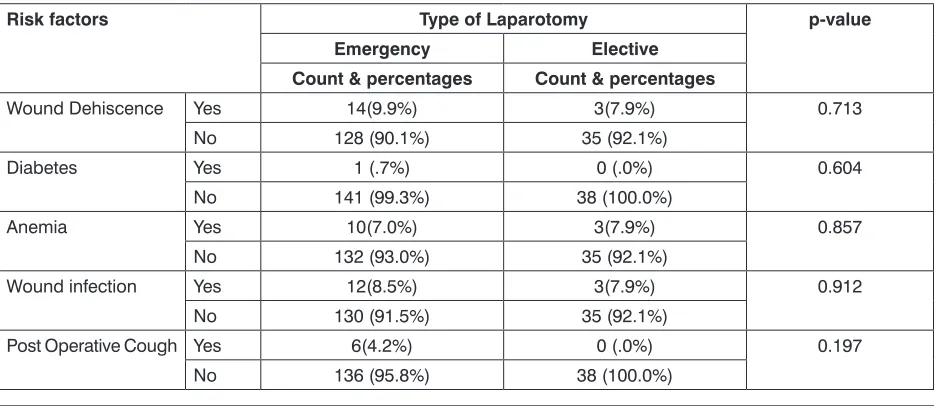
Gender wise wound dehiscence and its common risk factors shows that gender have also no role over common risk factors for wound dehiscence. There is 11.1% wound dehiscence in male while in female
pa-tients it was 6.9%. All the factors are insignificant over
gender as shown in Table 2. Stratification of wound
dehiscence and its common risk factor also shows
insignificance as shown in Table 3.
DISCUSSION
Table 1: Age Wise Distribution of Wound Dehiscence and its Common Risk Factors
Risk factors age (in years) p-value
<= 30 31 - 45 46 - 60 61 +
Wound
Dehis-cence YesNo 27 90.0%3 10.0% 33 97.1%1 2.9% 80 90.9%8 9.1% 23 82.1%5 17.9% 0.259
Diabetes Yes 0 .0% 0 .0% 1 1.1% 0 .0% 0.789
No 30 100.0% 34 100.0% 87 98.9% 28 100.0%
Anemia Yes 2 6.7% 1 2.9% 5 5.7% 5 17.9% 0.113
No 28 93.3% 33 97.1% 83 94.3% 23 82.1%
Wound
infec-tion YesNo 27 90.0%3 10.0% 33 97.1%1 2.9% 81 92.0%7 8.0% 24 85.7%4 14.3% 0.437 Post Operative
Cough YesNo 30 100.0%0 .0% 34 100.0%0 .0% 83 94.3%5 5.7% 27 96.4%1 3.6% 0.294
Table 2: Gender Wise Distribution of wound dehiscence and its Common Risk Factors
Risk factors Gender p-value
Male Female
Count & percentages Count & percentages
Wound Dehiscence Yes 12 (11.1%) 5(6.9%) 0.349
No 96 (88.9%) 67 (93.1%)
Diabetes Yes 1 (.9%) 0 (.0%) 0.413
No 107 (99.1%) 72 (100.0%)
Anemia Yes 9(8.3%) 4(5.6%) 0.481
No 99 (91.7%) 68 (94.4%)
Wound infection Yes 11 (10.2%) 4(5.6%) 0.271
No 97 (89.8%) 68 (94.4%)
Post Operative Cough Yes 5(4.6%) 1(1.4%) 0.235
No 103 (95.4%) 71 (98.6%)
Table 3: Type of Laparotomy Wise Distribution of Wound Dehiscence and its Common Risk Factors
Risk factors Type of Laparotomy p-value
Emergency Elective
Count & percentages Count & percentages
Wound Dehiscence Yes 14(9.9%) 3(7.9%) 0.713
No 128 (90.1%) 35 (92.1%)
Diabetes Yes 1 (.7%) 0 (.0%) 0.604
No 141 (99.3%) 38 (100.0%)
Anemia Yes 10(7.0%) 3(7.9%) 0.857
No 132 (93.0%) 35 (92.1%)
Wound infection Yes 12(8.5%) 3(7.9%) 0.912
No 130 (91.5%) 35 (92.1%)
Post Operative Cough Yes 6(4.2%) 0 (.0%) 0.197
wound disruption and evisceration. It is a very serious complication of abdominal surgery, with very high mortality rate and no single cause being responsible: rather it is a multi-factorial problem18.
The higher frequency of burst abdomen is, in contrast with many Western studies which showed an incidence of 0.4 to 3.5% but is in accordance with the study done by Amini AQ et al which showed that the problem of wound dehiscence is much more prevalent in South East Asia than the Western world.19 This may be attributable to poor nutritional state of the patients, delayed presentation to the tertiary care hospitals, poor quality of suture material, disease like tuberculosis of the abdomen which is endemic in the countries of South East Asia and higher load of emergency surgeries.
In our study also males were 107 in number and predominated the females who were 70 in number with the ratio of 1.53:1. This male predominance probably due to the higher incidence of peptic ulcer perforation, intestinal obstruction and malignancies in male sex. The mean age of presentation was 47.50years+13.34SD as incidence of perforation and intestinal obstruction was common in this age group. Which is similar to the study condeucted by Sivender et al.20
The frequency of wound dehiscence /burst abdo-men varies from centre to centre worldwide. Frequency of wound dehiscence or burst abdomen was 14.7% in this study. It proves high when compared to western studies where its frequency ranges from 1-3%21,22 while it seems comparable to results of some centers in In-dia with frequency of 10-30%23,24 and even some local studies with frequency of 5.9%.25
Many risk factors are incriminated in development of burst abdomen. Some of the major independent risk
factors that have been identified are age, gender, as -cites prolonged post-operative abdominal distension or cough, anemia, peritonitis jaundice, emergency surgery and wound infection.Factors related to surgeon/expe-rience are type of incision, suture material, drain, and ostomy.26,27 Abdominal distension, vomiting, and nausea are risk factors caused by increasing intra-abdominal pressure.28
In this study, the most common age group affect-ed was 31-50 years (14 cases). Old age has been found to be another independent risk factor for abdominal wound dehiscence. Waqar S et al found 57% of their patients with wound dehiscence above the age of 5025. Hanif N et al also showed advanced age in 50 % of cas-es.28 Th e explanation for this might lie in deterioration of the tissue repair mechanism in the elderly especially
during the first few days of the wound healing process,
the immune system plays a key role.
There are major risk factors for burst abdomen as 1(5.88%) were Diabetes, 13(76.47%) were anemia, 15(88.24%) have wound infection and 6(35.29%) were post-operative cough in this study. Sinha A et al.
car-ried out a study in Oula University Hospital,29 among 48 patients who developed burst abdomen and found that 65% patients with pre-operative hypoalbuminemia, other risk factors included anemia, malnutrition, chronic lung disease and emergency procedure. In another study, 43.8% of patients showed hemoglobin <10 g% as the chief risk factor. Other factors were poor nutritional status, obesity, diabetes mellitus, and hypoproteine-mia.30
In this study wound infections were present in all 26 (100%) cases of wound dehiscence making it the most predominant risk factor causing burst abdomen. As most of the patients were operated in emergency with acute conditions like peritonitis, gangrenous or obstructed bowel with a contaminated abdominal cavity, which led to inevitable development of wound infection. Waqar et al found wound infection in all 7 cases with dehiscence.25 Col and Soran also reported wound infection as an important risk factor for wound dehiscence.22
The frequency of burst abdomen in the present survey was 9.60% with a higher range than other studies which showed a frequency ranging from 5.3% to 8.3%.31,32 The incidence of burst abdomen is com-paratively less in many Western studies which showed its occurrence as 0.4-3.5%. This may be attributable to poor nutritional status of patients, severe anemia hypo-proteinemia, delay in presentation to tertiary health care hospitals, diseases, such as pregnancy with obstructed labor and rupture uterus, pancreatitis, tuberculous ab-domen, and perforation peritonitis, among patients in the current study.
CONCLUSION
Intra-peritoneal infection is the most important factor in predicting wound dehiscence. Patient factors like older age group, male sex, anaemia, diabeties and post opertaive cough act as determinant for wound dehiscence. Surgeon factors like midline incisions, improper suture technique and improper aseptic pre-cautions which may lead to wound infection and then wound dehiscence.
RECOMMENDATIONS
Postoperative abdominal wound dehiscence can be prevented by improving the nutritional status of the patient, strict aseptic precautions, avoiding midline inci-sions, improving patients respiratory pathology to avoid postoperative cough and by proper surgical technique.
REFERENCES
1. Spiliotis J, Tsiveriotis K, Datsis a, Vaxevanidou A, Zacharis G, Giafis K, et al. Wound dehiscence: is still a problem in the 21th century: a retrospective study. Worlds J Emergency Surg. 2009;4:12-16.
3. Fleischer GM, Rennert A, Rühmer M. Die infi-zierte Bauchdecke und der Platzbauch. Chirurg. 2000;71:754–62
4. Carlson MA. Acute wound failure. Surg Clin North Am. 1997;77(3):607–36.
5. Webster C, Neumayer L, Smout R. National Veterans Affairs Surgical Quality Improvement Program. Prog-nostic models of abdominal wound dehiscence after laparotomy. J Surg Res. 2003;109:130–37.
6. Armstrong CP, Dixon JM, Duffy SW. Wound healing in obstructive jaundice. Br J Surg. 1984;71(4):267–70. 7. Halasz NA. Dehiscence of laparotomy wounds. Am J
Surg. 1968;116:210–14.
8. Lotfy W. Burst abdomen: it is a preventable complica-tion. Egyptian J surg. 2009;28(3):128.-32.
9. Chin G, Diegelman R, Schultz G. Cellular and molec-ular regulation of wound healing. In wound healing Edited by: Falabella A, Kirschner R, Roton FL, Talor editors. Francis Group. 2005;17-37.
10. West J, Gimbel M. Acute surgical and traumatic wound healing. In Acute and chronic wounds: Nursing management Edited by: Brayant.St. Louis Mosby-;2005.p.189-96.
11. Sorensen LT, Hemingsen U, Kallehave F. Risk factors for tissue and wound complications in gastrointestinal surgery. Ann Surg. 2005;24(4):654-58.
12. Pavlidis TE, Galatianos IN, Papaziogas BT. Complete dehiscence of the abdominal wound and incriminating factors. Eur J Surg. 2001;167(5):351–54.
13. Niggebrugge AH, Hansen BE, Trimbos JB. Mechanical factors influencing the incidence of burst abdomen. Eur J Surg. 1995;161(9):655–613
14. Riou JP, Cohen JR, Johnson H Jr. Factors influencing wound dehiscence. Am J Surg, 1992;163(3):324–30. 15. Menke NB, Ward KR, Written TM. Impairrd wound
healing. Clin Dermatol. 2007;25(1):19-25.
16. Broughton G II, Janis JE, Attinger CE. Wound heal-ing:an overview. Plast Reconstre Surg. 2006;177(S7): 6-11.
17. Gabrielle H, Ramshort, Nieuwenhuizen J, Wim CJ, Hop, Arends P, Boom J, et al. Abdominal wound de-hiscence in adults: Development and validation of a risk model. World J Surg. 2010;34(1):20-27.
18. Lotfy W. Burst abdomen: Is it a preventable complica-tion?. Egyptian J Surg. 2009;28-32.
19. Amini AQ, Khan NA, Ahmad J, Memon AS. Dehis-cence: still a challenge. Pak J Surg. 2013;29(2):84-7 20. Sivender A, Ilaiah M, Reddy GS. A Clinical study on
risk factors causing abdominal wound dehiscence and management. J Dental Med Sci. 2015;14(10):18-23 21. Wilson JA, Clark JJ. Obesity: impediment to wound
healing. Crit Care Nurse Q. 2003;26:119-32.
22. Col C, Soran A, Col M. Can postoperative abdominal wound dehiscence be predicted? Tokai J Exp Clin Med. 1998;23(3):123-27.
23. Makela JT, Kiviniemi H . Factors influencing wound dehiscence after midline laparotomy. Am J Surg. 1995;170(4):387-90.
24. Lazarus GS, Cooper DM. Definitions and guidelines for assessment of wounds and evaluation of healing. Arch Dermatol. 1994;130(4):489-93.
25. Waqar S, Malik Z, Razzaq A, Abdullah M, Shaima A, Zahid, M. Frequency and risk factors for wound dehiscence/ burst abdomen in midline laparotomies. J Ayub Med Coll Abottabad. 2005;17(4):70-73 26. Begum B, Zaman R, Ahmad MU, Ali S. Burst
abdo-men- a preventable morbidity. Maymunsingh Med J. 2008;17(1):63-6
27. Richard NM, Ramzi SC. Repair; cell regeneration, fi broses and healing. In :Vinay K, Ramzi SC, Stanley LR. Basic Pathology. 6th ed. Philadelphia: WB Saun-ders;1997:56.
28. Hanif N, Ijaz A, Niazi UE, Akhtar I, Zaidi AA, Khan MM. Acute wound failure in emergency and elective lap-arotomies. J Coll Physician Surg Pak. 2000;11:23-6. 29. Sinha A, Jayanth DH, Saurabh P, Srihari SR, Uthraa
RT. Wound dehiscence still a post-operative morbidi-ty: A retrospective study. J Evid Based Med Healthc. 2015;2:12-17.
30. Grantcharov TP, Rosenberg J. Vertical compared with transverse incisions in abdominal surgery. Eur J Surg. 2001;167(4):260-67.
31. Kirshtein B, Roy-Shapira A, Lantsberg L, Mizrahi S. Use of the “Bogota bag” for temporary abdominal closure in patients with secondary peritonitis. Am Surg. 2007;73:249-52.
32. Shaikh MS, Shaikh SA, Shaikh BA. Abdominal wound dehiscence:Frequency and risk factors. J Surg Pak. 2005;10(4):30-33.
AUTHOR’S CONTRIBUTION
Following authors have made substantial contributions to the manuscript as under: Naeem M: Idea, operating surgeon.
Khattak IA: Data analysis
Samad A: Operating surgeon, follow-up Waheed R: Bibliography, statistics.
Authors agree to be accountable for all aspects of the work in ensuring that questions related to the accuracy or integrity of any part of the work are appropriately investigated and resolved.