Learning and gamification: a possible relationship?
L. Caporarello
1,*, M. Magni
1and F. Pennarola
11SDA Bocconi School of Management, and Department of Management and Technology, Bocconi University, Milano, Italy
Abstract
One of the most interesting and disruptive trends in the current elearning scenario is gamification, that is, the use of game design elements in non-game contexts. After providing a brief overview of the main contemporary gamification applications in organizations, this paper especially focuses on gamification in the educational field. It dis-cusses the existing studies on the effectiveness of gamification for learning purposes, ana-lyzing their impact on students’ attitude, knowledge and behavior. Finally, it highlights the main gaps in the current literature, pointing to new directions of research.
Keywords: e-learning, gamification, game-based learning, instructional design
Received on 4 December 2017; accepted on 12 December 2017; published on 19 December 2017
Copyright © 2017 Leonardo Caporarello et al., licensed to EAI. This is an open access article distributed under the terms of the Creative Commons Attribution license (http://creativecommons.org/licenses/by/3.0/), which permits unlimited use, distribution and reproduction in any medium so long as the original work is properly cited.
doi: 10.4108/eai.19-12-2017.153488
*Corresponding author. Email:[email protected]
1. Introduction
Learning is one of the most relevant evolutionary and development processes of hu-man beings, which has been studied and modeled by a wide number of different theories and approaches. In the last decades, the overall learning scenario has seen a dis-ruption due to the digital revolution started in the latter half of the 20th century. Digital innovation has indeed brought to an expansion of the learning scenario towards e-learning, both vertically and horizontally. This shift has been pushed further by the increased connection of younger generations of learners to the digital world.
Among the other digital tools, videogames have aroused particular interest due to their diffusion among the younger generations. As a result, e-learning has paid in-creasing attention to the gaming universe, from the first attempts to the most sophisticated systems. One of the most appropriate definitions for this trend is Game Based Learning (GBL)††: with Game Based Learning, it is
†† For the purposes of this paper the term “Game Based Learning” will be used as a comprehensive label that
addressed the use of educational-related digital games that allow learners to play and experience situations that, other-wise, would have been impossible for cost, time, logistical or safety issues.
One of the most interesting and disruptive GBL trends is the gamification one due to its complexity, its completeness, and versatility. Although until now literature does not provide a standard definition of gamification, maybe one of the simplest but more appropriate definitions is the one by Deterding et al. [1] describing it as the use of game design elements in non-game contexts; therefore, gamification represents the use of game mechanics, dynamics, and frameworks not just in education, but poten-tially in any field, from retail to behavioral change.
In this paper, after providing a brief overview of the main contemporary gamification applications in organizations, we shall focus on education, at all levels, proposing a specific definition of gamification in this field; we shall then review the studies on the effectiveness of gamification for learning purposes, and discuss them
includes all the learning techniques using digital games and game mechanics.
2
critically; and finally, we shall point to new directions of research in the field.
2. Gamification applications
Due to their flexibility, from the very beginning applications of gamification to products and services have been used in several industries, including but not limited to: retail and consumer goods; entertainment; media and publishing; healthcare; e-commerce; BFSI; education; travel and logistics; and government.
In order to draw a meaningful picture of gamification applications, nevertheless, an industry classification seems not to be the best solution. Even though such a classification of the existing implementations would be easy to outline at first, it would actually create confusion among examples due to their functional applications: it is indeed common to find the same gamified processes and functionalities cross-industry (e.g. in the marketing or HR departments). A more meaningful classification of gamification systems can be made according to their function in supporting processes such as:
• Sales: gamified strategies can be applied to sales from two perspectives. On the one hand, they can be considered a means to promote products or services on the market. For example, customers-players can accumulate points and win badges or discounts to spend in real-world experiences through some gamified systems. An example of this strategy is FourSquare, an app that allow customers to visit real shops to “check-in” and gain rewards. On the other hand, gamified systems can be applied to sales on a business perspective, to motivate the salesforce to promote companies’ products and services. For example, the sales activity itself can be seen as a game, where employees can record their activities measuring KPIs, giving and receiving feedbacks, and setting realistic goals. These systems can be used as proper performance-enhancing and accountability tools. Examples of solutions like this are implemented by software houses such as Salesforce or ad hoc com-panies like Gameffective.
• Human Resources: Human Resource Management can be enhanced with gamification in several ways and at different stages, from the recruiting phase, to employee training and engagement. The benefits of games, in fact, are cross-functional when directly applied to human connections, since they can express all their potential to connect people through interaction, motivate them in the short term and reward them. Moreover, games can be useful for both employees and employers to understand not just hard-skills, but also soft skills, inclinations and attitudes. An example of a HR management game is Wasabi Waiter, designed in order to select and train employees as managers of a busy sushi restaurant. It must be said that nowadays the use of HR gamified
systems is heavily debated. In fact, the morality of people evaluation through machines is a hot topic in the whole HR management field.
•Marketing: the application of gamification to marketing is accounted as part of the service marketing sphere‡‡. Here, games are seen as co-produced by the game developer and the player(s)§§. An example are loyalty programs enhanced by games. Marketers, in fact, gamify loyalty programs in order to encourage a deeper customer engagement with the brand. An example is My Starbucks Rewards, an app that rewards customers for visiting the cafes with points and badges. Another example of gamified marketing are communities. Their gamification, in fact, can increase customer engagement both with the brand and other users. Companies commonly use Points, Badges, Leader-boards, and Challenges to promote challenges, the sharing of ideas, and the creation of new connections. A third example is the gamification of software: gamified systems are used to reduce the hostility of employees and customers towards new solutions, and encourage their initial adoption. •Support/Assistance: gamified support and assistance
are among the most diffused applications. They can be both stand-alone games and system implementations of more complex business realities. First, self-referring gamified processes provide one-to-one support to their users with respect to a specific topic. For example, they enact game logics to push gamers to per-form in-game actions that have a direct effect on everyday life. An example is training and fitness apps that use points and achievements to motivate their users to exercise more. Second, gamified implementations of more complex services are commonly used as part of the customer service management or the company internal Enterprise Resource Planning software. As far as customer service implementations are concerned, gamified solutions can provide useful information, be an effective solution for problem management, and give customers the possibility to evaluate and contribute to the customer service itself. As far as internal business processes are concerned, instead, their gamification can be a supportive solution that makes them easier and more enjoyable to adopt and to use. •Behavioral change: when talking about behavioral
change, two different streams of gamified systems should be mentioned. One, in fact, is aimed at inducing behavioral change, while the other is built
‡‡ The Service marketing logic was born in 2004. It is based on the concept that the customer is a co-producer of the value, and the value perceived is a value-in-use. §§ The developer is responsible of the creation of storyline, rules, game patterns and visuals, while players take part in the co-production of value every time the game is played.
EAI Endorsed Transactions on
e-Learning
in order to study it. As far as the former is concerned, the games are usually aimed to promote positive life-style changes, social responsibility, and awareness. This kind of gamified systems are especially used by governments and public offices in order to encourage best practices or solve social issues. Examples of public usage of games for these purposes are apps to stimulate the reduction of pollution or energy consumption. The same concept has been applied in the private sector as well. Examples are apps such as Chore Wars and EpicWin that encourage players to complete daily chores. As far as study-oriented games are concerned, instead, they can be seen as a tool of Behavioral Change sciences, used to provide accurate pictures of preferences and attitudes. • Product development: another application of
gamification to business that leverages on co-production by customers, is product development. Here users are seen as part of the service itself. Interacting with the game, in fact, they are guided through all the steps of the development of a real product, ready to be produced and commercialized. In this view, gamification can be accounted as part of the crowd searching innovation paradigm. Indeed, through gaming companies could not just gather information and feedbacks, but also keep their customers engaged and committed. Indeed, on the one hand customers are rewarded with status, identity, or real-life gains such as winning and purchasing personalized products. On the other hand, companies obtain real time feedback and detailed information about their customer preferences, increase their brand identity, the loyalty of their customer base and the interest in their products. Examples are common in the fashion industry, where users are encouraged to express their creativity and their style by designing personalized items.
The wider the application fields of gamification have become, the more their characteristics have changed and differentiated the ones from the others, although some general trends can be observed. A common evolution pattern in gamification applications can be seen especially in their design. Early gamification strategies, in fact, used simple components such as points or rewards to engage players, in order to motivate them to accomplish desired tasks. Over time, the approach shifted towards a more implicit and deep level. Indeed, the aim of gamified systems has increasingly become to make users feel to be like in a game. This has been possible not only by employing game components, but also by leveraging on game logics and the related aesthetics – a key aspect in the development of gamification applications for learning purposes.
3. Gamification in learning
When talking more specifically about gamification of learning processes, the spectrum of possible applications is extremely wide and diversified. In fact, gamified learning systems are used in different contexts (work, school or personal life) with different aims (initiation, engagement and evaluation of the learning process). When talking about the use of gamification at school, several applications can be seen, from first-grade school to executive education and MBA programs. Indeed, solutions differ deeply the ones from the others according to the target audience and to the quality of information transferred. An example of gamification applied to a first level classroom is the teaching of mathematical principles through the filling of puzzles and quizzes. When talking about learning in a business context, instead, the target audience is just adults. Also here solutions are several, even if less diversified in terms of game thinking than the schooling ones. An example of gamified learning applied to the work environment is the one of change management. Thanks to desktop or mobile games, employees can be involved in learning activities through games crafted to overcome their hostility towards changes or their low proactive attitude. Together with the other traditional activities, games can make it fun to learn new information about subject matters, languages, organization, processes, technologies, products and services.
In the field of gamification for learning, at all levels, there is increasing awareness about the “double soul” of gamification processes. On the one hand, there is the “gaming” part of the process, the one that allows users to interact with the system. On the other, there is the specific subject’s part. This should never be just considered as the filling content of the system, because it represents the core of the learning activity itself and gives to the entire process the theoretical validation and justification. Each valuable gamified process, in fact, should be designed accordingly to specific aims supported by field’s previous research and experience.
4. Theoretical framework
As far as gamification for learning purposes is concerned, the whole phenomenon can’t be reduced nor to just one learning theory, nor to a single design and develop-ment strategy [2]. Implications aroused by gamification of learning processes can be summarized in two main groups of theories explaining the learning dimension of gamification:
•how learning occurs on networks by connection (Connectivism approach to knowledge transfer) or collaboration (Constructivism approach to knowledge transfer);
4
learning through actions (Self-Determination the-ory and related sub-theories).
In addition to this, researchers focused on the support dimension of gamification:
• how people accept multimedia and interactive delivery methods (gamification is here considered as an evolutional step of the Digitization of learning trend)
• how people perceive games both as entertainment and in their application to the learning dimension (gamification as a Game Based Learning trend).
These dimensions, moreover, are strictly interconnected and an appropriate comprehension of the topic is possible just through its complete overview. Nevertheless, we shall provide a brief outline of gamification characteristics, means and aims when applied to education, based on the gamification literature addressing its definition [1; 3; 4; 5] through the various learning and gaming frameworks. In this view, a new definition of gamification for learning, summarizing the related literature, can be the following:
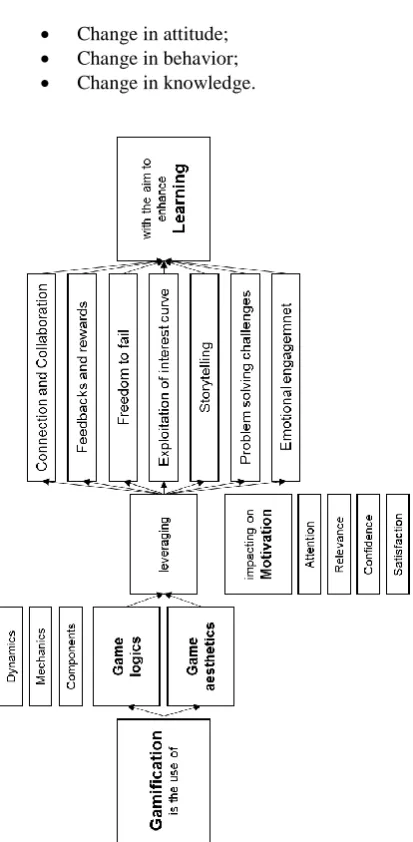
Gamification of learning consists in the use of game logics [6] (components, mechanics and dynamics) and game aesthetics [7] designed with the aim to promote and enhance learning through motivation [8; 9; 10] (seen as the combination of the elements of attention, relevance, confidence and satisfaction***).
Learning is the final outcome of a complex process entirely studied for and performed by the user. The stimuli of the gamified system, according to literature, leverage on its interest curve [3], connection and collaboration among participants [12], feedbacks and rewards [13], freedom to fail [3], storytelling, problem solving challenges and emotional engagement [14]. In this perspective, a definition of the system allowing the enhancing of the learning activity through gamification can be stated as:
A gamified system is a digital structure built on game logics [6] and game aesthetics [7] to create student-centered learning experience [15] in order to enhance it in a self-determination perspective [16].
A schematization of the gamification of learning process as analyzed until now is provided in Figure 1.
*** Among the different theories on the motivational dimension on learning, one of the most complete is the so-called ARCS model of motivational design [11]
5. Studies on effectiveness
A whole branch of studies analyzed gamification
performances as a learning tool through experiments with students. Indeed, several gamified systems were ad hoc created to test whether they were effective. For others, instead, existing gamified tools or game-based-learning tools were tested on individuals to study which
dimensions of learning experience were impacted. Indeed, studies on the enhancement of the learning processes through gamification can be split into three inter-connected sub-categories, defined by outcome measure:
• Change in attitude; • Change in behavior; • Change in knowledge.
For the purposes of this paper, a consolidation of the results was carried out based on this three-dimensional perspective of effectiveness.
Evidence from the analyzed studies showed that the most frequently occurring outcomes are positive changes in attitude towards learning (more than 70% of the analyzed Figure 1. The gamification for learning framework: from the game design to the learning experience
EAI Endorsed Transactions on
e-Learning
studies), followed by changes in knowledge/content understanding (almost 50% of the analyzed studies) (Table 1). This reflects the parallel interests in the engaging features of games as an entertainment medium and increasingly also their use for learning. Evidence in behavioral changes is instead less strong, where most of the studies (almost 60% of them) didn’t notice any change in users’ behavior. Among these, moreover, one study reported also a negative result, where behaviour was found not changed at all ††† [17].
Some studies appeared effective in every dimension. One example is the contribution of Fujimoto et al. [18], who conducted an experiment using a card game called
JobStar. The results of a pre- and post-survey for participants indicated that the game offered an engaging opportunity that enhanced social interactions and facilitated participants’ learning. Participants gained a positive attitude regarding their future paths and experiencing with the game made them more confident about their competence in choosing their future occupations.
Table 1. Study on gamification effectiveness in changes in attitude, behavior and knowledge acquisition
Change in attitude
Change in behavior
Change in knowledge
Positive 15 8 10
Negative 0 1 0
Neutral 6 12 11
Another example is the study of Morrison [19] that ran an experiment on students with BrainPlay, an artefact designed to teach and practice primary school subjects and test explicit memory acquisition. The research showed that games are useful above all to represent complexity. Indeed, they often possess mechanisms that make learning more effective through mimicking behaviors required for study (call to focus, increasing levels of difficulty of skill, repetition and the need for players to regularly remember elements such as rules or previous moves). In the repetition of the learning activity, these elements have a positive effect on learners’ attitude towards school as well.
Another interesting result about how gamified systems are able to impact on people’s behavior, is the study of Przybylski et al. [20]. The study is based on the motivational model associated to videogames and proves that videogames are a key tool for influencing cognitive
††† For the sake of accuracy, it should be mentioned that most of the times changes in behaviors were out of scope of the analyzed papers. This means that evidence was not found, sometimes also because not specifically addressed.
evaluation. Indeed, the findings showed that different games are able to induce different decisions. That means, they change users’ behaviors. Deep immersion in natural environments resulted positively correlated with more prosocial goals and decision-making, whereas high levels of immersion in less natural contexts produced more self-interested orientations.
These are among the best representative outcomes for highly effectiveness gamification systems. A complete overview of the studies, nevertheless, highlights that results appear overall highly heterogeneous. Indeed, a deeper analysis of the studies’ characteristics could explain why the outcomes are not uniform. First, every gamified system is different from the others. A direct comparison among different systems, due to the importance of game logic design and desired aesthetics, wouldn’t be reliable. Second, studies differed for learning topics and objectives. This is for sure a further obstacle in the comparison of different research works, since the effectiveness of knowledge acquisition doesn’t just depend on the means involved, but also on the complexity of what is taught/learned. Last but not least, some differences concern the target users involved in the gamified experiences. Indeed, almost every study devoted some effort to the definition of the target users. As mentioned before, in fact, the personal background of learners is fundamental both during the game play and in its approach.
6. Discussion
As emerged in the screening of the literature on gamification, until now researchers have mostly focused especially on the definition and evaluation of two aspects of gamification for education: its design and its educational effectiveness.
As far as the design of gamified systems and their relative definition and classification are concerned, a branch of the studies aimed to create a systematic review of all the gamification theorization attempts, based on its frameworks. Indeed, they suggested specific definitions and evaluation criteria starting from the educational and gaming literature. Here, references to other learning tools such as serious games, simulations, and business cases are common. For example, Frost et al. organized a literature re-view on gamification based on previous attempts of incorporation of game dynamics in learning [21]. Another example is the one of Connolly et al, who in 2012 examined the literature on computer games and serious games with regard to their potential positive impacts on users in terms of learning and acquisition of skills [14]. One of the most significant attempts to define gamification, indeed, remains the one of Huotari and Hamari, that in 2012 defined gamification in a marketing-service perspective [22].
6
attitude, in behavior and in knowledge. Indeed, the vast majority of the studies on gamification applications to learning provided positive or neutral results. Gamification resulted to be at least not significantly correlated to student’s performances in everyone of the case studies. This is not a minor outcome. Indeed, negative effects of both digital learning systems and gaming tools have been found. As far as digital learning is concerned, for example, Sereetrakul [23] tested Facebook as a facilitator of connection among people to enhance a learning goal. Nevertheless, they found that it had a negative impact on students’ performance, due to its distracting potential. Most of the empirical studies on gamified systems focused on during-the-experience evaluation and after-the-experience evaluation. Indeed, just a very limited number of studies focused consistently on before-the-experience evaluation. The dimension, nevertheless, is far from being easy to address. Expectations towards gamified learning systems, in fact, involve both elements coming from the socio-demographic background and from the personal learning, gaming and ICT perception. Moreover, expectations appear to be fundamental in order to predict the motivation to use a gamified system and, indeed, the intention to use it.
In particular, people’s expectations towards gamification should not be underestimated due to two main reasons regarding both the first adoption and the iteration in using gamified systems. First of all, expectations are crucial when evaluating the intention of people to start using a gamification method for the first time. Indeed, the choosing process of whether put effort in a new activity or not was theorized by the so-called Expectancy Theory of Motivation [24]. This model is based on the concept of scarcity, and proposes that individuals are motivated to choose a certain behavior over others, based on what they expect the result of that behavior will be [25]. Indeed, people would be motivated to choose gamification over other learning methods just if their expectations towards gamification will be higher than the ones towards traditional learning. According to this theory, underestimating or overestimating the evaluation of people’s expectations would lead to a misrepresentation of their motivation to take part in the gamified experience. That means, consequently, an erroneous prediction of prospect users’ intention to participate.
Another support to the importance of expectations not just in the phase of first adoption of the gamified system, but also in its further iterated use, is the expectation dis-confirmation theory (EDT) [26]. In IT context, EDT explains how technology satisfaction is created as users form initial expectations of the technology, use it and com-pare technology performance against initial expectations. Indeed, expectations are seen as user’s anticipated perceptions of the future experience itself. Although apparently self-explaining, the results of the model are far from being obvious, especially if combined with the Expectancy Theory of Motivation’s ones. For example, according to the Expectations Disconfirmation Theory, higher satisfaction is easier to
reach when expectations are low, and vice-versa. When pre-test expectations are extremely high, it is harder to overcome them and consequently the post-test evaluation is more likely to show a medium-low satisfaction. Nevertheless, low expectations are not always a good index at all. Without a reasonably high level of expectations, in fact, according to the Expectancy Theory of Motivation people will not be motivated enough to live the experience itself.
Indeed, it is due to the fundamental role of motivation in gamification literature that a study wholly devoted to its connection to expectations is needed. Motivation, in fact, is important in gamification for more than one reason: on the one hand, it allows users to play the gamified system action after action, enacting, one step after the other, the whole learning path. On the other hand, as mentioned before, the motivational incentive is critical in the approach to the gamified system itself.
Despite the rich theoretical evidence for the importance of expectations and motivation of prospect users towards gamified learning systems, just a very limited number of studies focused on the before-the-experience moment. Moreover, none of the investigated studies went deeper in the analysis of general expectations towards gamified learning systems, and of the intention whether to use them. Most of the studies testing expectations and perceptions of gamified systems, in fact, were conducted in already existing classes. Even though different studies were conducted in classes differing for both dimension and school grade, any comparison among results of the existing literature appears to be difficult run due to several reasons.
First, most of the times results show per se a scarce significance. At first, this limit may be explained because the topic is almost never the main research purpose. A deeper analysis of the reasons behind a low significance of results shows that students in the same class tend to have a similar background. Analyzed records, in fact, will be likely to be really close to each other, representing a poor estimation model not able to predict expected behaviors. What could happen is that apparently identical children under the considered dimensions would take opposite decisions without apparent reason.
A practical example of this limitation was described in the research of Cheong et al. [6] that focused on the perception of gamified learning in a group of 51 undergraduate IT students. The study consisted in a before-the-experience evaluation and was centered on the perception of game elements. Indeed, among the limitations of the study the researchers reported the extremely similar background of participants that did not allow researchers to specifically find some significant trends. In literature, the fact that gamified experiences are usually offered to homogeneous classes leads to both a scarce consistency of the tested model and a low representativeness of the results for a wider public. Second, experiments are hard to compare since students living in-class experiences are really likely to be influenced by contingent extra-experiment interactions.
EAI Endorsed Transactions on
e-Learning
Indeed, this could happen in both the instructor-student relationship and the student-student one. As far as the first kind of connection is concerned, studies are not comparable since the personality of the instructors and their relationship with the class (which usually fall outside the scope of gamifications studies) is a potentially extremely high bias in expectations’ measurement. Whether a teacher is considered reliable by his students, for example, could significantly influence learners’ expectations.
As far as the relationship among classmates is concerned, instead, the bias stems from the different nature of classmates’ relationships in different classes (e.g. relationships among primary school children vs. relationships among MBA students). It should also be considered that in almost every study, interactions happened both online and offline. Indeed, a further problem concerns the tracking of interactions in order to measure their relevance and relative influence in the measured outputs. Once again, the heterogeneity of the samples, even if potentially positive for its broad spectrum, does not allow an effective comparison of results. Last but not least, it should be mentioned that the analyzed studies don’t even share a common definition of gamification: as it has been seen, in fact, definitions substantially differ the ones from the others.
7. Research proposition
What appears to be useful in order to overcome all of these limits is a cross-sectional study on the topic. Indeed, an ad-hoc designed cross-sectional study may help investigate different people’s expectations and motivation to take part in a gamified learning system. A deeper analysis of literature in this direction showed that some cross-sectional surveys have already being carried out with the aim to investigate the willingness to use gamification. A meaningful example is the study of Hamari and Koivisto [27], which focused on the social factors predicting attitudes towards gamification and intention to continue using a gamified service (Fitocracy) for physical exercise. As it can be easily argued, nevertheless, the study is not related to learning at all. Other studies have been carried out but none of them specifically addressed gamification for learning. Indeed, these studies could not be significant for this purpose for two reasons. First, the personal background of individuals involved in the learning experience is not accounted for. Second, the expectations towards the effectiveness of gamification as a learning tool are totally missing. Moreover, none of them adopted the aforementioned theoretical framework connecting expectations towards gamification to motivation and, in the end, the intention to really use it.
Indeed, this is why further study on the topic is needed. In particular, it could be interesting to examine which aspects of the personal background majorly impact on prospect users’ expectations. Moreover, the expectation
dimension could be analyzed taking into account both the learning aspect and the interactive and connecting one. Indeed, assumed that the final aim of the gamified experience is the acquisition of knowledge through a non-conventional method, this study might also help understand how different dimensions of expectations affect people’s motivation to take part in the process. These findings, in the end, may be a significant addition to gaming and learning literature, not just towards designing successful gamified systems, but also towards properly tailoring them to their prospect users’ background and expectations.
References
[1] Deterding, S., Dixon, D., Khaled, R., & Nacke, L. From game design elements to gamefulness: Defining “gamification”. MindTrek 11. Tampere, Finland (2011) [2] Bozkurt, A., Akgun-Ozbek, E., Yilmazel, S., Erdogdu, E.,
Ucar, H., Gule, E., & Aydin, C. H. Trends in distance education research: A content analysis of journals 2009-2013. The International Review Of Research In Open And Distributed Learning, 330-363 (2015)
[3] Kapp, K. Games, gamification, and the quest for learner engagement. T+D Magazine American Society for Training and Development, 64-68 (2012a)
[4] Kapp, K. The Gamification of Learning and Instruction: Game-Based Methods and Strategies for Training and Education. San Francisco: Pleiffer (2012b)
[5] Zichermann, G., & Linder, J. (2010). Game-Based Marketing: Inspire Customer Loyalty though Rewards, Challenges and Contests. Hoboken, NJ: Wiley.
[6] Cheong, C., Filippou, J., & Cheong, F. Towards the gamification of learning: investigating student perceptions of game elements. Journal of Information Systems Education (2014)
[7] Hunicke, R., LeBlanc, M., & Zubek, R. (2004). MDA: A formal approach to game design and game research. Game Design and Tuning Workshop at the Game Developers Conference. San Jose.
[8] Zichermann, G., & Cunningham, C. Gamification by Design: Implementing Game Mechanics in Web and Mobile Apps. O'Reilly Media, Inc. (2011)
[9] Rubin, K., Fein, G.G., & Vandenberg, B. Handbook of Child Psychology: Vol 4. Socialization, Personality, and Social Development. New York: E.M. Hetherington (Ed.) (1983)
[10] Dörnyei, Z., & Ushioda, E. Teaching and Researching: Motivation. Longman (2010)
[11] Hamzah, W. A., Haji Ali, N., Saman, M. M., Yusoff, M. H., & Yacob, A. Influence of gamification on students' motivation in using e-learning applications based on the motivational design model. International Journal of Emerging Technologies in Learning, 30-34 (2015) [12] Romero, M., Ott, M., de Freitas, S., & Earp, J. Learning
through playing for or against each other? Promoting collaborative learning in digital game based learning. European Conference on Information Systems (ECIS). Association for Information Systems AIS Electronic Library (AISeL) (2012)
8 [14] Connolly, T. M., Boyle, E. A., MacArthur, E., Hainey, T.,
& Boyle, J. M. A systematic literature review of empirical evidence on computer games and serious games. Computers & Education, 661-86 (2012)
[15] Nicholson, S. A user-centred theoretical framework for meaningful gamification. Proceedings of Games+Learning+Society 8.0. Madison, WI (2012) [16] Aparicio, A. F., Vela, f. L., Sànchez, J., & Montes, J.
Analysis and application of gamification. Proceedings of the 13th International Conference on Interacciòn Persona-Ordenador (p. 17). Elche: Interacion (2012)
[17] Bahji , S. E., Lefdaoui, Y., & El Alami, J. S2P learning model for combining game-based learning and text-based learning. 5th Guide International Conference 2011 E-learning innovative models for the integration of education, technology and research. Rome, Italy (2011) [18] Fujimoto, T., Fukuyama, Y., & Azami, T. Game-based
learning for youth career education with the card game 'JobStar'. In Conference: The 9th European Conference on Games Based Learning (p. 203). Steinkjer, Norway; Nord-Trondelag University College (2011)
[19] Morrison, G. BrainPlay: Serious game, serious learning? European Conference on Games Based Learning (pp. 680-686). Reading: Academic Conferences International Limited (2015)
[20] Przybylski, A., Rigby, C. S., & Ryan, R. M. A motivational model of video game engagement. Review of General Psychology American Psychological Association, 154-166 (2010)
[21] Frost, R., Matta, V., & Maclvor, E. Assessing the efficacy of incorporating game dynamics in a learning management Systems. Journal of Information System Education, 59-70 (2015)
[22] Huotari, K., & Hamari, J. (2012). Defining gamification – a service marketing perspective. Proceedings of the 16th International Academic MindTrek Conference (pp. 17–22). MindTrek'12
[23] Sereetrakul, W. Students' Facebook usage and academic achievement: A case study of private university in Thailand. IADIS International Conference con Cognition and Exploratory Learning in the Digital Age (pp. 40-56). Fort Worth, Texas: Unt University of North Texas (2013) [24] Vroom, V. H. Work and motivation. New York: Wiley,
196 (1964)
[25] Oliver, R. L. Expectancy theory predictions of salesmen's performance. Journal of Marketing Research, 243-253 (1974)
[26] Lankton, N. K., & McKnight, H. D. Examining two expectation disconfirmation theory models: Assimilation and asymmetry effect. Journal of the Association fot Information Systems, 88-115 (2012)
[27] Hamari, J., & Koivisto, J. Social motivations to use gamification: an empirical study on gamified exercise. Proceedings of the 21st European Conference on Information Systems. Association for Information Systems AIS Electronic Library (2013)
EAI Endorsed Transactions on
e-Learning