http://www.ijcmph.com pISSN 2394-6032 | eISSN 2394-6040
Original Research Article
Mental health assessment of adolescent girls in an observational home
in North coastal Andhra Pradesh: a cross sectional study
Mounica Kollabathula*, Devi Madhavi Bhimarasetty
INTRODUCTION
Adolescence is a transition period from childhood to adulthood. It is in particular a stressful period, which involves changes both physically and mentally. This phase plays a major role in shaping their ultimate personality that is reflected in their adulthood.1 Relationship with their family, elders and peers, and the kind of support obtained from them are crucial for their mental health. Mental health is not only a matter of relationship between the individuals but also between the individual & the society of which the individual is a part.2 Mental health conditions account for 16% of the global burden of disease in people aged between 10-19 years and mental health disorders begin during the age of 12 to 24 years.3,4
It is essential to study, address and nurture the mental health of an adolescent to prevent the emergence of mental health diseases and also to identify them at the earliest. This study was conducted among adolescent girls in government special cum children home and observational home for girls in Visakhapatnam, where runaway girls, destitute and delinquent teenagers reside. Individual attention is not feasible in an institution as opposed to that obtained at home. The objective of this study was to assess the mental health status of adolescent girls in government special cum children home and observational home for girls in Visakhapatnam and to see the association of metal health with various individual and family related factors.
ABSTRACT
Background: Adolescence is a stressful period involving changes both physically and mentally and requires support from family as well as peers. Assessment of mental health of adolescent girls in government special cum children home and observational home for girls in Visakhapatnam.
Methods: It is a cross sectional descriptive study conducted in November 2016 using strengths and difficulties questionnaire among all 10 to 18 year old girls in the observational home. Social history was also taken additionally. Data was entered and analyzed in Microsoft Excel.
Results: 16% girls had abnormal total difficulty scoring. Emotional problems were the highest (22%) followed by conduct (16%), peer problem (14%) and hyperactivity (5%). Abnormal pro social behavior was observed among 5% of the study population observed.
Conclusions: Emotional problems were more common and only two thirds had and a normal total difficulties score. All children may be assessed periodically to know their psychological requirements and to identify at risk individuals.
Keywords: Mental health, Adolescent girls, Strengths and difficulties questionnaire
Department ofCommunity Medicine, Andhra Medical College, Visakhapatnam, Andhra Pradesh, India
Received: 18 February 2019 Accepted: 02 April 2019
*Correspondence: Dr. Mounica Kollabathula, E-mail: [email protected]
Copyright: © the author(s), publisher and licensee Medip Academy. This is an open-access article distributed under the terms of the Creative Commons Attribution Non-Commercial License, which permits unrestricted non-commercial use, distribution, and reproduction in any medium, provided the original work is properly cited.
METHODS
This cross sectional study was conducted among Adolescent girls residing in government special cum children home and observational home for girls in Visakhapatnam, Andhra Pradesh. The study was conducted during the period of November-December 2016.
There were 64 adolescent girls residing in the home and of them 63 participated in the present study. The term adolescence has been defined as those aged between 10 years and 19 years.2 Those who were not willing to participate in the study, girls less than 10 years of age and more than 19 years of age and mentally challenged girls were excluded from the study.
The interview schedule in the current study included the details of age, education status, the reason for them to join the home, their duration of stay, type of family, history of mental illness in the family, history of breaking of law in the family, history of sexual abuse, history of suicidal thoughts and history of suicide attempt. The schedule also included a structured and validated strengths and difficulties questionnaire (SDQ). The questionnaire was validated by translation to the vernacular (Telugu) and back translation to English again by different individuals.
Strengths and difficulties questionnaire
The strengths and difficulties questionnaire asks 25 attributes and are divided into 5 scales
Emotional symptoms (5 items) Conduct problem (5 items) Hyperactivity (5 items) Peer pressure (5 items) Pro-social behavior (5 items)
The scales 1 to 4 mentioned above together gives total difficulties score. Emotional disturbances are usually seen in adolescents who are depressed, withdrawn, anxious or aggressive. Conduct problem is a pattern of repetitive behavior wherein the rights of others or social norms are violated. Hyperactivity can be described as a physical state in which a person is abnormally and easily excitable. Peer pressure scoring indicates the adolescent’s relationship with those around her.
Pro-social behavior refers to the helpful nature of an adolescent without expecting reward or compensation. The score ranges of the scales are mentioned in (Table 1).
Consent was obtained from the authorities of the home after informing them of the purpose of this study and after giving assurance to maintain confidentiality.
Data was entered in Microsoft Excel and analyzed using SPSS ver.23. The qualitative data is represented in
numbers and percentages. The quantitative data is expressed in mean. Comparisons were made using chi square test and Fisher’s exact test. P value <0.05 was considered to be significant statistically at 95% confidence interval.
Table 1: Scoring of the scales in SDQ.
Normal Borderline Abnormal Emotional
symptoms score (ESS)
0-5 6 7-10
Conduct problems score (CPS)
0-3 4 5-10
Hyperactivity
score (HS) 0-5 6 7-10
Peer pressure
score (PPS) 0-4 5 6-10
Total difficulties
score (TDS) 0-15 16-19 20-40
Pro-social behavior score (PSBS)
6-10 5 0-4
RESULTS
This study was done among 63 adolescent girls whose mean age was found to be 14.2 (SD=3.16). Majority of the study participants from the home were runaway children (44.4%) and destitute (34.9%). The mean duration of stay of the study group was 20 months (SD=28.9). About 63% of the study group were staying there since less than 1 year at the time of the study.
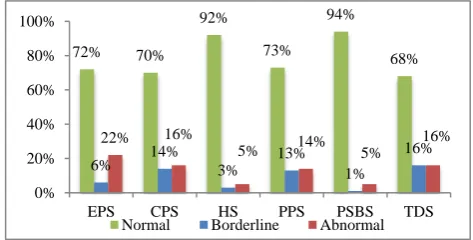
Among the mental problems identified, Emotional problems (22%) were the highest followed by conduct problem (16%), peer problem (14%) and hyperactivity (5%). The average total difficulties score (TDS) was 12.89 (SD=5.4), which falls under the normal range. Only 10 (16%) study subjects had an abnormal total difficulties score as shown in (Figure 1).
Figure 1: Mental problems among the adolescent girls in the home.
ESS=emotional problem score. CPS=conduct problem score. HS=hyperactivity score. PPS=peer pressure score PSBS=pro-social behaviour score. TDS=total difficulties Score.
72% 70%
92%
73% 94%
68%
6% 14% 3% 13% 1%
16%
22% 16%
5% 14% 5%
16% 0% 20% 40% 60% 80% 100%
EPS CPS HS PPS PSBS TDS
Table 2: Factors related to family and their association with total difficulties score.
Total Normal Borderline Abnormal P value
N (%) N (%) N (%) N (%)
Type of family (n=63)
Broken 22 (34.9) 13 (59) 5 (23) 4 (18)
0.01*
Healthy 5 (7.9) 0 2 (40) 3 (60)
No family 9 (14.3) 9 (100) 0 0
Others 4 (6.3) 3 (75) 0 1 (25)
Problem 23 (36.5) 18 (78) 3 (13) 2 (9)
Family history of mental illness (n=54)
Yes 6 (11.2) 2 (33.4) 2 (33.3) 2 (33.3)
0.183
No 48 (88.8) 32 (66.67) 8 (16.67) 8 (16.66)
History of law-breaking in the family (n=54)
Yes 9 (16.67) 5 (55.56) 0 4 (44.44)
0.073
No 45 (83.33) 29 (64.45) 10 (22.22) 6 (13.33)
Table 3: Individual factors and their association with total difficulties score (n=63).
Total Normal Borderline Abnormal P value
N (%) N (%) N (%) N (%)
Education
Primary 15 (23.8) 10 (66.67) 2 (13.33) 3 (20)
0.939
Secondary 14 (22.2) 9 (64.3) 2 (14.3) 3 (21.4)
High School 23 (36.5) 14 (61.9) 5 (21.7) 4 (17.4)
Intermediate 8 (12.7) 7 (87.5) 1 (12.5) 0
Illiterate 3 (4.8) 3 (100) 0 0
History of sexual abuse
Yes 17 (27) 9 (53) 3 (17.6) 5 (29.4)
0.191
No 46 (73) 34 (73.9) 7 (15.2) 5 (10.9)
History of suicidal thoughts
Yes 30 (47.6) 15 (50) 8 (26.67) 7 (23.33)
0.012*
No 33 (52.4) 28 (84.8) 2 (6.1) 3 (9.1)
History of suicide attempt
Yes 18 (28.6) 7 (38.89) 5 (27.78) 6 (33.33)
0.004*
No 45 (71.4) 36 (80) 5 (11.11) 4 (8.89)
The family and individual factors and their association to total difficulties score is shown in (Table 2) and (Table 3) respectively.
It was observed that the participants who reported that they had healthy family, have an abnormal total difficulties score. Furthermore, the type of family is found to significantly affect the total difficulties score. 33.3% of the subjects who reported a family history of mental illness, and 44.44% of subjects who had a family member who broke the law, observed to have an abnormal TDS.
Subjects who have had primary education and secondary education were observed to have a higher TDS. 29.4% of the study participants who were sexually abused, 33.33%
of study participants who attempted for suicide had an abnormal TDS score.
DISCUSSION
were high.6-9 Whereas, in rural Anand peer problems were high. This might be because of the difference in the study setting.10
In the current study, 16% had an abnormal total difficulties score, which is in concordance with the findings of studies conducted in Chennai and Bangalore.6,11 But, it was lower than that conducted in rural Anand, where students of government school participated and in a study conducted in Karnataka, where subjects were selected from both rural and urban schools.8,9 A higher number, compared to the present study reported to have abnormal difficulties score, in the study conducted in Aligarh and in Anand, which might be because of the difference in the study setting and population.8,7
Type of family had a significant impact on the total difficulties score in the current study. Similar findings were noted in a study conducted among pre-university students in Bangalore where parental marital discord and death of a parent was significantly associated with the total problems on SDQ.11
In a study conducted among runaway adolescents in a Boys observational home in Delhi, 69.33% were found to have behavioural problems and 81% had antisocial behaviour.12 Whereas, in the current study only 5% showed anti-social behavior. This is probably due to the difference in gender and place, and also because a different questionnaire was used. In the study conducted in rural Anand it is only 1.1% and in the study in Chennai it was found to be higher compared to the current study, which might be because of a a different study setting and a bigger sample size.9,10
In the present study the type of family, suicidal ideation and previous suicide attempt were found to have a significant affect on the total difficulties score. Suicidal ideation in itself is a sign of an unhealthy mental status. More than 50% of those who attempted for suicide previously show a borderline or abnormal TDS. SDQ can help as a screening tool to help in early detection of mental health problems and also the area in which an adolescent needs the maximum support. A screening of mental health might give us a better insight into the psychological needs. This will in turn help in planning of management action for the betterment of the mental health of the adolescents.
CONCLUSION
The objective of the present study was to assess the mental health of the adolescent girls in a special home using Strengths and Difficulties Questionnaire. It was found that emotional problems were more common and only two thirds had and a normal total difficulties score, which considers, emotional problem, hyperactivity problem, conduct problem and peer pressure problem.
All children may be assessed periodically to know their psychological requirements. Attention should be given to identify at risk individuals. Provision for counsellling services may be made available. Introduction of life skill education might furthermore help in giving the adolescent a direction and hope to deal with the mental health issues.
ACKNOWLEDGEMENTS
We extend our gratitude to Dr. T. Jeevan, the then Medical Officer of the Government Special cum Observational home for girls, Visakhapatnam for helping us and giving us permission to conduct a study in the institute. I thank the Superintendent, and the staff of the home for their cooperation. I thank all the subjects of the study group for their participation.
Funding: No funding sources Conflict of interest: None declared
Ethical approval: The study was approved by the Institutional Ethics Committee
REFERENCES
1. Feldman SS, Elliot GR. At the threshold ‘The developing Adolescent’. Cambridge: Harvard University Press, 1990:3.
2. Park S. A Text Book of Preventive & Social Medicine. 22nd Ed. Jabalpur: Bhanot Publishers, 2013.
3. World Health Organization. Adolescent Mental Health: 2018. Available at: https://www.who.int/ news-room/fact-sheets/detail/adolescent-mental-health. Accessed on 04 February 2019.
4. Patel V, Flisher A, Hetrick S, McGorryP. Mental Health of Young People: a Global Public Health Challenge. Lancet. 2007;369:1302-13.
5. Available at: https://www.ehcap.co.uk/content/sites/ ehcap/uploads/NewsDocuments/236/SDQEnglishU K4-17scoring-1.PDF. Accessed on 04 February 2019.
6. Seenivasan P, Kumar CP. A comparison of mental health of urban Indian adolescents among working and non-working mothers. Annals Comm Health. 2014;2:39–43.
7. Nair S, Ganjiwale J, Kharod N, Varma J, Nimbalkar SM. Epidemiological survey of mental health in adolescent school children of Gujarat, India. BMJ Paediatr Open. 2017;1(1):e000139.
8. Faizi N, Azmi SA, Ahmad A, Shah MS. Assessment of psychological problems in schoolgoing adolescents of Aligarh. Ind Psychiatry J. 2016;25(2):184-8.
10. Kharod N, Kumar D. Mental health status of school going adolescents in rural area of Gujarat. Indian J Youth Adolesc Health. 2015;2:17 21.
11. Bhola P, Sathyanarayanan V, Rekha DP, Daniel S, Thomas T. Assessment of self-reported emotional and behavioral difficulties among pre-university college students in Bangalore, India. Indian J Community Med. 2016;41:146-50.
12. Khurana S, Sharma N, Jena S, Saha R, Ingle GK. Mental Health Status of Runaway Adolescents. Indian J Pediatr. 2004;71(5):405-9.