Original Research Article
Knowledge attitudes and practices about diabetes and diabetic
retinopathy among diabetic retinopathy patients
at a tertiary care hospital in Goa
Tanvi Poy Raiturcar
1, Apika K. Sawant
2, Shreya S. Lotliker
2*,
Jagadish A. Cacodcar
2, Preksha P. Vernekar
2INTRODUCTION
It has been estimated that there are about 69.2 million Indians suffering from diabetes.1 The increasing prevalence of diabetes and the increased life expectancy; raises the time period for which patients have been suffering from diabetes; this increases the risk of long term complications of diabetes, a very important one
being diabetic retinopathy. The prevalence of diabetic retinopathy in India is between 7.3-25%.2,3 Early detection of diabetic retinopathy and its appropriate management is very important to prevent irreversible visual loss. This can only be achieved with better knowledge and awareness among patients. There have been many studies done in other states in India to assess the knowledge and awareness on diabetes and diabetic
ABSTRACT
Background: Diabetic retinopathy is one of the most common complication of diabetes with a prevalence of 7.3-25%. There have been several studies done in India to assess the knowledge and awareness on diabetes and diabetic retinopathy among patients with diabetes, however very few studies assessed knowledge, awareness and practices amongst patients with diabetic retinopathy.4-7 Besides, no such study was undertaken at Goa Medical College.
Methods: A cross-sectional study was conducted among 100 consecutive diabetic retinopathy patients attending ophthalmology out-patient department (OPD) at Goa Medical College and Hospital. The patients were administered a pre-tested proforma to assess their level of awareness and attitudes and practices towards diabetes and diabetic retinopathy. Data was entered in Microsoft excel 2010; analysed using the SPSS version 22. Chi-square test was used as test of significance.
Results: In our study, 58% were aware of the symptoms of diabetes. 15% were aware of the multiple complications. 35% had knowledge about only one test for detecting diabetes i.e. fasting blood sugar level. 22% had never heard about HbA1c. 49% were not aware that they had diabetic retinopathy. 76% felt it is important to continue medications even if blood sugar levels were normal. 62% were aware of the importance of exercise. 71% took their medications regularly, 72% checked their blood sugar regularly. There was a significant association between educational status and awareness and practices towards diabetes.
Conclusions: The diabetic retinopathy patients in our study had a fair knowledge about diabetes and diabetic retinopathy.
Keywords: Diabetes mellitus, Diabetic retinopathy, KAP
1
Department of Ophthalmology, 2Department of Preventive and Social Medicine, Goa Medical College, Bambolim, Goa, India
Received: 19 January 2019
Revised: 05 March 2019
Accepted: 06 March 2019
*Correspondence:
Dr. Shreya S. Lotliker,
E-mail: [email protected]
Copyright: © the author(s), publisher and licensee Medip Academy. This is an open-access article distributed under the terms of the Creative Commons Attribution Non-Commercial License, which permits unrestricted non-commercial use, distribution, and reproduction in any medium, provided the original work is properly cited.
retinopathy among patients with diabetic retinopathy, however very few studies assessed knowledge, awareness
and practices amongst patients with diabetic
retinopathy.4-7 Besides, no such study was undertaken amongst patients diagnosed with diabetic retinopathy who presented to Goa Medical College.
The objective of the study was to assess the knowledge, attitudes and practices about diabetes and diabetic retinopathy among patients diagnosed with diabetic retinopathy at a tertiary care hospital in Goa.
METHODS
The present cross sectional hospital based study was conducted in ophthalmology out-patient department (OPD) at Goa Medical College and Hospital. The study was conducted for a period of three months i.e. July to September 2018. Approval from the institutional ethical committee was duly obtained prior to conduct of the study. Total of 100 consecutive diabetic retinopathy patients attending ophthalmology OPD who met the eligibility criteria were included in the study.
The inclusion and exclusion criteria were as followed.
Inclusion criteria: All patients who were diagnosed to have diabetic retinopathy irrespective of age or gender or treatment.
Exclusion criteria: Patients who refused to give consent for participation were excluded from the study.
Informed consent was taken, and patients were interviewed based on a pre-tested pre designed questionnaire. The socioeconomic and educational status of each patient was obtained. Questionnaire comprised of both open and close ended questions to assess their level of awareness and attitudes and practices towards diabetes and diabetic retinopathy.
Study participant’s knowledge about signs and symptoms of diabetes, complications, and tests available for detection of Diabetes etc. was assessed. The questions in the attitude section were framed as statements, and the patient was asked whether he or she agreed or disagreed with the statement, or was undecided. The patients were categorized as having ‘positive’ or ‘negative’ attitude. They were also asked details of their diabetic status for e.g. how long ago Diabetes was detected, where it was diagnosed, how do they manage diabetes currently and how often they monitor their sugars, whether they exercise regularly or not etc. Awareness about their own DR status was also assessed.
The data was entered in Microsoft excel 2010; analysed using the SPSS version 22 and the results were expressed as simple proportions and percentages. Chi-square test was used for statistical association as test of significance.
RESULTS
Majority of our study participants (80%) were between the age group of 36-65 years. More than half (66%) were males, 54% belonged to urban areas and 46% belonged to rural areas. The occupation, education and socio-economic status of the participants are depicted in Table1.
Table 1: Sociodemographic profile of the diabetic retinopathy (DR) patients (n=100).
Patients characteristics N (%)
Age (in years)
21-35 3
36-50 40
51-65 40
66-80 17
Sex
Male 66
Female 34
Residence
Urban 54
Rural 46
Occupation
Unskilled 9
Semi-skilled 14
Skilled 28
Professional 13
Housewife 25
Unemployed (retired) 11
Education**
Pre-primary 2
Primary (1-5) 11
Upper primary (6-8) 3
Secondary (9-10) 9
Senior secondary (11-12) 7
Upper graduate 24
Uneducated 34
Socio economic status ***
Class I 4
Class II 27
Class III 50
Class IV 6
Class V 13
**Resource H. Indian standard classification of education InSCED ministry of human resource development 2014. ***Modified BG Prasad’s socio-economic classification.
of the existence of a diabetic retinopathy clinic in the hospital (Table 2).
Table 2: Distribution of DR patients as per their knowledge regarding diabetes mellitus and its
complications (n=100).
Study variable N (%)
Awareness of any symptom of DM
Aware* 58
Not aware 42
Awareness regarding complications of DM
Foot ulcers 11
Losing a leg 33
Kidney failure 13
Blindness/visual loss 7
Heart attack 8
Tingling/numbness (neuropathy) 12
Stroke 1
Aware of multiple complications 15
Not aware 0
Awareness about tests for DM detection
FBSL+PPBSL+HBA1C 16
FBSL+PPBSL 27
FBSL 35
Not Aware 22
Awareness about HBA1c test for DM
Aware 24
Not aware 76
Awareness of being diagnosed with diabetic retinopathy
Aware 51
Not aware 49
Awareness about diabetic retinopathy clinic at the hospital
Aware 40
Not aware 60
*Patients who correctly responded at least two of the following options were considered aware of DM symptoms i.e. increased thirst, increased hunger, increased frequency of passing urine, weight loss, weight gain, tingling /numbness.
Most patients (76%) participants felt that it is important to continue medications even if the blood sugar levels are within control, while 62% participants knew the importance of physical exercise. Only 22% participants considered HbA1c as a measure of diabetes control. 69% felt it was important to visit a doctor even if their sugar levels were under control (Table 3).
Majority of the participants i.e. 71% took their diabetic medications regularly, while 52% participants performed physical exercise of any form. Less than half i.e. 41% participants checked their blood sugar levels on a regular basis (Table 4).
Table 3: Distribution of DR patients as per their attitudes towards diabetes mellitus, its complications
and management (n=100).
Study variable N (%)
Need to continue medications even if blood sugar is normal
Agree 76
Disagree 24
Whether exercise is important for sugar control
Agree 62
Disagree 38
Perception of their DM control
Good control 32
Adequate control 41
Poor control 25
Very poor control 2
Awareness regarding the measure of DM control
As per HbA1c 22
As per blood test 67
As per symptoms 11
Acceptability towards consumption of sweets
Agree 9
Undecided 33
Disagree 58
Importance to visit doctor even if blood sugar is controlled
Agree 69
Undecided 13
Disagree 18
Table 4: Distribution of DR patients as per their practices towards diabetes mellitus, its complications
and management (n=100).
Study variable N (%)
Compliance with regular DM medications
Yes 71
No 29
Compliance towards regular blood sugar check ups
Yes 72
No 28
Practise of physical activity
Everyday 14
Once a week 17
Occasional 21
Never 48
Frequency of checking blood sugar levels
Every day 41
Every 3 monthly 22
Every 6 monthly 24
Once a year 13
status of the participants and their attitude towards the importance of regular exercise was found (Table 5). Figure 1 shows the distribution of the diabetic retinopathy
patients according to the medications used for diabetic control. Most of the patients were seen to be using oral hypoglycaemic agents.
Table 5: Association of patient education and selected attitude and practice towards DM.
Patients practices χ ² P value
Patient education 1. Patients who checked DM regularly
28.22 0.000
Yes (72) No (28) Total (100)
Patient education 2. Patients who felt it is important to exercise regularly
29.16 0.000
Yes (62) No (38) Total (100)
Figure 1: Distribution of DR patients as per their management of DM.
Most of the patients were diagnosed to have diabetes at a government health care facility followed by private clinic and very few were diagnosed at a speciality diabetic clinic (Figure 2).
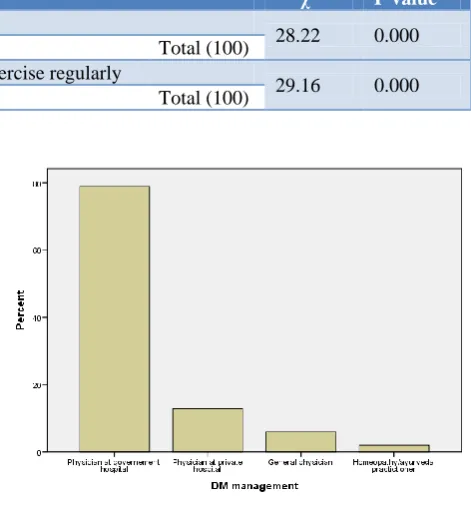
Most of our study participants were being treated by a physician at a government hospital (Figure3).
Figure 2: Distribution of DR patients as per set up where DM detected.
Figure 3: Distribution of DR patients as per health care provider.
When interviewed about the problems faced by the participants in adhering to the treatment being provided, 48% said that they were unable to remember to take timely dosages, 24% reported that they were unable to find time for the same, 6% reported difficulty in visiting the treating doctor and 22% reported inability to afford the medications (Figure 4).
DISCUSSION
Early detection and appropriate management of diabetes and its complications helps prevents irreversible damage. The same holds true for diabetic retinopathy. In its initial stages diabetic retinopathy is asymptomatic, and patients usually present to an ophthalmologist once irreversible visual damage has occurred. Hence awareness and knowledge about diabetes and diabetic retinopathy becomes very important in early detection and treatment.
In our study we interviewed 100 consecutive patients with diabetic retinopathy to assess their knowledge attitudes and practices about diabetes and diabetic retinopathy.
Knowledge regarding diabetes and its complications
Out of total 100 participants, 58% were aware of the symptoms of diabetes such as, increased thirst and hunger, increased urinary frequency, weight loss or gain and tingling numbness in the extremities. These patients were able to list at least two of the enlisted symptoms.
When asked about the complications related to diabetes, 15% were aware of multiple complications of diabetes, 33% were aware of losing a leg, 13% were aware of kidney failure, 12% about diabetic neuropathy, 11% about foot ulcers, 8% were aware about heart attack and
only 7% were aware of eye complications
(blindness/visual loss). We may thus say that a considerable percentage of our study participants had a fair knowledge about the symptoms and complications of diabetes. Our study findings are comparable to similar studies done in the past in South India by Hussain et al and Rani et al where they found that the patients in South India had good knowledge about diabetes and its complications.5,6
Our findings can also be compared with the findings of Mohan et al in South India, where 21.8% were aware of foot related complications of diabetes, 15.9% were aware of kidney failure, and 16.3% were aware of diabetic retinopathy as a complication of diabetes.8
We noted that among the participants who had good knowledge about diabetes, majority i.e. 55% were those who had a level of education higher than secondary education. Also all of these were patients who were being treated by M.B.B.S and M.D physicians and none by AYUSH providers; hence pointing to their source of information.
Out of the 100 study participants 35% had knowledge about only one test for detecting diabetes i.e. fasting blood sugar level, 27% were aware of the two tests i.e. fasting and post prandial sugar levels and only 16% were aware of all three tests ( FBSL, PPBSL, HbA1c). However about 22% did not know of any tests for detection of diabetes. Although HbA1c is now
recommended as a standard of care for the diagnosis and monitoring of diabetes, most of our subjects (76%) were not aware of the existence of such a test.9 All the 24% participants who knew about the test had a level of education higher than higher secondary level. Our study findings are similar to those found by Gulabani et al, wherein 94% patients had never heard of the test HbA1c for diabetes.10
Many of the patients i.e. 49% were not aware that they had developed diabetic retinopathy, while 51% were aware of the same. Further, majority of the subjects did not know about the diabetic retinopathy clinic in this hospital (60%). Among those patients who were not aware, included patients who had presented to the ophthalmologist for the first time, and also those who were follow up patients. These patients were made aware of the existence of retinal damage and asked to follow up for monitoring. Those patients who required treatment of the condition were either given laser photocoagulation therapy or intravitreal anti-vascular endothelial growth factor injections.
Attitudes of the participants towards diabetes mellitus, its complications and management
Adequate management of diabetes and prevention of its complications is only possible when the patient is educated about the disease by the health care personnel, highly motivated, and compliant to therapy. In order to achieve adequate control, along with timely medications, exercise, dietary control and regular monitoring is very important. To assess this aspect, we interviewed the participants and found that maximum patients i.e. 76% felt it is important to continue medications even if blood sugar levels were normal, whereas 24% did not feel so.
It was observed that 62% of the participants also felt it is important to exercise besides their medications whereas 38% did not feel that physical exercise is important. This is comparable to the study findings of Aurang Zeb et al who reported that 68.35% patients were aware of the importance of physical exercise for diabetic control.11 When questioned further, the participants revealed that they were made aware of the importance of physical exercise by their treating physician; which indicates successful communication between the treating doctor and patient; an important part in the management of diabetes.
In our study 32% of the study participants felt they had good sugar control, 41% felt they had adequate control, 25% felt they had poor control and 2% felt their sugars were very poorly controlled.
Around 9% believed it is alright to eat sweets, 58% did not believe so and remaining (33%) were not sure. Majority (69%) of them felt it is important to visit doctor even if their blood sugar was normal, 18% did not agree to this and 13% were not sure whether to visit or not. This indicates that our participants had good knowledge about dietary control, and the importance of regular follow up. Our study findings are contrasting with those of Mohan et al in their study in Chennai, who reported that only 21.2% were aware of high sugar diet as a risk factor for poor diabetic control. The reason for the contrasting findings could be that any patient that is detected of having diabetes at our tertiary care centre is made to attend dietary control classes which conducted twice a week at the hospital premises. Hence those who have attended these classes would be well informed about the recommended diet for a diabetic patient.
Practices towards diabetes mellitus, its complications and management
Knowledge about a particular subject or disease condition does not necessarily mean that the right practices are followed. In our study it was striking to note that a large number of participants were aware of diabetes, diabetic retinopathy and their risk factors and complications, and majority of them were following the right practices. Majority of the study participants (71%) reportedly took their medications regularly, 72% of them checked their blood sugar regularly. Out of 100 participants 52% performed physical exercise of any form; 21% performed exercise occasionally, 17% did so once a week and only 14% did so, on an everyday basis.
It was seen that 41% of the patients reported to have been checking their blood sugar every day, 22% checked every 3 monthly, 24% once in a six months and 13% once in a year.
Our study findings are comparable to the findings of Dinesh et alwho found that majority (60%) of the study participants checked their blood sugar levels regularly and performed some form of physical exercise.12 Similar findings were reported by and Gopichandran et al who reported that majority of participants followed correct practices for management and monitoring of blood sugar levels.13
Association between patient education and selected attitude and practices towards DM
The association between the educational status of diabetic retinopathy patients and regular blood sugar testing for diabetes was found to be statistically significant (χ²=28.22, p=0.000). The association between educational status of diabetic retinopathy patients and attitude towards importance of regular exercise was also found to be statistically significant (χ²=29.16, p=0.000). Most of the participants who belonged to the higher educated group were the ones who had been following correct
practices. Also these were the patients who were being treated by M.B.B.S or M.D physicians and were made aware of the right practices advised by the medical personnel.
In order to know the reasons for poor compliance among some of the patients, we interviewed them regarding challenges faced by them for sugar control. We noted that 48% participants found it difficult to remember to take diabetic medication, 24% did not find time, 6% had difficulty in visiting a doctor, and 22% could not afford the cost of the medications and investigations.
CONCLUSION
We conclude that the diabetic retinopathy patients in our study had a fair knowledge about diabetes and diabetic retinopathy. However there is still a need to increase awareness and ensure that proper practices are followed in the management of diabetes by the patients. This can be achieved by good doctor-patient communication and health education. Early diagnosis and appropriate management is the key towards prevention of complications of diabetes. Diabetic retinopathy is a very important and a common complication of diabetes which causes irreversible vision loss. Early recognition of symptoms and regular follow-up helps in preventing blindness.
Funding: No funding sources Conflict of interest: None declared
Ethical approval: The study was approved by the Institutional Ethics Committee
REFERENCES
1. International Diabetes Federation. IDF Diabetes Atlas. 7th edn. Brussels, Belgium: International Diabetes Federation; 2015.
2. Dandona L, Dandona R, Naduvilath TJ, Mc Carty, Rao GN. Population based assessment of diabetic retinopathy in South Indian population. Br J Ophthalmol.1999;83(8):937-40.
3. Jonas JB, Nangia V, Khare A, Matin A, Bhojwani K, Kulkarni M. Prevalence and associated factors of diabetic retinopathy in rural Central India. Diabetes care. 2013;36(5):69.
4. Srinivasan NK, John D, Rebekah G, Kujur ES, Paul P, John SS. Diabetes and diabetic retinopathy: KAP among diabetes patients in a tertiary care centre. J Clin Diag Res. 2017; 11(7):1-7.
5. Hussain R, Rajesh B, Giridhar A, Gopalakrishnan M, Sadasivan S, James J, et al. Knowledge and attitudes about diabetes and diabetic retinopathy in suburban population of a South Indian state and its practice among patients with diabetes mellitus: A population based study. Indian J Ophthalmol. 2016;64(4):272-6.
diabetes and diabetic retinopathy among rural population in India and its influence on knowledge of diabetic retinopathy on attitude and practice. Rural and remote health. 2008;8(3):838.
7. Koshy J, Varghese DL, Mathew T, Kaur G, Thomas
S, Bhatti SM. Study on KAP of ocular complications due to diabetes among type 2 diabetes visiting a tertiary teaching hospital. Indian J Community health. 2012;24:27-31.
8. Mohan D, Raj D, Shantirani CS. Awareness and knowledge of diabetes in Chennai- the Chennai urban rural epidemiology study [CURES-9]. J Assoc Physicians India. 2005;53:283-7.
9. World Health Organization (WHO). Use of
Glycated Haemoglobin (HbA1c) in the Diagnosis of Diabetes Mellitus Abbreviated Report of a WHO Consultation. Geneva: WHO; 2011.
10. Gulabani M, Joshi M, Isaac R. Knowledge of diabetes, its treatment and complications amongst diabetic patients in a tertiary care hospital. Indian J Community Med. 2008;33:204-6.
11. Zeb A, Khan M, Wahab F, Khan MT, Nawaz A, Faraz N. Knowledge Attitude and Practice of Diet
and Exercise among Diabetic Patients for Normal Plasma Glucose Level. International J Sci Res Publications. 2017;7(1).
12. Dinesh PV, Kulkarni AG, Gangadhar NK.
Knowledge and self-care practices regarding diabetes among patients with type 2 diabetes in rural Sullia, Karnataka: A community based, cross-sectional study. J Family Med and primary care. 2016;5(4):847-52.
13. Gopichandran V, Lyndon S, Angel MK, Manayalil BP, Blessy KR, Alex RG, et al. Diabetes self-care activities: a community based survey in urban Southern India. Natl Med J India. 2012;25(1):14-7.