Evaluation of allelopathic competency of
Lamium
amplexicaule
and identification of its allelopathic active
substance
Chisato Sakamoto1, Masahiko Suzuki1,2, Arihiro Iwasaki3, Kiyotake Suenaga3, Hisashi Kato-Noguchi1,2*
1Department of Applied Biological Science, Faculty of Agriculture, Kagawa University, Miki, Kagawa 761-0795, Japan, 2The United Graduate School of Agriculture Sciences, Ehime University, 3-5-7 Tarumi, Matsuyama, Ehime 790-8566, Japan, 3Department of Chemistry, Faculty of Science and Technology, Keio University, Yokohama 223-8522, Japan
INTRODUCTION
Lamium amplexicaule (L.) is a weedy annual plant species of the Lamiaceae family that originated from the Mediterranean region and spread in Europe, Asia, and northern Africa. The species has adapted to quickly grow
in crop fields, gardens, and pastures (USDA-NRCS, 2015; Stojanova et al., 2016). It competes with crops and other plant species and is categorized as an invasive alien weed in the USA and Canada (CABA, 2018).
Invasive plants possibly have physiological and ecological
characteristics, such as high growth and reproduction
rates, and phenotypic plasticity (Cappuccino and Arnason, 2006). The interactions of the invasive plants
with natural enemies are also important. A strong
defense capability against herbivores and pathogens may contribute to invasion (Keane and Crawley, 2002; Cappuccino and Carpenter, 2005). The interaction
between invasive plants and native plants is also crucial. Several invasive plants contain unique compounds that are highly toxic to native plants (Callaway and Ridenour, 2004; Chengxu et al., 2011). Therefore, phytotoxicity or allelopathy or both are considered to be important for invasive plants to become naturalized in new habitats (Meiners et al., 2012).
The allelopathic activity of L. amplexicaule has been reported (Fujii et al., 1992). The species spreads quickly throughout wheat fields and suppresses crop production (Conley and Bradley, 2005). Jones et al. (2012) evaluated the volatile compounds in L. amplexicaule to determine if
they contribute to its allelopathy. However, they could not find any volatile compounds that were responsible for the allelopathy. The objective of this study was to re-evaluate the allelopathic potential of L. amplexicaule and to isolate and identify potential phytotoxic compounds with
allelopathic activity.
The weedy annual grass Lamium amplexicaule (L.) originated from the Mediterranean region, spreads quickly, and becomes naturalized in areas it invades. It was assumed that volatile phytotoxic substances are one of the invasive characteristics of L. amplexicaule. However, no volatile compound has been found. Therefore, we re-evaluated the allelopathic potential of L. amplexicaule and investigated the phytotoxic substances with allelopathic activity. An extract of L. amplexicaule inhibited the root and shoot growth of Lepidium sativum, Lactuca sativa, Arctium lappa, Lolium multiflorum Lam., Echinochloa crus-galli, and Vulpia myuros, which indicates that the extract has an allelopathic
effect. The extract was purified using bioassay-guided chromatographic separations, and a phytotoxic substance with allelopathic activity
was isolated and characterized as methyl caffeate. The compound significantly inhibited the root and shoot growth of L. sativum and
L. multiflorum. The present results suggest that methyl caffeate may contribute to the allelopathic effect of the L. amplexicaule extracts and consequently, may be partly responsible for the invasive characteristics of the species.
Keywords: Allelopathy; Invasive weed; Growth inhibition; Lamium amplexicaule; Phytotoxicity
http://www.ejfa.me/
A B S T R A C T
*Corresponding author:
Hisashi Kato-Noguchi,Department of Applied Biological Science, Faculty of Agriculture, Kagawa University, Miki, Kagawa 761-0795, Japan.
E-mail: [email protected]
Received: 01 October 2018 ; Accepted: 11 January 2019
MATERIALS AND METHODS
Plant material
Whole plants of Lamium amplexicaule (L.) were collected
at Kumagaya, Japan in 2017 and kept at −20°C until extraction. Dicotyledonous Lepidium sativum L., Lactuca sativa L., and Arctium lappa L. and monocotyledonous Lolium multiflorum Lam., Echinochloa crus-galli (L.) Beauv, and Vulpia myuros (L.) C. C. Gmel. were used as test plants for bioassay.
Extraction and bioassay
Whole plants of L. amplexicaule (170 g fresh weight) were cut into small pieces and extracted with 850 mL of 80% (v/v) aqueous methanol for two days. After filtration using filter paper (No. 2; Toyo Ltd., Tokyo, Japan), the residue was extracted again with 500 mL of methanol for two days and filtered. The two filtrates were combined and concentrated in vacuo at 40°C.
An aliquot of the extract was added to a sheet of filter paper in a 2.8 cm Petri dish and dried in a fume hood. The filter paper was moistened with 0.6 mL of 0.05% (v/v) aqueous solution of Tween 20 (polyoxyethylene sorbitan monolaurate; Nacalai, Kyoto, Japan). Ten seeds each of L. sativum, L. sativa, and A. lappa, and 10 pre-germinated seedlings each of V. myuros, E. crus-galli, and L. multiflorum were placed onto
filter paper in Petri dishes. L. sativum, L. sativa, L. multiflorum,
E. crus-galli,and V. myuros were incubated in the dark at 25°C for 48 h, and A. lappa was incubated in the dark at 25°C for 120 h. After incubation, the root and shoot length of the test plants were measured. The bioassay concentrations of the extracts were 1, 3, 10, 30, 100, 300, and 1000 mg fresh weight equivalent extract mL−1. Control test plants were incubated without the extracts. The bioassay was repeated two times using a randomized design with 10 plants for each determination. The concentrations required for 50% growth inhibition (IC50 values) of the test plant roots and
shoots were determined using a logistic regression function
with Microsoft Excel based on the bioassay.
Separation of the extract
Whole plants of L. amplexicaule (5 kg fresh weight) were extracted with 18 L of 80% (v/v) aqueous methanol as described above. The extract was concentrated at 40°C
to produce an aqueous solution. The aqueous solution
was adjusted to pH 7.0 with 1 M phosphate buffer and partitioned three times with an equal volume of ethyl acetate. The ethyl acetate fraction was evaporated to dryness after drying over anhydrous Na2SO4, and then separated
on a column of silica gel (40 g, silica gel 60, 70-230 mesh; Nacalai) with elution by 20 (fraction 1), 30 (fraction 2), 40 (fraction 3), 50 (fraction 4), 60 (fraction 5), 70 (fraction 6), and 80% (fraction 7) ethyl acetate in n-hexane (v/v, 100 mL per step), ethyl acetate (fraction 8; 100 mL), and methanol
(fraction 9; 200 mL). The biological activity of all the
separated fractions was determined using a L. sativum bioassay as described above.
Isolation of an active compound
An active fraction obtained from the silica gel column was evaporated, and the residue was purified using a column of Sephadex LH-20 (40 g; GE Healthcare, Uppsala, Sweden) eluted with 20, 30, 40, 50, 60, 70, 80, and 90% aqueous methanol (v/v, 100 mL per step) and methanol (200 mL). The fraction eluted with 60% aqueous methanol was active, and that active fraction was evaporated to dryness. The residue of the fraction was separated using flash chromatography
(KeyChem-Flash, YMC-DospoPack AT ODS-25; YMC Co., Ltd.) eluted with 20, 30, 40, 50, 60, 70, and 80% aqueous methanol (v/v, 150 mL per step) and methanol (300 mL). The active fraction was eluted with 40% aqueous methanol and evaporated to dryness. The residue of the fraction was finally separated using reverse-phase HPLC (μBondshere 5 µ, 19×150 mm; Waters) eluted at a flow rate of 1.5 mL min−1 with 55% (v/v) aqueous methanol and detected at 220 nm. Activity was found in a peak fraction at 55 min. The active compound was characterized using HRESI-MS, 1H-NMR (400 MHz, CDCl3), and 13C NMR (100 MHz, CDCl
3) spectra (TMS as internal standard). An active compound of 2.8 mg was isolated from the extracts obtained from an extracted amount of 0.5 kg of L. amplexicaule.
Bioassay for the isolated compound
The isolated compound was dissolved in methanol and added to a sheet of filter paper (No. 2) in a 2.8 cm Petri dish. The methanol was evaporated in a fume hood. The biological activity of the compound was determined by bioassay using L. sativum and L. multiflorum as described above. L. sativum and L. multiflorum were used as the test
plants because those plants had relatively high sensitivity
to the extracts of L. amplexicaule among the dicotyledonous
and the monocotyledonous test plants, respectively. The bioassay concentrations were 0.1, 0.3, 1, 3, and 10 mM. The bioassay was repeated two times using a completely randomized design with 10 plants for each determination.
Statistical analysis
Significant differences between treatment and control were examined using Welch’s t-test (two sided) at p<0.05, 0.01, or 0.001.
RESULTS AND DISCUSSION
Growth inhibitory activity of the extracts of
L. amplexicaule
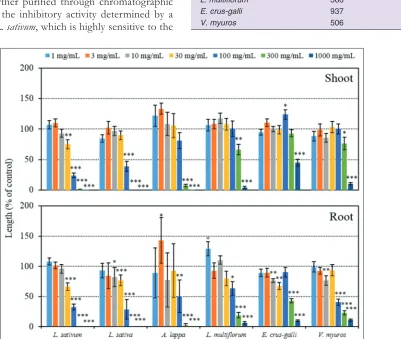
The extracts of L. amplexicaule inhibited the root and shoot
growth of L. sativum, L. sativa, A. lappa, L. multiflorum,
with increasing concentrations of the extracts (Fig 1). The
extracts of L. amplexicaule therefore had an allelopathic
effect on both the dicotyledonous and monocotyledonous
plants. These results suggest that L. amplexicaule may
contain phytotoxic substances with allelopathic activity.
The IC50 values of the extracts on the test plants were in the range of 38.5–137 mg fresh weight equivalent extract
mL−1 for L. sativum, L. sativa, and A. lappa (dicotyledonous plants) and in the range of 126–937 mg fresh weight equivalent extract mL−1 for L. multiflorum, E. crus-galli,
and V. myuros (monocotyledonous plants). Thus, the
dicotyledonous plants were more sensitive to the extracts
than the monocotyledonous plants (Table 1).
Identification of the growth inhibitory substances in
L. amplexicaule
The extracts of L. amplexicaule were separated using a
silica gel column, and the most active fraction was eluted with 60% ethyl acetate in n-hexane (Fig 2). The active fraction inhibited the L. sativum roots and shoots resulting
in growth of 12.4 and 13.2%, respectively, compared with the growth of the control plants. Therefore, the active fraction was further purified through chromatographic
separation with the inhibitory activity determined by a bioassay using L. sativum, which is highly sensitive to the
extracts of L. amplexicaule, and an active compound was isolated.
The active compound has the molecular formula of C10H8O4 as suggested by HRESI-MS at m/z 192.9761 [M-H]− (calcd for C
10H9O4 193.0501, Δ= −383 ppm). 1H NMR (400 MHz, CD3OD) δH 7.54 (d, J = 16.2 Hz, 1 H, H-7), 7.03 (d, J = 2.1 Hz, 1 H, H-2), 6.94 (dd, J = 8.4, 2.1 Hz, 1 H, H-6), 6.77 (d, J = 8.4 Hz, 1 H, H-5), 6.26
(d, J = 16.2 Hz, 1 H, H-8), 3.76 (s, 3 H, H-10); 13C NMR (100 MHz, (CD3OD) δC 169.8 (C-9), 149.6 (C-4), 147.0
Fig 1.Effect of the extracts of L. amplexicaule on the root and shoot growth of L. sativum, L. sativa, A. lappa, L. multiflorum, E. crus-galli,and
V. myuros. Concentrations of the tested samples corresponded to the extracts obtained from 1, 3, 10, 30, 100, 300, and 1000mg fresh weight
of L. amplexicaule per mL. Means ± SE from 2 independent experiments with 10 plants for each determination are shown. Asterisks indicate
significant difference between control and treatment: *, p<0.05, **, p<0.01, ***, p<0.001.
Table 1. IC50 values (concentrations required for 50% growth inhibition) of the extracts of L. amplexicaule on L. sativum,
L. sativa, A. lappa, L. multiflorum, E. crus-galli, and V. myuros
Test plant IC50 (mg fresh weight equivalent extract mL−1)
Shoot Root
Dicotyledonous
L. sativum 46.9 52.6
L. sativa 67.9 38.5
A. lappa 137 93.3
Monocotyledonous
L. multiflorum 366 126
E. crus-galli 937 323
(C-3), 146.8 (C-7), 127.6 (C-1), 122.9 (C-6), 116.5 (C-5), 115.1 (C-8), 114.8 (C-2), 52.0 (C-10). The active compound was identified as methyl caffeate (Fig 3) by comparing with previous data (Zhu et al., 2010; Prevost et al., 2013). Although methyl caffeate has been isolated from several plant species (Xiang et al., 2011; Balachadran et al., 2015; Wang et al., 2015), the present report is the first on methyl caffeate as a phytotoxic substance in L. amplexicaule.
Biological activity of the isolated substances
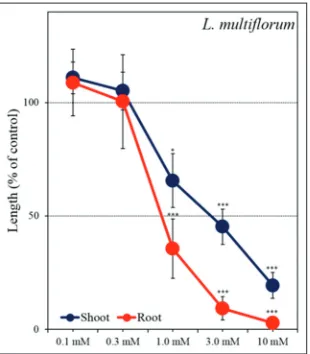
Methyl caffeate significantly inhibited the root and shoot
growth of L. sativum and L. multiflorum at concentrations
greater than 1 mM (Fig 4 and 5). The IC50 values of methyl
caffeate on the roots and shoots of L. sativum were 2.0 and 1.4 mM, respectively, and on the roots and shoots
of L. multiflorum were 1.1 and 2.5 mM, respectively. The compound has also been reported to possess anticancer activity against human breast cancer cells (Bailly et al., 2013), antimalarial activity against a Plasmodium berghei strain
(Alson et al., 2018), antihyperglycemic activity in diabetic
rats (Gandhi et al., 2011), and antioxidant activities under in vitro conditions (Wang et al., 2015). Methyl caffeate is a methyl ester of caffeic acid, which has also been reported to have biological activity (Fernandez et al., 2009; Scognamiglio et al., 2012). However, the activity of methyl caffeate was 2.9-fold greater than that of caffeic acid (Alson et al., 2018), which suggests that the methoxy group at the C-10 position in caffeic acid may be important for the activity.
Phytotoxic active substances in plants are released into the soil by decomposition of plant residues and exudates from living plant tissues, and act as allelopathic substances. Those substances can inhibit seed germination and plant growth (Bais et al., 2006; Bonanomi et al., 2006; Belz, 2007). Methyl caffeate in L. amplexicaule may also be
released into the soil in the same manner and act as an
allelopathic substance.
Fig 2. Effect of the fractions obtained from silica gel column chromatography of the L. amplexicaule extracts on the root and shoot growth of L. sativum. The length of the roots and shoots of the L. sativum seedlings was determined after 48 h of incubation in the dark at 25°C. The concentration of the tested samples corresponded to the extract obtained from 1000 mg fresh weight of L. amplexicaule per mL. Means ± SE from 2 independent experiments with 10 plants for
each determination are shown. Asterisks indicate significant difference between control and treatment: *, p<0.05, ***, p<0.001.
Fig 3. Chemical structure of methyl caffeate.
Fig 4. Effect of methyl caffeate on the root and shoot growth of L. sativum. Means ± SE from 2 independent experiments with 10
seedlings for each determination are shown. ***, p<0.001.
Fig5. Effect of methyl caffeate on the root and shoot growth of
L. multiflorum. Means ± SE from 2 independent experiments with 10
The weedy grass L. amplexicaule strongly competes with other
plants and is categorized as an invasive alien weed (CABA, 2018). Phytotoxicity and allelopathy are considered to be important for invasion of new habitats (Meiners et al., 2012). It has been reported that L. amplexicaule possesses allelopathic
potential (Fujii et al., 1992). However, volatile compounds involved in the allelopathy could not be found (Jones et al., 2012). The present research re-evaluated the allelopathic activity of L. amplexicaule and isolated methyl caffeate, which
showed phytotoxic activity. The phytotoxic compound may contribute to the invasive characteristics of L. amplexicaule.
CONCLUSION
The extracts of L. amplexicaule show allelopathic activity. The extract was purified using bioassay-guided chromatographic
separations, and a phytotoxic substance with allelopathic activity was isolated and characterized as methyl caffeate. The compound significantly inhibited the growth of L. sativum and L. multiflorum. These results suggest that
methyl caffeate may contribute to the allelopathic activity of
the L. amplexicaule extracts and consequently, may be partly responsible for the invasive characteristics of L. amplexicaule.
However, further experiments are required to clarify the release route of this compound into the environment.
Authors’ contributions
Chisato Sakamoto: ran the experiments and data analysis. Masahiko Suzuki: technical support for the experiments. Arihiro Iwasakiand Kiyotake Suenaga: determination of chemical structures of the compounds. Hisashi Kato-Noguchi: responsible for experimental design and results
interpretation coordinated data analysis and wrote the paper.
REFERENCES
Alson, S. G., O. Jansen, E. Cieckiewicz, H. Rakotoarimanana, H. Rafatro, G. Degotte, P. Francotte and M. Frederich. 2018. In-vitro and in-vivo antimalarial activity of caffeic acid and some of its derivatives. J. Pharm. Pharmacol. 70: 1349-1356.
Bailly, F., R. A. Toillon, O. Tomavo, N. Jouy, H. Hondermarck and P. Cotelle. 2013. Antiproliferative and apoptotic effects of the oxidative dimerization product of methyl caffeate on human breast cancer cells. Bioorg. Med. Chem. Lett. 23: 574-578. Bais, H. P., T. L. Weir, L. G. Perry, S. Gilroy and J. M. Vivanco. 2006.
The role of root exudates in rhizosphere interactions with plants and other organisms. Ann. Rev. Plant Biol. 57: 233-266. Balachadran, C., N. Emi, Y. Arun, Y. Yamamoto, B. Ahilan,
B. Sangeetha, V. Duraipandiyan, Y. Inaguma, A. Okamoto, S. Ignacimuthu, N. A. Al-Dhadi and P. T. Perumal. 2015. In vitro anticancer activity of methyl caffeate isolated from Solanum torvum Swartz. Fruit. Chem. Biol. Interact. 242: 81-90.
Belz, R. G. 2007 Allelopathy in crop/weed interactions-an update. Pest Manag. Sci. 63: 308-326.
Bonanomi, G., M. G. Sicurezza, S. Caporaso, A. Esposito and S. Mazzoleni. 2006. Phytotoxicity dynamics of decaying plant
materials. New Phytol. Trust. 169: 571-578.
CABA. 2018. Invasive Species Compendium. Available from: https:// www.cabi.org/isc/datasheet/29728.
Callaway, R. M. and W. M. Ridenour. 2004. Novel weapons: Invasive success and the evolution of increased competitive ability. Front. Ecol. Environ. 2: 419-426.
Cappuccino, N. and D. Carpenter. 2005. Invasive exotic plants suffer less herbivory than non-invasive plants. Biol. Lett. 1: 435-458. Cappuccino, N. and J. T. Arnason. 2006. Novel chemistry of invasive
exotic plants. Biol. Lett. 2: 189-193.
Chengxu, W., Z. Mingxing, C. Xuhui and Q. Bo. 2011. Review on allelopathy of exotic invasive plants. Procedia Eng. 18: 240-246. Conley, S. P. and K. W. Bradley. 2005. Wheat (Triticum aestivum) yield response to henbit (Lamium amplexicaule) interference and simulated winterkill. Weed Technol. 19: 902-906.
Fernandez, C., Y. Monnier, E. Ormeño, V. Baldy, S. Greff, V. Pasqualini, J. P. Mévy and A. Bousquet-Mélou. 2009. Variations in allelochemical composition of leachates of different organs and maturity stages of Pinus halepensis. J. Chem. Ecol. 35: 970-979.
Fujii, Y., T. Shibuya and T. Yasuda. 1992. Allelopathy of velvet bean: Its discrimination and identification of L-DOPA as a candidate of allelopathic substances. Jpn. Agric. Res. Q. 25: 238-247. Gandhi, G. R., S. Ignacimuthu, M. G. Paulraj and P. Sasikumar.
2011. Antihyperglycemic activity and antidiabetic effect of methyl caffeate isolated from Solanum torvum Swartz. Fruit in streptozotocin induced diabetic rats. Eur. J. Pharmacol. 670: 623-631.
Jones, C. D., K. E. Woods, N. William and W. N. Setzer. 2012. A chemical ecological investigation of the allelopathic potential of Lamium amplexicaule and Lamium purpureum. Open J. Ecol. 2: 167-177.
Keane, R. M. and M. L. Crawley. 2002. Exotic plant invasions and the enemy release hypothesis. Trend Ecol. Evol. 17: 164-170. Meiners, S. J., C. H. Kong, L. M. Ladwig, N. L. Pisula and K. A. Lang.
2012. Developing an ecological context for allelopathy. Plant Ecol. 213: 1861-1867.
Prevost, M. S., S. Delarue-Cochin, J. Marteaux, C. Colas, C. van Renterghem, A. Blondel, T. Malliavin, P. J. Corringer and D. Joseph. 2013. Identification of cinnamic acid derivatives as novel antagonist of the prokaryotic proton-gated ion channel GLIC. J. Med. Chem. 56: 4619-4630.
Scognamiglio, M., A. Esposito, B. D’Abrosca, S. Pacifico, V. Fiumano, N. Tsafantakis, P. Monaco and A. Fiorentino. 2012. Isolation, distribution and allelopathic effect of caffeic acid derivatives from Bellis perennis L. Biochem. Syst. Ecol. 43: 108-113.
Stojanova, B., S. Maurice and P. O. Cheptou. 2016. Is plasticity across seasons adaptive in the annual cleistogamous plant Lamium amplexicaule? Ann. Bot. 17: 681-691.
USDA-NRCS. 2015. The Plants Database. Available from: http:// www.plants.usda.gov/core/profile?symbol=LAAM.
Wang, L., J. Guo, J. Zhang, J. Peng, T. Liu and Z. Xin. 2015. Isolation, identification and antioxidant activity of bound phenolic compounds present in rice bran. Food Chem. 171: 40-49. Xiang, M., S. Hanwen, H. Jinyue and Y. Yunjin. 2011. Isolation,
identification and determination of methyl caffeate, ethyl caffeate and other phenolic compounds from Polygonum amplexicaule var. sinense. J. Med. Plants Res. 5: 1685-1691.