An Efficient Content Based Image Retrieval System by
Optimizing SOH
S Agalya
Computer Science Department, Pondicherry University, Puducherry, Tamil Nadu, India
ABSTRACT
This work presents a Content-Based Image Retrieval (CBIR) system embedded with a clustering technique to retrieve images similar to query image. In this work, extensive robust and important features were extracted from the images database and then stored in the feature repository. This feature set is composed of color signature with the shape and color texture features. After that number of cluster formed in dataset. Cluster formation based on find Euclidean distance between each pairs in dataset QI image feature extraction is based on salient orientation histogram. Consequently, a novel image retrieval using k nearest neighbour (KNN) classifier is achieved between the features of the QI and the features of the cluster images. This method is entirely different from the existing histograms, most of the existing histogram techniques merely count the number or frequency of pixels. However, the unique characteristic of SOH is that they count the perceptually uniform color difference between two points under different backgrounds with regard to colors and edge orientations. Our proposed CBIR system is assessed by inquiring number of images (from the test dataset) and the efficiency of the system is evaluated by calculating precision-recall value for the results. The results were superior to other state-of-the-art CBIR systems in regard to precision
Keywords: CBIR, Query Image(QI), k-Nearest Neighbor, Feature Extraction, SOH
I.
INTRODUCTION
With the development of digital image processing technology, it has become imperative to find a method to efficiently search and browse images from large image collections. Generally, three categories of methods for image retrieval are used: text-based, content-based and semantic-based. In daily life, people search for images mainly via search engines such as Google, Yahoo, etc., which are based mainly on text keyword searches. In general, images could be classified into two classes, texture and non-texture. Texture images form an important class, where an object within the image is repeated periodically throughout the image. Some medical images such as X-rays and some topographic images fall under this category. Non-texture images tend to have objects of
interest clustered in one or more regions of an image. Most of the real world images that people are familiar with fall under the second category. In this study, we focus on non-texture images, they are more challenging to handle.
belong to predefined classes with close probabilities. Color, shape and texture features are considered to be the low-level contents. Most of the CBIR methods are based on low-level features. Content-based algorithm uses visual content of the image for retrieval removing the disadvantages of text-based retrieval systems. Content Based Image Retrieval (CBIR) is the process of searching and retrieving images from a database on the basis of features that are extracted from the image themselves.
In this paper image classes are used such as Africa, beaches, building, bus, dinosaur, elephants, flowers, food, horses and mountains. Features are extracted from the entire image database and the feature vectors have been stored. Features are extracted using HSV histogram, Texture features are derived from the gray-level co-occurrence matrix, Color and Edge Directivity Descriptors and Color moments. Feature extraction using HSV histogram includes color space conversion, color quantization and histogram computation.
Retrieval algorithms used in traditional CBIR systems search the whole database independently for different image features. Each of the features is represented by a point in the corresponding feature space. Some systems use several feature spaces to represent the same feature to improve retrieval accuracy. In this case, search in each feature space is performed independently, followed by data fusion methods to merge the retrieved sets (intermediate outputs) into one common output. An output is a ranked set of retrieved objects, which is an answer of the retrieval system to a given query. To merge the results of retrieval in different feature spaces, it is common to use linear combinations of the ranks of an element in each intermediate output as its rank in the common output. An image database contains a wide variety of images which are relevant to the query may be few. For better meet the user intent, the proposed system performs a search in relevant images only.
It is different from traditional CBIR systems, which search the whole database for every feature. Relevance of the images are first established by comparing their color feature. Search based on texture and shape features is performed only on the images having color similarity with query image. This approach reduces the diversity of database by removing irrelevant images at each stage so that low level features can better represent the semantics of images. Experiments have shown that the proposed system produces desired results with greater accuracy. The present paper proposes a suggested image retrieval model based on extracting the most relevant features from the image dataset by using k-nn algorithm. The main purpose of texture- based retrieval is to find images or regions with similar texture.
II.
PROPOSED WORK
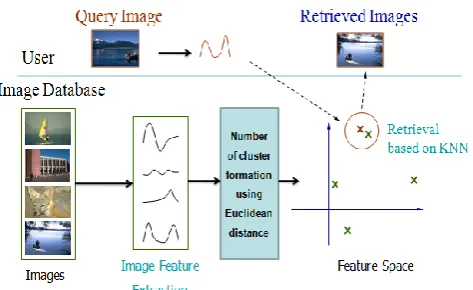
Our proposed work utilizes a K nearest neighbour (KNN) to find the images that has the highest similarity with the QI from a database. During the CBIR process every image in the database color, shape and texture features are extracted for clustering of database images. In QI SOH features are extracted. To build the descriptor only on the most relevant pixels, orientation feature is extracted at salient Modified Harris for Edges and Corners (MHEC) keypoints using an improved edge map, resulting in a Salient Orientation Histogram (SOH). The proposed SBIR system is also augmented with a segmentation step for object detection. After that the CBIR retrieves the most relevant images to the QI from the images database based on KNN. By using a cluster formation in a dataset images can be retrieved easily, the main purpose of proposed work is to improve accuracy of the retrieval system and it reduces the processing time.
1. Collection of images present in a public database 2. Visual features such as color, texture and shape
3. Finally dataset features are generated. 4. Clustering process is explored in database. 5. We proposed number of clusters generation in
database for efficient image retrieval
6. SOH feature extraction is performed in query image.
7. Finally similar images are retrieved using KNN.
Figure 1. Overview of Storing an Image, Extracting the feature and Retrival of image from the dataset
There are two Modules included in a Image Retrieval Process
i) Processing an image in a Database ii)Retrieving similar image from a Database
A. Processing an image in a Database
1) Collection of images: In that, set of images are collected from publicly available database. Here we are used Corel dataset for our work. The Corel dataset consists of 10,908 different images with the size of 256 * 384 or 384 * 256 for each image. The results were reported using ten semantic sets, each set has 100 images. These groups of datasets are Buses, Mountains, Beach, Elephants, Food, Wheel Chair, Horses, Dinosaurs and Tea cups.
2)Feature Extraction: The visual features are extracted from database images. In this stage image descriptor such as Content-based image retrieval method is used for feature extraction. Color, Texture and shape features are extracted in database images. Finally encoding the extracted information into feature
vectors for further process. In colour based, colour hsv histogram, autocorrelation and color moments features are extracted. In texture based, energy, contrast, correlation and homogeneity features are extracted using GLCM method. In shape based, edge feature is extracted. It includes color, texture and shape feature.
3) Formation of cluster: In this stage, group of visual features formation is explored. After feature extraction, a distance model containing similarity between each image pair is computed. Using this model, two representative images with maximum similarity are identified and clustered in bottom-up manner. Euclidean distance are used for cluster generation.
B.Salint region detection
To detect an Salient Region SOH is used for salient edges which provide perceptual features to represent the image content, detection of salient regions in images is also very useful for object- based image retrieval and browsing applications. Several algorithms based on the selective visual attention model have been developed for this task. The traditional method incorporated visual attention with seeded region growing to extract the attention objects. However, since finding the best seed areas is a crucial issue in region growing, the blurred saliency map could not always provide such reliable information. Fu et al. [15] proposed an iterative object popping-out algorithm to obtain the combined regions with the maximal attention value at each iteration step. To the best of our knowledge, it is the first attempt that try to discover the salient regions via popping-out strategy which does not need to calculate the saliency map as the preprocess stage.
i)Corner Detection: It is frequently used in motion detection, image registration, video tracking, image
mosaicing, panorama stitching, 3D
overlaps with the topic of interest point detection. A simple approach to corner detection in images is using correlation, but this gets very computationally expensive and suboptimal. An alternative approach used frequently is based on a method proposed by Harris and Stephens (below), which in turn is an improvement of a method by Moravec.
ii)Edge Detection: The general three-step approach, Denoise suppress the image noise without loosing the real edges. Edge enhancement use filters that give only large responses to edges. Edge localization distinguish large filter responses caused by real edges and noise. This is usually a two-step process: finding local maximums and reasoning about noise and true edges.
C. Retrieving Image From The Dataset
Similar images are retrieved based on features. Same feature extraction such as color, texture and shape features are extracted for query image. After that the similar images are retrieved by using KNN classifier model between cluster features and test features.
The Clustering Algorithm for grouping an image in a database includes following steps
i) Collecting the images from public database. ii) Extract the visual features for database images. iii) Get the size and number of image features. iv) Randomly select the k cluster centre.
v) Euclidean distance is calculated from the center of the source features to the center of each of the surrounding features.
vi) Orientation feature is extracted at salient Modified Harris for Edges and Corners
vii) Finally we get group of images called clusters within dataset.
III.
EXPERIEMENTAL RESULTS
A. K-Nearest-Neighbor Classification
k-nearest neighbor algorithm is a method for classifying objects based on closest training examples in the feature space. k-nearest neighbor algorithm is among the simplest of all machine learning algorithms. Training process for this algorithm only consists of storing feature vectors and labels of the training images. In the classification process, the unlabelled query point is simply assigned to the label of its k nearest neighbors. Typically the object is classified based on the labels of its k nearest neighbors by majority vote.
If k=1, the object is simply classified as the class of the object nearest to it. When there are only two classes, k must be a odd integer. However, there can still be ties when k is an odd integer when performing multiclass classification. After we convert each image to a vector of fixed-length with real numbers, we used the most common distance function for KNN which is Euclidean distance.
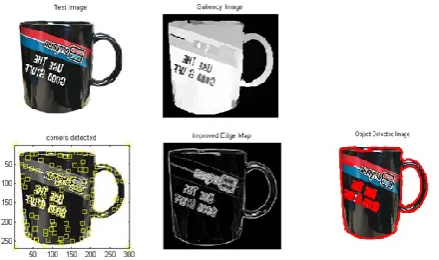
Figure 2. Test image is uploaded, then it finds an salient region, corner detection and edge detection
Figure 3. Similar Images are retrieved from the Database
IV.
CONCLUSIONThis work proposed an effective CBIR system using KNN to retrieve images from databases. Once the user inputted a query image, the proposed CBIR extracted image features like color signature, shape and texture color from the image. Then, database clustering model was explored by using Euclidean distance and using the KNN based similarity measure; images that are relevant to the QI were retrieved efficiently. The conducted experiments based on the Corel image database indicate that the proposed KNN algorithm has strong capability to discriminate color, shape, texture and SOH features. Our proposed CBIR system was evaluated by different images query. The execution results presented the success of the proposed method in retrieving the similar images
from the images database and outperformed the other CBIR systems in terms of average precision and recall rates. This can be represented from the precision and recall values calculated from the results of retrieval.
V.REFERENCES
[1] E. Yildizer, A. M. Balci, M. Hassan, and R. Alhajj, “Efficient content-based image retrieval using Multiple Support Vector Machines Ensemble,” Expert Syst. Appl., vol. 39, no. 3, pp. 2385–2396, 2012.
[2] Y. Xu, J. Gong, L. Xiong, Z. Xu, J. Wang, and Y. qing Shi, “A privacy-preserving content-based image retrieval method in cloud environment,” J. Vis. Commun. Image Represent., vol. 43, pp. 164–172, 2017.
[3] S. Fadaei, R. Amirfattahi, and M. R. Ahmadzadeh, “Local derivative radial patterns: A new texture descriptor for content-based image retrieval,” Signal Processing, vol. 137, pp. 274–286, 2017.
[4] C. Höschl and J. Flusser, “Robust histogram-based image retrieval,” Pattern Recognit. Lett., vol. 69, pp. 72–81, 2016.
[5] A. Kumar et al., “Adapting content-based image retrieval techniques for the semantic annotation of medical images,” Comput. Med. Imaging Graph., vol. 49, pp. 37–45, 2016.
[6] J. Yue, Z. Li, L. Liu, and Z. Fu, “Content-based image retrieval using color and texture fused features,” Math. Comput. Model., vol. 54, no. 3– 4, pp. 1121–1127, 2011.
[7] M. Mehrabi, F. Zargari, M. Ghanbari, and M. A. Shayegan, “Fast content access and retrieval of JPEG compressed images,” Signal Process. Image Commun., vol. 46, pp. 54–59, 2016.
[9] A. Alzu’bi, A. Amira, and N. Ramzan, “Content-based image retrieval with compact deep convolutional features,” Neurocomputing, vol. 249, pp. 95–105, 2017.
[10] D. C. G. Pedronette and R. da S. Torres, “Unsupervised rank diffusion for content-based image retrieval,” Neurocomputing, vol. 260, pp. 478–489, 2017.
[11] A. Manno-Kovacs, “CONTENT BASED IMAGE RETRIEVAL USING SALIENT ORIENTATION HISTOGRAMS Andrea Manno-Kovacs,” Image Process. (ICIP), 2016 IEEE Int. Conf., pp. 2481– 2484, 2016.
[12] A. Manno-Kovacs, “CONTENT BASED IMAGE RETRIEVAL USING SALIENT ORIENTATION HISTOGRAMS Andrea Manno-Kovacs,” Image Process. (ICIP), 2016 IEEE Int. Conf., pp. 2481– 2484, 2016.
[13] D. Feng, N. Barnes, and S. You, “HOSO : Histogram Of Surface Orientation for RGB-D Salient Object Detection.”
[14] J. Zhang, S. Feng, D. Li, Y. Gao, Z. Chen, and Y. Yuan, “Image retrieval using the extended salient region,” Inf. Sci. (Ny)., vol. 399, pp. 1339–1351, 2017.