Original Research Article
Awareness regarding medical ethics in health care practice among the
resident doctors in a tertiary care hospital of the sub-Himalayan region:
a cross sectional study
Anupam Parashar, Nidhi Chauhan, Rahul Gupta*, Vineet Kumar
INTRODUCTION
Bio-ethics i.e. health care ethics is a set of moral principles, beliefs and values that guide us in making choices about medical care. At the core of health care ethics is our sense of right and wrong and our beliefs about rights we possess and duties we owe to others. Globally, health care institutions are facing challenges in issues regarding ethics while organising for delivering services. Many universities and medical colleges are making efforts to introduce it in the curriculum. The
doctor-patient relationship is hampered due to inadequate management of the cases, that lead to sub-optimal service delivery and potentially trigger incidences of violence and abuse. These all are intensified due to non-adherence to healthcare ethics. Evidences of unethical conduct observed by medical professionals have also been reported.1–3
The Hippocratic Oath, created in the late 5th Century BC, was the first major document to serve as a code of ethics in regards to medicine. Since its creation, doctors have
ABSTRACT
Background: Bio-ethics i.e. health care ethics is a set of moral principles, beliefs and values that guide us in making choices about medical care. This novel study was carried out with an objective of assessment of knowledge regarding the medical ethics among the resident doctors of Indira Gandhi Medical College, Shimla Himachal Pradesh.
Methods: This descriptive analytical cross-sectional study was conducted at Indira Gandhi Medical College (IGMC), Shimla, Himachal Pradesh among the resident doctors using predesigned, structured, self-administered anonymous close-ended questionnaire. We analyzed the data using Stata software version 12.
Results: There were a total of 61 study participants, who consented to participate, of which more than half were females (52.5%). The mean age of the study participants was 28.6±0.63 years. Regarding the source of knowledge about medical ethics most of the study participants had acquired the information during their experience at their workplace (42.6%). A majority of the male participants disagreed that confidentiality while providing the health care services should be abandoned (54.3%). More than 90% of the study participants agreed that incorporation of medical ethics is necessary in undergraduate curriculum.
Conclusions: Incorporation of a formal structured teaching on medical ethics in the undergraduate curriculum is the need of the hour. Besides research work, the medical ethics committee in the institution should also act as the guiding hands to address the grievances faced by the doctors during medical practice.
Keywords: Medical ethics, Cross-sectional study, Resident doctors, Health care practice
Department ofCommunity Medicine, Indira Gandhi Medical College, Shimla, Himachal Pradesh, India
Received: 21 November 2018
Revised: 24 December 2018
Accepted: 26 December 2018
*Correspondence:
Dr. Rahul Gupta,
E-mail: [email protected]
Copyright: © the author(s), publisher and licensee Medip Academy. This is an open-access article distributed under the terms of the Creative Commons Attribution Non-Commercial License, which permits unrestricted non-commercial use, distribution, and reproduction in any medium, provided the original work is properly cited.
tried to adhere to its principles when serving the medical community.4 It forms the moral ground of clinical practice and is currently viewed dialectically. But with the relentless progress in medicine, the basis of ethical aspects of clinical practice has been redefined in major documents like Nuremberg code and Helsinki declaration. Autonomy, justice, beneficence and non-maleficence, these four basic principles of medical ethics form the foundation for health professionals to decide what practices are ethical in clinical settings.5,6 Appropriate education of such principles of ethics are, therefore, of utmost importance during early clinical practice for medical students.7
Health personnel are the key pillars of healthcare delivery, so there is an urgent need of standardization and uniformity in medical ethics among all health care professionals.8–10 In the Indian context, where health indicators are poor, the issue of ethics becomes more complex and requires a better understanding and appreciation of the context.11
At present there is also a dearth of teachers and resources for teaching medical ethics. In India the Medical Council of India (MCI) curriculum does not have medical ethics as a separate subject in any of its courses.12 So, it becomes important to encourage medical universities to establish chairs and departments of medical ethics to develop the subject in the country. This novel study was carried out with an objective of assessment of knowledge regarding the medical ethics among the resident doctors of Indira Gandhi Medical College, Shimla Himachal Pradesh.
METHODS
Study population
The study was conducted at Indira Gandhi Medical College (IGMC), Shimla, Himachal Pradesh among the first-year resident doctors pursuing their post-graduation in various departments of the institute. Currently, the intake capacity of postgraduate admission in the college is 90 per year.
Study design
This study was an analytical cross-sectional study.
Study duration
Study was carried out for three months from July to September 2018.
Inclusion criteria
All the first-year residents pursuing their postgraduation in various departments of IGMC Shimla were included in the study.
Exclusion criteria
Residents not present on the day of study in the department, not willing to participate and whose response rate is less than 50% in the prescribed format were excluded from the study.
Data collection tool
Data was collected using a predesigned, structured, self-administered anonymous close-ended questionnaire for our study. The questionnaire consisted of questions regarding demographic characteristics, issues in health care ethics and practices, role of ethics committee, and knowledge about medical codes of ethics.
Study methodology
Before start of the study, participants were told about the purpose of the study and informed consent was taken prior to the commencement of the study. Data regarding various sociodemographic variables and regarding different aspects of medical ethics were collected using data collection tool as described above.
Statistical analysis
We entered and cleaned the data in Microsoft excel spreadsheet. The quantitative variables were described as mean and standard deviation, whereas the qualitative variables were described as proportions and frequencies. We analyzed the data using Stata software version 16. We applied chi square test as a test of significance where ever applicable. Fischer exact test was used wherever the cell frequency of a variable was less than 5. A p-value of less than 0.05 was taken to be statistically significant.
RESULTS
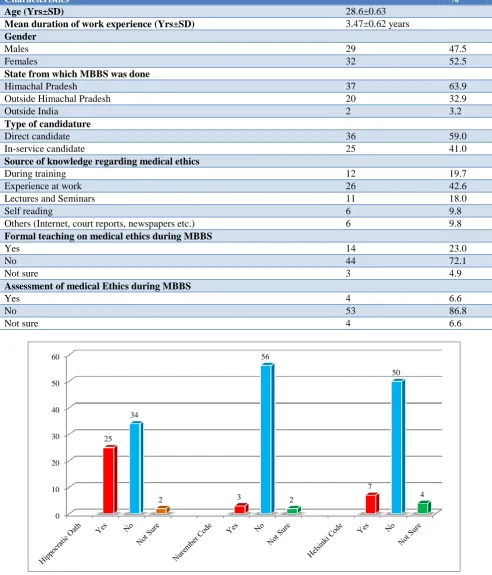
There were a total of 61 study participants, who consented to participate, of which more than half were females (52.5%). The mean age of the study participants was 28.6±0.63 years. A majority of the participants had graduated from Himachal Pradesh and more than half (59%) of them had not joined the government service before taking admission in respective Post Graduate courses. Regarding the source of knowledge about medical ethics most of the study participants had acquired the information during their experience at their workplace (42.6%) followed by non-formal training during their graduation (19.7%). A majority (86.8%) of the participants responded that there was no assessment of medical ethics during their graduation (Table 1).
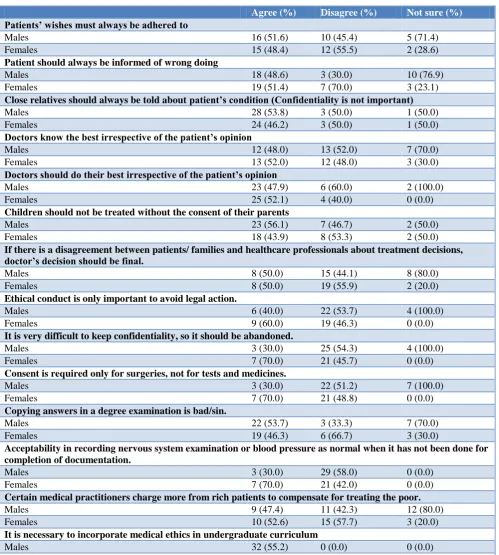
know the best (52.0%) and should do their best irrespective of the patients’ opinion (52.1%). However, they also stated that if there was a disagreement between patients or families and health care professionals about treatment decisions, doctor’s decision should be final
(50%). More than half of the male participants mentioned that parents’ consent is must for treating their children (56.1%). Both males and females disagreed that ethical conduct during health care practice is only important to avoid legal actions (Table 2).
Table 1: Demographic characteristics of the study participants (n=61).
Characteristics %
Age (Yrs±SD) 28.6±0.63
Mean duration of work experience (Yrs±SD) 3.47±0.62 years
Gender
Males 29 47.5
Females 32 52.5
State from which MBBS was done
Himachal Pradesh 37 63.9
Outside Himachal Pradesh 20 32.9
Outside India 2 3.2
Type of candidature
Direct candidate 36 59.0
In-service candidate 25 41.0
Source of knowledge regarding medical ethics
During training 12 19.7
Experience at work 26 42.6
Lectures and Seminars 11 18.0
Self reading 6 9.8
Others (Internet, court reports, newspapers etc.) 6 9.8
Formal teaching on medical ethics during MBBS
Yes 14 23.0
No 44 72.1
Not sure 3 4.9
Assessment of medical Ethics during MBBS
Yes 4 6.6
No 53 86.8
Not sure 4 6.6
Figure 1: Knowledge on ethical codes among the study participants (n=61). 0
10 20 30 40 50 60
25 34
2 3
56
2
7 50
Table 2: Issues regarding health care and practice of health care ethics (n=60).
Agree (%) Disagree (%) Not sure (%)
Patients’ wishes must always be adhered to
Males 16 (51.6) 10 (45.4) 5 (71.4)
Females 15 (48.4) 12 (55.5) 2 (28.6)
Patient should always be informed of wrong doing
Males 18 (48.6) 3 (30.0) 10 (76.9)
Females 19 (51.4) 7 (70.0) 3 (23.1)
Close relatives should always be told about patient’s condition (Confidentiality is not important)
Males 28 (53.8) 3 (50.0) 1 (50.0)
Females 24 (46.2) 3 (50.0) 1 (50.0)
Doctors know the best irrespective of the patient’s opinion
Males 12 (48.0) 13 (52.0) 7 (70.0)
Females 13 (52.0) 12 (48.0) 3 (30.0)
Doctors should do their best irrespective of the patient’s opinion
Males 23 (47.9) 6 (60.0) 2 (100.0)
Females 25 (52.1) 4 (40.0) 0 (0.0)
Children should not be treated without the consent of their parents
Males 23 (56.1) 7 (46.7) 2 (50.0)
Females 18 (43.9) 8 (53.3) 2 (50.0)
If there is a disagreement between patients/ families and healthcare professionals about treatment decisions, doctor’s decision should be final.
Males 8 (50.0) 15 (44.1) 8 (80.0)
Females 8 (50.0) 19 (55.9) 2 (20.0)
Ethical conduct is only important to avoid legal action.
Males 6 (40.0) 22 (53.7) 4 (100.0)
Females 9 (60.0) 19 (46.3) 0 (0.0)
It is very difficult to keep confidentiality, so it should be abandoned.
Males 3 (30.0) 25 (54.3) 4 (100.0)
Females 7 (70.0) 21 (45.7) 0 (0.0)
Consent is required only for surgeries, not for tests and medicines.
Males 3 (30.0) 22 (51.2) 7 (100.0)
Females 7 (70.0) 21 (48.8) 0 (0.0)
Copying answers in a degree examination is bad/sin.
Males 22 (53.7) 3 (33.3) 7 (70.0)
Females 19 (46.3) 6 (66.7) 3 (30.0)
Acceptability in recording nervous system examination or blood pressure as normal when it has not been done for completion of documentation.
Males 3 (30.0) 29 (58.0) 0 (0.0)
Females 7 (70.0) 21 (42.0) 0 (0.0)
Certain medical practitioners charge more from rich patients to compensate for treating the poor.
Males 9 (47.4) 11 (42.3) 12 (80.0)
Females 10 (52.6) 15 (57.7) 3 (20.0)
It is necessary to incorporate medical ethics in undergraduate curriculum
Males 32 (55.2) 0 (0.0) 0 (0.0)
Females 26 (44.8) 2 (100.0) 0 (0.0)
A majority of the male participants disagreed that confidentiality while providing the health care services should be abandoned (54.3%). Nearly one-third of the male participants disagreed that consent was required only for performing surgeries and not for conducting investigations and providing medications. It was also found that more than half of the females disagreed that certain medical practitioners charged more from rich
patients to compensate for treating the poor (52.6%) whereas most of the male participants were not so sure about it (80%). More than 90% of the study participants agreed that incorporation of medical ethics is necessary in undergraduate curriculum (Table 2).
participants was to ensure standard ethical practices among health care personnel and to advise them in case they encountered ethical/legal problems. Males (56.4%) agreed more than females (43.6%) that role of the medical ethics committee was also to advise administration on ethics and rules in the institution.
Additionally, the majority of the participants replied that other roles of Medical Ethics committee was also to approve and guide research, teach medical ethics and to conduct conferences and workshops on various issues of ethical importance (Table 3).
Table 3: Responses regarding ethics committees (n=60).
Role of a medical ethics committee Yes (%) No (%) Not sure (%)
Ensure standard ethical practices among healthcare personnel
Males 31 (53.4) 0 (0.0) 0 (0.0)
Females 27 (46.6) 1 (100.0) 1(100.0)
Advise healthcare personnel when they encounter ethical/legal problems
Males 28 (50.9) 2 (66.7) 2 (100.0)
Females 27 (49.1) 1 (33.3) 0 (0.0)
Advise the administration on ethics and rules in the institution
Males 31 (56.4) 0 (0.0) 0 (0.0)
Females 24 (43.6) 3 (100.0) 2 (100.0)
Approve and guide research
Males 24 (53.3) 4 (40.0) 3 (60.0)
Females 21 (46.7) 6 (60.0) 2 (40.0)
Settle conflicts between professionals and patients’ relatives
Males 18 (52.9) 11 (55.0) 1 (16.7)
Females 16 (47.1) 9 (45.0) 5 (83.3)
Teach Medical Ethics to students
Males 28 (53.8) 2 (40.0) 1 (33.3)
Females 24 (46.2) 3 (60.0) 2 (66.7)
Conduct conferences and workshops on various issues of ethical importance
Males 22 (48.9) 3 (50.0) 6 (66.7)
Females 23 (51.1) 3 (50.0) 3 (33.3)
Table 4: Participants knowledge of healthcare ethics (n=60).
Variables N Proportion (%)
Importance of ethics knowledge in work
Very 50 83.3
Moderately 10 16.7
Entertain patients’ questions during their visits
Yes 53 88.3
No 7 11.7
How often you come across ethical issues during your practice
Daily 18 30.0
Weekly 16 26.7
Monthly 11 18.3
Yearly 9 15.0
Never 6 10.0
How often patients ask about their diagnosis
Never 1 1.7
Seldom 27 45.0
Always 32 53.3
Discuss daily cases with colleagues
Seldom 31 51.7
Always 29 48.3
Any training in bioethics
Yes 6 10.0
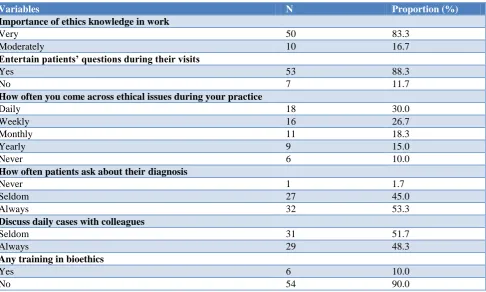
Out of the 60 respondents, 83% of them were of the opinion that the knowledge of ethics was very important at work. 30% of the participants reported that they came across ethical issues during practice on daily basis. More than half of the participants mentioned that they discussed daily cases with their colleagues quite often (52%). When asked whether they had ever taken informed consent, majority of them (71%) had taken written consent, whereas only a few of them had taken both verbal and signed consent. However, only 5% of the respondents had never taken an informed consent. In case of any ethical problem the participants preferred to consult ethics committee (18%) alone, followed by head of department and colleagues. While others would prefer consulting textbooks or internet, rest of them would prefer to consult colleagues, hospital administrator and ethics committee collectively (Table 4).
DISCUSSION
Medical ethics is concerned with moral values and judgment as it applies to medicine.13 Ethics education aims to help medical students understand moral principles, analyse and define their own values.14 Owing to increasing privatization and commercialization of healthcare service delivery, the role of ethics in healthcare practice is being belittled. The rising awareness among the general public regarding their rights of receiving the best health care services and declining efficiency either due to dearth of knowledge or non-adherence of the medical ethics is pushing the doctors more into the legal issues. Hence, it becomes imperative that medical ethics be taught and strictly adhered to avoid such litigations. In our study we found that the source of information of ethics during health care practice was mostly during experience at work. A study done by Aacharya et al found that the most common source of obtaining knowledge in medical ethics was lectures/ seminars which is not in similar lines with our study.15 According to our study, we found that the majority of the study participants disagreed that they were taught or ever assessed regarding the medical ethics as a part of their syllabus during their undergraduate course. Training in medical ethics has been made mandatory in the undergraduate curriculum by the regulatory body of medical education, the Medical Council of India (MCI). MCI in 2002 released its code of ethics which was a regulatory document on professional conduct, etiquette, and ethics of doctors.16
Majority of the participants in our study agreed that patients wishes must always be adhered to which is very less as compared to the study conducted by Iswarya et al.14 The participants, however, also agreed that doctors should do their best irrespective of the patients’ wishes which is not in concordance with the study done by Bhardwaj et al.17 Most of the study participants in our study disagreed that confidentiality should be abandoned.
A study done by Singh et al also reported the same findings.18
CONCLUSION
The role of ethics is inevitable in day to day health care practice, not only in tertiary medical colleges but also for the health professionals who are providing services in primary as well as secondary health care institutions. The main source of knowledge regarding medical ethics is through experience acquired at work. A majority of the medical officer’s face issues related to medical ethics frequently. Moreover, no formal teaching on medical ethics is imparted during MBBS course, nor to residents during their residency period.
Recommendations
Incorporation of a formal structured teaching on medical ethics in the undergraduate curriculum is the need of the hour, which should be followed by assessment on periodic basis. Not only this, heuristic training should also be provided for the medical officers frequently. During the residency of doctors in the medical colleges, a structured teaching package should be provided in the form of continuous medical education (CME), workshops, seminars as well as lectures, followed by regular evaluation. Besides research work, the medical ethics committee in the institution should also act as the guiding hands to address the grievances faced by the doctors during medical practice.
Funding: No funding sources Conflict of interest: None declared
Ethical approval: The study was approved by the Institutional Ethics Committee
REFERENCES
1. Baldwin Jr D, Daugherty SR, Rowley BD. Unethical and unprofessional conduct observed by residents during their first year of training. Acad Med. 1998;73(11):1195–200.
2. Ulrich CM, Taylor C, Soeken K, O’Donnell P, Farrar A, Danis M, et al. Everyday ethics: ethical issues and stress in nursing practice. J Adv Nurs. 2010;66(11):2510–9.
3. Feudtner C, Christakis DA, Christakis NA.Do clinical clerks suffer ethical erosion? Students’ perceptions of their ethical environment and personal development. Acad Med. 1994;69(8):670– 9.
4. Hippocratic Oath. Available at: https://rampages. us/univ200hippocraticoath /2016/ 04/21 /introduction. Accessed on 18 August, 2018. 5. Summers J, Morrison E. Principles of healthcare
6. Beauchamp TL, Childress JF. Principles of biomedical ethics. USA: Oxford University Press; 2001: 1-12.
7. Kalantri S. Ethics in medical education. Indian J Anaesth. 2003;47(6):435–6.
8. Oberle K, Hughes D. Doctors’ and nurses’ perceptions of ethical problems in end-of-life decisions. J Adv Nurs. 2001;33(6):707–15.
9. Walker RM, Miles SH, Stocking CB, Siegler M. Physicians’ and nurses’ perceptions of ethics problems on general medical services. J Gen Intern Med. 1991;6(5):424–9.
10. Mckay K, Narasimhan S. Bridging the gap between doctors and nurses. J Nurs Educ Pract. 2012;2(4):52. 11. Chatterjee C, Srinivasan V. Ethical issues in health care sector in India. IIMB Management Review. 2013;25:5.
12. Medical Council of India. Salient features of regulations on graduate medical education, Gazette of India. 1997;part III, section 4. Available from: https://old.mciindia.org/RulesandRegulations/Gradu ateMedicalEducationRegulations1997.aspx. Accessed on 21 November 2018.
13. Baldwin DC, Dughtery SR, Rowley BD. Unethical and Unprofessional conduct observed by residents during their first year of training. Acad Med. 1998;73:1195-200.
14. Iswarya S, Bhuvaneshwari S. Knowledge and attitude related to medical ethics among medical
students. Int J Community Med Public Health. 2018;5(6):2222-5.
15. Aacharya RP, Shakya YL. Knowledge, attitude and practice of medical ethics among medical intern students in a Medical College in Kathmandu. Bangladesh J Bioethics. 2015;6(3):1-9.
16. MCI. Indian Medical Council. Professional Conduct, Etiquette and Ethics Regulations, 2002. Gazette of India. 2002;Part-III-Sec-4. Available from: https://www.mciindia.org/documents/rules AndRegulations/Ethics%20Regulations-2002.pdf. Accessed on 21 November 2018.
17. Bhardwaj A, Chopra M, Mithra P, Singh A, Siddiqui A, Rajesh DR. Current status of knowledge, attitudes and practices towards healthcare ethics among doctors and nurses from Northern India - A multicentre study. Pravara Medical Rev. 2014;6(2):4-8.
18. Singh S, Sharma PK, Bhandari B, Kaur R. Knowledge, awareness and practice of ethics among doctors in tertiary care hospital. Indian J Pharmacol. 2016;48(1):89-93.