Original Research Article
Public health concern on occupational hazards among pathologists and
microbiologists in Mysuru district, India
D. Sunil Kumar
1*, G. Anup
2, Praveen Kulkarni
1, Nayana Shabadi
1, M. R. Narayana Murthy
1INTRODUCTION
Pathologists and Microbiologists who work at the microscope for long hours are at a high risk of musculoskeletal and ophthalmic disorders. Also, they are at the risk of exposure to infective agents and chemicals. Most of them do not realise these hazards and neglect the symptoms which can lead to disabilities and diseases. The Centres for Disease Control and Prevention (CDC) has recommended Laboratory Ergonomics to help
minimise such occupational hazards. Laboratory
researchers are at risk for repetitive motion injuries during routine laboratory procedures such as pipetting, working at microscopes, operating microtomes, using cell counters and video display terminals. Repetitive motion injuries develop over time and occur when muscles and joints are stressed, tendons are inflamed, and nerves are pinched, and the flow of blood is restricted. Standing and
working in awkward positions in laboratory
hoods/biological safety cabinets can also present
ABSTRACT
Background: Highly qualified and trained medical specialists such as Pathologists and Microbiologists who need to work at the microscope for long hours are at a high risk of musculoskeletal and ophthalmic disorders. This study is an attempt to identify such potential occupational hazards with the objectives to estimate the magnitude of occupational hazards among Pathologists and Microbiologists in Mysuru, and to assess the factors influencing these hazards among the study participants.
Methods: This cross-sectional study was conducted among the Pathologists and Microbiologists of Mysuru district over a period of six months, a total of 45 study participants were included. An online self-administered questionnaire was sent to the study participants through e-mail and asked to fill and submit online, keeping complete confidentiality, and with informed consent. The results were analysed using appropriate statistical methods.
Results: Pathologists and Microbiologists in almost equal proportions consented and took part in the study. 67% of them reported work related musculoskeletal problems, and 42% had visual refractive errors, mostly myopia. 9% of them reported to have experienced occupational injuries, mostly needle-stick injuries. None of them reported to smoke. Majority were happy with the work atmosphere and environmental conditions. Most of them were positive about the work-related situation in the coming years.
Conclusions: This study found that more than half of the pathologists and microbiologists are exposed to occupational hazards and have suffered musculoskeletal, ophthalmic morbidities and had injuries, but none of which were life-threatening. Most of the risk factors are avoidable through ergonomic equipment and training.
Keywords: Occupational hazards, Pathologists, Microbiologists, Musculoskeletal disorders 1
Department of Community Medicine, JSS Medical College, Mysuru, Karnataka, India 2
Apollo BGS Hospitals, Mysuru, Karnataka, India
Received: 28 November 2018
Revised: 04 January 2019
Accepted: 07 January 2019
*Correspondence:
Dr. D. Sunil Kumar,
E-mail: [email protected]
Copyright: © the author(s), publisher and licensee Medip Academy. This is an open-access article distributed under the terms of the Creative Commons Attribution Non-Commercial License, which permits unrestricted non-commercial use, distribution, and reproduction in any medium, provided the original work is properly cited.
ergonomic problems. By becoming familiar with how to control laboratory ergonomic risk factors, you can improve employee comfort, productivity, and job satisfaction while lowering chances for occupational injuries.1
The musculoskeletal disorders have a huge impact in the health care settings, emerging as a new growing problem in our modern societies; they contribute to the second largest cause of short‑term or temporary work disability
after the common cold.2,3 The work‑related
musculoskeletal disorders are responsible for morbidity in health care working populations and are known as an
important occupational problem with increasing
compensation and health costs, reduced productivity, and lower quality of life.4 They are caused by multifactorial conditions and cannot be downsized to a single causative factor which are also reported to cause lost work time or absenteeism, increase work restriction, transfer to another job, or disability than any other group of diseases with a considerable economic burden on the individual, the organization and the society as a whole.5-10
The musculoskeletal disorders are the most expensive form of work disability which affect both the individuals and the health care system management. India is going the double burden of the health and diseases like communicable diseases are already existing and now the non-communicable diseases are also in the raise. Studies have shown that musculoskeletal disorders are among the major occupational health problems in India and estimates have shown that the contribution is to about 30% of all costs toward the treatment of work‑related injuries.11 Health care profession and workers are known to be at high risk and are reported to be vulnerable to sustaining musculoskeletal disorders during their routine work. So, the current study is focused on the occupational hazards and musculoskeletal problems of the health care professionals to estimate the magnitude of occupational hazards among Pathologists and Microbiologists and to assess the factors influencing these hazards among the study participants around the Mysuru district, Karnataka, India.
METHODS
This cross-sectional study was conducted among the Pathologists and Microbiologists of Mysuru district over a period of six months. The study participants were enrolled from the two medical colleges of Mysuru (Mysore Medical College and JSS Medical College) and those working in private laboratories across Mysuru district and all those who were willing and consenting to participate were included in the study. After obtaining Institutional Ethics Committee approval, the study was conducted over a period of six months from January 2018 to June 2018. Sample size was calculated by Raosoft online sample size calculator the final number came to 45 with the margin of 15% relative allowable error and the
confidence level of 95% with the response distribution of 50%.12
An online self-administered semi structured questionnaire was sent to the study participants through e-mail and asked to fill and submit online, keeping complete confidentiality, and with informed consent. Those who did not respond online were interviewed personally and data was collected. The first part of the questionnaire consists of information regarding the socio demographic characteristics and the second part consists of questions regarding the position, years of experience, mean weekly hours of work, work load manageable in regular working time, workflow for research/teaching/administration, workplace ergonomics and musculoskeletal problems etc.
Statistical analysis
Data collection and entry was done using Google Forms and Google Docs (https://www.google.co.in/docs), from which summary statistics was obtained. The data collected were entered in MS Excel 2010 and analysed using SPSS version 22 (Chicago, IBM, SPSS Inc.). Descriptive statistics such as mean, and SD were applied. Inferential statistical tests such as one proportion Z test, Chi-square test and Fisher’s exact test were applied. The associations and differences were interpreted statistically significant at p<0.05.
RESULTS
45 Pathologists and Microbiologists consented and participated in the study. Table 1 shows the general characteristics of study participants. 37.8% of study participants were male and 62.2% of study participants were female, maximum 37.8% belonged to the age group of 36–45. 60% pathologists and 40% microbiologists constituted the group of health professionals and majority 84.4% of them were working in a teaching hospital. 88.9% had research/teaching/administration as a relevant part of working time, 62.2% of them were not indulged in any form of exercise/physical activity. 57.8% participants felt good for work-related situation in terms of the next two years. 75.6% had less than 50 hours weekly working hours and full-time work. 97.8% participant were able to manage their workload in the regular working time. In the workflow management 88.9% had organized efficiently. The medical relevance of the discipline in terms of the next 5-10 years 48.9% felt that is going to increase.
Table 1: General characteristics of study participants.
Parameter Number (%)
Gender
Male 17 (37.8)
Female 28 (62.2)
Age group (in years)
25-35 15 (33.3)
36-45 17 (37.8)
46-55 10 (22.2)
>55 3 (6.7)
Speciality
Pathology 27 (60)
Microbiology 18 (40)
Place of work
Private practice 6 (13.3)
Teaching hospital 38 (84.4)
Non-teaching hospital 1 (2.2)
Research/teaching/administration relevant parts of working time
Yes 40 (88.9)
No 5 (11.1)
Exercise
Endurance 7 (15.5)
Muscle 6 (13.3)
Yoga 4 (8.9)
None 28 (62.2)
Work-related situation in terms of the next two years
Very good 9 (20)
Good 26 (57.8)
Rather bad 10 (22.2)
Weekly hours of work
<50 34 (75.6)
50–60 9 (20)
>60 2 (4.4)
Part time
Yes 2 (4.4)
No 43 (95.6)
Work load manageable in regular working time
Yes 44 (97.8)
No 1 (2.2)
Workflow predominantly organized efficiently
Yes 40 (88.9)
No 5 (11.1)
Work-related situation in terms of the next 5 years
Very good 10 (22.2)
Good 26 (57.8)
Rather Bad 8 (17.8)
Bad 1 (2.2)
Medical relevance of the discipline in terms of the next 5-10 years
Decreasing 3 (6.7)
Remaining the same 20 (44.4)
Increasing 22 (48.9)
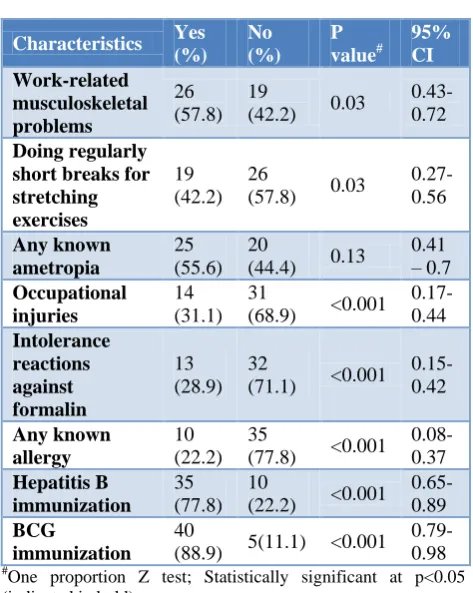
Table 2: Health characteristics of the study participants.
Characteristics Yes (%) No (%) P value# 95% CI Work-related musculoskeletal problems 26 (57.8) 19
(42.2) 0.03
0.43- 0.72
Doing regularly short breaks for stretching exercises
19 (42.2)
26
(57.8) 0.03
0.27- 0.56 Any known ametropia 25 (55.6) 20
(44.4) 0.13
0.41 – 0.7 Occupational injuries 14 (31.1) 31
(68.9) <0.001 0.17- 0.44 Intolerance reactions against formalin 13 (28.9) 32
(71.1) <0.001 0.15- 0.42 Any known allergy 10 (22.2) 35
(77.8) <0.001 0.08- 0.37 Hepatitis B immunization 35 (77.8) 10
(22.2) <0.001 0.65- 0.89
BCG
immunization
40
(88.9) 5(11.1) <0.001 0.79- 0.98 #
One proportion Z test; Statistically significant at p<0.05 (indicated in bold)
Figure 1: Distribution of musculoskeletal problems based on the part of body affected among the study
participants.
Figure 1 shows the region-wise distribution of musculoskeletal problems among the study participants, majority of them had back pain, neck and shoulder pains. Figure 2 shows the type of injury among the study participants where 94.1% needle stick injury, 64.7% cuts and 41.2% had splash on to mucous membranes. Figure 3: Type of allergen among the study population, majority of them had allergy to dust and pollen grains.
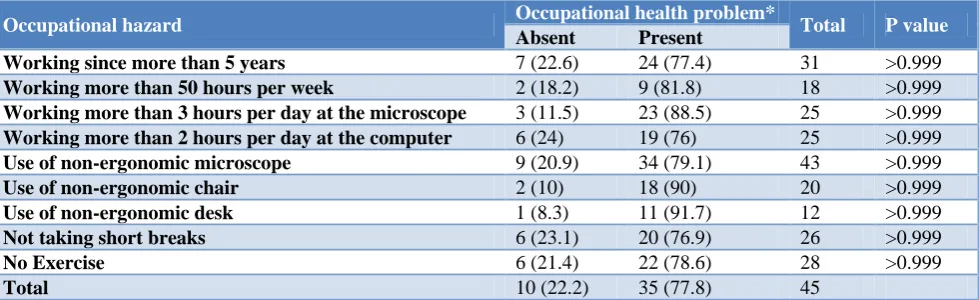
Table 3 shows factors influencing occupational health where majority of the participants Working since more than 5 years, more than 50 hours per week, more than 3 hours at the microscope, 2 hours on the computer, use of
76.9
69.2
38.5 38.5
3.8 0 10 20 30 40 50 60 70 80 90 100
Neck Shoulder Lower back Upper back Arm / hand
Perc
entag
e
non-ergonomic microscope, non-ergonomic chair and desk had experienced the occupational health problems.
Figure 2: Type of injury among the study participants.
Figure 3: Type of allergen among the study population.
Table 3: Factors influencing occupational health.
Occupational hazard Occupational health problem* Total P value
Absent Present
Working since more than 5 years 7 (22.6) 24 (77.4) 31 >0.999
Working more than 50 hours per week 2 (18.2) 9 (81.8) 18 >0.999
Working more than 3 hours per day at the microscope 3 (11.5) 23 (88.5) 25 >0.999
Working more than 2 hours per day at the computer 6 (24) 19 (76) 25 >0.999
Use of non-ergonomic microscope 9 (20.9) 34 (79.1) 43 >0.999
Use of non-ergonomic chair 2 (10) 18 (90) 20 >0.999
Use of non-ergonomic desk 1 (8.3) 11 (91.7) 12 >0.999
Not taking short breaks 6 (23.1) 20 (76.9) 26 >0.999
No Exercise 6 (21.4) 22 (78.6) 28 >0.999
Total 10 (22.2) 35 (77.8) 45
*Occupational health problem: having at least one of exact test; Statistically significant at p<0.05.
DISCUSSION
The public health concern on occupational hazards among pathologists and microbiologists in developing country like India is most needed. As most of the health care settings are still under the process of upgrading and lack the basic minimum application of the concept of ergonomics in the workplace.
In this present study the gender profile shows that most of the study participants were female and many of the previous studies reported the similar pattern of musculoskeletal disorders being more among females. Yasobantet al, the prevalence of occupational hazards and morbidity related to musculoskeletal disorders are more among pathologists which are in the younger and middle-aged group with the experience of more than 5 years, this may be due to more stress and work load at the early stage of their career, similar findings were observed in a study done by Fritzsche et al.13,14
The health care professionals who are working in the teaching hospital and involved in research, teaching and/or administration during working hours along with
their routine clinical work have experienced more work-related musculoskeletal problems which were similar to the study done by Yasobant et al, which showed that those professionals involved in both clinical as well as academic work (32.4%) have 1.1 times higher chance of developing WMSDs (Work related Musculoskeletal Disorders) as compared with those who are exclusively involved in clinical work.13
The regions of musculoskeletal problems among the study participants were back pain, neck pain and shoulder pains, the prevalence of upper extremity symptoms in working populations is estimated to be between 20%-30%.15
More than half of our study participants experienced the visual problems like ametropia which has proven by past studies where visual refractive errors are more common in pathologists than in the general population, university students or other hospital workers.16-21 It is possible that ametropic students may choose more likely to enter this discipline. On the other hand, the work of pathologists is associated with possibly eye-straining activities such as long-lasting microscopy and computer work.22-25 The
41.2 64.7
94.1
0 50 100
Splash onto mucous membranes
Cuts Needle stick
Percentage
Ty
pe of
injury*
40
30
10 10
0 10 20 30 40 50 60 70 80 90 100
Dust Pollen Proton pump inhibitors
Stains
Pe
rc
entage
aggravation of ametropia while working in pathology, experienced by 50% of participants, might be part of the normal time course of conventional myopia, yet it may also be associated with the continuous near-field work required.26
One third of them suffered from occupational injuries such as needle stick, cuts and splash on to mucous membrane, fortunately 80% of them were immunized with hepatitis B and BCG which even the developed countries are experiencing and the hepatitis B immunization levels among Swiss pathologists were high compared to subjects in present study. About 5% of pathologists, almost exclusively senior consultants, reported being insufficiently immunized. Tuberculosis is often considered a ‘pathologists’ disease’ and has been demonstrated to affect pathologists much more often than the general population and other professional medical groups. Fritzsche et al, also found that almost 80% of pathologists had a BCG vaccination during their lifetime.14 Six to 10% of positive skin tests are thought to be attributable to a previous BCG vaccination but after more than 10 years after the vaccination it should no longer be considered in the interpretation of a positive test result
Intolerance reactions against formalin and allergies were found among one third of the study subjects which were similar to past studies where Intolerance reactions to formalin were reported by 25% of pathologists but specific allergies against formalin’s well as against latex are rare. The use of formaldehyde and its adverse effects needs a further research or any alternate for the use. None of our study participants ever smoked which shows that the banning of smoking in hospital premises and the effective implementation of the cigarettes and other tobacco products act have shown the positive results.
The factors influencing occupational health where majority of the participants working since more than 5 years, more than 50 hours per week, more than 3 hours at the microscope, 2 hours on the computer, use of non-ergonomic microscope, non-non-ergonomic chair and desk had experienced the occupational health problems, which is in agreement with a study by Lorusso et al where
increased working hours were associated with
musculoskeletal problems, other factors such as working time at the microscope/ computer or ergonomic workplace settings.27
CONCLUSION
This study found that more than half of the pathologists and microbiologists are exposed to occupational hazards and have suffered from musculoskeletal, ophthalmic morbidities and needle stick injuries, but none of which were life-threatening. Most of the risk factors are avoidable through ergonomic equipment and training. Workplace ergonomics must be implemented through training of the consultants as well as through upgrading
to ergonomically designed laboratory equipment. Focus needs to be placed on health education regarding workplace ergonomics especially selection and use of ergonomic microscope, chair and desk. Also, personal protection measures such as cut resistant gloves, protective eyewear and masks need to be used to prevent occupational injuries especially needle stick injury, and protect splash on mucosal surfaces.
ACKNOWLEDGEMENTS
We are thankful to all the pathologists and microbiologists of Mysuru who took out time from their busy schedule and consented to participate in this study. Thankful to the department of community medicine, JSS Medical College, Mysuru.
Funding: No funding sources Conflict of interest: None declared
Ethical approval: The study was approved by the Institutional Ethics Committee
REFERENCES
1. CDC. Laboratory Ergonomics. URL available from http://ehs.uky.edu/docs/pdf/ohs_lab_ergonomics_00 01.pdf. Accessed 22 November 2018.
2. Yelin EH, Felts WR. A summary of the impact of musculoskeletal conditions in the United States. Arthritis Rheum. 1990;33:750‑5.
3. Yelin EH, Henke CJ, Epstein WV. Work disability among persons with musculoskeletal conditions. Arthritis Rheum. 1986;29:1322‑33.
4. Karwowski W, Marras WS. Occupational
ergonomics: Principles of work design. Florida: CRC Press; 2003.
5. Aptel M, Aublet‑Cuvelier A, Cnockaert JC. Work related musculoskeletal disorders of the upper limb. Joint Bone Spine. 2002;69:546‑55.
6. Kilbom A. Editorial/Prevention of work‑related musculoskeletal disorders in the workplace. Int J Ind Ergon. 1998;21:1‑3.
7. Badley EM, Rasooly I, Webster GK. Relative importance of musculoskeletal disorders as a cause of chronic health problems, disability, and healthcare utilization: Findings from the 1990 Ontario Health Survey. J Rheumatol. 1994;3:505‑ 14.
8. Riihimaki H. Editorial: Hands up or back to work– future challenges in epidemiologic research on musculoskeletal diseases. Scand J Work Environ Health. 1995;21:401‑3.
9. Leijon M, Hensing G, Alexanderson K. Gender trends in sick listing with musculoskeletal symptoms in a Swedish county during a period of rapid increase in sickness absence. Scand J Soc Med. 1998;26:204‑13.
injuries (licentiate thesis). Solna, Sweden: National institute of occupational health; 1994.
11. European Agency for Safety and Health at Work Fact Sheet. Available at: http://www.osha.europa. eu. Accessed 22 November 2018.
12. Sample size calculator. Available at: http://www.
raosoft.com/samplesize.html. Accessed 15
December 2017.
13. Yasobant S, Rajkumar P. Work-related
musculoskeletal disorders among health care professionals: A crosssectional assessment of risk factors in a tertiary hospital, India. Indian J Occup Environ Med. 2014;18:75-81.
14. Fritzsche. Occupational health risks of pathologists - results from a nationwide online questionnaire in Switzerland. BMC Public Health. 2012;12:1054.
15. Punnett L, Wegman DH. Work-related
musculoskeletal disorders: the epidemiologic evidence and the debate. J Electromyogr Kinesiol. 2004;14(1):13–23.
16. Logan NS, Davies LN, Mallen EA, Gilmartin B. Ametropia and ocular biometry in a U.K. university student population. Optom Vis Sci. 2005;82(4):261– 6.
17. Kinge B, Midelfart A, Jacobsen G. Refractive errors among young adults and university students in Norway. Acta Ophthalmol Scand. 1998;76(6):692– 5.
18. Risovic DJ, Misailovic KR, Eric-Marinkovic JM, Kosanovic-Jakovic NG, Milenkovic SM, Petrovic LZ. Refractive errors and binocular dysfunctions in a population of university students. Eur J Ophthalmol. 2008;18(1):1–6.
19. Hendricks TJ, de Brabander J, Vankan-Hendricks MH, van der Horst FG, Hendrikse F, Knottnerus JA. Prevalence of habitual refractive errors and anisometropia among Dutch schoolchildren and
hospital employees. Acta Ophthalmol.
2009;87(5):538–43.
20. Onal S, Toker E, Akingol Z, Arslan G, Ertan S, Turan C, Kaplan O. Refractive errors of medical students in Turkey: one-year follow-up of refraction and biometry. Optom Vis Sci. 2007;84(3):175–80. 21. Fehlsichtigkeiten (Ametropia). Available at:
http://www.augeninfo.de/stat_db/fehls.php. Accessed on 3 August 2018.
22. Korniushina TA: Physiological mechanisms of the etiology of visual fatigue during work involving visual stress. Vestn Oftalmol. 2000;116(4):33–6. 23. Mutti DO, Zadnik K. Is computer use a risk factor
for myopia? J Am Optom Assoc. 1996;67(9):521– 30.
24. Rosenfield M. Computer vision syndrome: a review of ocular causes and potential treatments. Ophthalmic Physiol Opt. 2011;31(5):502–15. 25. Blehm C, Vishnu S, Khattak A, Mitra S, Yee RW.
Computer vision syndrome: a review. Surv Ophthalmol. 2005;50(3):253–62.
26. Rosenfield M, Gilmartin B. Myopia and nearwork: causation or merely association? In: Myopia & Nearwork. Edited by Rosenfield M, Gilmartin B. Oxford: Butterworth-Heinemann; 1998: 193–206. 27. Lorusso A, Bruno S, Caputo F, L'Abbate N. Risk
factors for musculoskeletal complaints among microscope workers. G Ital Med Lav Ergon. 2007;29(4):932–7.