Original Research Article
A cross sectional study to assess the awareness and practice about cough
etiquettes among respiratory symptomatic patients in Tamil Nadu
Prateek Saurabh Shrivastava, Saurabh RamBihariLal Shrivastava*
INTRODUCTION
The emergence of respiratory infections has been attributed to the exposure of human beings to the wide gamut of airborne pathogens.1 Respiratory infections have a significant impact on health worldwide. Most acute respiratory infections are caused by rhinovirus, influenza A and B viruses, para-influenza viruses, or adenovirus, tubercle bacillus, pneumococcus, etc. 21st century has seen emergence of new respiratory viruses viz. severe acute respiratory syndrome coronavirus,
human meta-pneumovirus, coronaviruses NL 63, etc. These infections spread mainly by droplets generated by coughing or sneezing. Hands are a major alternative means for spread, either directly or indirectly.2,3 Airborne infection control guidelines specific to developed and developing nations have been developed by multiple international agencies for the benefit of the health care providers and the general population.4 The proposed measures broadly comprise of interventions in three major aspects namely, administrative control; environmental control; and personal respiratory protective measures.4,5
ABSTRACT
Background: The emergence of respiratory infections has been attributed to the exposure of human beings to the wide gamut of airborne pathogens. Cough etiquette and respiratory hygiene have been recommended as tools to reduce such transmission.
Methods: A cross-sectional descriptive study was conducted among respiratory symptomatic patients attending urban
and rural health training centre of a tertiary care hospital for 6 months duration (October 2018 to March 2019) to study their knowledge and practices related to cough etiquettes. A total of 240 study subjects were interviewed face to face with the help of a semi-structured questionnaire after obtaining their written informed consent. The study findings were recorded in an Excel sheet and analysis was done using SPSS version 20.
Results: Correct knowledge about cough etiquettes was found in only 22 (9.1%) participants. Almost half of the participants 122 (50.8%) covering mouth and nose with hands while only 14 (9.7%) were using of face mask during bouts of coughing. Barriers to preventive practices were lack of awareness about cough etiquettes and hand hygiene in 14.1% and 66.3%, respectively followed by severity and frequency of bouts of cough in 29 (12.1%) subjects.
Conclusions: Knowledge and practice of cough etiquette was not found to be satisfactory in the present study. Thus,
it is high time to address this issue and bridge the gap in knowledge as well as practice of cough etiquette among the general population in order to reduce the person to person transmission and thereby decreasing the burden of respiratory infection.
Keywords: Cough etiquette, Hand hygiene, Respiratory infections
Department of Community Medicine, Shri Sathya Sai Medical College and Research Institute, Sri Balaji Vidyapeeth - Deemed to be University, Ammapettai, Nellikuppam, Chengalpet, Tamil Nadu, India
Received: 17 August 2019
Revised: 30 August 2019
Accepted: 04 September 2019
*Correspondence:
Dr. Saurabh RamBihariLal Shrivastava, E-mail: [email protected]
Copyright: © the author(s), publisher and licensee Medip Academy. This is an open-access article distributed under
the terms of the Creative Commons Attribution Non-Commercial License, which permits unrestricted non-commercial use, distribution, and reproduction in any medium, provided the original work is properly cited.
The World Health Organization, and other international agencies, recommend the application of and compliance with basic infection control precautions known as non-pharmaceutical interventions (NPI) as the cornerstone to prevent transmission of droplet-spread epidemic-prone diseases in health care facilities.6,7 Cough etiquette and respiratory hygiene (as a part of administrative as well as personal control measure) have been recommended as tools to reduce the transmission of M. tuberculosis, but these practices are rarely observed.8,9 These protective measures are referred to as measures of outward protection, in which an infected patient can limit spread of organisms, which is even more important at the population level. Different photographic techniques have demonstrated that covering the mouth while coughing reduces droplet production.10 Cough etiquette is especially important for infection control in healthcare settings, such as emergency departments, doctor’s offices, and clinics to prevent the transmission of allrespiratory infections, including influenza. Hence, this study was conducted to assess the awareness and practices regarding cough etiquettes among respiratory symptomatic patients attending a tertiary care hospital.
METHODS
A cross-sectional descriptive study was conducted among respiratory symptomatic patients at a tertiary care hospital for 6 months duration (October 2018 to March 2019). All patients suffering from cough and/or common cold due to any etiology attending urban health training centre and rural health training centre of Shri Sathya Sai Medical College and Research Institute during the study period were included as study population. The study participants were selected based on the following inclusion criteria.
Inclusion criteria
Inclusion criteria were any subject who is above 18 years of age and suffering from cough and/or common cold due to any etiology; any subject who is willing to participate in the study.
Using purposive sampling, a total of 250 patients, more than 18 years of age, with respiratory symptoms were found to be available as the study sample. Out of these 250 patients, 10 patients did not give consent for the study so they were also excluded from the study. Thus, a total of 240 study subjects were available as the final sample size.
Each participant was then interviewed face to face with the help of a semi-structured questionnaire after obtaining their written informed consent. The questionnaire comprised of information pertaining to the socio-demographic profile, awareness about transmission of
class was ascertained using Modified B G Prasad classification.
Operational definition
Cough etiquette includes respiratory hygiene and hand hygiene. (a) Respiratory hygiene was defined as “Covering mouth and nose with a tissue or mask when coughing or sneezing. Disposing the used tissues and masks and performing hand hygiene after contact with respiratory secretions. If a tissue is not available, then coughing or sneezing into the elbow or sleeve and not in hands; (b) hand hygiene was defined as “Hand washing with soap for 40-60 seconds rubbing all surfaces; rinsing hands and drying thoroughly with a single use towel and using towel to turn off faucet or Hand rubbing with disinfectant for 20-30 seconds enough product to cover all areas of the hands; rub hands until dry”.
Ethical considerations
Ethical clearance was obtained from the Institutional Ethics Committee prior to the start of the study. Written informed consent was obtained from the study participants before obtaining any information from them. Utmost care was taken to maintain privacy and confidentiality.
Statistical analysis
Data entry was done in Microsoft Excel and statistical analysis was done using SPSS Version 20. Frequency distribution was calculated for all the variables.
RESULTS
Table 1 shows that majority 112 (46.7%) of the participants belonged to 40 to 60 years age group and 179 (74.6%) and 167 (69.6%) were Hindu by religion and married respectively.
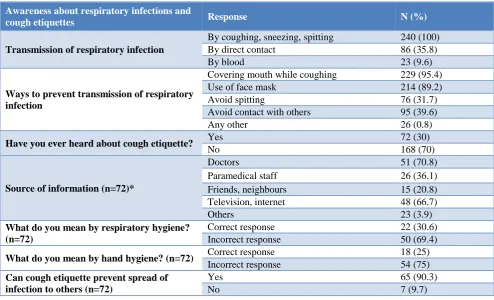
Table 2 shows the awareness about respiratory infections and cough etiquettes among study participants. It was found that all 240 (100%) study participants were aware that respiratory infections spread by coughing, sneezing and spitting. However, a few participants, 23 (9.6%) were of the opinion that these infections can be transmitted through blood. Among all 240 participants, correct knowledge about respiratory hygiene was found in only 22 (9.1%) participants.
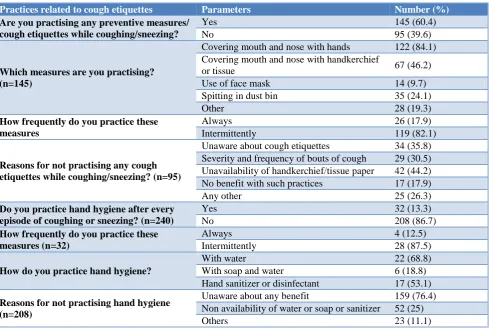
few participants 17 (17.9%) believed that there was no benefit with such practices in preventing respiratory infections. Only 32 (13.3%) participants agreed to practice hand hygiene after every episode of coughing or
sneezing; majority among them 22 (68.8%) using water. Majority of the subjects, 159 (76.4%) were unaware about any benefit of hand washing in preventing respiratory illness.
Table 1: Baseline characteristics of the study subjects.
Socio-demographic parameters Number Percentage (%)
Age (in years)
18-40 47 19.7
40-60 112 46.7
>60 81 33.6
Sex Male 107 44.6
Female 133 55.4
Religion
Hindu 179 74.6
Muslim 44 18.3
Others 17 7.1
Marital status
Married 167 69.6
Unmarried 24 10
Others (divorcee or widow, etc.) 49 20.4
Literacy Literate 189 78.8
Illiterate 51 21.2
Socio-economic status
Upper 7 2.9
Middle 75 31.3
Lower 158 65.8
Occupation Employed 138 57.5
Unemployed 102 42.5
Table 2: Awareness about respiratory infections and cough etiquettes among study participants.
Awareness about respiratory infections and
cough etiquettes Response N (%)
Transmission of respiratory infection
By coughing, sneezing, spitting 240 (100) By direct contact 86 (35.8)
By blood 23 (9.6)
Ways to prevent transmission of respiratory infection
Covering mouth while coughing 229 (95.4) Use of face mask 214 (89.2)
Avoid spitting 76 (31.7)
Avoid contact with others 95 (39.6)
Any other 26 (0.8)
Have you ever heard about cough etiquette? Yes 72 (30)
No 168 (70)
Source of information (n=72)*
Doctors 51 (70.8)
Paramedical staff 26 (36.1) Friends, neighbours 15 (20.8) Television, internet 48 (66.7)
Others 23 (3.9)
What do you mean by respiratory hygiene? (n=72)
Correct response 22 (30.6) Incorrect response 50 (69.4)
What do you mean by hand hygiene? (n=72) Correct response 18 (25)
Incorrect response 54 (75) Can cough etiquette prevent spread of
infection to others (n=72)
Yes 65 (90.3)
Table 3: Practices related to cough etiquettes among study participants.
Practices related to cough etiquettes Parameters Number (%)
Are you practising any preventive measures/ cough etiquettes while coughing/sneezing?
Yes 145 (60.4)
No 95 (39.6)
Which measures are you practising? (n=145)
Covering mouth and nose with hands 122 (84.1) Covering mouth and nose with handkerchief
or tissue 67 (46.2)
Use of face mask 14 (9.7) Spitting in dust bin 35 (24.1)
Other 28 (19.3)
How frequently do you practice these measures
Always 26 (17.9)
Intermittently 119 (82.1)
Reasons for not practising any cough etiquettes while coughing/sneezing? (n=95)
Unaware about cough etiquettes 34 (35.8) Severity and frequency of bouts of cough 29 (30.5) Unavailability of handkerchief/tissue paper 42 (44.2) No benefit with such practices 17 (17.9)
Any other 25 (26.3)
Do you practice hand hygiene after every episode of coughing or sneezing? (n=240)
Yes 32 (13.3)
No 208 (86.7)
How frequently do you practice these measures (n=32)
Always 4 (12.5)
Intermittently 28 (87.5)
How do you practice hand hygiene?
With water 22 (68.8)
With soap and water 6 (18.8) Hand sanitizer or disinfectant 17 (53.1) Reasons for not practising hand hygiene
(n=208)
Unaware about any benefit 159 (76.4) Non availability of water or soap or sanitizer 52 (25)
Others 23 (11.1)
DISCUSSION
In the present study, all 240 (100%) study participants were aware about the modes of transmission of respiratory infections, however, correct knowledge about respiratory hygiene was found in only 22 (9.1%) participants. In similar studies conducted in Korea and Japan among university students as well as general population, 61.5%, 56.1% and 31% participants had correct knowledge about cough etiquettes, respectively, which may be as one of these studies was conducted among university students, they may have a better knowledge about cough etiquettes than our population.
11-13 In this study, only 18 (7.5%) participants showed
correct knowledge about hand hygiene whereas it was comparatively higher, 49.8% in a study conducted in Korea.12 In the current study, only 65 (27.1%) participants believed that cough etiquettes are effective in preventing spread of infection to others however in a study conducted in Canada, almost 96% participants were of the opinion that it is effective in preventing spread of infections. This difference of opinion may be due to overall better awareness among general population in Canada as it is a developed nation.14
122 (84.1%) participants were covering mouth and nose with hands while only 14 (9.7%) were using of face mask. In another study conducted in Bangladesh, in 81% events, participants coughed or sneezed uncovered in the air, 11% into their hands and 7% into their clothing.15 These results may have been found as this was a direct observational finding among the household participants. Another similar study conducted in Canada reported covering of mouth with hand (37 per cent) as the most common practice followed by that with their sleeve or arm (34 per cent) and use a tissue or handkerchief (25 per cent), while some 16 per cent just turned their head away.14 In the current study, unavailability of handkerchief or tissue paper was cited as the main reason for not practising cough etiquettes by 42 (44.2%) participants followed by 34 (35.8%) who were unaware about cough etiquettes. Similar results were obtained in a study done in Korea, where practice of respiratory hygiene was found to significantly higher (p<0.05), among those carrying a handkerchief or carrying tissues and those who are aware of respiratory hygiene and cough etiquette.12
hygiene after every episode of coughing or sneezing.14 Even worse results were obtained in study conducted in Bangladesh where hand washing was never observed after using hands to cover coughs or sneeze.15 Unaware about any benefit of hand hygiene was cited as the most common reason for not practising hand hygiene by 159 (76.4%) participants in our study. In contrast to our findings, 77% of the aboriginal population in Canada perceived that appropriate hand hygiene was an effective measure in reducing chances of catching the flu.14
Barriers to preventive practices related to respiratory infections reported in our study were lack of awareness about cough etiquettes and hand hygiene in 34 (14.1%) and 159 (66.3%), respectively followed by severity and frequency of bouts of cough in 29 (30.5%). The study done in Korea reported a knowledge application gap of 22%.12 While major barriers reported in Canadian population were feeling of being healthy and thus no need for prevention followed by casual approach of not caring enough about ones` health.14
CONCLUSION
Knowledge and practice of cough etiquette was not found to be satisfactory in the present study. Even though respiratory infections are still one of the most common infections in India and cough etiquettes have been recommended as a tool to prevent transmission of infections, there is a huge lacuna in the awareness among general population about the importance of practicing cough etiquette. It is high time to address this issue and bridge the gap in knowledge as well as practice of cough etiquette among the general population in order to reduce the person to person transmission and thereby decreasing the burden of respiratory infection in general.
Funding: No funding sources Conflict of interest: None declared
Ethical approval: The study was approved by the Institutional Ethics Committee
REFERENCES
1. Martin PM, Martin-Granel E. 2,500-year evolution of the term epidemic. Emerg Infect Dis. 2006;12(6):976-80.
2. Hayden FG. Respiratory viral threats. Curr Opin Infect Dis. 2006;19(2):169-78.
3. Peltola V, Ruuskanen O. Respiratory viral infections in developing countries: Common, severe, and unrecognized. Clin Infect Dis. 2008;46(1):58-60. 4. Writing Committee (CDC, WHO, IUATLD).
Tuberculosis infection control in the era of expanding HIV care and treatment: An addendum to WHO guidelines for the prevention of tuberculosis
in health care facilities in resource limited settings. Geneva: WHO Press; 1999: 1-24.
5. Ministry of Health and Family Welfare. Guidelines on airborne infection control in healthcare and other settings; 2010. Available at: http://www.tbcindia. nic.in/pdfs/. Accessed on 3 August 2019.
6. World Health Organization. WHO policy on TB infection control in health-care facilities, congregate settings and households. Geneva: WHO press; 2009: 1-18.
7. Centers for Disease Control and Prevention. Use of quarantine to prevent transmission of severe acute respiratory syndrome - Taiwan. MMWR Morb Mortal Wkly Rep. 2003;52(29):680-3.
8. World Health Organization. Infection prevention and control of epidemic- and pandemic-prone acute respiratory infections in health care. Geneva: WHO press; 2014: 1-26.
9. Center for Disease Control and Prevention: Guideline for isolation precautions: Preventing transmission of infectious agents in healthcare settings. Geneva: WHO press; 2007. Available at: https://www.cdc.gov/infectioncontrol/guidelines/isol ation/index.html. Accessed on 20 July 2019. 10. Wei L, Qin G, Yang X, Hu M, Jiang F, Lai T. A
new nasal cavity nursing methods application in patients with mechanical ventilation. Pak J Med Sci. 2013;29(4):977-81.
11. Jin BY, Kim SS. University students' cough etiquette knowledge and practice to protect droplet infection. J Korean Biol Nursing Sci. 2015;17(4):348-55.
12. Choi JS, Kim KM. Predictors of respiratory hygiene/cough etiquette in a large community in Korea: A descriptive study. Am J Infect Control. 2016;44(11):271-3.
13. Miyake T, Wakimoto H. Awareness of the "cough etiquette" in the general public of our country by the Internet survey. Env Infection Magazine. 2011;26(2):87-93.
14. Ekos Research Associates Inc. Survey findings regarding infection prevention and control behaviours - Final Report. Ottawa: Public Health Agency of Canada; 2009.
15. Nasreen 1, Azziz-Baumgartner E, Gurley ES, Winch PJ, Unicomb L, Sharker MA, et al. Prevalent high-risk respiratory hygiene practices in urban and rural Bangladesh. Trop Med Int Health. 2010;15(6):762-71.
Cite this article as: Shrivastava PS, Shrivastava SR.