© 2017 IJSRSET | Volume 3 | Issue 8 | Print ISSN: 2395-1990 | Online ISSN : 2394-4099 Themed Section : Engineering and Technology
Improved Sobel Algorithm Based Image Edge Detection using
Gaussian Filter
Priyanka Pawar
1, Deepti Rai
21,2
DoEC, AIT, Ujjain, Madhya Pradesh, India.
ABSTRACT
Edge detection from images is one of the most important concerns in digital image and video processing. With development in technology, edge detection has been greatly benefited and new avenues for research opened up, one such field being the real time video and image processing whose applications have allowed other digital image and video processing. It consists of the implementation of various image processing algorithms like edge detection using Sobel, Prewitt, Canny and Robert etc. A different technique is reported to increase the performance of the edge detection. The algorithmic computations in real-time may have high level of time based complexity and hence the use of MATLAB and Image processing system for the implementation of such algorithms is proposed here. Processor is a dedicated high speed image processing module for use in a wide range of image analysis systems. It is observed that techniques which follow the stage process of detection of noise and filtering of noisy pixels achieve better performance than others. In this thesis such schemes of Sobel, Prewitt, Canny and Robert detector are proposed.
Keywords : Robert, Sobel, Prewit, Edge Detection, Gaussian Filter.
I.
INTRODUCTION
Digital image processing is an ever expanding and dynamic area with applications reaching out into our everyday life such as in medicine, space exploration, surveillance, authentication, automated industry inspection and in many more areas.
Edge detection refers to the process of identifying and locating sharp discontinuities in an image. The discontinuities are abrupt changes in pixel intensity which characterize boundaries of objects in a scene. Classical methods of edge detection involve convolving the image with an operator (a 2-D filter), which is constructed to be sensitive to large gradients in the image while returning values of zero in uniform regions. There is an extremely large number of edge detection operators available, each designed to be sensitive to certain types of edges.
Applications such as these involve different processes like image enhancement, and object detection. Implementing such applications on a generable purpose computer can be easier but not very efficient
in terms of speed. The reason being the additional constraints put on memory and other peripheral device management. Application specific hardware offers much greater speed than a software implementation.
There are two types of technologies available for hardware design. Full custom hardware design also called as Application Specific Integrated Circuits (ASIC) and semi-custom hardware device, which are programmable devices like Digital signal processors (DSP‟s) and Field Programmable Gate Arrays (FPGA‟s).
Full custom ASIC design offers highest performance, but the complexity and the cost associated with the design is very high. The ASIC design cannot be changed; time taken to design the hardware is also very high. ASIC designs are used in high volume commercial applications. In addition, if an error exist in the hardware design, once the design is fabricated, the product goes useless.
specialized microprocessor, typically programmed in C, perhaps with assembly code for performance. It is well suited to extremely complex math intensive tasks such as image processing. Hardware design knowledge is still required, but the learning curve is much lower than some other design choices.
The goal of this research paper is to implement image processing algorithms like convolution and different edge detectors like a Sobel, Prewitt and Robert edge detection through MATLAB and compare against the performance of different detector.
Li Dong Zhang and Du Yan Bi [1] presented an edge detection algorithm that the gradient image is segmented in two orthogonal orientations and local maxima are derived from the section curves. They showed that this algorithm can improve the edge resolution and insensitivity to noise.
Zhao Yu-qian et al. [2] proposed a novel mathematic morphological algorithm to detect lungs CT medical image edge. They showed that this algorithm is more efficient for medical image denoising and edge detecting than the usually used template-based edge detection algorithms such as Laplacian of Gaussian operator and Sobel edge detector, and general morphological edge detection algorithm such as morphological gradient operation and dilation residue edge detector.
Fesharaki, M.N. and Hellestrand, G.R [3] presented a new edge detection algorithm based on a statistical approach using the student t-test. They selected a 5x5 window and partitioned into eight different orientations in order to detect edges. One of the partitioning matched with the direction of the edge in the image shows the highest values for the defined statistic in that algorithm. They show that this method suppresses noise significantly with preserving edges without a prior knowledge about the power of noise in the image.
Lim [5] defines an edge in an image as a boundary or contour at which a significant change occurs in some physical aspect of the image. Edge detection is a method as significant as thresholding. A survey of the differences between particular edge detectors is presented by Schowengerdt [6]. Four different edge detector operators are examined and it is shown that the Sobel edge detector provides very thick and sometimes very inaccurate.
II.
PROPOSED WORK
In imaging science, image processing is any form of signal processing for which the input is an image, such as a photograph or video frame; the output of image processing may be either an image or a set of characteristics or parameters related to the image. Most image-processing techniques involve treating the image as a two-dimensional signal and applying standard signal-processing techniques to it. Image processing usually refers to digital image processing, but optical and analog image processing also are possible.
An image defined in the “real world” is considered to be a function of two real variables, for example, a (x, y) with a as the amplitude (e.g. brightness) of the image at the real coordinate position (x, y).
Modern digital technology has made it possible to manipulate multi-dimensional signals with systems that range from simple digital circuits to advanced parallel computers. The goal of this manipulation can be divided into three categories:
Image Processing (image in -> image out) Image Analysis (image in -> measurements out) Image Understanding (image in->high-level
description out)
An image may be considered to contain sub-images sometimes referred to as regions-of-interest, ROIs, or simply regions. This concept reflects the fact that images frequently contain collections of objects each of which can be the basis for a region. In a sophisticated image processing system, it should be possible to apply specific image processing operations to selected regions. Thus one part of an image (region) might be processed to suppress motion blur while another part might be processed to improve color rendition.
Before going to processing an image, it is converted into a digital form. Digitization includes sampling of image and quantization of sampled values. After converting the image into bit information, processing is performed. This processing technique may be Image enhancement, Image restoration, and Image compression.
Image enhancement:
It refers to accentuation, or sharpening, of image features such as boundaries, or contrast to make a graphic display more useful for display & analysis. This process does not increase the inherent information content in data. It includes gray level & contrast manipulation, noise reduction, edge crispening and sharpening, filtering, interpolation and magnification, pseudo coloring, and so on.
Image restoration:
It is concerned with filtering the observed image to minimize the effect of degradations. Effectiveness of image restoration depends on the extent and accuracy of the knowledge of degradation process as well as on filter design. Image restoration differs from image enhancement in that the latter is concerned with more extraction or accentuation of image features.
Image compression:
It is concerned with minimizing the number of bits required to represent an image. Application of compression are in broadcast TV, remote sensing via satellite, military communication via aircraft, radar, teleconferencing, facsimile transmission, for educational & business documents, medical images that arise in computer tomography, magnetic resonance imaging and digital radiology, motion, pictures, satellite images, weather maps, geological surveys and so on.
Image processing is defined as the manipulation of image representation stored on a computer. Operations on images that are considered a form of image processing include zooming, converting to gray scale, increasing or decreasing image brightness, red-eye reduction in photographs, edge and shape detection of an object and always possible for every customers or students to be able to get this up-to-date information.
Edge detection is a fundamental tool in image processing, machine vision and computer vision, particularly in the areas of feature detection examples of operators such as Canny, Sobel, Kayyali, etc. and feature extraction. Points in an image where brightness changes abruptly are called edges or edge points. There
are different types of sharp changing points in an image. Edges can be created by shadows, texture, geometry, and so forth. Edges can also be defined as discontinuities in the image intensity due to changes in image structure. These discontinuities originate from different features in an image.
This was followed by work by Fram and Deutsch [7], Peli and Malah [8] and more recently, Ramesh and Haralick [9]. The emphasis in this line of work has been to characterize the edge detector based on local signal considerations. The typical quantitative measures have been the probability of false alarms, probability of missed edges, errors of estimation in the edge angle, localization errors, and the tolerance to distorted edges, corners and junctions.
The Four Steps of Edge Detection
(1)
Smoothing: suppress as much noise as possible, without destroying the true edges.(2)
Enhancement: apply a filter to enhance the quality of the edges in the image (sharpening).(3)
Detection: determine which edge pixels should be discarded as noise and which should be retained (usually, thresholding provides the criterion used for detection).(4)
Localization: determine the exact location of an edge (sub-pixel resolution might be required for some applications, that is, estimate the location of an edge to better than the spacing between pixels). Edge thinning and linking are usually required in this step.Edge points are to be associated with the boundaries of objects and other kinds of changes. Edges within an image generally occur at various resolutions or scales and represent transitions of different degree, or gradient levels. Edge detection refers to the process of identifying and locating sharp discontinuities in an image. There are many ways to perform edge detection. However, most of them may be grouped into two categories, namely, gradient based edge detection and Laplacian-based edge detection. In the gradient based edge detection, we calculate an estimate of the gradient magnitude using the smoothing filter and use the calculated estimate to determine the position of the edges.
derivative of the image. In the Laplacian method we calculate the second derivative of the signal and the derivative magnitude is maximum when second derivative is zero. In short, Laplacian method searches for zero crossings in the second derivative of the image to find edges.
An edge map detected from its original image contains major information, which only needs a relatively small amount of memory space to store. The original image can be easily restored from its edge map. Various edge detection algorithms have been developed in the process of finding the perfect edge detector. Some of the edge detection operators are Robert, Prewitt, Sobel, FreiChen and Laplacian of Gaussian (LOG) operators. Prewitt, Sobel and FreiChen are 3x3 masks operators. The Prewitt masks are simpler to implement than the Sobel masks, but the later have slightly superior noise suppression characteristics. LOG is a more complicated edge detector than the previous mentioned operators.
The proposed method is implemented on matlab to thoroughly investigate the required time to detect edges with in an object and compare output image with various parameters. Here we will use grayscale image and we will find Sobel edge detection with improved filter based technique and here for filter we are using approximate 2D Gaussian filter.
Sobel Operator
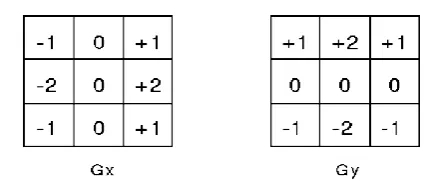
Sobel operator is a pair of 3x3 convolution kernels as shown in Figure 1 [1]. The second kernel is obtained by rotating the first by 90; the two kernels are orthogonal to each other. These kernel values are designed for maximum response to edges running vertically and horizontally relative to the pixel grid, one kernel for each of the two perpendicular orientations. One can apply kernels separately to the input image, in order to produce separate measurements of the gradient component in each orientation (known as Gx and Gy). These can then be combined together to find the absolute magnitude of the gradient at each point and the orientation of that gradient. The gradient magnitude is given by Equation. The angle of orientation of the edge (relative to the pixel grid) giving rise to the spatial gradient is given by,
Figure 1. The convolution kernel for the Sobel Edge detector. Note the emphasis on the horizontal and
vertical edges
The gradient magnitude is given by:
Although typically, an approximate magnitude is computed using:
which is much faster to compute. And the angle of orientation is given by:
In this case, orientation 1 is taken to mean that the direction of maximum contrast from black to white runs from left to right on the image, and other angles are measured anticlockwise from this.
Parameter comparison:
Various parameters are used to evaluate the proposed algorithm at both levels. The various parameters are
1.
PSNR (Peak signal-to-noise ratio)2.
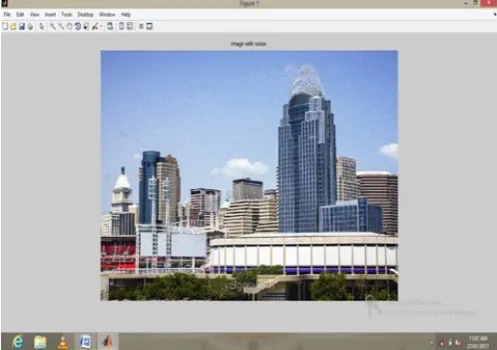
SSIM (structural-similarity-based image quality assessment)Figure 2. image represent noise which is taken as a input for Gaussian filter.
Figure 3. image represent output after applying Gaussian filter.
Figure 4. result indicates output after applying Robert operator over the output image of Gaussian filter and compare it with original image.
Figure 5. result indicates output after applying Prewit operator over the output image of Gaussian filter
and compare it with original image.
Figure 6. result indicates output after applying Sobel operator over the output image of Gaussian
filter and compare it with original image.
III. COMPARISSION AND DISCUSSION
Figure shows through the edges for the different operators. The focus in the detection of the edges that produces representing the original image. This provides a foundation for selecting an appropriate edge detector for further application. Investigation is aimed at aiding the choice of an appropriate operator that is capable of detecting boundaries based on intensity discontinuities. The Sobel and Prewitt both are differencing and smoothing. It detects part of the edges in the original image. The problem with these detectors is that it relies on finding edges which fails to detect fine edges.
noise. Moreover the Laplacian produces double edges and is sometimes unable to detect edge direction.
The Canny edge detector is capable of reducing noise. The Canny operator works in a multistage process. These can be summarized in a smoothing with a Gaussian filter. Followed by gradient computation and use of a double threshold. The Canny produces the best edge map.
The result is show that the behavior of zero crossing operator and gradient operator on the capability of edge detection. The objective is to investigate the effect of the various methods applied in finding edges of the image. It can show clearly that the Sobel and Prewitt low quality edges as compared to other two detectors. A representation of the image can be obtained through the Canny and Laplacian of Gaussian method. Among the various methods investigate the Canny method is able to detect both strong and week edges and seems to be more suitable than the Laplacian of Gaussian.
As edge detection is a fundamental step, it is necessary to point out the true edges to get the best results from the matching process. That is why it is important to choose edge detectors that fit best to the application. In this respect, we present some advantages and disadvantages of algorithms within the context of our classification as follows:
i) Sobel and Prewitt Advantages:
1)
Simple to understand and implement2)
Detection of edges and their orientationsDisadvantages:
1)
Sensitive to noise,2)
Inaccurateii)Canny operator advantage:
1)
Using probability for finding error rate,2)
Localization and response,3)
Improving signal to noise ratio,4)
Better detection specially in noise conditionsDisadvantages:
1)
Complex Computations,2)
False zero crossing,3)
Time consumingEdges can be detected in many ways such as Laplacian Roberts, Sobel and gradient [27]. In both intensity and color, linear operators can
detect edges through the use of masks that represent the „ideal‟ edge steps in various directions. They can also detect lines and curves in much the same way.
Traditional edge detectors were based on a rather small 3x3 neighborhood, which only examined each pixel‟s nearest neighbor. This may work well but due to the size of the neighborhood that is being examined, there are limitations to the accuracy of the final edge. These local neighborhoods will only detect local discontinuities, and it is possible that this may cause false edges to be extracted. A more powerful approach is to use a set of first or second difference operators based on neighborhoods having a range of sizes (e.g. increasing by factors of 2) and combine their outputs, so that discontinuities can be detected at many different scales [8]. Usually, gradient operators, Laplacian operators, and zero-crossing operators are used for edge detection. The gradient operators compute some quantity related to the magnitude of the slope of the underlying image gray tone intensity surface of which the observed image pixel values are noisy discretized samples. The Laplacian operators compute some quantity related to the Laplacian of the underlying image gray tone intensity surface. The zero-crossing operators determine whether or not the digital Laplacian or the estimated second direction derivative has a zero-crossing within the pixel. There are many ways to perform edge detection. However, the most may be grouped into three categories, gradient (Approximations of the first derivative), Laplacian (Zero crossing detectors) and Image approximation algorithms. Edge detectors based on gradient concept are the Roberts [9], Prewit and Sobel [10] show the effect of these filters on the sensing images. The major drawback of such an operator in segmentation is the fact that determining the actual location of the edge, slope turn overs point, is difficult. A more effective operator is the Laplacian, which uses the second derivative in determining the edge.
IV. CONCLUSION
result if choosing suitable edge detection operator according to specific situation in practice.
Supported by a comprehensive software environment, such complex hardware can become both adaptable and accessible, allowing its collective power to be finely tuned to the desired application. After the solution is developed, with such a modular approach, you can then create a production system efficiently from off the shelf modules.
V.
REFERENCES
[1]. Heath M.,Sarker S.,Sanocki T.and Bowyer K.,"Comparison of Edge Detectors: A Methodology and Initial Study",Proceedings of CVPR'96 IEEE Computer Society Conference on Computer Vision and Pattern Recognition,pp.143-148,2014.
[2]. Li Dong Zhang;Du Yan Bi;"An improved morphological gradient edge detection algorithm",Communications and Information Technology,ISCIT 2015.IEEE International Symposium on Volume 2,Page(s):1280-1283,12-14 Oct.2015.
[3]. Zhao Yu-qian;Gui Wei-hua;Chen Zhen-cheng;Tang Jing-tian;Li Ling-yun;"Medical Images Edge Detection Based on Mathematical Morphology"Engineering in Medicine and Biology Society,IEEE-EMBS.27th Annual International Conference,Page(s):6492-6495,01-04 Sept.2015.
[4]. Fesharaki,M.N.;Hellestrand,G.R.;"A new edge detection algorithm based on a statistical approach",Speech,Image Processing and Neural Networks,Proceedings,ISSIPNN '94.International Symposium,Page(s):21 -24 vol.1,13-16 April 2014.
[5]. Gonzalez,R and Woods,R.,"Digital Image Processing"2/E,Prentice Hall Publisher,2012 [6]. J.S.Lim,"Two Dimensional Signal and Image
Processing,"Prentice Hall,Englewood Cliffs,New Jersey,2013.
[7]. Robert A.Schowengerdt,"Remote sensing,Models and Methods for Image Processing,"2012.
[8]. Berzins,"V.Accuracy of Laplacian Edge Detector Computer Vision,Graphics,and Image Processing,,"Vol.27,pp.195-210,2013.
[9]. D.H.Ballard and C.M.Brown,"Computer Vision,"Prentice-Hall,New Jersey,2014.
[10]. J.M.S.Prewitt,"Picture Processing and Psychpictorics,"B.S.Lipkin and A.Rosenfeld Eds,Academic Press,New York,2013.
[11]. R.O.Duda.and P.E.Hart,"Pattern Classification and Scene Analysis,"Wiley,New York,2013. [12]. I.E.Abdou and W.K.Pratt,Quantitative design and
evaluation of enhancement/thresholding edge detectors,in Proceedings of the IEEE,May 2014,pp.753-763.
[13]. J.R.Fram and E.S.Deutsch,On the quantitative evaluation of edge detection schemes and comparison with human performance,IEEE Trans.Comput.C-24,1975,616-628.
[14]. T.Peli and D.Malah,A study of edge detection algorithms,20,1982,1-21.
[15]. V.Ramesh and R.M.Haralick,Random perturbation models and performance characterization in computer vision,in Proceedings of the Conference on Computer Vision and Pattern Recognit.,1992,pp.521-527. [16]. D.Nair,A.Mitiche,and J.K.Aggarwal,On