Original Research Article
The association between internet addiction, social phobia and
depression in medical college students
Karthikeyan Elavarasan, Thirunaaukarasu Dhandapani, Prasan Norman*,
Vidya D. C., Geetha Mani
INTRODUCTION
Addiction is defined as the state of being enslaved to a habit or practice or to something that is psychologically or physically habit-forming, to such an extent that its cessation causes severe trauma.1
“I hear babies crying, I watch them grow. They’ll learn much more than I'll never know and I think to myself what a wonderful world” Those are Louis Armstrong’s words, and the world got wilder when internet started being an integral part of our lives. Internet has forever
changed the way we learn, live and work. It was noticed that people started losing track of time when they were online, had trouble filling personal and professional obligations because of their online activities and their use of the Internet caused strain on relationships with family and friends. Some experienced negative emotions or withdrawal symptoms when their Internet access was restricted. Internet addiction may also be called computer addiction, compulsive internet use, problematic internet use (PIU), internet dependence.2 The American Society of Addiction Medicine (ASAM) released a new definition of addiction as a chronic brain disorder, officially
ABSTRACT
Background: Internet has become an integral part of day-to-day life of the university students. It has become indispensable. It gives unlimited access to information; it keeps you updated with the latest techniques and drugs. But internet usage is known to lead to addictive behavior, and Internet addiction threatens to develop into a major public health issue in the near future in a rapidly developing country like India.
Methods: A study was conducted in a medical college of 600 students, of which 489 gave consent to participate. They were evaluated using a questionnaire which included an internet addiction scale to assess internet addiction, social phobia inventory to assess social phobia and depression and somatic scale to assess depression.
Results: Of the 489 students who participated, 54.4% were females.63.8% had mild internet addiction and only 0,4% had severe addiction. Of those suffering from internet addiction 52.5% of the students were suffering from social phobia. It was found that students with internet addiction had three times the risk of developing social phobia, four times the risk of developing depression when compared with students without internet addiction.
Conclusions: Excessive use of internet affects the academic achievements of students. Students addicted to internet are more involved in it and spend more time online than their studies which invariably affects their grades. Seminars and media can play an important role in making people aware of causes and effects of internet addiction.
Keywords: Internet addiction, Social phobia, Depression
Department of Community Medicine, Karpaga Vinayaga Institute of Medical Sciences and Research Institute, Tamil Nadu, India
Received: 02 July 2018 Revised: 10 August 2018 Accepted: 11 August 2018
*Correspondence: Dr. Prasan Norman,
E-mail: [email protected]
Copyright: © the author(s), publisher and licensee Medip Academy. This is an open-access article distributed under the terms of the Creative Commons Attribution Non-Commercial License, which permits unrestricted non-commercial use, distribution, and reproduction in any medium, provided the original work is properly cited.
proposing for the first time that addiction is not limited to substance use.3 China and South Korea have identified Internet addiction as a significant public health threat and both countries support education, research and treatment.4 Some researchers and mental health practitioners see excessive Internet use as a symptom of another disorder such as anxiety social phobia or depression rather than a separate entity.5
Internet addiction has also been shown to be associated with various psychiatric disorders such as depression, anxiety, alcohol abuse, social anxiety and ADHD.6 Social anxiety disorder typically begins in the early teenage years. They achieve less in school, work and are less likely to marry than people who do not have the disorder.7 It has been stated that people with social phobia are 3.5 times more prone for clinical depression. Depression is the state of low mood and aversion to activity.There is a higher overall psychological distress among medical students than in general population.8 The Internet has in recent years become ubiquitous in the lives of young persons and children due to rapid information technology (IT) development, high speed wire connection, easy accessibility and increasing affordability. It has also started substituting book reading and outdoor games. It’s easy to access any book through Kindle and you don’t have to walk down stores to purchase a hard cover book. Games are easily available online. You can level up, gain points and get rewards which boosts up self-esteem for some people. The digital world can be the perfect escape for a person who is struggling socially at school, college or at work. There is also the part where “Peer pressure” makes you do it. Everyone is doing it why can’t I?
One of the most popular peripherals that are being used when you go online are headsets – which allow people, when they enter public chat rooms, to listen and communicate audibly with one another online. It’s almost as if you are chatting or gamming with each other but within the comforts of your home. Another reason is “Escapism”. The oldest one in the book- “I can be whoever I want in this world of virtual reality”. People who may feel insecure about his/her appearance in real life, can have a cool avatar which could be liked by all. People having trouble conversing with the opposite sex, in the world of Internet, have no trouble doing it and can be creative too.
Basically, everything is easier online. But when people get too dependent on it, as in “addicted” to it, its hard to leave the world of virtual reality and get back to real life. Addictions activate a combination of sites in the brain associated with pleasure, known together as the “reward center” or “pleasure pathway” of the brain. When activated, dopamine release is increased, along with opiates and other neurochemicals. Over time, the associated receptors may be affected, producing tolerance or the need for increasing stimulation of the reward center to produce a “high” and the subsequent
characteristic behavior patterns needed to avoid withdrawal. Internet use may also lead specifically to dopamine release in the nucleus accumbens, one of the reward structures of the brain specifically involved in other addictions. The reward experienced is intensified when combined with mood enhancing/stimulating content. Examples of this would be pornography (sexual stimulation), video games (e.g. various social rewards, identification with a hero, immersive graphics), dating sites (romantic fantasy). Many researchers and clinicians have noted that a variety of mental disorders co-occur with internet addiction.2
Aside from its positive effects, what have garnered everyone’s attention are its adverse side effects and addiction to it. In view of this recent growing trends in internet addiction, it was proposed to conduct a study to find the the association between internet addiction, social phobia and depression in medical students.
METHODS
A cross sectional study was conducted in Karpaga Vinayaga Institute of Medical Sciences, Maduranthagam. It was conducted in medical students and interns studying in this college. The sample size was derived based on study by Chaudari et al,prevalence=58.8%, 5% absolute precision, min sample size=388.9 Permission was obtained from the college administration to conduct the study among the medical college students and Interns
Study was conducted during the months of March 2017 to May 2017. All those who gave consent to participate in the study were included. All the authors were briefed about the questionnaire and the doubts were cleared.
A pilot study was conducted initially among the interns. Corrections made were intimated to all the authors. Of the 700 students (including interns), 489 students (including interns) gave consent to participate in this study.
The participants were briefed about the study. And after getting consent the questionnaire was administered. Three rooms were selected for individual questioning of the students. Each room had an investigator to question the participants. The questionnaire was administered to each student by the investigator. All participants were explained about the study individually and questioned in the three separate rooms to prevent inhibitions. Every question was read out to the participant from the questionnaire in his/her local dialect (Tamil/Telugu/ Hindi) and doubts raised by the participants were cleared. The answers given by the participant were marked in the questionnaire by the Investigator. It took around ten minutes to fifteen minutes for a participant to finish a questionnaire. The same procedure was followed all through the study.
internet. This was followed by an internet addiction test by Dr. Kimberly Young. It is a 20-item scale that measures the presence and severity of Internet dependency. The scale was created by adapting DSM-IV criteria for pathological gambling and is a modification of the earlier 8 item scale, Young’s internet addiction diagnostic questionnaire (IADQ). The IAT views Internet addiction as an impulse-control disorder and the term Internet refers to all types of online activity. The IAT is the most widely used Internet addiction scale.10
This was followed by social phobia inventory (SPIN). The SPIN is a 17-item questionnaire developed by the Psychiatry and Behavioral Sciences Department at Duke University. It is effective in screening for and measuring the severity of social anxiety disorder.11
This was followed by depression and somatic symptoms scale. The depression and somatic symptoms scale (DSSS) is a self-administered scale developed for monitoring both depression and somatic symptoms.12
Numbers and codes were assigned to each variable. Data entry was done in Excel spread sheet (Microsoft Office 2010). Data was later transformed to SPSS (Statistical Package for Social Sciences) software. Descriptive statistics was used to present the data.
RESULTS
Out of the 489 students who participated in this study, 266 (54.4%) students were female and 223 (45.6%) were male (Figure 1).
Figure 1: Pie chart showing distribution of study subjects by gender.
Figure 2: Bar diagram showing distribution of study subjects by internet addiction.
Of the 489 participants 76 (15.5%) participants had no addiction, 312 (63.8%) participants had mild addiction, 99 (20.2%) participants had moderate addiction and 2 (0.4%) participants had severe addiction. Addiction was more in the age group of 20 (25.4%) years to 21 (23.3%) years (Figure 2).
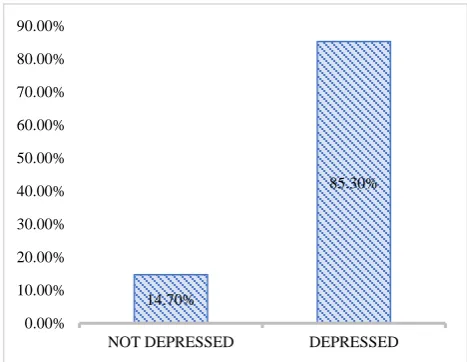
Figure 3: Bar diagram showing distribution of study subjects by depression.
417 (85.3%) participants were suffering from depression (Figure 3).
Figure 4: Pie chart showing distribution of study subjects by social phobia.
191 (39.1%) participants were not suffering from social phobia. 145 (29.7%) participants were suffering from mild social phobia. 105 (21.5%) participants were suffering from moderate social phobia. 47 (9.6%) participants were suffering from severe social phobia. 1 (0.2%) participant was suffering from very severe social phobia (Figure 4).
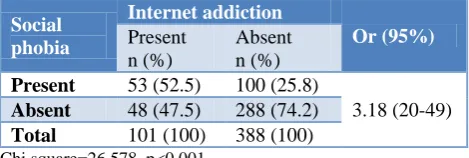
52.5% of the participants who were addicted to internet were found to be suffering from social phobia and it is statistically significant. People with internet addiction had three times the risk of developing social phobia when compared with the people without internet addiction (Table 1).
54.40%
45.60% FEMALE
MALE
15.5%
63.8%
20.2%
0.4% 0.0
10.0 20.0 30.0 40.0 50.0 60.0 70.0
NIL MILD MODERATE SEVERE
14.70%
85.30%
0.00% 10.00% 20.00% 30.00% 40.00% 50.00% 60.00% 70.00% 80.00% 90.00%
NOT DEPRESSED DEPRESSED
39.10%
29.70% 21.50%
9.60% 0.20%
Table 1: Association of internet addiction with social phobia.
Social phobia
Internet addiction
Or (95%) Present
n (%)
Absent n (%) Present 53 (52.5) 100 (25.8)
3.18 (20-49) Absent 48 (47.5) 288 (74.2)
Total 101 (100) 388 (100) Chi square=26.578, p<0.001.
Table 2: Association of internet addiction with depression.
Depression
Internet addiction
Or (95%) Present
n (%)
Absent n (%) Present 96 (95) 321 (82.7)
4 (1.5-10.2) Absent 5 (5) 67 (17.3)
Total 101 (100) 388 (100) Chi square =9.684, p<0.001.
95% of the participants who were addicted to the internet were found to be suffering from depression and it is statistically significant. People with internet addiction had four times the risk of being depressed when compared with the people without internet addiction (Table 2).
DISCUSSION
In this study of the 489 participants 76 (15.5%) participants had no addiction, 312 (63.8%) participants had mild addiction, 99 (20.2%) participants had moderate addiction and 2 (0.4%) participants had severe addiction
In a study by Chaudari et al, the prevalence of internet addiction among medical students in was found to be 58.8%, with mild and moderate internet addiction accounting for 51.42% and 7.45% respectively.13 This study was done with a sample size of 282 medical college students
In another study by Subhaprada, the prevalence of internet addiction among the study subjects in the present study was 52.63% mild, 24.21% moderate, while 23.16% students reported normal internet usage.14 This study was done with a sample size of 95 medical college students
In a study done in Central India, the total prevalence of internet addiction was found to be 23.3% with moderate and severe addiction being 21.0% and 2.3% respectively.15 This study was done with a sample size of 415 medical college students
In a study conducted in Egypt, the prevalence of internet addiction (moderate and severe) was determined to be 18.88%. Majority (57.77%) conformed to mild addiction.16 This study was done with a sample size of 369 medical college students
Irrespective of the number of students screened or the place the study has been conducted, Medical students are vulnerable for internet addiction and efforts should be taken to increase awareness and prevent the problem of internet addiction in them
52.5% of the participants who were addicted to internet were found to be suffering from social phobia and it is statistically significant. People with internet addiction had three times the risk of developing social phobia when compared with the people without internet addiction. 95% of the participants who were addicted to the internet were found to be suffering from depression and it is statistically significant. People with internet addiction had four times the risk of being depressed when compared with the people without internet addiction
Of the student population who participated in a study in Tunisia, 21.8% showed significant association between social anxiety and internet addiction.17 This study was conducted in monastir_tunisia among 188 medical students.
Capetillo-Ventura in his study which comprised of 522 medical students says that internet addiction had a highly significant correlation with somatic symptoms, anxiety, insomnia, social dysfunction and severe depression.18 He also states that problematic use of the Internet is only the manifestation of an underlying problem, highlighting frequent comorbidities with mood disorders, anxiety, and other addictions.
Alavi in his study states that, Internet addicts have various co-morbid psychiatric disorders. It means that Internet addiction brings with it various dimensions of psychiatric symptoms, which suggests that the addiction could have a negative effect on the mental health status leading to depression. His study which had a sample of 250 students who were randomly selected from four universities including Isfahan University, Isfahan University of Medical Sciences, Islamic Azad University and Isfahan University of Technology in Iran, says Depression is the most frequently reported psychiatric symptom associated with Internet overuse but could not be significantly correlated.19
Seifi states that high anxiety and stress may have existed before the Internet use, that is, the anxious individuals may use internet as an escape way. Similarly, anxiety and stress may occur due to addiction to the Internet, that is, when the individual becomes addicted to the internet. His study shows that addiction to the Internet can predict about 17% of depression variable, 20% of anxiety variable and 13% of stress variable.20
The internet is not an enemy, but the people depend on it for various reasons, as it’s a portal for many, which whisks them away from their real life and gives a negative impact on it. Using the internet due to its false appeal to the people slowly makes them addicted to it and can provide them the emotional and psychological needs. It is only while overusing Internet that it causes the mental, social and emotional growth of the users to become behaviorally disordered due to the lack of socializing with other people and leads them to loneliness. Further studies have investigated the relationship between internet addiction and psychiatric symptoms and it has been found that there is a significant relationship between daily use of the internet and the degree of psychiatric symptoms such as depression, obsessive compulsion, interpersonal sensitivity, anxiety, hostility, phobic anxiety.21
Limitations
Cross sectional study Small study sample
Generalization of results cannot be made.
CONCLUSION
In explaining the relationship between depression and Internet addiction it can be said that depression may therefore acts as a trauma that predisposes individuals to develop Internet addiction. Some people use the internet to reduce their depression so that the Internet may provide an alternative to the joyless life. Or the individuals who become addicted to the Internet experience the negative consequences resulting from it such as depression
Similarly, social phobia may occur due to addiction to the Internet as they spend more time online and avoid socializing or as mentioned earlier, due to problems faced in the workplace or from peers, the individuals affected tend to turn to internet as an outlet for their feelings and prefer to stay there longer than needed.
Excessive use of internet affects the academic achievements of students. Students addicted to internet are more involved in it and spend more time online than their studies. So their grades drop and leads to poor academic performance. Campaigns can be held to inform parents, teachers and state officials about the danger of internet. Online wellbeing interventions can effectively enhance wellbeing and can help to reduce anxiety and depression symptoms. Parents, teachers and other authorities should have a check and balance over internet use by students both at home or hostels and at work; so that internet addiction can be prevented
Seminars and media can play an important role in making people aware of causes and effects of internet addiction.
ACKNOWLEDGEMENTS
We, the authors, would like to thank the administration and the medical students of Karpaga Vinayaga Institute of Medical sciences and Research for their support and participation in this study
Special Thanks to Dr. Nishanth VS, Dr. Logana KS, Dr. Priyanka S, Dr. Nivetha TP for their cooperation.
Funding: No funding sources Conflict of interest: None declared
Ethical approval: The study was approved by the Institutional Ethics Committee
REFERENCES
1. American Heritage HC. http://www.dictionary.com. 2018. Available at: http://www.dictionary.com/ browse/addiction. Accessed on 28 June 2018. 2. Chaudhari B, Menon P, Saldanha D, Tewari A,
Bhattacharya L. Internet addiction and its determinants among medical students. Ind Psychiatry J. 2015;24(2):158-62.
3. Faraci P, Craparo G, Messina R, Severino S. Eysenbach G. Internet Addiction Test (IAT): Which is the Best Factorial Solution? J Med Int Res. 2013;15(10):225.
4. Psychiatry and Behavioral Sciences Department, Duke University. psychology-tools.com/. 1995. Available from: https://psychology-tools.com/spin. Accessed on 6 May 2017.
5. Hung CI, Weng LJ, Su YJ, Liu CY. Depression and somatic symptoms scale: A new scale with both depression and somatic symptoms emphasized. Psychiatry Clin Neurosci. 2006;60(6):700-8. 6. Cynthia Subhaprada S, Kalyani P. A cross-sectional
study on internet addiction among medical students. Int J Community Med Public Health. 2017;4(3):670-4.
7. Gedam S, Goyal A, Mod L, Babar V, Patond SK. A Study Internet Addiction among Medical Students from Central India. J Datta Meghe Institute Med Sci. 2016;2(2):233-8.
8. Shaheen HM, Farahat TM, Gaber HM. Problematic Internet Use among Medical School Students in Menoufia University Egypt. J Child Adolescent Behavior. 2016;4(298):1000298.
9. Amamou B, Haoual AB, Mhalla A, Zaafrane F. Relationship between cyberaddiction and social anxiety among students in medicine: about 188 students. Eur Coll Neuropsycho Pharmocol. 2017;27(4):1081-2.
10. Capetillo-Ventura N, Juárez-Treviño M. Internet addiction in university medical students. Medicina Universitaria. 2015;17(67):88-93.
12. Hilarie C, Rae CD, Steel AH, Winkle A. Internet addiction: A Brief Summary of Research and Practice. Current Psychiatry Rev. 2012;8(4):292-8. 13. Seifi A, Ayati M, Fadaei M. The Study of the
Relationship between Internet Addiction and Depression, Anxiety and Stress among Students of Islamic Azad University of Birjand. Int J Economy, Management Social Sci. 2014;3(12):28-32.
14. Mustafa KOÇ. Internet addiction and psychopathology. Turk Online J Education Technol. 2011;10(1):143-8.
15. Medicine Asoa. https://www.asam.org. 2018. Available at: https://www.asam.org/advocacy/find- a-policy-statement/view-policy-statement/public- policy-statements/2011/12/15/the-definition-of-addiction. Accessed on 25 June 2018.
16. Block JJ. Issues for DSM-V: internet addiction. Am J Psychiatry. 2008;165(3):306-7.
17. Kratzer SHU. Is "Internet Addiction" a disorder of its own? A study on subjects with excessive internet use. Psychiatrische Praxis. 2008;35(2):80-3.
18. Aviv W. Co-Morbidity of Internet Addiction with Anxiety and Depression. JSM Anxiety Depression. 2016;1(1):1003.
19. Franklin R. Schneier MD. Social Anxiety Disorder. Br Med J. 2003;327(7414):515-6.
20. Dahlin ME, Runeson B. Burnout and psychiatric morbidity among medical students entering clinical training: a three year prospective questionnaire and interview-based study. BMC Med Educ. 2007;7:6. 21. Mustafa KOÇ. Internet Addiction And
Psychopatology. Turkish Online J Edu Tech. 2011;10(1):143-8.