93
Original Article
Higgs and Vector Unparticle Production via
Collision
in the Randall – Sundrum Model
Nguyen Thi Hau
1,*, Dao Thi Le Thuy
21Hanoi University of Mining and Geology, 18 Pho Vien, Dong Ngac, Hanoi, Vietnam 2
Faculty of Physics, Hanoi National University of Education, 136 Xuan Thuy, Cau Giay, Hanoi, Vietnam
Received 14 September 2019
Revised 08 November 2019; Accepted 11 November 2019
Abstract: This paper studies the production of Higgs boson and vector U unparticle, which has been proposed as an option for collision by s, t, u-channels in the Randall-Sundrum model. The cross-section is presented and numerical evaluation is detailed. The study results reveal that the cross-section increases as fast as 1.8dU 2. The advantageous directions to collect Higgs boson
and U are either the same or opposite to the initial muon beams by s-channel. The U exchange contribution is much larger than muon exchange contribution.
Keywords: Randall-Sundrum model, cross-section, Higgs, vector unparticle, muon.
1. Introduction
The discovery of Higgs boson in 2012 at the LHC [1, 2] verify the correctness of the standard model, but it still has many unanswered issues [3]. In order to solve this remaining problems, the extended models are proposed. In this paper, we are interested in two extended models, namely the Randall-Sundrum model and unparticle physics.
The Randall-Sundrum model [4] is one of the extended models that brings many new physical consequences. This model extends 4-dimensional space-time with x coordinates to 5-dimensional
space-time with coordinates (x, ) . The fifth dimension is a single S1/Z2 orbifold of radius r. The
5-________
Corresponding author.
dimensional space-time has two 3-branes placed at two fixed points, the Planck brane (UV brane) at 0
and the TeV brane (IR brane) at .
Unparticle physics proposed by Georgi [5] in 2007, which includes the standard model fields and the Banks-Zaks fields [6]. The two fields interact through the interchange of particles with a large mass scale MU . In unparticle physics, there are scalar U, vector U
and spinor Us unparticles. Their interactions with standard model particles are presented in Ref. [7].
In the previous paper we have studied the effect of vector unparticle on some of the high energy processes in the Randall-Sundrum model [8-10]. In this article, we discuss the U production in the process hU in the Randall-Sundrum model. The paper is organized as follows. The Feynman rules for the vector unparticle interactions with leptons and Higgs boson; the Higgs boson interactions with leptons and photons are given in section 2. The calculation results of the cross-section of collisions are discussed in section 3. Finally, in section 4 we give a brief summary and discussions.
2. Formalism
As already mentioned, in this work we only consider the vector unparticle in the unparticle physics and the Randall-Sundrum model. The interaction of vector unparticle with leptons according to the Feynman rules is shown in Fig. 1[11].
5 1
1 (1 )
U
d U
i
Fig. 1. Feynman rules for the interaction of vector unparticle with leptons.
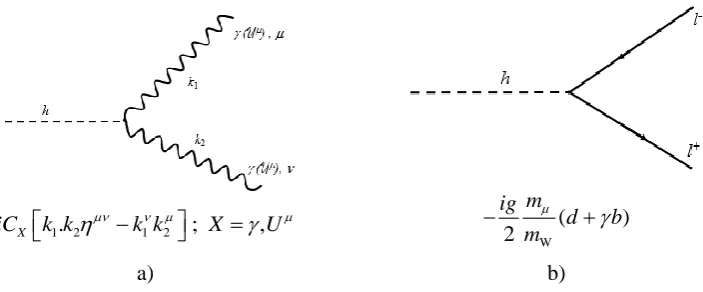
In Ref. [12] shows Feynman rules for the interactions of Higgs boson with photons and leptons in the Randall-Sundrum model (Fig.2). Based on the efficiency theory, we proposed the Feynman rule for the interaction of Higgs boson with vector unparticles in this model (Fig. 2a) following:
1. 2 1 2 ; ,
X
iC k kk k X U
W
( )
2
m ig
d b
m
a) b)
where 2 ( ) ( 2 ) 2
i
fV i c i i Y r i
C g e N F b b g
[12] and CU is the coefficient that we includedbased on the efficiency theory and we evaluated the cross-section according to CU C.
3. The process hU in the Randall-Sundrum model
In the rest of the paper, we concentrate on the possibility of Higgs boson and vector unparticle production in the collisions according to s, t, u-channels in the Randall-Sundrum model. The Feynman diagrams of the above processes are shown in Fig. 3.
Fig. 3. Feynman diagram for Higgs boson and vector unparticle productions at collision
The matrix elements of the process hU through by s, t, u-channels in Fig. 3a, b, c, respectively are given by the expression:
2 2 5
1
2 1 2 2 2
1 ( ) ( ) (1 ) ( ) . ( ).
2sin( )
du du
s du s U s s
u
i A
M q C v p u p q k g q k k
du (1) * 5 1
2 2 1
1 2 2
w
( )
ˆ
( )( ) ( ) (1 ) ( )
2 ( )
u
t d t
t u
gm d b
M v p q m k u p
m q m
(2)
5 * 1
2 2 1
1 2 2
w
( )
ˆ
( ) (1 ) ( )( ) ( )
2 ( )
u
u d u
u u
gm d b
M v p k q m u p
m q m
(3)
where qs p1p2 k1 k2; qt p1 k1 k2p2; qu k1 p2p1k2, 2 s s s q q g q .
The matrix elements squared for the different channel are given by:
2
2 1 2 2 2 2
2 1 2 2 1 1 2
1 2
1
2 ( ) {( ) [ 2( ) ( 2( )( ) ( ) )]
2sin( )
du du
s du s U s s s s
u s
i A
M q C q k p p p q p q p p q
du q
2 2 2 2 2
2 2 1 2 1 2 2 4 2 1 2 1 2 2
1
[2( )( ) ( ) (2( )( )( ) ( ) ( ) )
s s s s s s
s
q p k p k p p k p q p q q k p p q q k
q
2
2 2 1 2 1 2 2 2 1 2 2
2
1
(2( )( s)( s ) 2( )( s)( s ) 2( )( s ) )]}
s
p k p q q k p k p q q k p p q k
q
,
2
2 1 2 2 2
2 1 2 1 2 1 1
1 2 2
w
( )
4 {2( )( ) ( ) ( ) 2 ( )}
2 ( )
u
t d t t t t
t u
gm d b
M p q p q p p q m p p m p q
m q m
, (5)
2
2 1 2 2 2
2 1 2 1 2 1 2
1 2 2
w
( )
4 {2( )( ) ( ) ( ) 2 ( )}
2 ( )
u
u d u u u u
u u
gm d b
M p q p q p p q m p p m p q
m q m
. (6)
The differential cross-section for hU at a center-of-mass energy s is given by:
1 2 1 1 , cos 64 k d M
d s p
(7)
where 2
1 2
( )
s p p
,
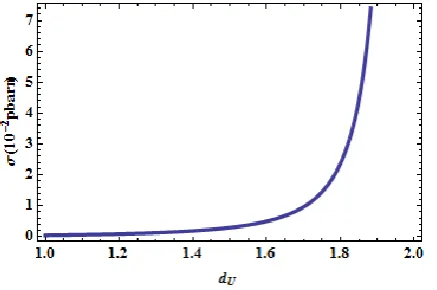
is the angle between p1 and k1.The cross-section is plotted taking 11, U 1TeV[11], CU C, s500GeV and 1dU 2
[13], in Fig. 4.
Fig 4. The cross-section of hU as a function of dU
Here, the cross-section increases fastly as 1.8dU 2. Therefore, we evaluated it at dU 1.9. In
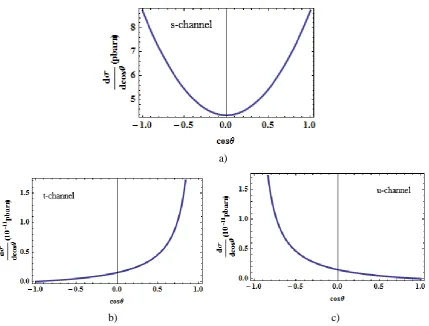
Fig. 5 we charted the differential cross-section of the Higgs and vector unparticle production as a function of cos
at dU 1.9. The center-of-mass energy is chosen as s500GeV.The figure shows that the value of the differential cross-section by s-channel is much larger than t, u-channels. It reaches maximum values when cos
1. For that reason, the advantageous directions to collect Higgs boson and vector unparticle are the same or opposite direction to the initial , beams.Finally, Figure 6 shows the range of the cross-section of hU as a function of s at 1.9
U
a)
b) c)
Fig. 5. The differential cross-section of hU as a function of cos
Conclusions
In summary, we have calculated the cross-section of process hU by s, t, u-channels. The result shows that the cross-section increases fastly as 1.8dU 2. According to the s-channel, the advantageous directions to collect Higgs boson and vector unparticle are the same or opposite direction to the initial , beams. The vector unparticle exchange contribution is much larger than muon exchange contribution.
Acknowledgments
The authors would like to thank the sponsors of the Hanoi University of Mining and Geology for the basic science project in 2019, code T19-06.
References
[1] ATLAS Collaboration, Observation of a new particle in the search for the Standard Model Higgs boson with the ATLAS detector at the LHC, Phys. Lett. B 716 (2012) 1-29. https://doi.org/10.1016/j.physletb.2012.08.020. [2] CMS Collaboration, Observation of a new boson at a mass of 125 GeV with the CMS experiment at the LHC, Phys.
Lett. B 716 (2012) 30-61. https://doi.org/10.1016/j.physletb.2012.08.021.
[3] Particle Data Group Collaboration, Review of particle physics, Chin. Phys. C 38 (2014) 090001. http://doi.org/ 10.1088/1674-1137/38/9/090001.
[4] L. Randall, R. Sundrum, Large Mass Hierarchy from a Small Extra Dimension, Phys. Rev. Lett. 83 (1999) 3370.
https://doi.org/10.1103/PhysRevLett.83.3370.
[5] H. Georgi, Unparticle physics, Phys. Rev. Lett. 98 ( 2007) 221601. https://doi.org/10.1103/PhysRevLett.98.221601
[6] T. Banks, A. Zaks, On the phase structure of vector-like gauge theories with massless fermion, Nucl. Phys. B196 (1982) 189-204. http://doi.org/10.1016/0550-3213(82)90035-9.
[7] S.L. Chen, X.G. He, Interactions of Unparticles with Standard Model Particles, Phys. Rev. D76 (2007) 091702. https://doi.org/10.1103/PhysRevD.76.091702.
[8] D.T.L. Thuy, N.T. Hau, The process of e e scattering in unparticle physics, J. Sci. HNUE 7 (2016) 80-87. http://doi.org/10.18173/2354-1059.2016-0035.
[9] N.T. Hau, L.N. Thuc, The process of e e hU in the Randall – Sundrum, J. Mi. Sci. Tec, Special number CBES2 -Humg 2018 (2018) 210-214 (in Vietnamese).
[10] N.T. Hau, D.T.L. Thuy, The process of e e in the Randall – Sundrum Model, Supersymmetric model and unparticle physics, J. Commu. Phys 1 (2018) 29-40. http://doi.org/10.15625/0868-3166/28/1/9131.
[11] K. Cheung, W.Y. Keung, T.C. Yuan, Collider phenomenology of unparticle physics, Phys. Rev. D76 (2007) 055003. http://doi.org/10.1103/PhysRevD.76.055003.
[12] D. Dominici, B. Grzadkowski, J.F. Gunion, M. Toharia, The scalar Sector of the Randall-Sundrum Model, Nucl. Phys. B671 (2003) 243-292. http://doi.org/10.1016.j.nuclphysb.2003.08.020.