Original Research Article
Effectiveness of structured group reminiscence therapy in decreasing
the feelings of loneliness, depressive symptoms and anxiety among
inmates of a residential home for the elderly in Chittoor district
Jayanthi Tarugu
1, R. Pavithra
1, Sivagami Vinothchandar
2, Aniruddha Basu
3,
Sirshendu Chaudhuri
4*, K. R. John
4INTRODUCTION
Over the past few decades, life expectancy has been increased substantially across the globe as reflected by an increased proportion of the geriatric population.1 Although this proportion is much higher in high-income
countries like Japan, Germany, and Italy; the low and middle-income countries are also experiencing such situation and the rate of increase of geriatric people is comparable with the high-income countries, sometimes even higher. (World Bank) India has the second largest population of elderly in the world. According to the
ABSTRACT
Background: The proportion of the elderly population is increasing in low and middle-income countries. Apart from systemic illnesses, elderly people face mental illnesses. Effect of group reminiscence therapy in reducing some of the mental health aspects showing a promising effect but the evidence is lacking in Indian settings. The present study aimed to determine the effect of reminiscence therapy in decreasing the level of loneliness, depressive symptoms, and anxiety among the elderly population at an institutional level.
Methods: In this quasi-experimental study, residents of an old age home were evaluated for loneliness, depressive symptoms and anxiety through revised UCLA, geriatric depression scale, and Geriatric Anxiety Scale respectively. Group reminiscence therapy was applied to them and post-intervention assessment was done by the same scales.
Results: Significant reduction of anxiety score [1.33 (0.03, 2.64)] was noticed in anxiety. Depressive symptoms showed a mean reduction in score [0.59 (-0.41, 1.6)] but statistically not significant. When graded into severity, all three outcomes showed improvement from higher severity grade to lower grade in post-intervention assessment. The intervention resulted in an improvement of 66.7% in depressive symptoms, 33.3% in anxiety and 30.8% in loneliness.
Conclusions: The study found reminiscence therapy could be encouraging in resource-poor Indian settings. We recommend for further exploration of the long-term effects of this program, its feasibility, cost-effectiveness, and validation of the content for large-scale implementation.
Keywords: Reminiscence therapy, Elderly, Loneliness, Depressive symptoms, Anxiety
1
Apollo College of Nursing, Apollo Institute of Medical Sciences and Research, Murukambattu, Chittoor, Andhra Pradesh, India
2
Department of Community Health Nursing, Apollo College of Nursing, Apollo Institute of Medical Sciences and Research, Murukambattu, Chittoor, Andhra Pradesh, India
3
Department of Psychiatry, All India Institute of Medical Sciences, Rishikesh, Uttarakhand, India
4
Department of Community Medicine, Apollo Institute of Medical Sciences and Research, Murukambattu, Chittoor, Andhra Pradesh, India
Received: 11 December 2018
Accepted: 15 January 2019
*Correspondence:
Dr. Sirshendu Chaudhuri,
E-mail: [email protected]
Copyright: © the author(s), publisher and licensee Medip Academy. This is an open-access article distributed under the terms of the Creative Commons Attribution Non-Commercial License, which permits unrestricted non-commercial use, distribution, and reproduction in any medium, provided the original work is properly cited.
report ‘Elderly in India- Profile and Programmes 2016’ by Government of India, a little more than hundred million elderly persons aged 60 years or above were there during 2011 census and thereby contributed 8.6% of the total population. The proportion has increased by one and a half times over the last 50 years.
As people grow old, the likelihood of experiencing age-related health issues increase. Other than systemic diseases, many people experience mental illnesses including loneliness, depression, and anxiety in old age.2 Increase in the number and proportion of older adults in the country, changing family structure, contemporary changes in psychosocial matrix and values are compelling the elderly to live alone or in old age homes resulting in a feeling of isolation, loneliness, anxiety, and depression.3 With advancing age, it is inevitable that people lose connection with their friendship networks and that they find it more difficult to initiate new friendships and to belong to new networks.4
Loneliness, anxiety, and depression are closely associated with each other.5 Although it is difficult to assess the prevalence separately, the high burden of these mental conditions has been reported around the world. A meta-analysis reported the worldwide prevalence rate of depressive disorders in the elderly population between 4.7 to 16% with a comparatively higher prevalence of 21.9% in India.6 Prevalence of late-life anxiety disorders are quite high and can be two to eight times higher than major psychiatric illness like dementia or major depressive disorders. This affects substantially on quality of life, morbidity, and mortality of older adults.7 On the other hand, although loneliness is not measured as a single entity, reported having a high burden among the elderly population across the globe.8-10 The condition is often associated with mental health conditions like depression and can act as a precursor of different psychological morbidities.9-12
Nevertheless, in countries like India, where both human resources and infrastructural facilities are lacking to address such a huge burden comparatively low-cost alternative management options are needed. Reminiscence therapy has been proposed as a potentially effective strategy to improve quality of life and psychological well-being for elderly nursing home residents.13 According to the Nursing Interventions Classification (NIC) system, reminiscence therapy is an intervention using recall of past events, feelings, and thoughts to facilitate pleasure, quality of life, or adaptation to the present.14 Reminiscence therapy, in general, lasts for a period of six to eight weeks. In each week, one or two sessions are conducted by a psychologist or by a health care worker which last for one to two hours.15,16 Although the effects of reminiscence therapy have been studied in a wide range of mental health conditions like depressive symptoms, psychological well-being, and cognitive functions in various parts of the globe, such kind of therapy is yet to
be tested in Indian context, especially among the elderly.17-19 In this context, the present study aimed to determine the effect of reminiscence therapy in decreasing the level of loneliness, depressive symptoms, and anxiety in the residents of a selected old age home.
METHODS
Design of the study
Quasi-experimental design.
Settings and location
The present study was conducted in an old age home in Tiruchanur near Tirupathi town of Chittoor district in Andhra Pradesh; a state situated in southern part of India. Due to ethical concern, we are not revealing the name of the center. This registered center is working for last four decades and presently has services like free health check-ups, medical and financial aid towards the destitute aged and different rehabilitative services. Henceforth, we will use the term ‘home’ interchangeably with ‘old age home’.
Study duration
July 2017 till September 2017.
Study participants
All the residents were eligible to take part in the study. However, considering the fact that serious visual, auditory and physical problems can interfere with participation in ‘Group Reminiscence Therapy’, we considered residents with complete blindness due to any reason at the time of intervention, severe auditory impairment, residents with clinically significant cognitive impairment as exclusion criteria in addition to consent failure in an otherwise physically well resident. The first author, with the help of trained nursing staffs, did the physical assessment by checking medical records and clinical examination. Although taking antidepressants or anxiolytic medicines were not exclusion criteria, none of the residents were on such medicines.
Sample size
We intended to take all the residents of the home. Although 32 residents were there, the final sample size was 27 (Figure 1).
Recruitment of the subjects
Figure 1: Flow chart showing different stages of the trial.
Study procedure
After recruitment, we paid few visits to the home and collected the baseline information. This included- socio-demographic and personal information in addition to the assessment of depressive symptoms, loneliness, and anxiety. One of the authors, who is formally trained in such assessment, completed the assessment through face to face interview. Tools used for such assessment has been explained afterward.
Intervention (Group reminiscence therapy)
After completing the initial assessment, we divided the participants into two equal groups having 15 numbers as there was no space to accommodate all the participants at a time. We held two successive group reminiscence therapy sessions for each of the groups in the same area of the home. To avoid bias, we maintained the duration and content of the sessions according to the protocol for both groups. The content of the group reminiscence therapy was designed by the PI in accordance with the local culture. We held a total number of six sessions for the participants, each carrying 60-minutes duration, the content of which is given below.
Session 1
Introduction of members (Personal details including name, age, date of birth, place of birth, details of family
members with photos if available; prior occupation; hobbies).
Session 2
In this session, participants remembered their school days (elementary, high school, college) including friends and teachers, activities, favourite subjects, examinations, celebrating holidays, national day celebration, sports and games, tours, and picnics etc. Those participants who never went to school were asked to describe their childhood spent at home. Participants were encouraged to show photos if any available.
Session 3
Jobs and other activities were shared in this session. For instance, the first appointment, salary, promotions, transfers, retirement, pension etc. were shared.
Session 4
In this session, we concentrated mostly on family life. The relationship among different family members was shared along with photos, if available.
Session 5
In this session, the participants recalled different favorite items like foods, colors etc. Some experiences when they enjoyed such items. Some of them were encouraged to discuss recipes of different foods as well.
Session 6
In the last week of the intervention, the participants recalled favorite movies and songs they have experienced, favorite hero and heroine they have watched. They also performed activities like mimicking artists and singing songs. For those who didn’t come across such things or couldn’t perform, we encouraged them to describe anything which is favorite for them but not shared in any of the previous sessions.
Our role as investigators in these sessions remained as facilitators only. Additionally, we checked the clinical condition of all the residents before starting a session and during the session, if needed. However, we did not control the emotional expressions of the residents as it was part of the outcome measurement. We allowed group activities among the residents to control such a situation. Most of the participants encouraged each other to come forward to share their special talents.
Outcome assessment
After one week of the last session, another trained nursing staff assessed the outcome variables with the same tools used to assess the outcome variables.
Screening of all residents (n=32)
3 excluded Complete blindness (1) Severe hypothyroidism (1) Completely bed-ridden (1)
Final recruitment (n=29)
Intervention
Weekly 1-hour session for 6 weeks
Drop out (n=2)
Outcome variables and research tools
Depressive symptoms
We measured depressive symptoms by the short form of Geriatric Depression Scale (GDS) after translating into Telugu.20 This version of the scale has been tested and used substantially among the older population. Of the 15 items, 10 indicated the presence of depression when answered positively, while the rest indicated depression when answered negatively. We classified the scores into normal (0-4), mild depression (5-8), moderate depression (9-11) and severe depression (12-15).20,21
Loneliness
We adopted Revised University of California, Los Angeles loneliness scale (R-UCLA) after translating into Telugu for measuring loneliness.22 It consists of 20-items to measure one’s subjective feelings of loneliness by rating each item on a scale from 1 (Never) to 4 (Often). The score has been categorized to mild loneliness (score 20-40); moderate loneliness (score 41-60) and severe loneliness (score 61-80).23
Anxiety
We translated the geriatric anxiety scale (GAS) developed by Daniel L. Segal, 2013, into Telugu and administered to screen for anxiety symptoms. GAS includes 30 items; each individual was asked to indicate how often they experienced each symptom in the last week including the day of assessment. Each item scores through a 4-point Likert scale ranging from 0 (not at all) to 3 (all the time), with higher scores indicating greater levels of anxiety. The possible score ranges between zero and 75. The score was classified into mild (0-25), moderate (26-50) and severe (51-75).
Ethical considerations
The institutional ethical committee of Apollo Institute of Medical Sciences and Research, Chittoor, approved the study. We collected informed consent from all the participants. Additionally, we took formal permission from the authority of the home.
Statistical analysis
Data entry was done in ‘Microsoft Excel, 2010’ and statistical analysis was done in ‘SPSS version 20’ for
Windows (IBM Corp., Armonk, New York, 2010). Prevalence of different outcomes was expressed as a proportion with 95% confidence interval (CI). For scores in different domains, we have provided a mean or median as appropriate with standard deviation (SD). To detect any significant difference between the mean scores of pre and post-intervention, we used a paired t-test. A p value of <0.05 was considered statistically significant. We performed both intention to treat (ITT) analysis and per protocol analysis to look for the effect of the intervention. ITT analysis was done by assuming all drop-out as no improvement for the minimum effect; while all drop-out showing improvement for maximum effect from their baseline. All the dropouts with depressive symptoms, anxiety, and loneliness in the pre-intervention assessment were included in the denominator for such analysis.
RESULTS
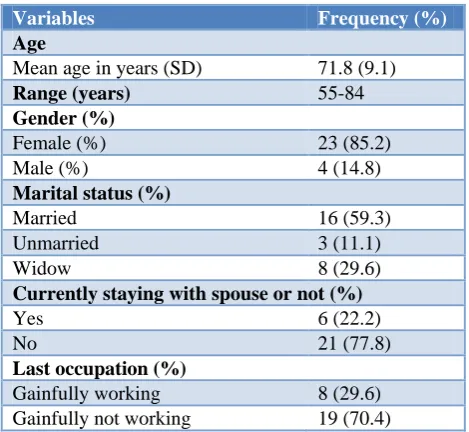
Total 27 residents of the home completed the intervention according to protocol. The socio-demographic variables have been shown in Table 1. Majority of the residents were female. Out of the four male residents, three were staying with their spouse.
Table 1: Socio-demographic variables of the residents (n=27).
Variables Frequency (%)
Age
Mean age in years (SD) 71.8 (9.1)
Range (years) 55-84
Gender (%)
Female (%) 23 (85.2)
Male (%) 4 (14.8)
Marital status (%)
Married 16 (59.3)
Unmarried 3 (11.1)
Widow 8 (29.6)
Currently staying with spouse or not (%)
Yes 6 (22.2)
No 21 (77.8)
Last occupation (%)
Gainfully working 8 (29.6) Gainfully not working 19 (70.4)
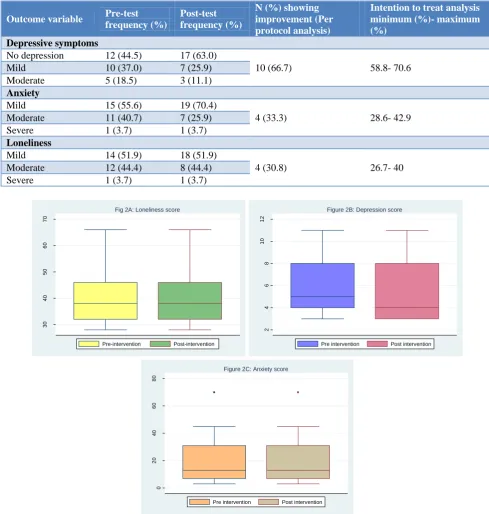
Distribution of scores of three different outcome variables has been depicted in Figure 2A-C.
Table 2: Distribution of pre-test and post-test scores among the residents.
Domain Mean score (SD) Difference (95% CI) P value
Loneliness Pre-test: 39.8 (9.6) 0.18 (-1.37, 1.73) 0.8
Post-test: 40.0 (9.4)
Depression Pre-test: 5.81 (2.63) 0.59 (-0.41, 1.6) 0.24
Post-test: 5.22 (2.53)
Anxiety Pre-test: 21.52 (16.5) 1.33 (0.03, 2.64) 0.04
Table 3: Category wise outcome of intervention.
Outcome variable Pre-test
frequency (%)
Post-test frequency (%)
N (%) showing improvement (Per protocol analysis)
Intention to treat analysis minimum (%)- maximum (%)
Depressive symptoms
No depression 12 (44.5) 17 (63.0)
10 (66.7) 58.8- 70.6
Mild 10 (37.0) 7 (25.9)
Moderate 5 (18.5) 3 (11.1)
Anxiety
Mild 15 (55.6) 19 (70.4)
4 (33.3) 28.6- 42.9 Moderate 11 (40.7) 7 (25.9)
Severe 1 (3.7) 1 (3.7)
Loneliness
Mild 14 (51.9) 18 (51.9)
4 (30.8) 26.7- 40
Moderate 12 (44.4) 8 (44.4)
Severe 1 (3.7) 1 (3.7)
Figure 2: Box and whisker plots showing the distribution of loneliness, anxiety and depression scores before and after intervention. (A) Loneliness score, (B) Depression score, (C) Anxiety score.
All the domains except loneliness showed improvement after the intervention. However, the difference was significant for anxiety only (Table 2).
When classified into different groups (Table 3) according to the severity of the outcome variables, all the outcomes showed variable improvement in post-intervention assessment. Out of 15 residents, who had pre-intervention depressive symptoms, 10 (66.7%) showed improvement
to lower category. However, two (7.4%) residents showed mild depressive symptoms in post-intervention assessment who were in the normal range during the pre-intervention assessment. Unlike depression, where a normal category is existing, anxiety and loneliness domain did not have a normal category. Considering the ‘mild’ category as maximum possible outcome after intervention in both these domains, we found four (33.3%) residents with moderate and severe category of
30
40
50
60
70
Sc
o
re
Fig 2A: Loneliness score
Pre-intervention Post-intervention
2
4
6
8
10
12
Sc
o
re
Figure 2B: Depression score
Pre intervention Post intervention
0
20
40
60
80
Sc
o
re
Figure 2C: Anxiety score
anxiety, improved to mild category; whereas in loneliness domain, the proportion improved is 30.8% as four out of 13 residents showed improvement from moderate and severe category. None of them moved from a lower level to a higher level of anxiety and loneliness.
DISCUSSION
Our analysis of the effectiveness of structured Reminiscence therapy on loneliness, depression & anxiety, experienced by residents, elucidated variable responses. We observed that the group’s scores support the effectiveness of RT in decreasing the feelings of anxiety at a statistically significant level. Although depression showed a reduction in mean score, loneliness score remains almost unchanged. Most of the studies on RT showed effective results for loneliness outcomes; however, scales used for measuring were varying.23-26 Moreover, the content of the therapy varied among different cultures and should be considered carefully before drawing a conclusion. For instance, assessed the effectiveness of the application of computer and internet intervention for reducing loneliness and found to have a significant reduction in loneliness score.27 Such intervention, for reminiscence therapy in Indian setting may not be culturally suitable and therefore needs culturally appropriate modification. When we categorized the loneliness score in different levels of severity, almost one-third of the residents showed improvement from a higher loneliness class to a lower one. None of the other studies reported category wise improvement.
In our study, anxiety score improves both as mean score as well as improvement in a higher class of anxiety to lower class. Literature from other countries also found similar findings.28,29 Nevertheless, high-quality evidence or pooled estimate on reduction in anxiety through such therapy is lacking. Additionally, similar to depression, usage of different scales in different settings makes it difficult to compare between the studies.30
Unlike anxiety, depressive symptoms did not show a substantial reduction in mean score after application of the therapy. The lack of significant results may be related to the small sample size. Paradoxically, when classified into the different category of severity, more than two-thirds of the participants showing any form of depression at baseline, showed improvement in the post-test evaluation. In contrary to the improvement in the other two domains, higher improvement in depressive symptoms could be due to a short class interval. However, we didn’t consider for the other factors like the treatment of multiple health problems which can result in variation in depressive symptoms.31 For depression outcome, the research review showed mixed findings of Reminiscence therapy. While most of the studies support for substantial improvement in depressive symptoms, few studies showed insignificant finding.30.32-36 Also, the response may depend upon the number of sessions took place. Studies with a greater number of sessions mostly showed better outcome compared to the studies with
fewer sessions. Additionally, duration of effect in reducing depressive symptoms persists for a longer period with a greater number of sessions. Overall, reminiscence therapy is found to be effective for loneliness and depressive symptoms but mixed effects were noticed for anxiety.19,30,31,36
CONCLUSION
Although primarily we didn’t attempt to measure the improvement in well-being; this benefit could be an auxiliary gain for the elderly. Additionally, this study gave us the opportunity in recognizing different personal skills of residents. For example, few subjects were well versed in playing keyboard, singing, writing poetry etc. This provides an opportunity to have a sustainable effect of such therapy. All the residents were supportive of the RT program and enjoyed the content of the therapy. The RT sessions resulted in laughter, enthusiasm, competing nature to share their similar experiences and exhibit their talents. The group therapy built a strong sense of belonging and cohesion among participants that helped to ease feelings of loneliness. However, the content of such therapy is subject to validation in the future.
Although we could not compare our findings with a suitable comparison group, the study has its own strength. Role of reminiscence therapy has hardly been explored in an Indian setting. Considering the positive outcome from our study, we strongly recommend assessing the outcome and technical feasibility of the therapy in a resource-poor country like India. We also recommend for further exploration of the long-term effects of this program. Follow-up studies for a longer duration can help us to identify the critical time when reinforcing such therapy is needed. Additionally, cost-effectiveness analysis can help in policy formation in implementing such therapy at a large scale.
Funding: No funding sources Conflict of interest: None declared
Ethical approval: The study was approved by the Institutional Ethics Committee
REFERENCES
1. Rockwood K. What can we expect of health in old age? The Lancet. 2016;387(10020):730–1.
2. Parkar SR. Elderly Mental Health: Needs. Mens Sana Monogr. 2015;13(1):91–9.
3. Tiwari SC, Pandey NM, Singh I. Mental health problems among inhabitants of old age homes: A preliminary study. Indian J Psychiatry. 2012;54(2):144–8.
4. Singh A, Misra N. Loneliness, depression and sociability in old age. Ind Psychiatry J. 2009;18(1):51–5.
6. Barua A, Ghosh MK, Kar N, Basilio MA. Prevalence of depressive disorders in the elderly. Ann Saudi Med. 2011;31(6):620–4.
7. Cassidy KL, Rector NA. The Silent Geriatric Giant: Anxiety Disorders in Late Life. Anxiety Disord. 2008;11(3):150-6.
8. Anil R, Prasad KN, Puttaswamy M. The prevalence of loneliness and its determinants among geriatric population in Bengaluru City, Karnataka, India. Int J Community Med Public Health. 2016;3(11):3246– 51.
9. Koropeckyj-Cox T. Loneliness and Depression in Middle and Old Age: Are the Childless More Vulnerable? J Gerontol Ser B. 1998;53B(6):S303– 12.
10. VanderWeele TJ, Hawkley LC, Cacioppo JT. On the Reciprocal Association Between Loneliness and Subjective Well-being. Am J Epidemiol. 2012;176(9):777–84.
11. Alpass FM, Neville S. Loneliness, health and depression in older males. Aging Ment Health. 2003;7(3):212–6.
12. Jaremka LM, Fagundes CP, Glaser R, Bennett JM, Malarkey WB, Kiecolt-Glaser JK. Loneliness predicts pain, depression, and fatigue: Understanding the role of immune dysregulation. Psychoneuroendocrinology. 2013;38(8):1310–7. 13. McKee KJ, Wilson F, Chung MC, Hinchliff S,
Goudie F, Elford H, et al. Reminiscence, regrets and activity in older people in residential care: associations with psychological health. Br J Clin Psychol. 2005;44(Pt 4):543–61.
14. Bulechek G, Butcher H, Dotcherman JM, Wagner C. Nursing Interventions Classification (NIC) - 6th Edition. 2012. Available at: https://www.elsevier. com/books/nursing-interventions-classification-nic/bulechek/978-0-323-10011-3. Accessed on 27 August 2018.
15. Chen T, Li H, Li J. The effects of reminiscence therapy on depressive symptoms of Chinese elderly: study protocol of a randomized controlled trial. BMC Psychiatry. 2012;12:189.
16. Gaggioli A, Scaratti C, Morganti L, Stramba-Badiale M, Agostoni M, Spatola CA, et al. Effectiveness of group reminiscence for improving wellbeing of institutionalized elderly adults: study protocol for a randomized controlled trial. Trials. 2014;15:408.
17. Huang HC, Chen YT, Chen PY, Huey-Lan Hu S, Liu F, Kuo YL, et al. Reminiscence Therapy Improves Cognitive Functions and Reduces Depressive Symptoms in Elderly People With Dementia: A Meta-Analysis of Randomized Controlled Trials. J Am Med Dir Assoc. 2015;16(12):1087–94.
18. Pinquart M, Forstmeier S. Effects of reminiscence interventions on psychosocial outcomes: A meta-analysis. Aging Ment Health. 2012;16(5):541–58. 19. Song D, Shen Q, Xu T-Z, Sun Q-H. Effects of
group reminiscence on elderly depression: A meta-analysis. Int J Nurs Sci. 2014;1(4):416–22.
20. Sheikh JI, Yesavage JA. Geriatric Depression Scale (GDS): Recent evidence and development of a shorter version. Clin Gerontol J Aging Ment Health. 1986;5(1–2):165–73.
21. Greenberg SA. The Geriatric Depression Scale (GDS). 2019: 4.
22. Russell D, Peplau LA, Ferguson ML. Developing a Measure of Loneliness. J Pers Assess. 1978;42(3):290–4.
23. Chiang KJ, Chu H, Chang HJ, Chung MH, Chen CH, Chiou HY, et al. The effects of reminiscence therapy on psychological well-being, depression, and loneliness among the institutionalized aged. Int J Geriatr Psychiatry. 2010;25(4):380–8.
24. Liu L-J, Guo Q. Loneliness and health-related quality of life for the empty nest elderly in the rural area of a mountainous county in China. Qual Life Res. 2007;16(8):1275–80.
25. McDougall GJ, Blixen CE, Suen LJ. The Process and Outcome of Life Review Psychotherapy With Depressed Homebound Older Adults. Nurs Res. 1997;46(5):277–83.
26. Nooripou R, Ghasemzadeh S, Rahnama F, Ardekani SMY, Farnia V. The Effectiveness of Group Reminiscence on Life Quality, General Health and Loneliness in Elderly. Bulletin. Philadelphia. Pennsylvania Hospital. Ayer Clinical Lab. 2014;1:406-13.
27. Choi M, Kong S, Jung D. Computer and Internet Interventions for Loneliness and Depression in Older Adults: A Meta-Analysis. Healthc Inform Res. 2012;18(3):191–8.
28. Haslam C, Haslam SA, Jetten J, Bevins A, Ravenscroft S, Tonks J. The social treatment: the benefits of group interventions in residential care settings. Psychol Aging. 2010;25(1):157–67. 29. Lopes TS, Afonso RMLBM, Ribeiro ÓM. A
quasi-experimental study of a reminiscence program focused on autobiographical memory in institutionalized older adults with cognitive impairment. Arch Gerontol Geriatr. 2016;66:183– 92.
30. Syed Elias SM, Neville C, Scott T. The effectiveness of group reminiscence therapy for loneliness, anxiety and depression in older adults in long-term care: A systematic review. Geriatr Nur (Lond). 2015;36(5):372–80.
31. Stinson CK, Kirk E. Structured reminiscence: an intervention to decrease depression and increase self-transcendence in older women. J Clin Nurs. 2006;15(2):208–18.
32. Bohlmeijer E, Smit F, Cuijpers P. Effects of reminiscence and life review on late-life depression: a meta-analysis. Int J Geriatr Psychiatry. 2003;18(12):1088–94.
empirical study. Aging Ment Health. 2010;14(7):881–7.
34. Korte J, Bohlmeijer ET, Westerhof GJ, Pot AM. Reminiscence and adaptation to critical life events in older adults with mild to moderate depressive symptoms. Aging Ment Health. 2011;15(5):638–46. 35. Serrano JP, Latorre JM, Gatz M, Montanes J. Life review therapy using autobiographical retrieval practice for older adults with depressive symptomatology. Psychol Aging. 2004;19(2):270– 7.
36. Chao SY, Liu HY, Wu CY, Jin SF, Chu TL, Huang TS, et al. The effects of group reminiscence therapy
on depression, self esteem, and life satisfaction of elderly nursing home residents. J Nurs Res JNR. 2006;14(1):36–45.