© 2018 IJSRSET | Volume 4 | Issue 1 | Print ISSN: 2395-1990 | Online ISSN : 2394-4099 Themed Section : Engineering and Technology
An Encrypted and Dynamic Multi-Keyword Ranked Search in
Cloud Storage
1Alisha Damodare, 1Prajakta Lanjewar, 1Neha Bhoyar, 1Manasi Bire, 1Vaishnavi Ajankar, 2Prof. Manish. M. Goswami 1
BE Students, Department of Information Technology, Rajiv Gandhi College of Engineering and Research, Nagpur, Maharashtra, India
2
Assistant Professor, Department of Information Technology, Rajiv Gandhi College of Engineering and Research, Nagpur, Maharashtra, India
ABSTRACT
Recently, advancement of private and semi-private information has grown up rapidly on information mastermind; instruments to interest such information have bombarded in security protecting. The security sparing looking for is expecting basic part in the field of information frameworks to perform diverse data mining activities on encoded data set away in various storing systems. It is furthermore fundamental and testing undertaking to secure the mystery of private data shared among master communities and data proprietors. Existing system gives one possible course of action that is security protecting requesting (PPI). In this structure, chronicles are secured fit as a fiddle on private server that is security is exchanged off. So to enhance this system to influence it more to secure and viable, first we store the records on server fit as a fiddle and after that usage Key Distribution Center (KDC) for allowing deciphering of data gotten from private server, at client side. We moreover complete TF-IDF, which gives the compelling situating of results, to improve the customer look inclusion. Finally we coordinate the wide tests on dataset, to survey the execution of our proposed structure. Exploratory results will show that the proposed system is better than anything existing one, to the extent, insurance protecting, capable and secure request on mixed appropriated files.
Keywords : Cloud computing, Encryption, Inner product similarity, Single Keyword Search, Multi-keyword search, ranking.
I.
INTRODUCTION
Presently incalculable is fundamental general on the web. Reliably new information is outsourced because of progression away, despite necessities of clients, at that point basically semi-put stock in servers. Cloud enrolling is a Web-based model, where cloud customers can supply their information into the cloud [1]. By stacking information into the cloud, the information proprietors remain unbound after the limit of breaking point. Thusly, to guarantee delicate information validity is an essential errand. To shield information security in the cloud, the information
the genuine information recuperation, the colossal measure of information documents in the cloud server satisfies to occur basic rank as opposed to returning undistinguishable results. Arranging course of action minds various keyword enthusiasm to recoup the demand rightness. The present Google arrange search for gadgets, information clients offer approach of keywords rather than imperative keyword look centrality to recover the most absurd fundamental information. Make arranging is a synchronize organizing of question keywords which are vitality to that response to the demand. Because of inherence success and security, it remains the enthralling work for how to relate the blended cloud searches for. The troublesome of multi-keyword arranged search for over encoded cloud information is settled by utilizing stringent security necessities then extraordinary multi-keyword semantics. Among various multi-keyword arranged semantics, we pick support arranging. Our obligations are thick as takes after, 1) for the essential occasion when, we investigate the issue of multi keyword arranged explore blended cloud information, and build up a course of action of strict security fundamentals for such a protected cloud information use framework. 2) We propose two MRSE orchestrates in context of the similarity measure of "compose arranging" while in the meantime meeting different confirmation basics in two specific risk models. 3) Thorough examination exploring security and productivity affirmations of the proposed courses of action is given; an examination on this present reality dataset likewise display the proposed plots in fact present low overhead on check and correspondence.
II.
LITERATURE SURVEY
Qin Liu et al. proposed Secure and affirmation sparing keyword search for in [1]. It gives keyword insurance, data confirmation and semantic secure by open key encryption. The control issue of this interest is that the correspondence and computational cost of encryption and unscrambling is more.
Ming Li et al. proposed Authorized Private keyword Search (APKS) in [2]. It gives keyword security, Index
and Query Privacy, Fine-grained Search
Authorization and Revocation, Multi-dimensional Keyword Search, Scalability and Efficiency. This interest framework makes the interest adequacy using quality chain of significance however a little while later every last one of the attributes are not unmistakable leveled.
Cong Wang et al in [3] proposed Secure and Efficient Ranked Keyword Search which lights up get ready overhead, data and keyword assurance, minimum correspondence and figuring overhead. It isn't important for various keyword missions, Also there is an unassuming piece of overhead in record building.
Kui Ren et al. [4] proposed Secured cushioned keyword search for with symmetric searchable encryption (SSE). It doesn't reinforce fragile eagerness with open key based searchable encryption, in addition it can't play out different keywords semantic seek after. The redesigns for cushioned searchable report are not capability performed.
Ming Li et al. [5] proposed Privacy ensured searchable scattered amassing framework. It is executed using SSE, Scalar-Product-Preserving Encryption and
Order-Preserving Symmetric Encryption. It
invigorates the security and utilitarian essentials. This course of action does not reinforce open key based searchable encryption.
J. Baek et al. in [7] proposed Secure Channel Free Public Key Encryption with Keyword Search (SCF-PEKS) structure. In these framework bundle servers makes its own particular open and private key join however this system encounters outside assailant by KGA.
H. S. Rhee et al. [8] proposed Trapdoor in recognisability Public-Key Encryption with Keyword Search (IND-PEKS). In this outsourcing is done as SCF-PEKS. It encounters outside attacker using KGA and secluding the repeat of occasion of keyword trapdoor.
Peng Xu et al. [9] proposed Public-Key Encryption PEFKS with Fuzzy Keyword Search, in this customer makes cushioned keyword trapdoor Tw and right keyword trapdoor Kw for W. Customer requests Tw to CS. By then CS checks Tw with fragile keyword record and sends superset of dealing with figure messages by Fuzz Test estimation that is executed by CS. The customer technique Exact Test implies checking figure works with Kw and recuperate the encoded records. The course toward influencing cushioned keyword to chronicle and right keyword once-finished is troublesome for tremendous size database.
Ning et al. [10] proposed Privacy Preserving Multi Keyword Ranked Search (MRSE). It is profitable for known figure content model and establishment appear over mixed data. It gives low count and correspondence overhead. The work environment organizing is decided for multi-keyword searches for. The drawback is that MRSE have immaterial standard deviation which decreases the keyword security.
III.
PROPOSED APPROACH
We propose a successful framework where any supported client can complete an enthusiasm on blended information with various keywords, without uncovering the keywords he searches for, nor the
Confirmed clients can make search for structures by unmistakable keywords on the cloud to recover the associated reports. Our recommendation framework engages that a party of clients can ask for the database gave that they have inferred trapdoors for the pursuit terms that support the clients to merge them in their demand. Our proposed framework can play out various keyword pursues in a single inquiry and positions the outcomes so the client can recover just the most essential matches asked. Moreover, we build up an arrangement of strict security fundamentals. Among various multi keyword semantics, we select the plausible control of "deal with arranging".
IV.
SYSTEM OVERVIEW
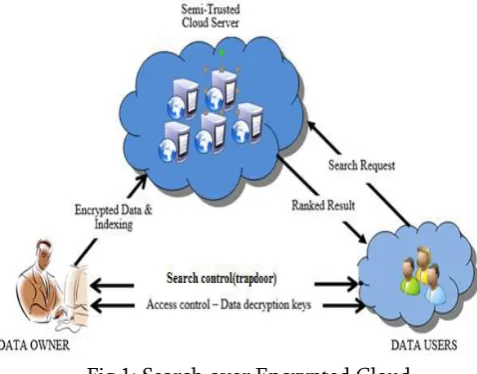
The system architecture is presenting the simple structural framework for a system. It defines the overall flow of the system which briefly describes the functioning and the purpose of the implementation phase is to plan a solution of the problem identified by the necessity file. The underneath Figure 1 exhibit the system of the structure. We consider three segments in our structure designing: Data Owner, Data customer and Cloud Server.
Data Owner is in charge of the making of the database.
Data Users are the devotees in a gathering who can utilize the documents of the database.
Cloud Server bargains information offices to confirmed clients. It is fundamental that server be torpid to substance of the database it keeps.
displays a request in a secret casing a trapdoor of the keyword to the cloud server. In the wake of getting the chase request, the server is in charge to look for the record and give back the planning course of action of reports to the customer. We think the ensured situated keyword look risky as takes after: the question yield must be returned accommodating clear situated noteworthiness principles, to make record recuperation precision for customers. In any case, cloud server must audit dark or insignificant about the basic guidelines themselves as they reveal critical sensitive data against keyword insurance. To decay exchange speed, the customer may send possible regard k nearby the trapdoor and cloud server just sends back the top-k most appropriate archives to the customer's concerned keyword. Plot Goals: To allow situated output for specialist use of outsourced cloud data under the already specified show, our system setup should rapidly finish security and execution attestations as takes after.
Fig 1: Search over Encrypted Cloud
Multi-keyword Ranked Search: To design look for arrangements which allow multi-keyword question and give result closeness situating to fruitful data recuperation, instead of returning undifferentiated results.
Insurance Preserving: To shield the cloud server from taking in additional data from the dataset and the record, and to meet security.
Viability: Above goals on helpfulness and security should be expert with low correspondence and
estimation overhead. Mastermind Matching:
"Compose planning" [2] is a widely appealing likeness measure which uses the amount of question keywords appearing in the answer to assess the significance of that chronicle to the request. Exactly when customers recognize the right subset of the dataset to be recovered, Boolean request finish well with the right chase require communicated by the customer. It is more adaptable for customers to perceive a summary of keywords exhibiting their stress and recoup the most imperative reports with a rank demand.
V.
METHODOLOGY
A. Stemming:
In phonetic morphology and data recovery, stemming is the way toward decreasing bent (or once in a while determined) words to their pledge stem, base or root shape—for the most part a composed word frame. The stem require not be indistinguishable to the morphological foundation of the word; it is generally adequate that related words guide to a similar stem, regardless of the possibility that this stem is not in itself a substantial root. Calculations for stemming have been considered in software engineering since the 1960s. Many web indexes treat words with an indistinguishable originate from equivalent words as a sort of question extension, a procedure called conflation. Stemming projects are regularly alluded to as stemming calculations or stemmers.
B. Suffix-stripping algorithms:
Suffix-stripping algorithms don't depend on a query table that comprises of curved structures and root frame relations. Rather, a commonly littler rundown of "tenets" is put away which gives a way to the calculation, given an information word shape, to discover its root frame. A few cases of the principles include:
if the word ends in 'ed', remove the 'ed'
if the word ends in 'ing', remove the 'ing'
if the word ends in 'ly', remove the 'ly'
Addition stripping approaches appreciate the advantage of being considerably easier to keep up than savage constrain calculations, accepting the maintainer is adequately educated in the difficulties of etymology and morphology and encoding postfix stripping rules. Addition stripping calculations are here and there viewed as unrefined given the poor execution when managing remarkable relations (like "ran" and 'run'). The arrangements delivered by postfix stripping calculations are restricted to those lexical classes which have surely understood additions with couple of special cases. This, notwithstanding, is an issue, as not all parts of discourse have such an
all-around planned arrangement of standards.
Lemmatization endeavors to enhance this test.
C. Stop-Words:
In registering, stop words will be words which are sifted through before or subsequent to handling of normal dialect information (text).Though stop words more often than not allude to the most widely recognized words in a dialect, there is no single all inclusive rundown of stop words utilized by all common dialect preparing apparatuses, and in fact not all devices even utilize such a rundown. A few apparatuses particularly abstain from evacuating these stop words to bolster state seek.
Any gathering of words can be picked as the stop words for a given reason. For some web crawlers, these are the absolute most normal, short capacity words, for example, the, is, at, which, and on. For this
scanning for expressions that incorporate them, especially in names, for example, "The Who", "The", or "Take That". Other web crawlers expel the absolute most normal words—including lexical words, for example, "need"— from an inquiry with a specific end goal to enhance execution.
Hans Peter Luhn, one of the pioneers in data recovery, is credited with begetting the saying and utilizing the idea. The expression "stop word", which is not in Luhn's 1959 introduction, and the related terms "stop rundown" and "stoplist" show up in the writing in the blink of an eye a short time later.
A forerunner idea was utilized as a part of making a few concordances. For instance, the principal Hebrew concordance, Meir local, contained a one-page rundown of unindexed words, with no substantive relational words and conjunctions which are like present day stop words.
D. TF-IDF
TF-IDF remains for term recurrence opposite archive recurrence, and the TF-IDF weight is a weight regularly utilized as a part of data recovery and content mining. This weight is a factual measure used to assess how critical a word is to a record in an accumulation or corpus. The significance builds relatively to the quantity of times a word shows up in the archive yet is balanced by the recurrence of the word in the corpus. Varieties of the TF-IDF weighting plan are regularly utilized via web search tools as a focal apparatus in scoring and positioning an archive's importance given a client inquiry.
One of the least difficult positioning capacities is figured by summing the TF-IDF for each question term; numerous more complex positioning capacities are variations of this straightforward model.
Commonly, the tf-idf weight is formed by two terms: the principal processes the standardized Term Frequency (TF), otherwise known as. The quantity of times a word shows up in a report, isolated by the aggregate number of words in that archive; the second term is the Inverse Document Frequency (IDF), processed as the logarithm of the quantity of the records in the corpus partitioned by the quantity of records where the particular term shows up.
TF: Term Frequency, which measures how much of the time a term, happens in a report. Since each record is distinctive long, it is conceivable that a term would seem significantly more circumstances in long reports than shorter ones. Along these lines, the term recurrence is regularly separated by the report length (otherwise known as. the aggregate number of terms in the record) as a method for standardization:
TF (t) = (Number of times term t appears in a document) / (Total number of terms in the
document).
IDF: Inverse Document Frequency, which measures how important a term is. While computing TF, all terms are considered equally important. However it is known that certain terms, such as "is", "of", and "that", may appear a lot of times but have little importance. Thus we need to weigh down the frequent terms while scale up the rare ones, by computing the following:
IDF (t) = log_e (Total number of documents / Number of documents with term t in it).
E. Build Index Tree
Input: the document collection F = ff1, f2, ..., fn g with the identifiers FID = {FID—FID = 1, 2... n }.
Output: the index tree T
1. for each document fFID in F do 2. Construct a leaf node u for fFID, 3. Insert u to CurrentNodeSet; 4. end for
5. while the number of nodes in
CurrentNodeSet is larger than 1 do
6. if the number of nodes in CurrentNodeSet is even, i.e. 2h then
7. for each pair of nodes u0 and u00 in CurrentNodeSet do
8. Generate a parent node u for u0 and u00 , 9. Insert u to TempNodeSet;
10. end for 11. else
12. for each pair of nodes u0 and u00 of the former (2h � 2) nodes in CurrentNodeSet do 13. Generate a parent node u for u0 and u00 ; 14. Insert u to TempNodeSet;
15. end for
16. Create a parent node u1 for the (2h - 1)-th and 2h-th node, and then create a parent node u for u1 and the (2h + 1)-th node;
17. Insert u to TempNodeSet; 18. end if
19. Replace CurrentNodeSet with TempNodeSet and then clear TempNodeSet;
20. end while
21. return the only node left in CurrentNodeSet, namely, the root of index tree T ;
F. BDMRS
SK Setup () initially, the data owner generates the secret key set SK, including 1) A randomly generated m-bit vector S where m is equal to the cardinality of dictionary, and 2) two (m X m) invertible matrices M1 and M2. Namely, SK = {S, M1, M2}.
I GenIndex (F, SK) First, the unencrypted index tree T is built on F by using
T BuildIndexTree (F) Secondly, the data owner generates two random vectors (D’u, D”u) for index vector Du in each node u, according to the secret vector S. Specifically, if S[i] = 0, D’u[i] and D”u[i] will
be set equal to
Du[i]; if S[i] = 1,
TD GenTrapdoor (Wq, SK) with keyword set Wq, the unencrypted query vector
Q with length of m is generated. If wi “Wq, Q[i] stores the normalized IDF value of wi; else Q[i] is set to 0. Similarly, the query vector Q is split into two random vectors Q’ and Q”. The difference is that if S[i] = 0, Q? [i] and Q” [i] are set to two random values
whose sum equals to Q[i];
else Q’ [i] and Q” [i] are set
as the same as Q[i]. Finally, the algorithm returns the trapdoor TD =
Relevance Score SRScore (Iu, TD) With the trapdoor TD, the cloud server computes the relevance score of node u in the index tree I to the query.
G. EDMRS Scheme
The enhanced EDMRS scheme is almost the same as BDMRS scheme except that:
SK Setup (): In this algorithm, we set the secret vector S as a m-bit vector, and set M1 and M2 are (m + m’) (m + m’) invertible matrices, where m’ is the number of phantom terms.
I GenIndex (F; SK): Before encrypting the index vector Du, we extend the vector Du to be a (m+m’) - dimensional vector. Each extended element Du [m+ j], j = 1... m’, is set as a random number”j .
TD GenTrapdoor (Wq, SK) The query vector Q is extended to be a (m + m’)- dimensional vector. Among the extended elements, a number of m” elements are randomly chosen to set as 1, and the rest are set as 0.
Relevance Score SRScore(Iu, TD) After the execution of relevance evaluation by cloud server, the final relevance score for index vector Iu equals to Du ˆA
A.Data User Module:
Information clients are clients on this framework, will's identity arranged to download documents from the cloud that are traded by the information proprietors. Since the documents set away on the cloud server could be in huge numbers, there is an intrigue office accommodated the client. The client ought to be able to do a multi-keyword look on the cloud server. Once, the outcome shows up for the particular intrigue, these clients ought to be able to send a demand to the individual information proprietors of the document through the framework (likewise called trap-section ask for) for downloading these records. The information clients will comparatively be given a demand bolster screen, where it will tell if the information proprietor has perceived or rejects the demand. On the off chance that the demand has been affirmed, the clients ought to be able to download the decoded record.
B. Information Owner Module:
In this module, the data proprietors should have the ability to exchange the records. The reports are encoded before the records are exchanged to the cloud. The data proprietors are given another option to enter the keywords for the record that are exchanged to the server. These keywords are used for the requesting reason which helps the interest return values quickly. These records when once available on the cloud, the data customers should be skilled interest using the keywords. The data proprietors will moreover be outfitted with a request underwriting screen so they can support or reject the request that is gotten by the data customers.
C. Document Upload and Encryption Module:
the data customers should have the ability to chase using keywords. The data proprietors will in like manner be outfitted with a request underwriting screen so they can support or reject the requests that are gotten by the data customers. The record before exchange ought to be encoded with a key so that the data customers can't just download it without this key. This key will be requested by the data customers through the trap-portal. The encryption of these records uses RSA figuring so that unapproved customers won't have the ability to download these archives.
D. Document Download and Decryption Module:
Information clients are clients on this framework, will's identity ready to download documents from the cloud that are transferred by the information proprietors. Since the records put away on the cloud server could be in immense numbers, there is a pursuit office gave to the client. The client ought to have the capacity to do a multi-keyword seek on the cloud server. Once, the outcome shows up for the particular pursuit, the clients ought to have the capacity to send a demand to the individual information proprietors of the document through the framework (additionally called trap-entryway ask for) for downloading these records. The information clients will likewise be given a demand endorsement screen, where it will tell if the information proprietor has acknowledged or dismisses the demand. On the off chance that the demand has been endorsed, the clients ought to have the capacity to download the unscrambled document. The record before download should be unscrambled with a key. This key will be asked for by the information clients through the trap-entryway ask. Once the key is given amid the download, the information clients will have the capacity to download the record and utilize them.
E. Rank-Search Module:
This module enables the information clients to search for the reports with multi-keyword rank looking. This model uses the on occasion utilized rank pursuing figuring down present the yield for
multi-keywords. "Energize Matching" administer will be gotten a handle on for the multi-keyword pursuing. This module in like way oversees making an archive for speedier pursue.
II. EXPERIMENTAL RESULT
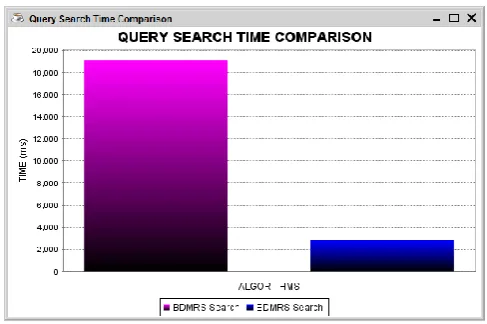
Fig. 2 shows look time correlation diagram; in roar chart X-hub demonstrates the calculation by which records are sought while Y-pivot indicate time required for seeking question related in ms.
Fig 2: Query Search Time Comparison
Fig. 3 shows time diagram; in above chart X-pivot indicates number of records in gathering while Y-hub demonstrate time required for producing file tree in ms, with increment in number of archives the time required to create list tree is additionally increment.
Figure 3: Time Graph for Document Collection
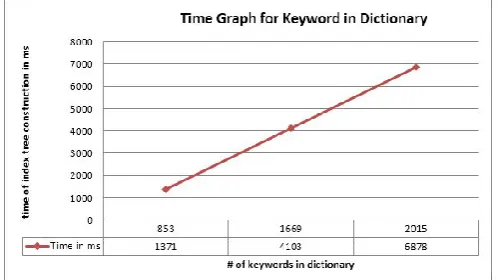
of keywords the time required to create list tree is additionally increment.
Figure 4: Time Graph for Keyword in Dictionary
VI.
CONCLUSION
In this work, firstly we portray and resolve the troublesome of multi-keyword positioned look over scrambled cloud information, and make an assortment of protection necessities. Between various multi-keyword semantics, we select the compelling likeness measure of "facilitate coordinating", i.e., as different matches as likely, to adequately catch the importance of outsourced archives to the question correspondence .In our future work, we will seek supporting other multi keyword semantics over encoded information and checking the honesty of the rank request in the item keywords. For tradition the test of steady multi-keyword semantic without security breaks, we propose an essential thought of MRSE. At that point we give two better MRSE diagrams to acknowledge numerous stringent security necessities in two divergent risk models. Nitty gritty examination contemplating security and effectiveness assurances of proposed plans is given, and trials on this present reality information set demonstrate our future frameworks present low overhead on both calculation and correspondence.
VII.
REFERENCES
[1]. Qin Liuy, Guojun Wangyz, and Jie Wuz,”Secure and privacy preserving keyword searching for
Network and computer Applications, March 2011
[2]. Ming Li et al.,” Authorized Private Keyword Search over Encrypted Data in Cloud Computing,IEEE proc. International conference on distributed computing systems, June 2011,pages 383-392
[3]. Cong Wang et al.,”Enabling Secure and
Efficient Ranked Keyword Search over Outsourced Cloud Data”, IEEE Transactions on parallel and distributed systems, vol. 23, no. 8, August 2012
[4]. Kui Ren et al., “Towards Secure and Effective Data utilization in Public Cloud”, IEEE Transactions on Network, volume 26, Issue 6, November / December 2012
[5]. Ming Li et al.,”Toward Privacy-Assured and Searchable Cloud Data Storage Services”, IEEE Transactions on Network, volume 27, Issue 4, July/August 2013
[6]. Wei Zhou et al., “K-Gram Based Fuzzy
Keyword Search over Encrypted Cloud Computing “Journal of Software Engineering and Applications, Scientific Research , Issue 6, Volume 29-32,January2013
[7]. J. Baek et al., “Public key encryption with keyword search revisited", in ICCSA 2008, vol. 5072 of Lecture Notes in Computer Science, pp. 1249 - 1259, Perugia, Italy, 2008. Springer Berlin/Heidelberg.
[8]. H. S. Rhee et al., “Trapdoor security in a searchable public-key encryption scheme with a designated tester," The Journal of Systems and Software, vol. 83, no. 5, pp. 763-771, 2010. [9]. Peng Xu et al., Public-Key Encryption with
Fuzzy Keyword Search: A Provably Secure Scheme under Keyword Guessing Attack”,IEEE Transactions on computers, vol. 62, no. 11, November 2013
[11].D. X. D. Song, D. Wagner, and A. Perrig, ”Practical techniques for searches on encrypted data,” in Proc. S & P, BERKELEY, CA, 2000, pp. 44.
[12].C. Wang, N. Cao, K. Ren, and W. J. Lou, Enabling Secure and Efficient Ranked Keyword Search over Outsourced Cloud Data, IEEE Trans. Parallel Distrib. Syst., vol. 23, no. 8, pp. 1467-1479, Aug. 2012.
[13].W. Sun, B. Wang, N. Cao, M. Li, W. Lou, Y. T. Hou, and H. Li, ”Privacy-preserving multi-keyword text search in the cloud supporting similarity-based ranking,” in Proc. ASIACCS, Hangzhou, China, 2013, pp. 71-82.
[14].R. X. Li, Z. Y. Xu, W. S. Kang, K. C. Yow, and C. Z. Xu, Efficient multi-keyword ranked query over encrypted data in cloud computing, Futur. Gener. Comp. Syst., vol. 30, pp. 179-190, Jan. 2014.
[15].Gurdeep Kaur, Poonam Nandal, “Ranking