* To whom all correspondence should be addressed. E-mail: [email protected]
Comparative Morphology of the Otolith of
Carangids species in the Persian Gulf and Oman Sea
A. Mansourkiaei¹, T. Valinasab², G.H.Vosoughi³ and P. Ghavam Mostafavi³
¹Department of Marine Biology, Tonekabon Branch, Islamic Azad University, Tonekabon (Iran). ²Iranian Fisheries Research Organization, P.O.Box: 14155-6116, Tehran (Iran).
³Department of Marine Biology, Science and Research branch, Islamic Azad University, Tehran (Iran).
(Received: September 01, 2011; Accepted: October 08, 2011)
The otolith morphology of 10 species belonging to the Carangidae family collected from the Persian Gulf and Oman Sea (coast of Iran). Were examined separately and the characteristics were drawn. The morphomttric parameters determined were total length (TL, mm), weight (W, gr), otolith length (OL, mm), weight of right otolith(WRO, mm), weight of left otolith(WLO, mm), height of right otolith (HRO, mm), height of left otolith (HLO, mm),. The values obtained from measurements are given in the 90% confidence interval in most spesies. The observation of this family three shape of sagittal, Sagitiform, Fusiform and Lanceolated. As a result of this analysis, it is possible to identify the species from the Carangidae family by the otolith characters.
Key words: Otolith, Morphology, Sagitta, Carangidae, Persian Gulf, Oman Sea.
Otoliths are acellular concretions of calcium carbonate and other inorganic salts, witch develop over a protein matrix in the inner ear of vertebrates, in close association with the sensitive maculae of labyrinthic compartments (Weichert and Prech 1981; Hildebrand, 1988; Jobling, 1995). Otoliths are enclosed in three compartments linked with the ear in teleost fishes (Popper et al, 2005). The labyrinth includes three semicircular canals oriented in different planes and three compartments: the utriculus, sacculus and lagena. Each compartment contains otoliths (earbones or earstones), the lapillus, sagitta,and asteriscus (Berra &Aday,2004).The sacular otolith (sagitta) is the largest and the utricular otolith (lapillus) is the smallest among the three (Paxton, 2000) at least in most teleost families (Schulzmirbach and
Reichenbacher, 2006). Although the morphological features of otoliths are highly variable between species, ranging from the relatively simple disc shape of some flat fishes (Pleuronectidae) to the irregular shape of others, a high level of species specificity has, for along time, been used to achieve various taxonomic objective (Hecth, 1987; Hunt, 1992).
Otoliths have an important biological function because they enable the inner ear to mediate the senses of hearing and balance (Popper et al, 2005). Otoliths growth is related to increase in size of the fish and generally follows and allometric increase in dimensions (Chilton and Beanish, 1982).
Otoliths of each species of fish have characteristic shapes and features and given adequate comparative material or appropriate keys, identification to species can usually be done provided that the otoliths are not broken or badly digested. The fact that otoliths persist in the stomach, intestines, or feces after after soft parts and bones have disappeared increases their utility. In the present work, an attempt was made to describe the otolith morphological characters of the family Carangidae collected mainly from Persian Gulf and Oman Sea. There is no work or record that deals solely with the otoliths of
carangidae in Persian Gulf and Oman Sea. The aim of this study was to provide new information regarding otolith morphology and body size relationships of 10 species of carangidae.
MATERIAL AND METHODS
The otolith of 10 species of Persian Gulf and Oman Sea carangidae were examined. The number of observations on each species and range in fish lengths is given in table 1. The total length and body weight in fishes were measured.
Table 1. Sample sizes of 10 carangid species in the Persian Gulf and Oman Sea
Species N Standard length Mean Standard Weight Mean
range (mm) length (mm) range (gr) weight (gr)
Parastromateus niger 59 130-370 173.02±64.67 98-2051 320.14±507.54
Alectis indicus 30 155-490 319.67±79.14 147.24-2000 819.53±383.73
Uraspis helvola 30 145-290 185.43±36.62 109.67-287.67 194.40±50.37
Atropus atropus 42 140-200 160.14±16.14 94.46-260.4 153.32±45.29
Megalaspis cordyla 26 260-380 292.50±39.93 263.12-673.07 359.99±146.28
Scomberoides 29 292-425 334.10±28.84 205.73-777.27 518.20±127.84
commersonnianus
Caranx papuensis 27 152-245 176.33±17.11 95.57-388.14 167.68±52.58
Aleps djedaba 64 155-190 169.56±9.49 76.2-165.35 112.05±18.61
Carangoides chrysophrys 32 153-362 195.69±42.13 97.27-544.45 214.98±111.00
Carangoides armatus 30 143-235 186.93±18.23 126.76-555.26 282.15±78.91
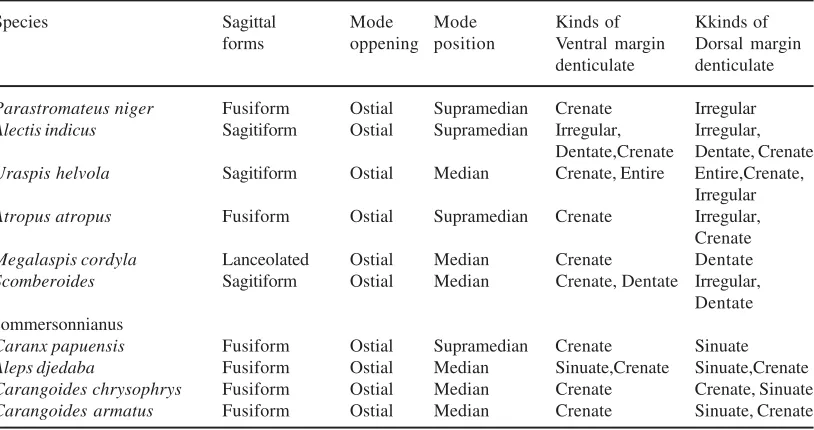
Table 2. Shape of otolith and different mode opening and kinds of denticulate
Species Sagittal Mode Mode Kinds of Kkinds of
forms oppening position Ventral margin Dorsal margin
denticulate denticulate
Parastromateus niger Fusiform Ostial Supramedian Crenate Irregular
Alectis indicus Sagitiform Ostial Supramedian Irregular, Irregular,
Dentate,Crenate Dentate, Crenate
Uraspis helvola Sagitiform Ostial Median Crenate, Entire Entire,Crenate, Irregular
Atropus atropus Fusiform Ostial Supramedian Crenate Irregular, Crenate
Megalaspis cordyla Lanceolated Ostial Median Crenate Dentate
Scomberoides Sagitiform Ostial Median Crenate, Dentate Irregular, Dentate commersonnianus
Caranx papuensis Fusiform Ostial Supramedian Crenate Sinuate
Aleps djedaba Fusiform Ostial Median Sinuate,Crenate Sinuate,Crenate
Carangoides chrysophrys Fusiform Ostial Median Crenate Crenate, Sinuate
Fish were caught in the Persian Gulf and Oman Sea by trawling ship. The total length and weight, for each fish were determined. Only sagittal otoliths were extracted from fresh specimens. These otoliths are located on the two sides of basioccipital bone and are separated by a thin septum arising from the mid ventral ridge of the occipital (Ruck, 1976). The otoliths were removed by turning the ventral side of the fish upward to allow removal of the lower jaw, the gills and the hypobranchial apparatus and to expose the base of skull. With a sharp scalpel, the optic capsules were separated and the otoliths gently removed with a pair of fine tweezers. Later, the otoliths were cleaned with 70% ethanol and stored dry in small glass tube.
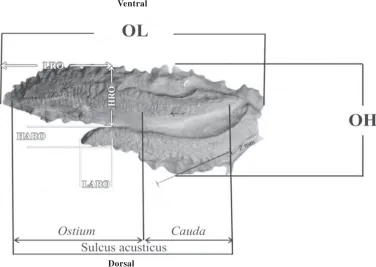
Length (OL), defined as the longest dimension between the anterior and posterior edges of the otolith, and Otolith Height (OH) as the dimension from the dorsal to ventral edge, and Antirostrum Length of Otolith (LARO), and Antirostrum Height of Otolith (HARO), and Rostrum Length of Otolith(LRO),and Rostrum Height of Otolith(HRO)(Fig. 1).
Length (OL), defined as the longest dimension between the anterior and posterior edges of the otolith, and Otolith Height (OH) as the dimension from the dorsal to ventral edge, and Antirostrum Length of Otolith (LARO), and Antirostrum Height of Otolith (HARO), and Rostrum Length of Otolith(LRO),and Rostrum Height of Otolith(HRO)(Fig. 1).
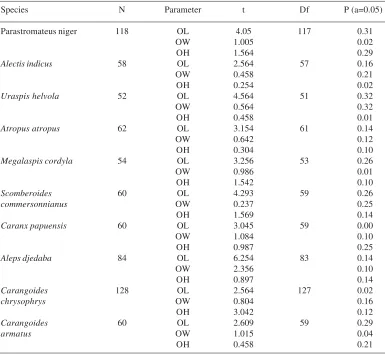
Table 3. Differences between right and left otolith of 10 carangid species from the Persian Gulf and Oman Sea. (OL) otolith length, (OW) otolith weight,
(OH) otolith height (N=number of right otolith + left otolith)
Species N Parameter t Df P (a=0.05)
Parastromateus niger 118 OL 4.05 117 0.31
OW 1.005 0.02
OH 1.564 0.29
Alectis indicus 58 OL 2.564 57 0.16
OW 0.458 0.21
OH 0.254 0.02
Uraspis helvola 52 OL 4.564 51 0.32
OW 0.564 0.32
OH 0.458 0.01
Atropus atropus 62 OL 3.154 61 0.14
OW 0.642 0.12
OH 0.304 0.10
Megalaspis cordyla 54 OL 3.256 53 0.26
OW 0.986 0.01
OH 1.542 0.10
Scomberoides 60 OL 4.293 59 0.26
commersonnianus OW 0.237 0.25
OH 1.569 0.14
Caranx papuensis 60 OL 3.045 59 0.00
OW 1.084 0.10
OH 0.987 0.25
Aleps djedaba 84 OL 6.254 83 0.14
OW 2.356 0.10
OH 0.897 0.14
Carangoides 128 OL 2.564 127 0.02
chrysophrys OW 0.804 0.16
OH 3.042 0.12
Carangoides 60 OL 2.609 59 0.29
armatus OW 1.015 0.04
T
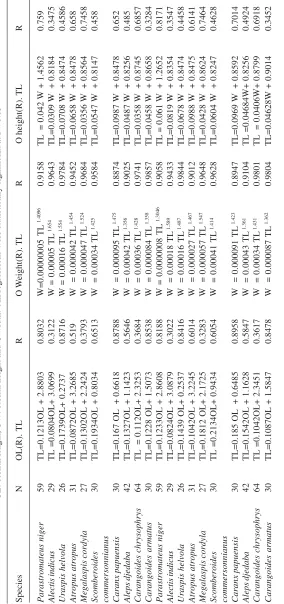
able 4.
Relationship between otolith morphometric parameters and
T
otal length (TL). Coef
ficient of determination (R).
OL: otolith length, OW
: otolith height and O width.
All regressions were statistically significant at P< 0.05
Species N OL(R). TL R O W eight(R). TL R
O height(R). TL
R
Parastromateus niger
59
TL=0.1213OL + 2.8803
0.8032 W= 0.00000005 TL 1.4096 0.9158 TL
= 0.042 W
+ 1.4562 0.759 Alectis indicus 29 TL =0.0804OL+ 3.0699 0.3122 W
= 0.00005 TL
1.654
0.9643
T
L=0.0309 W +
0.8184 0.3475 Uraspis helvola 26 TL=0.1739OL+ 0.2737 0.8716 W
= 0.00016 TL
1.554
0.9784
T
L=0.0708 W +
0.8474
0.4586
Atropus atropus
31
TL=0.0872OL + 3.2685
0.519
W
= 0.000042 TL
1.454
0.9452
T
L=0.0658 W +
0.8478
0.658
Megalaspis cordyla
27
TL=0.1302OL + 2.2424
0.3793
W
= 0.000047 TL
1.524
0.9684
T
L=0.0356 W +
0.8564
0.7458
Scomberoides
30
TL=0.1934OL + 0.8034
0.6513
W
= 0.00034 TL
1.425
0.9584
T
L=0.0547 W +
0.8147
0.458
commersonnianus Caranx papuensis
30
TL=0.167 OL + 0.6618
0.8788
W
= 0.000095 TL
1.475
0.8874
T
L=0.0987 W +
0.8478
0.652
Aleps djedaba
42
TL=0.1327OL + 1.1423
0.5646
W
= 0.00042 TL
1.356
0.9025
T
L=0.0487 W +
0.8256
0.485
Carangoides chrysophrys
64
TL = 0.112OL+ 2.3253
0.3684
W
= 0.00036 TL
1.428
0.9741
T
L=0.0358 W +
0.8745
0.6857
Carangoides armatus
30
TL=0.1228 OL+ 1.5073
0.8538
W
= 0.000084 TL
1.358
0.9857
T
L=0.0458 W +
0.8658 0.3284 Parastromateus niger 59 TL=0.1233OL + 2.8608 0.8188 W
= 0.0000008 TL
1.3046
0.9058
TL
= 0.061 W
+ 1.2652
0.8171
Alectis indicus
29
TL=0.0824OL + 3.0879
0.3022
W
= 0.00018 TL
1.589
0.9433
T
L=0.0819 W +
0.8354
0.3547
Uraspis helvola
26
TL=0.1439 OL+ 0.2537
0.8416
W
= 0.00016 TL
1.487
0.9844
T
L=0.0678 W +
0.8474
0.4458
Atropus atropus
31
TL=0.1042OL + 3.2245
0.6014
W
= 0.000027 TL
1.467
0.9012
T
L=0.0988 W +
0.8475
0.6141
Megalaspis cordyla
27
TL=0.1812 OL+ 2.1725
0.3283
W
= 0.000057 TL
1.547
0.9648
T
L=0.0428 W +
0.8624
0.7464
Scomberoides
30
TL =0.2134OL+ 0.9434
0.6054
W
= 0.00041 TL
1.414
0.9628
T
L=0.0604 W +
0.8247
0.4628
commersonnianus Caranx papuensis
30
TL=0.185 OL + 0.6485
0.8958
W
= 0.000091 TL
1.423
0.8947
T
L=0.0969 W +
0.8592
0.7014
Aleps djedaba
42
TL=0.1542OL + 1.1628
0.5847
W
= 0.00043 TL
1.361 0.9104 TL =0.04684W+ 0.8256 0.4924 Carangoides chrysophrys 64
TL =0.1042OL+ 2.3451
0.3617
W
= 0.00034 TL
1.431 0.9801 TL = 0.0406W+ 0.8799 0.6918 Carangoides armatus 30
TL=0.1087OL + 1.5847
0.8478
W
= 0.000087 TL
1.362
0.9804
TL=0.04628W +
0.9014
The sagittal otolith of each species, both left and right, photographs taken by scaning electron microscope (Philips XL30). The significance of the variance one way (ANOVA) relationships between otolith and fish length and fish weight. Difference between right and left sagittae were tested using a paired t-test. The following morphometric relationships were analyzed.
RESULTS
All parameter measured show significant morphometric between left and right otolith, (Table 2). The shape of the otolith in carangidae was different and can be classified into three types: fusiform, sagitiform, lanceolate and variable of margin in otolith were determined (Table 2).
The relationships of otolith length and otolith weight with fish length and fish weight in all species was observed. Generally, standard length of fishes is linearly related to otolith length.
Otolith length typically is linearly related to length of fish until the fish reaches maximum size; thereafter, the otolith increase only in thickness.
Analyses of otolith morphometric parameters vs.TL in the some species were showed high correlation and the some species were showed less correlation (Table 4). The relationship between fish OW and total length, the coefficient of determination being higher than 0.88 in all species (Table 4).
DISCUSSION
The present investigation has shown that the specific morphology of the otolith can used the taxonomy and identification in carangidae. All equations relating otolith length with fish size proportion of the variance in the all species.
Otoliths of each species of fish have characteristic shapes and features and given adequate comparative material or appropriate keys, Ventral
Dorsal
identification to species can usually be done provided that the otoliths are not broken or badly digested(Frost, 1981).
Relationship between otolith morphometric parameters and fish total length and weight for carangidae species studied were observed. Generally, total length of ûshes is linearly related to otolith length. Otolith length typically is linearly related to length of the all species examined (Table 4). Newman (2002) and Mosegaard & Reeves (2001) have recorded a linear relationship for both the total body length and weight and otolith weight. Al Dubakel in 2006 reported the relationships between both fish body size versus weight of the oto lith, eye lens and liver were studied in Acanthopagrus latus
Therapon theraps, and Pelates quadrilineatus
collected from the Khor Al-Zubair area, Iraq Otolith lengths of larval and juvenile ûshes may increase in a curvilinear fashion relative to ûsh length for some species, such as sockeye salmon (Oncorhynchus nerka ; West and Larkin, 1987) . The relationship between otolith length and ûsh length may be dependent on the growth rate of the ûsh, as was reported for striped bass
(Morone saxatilis; Secor and Dean, 1989).Similar
results have been reported for many fish species(Jawad, 2007; Hunt, 1992; Volpedo et al, 2006).
Studies of sagitta otolith morphometric parameter in all species of carangidae in research significantly between right and left otolith and different in size, similar to in a rockfish species left and right sagitta also may differ in size (Wyllie, 1987).Although in 8 species of Atlantic Ocean fishes were carried out and were not significantly different between left and right otolith (Hunt, 1992). Investigation of sagitta otolith morphometric parameter in 4 species of sciaenidae did not show significant morphometric differences between left and right otoliths, only otolith width in white mouth croaker and otolith length in king weakfish showed significant differences between left and right otoliths (Waessle et al., 2003).
Analyzing the morphometric relationships, we concluded that otolith length and otolith weight are indicators of fish total length and fish weight in all species. In most species otolith length and fish length the potential regression explained more than 90% variation and
in most species otolith weight and fish weight 90% variation. Baldas et al (1997) described the relationship between otolith length and fish total length by using potential models in stripped weakfish (50-600mmTL) and linear models in Whitemouth croaker ( 140-370mm TL). Also Waessle et al (2003) observed similar to results in juvenile sciaenidae.
Otolith growth is generally thought to uncouple from somatic growth at a very early age (Munk and smikrud, 2001). A variety of factors influence the degree or timing of this uncoupling (Moksness et al, 1995).
In this study has shown that the specific morphology of the otoliths examined can be used for taxonomic identification of carangidae species. The observation of this family three shape of sagittal, Sagitiform, Fusiform and Lanceolated (Table 2).
The analysis between left and right otolith showed morphometric difference. Sagitta is the best otolith to recognize in carangidae.
ACKNOWLEDGMENTS
We thanks Dr. Mohammad Reza Fatemi for his guides in research and we would like to thanks Mr. Azhir for collected in samples from trawl ship. The author thanks the director Mr Pourbakhshian and the staff of laboratory in Islamic Azad university Tonekabon branch.
REFERENCES
1. Al-Dubakel, A.Y & J. N. Abdullah. Relationship
of body size with some body structures of three young marine fish species collected from Khor
Al-Zubair, Iraq, Anales de biologia 28: 95-99
(2006).
2. Baldas, M.I., G. Perez Macri, A.V. Volpedo and
D.D. Echeverria., Morphology sagittal in
Carangidae, Scianidae, Mullidae in costal sea of
Argentina, 19: 99-112 (1997).
3. Berra, T. M. & Aday, D. D., Otolith description
and age-and-growth of Kurtus gulliveri from
northern Australia. J. Fish Biol. 65: 354–362
(2004).
4. Chilton, D.E., and R.J. Beamish, Age
determination methods for studies by the Ground fish program at the pacific Biological
station. Can. Spec. Pub. Fish. Aquatic Sci, 60:
5. Frost, K. J. & Lowry, L. F., Trophic importance of some marine gadids in northern Alaska and their body-otolith size relationships, Fish. Bull.,
79: 187-192 (1981).
6. Hecht T., Guide to the otoliths of southern
Ocean fishes. Suid-Afrikaanse Tydskrif Vir
Antarkieses Navorsing17: 2-87 (1987).
7. Hunt, J.J., Morphological characteristics of
otoliths for selected fish in the Northwest
Atlantic, Journal Northw Atl. Fish.Sci., 13
:63-75 (1992).
8. Jawad, L.A.,Al-Jufaili, S.A, Al-Shuhaily, S.S.
Morphology of the otolith of the greater Lizardfish Saurdiatumbil (pisces:synodontidae),
Journal of Natural History, 42(35-36): 2321-233. 2008.
9. Jobling, M. and A. B Reiby., The use and abuse
of fish otoliths in studies of feeding habits of
marine piscivorores, Sarsia, 71: 265-274
(1986).
10. Moksness, E., K. Rukan, L. Ystanes, A.
Folkvord, and A. Johannessen., Comparison of somatic and otolith growth in North sea herring (Clupea harengus L.) larvae: evaluation of growth dynamics in mesocosms. University of South Carolina Press, Columbia. P: 119-134 (1995).
11. Mosegaard H & Reeves SA., Revision of Baltic
cod age determination based on otolith accretion charac- teristics and weight distribution. International Council for the Exploration of the Sea. Report 2001/p12 (2001).
12. Munk, K. M. 2001. Maximum ages of ground
fishes in waters off Alaska and British Columbia and considerations of age determination. Alaska Fishery Research Bulletin 8(1): 12-21.
13. Newman SJ., Age, growth, mortality, and
population characteristic of the pearl perch (Glaucosoma buer- geri Richardson, 1845), from deeper continental shelf waters off the Pibara
coast of North Western Australia. Journal of
Applied Ichthyology 18(2): 95-101 (2002).
14. Paxton, J.R.Fish otoliths: do size correlate with
taxonomic group, habitat and Luminescence. Philosophical Transactions of the Royal Society
of London B 365: 1299-1303 (2000).
15. Popper, A.N, Ramcharitar, J. U. & Campana,
S.E., Why otoliths Insights from inner ear
physiology and fisheries biology. Mar Fresh w
Res, 56: 497-504 (2005).
16. Ruck J.G. 1976. Studies on the development
and osteology of some New Zealand in shore Fishes (PhD thesis). Wellington: Victoria University of Wellington.
17. Schulzmirbach T, Reichenbacher B.
Reconstruction of Oligocene and neogene freshwater fish faunas-an acutualistic study on
cyprniiformotolith. Actapalaeontol Pol: 51(2):
283-304 (2006).
18. Secor, D.H. & Dean, J. M., Somatic growth
effects on the otolith- fish size relationship in young pound- reared striped bass, Morone
saxatilis. Can J. Fish. Aquat. Sci. 46: 113-121
(1989).
19. Volpedo, A.Echererria, D.D, Ecomorphological
patterns of the sagitta in fish on the continental
shelf off Argentine, Fisheries Research, 60:
551-560 (2003).
20. Waessle, J.A., Lasta, C.A., & Favero, M.,
Otolith morphology and body size relationships for juvenile Sciaenidae in the Rio de la Plata
estuary. Scientia Marina1 67: 233-240 (2003).
21. West, C. J. & Larkin P. A., Evidence of
size-selective mortality of juvenile sockeye salmon (Oncorhynchus nerka) in Babine Lake, British
Columbia. Can. J. Fish. Aquat. Sci. 44: 712-721
(1987).
22. Wyllie, E. T., Relationship of otolith length to
total length in rockfishes from northern and
central California. Fish. Bull. 85: 383–387