Original Research Article
Prevalence of addiction to online video games: gaming
disorder among medical students
Pradeep Yarasani
1, Roshakhi Sultana Shaik
2, Achyuth Rama Raju Myla
1*
INTRODUCTION
Gaming disorder is characterised by craving of the person to play video games. This may affect daily routine activities of the person, along with poor performance in studies, not able to meet the demands in occupation, other areas of important functioning and disturbances in family relationships.
According to world Health organization, gaming disorder
added under International Classification of Diseases 11, i.e. disorders due to substance use or addictive behaviours with a code 6C51.
Physical illnesses like recurrent frequent headaches, nausea, cervical spondylosis due to improper balancing of neck, blurring of vision, dry eyes, early development of cataracts, pain in wrist and interphalangeal joints were attributed to gaming addicts. A study conducted by Caplan et al, revealed that there was cognitive
2 ABSTRACT
Background: Video gaming has become a most popular leisure activity in many parts of the world, which appears to develop problems as a result of excessive gaming, most commonly among students. The behaviour pattern is of sufficient severity to result in significant impairment in personal, family, social, educational, occupational or other important areas of functioning. In this context present study was done to know the prevalence of addiction to online video games among medical students.
Methods: A cross sectional study was conducted from March 2017 to July 2018 in Katuri Medical College, Guntur among 575 undergraduate medical students including interns. The data was collected using Young’s online gaming addiction scale questionnaire and was analyzed using SPSS 21 version and Epiinfo 7.
Results: In our study, the mean age of students was22±4 and the average duration of gaming was 3 hours, while students who were addicted to gaming had playtime for 7 hours. Majority of the students used Mobile phones (73.9%), followed by computers (12.2%) for playing games. There was statistical significance between male and female students regarding usage and Problems faced due to video games (p<0.0001, S*).
Conclusions: Gaming disorders are on a rise, which had lead students to psychosocial disturbances, anxiety, depression, mood disorders, sleep disturbances, head ache, lack of social activities, and impairment in education. So, it is time to regulate the usage of Electronic devices, Internet and video games.
Keywords: Video gaming, Addiction, Medical students
1
Department ofCommunity Medicine, Katuri Medical College, Guntur, Andhra Pradesh, India
2
Katuri Medical College, Guntur, Andhra Pradesh, India
Received: 10 August 2018
Revised: 27 August 2018
Accepted: 28 August 2018
*Correspondence:
Dr. Achyuth Rama Raju Myla, E-mail: [email protected]
Copyright: © the author(s), publisher and licensee Medip Academy. This is an open-access article distributed under the terms of the Creative Commons Attribution Non-Commercial License, which permits unrestricted non-commercial use, distribution, and reproduction in any medium, provided the original work is properly cited.
Recently, students were addicted to live streaming games like “Clash of Clans” “Clash Royale” “Mini Militia” and “Players unknown Battle ground [PUBG]”, while certain Video games like “Blue Whale”, “Pokémon” n “Momo
Challenge” etc have claimed lives of people who were playing them. So, in this context, this study was conducted to know the prevalence of game addiction among medical students.
Table 1: International comparison of prevalence rates of video game addiction/internet gaming disorder.
Reference Scale used Sample size Mean age Prevalence Country
Buiza-Aguado et al6 IGD-9 708 15.6 8.3 Spain
Hawi et al7 DSM-5 524 16.2 9.2 Lebanon
Deleuze et al8 DSM-5 and LCA 97 22.21 36 Belgium
Estévez et al9 DSM-5 2743 - 6.7 Spain
Fuster et al10 Spanish version IGD-20 test 1,074 12–58 2.6 Spain
Khazaal et al11 7-item game addiction scale (GAS) 5,983 20 2.3 Switzerland
Kim et al12 DSM-5 criteria 3,041 20–49 13.8 Korea
METHODS
This was a cross sectional study conducted from March 2017 to July 2018 in Katuri Medical College, Guntur among 750 undergraduate medical students including interns, 575 students have enrolled in the study. Remaining 175 students were excluded from study, as they don’t play online video games. Young’s internet addiction scale questionnaire was used to collect the data, which contains a Likert scale scored from “0” to “5”.The responses given by each individual student were totalled up and divided into 3 categories based on scores. Data was analysed using Microsoft Excel, SPSS 21 and Epiinfo 7 software.
Exclusion criteria
175 students were excluded from study, as they do not play online video games.
RESULTS
The mean age of students participated in the study is 22±4 and the average time of Play was 3 hours. However, the students who were having gaming disorder have playtime of 7 hours.
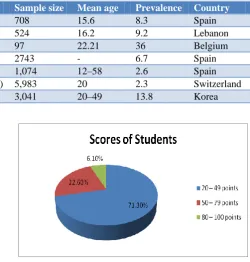
Figure 1: Scores based on Young’s online gaming addiction scale.
Out ofthe total students, 53% were males and 47% were
females. Majority of students used Mobile phones (73.9%), followed by computers (12.2%) for playing games.
There was statistical significance between male and female students regarding usage of video games. From the above table, addiction as well as problems faced to excessive usage is more common in male students.
Table 2: Demographic profile of students participated in study.
Variables Number Percentage (%)
Gender
Males 305 53
Females 270 47
Platform of internet gaming
Mobile Phones 425 73.9
Computers 70 12.2
Gaming Consoles 30 5.2
Table 3: Scoring of students.
S. No Scoring points Males Females Number of students Percentage (%)
1 20 – 49 190 220 410 71.3
2 50 – 79 90 40 130 22.6
3 80 – 100 25 10 35 6.1
Total 305 270 575 100
P value <0.0001; Significant.
DISCUSSION
The study was done to check whether, there are factors influencing online Internet gaming disorder and disturbances in daily activities, Studies and family relations by using Young’s online gaming addiction scale. In our study, around 23% having occasional disturbances, while, 6% students were experiencing severe disturbances in terms of sleep, concentration on studies, family relations and physical problems like headache, visual disturbances.
The average playtime with students having gaming disorder in the study was 7 hours which is higher than the study conducted by (6.3 hours) Rehbein et al.13 In our study, the students have admitted of sleeping disturbances, which was similar to other studies done by Hawi et al, Bartel et aland Satghare et al,which was due to late sleeping, waking up in the middle of night for scoring higher levels.7,14,15
Due to increased preoccupancy of students with gaming, they complained of having lesser concentration during classes thereby shown poor performance in their studies. Similar findings were seen in studies done by Hawi et al, Rehbein et al and KO et al.7,13,16 In this study, students who were having high scores complained of mood disorders like anxiety, depression, impulsivity and compulsivity, which was similar to the study conducted by Savvidou et al and Zhou et al.17,18
CONCLUSION
Gaming disorders are on a rise, which had lead students to psychosocial disturbances, anxiety, depression, mood disorders, sleep disturbances, head ache, lack of social activities, and impairment in education. These students felt difficulty in coping up in their studies, because they spent more time on gaming and less time on studies, sleep and other activities. The students who are addicted to online video gaming admitted that, they are spending less time with their families and are failing to control emotions with other family members. As well as, these students may develop conditions like dry eyes, early cataracts and deterioration of brain. So, it is time to regulate the usage of electronic devices, internet and video games.
ACKNOWLEDGEMENTS
We are thankful to our Professor and HOD Dr. D. Jagannath Rao, Institutional Ethical Committee and students, who participated in our study.
Funding: No funding sources Conflict of interest: None declared
Ethical approval: The study was approved by the Institutional Ethics Committee
REFERENCES
1. Available at: https://icd.who.int/browse11/l-m/en#/ http://id.who.int/icd/entity/1448597234. Accessed on 24 June 2018.
2. Caplan SE. Relations among loneliness, social
anxiety, and problematic internet use. Cyber Psychol Behav. 2007;10:234-42.
3. Kim H, Davis KE. Toward a comprehensive theory
of problematic internet use: Evaluating the role of self-esteem, anxiety, flow, and the self-rated importance of internet activities. Comput Hum Behav. 2009;25:490-500.
4. Liu M, Peng W. Cognitive and psychological
predictors of the negative outcomes associated with playing MMOGs (massively multiplayer online games). Comput Hum Behav. 2009;25:1306-11.
5. Stetina BU, Kothgassner OD, Lehenbauer M,
Kryspin-Exner I. Beyond the fascination of online-gaming: Probing addictive behavior and depression in the world of online-gaming. Comput Hum Behav. 2001;27:473-9.
6. Buiza-Aguado C, Alonso-Canovas A,
Conde-Mateos C, Buiza-Navarrete JJ, Gentile D. Problematic Video Gaming in a Young Spanish Population: Association with Psychosocial Health. Cyberpsychol Behav Soc Netw. 2018;21:388-94.
7. Hawi NS, Samaha M, Griffiths MD. Internet
gaming disorder in Lebanon: Relationships with age, sleep habits, and academic achievement. J Behav Addict. 2018;7:70-8.
8. Deleuze J, Nuyens F, Rochat L, Rothen S, Maurage
P, Billieux J. Established risk factors for addiction fail to discriminate between healthy gamers and gamers endorsing DSM-5 Internet gaming disorder. J Behav Addict. 2017;6:516-24.
land-based patients? J Behav Addict. 2017;6:639-47.
10. Fuster H, Carbonell X, Pontes HM, Griffiths MD. Spanish validation of the Internet Gaming
Disorder-20 (IGD-20) Test. Comput Hum Behav.
2016;56:215–24.
11. Khazaal Y, Chatton A, Rothen S, Achab S, Thorens
G, Zullino D, Gmel G. Psychometric properties of the 7-item Game Addiction Scale among French and
German speaking adults. BMC Psychiatry.
2016;16:132.
12. Kim NR, Hwang SS-H, Choi J-S, Kim D-J,
Demetrovics Z, Király O, et al. Characteristics and psychiatric symptoms of Internet gaming disorder among adults using self-reported DSM-5 criteria. Psychiatry Investig. 2016;13:58–66.
13. Rehbein F, Kliem S, Baier D, Mößle T, Petry NM. Prevalence of Internet gaming disorder in German adolescents: Diagnostic contribution of the nine DSM‐5 criteria in a state‐wide representative sample. Addiction. 2015;110;842–51.
14. Bartel K, Gradisar M. New directions in the link between technology use and sleep in young people sleep disorders in children. 2017: 69–80.
15. Satghare P, Abdin E, Vaingankar JA, Chua BY, Pang S, Picco L, et al. Prevalence of sleep problems among those with Internet gaming disorder in Singapore. ASEAN J Psychiatr. 2016;17:1–11.
16. Ko CH. Internet gaming disorder. Current Addiction
Reports. 2014;1:177–85.
17. Savvidou LG, Fagundo AB, Fernández-Aranda F,
Granero R, Claes L, Mallorquí-Baqué, N, et al. Is gambling disorder associated with impulsivity traits measured by the UPPS-P and is this association moderated by sex and age? Compr Psychiatry. 2017;72:106–13.
18. Zhou Z, Zhou H, Zhu H. Working memory,
executive function and impulsivity in Internet-addictive disorders: A comparison with pathological gambling. Acta Neuropsychiatr. 2016;28:92–100.
ANNEXURE I
Internet addiction test (IAT) by Dr. Kimberly Young
Internet addiction test (IAT) is a reliable and valid measure of addictive use of internet, developed by Dr. Kimberly Young. It consists of 20 items that measures mild, moderate and severe level of Internet Addiction.
To begin, answer the following questions by using this scale:-
0 Does not apply 1 Rarely
2 Occasionally 3 Frequently 4 Often 5 Always
S.No Question Scale
1 How often do you find that you stay on-line longer than you intended? 1 2 3 4 5 0
2 How often do you neglect household chores to spend more time on-line? 1 2 3 4 5 0
3 How often do you prefer the excitement of the Internet to intimacy with
your partner? 1 2 3 4 5 0
4 How often do you form new relationships with fellow on-line users? 1 2 3 4 5 0
5 How often do others in your life complain to you about the amount of time
you spend on-line? 1 2 3 4 5 0
6 How often do your grades or school work suffers because of the amount of
time you spend on-line? 1 2 3 4 5 0
7 How often do you check your email before something else that you need to
do? 1 2 3 4 5 0
8 How often does your job performance or productivity suffer because of the
Internet? 1 2 3 4 5 0
9 How often do you become defensive or secretive when anyone asks you
what you do on-line? 1 2 3 4 5 0
10 How often do you block out disturbing thoughts about your life with
soothing thoughts of the Internet? 1 2 3 4 5 0
11 How often do you find yourself anticipating when you will go on-line again? 1 2 3 4 5 0
12 How often do you fear that life without the Internet would be boring,
empty, and joyless? 1 2 3 4 5 0
13 How often do you snap, yell, or act annoyed if someone bothers you while
you are on-line? 1 2 3 4 5 0
14 How often do you lose sleep due to late-night log-ins? 1 2 3 4 5 0
15 How often do you feel preoccupied with the Internet when off-line, or
fantasize about being on-line? 1 2 3 4 5 0
16 How often do you find yourself saying “just a few more minutes” when online? 1 2 3 4 5 0
17 How often do you try to cut down the amount of time you spend on-lineand fail? 1 2 3 4 5 0
18 How often do you try to hide how long you’ve been on-line? 1 2 3 4 5 0
19 How often do you choose to spend more time on-line over going out with
others? 1 2 3 4 5 0
20 How often do you feel depressed, moody or nervous when you are off-line,
which goes away once you are back on-line? 1 2 3 4 5 0
Total up the scores for each item. The higher your score, the greater level of addiction is.
20 – 49 points: You are an average on-line user. You may surf the Web a bit too long at times, but you have control over your usage.