INTRODUCTION
Rice is one of the most important crops of the world. The biodiversity of rice is larger than that of other cereal grains (maize and wheat). Recent studies demonstrated that deference in physical behavior and functionality of rice starch are related to starch structure (Nakamura et al., 2002; Qi, Tester, Snape, & Ansell, 2003; Vandeputte, Vermeylen, Geeroms, & Delcour, 2003).
Starch is the major component of grains and a common ingredient used in the food industry. rice starch composes approximately 90% of milled rice. It is made up of two major glucose polymers, amylose, which is a slightly branched, primarily long chain a(1-4) glucan, and amylopectin, which is highly branched through (1-6) linkages. The amylose content of rice starch ranges from 0 to 30% (w/w).
Evaluation of starch polymer structure in
rice grain and its affect on cooking quality
FATEMAH HABIBI and ASIEH YAHYAZADEH*
Department of Chemistry, University of Guilan, P.O. Box 1914, Rice Research Institute of Iran (RRII), Rasht (Iran). (Received: July 16, 2009; Accepted: August 28, 2009)
ABSTRACT
Cooked rice texture and other aspects of rice starch functionality are influenced by amylose and amylopectin content and structure. With using of high performance size exclusion chromatography and capillary electrophoresis, we can determine amylose content, molecular mass of amylose and the weight- and molar-based distributions and degree of polymerization (DP) of amylose and amylopectin .this traits are the properties of starch that can be influenced on rice cooking and eating quality. For evaluation of starch and its component 10 of Iranian rice varieties with similarity in amylose content and the same gelatinization temperature were selected and after debranching of starch chain with isoamylase, the difference between varieties determined .in this procedure the structural analysis of
Iranian varieties starches are described.
Key words: Rice, Starch, Amylose, Amylopectin, Degree of polymerization, Chain length distribution, Molecular weight.
underestimation of the amylose content. Size-exclusion chromatography (SEC) is a new method that has also been used to determine amylose content by quantitation of the amount of amylose relative to amylopectin.
MATERIAL AND METHODS Materials
10 Iranian rice varieties with the same amylose content and gelatinization temperature were selected for analyzing of starch component structure. However these varieties are same in type of amylose and gelatinization temperature but they are different in some of quality properties. Methods
SEC (Size Exclusion Chromatography)
For SEC, the starch was solubilised and an enzyme was used to hydrolyse the branch. The Chains of starch were then injected into a column and separated on the basis of their molecular weight. It shows that chains from amylose can be separated from chains from amylopectin, and that amylose chains increase proportionately with amylose content. SEC can potentially be used to calibrate. For Using SEC, we can separate debranched chains of starch into long (consistent with being amylose) and short (consistent with being amylopectin).
Hot Water Soluble (HWS)
In order to analyze the hydrodynamic volume distribution of molecules in the hot water soluble (HWS) component of flour and the starches, a sample (250 mg) was suspended in 12.5 mL water and put in boiling water bath in 10 minutes with stirring.
For debranching an aliquot (794 µl) of the HWS starch solution was mixed with 206 of sodium acetate buffer (0.2 M, pH 4), and then isoamylase (7 µl) was added. The sample was incubated (50°C, 2h). Following incubation, the sample was boiled for 10 min to denature the isoamylase, and then centrifuged (12500g, 10min). The supernatant was desalted for 45min on 300 mg mixed bed resin (Bio-Rad) and then an aliquot (40 µl) of the desalted and debranched solution was analyzed by SEC using the calibrated UH 250 column.
Hot Water insoluble (HWI)
Whole flour (50mg) was placed into a scintillation vial and wetted with ethanol and a stirring magnet added. Sodium hydroxide (1mL.0.25M) was added with constant stirring and mixture refluxed on a hotplate (120°C, 10min). The mixture was then adjusted to 4 g water. For debranching ,an aliquot (794 µl) of the starch solution was mixed with 206 of (5 mL sodium acetate buffer (0.2 M,pH4) with glacial acetic acid (180 µl) and then isoamylase(7 µl) was added. The sample was incubated (50°C, 2h). Following incubation, the sample was boiled for 5 min to denature the isoamylase, and then centrifuged (12500g, 10min). The supernatant was desalted for 45min on 300 mg mixed bed resin (Bio-Rad) and then an aliquot (40 µl) of the desalted and debranched solution was analyzed by SEC using the calibrated UH 250 column.
CE (Capillary Electrophoresis)
Amylopectin is a highly branched polymer composed of glucose monomers. Enzymatic removal of the branches leaves many straight chains of different glucose chain lengths, or degrees of polymerisation (DP).
Capillar y electrophoresis allows the separation of the differently sized chains. However, since carbohydrates do not have functional groups that are detected by conventional detectors, reductive amination with a fluorophore is necessary to detect the amylopectin chains. The fluorophore, APTS, binds only to the reductive end of the chain, so each chain has one fluorophore each. Thus, the intensity detected by the FACE corresponds to the concentration of each DP, while each peak corresponds to one DP. Hence, the amylopectin chain length distribution.
The distribution of the different sizes of chains then gives an insight on how the amylopectin affects the cooking and eating qualities of starch.
The aim of this test is to determine the chain length distribution of amylopectin.
Reagents
acid (APTS), Sodium cyanoborohydride, Maltose mobility marker, Glucose ladder
Preparing of blank
5µl maltose mobility marker Put into an empty microfuge tube and then dried down in speed vac. 3.5µl APTS solution and 3.5µl sodium cyanoborohydride solution added to solution then the mixed with Vortex and after that incubated for 24 hours at 50°C. 40µl 6M urea and 40µl Millipore water added and mixed carefully. After Spin down for 30 seconds at 12000rpm, the sample Put in boiling water bath for 1 minute and transferred the labeled sample into a spin column and Spined for 2 minutes .it Prepared for CE run .
Prarariung Glucose ladder for Control
5µl maltose mobility marker put into the dried glucose ladder and then continued the steps as preparing of blank.
Preparing samples (in replicates)
100µl aliquot of the debranched sample collected into a fresh microfuge tube and then dried down in speed vac. 5µl maltose mobility marker added in to the dried sample and then continued the steps as preparing of blank . the amylopectin structure in samples evaluated with CE.
Statistical Analysis
Analysis of variance in a completely randomized design was made to detect significant differences among rice. Duncan’s multiple range test was employed to identify significantly different means. Statistical analyses were made with MSTATC Software.
RESULTS AND DISCUSSION
There is a dire need for alter native parameters that could adequately explain the complexities in rice functionality, especially within similar grain type. To gain a better understanding about the starch structure-functionality mechanisms in rice, we examined the structural features of the starches from ten Iranian rice cultivars which exhibit different grain quality and functional properties.
Our ultimate goal was to understand whether these cultivars showed distinct differences
T
a
b
le 1:
Ph
ysicoc
hemical pr
oper
ties of milled rice flour fr
om iranian rice v
arieties
Domsefid
Domsorkh
Sangtar
om
Domzar
d
Hasanseraee
salari
T
a
romsari
Domsiah
Shahak
tar
om
% Am
ylose
23.65
21.14
22.53
21.4
22.73
22.87
22.83
22.6
21.8
22.7
Gelatinization
71.17
73.74
72.94
71.69
72.86
72.49
71.68
73.80
72.62
71.64
T
emper
T
a
ble 2:
molecular weight distrib
ution of star
c
h
of iranian rice v
arieties b y SEC Domsefid Domsorkh Sangtar om Domzar d Hasanseraee salari T a romsari Domsiah Shahak tar om
HWS Am
ylose 42.99a 33.15c 30.02d 31.97c 25.56f 42.74a 36.37b 29.47d 28.53de 26.90ef
HWS Am
ylopectin 35.92 35.76 40.78 42.13 47.49 30.78 33.25 38.24 39.38 46.28
HWI Am
ylose 4.25cd 5.75ab 4.74bc 2.92cd 4.34de 6.72a 1.81f 4.78cd 4.98bc 3.37e
HWI Am
ylopectin 90.29 89.65 89.29 93.43 89.96 87.33 93.00 89.48 89.04 91.13 Retention time 11.22a 11.19a 11.21a 10.91c 10.91bc 10.90c 10.99bc 10.93b 10.90c 10.92bc
for AM Retention time
17.00 16.98 16.97 16.60 16.59 16.57 16.59 16.57 16.59 16.59
for AP DP
a f o r A M 2582.64 2694.87 2638.00 3945.94 3945.94 3945.9 3513.99 3765.68 3945.94 3854.48 D P f o r A p 19.12 19.52 19.93 30.43 30.98 31.54 30.98 31.54 30.98 30.98 a- Deg
ree Of P
olymer ization T a b le 3: Chain-Length Distrib
ution (DP) of Am
ylopectin fr
om Isoam
ylase-Debranched Star
c
h
of Iranian Rice v
Fig. 1: Structure of Amylose and Amylopectin
Fig. 3: Normalized Size-Exclusion Chromatography SEC) of native starch solutions from rice cultivars. AP, amylopectin; AM, amylose
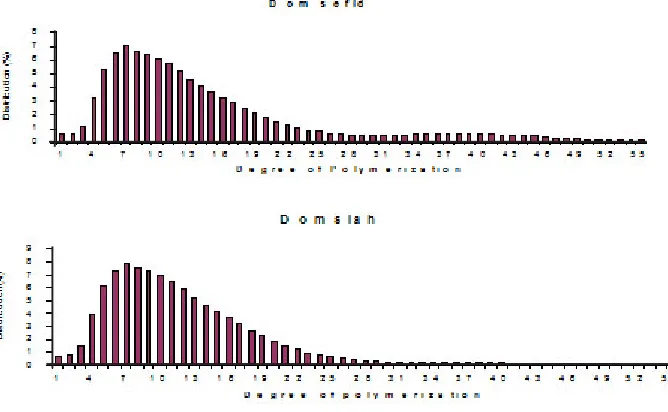
Fig. 4: Chain-length distribution of isoamylase-debranched amylopectin for Iranian rice varieties as determined by CE (Capillary Electrophoresis) in starch molecular size distribution and amylopectin
branch chain-length distr ibution, which may substantially explain observed variations in the functionality of these varieties such as milling quality, chalkiness, gelatinization, pasting behavior, and the like.
in rice varieties but in many of local Iranian varieties, the amylase content and gelatinization temperature are same (one range).but they are have different properties in cooking and eating quality.
Fine Structure and Functionality of Rice Starch Rice starch consists of two components: AP (very large and highly branched molecules); AM (smaller and predominantly linear molecules); (Hizukuri et al., 1989). These fractions constituted a trimodal chromatogram based on the SEC analysis of native r ice starch (Fig 3). The percentages of AM and AP based on the peak area of the SEC chromatogram. The ten cultivars were statistically comparable in the amount of AM.all of varieties are significant different at P=0.01 in HWS fraction and HWI fraction. We can use of this two traits for comparing of varieties.
The AP fractions resolved by CE were classified into chain types and corresponding degree of polymerization (DP) by Hanashiro et al (1996)
(Table 3). Respectively, which were close to the reported range of 18.8–22.7 for rice amylopectin (Jane et al 1999). As shown in Table 3 and Fig4. , the AP chain-length distribution differed among the ten cultivars.
The differences in AP chain length distribution of the ten rice starches may explain their differences in thermal properties and pasting behavior, and possibly milling quality and grain physical attributes. It appears that variations in structural features of rice starch may be also associated with the observed differences in the milling quality, grain chalkiness, and translucency among the ten cultivars. The higher percentage of chalky kernels, lower translucency, and lower head rice yield were linked to lower amount of shorter chain AP (A and B1) and higher amount of the longer chains (B2 and B3 longer chains). It is speculated that variations in the molecular structures of starch may result in different inter- and intramolecular interactions or associations, affect
Table 4: Analysis of variance for molecular weight distribution of HWS and HWI amylose of Iranian Rice varieties by SEC
Source Degree of Mean Square
Freedom HWS Fraction HWI Retention time
Fraction
Treatment 9 69.975* 2.789* 0.042
Error 100 0.759 0.121 0.00
Coefficient of Variation 2.68 8.11 0.12
* Significant different at P=0 .01
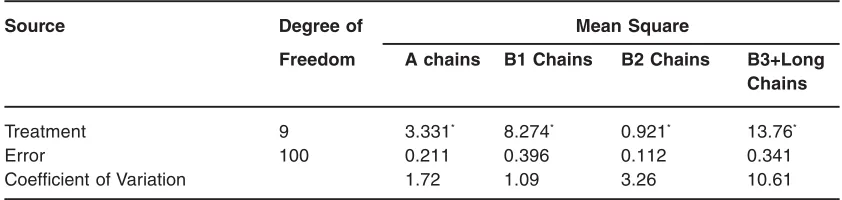
Table 5: Analysis of Variance for Chain-Length Distribution (DP) of Amylopectin of Iranian Rice varieties by CE
Source Degree of Mean Square
Freedom A chains B1 Chains B2 Chains B3+Long Chains
Treatment 9 3.331* 8.274* 0.921* 13.76*
Error 100 0.211 0.396 0.112 0.341
Coefficient of Variation 1.72 1.09 3.26 10.61
the packing and stability of starch granules that make up the rice kernels, and eventually bring about some differences in rice functionality. However, more work is needed to validate the observed trends. The results in table 3 showed that all of Iranian local varies in this research are significant different at P= 0.01 with evaluating of A,B and long chains we can find difference between varieties.
CONCLUSIONS
The local Iranian rice varieties were similar in rice quality parameters, particularly grain type and colorimetric amylose value based on conventional tests used in rice breeding programs. However, the structural features of their starches revealed
differences in the relative proportion of the starch components, amylopectin, amylose, and intermediate materials, and the chain-length distribution of amylopectin. These, in turn, may affect rice functionality, including gelatinization, retrogradation, pasting behavior, milling quality, and grain physical attributes. Cultivars belonging to the same grain type may behave differently when processed due to differences in the molecular structures of their starch.
ACKNOWLEDGMENTS
We thank of Dr. Melissa Fitzgerald, the head of grain quality, nutrition and post harvest Center at IRRI for providing the possibility for this research.
1. Bergman, C. J., Bhattacharya, K. R., & Ohtsubo, K., Rice End-Use Quality Analysis. In E. T. Champagne (Ed.), Rice Chemistry and Technology, 415-472 (2004).
2. Bhattacharya, K. R., Sowbhagya, C. M., & Indudhara Swamy, Y. M., Quality problems of rice: a tentative scheme for classi.cation. Journal of Food Science, 47: 564-569 (1982). 3 Champagne, E. T., Rice starch composition and characteristics. Cereal Foods World, 41: 833-838 (1996).
4 Chiou, H., Fellows, C. M., Gilbert, R. G., & Fitzgerald, M. A., Study of rice-starch structure by dynamic light scattering in aqueous solution. Carbohydrate Polymers, 61: 61-71 (2005).
5 Juliano, B. O., Perez, C. M., Blakeney, A. B., Castillo, D. T., Kongseree, N., Laignelet, P., Lapiz, E. T., Murty, V. V. S., Paule, C. M., & Webb, B. D., International cooperative testing of the amylose content of milled rice. Starch 33: 157-165 (1981).
6 Qi, X., Texter, R. F., Snape, C. E., & Ansell, R., Molecular basis of the gelatinization and swelling characteristics of waxy rice starches grown in the same location during the same
REFERENCES
season. Journal of Cereal Science, 37: 363-376 (2003).
7 Motawia, M. S., Damager, I., Olsen, C. E., Møller, B. L., Engelsen, S. B., & Hansen, S., Comparative study of small linear and branched a-glucans using size exclusion chromatography and static and dynamis light scattering. Biomacromolecules, 6: 143-151 (2005).
8 Nakamura, Y., Towards a better understanding of the metabolic system for amylopectin biosynthesis in plants: Rice endosperm as a model tissue. Plant and Cell Physiology, 43: 718-725 (2002).
9 Vandeputte, G. E., Vermeylen, R., Geeroms, J., & Delcour, J. A., Rice starches. I. Structural aspects provide insight into crystallinity characteristics and gelatinization behavior of granular starch. Journal of Cereal Science, 38: 43-52 (2003a).