Original Research Article
Tobacco use patterns among women in reproductive age group:
a cross sectional study in the rural area of Belgaum district,
Karnataka, South India
Namratha Kulkarni
1*, Pavan P. Havaldar
2, Vijaya A. Naik
3INTRODUCTION
Tobacco imposes a colossal burden of disease and death leading to catastrophic health, social, economic, and environmental effects.1 Tobacco consumption continues to grow at 2-3% per annum.2 It is estimated that by 2030,
the proportion will be one in six or 10 million deaths per year – more than any other single cause.3
Irrefutable evidence has accumulated in the last century on the deleterious effect tobacco use has on the human health. The impact has been studied in terms of both
ABSTRACT
Background: Tobacco imposes a colossal burden of disease and death leading to catastrophic health, social, economic, and environmental effects. “Tobacco” kills both men and women but sex-specific differences exist. Traditional forms of tobacco like dentifrice or tobacco tooth powder and betel quid, tobacco and lime mixture are commonly used and also, the new products use is increasing not only among men but even among children, teenagers, women of reproductive age. This study was done to know the patterns and other correlates of tobacco use among the rural women in the reproductive age group.
Methods: A community based cross sectional study, conducted from January 2011 to December 2011 among 1200 rural women aged between 15 years to 49 years residing in primary health centre, Vantmuri area, Belgaum, Karnataka, India. Statistical analysis was done using rates, ratios and chi-square tests.
Results: Tobacco consumption was seen in 9.7% of the study participants. A very high percentage of 79 (67.5%) had more than 10 years of exposure to tobacco amongst the users. Dentifrice was the most common form of tobacco used (85.5%) followed by 32 (27.4%) plain tobacco consumption. However, 49 (4.1%) consumed multiple forms of tobacco, most common being dentifrice along with plain tobacco or paan with beetelquid or used snuff.
Conclusions: The distribution of tobacco consumption is likely to maintain, and perhaps increase, the current considerable socioeconomic differentials in health in India. Dual users are at much higher health risks than those who consume the individual tobacco product. It also emphasizes the variations in patterns of using tobacco among rural women. There is a need for periodical surveys using more consistent definitions of tobacco use and eliciting information on different types of tobacco consumed.
Keywords: Smokeless tobacco use, Dentifrice, Patterns, Tobacco use, Tobacco consumption, Reproductive age group
1
Engender Health, Karnataka, India
2Department of Anatomy, Gadag Institute of Medical Sciences, Gadag, Karnataka, India
3Department of Community Medicine, JN Medical College, KLE University, Belagavi, Karnataka, India
Received: 18 January 2018
Revised: 20 November 2019
Accepted: 21 November 2019
*Correspondence:
Dr. Namratha Kulkarni,
E-mail: [email protected]
Copyright: © the author(s), publisher and licensee Medip Academy. This is an open-access article distributed under the terms of the Creative Commons Attribution Non-Commercial License, which permits unrestricted non-commercial use, distribution, and reproduction in any medium, provided the original work is properly cited.
morbidity and mortality. India is now believed to have a high burden of tobacco and its related morbidity and mortality. It has been estimated that among all the people who smoke worldwide, 16.6% live in India, an absolute figure of 182 million. It has also been estimated that in the SEAR-D (the high-mortality developing region of Southeast Asia dominated by India in terms of population), about 18% of all deaths among adult men and 3% of all deaths among adult women were attributable to tobacco, in year 2000. Strong evidence is available in India from large-scale studies on the association between tobacco use and mortality.4
Overall, 6.7% of women used smokeless tobacco (SLT) in the 16 global adult tobacco survey (GATS) countries surveyed.5 The use of SLT, which was limited to South-East Asian countries in the past is rapidly increasing all over. According to the Bloomberg global SLT market report the increasing awareness about the health risks associated with smoking has led to the development of several SLT alternatives.6
In India estimates reveal that roughly one-third of women and two-thirds of men use tobacco in one form or another. The estimated number of tobacco users in India is 274.9 million, with 163.7 million users of only smokeless tobacco; 68.9 million are exclusive smokers, and 42.3 million users of both smoking and smokeless tobacco. Nearly two in five (38%) adults in rural areas and one in four (25%) adults in urban areas use tobacco in some form. Prevalence of smoking among males is 24%, whereas, the prevalence among females is 3%. The extent of use of smokeless tobacco products among males (33%) is higher than among females (18%). Overall, the smoking epidemic is spreading from its original focus – among men in income countries to women in high-income countries and men in low-high-income regions.3 Tobacco use patterns in India are unique and reflect longstanding cultural practices. Two features stand out; bidis (tobacco wrapped in dried leaves of special trees) are more common than cigarettes; and chewing tobacco is widely prevalent. Smokeless tobacco use consists of chewing pan (mixture of lime, pieces of areca nut, tobacco and spices wrapped in betel leaf), chewing gutkha or pan masala (scented tobacco mixed with lime and areca nut, in powder form), and mishri (a kind of toothpaste used for rubbing on gums). India has one of the highest tobacco users in the world both in number and relative share. India is one of the fewer countries in the world where prevalence of smoking and smokeless tobacco use are high and is characterised by dual use of tobacco (use of both smoking and smokeless tobacco products) also contributes to a noticeable proportion.7 Similarly, a new trend of increased use of water pipes by women requires more attention. Many women are still unaware of the full scope of risks caused by the many toxic and carcinogenic compounds in tobacco smoke: tobacco smoke contains more than 4000 chemicals, hundreds of which are toxic or carcinogenic.
Women and tobacco and the need for study
Tobacco kills both men and women but sex-specific differences exist. A high prevalence of smokeless tobacco use is an additional risk for premature death, especially among women. Tobacco use is one of the top six leading attributable risk factors for chronic diseases in women aged 20 years and above.Women who consume tobacco experience unique risks related to menstrual and reproductive function such as an increased risk for primary and secondary infertility,increased risk for ectopic pregnancy and spontaneous abortions and poor pregnancy outcomes from tobacco use during pregnancy include still births, increase in placental weight, male fetus wastage, low birth weight, lower gestational periods (preterm), sudden infant death syndrome, premature rupture of membranes, abruptio placenta and placenta previa.8-10
The reasons for both men and women failing to get accurate health information concerning sex-specific impacts of tobacco use on health need further study, followed by intervention. Unless innovative and sustained initiatives are undertaken, the number of female users of tobacco is predicted to rise over the next several decades as a result of increased prevalence, as well as population growth. There are many gaps in the data about the health impact of tobacco use on girls and women of all ages and throughout the life-course. Tobacco use among women in the reproductive age group has various negative effects and the data available in this field is less.
However, except a few local studies, little systematic investigation has been done into how tobacco consumption is socioeconomically and geographically distributed in India. The gaps in tobacco consumption need to be examined to see which people are most likely to consume tobacco and which areas are more likely to have higher tobacco consumption. Such analyses are critical for designing policies and interventions aimed at achieving overall reductions in tobacco consumption at the population level and at reducing the inequalities insusceptibility to consume tobacco.
Hence this study was undertaken with the objective of assessing the patterns and other correlates of tobacco use among the rural women in the reproductive age group.
METHODS
A community based cross sectional study was conducted from January 2011 to December 2011 among 1200 rural women aged between 15 years to 49 years residing in PHC Vantmuri area, Belgaum, Karnataka, India.
all the villages depending upon the population of the each village using systematic random sampling method.
According to NFHS 3, 15-49 years aged women were considered as women under reproductive age group.11 So, all women in the age group of 15-49 years and girls less than 15 years who have attained menarche were in the inclusion criteria. Every tenth household was visited and data regarding woman under the reproductive age group was collected. In households with more than one eligible study subject, chit method was used for selecting the study participant.
With approval from the ethics committee and taking written informed consent from the study subjects, data regarding tobacco consumption was collected.
The data was tabulated using Microsoft Excel Worksheet and analyzed using mean, proportions and percentages. The statistical analysis was done with SPSS 18 statistical software.
Tobacco user classification
Tobacco users were classified according to WHO classification- tobacco consumption and tobacco use are used synonymously in our study.12,13
Never user/ non users: Not tried tobacco any time in life.
Ever user: Should have consumed tobacco at least once in her life time.
Current user: History of consuming tobacco within
30days preceding the survey.
Occasional users: Consuming tobacco for three or less number of days in a week.
Light users: Use of tobacco less than 6 times a day.
Heavy users: Tobacco use six or more than six times a day.
Types of tobacco consumption8-10
Dentifrice
Application of dried powdered tobacco to clean the teeth. Other forms include mishri which is a roasted, powdered preparation made by baking tobacco on a hot metal plate until it is uniformly black later on it is powdered. Other forms include Gul, lal dantmanjan, etc.
Smoking forms
Beedis: Made by rolling a dried square or rectangular piece of tendu leaf with 0.15-0.25 grams of sundried, flaked tobacco.
Cigarettes: Slender roll of cut tobacco enclosed in paper and meant to be smoked.
Smokeless forms
Gutka: Dry, relatively non-perishable, commercial
preparation containing areca nut, slaked lime, catechu and condiments and powdered tobacco (tobacco waste). The same mixture without tobacco is called pan masala. Paan /beetel quid masala: Betel quid consists of four main ingredients - betel quid leaf (Piper betel), areca nut (Areca catechu), slaked like [Ca(OH2)] and catechu (Acacia catechu). Condiments and sweetening agents may be added as per regional practices and individual preferences.
Khaini: A mixture of sun-dried tobacco and slaked lime. It is also called as Sada, Surti.
Zarda: Zarda is prepared by cutting tobacco leaves into small pieces and boiling them in water with slaked lime and spices until the water evaporates.
Snuff: Dry snuff is powdered tobacco that is inhaled through the nose or taken by mouth.
RESULTS
Out of the 1200 study participants, 117 had ever
consumed tobacco. The prevalence of tobacco
consumption was 9.7%. 100 (8.4%) of study participants were currently pregnant and 11 (10.9%) of currently pregnant women were consuming tobacco.
Out of total 117 ever users of tobacco, 98 (83.8%) were currently consuming tobacco, followed by 14 (12%) consuming occasionally. 5 (4.3%) were currently not using tobacco and 79 (67.5%) used tobacco for less than 6 times in a day whereas 38 (32.5%) used tobacco for more than 6 times. Majority, 71 (60.7%) of the women started using tobacco before eighteen years of age as against 46(39.3%) who initiated tobacco use after 18 years of age (Table 1).
A very high percentage of 79 (67.5%) had more than 10 years of exposure to tobacco use, followed by 22 (18.8%) having less than five years of exposure. 16 (13.7%) had more than five but less than 10 years of exposure (Table 1).
consuming for more than six times a day. 1 (10%), 2(15.4%) of them in the age groups of 30 to 34 years and 35 to 39 years respectively were consuming tobacco for more than six times a day. This association was statistically significant. (χ2=24.322, df=6, p<0.001)
(Table 2).
Table 1: Distribution of tobacco users based on current consumption, frequency, age of initiation and
duration of consumption (n=117).
Status of tobacco consumption Tobacco users Number %
Currently consuming 98 83.8
Occasional (<3 days/week) 14 12
Previously consuming 5 4.3
Frequency
Light users (<6 times/day) 79 67.5
Heavy users (>6 times /day) 38 32.5
Age of initiation
<18 years of age 71 60.7
>18 years of age 46 39.3
Duration of consumption
< 5 years 22 18.8
5-10 years 16 13.7
> 10 years 79 67.5
Table 2: Association of age of the study participants and frequency of tobacco consumption.
Age (in years)
Number of tobacco consumers and frequency
of tobacco use/day Total <6 times/
day
>6 times/ day
15-19 15 (100) 0 (0) 15 (100)
20-24 8 (72.7) 3 (27.3) 11 (100)
25-29 8 (72.7) 3 (27.3) 11 (100)
30-34 9 (90) 1 (10) 10 (100)
35-39 11 (84.6) 2 (15.4) 13 (100)
40-44 6 (31.6) 13 (68.4) 19 (100)
45-49 22 (57.9) 16 (42.1) 38 (100)
Total 79 (67.5) 38 (32.5) 117 (100)
χ2=24.322, df=6, p<0.001.
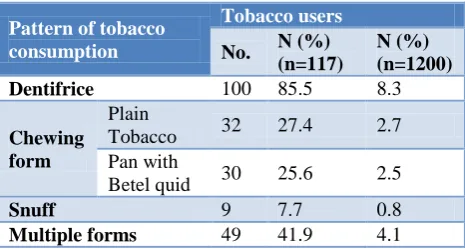
Table 3: Distribution of tobacco users based on patterns of tobacco consumption.
Pattern of tobacco consumption
Tobacco users
No. N (%) (n=117)
N (%) (n=1200)
Dentifrice 100 85.5 8.3
Chewing form
Plain
Tobacco 32 27.4 2.7
Pan with
Betel quid 30 25.6 2.5
Snuff 9 7.7 0.8
Multiple forms 49 41.9 4.1
Figure 1: Pattern of tobacco consumption.
Coming to the patterns of tobacco use, in this study, 49 (4.1%) consumed multiple forms of tobacco, most common being dentifrice along with plain tobacco or paan with beetelquid or used snuff. 100 women (8.3%) used dentifrice followed by 32 (2.7%) and 30 (2.5%) chewing plain tobacco and tobacco with paan/betel quid respectively. 9 (70.8%) used snuff form whereas smoking was not found in any participant. However, amongst the users, dentifrice was the most common form of tobacco used (85.5%) followed by 32 (27.4%) plain tobacco consumption (Table 3).
DISCUSSION
Tobacco is packed with harmful and addictive substances. In our study, the prevalence of tobacco consumption was 9.7%. This is less when compared to that of NFHS 3 where the prevalence of tobacco among women in rural areas was 13% in India and in Karnataka, 6.6% of the
women used some form of tobacco.11 According to NFHS
4, the prevalence of any form of tobacco among women in rural areas is 8.4% in India and in 5% Karnataka.14 In our study, 10.9% of the currently pregnant women were consuming tobacco as against 8.5% and 1% in India and Karnataka respectively according to NFHS 3.11 GATS in 2010 reported current tobacco use in any form in females was 20.3%.15 Indian Council of Medical
Research (ICMR) study reported 11.7% ever use of
tobacco among the women aged 15 to 49 years.12
In the study, it was found that two thirds used tobacco for less than 6 times in a day. As against this, ICMR study in Karnatakareported that slightly more than 50% (53.5%) of the females used tobacco less than 6 times a day.12 Majority (60.7%) of our study subjects started tobacco consumption during adolescence. ICMR study reported that regular habit of tobacco use in Karnataka started above 10 years in more than 99% cases.12 GATSin 2010 reported that in India, 25.8% of the females started consuming tobacco before the age of 15 years.15 The age
100
32 30
9
49 85.5
27.4 25.6
7.7
41.9
8.3
2.7 2.5 0.8 4.1 0
20 40 60 80 100 120
Dentifice Plain Tobacco
Paan with Betel quid
Snuff Multiple forms
of initiation of tobacco use is decreasing resulting in increased duration of exposure to tobacco use during their life time. These individuals will eventually succumb to the harmful effects at a younger age. Adolescent age group especially in the rural areas is neglected group. In the absence of the special services to this group, the prevalence is likely to go up.
More than two thirds of the tobacco users in our study had more than 10 years of exposure to tobacco use
whereas ICMR study reported that 41.2% in the
reproductive age group had more than 10 years of exposure tobacco consumption.12 This suggests that once a person/ woman start consuming tobacco then she will probably end up in higher frequencies of use per day and also for a longer duration (probably lifelong). Tobacco is easily available to the residents in this area as it is a crop cultivated in the surrounding region.
Tobacco consumption for more than 6 times a day was found in none of the study participants aged 15 to 19 years whereas higher percentage of women above forty years of age were consuming tobacco for more than 6 times a day. ICMR studyreported a higher proportion of young tobacco-users using tobacco five or less number of times, but adults commonly used 6 or more times a day.12 Majority of women in the elderly age group especially after 40 years of age used for more than 6 times a day. Elderly women in the rural areas belonging to lower socioeconomic group are illiterate and are ignorant about the hazards of tobacco consumption (Table 2).
Patterns of tobacco consumption
In our study, 4.1% consumed multiple forms of tobacco, most common being dentifrice along with plain tobacco or paan with betel quid or used snuff. 8.3% used dentifrice followed by 2.7% and 2.5% chewing plain tobacco and tobacco with pan/betel quid respectively. 0.8% used snuff form whereas none of our women were smoking. This suggests that dentifrice is the most common form followed by chewing plain tobacco or with beetel quid. This could be probably due to the belief among the population that tobacco use helps in relieving tooth ache. As against this, NFHS 3 reported that, in Karnataka, 0.1% women were smoking whereas 6% of them chewed pan, gutka or used other forms of tobacco and 0.5% used snuff form of tobacco.11 Whereas in India, 2% of rural women smoked cigarettes or bidis, while 10% chewed tobacco and 0.9% used snuff. GATS in 2010 reported that 2.9% females in India are current smokers 18.4% are current users of smokeless tobacco.15 In ICMR study, 0.5% of the rural women among the age group of 15-49 years were currently smoking and 0.5% used pan-tobacco quid (Table 3).12
A study conducted by Mishra Gouravi and others in seven community areas consisting of total population of 68,481, in Mumbai showed about 22.30% of the total female population consumed tobacco, mainly in the smokeless
forms, with only 0.50% of the tobacco users using smoked tobacco. Masheri was the most common form of tobacco used, followed by chewing tobacco. The median frequency of use of different tobacco products varied from 2 to 4 per day.6
CONCLUSION
Women under the reproductive age group constitute an important segment of the population. It was evident from this study that the tobacco use is widespread among the women under reproductive age group in the study area. Tobacco awareness and control has always been slightly gender blind, with little recognition of understanding the context and challenges of women's tobacco use.
There has been slightly less integration of gender considerations in research, policy and programmes.
It has become the need of the hour to provide enough evidence on the correlates of tobacco use in the community to assist government policy makers, health professionals and the public in developing realistic models towards effective tobacco control to cater to different sections of community in need.
Recommendations
Similar/interventional studies to be carried out even al lowest level to focus on,
decreasing tobacco use in specific sub-populations, such as schoolgirls, young pregnant and mothering women
increasing effort against expansion of tobacco companies in developing countries, which are often aimed at women.
Funding: No funding sources Conflict of interest: None declared
Ethical approval: The study was approved by the Institutional Ethics Committee
REFERENCES
1. Prabhakar B, Narake S S, Pednekar M S. Social disparities in tobacco use in India: The roles of occupation, education and gender. Indian J Cancer. 2012;49:401-9.
2. Jandoo T, Mehrotra R. Tobacco control in India: Present scenario and challenges ahead. Asian Pac J Cancer Prev. 2008;9:805‑10.
3. Barbeau EM, Krieger N, Soobader M. Working
class matters: Socio economic disadvantage, race/ethnicity, gender, and smoking in NHIS 2000. Am J Public Health. 2004;94:269‑78.
5. Giovino GA, Mirza SA, Samet JM, Gupta PC, Jarvis MJ, Bhala N, et al. Tobacco use in 3 billion individuals from 16 countries: An analysis of nationally representative cross-sectional household surveys. Lancet. 2012;380:668-79.
6. Mishra GA, Kulkarni SV, Gupta SD, Shastri SS. Smokeless tobacco use in Urban Indian women: Prevalence and predictors. Indian J Med Paediatr Oncol. 2015;36:176-82.
7. Singh A, Ladusingh L. Prevalence and Determinants
of Tobacco Use in India: Evidence from Recent Global Adult Tobacco Survey Data. PLoS ONE. 2014;9(12):e114073.
8. Mackay J, Eriksen M. The Tobacco Atlas. World
Health Organization; 2002. Available at:
http://www.who.int/tobacco/publications/surveillanc e/tobacco_atlas/. Accessed on 3 October 2019. 9. Sinha DN. Report on Oral Tobacco Use and its
Implications in South East Asia. WHO, SEARO 2004. Available at: http:// www.searo.who.int/ Linkfiles/ NMH_Tuse.pdf. Accessed on 3 October 2019.
10. Reddy Shrinath K, Gupta PC. Report on Tobacco Control in India -Executive Summary. New Delhi.
Ministry of Health and Family Welfare,
Government of India: 2004.
11. International Institute for Population Sciences (IIPS) and Macro International. 2007. National Family
Health Survey (NFHS-3), 2005–06: India: Volume I. Mumbai: IIPS.
12. Chaudhary K. Prevalence of Tobacco Use in
Karnataka and Uttar Pradesh in India;Indian Council
of Medical Research; SEARO;WHO 2001.
Available at: http://www.searo.who.int/LinkFiles/ Regional_Tobacco_Surveillance_SystemSentinel India2001.pdf. Accessed on 3 October 2019. 13. World Health Organization. Global Adult Tobacco
Report India 2000-2004;WHO. Available
at:http://www.whoindia.org/en/section20/section25_ 925. Accessed on 3 October 2019.
14. International Institute for Population Sciences (IIPS) and Macro International. 2016 National Family Health Survey (NFHS-4, 2015–16 India: Volume I. Mumbai: IIPS, 2016.
15. World Health Organization. Global adult tobacco survey (GATS) India Report 2009-2010. Available
at: http://www.searo.who.int/linkfiles/regional_
tobacco_surveillance_system_gats_india.pdf. Accessed on 3 October 2019.
Cite this article as: Kulkarni N, Havaldar PP, Naik
VA.Tobacco use patterns among women in