Original Research Article
Increasing drug compliance to hypertension patients through android
applications in Wonosobo regency province of Central Java Indonesia
Suyoto*, Farid Agushybana, Antono Suryoputro
INTRODUCTION
Non-communicable diseases are the leading cause of death globally. An estimated 29% of deaths in countries with low and middle economic level, which occurs in people aged less than 60 years due to non-communicable diseases, whereas in developed countries, contributing causes of death by 13%. In 2030 predicted non-communicable diseases cause 52 million deaths every year of them, which in 2014 rose by 9 million from 38 million.1 Based on data from Riskesdas 2018 some non-communicable diseases a trend rise of the year 2013,
including hypertension rose from 25.8% into 34.1%. The prevalence growth occurred almost in every province in Indonesia, including Central Java.2
Hypertension or pressure blood high is a state of the increase in the pressure of blood in the veins the blood of the artery is abnormal that involve blood from the heart and pumped to the entire network as well as the organs of the body are continuously than a period.3 Hypertension can increase the burden of work of heart and vascular arteries which, if allowed to continue in a relatively long time can lead to damage to the heart and vessels blood.4 Hypertension is a condition of the pressure of blood is
ABSTRACT
Background: Based on data from WHO, it is estimated that 70% of the 57 million deaths that occurred in the world in 2008 were caused by non-communicable diseases. The prevalence of cases of hypertension primary in the District of Wonosobo in the year 2016 as many as 43.30%. Hypertension patients must take medication during their lifetime to prevent rising blood pressure and complications. This research aims to find out the effect of hypertension management through an android application on the practice of adherence to taking medication in hypertensive patients in Wonosobo regency.
Methods: This research is a quasi-experimental with a non-randomized pre-post-test control group design. The study is conducted in patients prolanis hypertension as much as 105 respondents were divided into a treatment group 53 respondents and group control of 52 respondents.
Results: Results of the study showed the significant influence of the use of android application to practice obedience to drink medicine. Results of Mann Whitney U analysis showed the treatment group experienced a rise in the mean is higher than the group of control. Likewise, the results of the test Wilcoxon which compares the level of compliance before and after treatment obtained value significantly for both groups with a mean group of treatment is higher.
Conclusions: The management of hypertension through an android application has proven to be more effective in improving the practice of adherence to taking medication hypertension patients who take part in the prolanis program in Wonosobo regency.
Keywords: Android application, Medication compliance, Hypertension
Faculty of Public Health, Masters in Health Promotion, Diponegoro University, Semarang, Indonesia
Received: 31 October 2019
Accepted: 06 December 2019
*Correspondence:
Dr. Suyoto,
E-mail: [email protected]
Copyright: © the author(s), publisher and licensee Medip Academy. This is an open-access article distributed under the terms of the Creative Commons Attribution Non-Commercial License, which permits unrestricted non-commercial use, distribution, and reproduction in any medium, provided the original work is properly cited.
kept constant with pressure systolic in over 140 mmHg and the pressure diastolic in over 90 mmHg. In the age group of the elderly, said to be hypertensive if pressure blood systolic over 160 mmHg and the pressure of blood diastolic above 90 mmHg.5 Hypertension can lead to complications such as stroke, infarction, diabetes, failing heart, and failing kidneys.6 Hypertension is often known as a "silent killer" because patients with hypertension often do not feel symptoms. It is estimated that half the people who suffer from hypertension are not aware of going condition. Given hypertension is a condition that occurs lifetime, then patients who have the disease of hypertension should be monitored pressure of the blood of her with intervals regular.7
The prevalence of primary hypertension cases in Wonosobo district in 2016 was 43.30% of patients who visited the Puskesmas diagnosed with hypertension, 5,191 patients of 12,951 hypertensive patients recorded in the Wonosobo Regency.8 Patients with hypertension need ongoing treatment, even arguably must be done continuously throughout life, because hypertension is a condition that must be controlled with medication and supported with a healthy lifestyle during the patient's life, this condition can cause boredom or forget to take antihypertensive drugs. A person with primary hypertension must take medication every day. Joint National Committee VIII recommends that therapy antihypertensives in patients with hypertension are throughout their lives, therapies that aim to stabilize the pressure of blood thus lowering morbidity and mortality are associated with damage to organs of the heart, blood vessels, brain and kidneys that can cause diseases cerebrovascular, heart failure, cardiovascular, and kidney disease. The behavior of taking hypertension medication regularly plays a role in controlling blood pressure and preventing the occurrence of hypertension complications. The government through the social security agency (BPJS Kesehatan) held prolanis aimed support participants with illnesses chronic achieve the quality of life optimally with the indicator 75% of participants registered the visit to first level health facilities have the result "good" in the examination specific to the disease type 2 DM and hypertension in accordance guide clinical linked so as to prevent the onset of complications of the disease. Based on information from the Garung and Kertek I prolanis program holders of Wonosobo regency, it was stated that the number of hypertensive patients actively participating in prolanis activities was approximately 65% of 128 patients. This indicates that there are still around 35% to 40% of hypertensive patients not actively controlling blood pressure and seeking treatment at the Puskesmas. These conditions determine will be able to result in failure to achieve hypertension management goals. Based on the results of the Riskesdas 2018, there were 32.3% of hypertensive sufferers who did not routinely take medication, with the reason being feeling
healthy 59.8% and forgetting 11.5%. They believe that it does not affect their health if they forget once or twice a month. The research others who support such research conducted by Riza, with the result that the use of the application reminder to take medication effective for improving medication adherence in patients with diabetes mellitus.9 The results of the same study were also carried out by Sari which showed an increase in medication adherence in Tuberculosis patients through reminder-based short messages.10
METHODS
This type of research is quasi-experimental research (quasi experiment design). The design used is non-randomized pre-post-test control group design. The population in this study were all primary hypertension patients at the age of 46-55 years (early elderly) who participated in the prolanis program in Wonosobo district. The study was conducted in July 2019 for 1 month. The sampling method is purposive sampling, which is sampling that is adjusted to the purpose of the study.11 Samples from this study a number of 105 respondents comprised 53 respondents treatment group and 52 respondents the control group was taken from six health centers in the district of Wonosobo. The instrument used was the MMAS-8 questionnaire and android application, while the analysis used was the Wilcoxon test. The treatment given to the treatment group was in the form of the use of hypertension management through an android application, while the control group was given health education about medication adherence using the lecture method. Application menu contains information about hypertension and its management, remindering taking medication, compliance data input and compliance status.
RESULTS
Characteristics of respondents
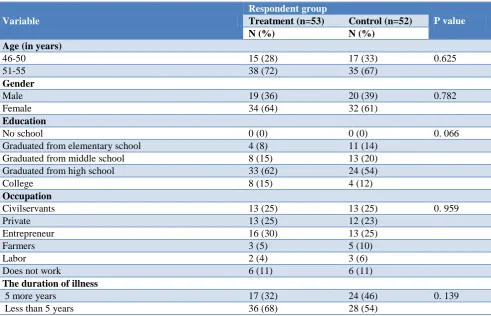
Table 1: Frequency distribution of characteristics of respondents by age, gender, education, occupation, and duration of illness.
Variable
Respondent group
P value Treatment (n=53) Control (n=52)
N (%) N (%)
Age (in years)
46-50 15 (28) 17 (33) 0.625
51-55 38 (72) 35 (67)
Gender
Male 19 (36) 20 (39) 0.782
Female 34 (64) 32 (61)
Education
No school 0 (0) 0 (0) 0. 066
Graduated from elementary school 4 (8) 11 (14)
Graduated from middle school 8 (15) 13 (20)
Graduated from high school 33 (62) 24 (54)
College 8 (15) 4 (12)
Occupation
Civilservants 13 (25) 13 (25) 0. 959
Private 13 (25) 12 (23)
Entrepreneur 16 (30) 13 (25)
Farmers 3 (5) 5 (10)
Labor 2 (4) 3 (6)
Does not work 6 (11) 6 (11)
The duration of illness
5 more years 17 (32) 24 (46) 0. 139
Less than 5 years 36 (68) 28 (54)
Table 2: Frequency distribution of the compliance level of taking hypertension medication in the treatment and control groups.
Level of compliance
Pre test Post test
Treatment group (n=53)
Control group (n=52)
Treatment group (n=53)
Control group (n=52)
N (%) N (%) N (%) N (%)
Obedient 7 (13) 9 (17) 32 (60) 13 (25)
Less obedient 20 (38) 23 (44) 21 (40) 29 (56)
Not obey 26 (49) 20 (39) 0 (0) 10 (19)
Amount 53 (100) 52 (100) 53 (100) 52 (100)
Level of compliance practice taking medication
Based on Table 2, it shows that in the treatment group, respondents who had a higher level of compliance at the posttest were 60% compared to at the pretest at 13%. In the control group, respondents who had a less obedient level of compliance at the posttest were more than 56% compared to the pretest which was 44%.
Analysis of differences in the compliance level of taking medicines
Based on Table 3 shows that the results of the analysis with the Mann Whitney U test in the pretest of the treatment group and the control group found no
compared with the provision of health education with lecture method.
Based on Table 4 shows that the results of the analysis with the Wilcoxon test found differences in significant changes in the level of medication adherence in hypertensive patients both the treatment group and the control group as evidenced by the p<0.05.
The mean difference in the level of medication adherence was higher (2.28) in the treatment group than in the control group (0.68). This shows that the use of hypertension management through an android application is more effective in improving medication adherence in hypertensive patients compared to health education methods through lectures.
Table 3: Differences in mean level of compliance in taking pre-test and post-test drug treatment and control groups.
Variable Score
Pre-test Post-test
Treatment group (n=53)
Control group (n=52)
Treatment group (n=53)
Control group (n=52)
Medication compliance
Mean 5.32 5.92 7.60 6.60
Standard deviation 1.784 1.506 0.494 1.107
Min 1 2 7 4
Max 8 8 8 8
P value 0.093 0.000
Table 4: Analysis of differences in changes in the level of compliance in taking medications after given action between the treatment group and the control group.
Difference in change Score
Group Treatment group (n=53)
Control group (n=52) Post-test
pre-test
Mean difference 2.28 0.68
Difference in Standard deviation 1.290 0.399
P value 0.000 00.001
DISCUSSION
The practice of adherence to taking medication is the degree to which the patient follows the clinical recommendations of the therapist who treats him to take the medicine in accordance with the recommendations given.14 Compliance is an extension behavior someone who relates to follow a diet, lifestyle changes and taking medication, which according to medical instructions are recommended. Compliance with the treatment of patients with hypertension, is influenced by health education provided regularly, promotion and counseling about hypertension and treatment of the community, patients and families.12
In this research, the treatment performed was the administration of hypertension through an android application. In this application, users can access information about hypertension and remindering take medication as well as monitoring the status of compliance to taking medicine. On the menu of compliance status, the user must input the data which will show the status of compliance that can be accessed in a daily, weekly or monthly. While the control group was given health education about medication adherence through the lecture method.
Based on the results of the non-parametric Mann-Whitney test by comparing the results of the pretest and posttest it
was found that there were significant differences in the level of adherence to taking medication. But the results of an increase in the mean treatment with android applications are higher. This means that the treatment in the form of hypertension management through an android application is more effective in increasing adherence to taking medication compared to conventional methods with lecture health education.
To strengthen the above results, a pretest and posttest comparison test of the treatment and control groups was carried out through the Wilcoxon test. The results found that there is a difference between the two data with the difference in the mean posttest-pretest treatment group compared with the control group the results are higher. This shows that those who use hypertension management through the android application increase their compliance higher than those who are only given health education by the lecture method.
The level of adherence to take medication is influenced by many factors including knowledge, age, affordability of health services, motivation and family support.13 Ways to improve patient compliance with medication include conveying information to patients about the benefits and importance of compliance so that treatment success can be achieved, patients are reminded by telephone or other communication tools to do everything that must be done for the success of treatment, increase confidence in effectiveness medicine in healing and conveying the consequences of non-compliance in taking medicine, as well as the support of family, friends and those around him to always remind patients, to regularly take medication for the success of treatment.14
According to the theory L. Green found that a person's behavior is determined by three main factors predisposing factors, enabling factors, and reinforcing factors. Predisposing factors include knowledge and attitudes of a person towards health. In this case the knowledge and attitudes towards hypertension, its consequences and management. Knowledge is the result of the process of sensing or knowing someone about something or an object through the five senses. Attitude is a closed response in response to a stimulus or object.
Enabling factors, in this study in the form of an andorid application as a means of increasing compliance in taking medication. This factor will influence the predisposing factors so that compliance is different from those without applications that only perform according to a predetermined schedule without or with family reminders. Knowledge and attitude of a person will give birth to a practice. Because someone acts or does something depending on their knowledge and attitude towards the action. Practice can be realized because of the presence of facilities, facilities or infrastructure. These facilities and infrastructure function to improve and strengthen one's attitude to act or practice.
Research supporting this condition includes research conducted by Sheny et al which proves that the application of remindering in 25 hypertensive patients is more effective in increasing adherence to taking medication compared to leaflets. This is due to the reminder intervention group, respondents get a short message reminding patients to consume drugs every day. The message contained information that reminded to take medication and motivation so that respondents were willing to take hypertension medication that had been given. Whereas in the leaflet intervention group, respondents were only given information when counseling at the beginning of the meeting to routinely consume hypertension medication.15
CONCLUSION
The management of hypertension through an android application has proven to be more effective in improving
the practice of adherence to taking medication compared to health education using the lecture method for hypertension patients who take part in the prolanis program in Wonosobo regency. The advantages of this application can be used among health workers in monitoring the health status of hypertensive patients. The weakness is in the form of dependency on internet services. It will be difficult to use in areas where there is no internet service.
Funding: No funding sources Conflict of interest: None declared
Ethical approval: The study was approved by the Institutional Ethics Committee
REFERENCES
1. Pusdatin; Depkes; Buletin Penyakit Tidak Menular, Depkes, Jakarta; 2012.
2. Data A. Kementerian Badan Penelitian dan Pengembangan Kesehatan. HASIL UTAMA RISKESDAS 2018. Kesehatan; 2018: 20-21. 3. Irianto K. Epidemiologi Penyakit Menular dan
Tidak Menular Panduan Klinis. Bandung: Alfabeta; 2014.
4. Siti S, Idrus A, Sudoyo AW, Simadibrata KM, Setiyahadi B, Syam FA, et al, ed. Ilmu Penyakit Dalam Jilid III Edisi keenam. Jakarta: Interna Publishing; 2014.
5. Udjianti W. Keperawatan Kardiovaskular. Jakarta: Salemba Medika; 2011.
6. Syamsudin. Buku Ajar Farmakoterapi Kardiovaskular Dan Renal. Jakarta: Penerbit Salemba Medika; 2011: 31.
7. Smeltzer SC, Bare BG. Buku Ajar Keperawatan Medikal Bedah Brunner dan Suddarth. Edition 8, Vol. 1,2, Alih bahasa oleh Agung Waluyo (DKK), EGC, Jakarta; 2002.
8. Dinas Kesehatan Kabupaten Wonosobo; Profil Kesehatan Kabupaten Woosobo Tahun 2016; 2016; Dikutip Tanggal 20 Mei; 2018.
9. Susanto Y, Alfian R, Rusmana I. Pengaruh Layanan Pesan Singkat Pengingat Terhadap Kepatuhan Konsumsi Obat Pasien DM Tipe 2 Di Puskesmas Melati Kabupaten Kapuas. J Ilmiah Manuntung. 2017;3(1):34-42.
10. Sari Y, Pemanfaatan Sms Gateway Sebagai Upaya Optimalisasi Program Dots Dalam Meningkatkan Kepatuhan Minum Obat Pasien Tuberkulosis Paru. Jurnal Kesehatan Terpadu. 2017;1(2):54-63. 11. Nursalam. Metode Penelitian Ilmu Keperawatan:
Pendekatan Praktis. Edisi 3. Jakarta: Salemba Medika; 2013.
12. Lewis LM. Factors associated with medication adherence in hypertensive blacks. J Cardiovascular Nurs. 2012;27(3):208-19.
14. Ananta SC, Ayu WD, Rusli R. Kajian Pemberian Leaflet dan Reminder pada Pasien Hipertensi Di Instalasi Rawat Jalan RSUD A. W Sjahranie Samarinda Periode Desember 2014-February 2015. Prosiding Seminar Nasional Kefarmasian Ke-1. 2015;1(1):222-30.
Cite this article as: Suyoto, Agushybana F, Suryoputro A.Increasing drug compliance to hypertension patients through android applications in Wonosobo regency province of Central Java