Original Research Article
Extent and pattern of paracetamol usage for children and knowledge
and attitude towards its usage among parents attending an outpatient
clinic in Warangal district of Telangana
Thatikonda Nithisha
1, Sarita K. Sharma
2*
INTRODUCTION
Paracetamol is the most frequently used over the counter drug in self medicating situations which is commonly practiced by people who are accustomed to use a wide range of medicines from conventional pain relievers to antibiotics without seeking a medical consultation.1 According to WHO, self-medication is defined as the selection and use of medicines by individuals to treat self-recognized illnesses and symptoms.2 Medicines for
self-medication are often called 'non prescription' or 'over the counter' (OTC) drugs and can be obtained from pharmacies without a doctor's prescription.3 It has also been pointed out by the WHO that some common ailments could be prevented and treated by self medication and provide a cheaper alternative treatment by avoiding the medical consultation.4 But it is the fact that medicines act as a double edged sword, they can restore the health and improve the quality of life; at the same time, if incorrectly used can cause serious harm to body. ABSTRACT
Background: Paracetamol is the commonest available analgesic and antipyretic. It is readily accessed from pharmacy and provisional shops as over the counter drug, misuse of which can result in serious side effects like hepatic injury. The incidence of paracetamol overdose and toxicity is increasing today in India. However, there is little research published on same. So the present study was carried out to identify the extent and pattern of paracetamol usage for children and the knowledge and attitude of parents towards it.
Methods: Present cross sectional study was carried out in an outpatient clinic in Warangal district of Telangana among 183 parents whose child had suffered from fever within one month of attending the clinic. Data was collected by interview technique using a pre tested questionnaire and analyzed using EPI INFO 7 3.5.
Results: Out of 183 subjects, 156 (85.2%) had given paracetamol (single and combination) for fever. Of these156, 39 (25%) gave excess dose than permitted for the weight of the child. 105 (58%) had self medicated. The dosage per day was significantly more in self medicaters (p≤0.01). 36 (23%) had the misconception that paracetamol overdose does not cause liver toxicity. 128 (89%) of 143 subjects who gave incorrect dosage stated that it is not harmful to self administer and they advise others to self medicate.
Conclusions: The knowledge of daily dosage and side effects of paracetamol is poor. The overall view is “self medication of paracetamol is not harmful”. This attitude of caregivers may pose a potential risk for paracetamol overdose unless they are educated.
Keywords: Paracetamol, Children, Knowledge, Attitude, Parents
1
Govt. Medical College Nagpur, MUHS Nashik, Maharashtra, India
2
Department ofCommunity Medicine, Govt. Medical College Nagpur, MUHS Nashik, Maharashtra, India
Received: 08 March 2018
Revised: 05 April 2018
Accepted: 06 April 2018
*Correspondence:
Dr. Sarita K. Sharma,
E-mail: [email protected]
Copyright: © the author (s), publisher and licensee Medip Academy. This is an open-access article distributed under the terms of the Creative Commons Attribution Non-Commercial License, which permits unrestricted non-commercial use, distribution, and reproduction in any medium, provided the original work is properly cited.
The potential risks of self-medication practices are many which include misinterpretation of the symptoms as a disease, refusal to seek medical advice in times of need, incorrect dose, duration and route of administration of the drug, sever adverse reactions and drug interactions all of which lead to masking of a severe underlying disease.5
Paracetamol as a drug is prescribed for mild to moderate pain and pyrexia. Over-dosage of paracetamol causes liver damage and renal tubular necrosis.6 Improper knowledge regarding side effects, over estimation of the toxic dose and wide and easy availability contributes to irrational usage of the drug.1 Paracetamol is the most frequently used antipyretic and absolutely safe for usage in children. But, if it is not given in appropriate doses results in serious side effects like hepatic injury.1 The recommended daily dosage of Paracetamol in children is 15 mg/kg/day for every 6-8 hours.7
The incidence of paracetamol overdose and toxicity is increasing today in India. However, there is little research published on same. With this background, the present study was carried out to
Identify the extent of paracetamol usage for fever in children.
Identify the pattern of paracetamol usage in children like prescription type, dose and dosage form.
To study the appropriateness of dosage of the drug in terms of body weight (kg).
Assess the knowledge and attitude on paracetamol usage among caregivers.
METHODS
Present cross sectional study was carried out in an outpatient clinic in Warangal district of Telangana in parents whose child had suffered from fever within one month of attending the clinic. Study duration was of three months i.e. between September 2015- November 2015. All the 183 parents who attended the clinic during this period having a child who had suffered from fever within the past month were included in the study. Data collection was by interview technique using pre tested questionnaire. Necessary consent was taken from study subjects after apprising them of the purpose of the study. Requisite permission was obtained from the ethics committee. Participants’ weight (in kg) was taken as per standard methods. The socio economic status of urban population was calculated by using Kuppuswamy scale modified as per the current CPI index and that of rural residence by Prasad’s scale. The questionnaire contained questions like “what is the drug you gave your child when he/she last suffered from fever, with or without doctor’s prescription, dose, dosage form etc.” Efforts were made to confirm that children were actually given Paracetamol and not any other drug by showing them different formulations and packs of the drug used in the locale. Questions like “maximum allowed daily dose, side effects and opinion towards self medication” were
asked to evaluate their knowledge and attitude towards paracetamol usage. Results were analyzed using EPI INFO 7 3.5.
RESULTS
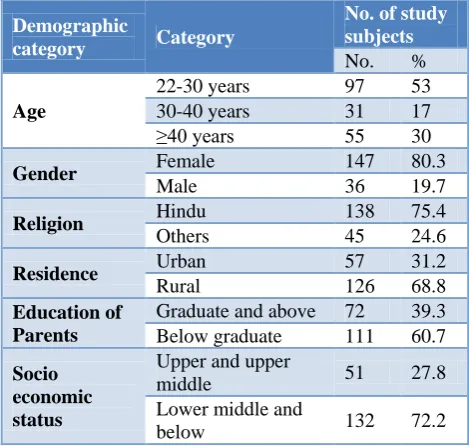
Total 183 parents were enrolled in the study. Table 1 shows the demographic data of study subjects. The age of study subjects varied between 22–57 years, the mean age being 32.5±4.5 years. 128 (70%) subjects were below 40 years of age. Among caregivers, majority were females 147 (80.3%) and 138 (75.4%) were Hindu by religion. Many of them 126 (68.8%) were from rural area and 111 (60.7%) were below graduate in their educational level. Total 132 (72.2%) were from lower middle and lower socio economic class.
Table 1: Demographic data of study subjects.
Demographic
category Category
No. of study subjects
No. %
Age
22-30 years 97 53
30-40 years 31 17
≥40 years 55 30
Gender Female 147 80.3
Male 36 19.7
Religion Hindu 138 75.4
Others 45 24.6
Residence Urban 57 31.2
Rural 126 68.8
Education of Parents
Graduate and above 72 39.3 Below graduate 111 60.7
Socio economic status
Upper and upper
middle 51 27.8
Lower middle and
below 132 72.2
Table 2: Demographic data of children of study subjects.
Demographic
category Category
No. of children
No. %
Age of the child
Below 1 years 90 49.2
1 - 4 years 63 34.4
≥5 years 30 16.4
Gender Male 93 50.8
Female 90 49.2
Weight
≤10 kg 132 72.2
11–25 kg 45 24.5
26–35 kg 6 3.3
Figure 1: Distribution of study subjects by the drug they gave their child for fever.
Out of 183 subjects, majority 156 (85.2%) had given paracetamol and its combinations, 15 (8.2%) gave Mefenemic acid and 12 (6.6%) gave other drugs like antibiotics and antihistaminics (Figure 1). For comparative purpose, paracetamol and its combinations are grouped together.
Figure 2: Distribution of study subjects by the pattern of usage of paracetamol.
Figure 3: Distribution of study subjects by the dosage from of paracetamol.
The pattern of administration of paracetamol was by doctor’s advice and prescription among 66 (42.3%),
previous prescription among 29 (18.6%) and self medication among 61 (39.1%) (Figure 2). Though they have visited doctor for previous complaints, the use of same prescription again for the similar complaint is regarded as self medication for this time. So total subjects who self medicated their children were 90 (57.7%).
As seen in Figure 3, majority of the subjects 134 (85.8%) used syrup formulation followed by drops form by 19 (12.2%) and tablet form by 3 (2%).
Figure 4: Distribution of study subjects by administered dosage of paracetamol to their children
per day in mg.
The amount of paracetamol consumed per day in mg was calculated from dose/each time and frequency of administration in a day. The measured weight of child and dosage of drug administered per day were compared. The details are shown in Figure 4. Among 156 subjects who have given paracetamol to their children, only 13 (8.3%) gave the appropriate dose of the drug/day as per the weight of the child. Most of the subjects 104 (66.7%) had administered below the recommended dosage (60 mg/kg/day). However significant no. of subjects 39 (25%) gave the dosage that is above recommended.
117(64%)
15(8.2%)
39(21.2%)
12(6.6%)
PARACETAMOL MEFENEMIC ACID PARACETAMOL
COMBINATION
OTHERS[ANTIBIOTICS & ANTIHISTAMINICS
NO
O
F
STUDY
SUBJ
ECT
S
Different drugd used for fever
66(42.3%) 29(18.6%)
61(39.1%)
DOCTOR'S PRESCRIPTION PREVIOUS DOCTOR'S
PRESCRIPTION SELF MEDICATION
No. of study subjects
PATTE
RN
O
F
USAG
E
O
F
THE
DRUG
134(85.8%)
19(14.2%)
3(2%)
SYRUP DROPS TABLET
NO
.
O
F
STUDY
SUBJ
ECT
S
Different dosage forms
13(8.3%)
104(66.7%)
39(25%)
CORRECT BELOW
RECOMMENDED
ABOVE RECOMMENDED
NO
.
O
F
STUDY
SUBJ
ECT
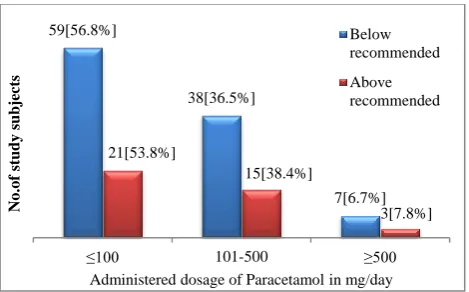
Figure 5: Amount in mg of paracetamol administered above or below the recommended dose.
Out of 39 (25%) subjects who gave excess dose than recommended, 21 (53.8%) gave paracetamol in excess of ≤100 mg/day. However, 15 (38.4%) and 3 (7.8%) subjects administered 101-500 mg/day and ≥500 mg/day more than the recommended dose respectively. Out of 104 subjects who administered below the recommended dose, 59 (56.8%) gave ≤100 mg less than the recommended dose. However, 38 (36.5%) and 7 (6.7%) gave 101-500 mg/day less and ≥500 mg/day less than the recommended dose respectively (Figure 5).
Table 3 shows 86 (60%) subjects who administered incorrect dose were by self medication. However, 9 (69.2%) out of 13 subjects who have administered correct dose were by doctor’s prescription. There is a significant association between the pattern of usage & administered dose of the drug (p=0.024).
Table 3: Comparison between pattern of consumption and administered dose of paracetamol.
Administered dose
Pattern of consumption
Doctor’s prescription % Self medication % Total % P X2 95% CI
Correct 9 69 4 31 13 100
0.024 3.394 1.474-2.629
Incorrect 57 40 86 60 143 100
Table 4: Comparison between dosage pattern and attitude towards paracetamol usage.
Dosage pattern
Attitude towards Paracetamol usage
Attitude in favor of self medication %
Attitude in favor of rational use
% Total % P X2 95% CI
Correct 4 31 9 69 13 100
<0.0002 19.2 3.620-12.031
Incorrect 128 89 15 11 143 100
Significant number 37 (23.7%) stated that paracetamol overdose does not cause liver toxicity. Most of them 89 (57%) had no idea of the same. However, 30 (19.3%) were aware of the consequences of Paracetamol over dose (Figure 6).
Figure 6: Knowledge regarding liver toxicity caused by overdose of paracetamol.
Most of them 79 (51%) stated that they had good experiences before and advice others to self medicate. Significant subjects 53 (34%) stated self medication is
not harmful. However, 24 (15%) stated that drug must be taken only with prescription & drug must contain information leaflet (Figure 7).
Figure 7: Overall attitude towards use of paracetamol.
For comparative purpose, the opinion of “good experiences and advice others to use” and “self medication is not harmful” are combined into a single group of attitude of promoting self medication of paracetamol usage. Similarly the opinion “it must be taken only with prescription of doctor” and “drug must
59[56.8%]
38[36.5%]
7[6.7%] 21[53.8%]
15[38.4%]
3[7.8%]
≤100 101-500 ≥500
No
.of
study
subject
s
Administered dosage of Paracetamol in mg/day Below recommended
Above recommended
30[19.3%]
89[57%]
37[23.7%]
YES NO IDEA NO
%
O
F
STUDY
SUBJ
ECT
S
Over dosage of Paracetamol causes liver toxicity
19[12%]
53[34%]
5[3%]
79[51%]
ONLY ON PRESCRIPTION
SELF MEDICATION
IS NOT HARMFUL
DRUG MUST CONTAIN INFORMATION
LEAFLET
GOOD EXPERIENCES & ADVICE TO
USE
NO
.
O
F
STUDY
SUBJ
ECT
S
contain the information leaflet of dosing schedule” are combined into a single group of attitude of using paracetamol rationally. Both the groups are compared with the pattern of prescription and results were tabulated (Table 4).
Among 13 subjects who gave correct dose, most of them 9 (69%) mentioned that drug must be taken only on prescription and drug must contain information on it. However, 128 (89%) of 143 subjects who gave incorrect dosage admitted that it is not harmful to self administer and they advise others to use. It shows the strong association (p≤0.0002) between the attitude of promotion for the drug with incorrect knowledge and practice of giving incorrect dosage.
DISCUSSION
Majority of the subjects 156 (85.2%) enrolled in the study had given paracetamol (single and combined form) for fever to their children. This is supported by the fact proved by many studies that paracetamol is the most commonly used antipyretic and analgesic in children.1-3,6,8
The administration of paracetamol by self medication 90 (57.6%) is far more than by doctor’s prescription 66 (42.3%). Similar results were obtained by Obu et al in his study on Enugu population of Nigeria where 59% subjects self-administered it.2 However, Ramanayake et al from Sri lanka reported that only 25% subjects self medicated.3
Significant subjects 29 (18.6%) administered paracetamol by themselves because of knowledge from previous prescription by doctor and only 13 (8.3%) subjects gave the appropriate dosage/day. However, the corresponding figures obtained in the study of Obu et al was 41% and 44% respectively.2
The finding that 39 (25%) administered above the recommended dose is supported by a study from Sri Lanka which reported that 43% subjects gave supratherapeutic dose of paracetamol.3
Most of the subjects 57% (below recommended dose) and 54% (above recommended dose) administered same amount of ≤10 mg/kg/dose less and more than the recommended dose respectively. However, as the quantity given above or below the recommended dose increases, no. of subjects who gave above and below the recommended doses differed considerably. This finding can’t be compared with the previous studies because of the dirth of studies focusing on the quantity by which the given dose differed from the recommended dose. This finding could be explained by the factor that the most common dosage form used was syrup by 134 (86%). The different strengths of syrup formulations and inappropriate methods of measuring the dose might
contribute to this deviation of dose from the recommended.
This over dosage of 500 mg/day (maximum) among 39 (25%) subjects is far less than that is required to cause the adverse effects of paracetamol over dose. But the literature says that the staggered overdose of little Paracetamol/day for a considerable period of time is found to be more potential risk than the acute ingestion of single over dose for developing the adverse effects of paracetamol.9
9 (69.2%) who gave correct dose had followed doctor’s prescription and most of them 86 (60%) who gave incorrect dose had self medicated. The pattern of administration and dosage quantity are significantly associated (p=0.024). Similar findings were obtained from a study conducted in Srilanka which reported the significant association between pattern of administration and dosage quantity (p=0.03 and X2=3.183).3
Only 30 (19.3%) of the subjects were aware of the side effects of paracetamol overdose and significant number 37 (23.7%) did not agree with the statement that paracetamol overdose causes liver toxicity. This might be because of the misconceptions like it is widely used drug so it is weak and less risky than the other drugs.8
There is significant association between the dosage administration pattern and overall attitude towards the paracetamol usage (p≤0.0002). This association explains that in spite of having poor knowledge on the drug dosage schedule, they did not think that it is necessary to take advice of doctor before using paracetamol. This could be due to poor socio economic status, lower level of education and rural residence.
CONCLUSION
In accordance with the results of this study, paracetamol is the most frequently used drug for fever in children. Self medication practice of paracetamol was more common than the doctor’s prescription. Administration of incorrect dosage was more common and this practice of administering the incorrect dosage is significantly related to pattern of prescription. However, the incorrect dosage administration is also found in doctor’s prescription pattern to an appreciable level. Over all the knowledge on the drug dosage, frequency of administration, indications and side effects was very poor. In spite of administering the incorrect dosage, many of them reported that they have good knowledge on the drug and they advise others to self.
REFERENCES
1. Barry HR. Chemical and drug poisoning. In: W.B. Saunders Company’s. The Nelson text book of Pediatrics. 18th edition. Philadelphia; 2010: 201-206.
2. Obu HA, Chinawa JM, Ubesie AC, Eke CB, Ndu IK. Paracetamol use [and/misuse] in children in Enugu, South – East, Nigeria. BMC Pediatrics. 2012;12:102-5.
3. Ramanayake RPJC, Jayasinghe LR, De Silva AHW, Wijesinghe WATA, Kanaganayagam N. Knowledge and Practices of Paracetamol Administration among Caregivers of Pediatric Age Group Patients. Sri Lanka J Family Med Prim Care. 2012;1(1):30-3. 4. Kontogiorgis C, Nena E, Berberoglou E, Moschoni
K, Polyzois S, Tselemponis A, et al. Estimating consumers’ knowledge and attitudes towards over the counter analgesics medication in Greece in the years of financial crisis: The case of Paracetamol. Greece J Child Health. 2015;25:9-13.
5. Kariyavasam SH, Nanayakkara DN, Mohottiarachchi MACP, Nandasena YLS. A descriptive cross sectional study on mothers self-medicating their children. Sri Lanka J Child Health. 2005;34:7-12.
6. British National Formulary No.62, September2011. Available at: http://www.worldcat.org/title/british-national-formulary-62/oclc/767695091.
7. Acetaminophen (OTC). Dosing and Uses. Available at: https://reference.medscape.com/drug/Tylenol-acetaminophen-343346.
8. British National Formulary No.54. September 2007. Available at: www.worldcat.org/title/british-national-formulary-54/oclc/852015259.
9. Utpal KS, Ramesh KP. Acetaminophen Poisoning. In: Sachdev HPS, Panna C, Arvind B’s The Principles of pediatric and neonatal emergencies. 2nd edition. New Delhi: Jaypee Brothers; 2004: 436.
10. Rivera-Penera T, Gugig R, Davis J. Outcome of acetaminophen overdose in pediatric patients and factors contributing to hepatotoxicity. J Pediatr. 1997;130:300-4.
11. Heubi JE, Barbacci MB, Zimmerman HJ. Therapeutic misadventures with acetaminophen: Hepatotoxicity after multiple doses in children. J Pediatr. 1998;132:22-7.
12. Abey SM, Amello W. Assessment of self - medication practices among medical, pharmacy and health science students in Gondar University, Ethiopia. J Young Pharm. 2010;2(3):306-10. 13. Gutema GB, Gadisa DA, Kidanemariam ZA, Berhe
DF, Berhe AH, Hadera MG, et al. Self medication practices among health care students: The case of Mekelle University. J applied Pharmaceutical Sci. 2011;1(10):183-9.