Original Research Article
Health seeking behaviour and factors affecting it among oral cancer
patients seeking radiotherapy at a regional cancer centre:
a retrospective study
Somen Kumar Pradhan
1*, Shubhra Agrawal Gupta
1, Neha Shrivastava
1, Nirmal Verma
1,
Srishti Dixit
1, Prem Sagar Panda
2INTRODUCTION
Oral cancer is turning out to be a significant public health problem in the Indian subcontinent where it ranks among the top three most common types of cancer in the country.1 The age standardized prevalence rate of oral cancer for males in India is 9.8 per 1,00,000 population which is much higher than that of the world (i.e.5.2 per 1,00,000).2 Higher incidence of Oral cancer in developing countries like India may be attributed to various
underlying risk factors like higher substance abuse rate, inadequate access to trained providers, limited health care services, lower socio-economic status, diagnosis at later stages etc.3-6
It has one of the worst 5-years survival rates of all cancers, probably because most lesions are not diagnosed in the initial stages. In spite of advancement in cancer diagnosis and treatment, delayed presentation of patients to proper healthcare facilities is creating a negative
ABSTRACT
Background: In spite of the progress in therapeutic science, the mortality among patients with Oral cancer is still high when compared to other cancers. However, early diagnosis and treatment are still key to improve prognosis, if a correct diagnosis is made at the initial stage of the disease. The objective of this study is to assess the health seeking behaviour and factors affecting it among oral cancer patients seeking radiotherapy at Regional cancer centre, Dr. B.R. Ambedkar Hospital, Raipur.
Methods: This hospital based cross sectional study was conducted in Regional cancer centre, Dr. B.R. Ambedkar Memorial Hospital, Raipur. Data was collected from previous patient records and by interview method regarding demographic details and health seeking behaviour including various delays in presentation of the study subjects.
Results: The most common primary presenting complaint among the study subjects was Ulcer (61.59%) followed by Mass (33.02%). The majority of the subjects sought care at Private hospitals (41.72%) followed by government public health care facilities (33.11%) as first health care provider. Among clinic-epidemiological factors, place of residence (p=0.001), distance from RCC, Raipur (p=0.035), Socio-economic status (p=0.01) and initial healthcare provider (p=0.027) were found to be significantly associated with delay in diagnosis and treatment of oral cancer.
Conclusions: The patient health seeking behavior can be improved by proper health education and increasing accessibility to primary health care.
Keywords: Oral cancer, Delay, Health seeking behaviour 1
Department ofCommunity Medicine, Pt. J.N.M. Medical College, Raipur, Chhattisgarh, India 2
All India Institute of Medical Science, Bhubaneswar, Odisha, India
Received: 11 February 2018
Revised: 07 March 2018
Accepted: 09 March 2018
*Correspondence:
Dr. Somen Kumar Pradhan, E-mail: [email protected]
Copyright: © the author(s), publisher and licensee Medip Academy. This is an open-access article distributed under the terms of the Creative Commons Attribution Non-Commercial License, which permits unrestricted non-commercial use, distribution, and reproduction in any medium, provided the original work is properly cited.
impact on outcomes of oral cancer control programmes.7 However, if early detection is ensured, the probability of survival from oral cancer is remarkably better than for most other cancers.8 Adequacy of health seeking behaviour has an important role in early diagnosis of Oral cancer which subsequently affects the quality of life as well as survival to a considerable extent.9
As Chhattisgarh, a state with sizable tribal population has shown a higher burden of oral cancer, present study tried to understand the underlying factors associated with health seeking behaviour and delay in diagnosis among patients with oral cancer.10
METHODS
A hospital based retrospective observational study was done at Regional cancer centre (RCC), Dr. B. R. Ambedkar Memorial Hospital, Raipur. 151 patients who were diagnosed cases of oral cancer, had undergone surgery and registered at Regional cancer centre (RCC), Dr. B. R. Ambedkar Memorial Hospital, Raipur and were more than 18 years old, were recruited consecutively as study subjects after proper informed consent during the period of April 2016 to August 2016. Patients who were critically ill and with co-morbidities, with history of previous malignancies and metastasis, with a level of cognitive impairment were excluded from study. A pre-designed pre-tested questionnaire was used in accordance with study objectives. The questionnaire consisted of two sections. The first section dealt with the demographic information followed by the second section which contained items regarding health seeking behaviour including the various delays in presentation of the study subjects. Relevant information were collected retrospectively from study subjects.
We classified time periods on the basis of stages of delay provided by Andersen, Cacioppo in their study i.e. Appraisal time, illness time, behavioural time, scheduling time and treatment time.11 First three deals with the patient while the later two deals with physician. Scheduling time was merged with treatment time in present study from feasibility point of view. In present study, appraisal time is the interval between when a person first detects an unexplained symptom and the moment they infer illness. Illness time is time between when a person first infers illness to when they decide to seek medical help (tertiary care hospital). Behavioural time is time between when a person decides to seek medical help to when they act on scheduling an appointment for medical attention. And finally, Treatment time is interval between when a person first seeks medical attention after scheduled appointment to when they begin treatment. Present study considered total delay of more than three months as similar to that defined by previous authors.12-14
The study protocol was reviewed and accepted by the Institutional scientific committee and Institutional ethical
committee. Statistical Package for Social Sciences Windows version 20 was used for database assembly and analysis. Descriptive analysis (means, standard deviations and percentages) was performed. To determine significant associations between variables, cross-tabbing of the variables was performed and Pearson Chi squared test was applied. P values were considered significant when they were below 0.05 (p<0.05) with 95% confidence interval.
RESULTS
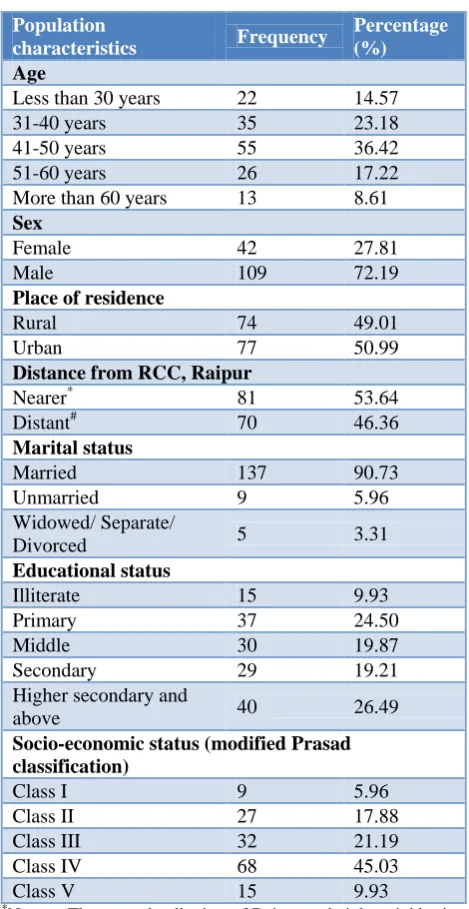
Table 1: Population characteristics.
Population
characteristics Frequency
Percentage (%)
Age
Less than 30 years 22 14.57
31-40 years 35 23.18
41-50 years 55 36.42
51-60 years 26 17.22
More than 60 years 13 8.61
Sex
Female 42 27.81
Male 109 72.19
Place of residence
Rural 74 49.01
Urban 77 50.99
Distance from RCC, Raipur
Nearer* 81 53.64
Distant# 70 46.36
Marital status
Married 137 90.73
Unmarried 9 5.96
Widowed/ Separate/
Divorced 5 3.31
Educational status
Illiterate 15 9.93
Primary 37 24.50
Middle 30 19.87
Secondary 29 19.21
Higher secondary and
above 40 26.49
Socio-economic status (modified Prasad classification)
Class I 9 5.96
Class II 27 17.88
Class III 32 21.19
Class IV 68 45.03
Class V 15 9.93
*
Nearer- These are the districts of Raipur and eight neighboring districts sharing border with Raipur.# Distant- Rest of the districts of Chhattisgarh not sharing any boarder with Raipur district.
subjects were 47.79+10.11 and 44.03+11.54 years respectively. Majority of subjects were in the age group of 41-50 years (36.42%). There is almost equal distribution of oral cancer patients among rural (49.01%) and urban (50.99%) areas in present study. Maximum proportion (53.64%) of the patients was from nearer districts of RCC, Raipur. Majority of subjects i.e. 137 (90.73%) were married. Among 151 patients, maximum i.e. 37 (24.50%) were with upto primary level education and 15 (9.93%) were illiterate. As far as socio-economic status is concerned, majority of subjects belonged to lower class IV SES i.e. 45.03% (Table 1).
Figure 1: Distribution of study subjects according to Stage at time of diagnosis.
Figure 2:Distribution of subjects according to primary presenting complaint to health care provider.
Figure 3:Distribution of study subjects according to their preference of first health care provider.
As depicted in Figure 1, oral cancer among study subjects was most commonly diagnosed at stage 2 (46.36%) followed by stage 3 (37.75%). The most common primary presenting complaint among the study subjects was Ulcer (61.59%) followed by Mass (33.02%). Difficulty in opening mouth was the least commonly reported primary presenting complaint. (Figure-2) According to the present study, the majority of the subjects sought care at private hospitals (41.72%) followed by government public health care facilities (33.11%) as first health care provider.19.21% of study subjects preferred Quacks as their initial health care provider (Figure 3).
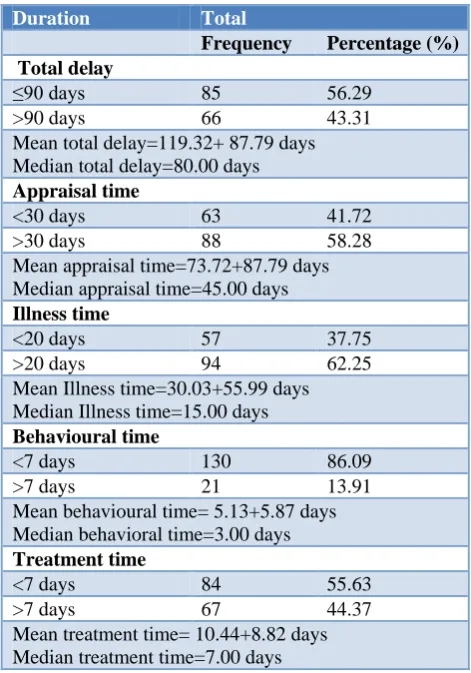
Table 2: Distribution of subjects according to time taken by them from detection of symptoms to start of
treatment.
Duration Total
Frequency Percentage (%) Total delay
≤90 days 85 56.29
>90 days 66 43.31
Mean total delay=119.32+ 87.79 days Median total delay=80.00 days
Appraisal time
<30 days 63 41.72
>30 days 88 58.28
Mean appraisal time=73.72+87.79 days Median appraisal time=45.00 days
Illness time
<20 days 57 37.75
>20 days 94 62.25
Mean Illness time=30.03+55.99 days Median Illness time=15.00 days
Behavioural time
<7 days 130 86.09
>7 days 21 13.91
Mean behavioural time= 5.13+5.87 days Median behavioral time=3.00 days
Treatment time
<7 days 84 55.63
>7 days 67 44.37
Mean treatment time= 10.44+8.82 days Median treatment time=7.00 days
In present study, the mean appraisal time was found to be 73.72±87.79 days. Out of 151, majority, 58.27 % of study subjects took more than 30 days of appraisal time. The mean Illness time was found to be 30.03±55.99 days and majority 62.25% of study subjects reported illness time of more than 20 days. The mean behavioural time was found to be 5.13±5.87 days with 86.09% study subjects showing behavioural time of less than 7 days. Similarly, the mean treatment time was 10.44±8.82 days and majority 84(55.62%) of study participants had treatment time of less than 7 days. Mean total delay was found to
15.89%
46.36% 37.75%
Stage 1 Stage 2 Stage 3
41.72%
33.11% 19.21%
3.97% 1.99%
Private hospital(Allopathy) Government hospital
Quacks Ayush (Private)
Dentist
41.72%
33.11% 19.21%
3.97% 1.99%
Private hospital(Allopathy) Government hospital
Quacks Ayush (Private)
be 119.32±87.79 days with 43.31% of subjects reporting a total delay of more than 3 months (Table 2).
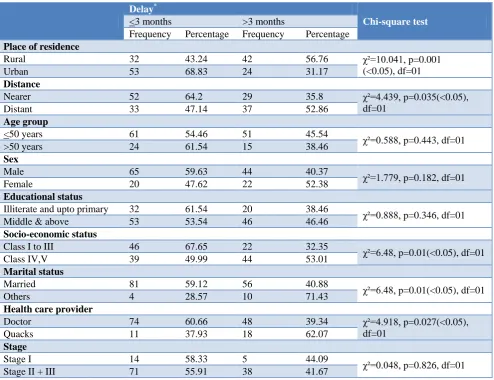
Total delay of more than 3 months was seen among subjects of rural area, distant districts from Raipur, females, education upto middle and above, with SES IV and V and age <50 years. Delay was clearly observed in subjects who choose Quacks as first health care provider (p=0.027) and this may have contributed to their diagnosis at stage II and III. As depicted in Table 3,
among clinic-epidemiological factors, place of residence (p=0.001), distance from RCC, Raipur (p=0.035), Socio-economic status (p=0.01) and initial healthcare provider (p=0.027) were found to be significantly associated with delay. Sex and marital status were not found to be significantly associated with delay. Delay in initiation of treatment was observed in subjects with rural residence, residents from distant districts and taking health service from quacks (Table 3).
Table 3: Association of various clinico-epidemiological variables of study subjects with total delay.
Delay*
Chi-square test
<3 months >3 months
Frequency Percentage Frequency Percentage
Place of residence
Rural 32 43.24 42 56.76 χ²=10.041, p=0.001
(<0.05), df=01
Urban 53 68.83 24 31.17
Distance
Nearer 52 64.2 29 35.8 χ²=4.439, p=0.035(<0.05),
df=01
Distant 33 47.14 37 52.86
Age group
<50 years 61 54.46 51 45.54 χ²=0.588, p=0.443, df=01
>50 years 24 61.54 15 38.46
Sex
Male 65 59.63 44 40.37 χ²=1.779, p=0.182, df=01
Female 20 47.62 22 52.38
Educational status
Illiterate and upto primary 32 61.54 20 38.46 χ²=0.888, p=0.346, df=01
Middle & above 53 53.54 46 46.46
Socio-economic status
Class I to III 46 67.65 22 32.35 χ²=6.48, p=0.01(<0.05), df=01
Class IV,V 39 49.99 44 53.01
Marital status
Married 81 59.12 56 40.88 χ²=6.48, p=0.01(<0.05), df=01
Others 4 28.57 10 71.43
Health care provider
Doctor 74 60.66 48 39.34 χ²=4.918, p=0.027(<0.05),
df=01
Quacks 11 37.93 18 62.07
Stage
Stage I 14 58.33 5 44.09 χ²=0.048, p=0.826, df=01
Stage II + III 71 55.91 38 41.67
*Delay is defined as total delay of more than 3 months.
DISCUSSION
The strategy of primary prevention through early diagnosis and treatment plays a crucial role in addressing the issue of increasing burden of morbidity and mortality due to oral cancer. However as observed in present study, most of the study subjects were diagnosed at stage II and III. These results are in agreement with studies undertaken by Shavi et al and Agrawal et al.15,16 Diagnosis of cancer at advanced stages may be attributed to the fact that there is inadequate awareness and inappropriate health seeking behaviour among general population. Lower doctor patient ratio as well as lack of
proper regulation in state of Chhattisgarh may be one of the reasons for 19.21% of the study subjects still ending up at quacks as their first health care provider. Zahid et al in their study reported that 24.7% of oral cancer patients consulted Quacks, Hakeems and spiritual healers first followed by 18.4% to doctors in hospital.17 The use of alternative medicine and the treatment delay caused by that has been well-documented in the past studies.18-20
socio- demographic factors such as age, sex and marital status and patient delay.21 Llewellyn et al in their study showed a positive association with being of a younger age group,which is in contrast to present study.22 RCC, Raipur is the only fully equipped tertiary care centre for cancer patients in the state. But distance and absence of adequate transport services has become a major obstacle for health care delivery in the state as evident from above results. This would help to understand the importance of reaching the unreached in cancer care. Rural residence and consulting untrained quacks may both have contributed to delay as, in Chhattisgarh, this could be attributed to the absolute ignorance regarding initial symptoms and lack of adequate primary health care facilities.
CONCLUSION
Present study concluded that in resource limited settings like Chhattisgarh, lack of awareness among general population, insufficient public health services and inadequately trained manpower is acting synergistically with high prevalence of tobacco consumption to increase the morbidity and mortality associated with oral cancer.
Recommendations
More aggressive strategy should be adopted for effective health education at community level which would reduce patient related delays in oral cancer like appraisal time, illness time and behavioural time to a greater extent. Promotion of interventions like oral self-examination has a definite role in the early detection of disease. School health programmes should also incorporate health education relevant to oral cancer in them. The present study highlights the need for implementation of stricter regulations to check the unethical practice by quacks in community. In addition to increasing awareness among general population regarding oral cancer, health system should also focus on the same for health care providers. Tertiary care institutions should take initiatives like outreach centres and telemedicine to reach the patients from distant tribal areas which can effectively reduce delay in diagnosis. Improving health-seeking behaviour can be a force multiplier for cancer screening programmes in prevention of oral cancer if implemented effectively.
ACKNOWLEDGEMENTS
Authors sincerely acknowledge the support of Department of Radiotherapy, Regional cancer centre, Dr.B.R. Ambedkar Memorial Hospital, Raipur to complete this study.
Funding: No funding sources Conflict of interest: None declared
Ethical approval: The study was approved by the Institutional Ethics Committee
REFERENCES
1. Elango JK, Gangadharan P, Sumithra S, Kuriakose MA. Trends of head and neck cancers in urban and rural India. Asian Pac J Cancer Prev. 2006;7(1):108–11.
2. Ferlay J, Soerjomataram I, Dikshit R, Eser S, Mathers C, Rebelo M, et al. Cancer incidence and mortality worldwide: sources, methods and major patterns in GLOBOCAN 2012. Int J Cancer. 2015;136(5):E359-86.
3. Kumar S, Heller RF, Pandey U, Tewari V, Bala N, Oanh KT. Delay in presentation of oral cancer: a multifactor analytical study. Natl Med J India. 2001;14(1):13-7.
4. Fritz A, Percy C, Jack A, Shanmugaratnam K, Sobin L, Parkin DM, et al. International Classification of Diseases For Oncology, World Health Organization, Geneva, Switzerland, 3rd edition, 2000.
5. Conway DI, Petticrew M, Marlborough H, Berthiller J, Hashibe M, Macpherson LM. Socioeconomic inequalities and oral cancer risk: a systematic review and meta-analysis of case-control studies. Int J Cancer. 2008;122(12):2811-9.
6. Neal RD1, Allgar VL. Sociodemographic factors and delays in the diagnosis of six cancers: analysis of data fromthe ’National Survey ofNHS Patients: cancer. Br J Cancer. 2005;92(11):1971-5.
7. Neal RD. Do diagnostic delays in cancer matter? Br J Cancer. 2009;101 Suppl 2:S9-S12.
8. Rajendran R, Sivapathasundharam B. Shafer’s text- book of oral pathology 5th ed, Elsevier; 2006: 113– 308.
9. Kowalski LP, Carvalho AL. Influence of time delay and clinical upstaging in the prognosis of head and neck cancer. Oral Oncol. 2001;37:94-8.
10. Cancer incidence report, Indian Council Medical Research (2009-2011).
11. Andersen BL, Cacioppo JT, Roberts DC. Delay in? seeking a cancer diagnosis: Delay stages and ? psychophysiological comparison processes. Br J So Psychol. 1995;34:33-52.
12. Sankaranarayanan R, Fernandez GL, Lence AL, Pisani P, Rodringuez SA. Visual inspection in oral cancer screening in Cuba: A case-control study. Oral Oncol. 2002;38:131-6.
13. Joshi P, Nair S, Chaturvedi P, Nair D, Agarwal J, D'Cruz A. Delay in seeking specialized care for oral cancers: Experience from a tertiary cancer center. Indian J Cancer. 2014;51(2):95.
14. Onizawa K, Nishihara K, Yamagata K, Yusa H, Yanagawa T, Yoshida H. Factors associated with diagnostic delay of oral squamous cell carcinoma. Oral Oncol. 2003;39:781–8.
based study. Indian J Comm Health. 2012;24(2):80-5.
17. Zahid T, Hussain SI, Siddiqui AH, Junaid ST, Ahmed Z, Noorani MM. Health seeking behavior of oral cancer patients of low socioeconomic status: a cross sectional study in a tertiary care hospital of Karachi. J Dow Univ Health Sci. 2014;8(2).
18. Davis GE, Bryson CL, Yueh B, McDonell MB, Micek MA,Fihn SD,Treatment delay associated with alternative medicine use among veterans with head and neck cancer. Head Neck. 2006;28(10):926–31.
19. Ernst E, Cassileth BR, The prevalence of complementary/alternative medicine in cancer: a systematic review. Cancer. 1998;83(4):777–82. 20. Patterson RE, Neuhouser ML, Hedderson MM,
Schwartz SM, Standish LJ, Bowen DJ, et al. Types of alternative medicine used by patients with breast,
colon, or prostate cancer: predictors, motives and costs. J Altern Complement Med. 2002;8(4):477– 85.
21. Scott SE, Grunfeld EA, McGurk M. Patient's delay in oral cancer: A systematic review. Community Dent Oral Epidemiol. 2006;34:337–43.
22. Llewellyn CD, Johnson NW, Warnakulasuriya S. Factors associated with delay in presentation among younger patients with oral cancer. Oral Surg Oral Med Oral Pathol Oral Radiol Endod. 2004;97:707– 13.