Original Research Article
Prevalence of undiagnosed hypertension: a public health challenge
Vamsi Krishna Undavalli
1*, Praveen Madala
1, Hanumanth Narni
2INTRODUCTION
The five leading global risks for mortality in the world are high blood pressure, tobacco use, high blood glucose, physical inactivity, and overweight and obesity. They are responsible for raising the risk of chronic diseases, such as heart disease and cancers. In developing and developed countries, most adults’ blood pressure is higher than the ideal level. Average blood pressure levels are particularly high in middle-income European countries and African countries. Globally, 51% of stroke (cerebrovascular disease) and 45% of ischaemic heart disease deaths are attributable to high systolic blood pressure. At any given age, the risk of dying from high blood pressure in low- and middle-income countries is more than double that in high-income countries.1
India is experiencing a rapid health transition with a rising burden of non-communicable diseases (NCD) surpassing the burden of Communicable diseases like water-borne or vector-borne diseases, TB, HIV, etc. NCDs are estimated to account for around 60% of all deaths, thus making them the leading causes of death. Losses due to premature deaths due to these NCDs are also projected to increase over the years.2 In a systematic review and meta-analysis, overall prevalence of HTN in India, after weighting the regional population size was 29.8%. Significant differences in HTN prevalence were noted between rural and urban parts of India.3
The increasing trend of NCD’s not only effect the physical health but also has an impact on the socio ABSTRACT
Background: Globally, 51% of stroke (cerebrovascular disease) and 45% of ischaemic heart disease deaths are attributable to high systolic blood pressure. At any given age, the risk of dying from high blood pressure in low- and middle-income countries is more than double that in high-income countries. The objective of the study was to know the prevalence of undiagnosed hypertension among rural population.
Methods: A community based cross-sectional study conducted in villages under the rural field practice area of medical college in the month of May, 2017. 365 people participated in the hypertension screening camp constituted the study sample.
Results: Prevalence of undiagnosed HTN was found to be 10.1% among study population. Nearly 58.1% of the people are with normal blood pressure while 31.2%, 10.7% of the study population are classified prehypertensive, hypertensives according to JNC- VII.
Conclusions: Early detection and treatment of hypertension and other risk factors through Health education programs, public awareness campaigns to be conducted actively among population.
Keywords: Cardiovascular disease, Hypertension, Undiagnosed hypertension, Pre-hypertension, JNC– VII
1
Assistant Professor, Department of Community Medicine, Dr. Pinnamaneni Siddhartha Insitiute of Medical Sciences and Research Foundation, Chinna Avutapalli, 2Lecturer in Statistics, GVP IHC and MT, Visakhapatnam, Andhra Pradesh, India
Received: 17 February 2018
Revised: 04 March 2018
Accepted: 05 March 2018
*Correspondence:
Dr. Vamsi Krishna Undavalli, E-mail: [email protected]
Copyright: © the author(s), publisher and licensee Medip Academy. This is an open-access article distributed under the terms of the Creative Commons Attribution Non-Commercial License, which permits unrestricted non-commercial use, distribution, and reproduction in any medium, provided the original work is properly cited.
economic status of the households. A study found that spending on NCDs accounted for 5.17% of household expenditure in a large national survey in India in 2004. It was found that households with NCDs spend a substantial share of their income on care for these diseases. In addition, some households' longer-term financial status was also adversely affected through the accumulation of debt and other risk mitigating strategies. Undoubtedly numerous people also simply forgo needed care for NCDs as a result of financial barriers.4
Hypertension is an iceberg disease only about half of the hypertensive subjects in the general population of most developed countries were aware of the condition. The hidden part of the iceberg thus constitutes important undiagnosed subjects with hypertension. Identification of those with disease is imperative. Hence present study was conducted with the objective of finding prevalence of undiagnosed hypertension in the field practice area.
METHODS
Study design, setting
It was a community based cross-sectional study conducted in villages under the rural field practice area of Dr. Pinnamaneni SIMS & RF, A.P. Study was done in the month of May, 2017.
Study population
Was constituted by people >18 years of age who attended health screening camp.
Inclusion criteria
Purpose of the study was explained and the required data for the study was collected from the participants who attended screening camp.
Sample size and samplings
Rural health and training center, under Dr. Pinnamaneni SIMS & RF caters services to 9 villages with a population of 31,420.Under the catchment area, free services are being provided for the patients with minor ailments and all the essential drugs are being provided. Regular house to house screening services are being done for the common diseases. Around 365 people participated hypertension screening camp conducted on May 2017, constituted the study sample.
Study instruments and data collection
Data regarding socio-demographic variables, behavioural risk factors was collected and physical measurement of blood pressure was recorded. The data was collected by personally interviewing the study participants.
Blood pressure recording5
Digital automatic blood pressure monitor Omron HEM-7120 was used for measurement of blood pressure, results are displayed simultaneously on the digital blood pressure monitor. Blood pressure was recorded three times in sitting position, in the left arm. During data analysis the mean of the second and third readings were calculated. The participant will rest for three minutes between each of the readings.
Case definitions6
Participants were divided into three categories on the basis of their BP as per JNC VII:
1) Normal BP: systolic BP <120 mmHg and diastolic BP <80 mmHg
2) Prehypertension (PHTN): either systolic BP 120 to 139 mmHg or diastolic 80 to 89 mmHg, but not qualifying for HTN
3) Hypertension (HTN):
1. Stage 1: systolic BP 140 to 159 mmHg or diastolic BP 90-99 mmHg
2. Stage 2: systolic BP ≥160 mmHg or diastolic ≥100 mmHg.
Ethical issues
Ethical clearance was obtained from the institutional ethical committee prior to the start of study. Consent was obtained after explaining the importance of the study in detail. Questionnaire does not contain any identification details of the participant and confidentiality was maintained throughout the study.
Statistical analysis
Data entry and statistical analysis was done using SPSS v 22. Missing values were not replaced with theestimated values. The study results were represented in form of percentages in tabular form and odds were calculated for various behavioral risk factors.
RESULTS
Prevalence of systolic and diastolic hypertension Prevalence of systolic and diastolic hypertension according to age is shown in Table 1. It shows 58.1% of the people are with normal BP while 31.2%, 10.7% of the study populations are classified as prehypertensive, hypertensives according to JNC VII. Majority of the prehypertensives and hypertensives belong to the age group of 41-50.
Prevalence of undiagnosed hypertension was found to be 10.1% (32) and 15.2% (7) of the known hypertensives unable to control their BP hence falls under uncontrolled hypertensive category.
Table 1: Prevalence of hypertension among study participants.
Age Normal Pre HTN HTN
Count % Count % Count %
≤30 69 32.5 12 10.5 5 12.8
31-40 48 22.6 30 26.3 8 20.5
41-50 45 21.2 32 28.1 14 35.9
51-60 30 14.2 24 21.1 9 23.1
61-70 15 7.1 11 9.6 3 7.7
71-80 3 1.4 5 4.4 0 0.0
81-90 2 .9 0 0.0 0 0.0
Total 212 100.0 114 100.0 39 100.0
Table 2: Prevalence of undiagnosed hypertension.
Currently on prescribed blood pressure lowering treatment Total
No Yes
Non HTN 287 39 326
89.9% 84.8% 89.3%
HTN 32 7 39
10.1% 15.2% 10.7%
Total 319 46 365
100.0% 100.0% 100.0%
Table 3: Socio demographic variables of the study population.
Variable Category
Group
Total Undiagnosed/newly diagnosed HTN No HTN
Count % Count % Count %
Age
≤30 5 15.6 80 28.0 85 26.7
31-40 7 21.9 71 24.8 78 24.5
41-50 12 37.5 64 22.4 76 23.9
51-60 6 18.8 43 15.0 49 15.4
61-70 2 6.3 20 7.0 22 6.9
71-80 0 0.0 7 2.4 7 2.2
81-90 0 0.0 1 0.3 1 .3
Religion
Hindu 23 71.9 169 86.2 192 86.5
Christian 8 25.0 24 12.2 26 11.7
Muslim 1 3.1 3 1.5 4 1.8
Education
Primary 8 38.1 58 36.7 66 36.9
Secondary 5 23.8 39 24.7 44 24.6
Intermediate 3 14.3 23 14.6 26 14.5
UG 4 19.0 26 16.5 30 16.8
PG and above 1 4.8 12 7.6 13 7.3
Marital status
Married 32 100.0 255 91.7 287 92.6
Unmarried 0 0.0 23 8.3 23 7.4
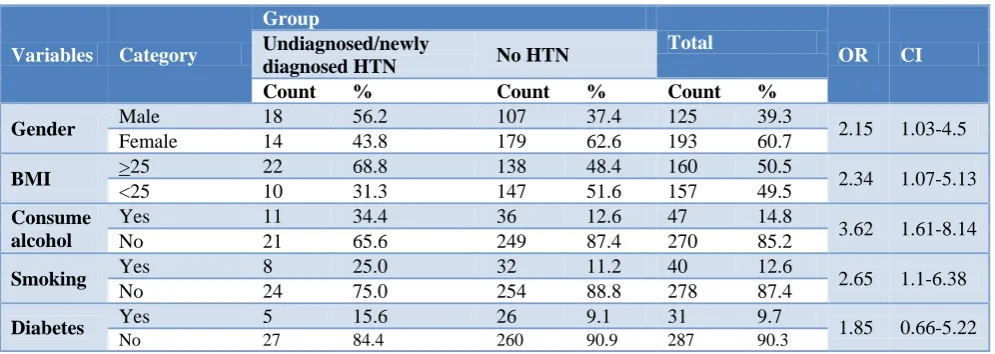
Prevalence of risk factors including odds ratio with 95% CI in systolic and diastolic hypertensive is shown in Table 4, except for those with history of diabetes significant positive association with gender, BMI, alcohol and smoking was noted. Alcohol consumption showed the significant positive association with newly diagnosed HTN (3.62; 95% CI 1.61–8.14) than normal people.
DISCUSSION
Table 4: Odds ratio of factors associated with HTN in study population.
Variables Category
Group
Total
OR CI
Undiagnosed/newly
diagnosed HTN No HTN
Count % Count % Count %
Gender Male 18 56.2 107 37.4 125 39.3 2.15 1.03-4.5
Female 14 43.8 179 62.6 193 60.7
BMI >25 22 68.8 138 48.4 160 50.5 2.34 1.07-5.13 <25 10 31.3 147 51.6 157 49.5
Consume alcohol
Yes 11 34.4 36 12.6 47 14.8
3.62 1.61-8.14
No 21 65.6 249 87.4 270 85.2
Smoking Yes 8 25.0 32 11.2 40 12.6 2.65 1.1-6.38
No 24 75.0 254 88.8 278 87.4
Diabetes Yes 5 15.6 26 9.1 31 9.7 1.85 0.66-5.22
No 27 84.4 260 90.9 287 90.3
Out of 365 study subjects 46 (12.6%) are currently on prescribed blood pressure lowering treatment and about 7 (15.2%) of them are unable to control their blood pressure. On contrast Kusuma et al in their study carried out in Delhi and found that only 59% of hypertension patients were on medication.11 In the study done by Gudina et al, reporting history of hypertension was found to be 13.2%.8 Only 35.1% of them were aware of their hypertension and only 23.7% were on treatment. The overall control rate was 15.5%.
In this study positive association with gender, BMI, alcohol, smoking and diabetes were identified among undiagnosed hypertension. With regards to gender difference the overall prevalence was found to be higher in men in this study (56.2%) but it is more among women in study done by Bonsa et al.9 Generally after the fifth decade of life, the incidence of hypertension increases more rapidly in women thus, women older than 60 years have higher rates of hypertension compared with men.12
CONCLUSION
Early detection and treatment of hypertension and other risk factors, as well as public health policies that reduce exposure to behavioural risk factors, have contributed to the gradual decline in mortality due to heart disease and stroke in high-income countries over the last three decades. Health education programs, public awareness campaigns to be conducted actively among population and detection of high risk subjects should be encouraged by the optimum use of clinical methods.
Limitation
Sample is mainly representative of rural population and few missing values are observed.
Funding: No funding sources Conflict of interest: None declared
Ethical approval: The study was approved by the Institutional Ethics Committee
REFERENCES
1. Global health risks: mortality and burden of disease attributable to selected major risks. Geneva 27, Switzerland: World Health Organization; 2009. Available at: http://www.who.int/healthinfo/global_ burden_disease/GlobalHealthRisks_report_full.pdf. Accessed on 3 March 2017.
2. Directorate General of Health Services. Dghs.gov.in. 2017. Available at: http://dghs.gov.in/ content/1363_3_NationalProgrammePreventionCont rol.aspx. Accessed on 3 March 2017.
3. Raghupathy A, Nanda KK, Hira P, Hassan K, Oscar HF, Emanuele Di A. Hypertension in India: a systematic review and meta-analysis of prevalence, awareness, and control of hypertension. J Hypertens. 2014;32:1170–7.
4. World Health Organization. Impact of out-of-pocket payments for treatment of non-communicable diseases in developing countries: A review of literature WHO Discussion Paper 02/2011. Geneva, World Health Organization.
5. World Health Organization. WHO STEPS Surveillance Manual: The WHO Stepwise approach to chronic disease risk factor surveillance. Geneva, World Health Organization, 2017.
6. The Seventh Report of the Joint National Committee on Prevention, Detection, Evaluation, and Treatment of High Blood Pressure. U.S. Department of Health and Human Services; 2004. Available at: https://www.nhlbi.nih.gov/files/docs/ guidelines/jnc7full.pdf. Accessed on 26 Mach 2017. 7. Getachew F, Dirar A, Solomon D. Prevalence of
Undiagnosed Hypertension and Associated Factors among Residents in Gulele Sub-City, Addis Ababa, Ethiopia. J Community Med Health Educ. 2018;8:590.
9. Bonsa F, Gudina EK, Hajito KW. Prevalence of hypertension and associated factors in Bedele town, southwest Ethiopia. Ethiopian J Health Sci. 2013;24:21-6.
10. Anand NS, Tarun M, Bhavesh MT, Meena MP, Komal HS. Prevalence and Predictors of Undiagnosed Hypertension in an Apparently Healthy Western Indian Population. Advan Epidemiol. 2015;2015:1-5.
11. Kusuma YS, Gupta SK, Pandav CS. Treatment seeking behaviour in hypertension: factors associated with awareness and medication among
socioeconomically disadvantaged migrants in Delhi, India. Collegium Antropologicum. 2013;37(3):717– 22.
12. Pemu PI, Offili E. Hypertension in women. J Clin Hypertens. 2008;10:406.