Study of Biogas Output Increase Depending on
Organic Load Conditions and Parameters
ZHANAR NURMAHANBAEVNA
KAIPOVA
1, MARAT ISAKOVICH SATAYEV
1,
RUSTEM FELIKSOVICH ALTYNBEKOV
1, RADYUK SVETLANA NIKOLAEVNA
2and ORAZOVA MEREKE MAMYROVNA
31M. Auezov South Kazakhstan State University, Kazakhstan, Shymkent 2Southern Methodist University, USA, Dallas
3South Kazakhstan State Pharmaceutical Academy, Kazakhstan, Shymkent
*Corresponding author E-mail: [email protected] http://dx.doi.org/10.13005/bpj/901
(Received: February 27, 2016; accepted: April 11, 2016) ABSTRACT
Organic load conditions and parameters on the anaerobic bioreactor operation, where comfort temperature is 35ºC, were determined. A specific biogas output, fallen into 1 m3 of the
bioreactor and specific biogas output, fallen into 1 kg of remote COD from the bioreactor organic load, were determined. The relationship between the rundown time and solids content based on viscosity measurement was determined. The relationship between measured rundown time and corresponding solids content in the fermenting material, as well as relationship between content of COD and organic solids in the substrate mixture were found. The relation between change in NH4 -N percentage in -N total – N, as well as between content of organic solids in the substrate mixture and settling time of the substrate were determined. The content of organic solids in the substrate mixture and CH4 output per one ton of the clean substrate and per one ton of the organic solids was correlated.
Key words: Organic load conditions, Organic solids, Substrate mixture.
INTRODUCTION
Energy is a moving force for economic development of many countries of the world. Biochemical processes, such as anaerobic digestion allow produce clean energy in the form of biogas1. A biotechnological process for the
biogas production was developed in India. The suggested technology allows recover wastes, produce clean electric energy and manure.
The paper2 studied digestion factors:
culture time, initial temperature and ðÍ. The endoglucanase (CMCase) activity of MY6 was increased by 200.74% and reached 137.36 U/ml under the optimized conditions (cultured for 48 h at
pH 7.0 and 40ºC with shaking at 160 rmp); while the activity of FY2 was enhanced by 150.61% and achieved 177.58 U/ml under the optimized conditions (cultured for 48 h at pH 7.0 and 45°C with shaking at 160 rmp).
Three types of biogas plants: continuously-operated, semi-continuous, regularly-operated were studied [3]. A boiler design for the regular operation and effective gas production in various load conditions was developed. Different tests that can help in accessing biogas as a contender for new generation energy source are controlled cooking test, kitchen performance test, boiling test, etc. 1.0 m3 of biogas is equal in energy
gas and 1.1 L of gasoline.
Physical and chemical properties of wastes, such as rumen, waste water and manure were studied4. The waste water has the potency for
producing total biogas as 2.472 m3/m3 of waste
water. The degradation of cattle manure has the potency for producing total biogas of 618.90 L/kg in dry based by the composition of CH4, CO2, NH3 were 48.89, 47.87, and 2.43 % volume, respectively. In other terms, cattle manure will produce CH4 as 305.06 L/kg in dry based.
The research results5 showed that rumen
fluid inoculated in the bio-boiler significantly increased the biogas production in more than two times compared to manure. At four F/I tested, after 80 days digestion, the biogas yield were 191, 162, 144 and 112 mL/g VS, respectively. About 80% of the biogas production was obtained during the first 40 days of digestion. The best performance of biogas production will be obtained if F/I ratio is in the range of 17.64 to 35.27 (correspond to 25–50% of rumen fluid).
The paper6 analyzed effect of
temperature, time, pH on the organic load of carbon nitrogen. The research showed that two-staged reactor leads to the biogas and methane output enhancement in comparison with one-staged reactor. However, two-staged reactors require more capital expenditures.
The paper7 studied utilization of wastes
for the biogas production, after which a slag has high nitrogen and carbon content. The slag can be used as a fertilizer and additionally treated for the gas production. Coconut husk, agricultural and cellulose wastes can be used as the wastes. The disadvantage of slow reaction times from the biogas (methane) production by bacterial action is avoided.
It is possible to enhance the biogas production significantly adding chicken feather8. In
case of biologically delignified bagasse, increase in biogas production is less compared to chemically delignified bagasse. Compared to control, there was considerable increase in biogas production after supplementing chicken feather hydrolysate in
both chemical and biologically delignified bagasse. Pretreatment of bagasse results in improved biogas production. Chemical method is faster, effective and cheaper than biological method. Chicken feather hydrolysate as nitrogen/amino acid additives enhances biogas from the delignified bagasse.
The paper9 carried out analysis for
processing of biodegradable wastes (haulm) in the processes of two phase methane production and organic fertilizers. The methane volume, formed from the biomass was higher in comparison with control one. It was shown that yard wastes can be used as a substrate for the methane production.
The studies10 on the biogas production on
a plant, which consists of a mixing chamber, boiler and regulating device were carried out. Results indicated that methane content of the scrubbed/ purified biogas was raised from 58% to 82% due to the reduction of Carbon dioxide and Hydrogen Sulfide. CO was reduced from 31% to 14% while HS was reduced from 1% to 0.4%. The corresponding Energy content of the purified biogas was evaluated to be 41 MJ/kg which is higher than that of the raw biogas which was evaluated to be 29 MJ/kg.
The paper11 considers effect of
temperature factors and organic load on biochemical processes of highly concentrated waste waters’ treatment from organic impurities and stabilization of settlings. It was shown that comparative effectiveness of a duck manure anaerobic digestion in a psychrophilic mode, at temperatures of 10 and 20ºC, was 51.4 … 78.5% and 65.0 … 86.2%, respectively. In a mesophilic mode at temperatures of 30 and 35ºC, these indicators were 81.8 … 94.9% and 73 … 95.9%, respectively, depending on the treatment duration. The specific biogas output per 1 kg of remote COD is fluctuated depending on the organic load of the bioreactor and temperature mode of the anaerobic treatment within the limits from 0.117 m3/kg of COD
at temperature 10ºC and treatment time 0.67 of a day to 0.520 m3/kg of COD at temperature of 35°Ñ
and treatment time 1.5 of a day.
The paper12 established that for the biogas
content of cattle rumen (wastes of meat industry), then a sugar-beet pulp. A brewing waste is the most difficult fermented raw material. It was shown that Amaranthus cruentus phytomass is a stimulant of methane-genesis-difficult-fermented substrates, such as brewing waste and sugar-beet pulp. In the presence of Amaranthus, the methane formation in the biogas may significantly increase. In a case of the manure, there is acceleration of the process.
Authors of the research13 established effect
of the load by the substrate on biotechnological parameters of the methane digestion process. The main reason of acidization effect origin at the digestion of the main substrate and co-substrates was determined. Calcium carbonate and calcium defecation were offered as disoxidating agents. Optimum relationship of the disoxidating agents to the studied co-substrates was obtained. Thus, use of buffer systems on the basis of calcium carbonate is the main factor, regulating acid-carbonate balance in the digestion systems of acidogenic substrates and determining potential to the load increase with the biogas output increase without loss of its quality. Obtained optimum relationship of the disoxidating agents (in terms of calcium carbonate) to the studied co-substrates appeared equal for calcium carbonate and calcium defecation and consisted 55% of calcium carbonate to the organic solid content of the co-substrate.
The papers14-16 carried out analysis of
present electrotechnics, where magnetic field effect on the organic substrate allows obtain high effectiveness of the anaerobic digestion process intensification.
Analysis of factors17, influencing on the
digestion process rate and amount of the obtained biogas, proves that there is close interrelation between characteristics of the initial substrate, loading conditions, operating temperature and dwelling time of the substrate in the methane tank. Currently it is impossible analytically determine exact effect of each separate factor on the formed biogas amount.
For objective estimation of the initial raw material quality and external factors effect on the digestion rate in the methane tank and biogas
output volume, it is reasonable to carry out experimental studies on laboratory and industrial plants.
The paper18 introduces research results
of the chicken manure anaerobic methanogenic digestion, where optimal values of the specific output on the mixing, equal to 3 W/m-3 and hydraulic
dwelling time of the substrate, equal to 5 days were determined. Obtained in the laboratory conditions numerical values of similarity tests were used at the bioreactor’s process design for industrial biotechnology of the manure processing by capacity 175 tons a day.
MATERIAL AND METHODS
Classical and modern physical-chemical research methods allowing obtain total characteristic of the research objects were used in the paper. With a view to ensure the obtained biogas safety and quality, certainty of all material and energy resources, conformity of developments by the technology, reliability of measurements in the research and papers, modern measuring equipment, metrological standards, statistical analysis methods of the measurement results providing integration and required precision of measurements, identification of reasonable errors and variations of the results and limits, outside of which they should not fall at the specified probabilities, were used in the research work. The units of measurement correspond to SI metrological rules and norms.
For experimental check and demonstration of renewable energy sources, as well as for the cattle manure anaerobic digestion modes’ development in the laboratory conditions, a laboratory biogas plant with reactor volume 0.25 m3 was designed and prepared in M. Auezov South
into gaseous products – methane and carbon dioxide, is developed in the manure during the digestion. At the same time, the manure’s deodorization, dehelminthization, destruction of weed seeds’ abilities to germinate, conversion of fertilizing element to the mineral form are provided during its digestion. The biogas plant consists of three base apparatus – the bioreactor for the manure’s anaerobic digestion, gasholder, unit for preparation of the manure to the digestion, and auxiliaries for support of the bioreactor system operations. The bioreactor is a cylindrical vessel – the methane tank of black steel by 7 mm thickness. Its depth is 1.5 m, diameter – 530 mm. The reactor is equipped by electric heating unit with heat-exchange surface area in 0.33 m2. The substrate is
mixed in the reactor hydraulically with the help of a pump and pipeline system with rectifiers. At the pump’s operation in the mixing mode, the substrate is taken off the reactor and supplied through the pipeline system to its upper part. The digested manure is removed as a fresh portion comes in through the pipeline system for the effluent removal. There is a discharge valve in the reactor’s bottom for its discharge. Table 1 presents main engineering performance of the biogas plant.
General requirements to the biogas plants, anaerobic conditions in the methane tank, accuracy in the temperature conditions, acid-base balance, requirements to the process waste
characteristics, operating mode of the bioreactor, requirements to the design, water- and gas impermeability, the methane tank design stability, measuring equipment, requirements to the biogas gathering facilities were determined by standards [19-23]: GOST R 52808-2007 Unconventional technologies. Bio-wastes energetics. Terms and definitions, GOST R 53790-2010 Unconventional technologies. Bio-wastes energetics. General operating requirements to biogas plants, GOST 14920-79 DRY GAS Method for determination of compositional analysis, Process procedure. Production of biogas from domestic solid garbage dumps. Scientific and technical information office AKH. Moscow 1990, GOST 22387.2-97 Methods for determination of hydrogen sulfide and mercaptan Sulphur.
RESULTS AND DISCUSSION
Experiments for investigation of the organic load effect on the process were carried out. The investigations on the anaerobic bioreactors’ operating modes showed (Figure 1) that at the cattle manure digestion in the mesophilic mode at temperature 35ïÑ, there is a sharp change in the
processing effectiveness, i.e. its rapid increase in the beginning of the treatment from 12 to 24 hours from 89 to 95.5%, after some period from 24 to 32 hours consists 95.5 – 96%, achieves final stationary value and does not rise further.
Table 1: Main engineering performance of the biogas plant
Figures Unit of measure Value
Total volume of the bioreactor m3 0.25
Gas space volume m3 0.07
Treatment temperature
at the mesophilic mode – M ºÑ 35-37
at the thermophilic – T 55-57
Treatment time 24 hours 20-22 at M 12-15 at T
Pump power for the manure mixing kW 0.37
Installed power of the electric heating unit kW 2.0
Heat-exchange surface area m2 0.33
Capacity:
by the initial manure M-T l/day 10-15
by the biogas M-T l/day 100-170
Fig. 1: Dependence of the anaerobic treatment effectiveness on the processing time
Fig. 2: Dependence of the biogas specific output per 1 m3 of the bioreactor
on its organic load and anaerobic
Fig. 3: Dependence of the biogas specific output fallen into 1 kg of the remote COD on the
bioreactor organic load
Fig. 5: Relationship between COD content and organic solid content in the substrate mixture
Fig. 6: Relationship between change in NH4-N part in Ngen.-N in percentage
and settling time of the substrate Fig. 4: Relationship between the measured rundown time and proper content of the dry
substance in the fermenting material Results of our studies of the biogas
specific output fallen into 1 m3 of the bioreactor
(Figure 2) shows that at the organic load 25 kg COD/m3·day, it achieves adequate specific output
of the biogas equal to 14 m3/m3·day. Beginning from
5 kg COD/m3·day of the organic load the biogas
specific output rises linearly and proportionally from
3 to 14 m3/m3·day, this evidences that the anaerobic
Figure 3 shows that with increase in the organic load from 7 to 16 kg COD/m3·day, there is
insignificant reduction of the biogas specific output from 0.53 to 0.5 m3/kg of COD removal. At values
from 10 to 13 of the bioreactor organic load, values of the biogas specific output reduce from 0.518 to 0.513.
A large volume of the manure in the reactor results in the viscosity increase. Heavy power consumption for the mixing is required for high performance mixing. Optimal relation between content of dry substances and viscosity is determined by the rundown time to the full discharge of the reservoir. Pursuant to Figure 4, at the content of dry substance in the reactor equal to 12%, the rundown time is 12 days, at the content of dry substance equal to 5%, the rundown time is 4 days. This means proportional increase in the dry substance content on the rundown time.
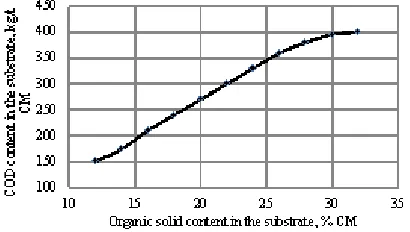
Biological decomposition of the substrate mixture part also characterizes the chemical oxygen demand (COD). As is clear from Figure 5, COD content in the substrate increase from 150 to 400 kg/t NI with increase in the organic solid content in the substrate from 12 to 32 %. The balanced condition is attained almost completely in the following.
Increase in the gas concentration results in the general nitrogen content increase (Ngen.-N). Mineralization of the organic nitrogen compounds at the anaerobic decomposition results in increase of NH4-N content. Experimental data (Figure 6) of the settling time effect on the change of NH4-N part in Ngen.-N (absolute %) showed that with increase in the settling time it rises to 68% on the 250th day.
The important characteristic of the reactor performance is hydraulic settling time value. The load value by the organic solid content effects on the gas formation process. Increase in the settling time in the whole system from 50 to 175 (d) at the organic solid content values in the substrate mixture from 10 to 30% ÑÌ, with increase in the linear dependence, is characteristic for the studied biogas plant (Figure 7).
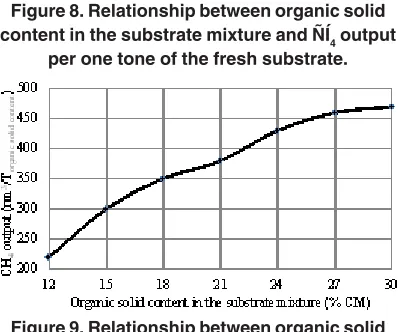
It is seen from Figure 8 that increase in the
Figure 7. Relationship between organic solid content in the substrate mixture and settling
time of the substrate.
Figure 8. Relationship between organic solid content in the substrate mixture and ÑÍ4 output
per one tone of the fresh substrate.
Figure 9. Relationship between organic solid content in the substrate mixture and CH4 output per one tone of the organic solid content organic solid content in the substrate mixture is accompanied by increase in CH4 output per one tone of the fresh substrate. At the organic solid content equal to 30% we registered maximum output of CH4 140 (nm3/Ò
substrate).
one of the organic solid content allowed us determine performance criteria of the substrate use. Figure 9 shows obvious increase dynamics in the dependence on the organic solid content in the substrate mixture on CH4 output. There is increase in the organic solid content values from 12 to 30 % to CH4 output from 220 to 470 nm3/Ò
organic solid content.
CONCLUSION
Experimental results show possibility to reduce the manure treatment process to 1-1.5 days. Content of dry substances over 12% results in significant increase of the mass viscosity and therefore greatly effects on the fermenter ability to the mixing. This, in turn, should be considered in selection of dimensions of plants for mixing of the substrate in design of the biogas plants.
Content of COD is a good alternative for the organic solid content factor, as in this case there is no any errors in a result of volatile organic acids’ spread.
In connection with various intensity in mineralization of the organic nitrogen compounds, NH4-N content limits significantly extend.
Using raw material with the organic solid content over 30%, general settling time in the plant is optimal.
In the organic solid content from 24 to 30% CM, CH4 output value on the plant achieves its maximum output.
ACKNOWLEGEMENTS
We would like to express our gratitude for your suppor t. The ar ticle describes results of research project “Production of fuel gas in the membrane purification of biogas as a raw material for alternative energy”, financed by the Ministry of Science and Education of the Republic of Kazakhstan (Contract No. 278 from 04.02.2014).
REFERENCES
1. Javed Ahmad, Touseef A. Ansari. Biogas from Slaughterhouse Waste: Towards an Energy Self-Sufficient Industry with Economical Analysis in India J Microbial BiochemTechnol 2012, S12 DOI http:// dx.doi.org/10.4172/1948-5948
2. Zhou Hong-li,Yang Xiao, Xiong Dong-mei, Zeng Lu, Tian Kai-zhong, Xiong Xing-yao, LiuYun, Su Xiao-jun. Isolation, Identification and Characterization of Cellulose-Degradation Bacteria from Fresh Cow Dung and Fer mentation Biogas Slurr y. Research&Reviews:Journal of Microbiology and Biotechnology. RRJMB | Volume 4, Issue 3, July-September, 2015, Ð.30-38. 3. Jyothilakshmi R. Biogas Technology in
Current Indian Scenario as Applicable to its Production, Maintenance and Utilization of the Slurry as Organic Manure after its Enrichment. Research & Reviews: Journal of Engineering and Technology RRJET,
Volume 4, Issue 3, July-September, 2015, Ð.40-43.
4. Budiyono, Widiasa I. N., Johari S.,Sunarso. Study on Slaughterhouse Wastes Potency and Characteristic for Biogas Production. Internat. J. of Waste Resources, Sept. 2011, Vol. 1(2):4-7.
5. Sunarso, Johari S., Widiasa I. N., Budiyono. The Effect of Feed to Inoculums Ratio on Biogas Production Rate from Cattle Manure Using Rumen Fluid as Inoculums. Internat. J. of Waste Resources, March 2012, Vol. 2(1):1-4.
6. Oliveira F., Doelle K., Anaerobic Digestion of Food Waste to Produce Biogas: A Comparison of Bioreactors to Increase Methane Content–A. Review. J Food Process Technol 2015, 6:8 DOI http:// dx.doi.org/10.4172/2157-7110.1000478 7. Rahul Basu, Processing urban waste for
Biotechnol Biomater 2015, 5:6 DOI http:// dx.doi.org/10.4172/2155-952X.C1.043 8. Gopinathan Chengalath, Co-digestion with
poultry feathers enhances biogas production from bagasse. J Biotechnol Biomater 2015, 5:6 DOI http://dx.doi.org/ 10.4172/2155-952X.C1.044
9. Poulomi Mukherjee, Darshana Salaskar, Sukhendu B. Ghosh, Sharad P. Kale Studies on feasibility of processing dry leaves by Nisargruna biogas technology. J Biotechnol Biomater 2015, 5:6 DOI http://dx.doi.org/ 10.4172/2155-952X.C1.043
10. Temilola T. Olugasa, Oluwafemi A. Oyesile. Design and Construction of a Water Scrubber for the Upgrading of Biogas. J Fundam Renewable Energy Appl 2015, 5:5 DOI http://dx.doi.org/10.4172/2090-4541.1000190
11. Kovalev V.V., Unguryanu D.V., Kovaleva O.V. Teoreticheskiye i prakticheskiye aspekty sovershenstvovaniya protsessov biogazovoy tekhnologii. PROBLEMELEL ENERGETICII REGIONALE 1(18) 2012, P.102-114.
12. Mindubayev A. Z., Minzanova S. T., Skvortsov YU. V., Mironov V. F., Zobov V. V., Akhmadullina F. YU., Mironova L. G., Belostotskiy D. Ye., Konovalov A. I. Stimuliruyushcheye vliyaniye sukhoy fitomassy amaranta Amaranthus cruentus na biometanogenez v trudnofermentiruyemykh substratakh. Vestnik Kazanskogo tekhnologicheskogo universiteta. Tekhnologiya i apparaty pishchevykh proizvodstv. 2009. No 4. P. 220-226.
13. Sotnikov V. A., Sotnikov D. V., Gamayurova V. S., Marchenko V. V. Kal’tsiy – karbonatnaya bufernaya sistema – faktor povysheniya effektivnosti substratnogo i kosubstratnogo metanovogo brozheniya. Vestnik Kazanskogo tekhnologicheskogo universiteta. 2009. No 4. P.198-203. 14. Obolenskiy N. V., Kraynov YU. Ye.
Uvelicheniye vykhoda biogaza s pomoshch’yu gidrodinamicheskikh kavitatsionnykh reaktorov. Vestnik NGIEI
Vypusk ¹ 2 / 2012 P.99-104.
15. Makarova G.V., Mozharov A.A. Elektrotekhnologii intensifikatsii protsessa anaerobnogo sbrazhivaniya otkhodov zhivotnovodstva. 8-ya Mezhdunarodnaya nauchno-tekhnicheskaya konferentsiya ENERGOOBESPECHENIYe I ENERGOSBEREZHENIYe V SEL’SKOM KHOZYAYSTVE Moskva, 16-17 maya 2012 g. P.189-195.
16. Satayev M., Shakirov B., Mutaliyeva B., Satayeva L., Altynbekov R., Baiysbay O. & Alibekov R. Mathematical modeling of methoxyanabasine Ñ11Í16N2O polymer solution ultrafiltration. Heat Mass Transfer. 2012. 48(6), 979-987. http://dx.doi.org/ 10.1007/s00231-011-0948-8
17. Sednin V. A., Sosnin A. V., Prokopenya I. N., Shimukovich A. A. Analiz faktorov, vliyayushchikh na proizvodstvo biogaza pri sbrazhivanii osadka stochnykh vod. Teploenergetika. Izvestiya vysshikh uchebnykh zavedeniy i energeticheskikh ob”yedineniy SNG - Energetika : nauchnotekhnicheskiy i proizvodstvennyy zhurnal. -2009. - N 5. P.49-58.
18. Khabibullin R. E., Shar ifullin V. N. Issledovaniye protsessa anerobnogo sbrazhivaniya kurinogo pometa i inzhenernaya metodika tekhnologicheskogo rascheta bioreaktora. Vestnik KGTU ¹9, 2010. P.639-646.
19. GOST R 52808-2007 Netraditsionnyye tekhnologii. Energetika biootkhodov. Terminy i opredeleniya.
20. GOST R 53790-20101 Netraditsionnyye tekhnologii. Energetika biootkhodov. Obshchiye tekhnicheskiye trebovaniya k biogazovym ustanovkam.
21. GOST 14920-79 GAZ SUKHOY Metod opredeleniya komponentnogo sostava 22. Tekhnologicheskiy reglament. Polucheniye
biogaza s poligonov tverdykh bytovykh otkhodov. Otdel nauchno-tekhnicheskiy informatsii AKKH. Moskva 1990