Original Research Article
A study on prevalence of risk factors of non-communicable
diseases among undergraduate medical student
Shamima Yasmin, Tanmay Kanti Panja*, Baijayanti Baur
INTRODUCTION
Non communicable diseases (NCDS) also referred to as “lifestyle diseases” are the leading cause of death globally. According to WHO NCDs, including heart disease, stroke, cancer, diabetes and chronic lung disease, are collectively responsible for almost 70% of all deaths worldwide.1 The rise of NCDs has been driven by primarily four major risk factors: tobacco use, physical inactivity, the harmful use of alcohol and unhealthy diets.2
Death from NCDS is on the rise, with developing world being hit hardest. Majority of these diseases are
preventable illnesses. So interventions targeting the main risk factors (e.g. smoking, alcohol intake, physical inactivity etc.) could have a significant impact on reducing the burden of non-communicable diseases. Most of the NCD risk factors are behaviorally acquired which are due to change in lifestyle during adolescent age groups.3
As the major NCDs risk factors are well documented, exposure to modifiable risk factors start in younger ages hence screening medical college students is definitely justified who will also be our future medical expert.4 With this in mind the present study was conducted with
ABSTRACT
Background: Non communicable diseases (NCDS) also referred to as “lifestyle diseases” are the leading cause of death globally. Most of the NCD risk factors are behaviorally acquired which are due to change in lifestyle during adolescent age groups With this in mind the present study was conducted with the following objective to determine the prevalence of risk factors of NCDS among medical undergraduates of a district of West Bengal.
Methods: Cross-sectional observational study among 96 medical students of a medical college in a district of West
Bengal using WHO STEPS questionnaire. Analysis of results was done by percentage and proportion.
Results: A total of 96 students were interviewed and examined. Mean age was 19.3 years.12.5% were current
smokers, 8.3% were alcohol users. 53.1% did no exercise. 46.5% female and 37.7% male had mild to moderate risk of high BMI, 51.2% female had abnormal waist circumference. 46.5% girls had abnormal waist hip ratio. 34.8% female and 35.8% males were pre hypertensive while 4% boys were hypertensive. Out of 22 students who had undergone blood test, 4.5% were early diabetic. 13.6% had borderline risk and 4.5% high risk for blood cholesterol.
Conclusions: A high prevalence of risk factors for non-communicable diseases was found in the present study which
emphasizes the need of interventions to reduce these risk factors among these future doctors.
Keywords: Non-communicable diseases, Risk factors, Lifestyle, Anthropometry
Department ofCommunity Medicine, Midnapore Medical College, Paschim Medinipur, West Bengal, India
Received: 22 May 2019
Revised: 06 June 2019
Accepted: 07 June 2019
*Correspondence: Dr. Tanmay Kanti Panja,
E-mail: [email protected]
Copyright: © the author(s), publisher and licensee Medip Academy. This is an open-access article distributed under
the terms of the Creative Commons Attribution Non-Commercial License, which permits unrestricted non-commercial use, distribution, and reproduction in any medium, provided the original work is properly cited.
the following objective to determine the prevalence of risk factors of NCDS among medical undergraduates of a district of West Bengal.
METHODS
Study design and setting
This was a cross-sectional institution based observational, descriptive type of study conducted in March 2017 to May 2017 in Midnapore Medical College Paschim Medinipur, West Bengal.
Study participants
Study participants were medical undergraduate students. Sample size:96.
Sampling technique
Out of students of 5 different batches of the college, a particular batch was chosen randomly and students from that batch were chosen as study participants. All students of the particular batch present on the day of data collection were included in the study.
Study tools
Pre-designed, Pre-tested, semi-structured interview schedule based on WHO Steps approach, BP machine, stadiometer, bathroom type weighing machine, laboratory blood reports
Study technique
After obtaining permission from higher authority the students were told about the study objectives importance and the procedure of the study. They were encouraged to participate in the study. After obtaining consent students were interviewed with the help of pre designed semi structured questionnaire regarding socio demographic factors like age, gender, religion, family history of NCDs etc. then anthropometry and BP was recorded, weight was recorded in nearest 500 g by standard bathroom scale, height was recorded in nearest 0.1 cm by stadiometer, waist and hip circumference were measured in cm by measuring tape, BP was recorded by sphygmomanometer and classified according to JNC-8. BMI was calculated from height and weight measurements. For analysis of BMI, South Asia Pacific guidelineswere followed.5 Students having more than 3 risk factor were motivated to undergo blood tests and those who consented their laboratory tests were done. This study was in accordance with Helsinki declaration. Waist and Hip circumference were measured in cm using non- stretchable measuring tape. Following South Asia Pacific guidelines for males >90 cms and for females >85
Waist hip ratio >1.0 for men and >0.85 for women were taken as abnormal.
Operational definition6
Current tobacco user: Someone who at the time of survey used tobacco either daily or occasionally.
Current alcohol user: Those who consumed 1 or more (30 ml) of any type of alcohol in the year preceding the survey.
Fruits and vegetables: 100 gm was considered as one serving. WHO recommends consumption of at least 400 grams of vegetables and fruits per day as adequate.
Adequate physical activity: Recall for one week. Physical activity of moderate intensity at least 30 minutes per day in any sphere of their daily routine activity (working hours, travelling, leisure time) for 5 days in a week i.e., ≥150 minutes/week was considered as adequate.
Students who had 3 or more risk factors were considered as at risk and advised for biochemical investigation. For biochemical investigations fasting blood sugar and serum cholesterol were taken
Statistical analysis
Data were entered into an MS Excel sheet. Data were analyzed by appropriate statistical techniques. Tables and diagrams were constructed.
Ethical issues and necessary approval
The study obeyed the ethical standards for an observational study and approved by the Institutional Ethics Committee, Informed written consent was obtained from each of the study participant.
RESULTS
A total of 96 students were interviewed and examined. Table 1 denotes the socio-demographic profiles of the study population. The mean age of the participants was 19.3 years Range varied from 18 to 22 years. 41.7% of the students were of 19 years of age. 53 were male (55.2%), 85.4% were Hindus. 80.4% were staying in the hostel. Majority of the participants were hailing from upper socioeconomic class as per modified BG Prasad socio economic scale January 2018.7 70.4% were from nuclear family. Positive family history of hypertension (54.2%), cardio vascular diseases (10.4%), diabetes mellitus (40.6%), obesity (20.8%), and dyslipidemia (07.3%) were present.
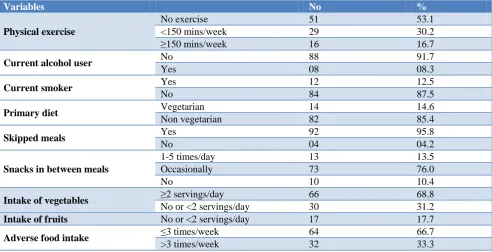
Although 68.85 had vegetables only 17.7% had adequate fruits. 66.7% had history of intake of adverse food habit. Table 3 shows 46.5% female and 37.7% male had mild to moderate risk of high BMI, 51.2% female and only 1.8%
male had abnormal waist circumference. None of the boys but 46.5% girls had abnormal waist hip ratio. 34.8% female and 35.8% males were pre hypertensive while 4% boys but no girls were frank hypertensive according to JNC-8 criteria.
Table 1: Sociodemographic variables and family history of non communicable diseases among medical undergraduates (n=96).
Variables
Mean age in years 19.3
No %
Residence Rural 33 34.3
Urban 63 65.7
Type of student Boarder 81 84.4
Day Scholar 15 15.6
Religion
Hindu 82 85.4
Muslim 12 12.5
Christianity 2 2.1
Gender Male 53 55.2
Female 43 44.8
Family type Nuclear 28 70.8
Joint 68 29.2
Socio-economic status*
Class I 72 75.0
Class II 17 17.7
Class III 07 07.3
Positive family history#
Hypertension 52 54.2
Cardio vascular diseases 10 10.4
Diabetes mellitus 39 40.6
Obesity 20 20.8
Dyslipidemia 07 07.3
#= Multiple response; *B. G. Prasad Scale, Jan 2016.
Table 2: Distribution of the students according to life style related risk factors.
Variables No %
Physical exercise
No exercise 51 53.1
<150 mins/week 29 30.2
≥150 mins/week 16 16.7
Current alcohol user No 88 91.7
Yes 08 08.3
Current smoker Yes 12 12.5
No 84 87.5
Primary diet Vegetarian 14 14.6
Non vegetarian 82 85.4
Skipped meals Yes 92 95.8
No 04 04.2
Snacks in between meals
1-5 times/day 13 13.5
Occasionally 73 76.0
No 10 10.4
Intake of vegetables ≥2 servings/day 66 68.8
No or <2 servings/day 30 31.2
Intake of fruits No or <2 servings/day 17 17.7
Adverse food intake ≤3 times/week 64 66.7
Table 3: Distribution of study population according to anthropometric measurements, blood pressure with gender.
Variables Male
(n=53)
Female
(n=43) Total Percentage
N (%) N (%) (%)
Body mass index (kg/m2)
Underweight (<18.5) 04 (07.1) 04 (09.3) 8 8.3 Acceptable (18.5-23) 26 (49.0) 15 (34.8) 41 42.7 Mild-moderate risk (23.1-27.5) 20 (37.7) 20 (46.5) 40 41.7 Higher high risk ( ≥27.6) 03 (05.7) 04 (09.3) 7 7.3
Waist circumference Normal 51 (96.2) 21 (48.8) 72 75.0
Abnormal 02 (01.8) 22 (51.2) 24 25.0
Waist:hip ratio Normal 53 (100.0) 23 (53.5) 76 79.2
Abnormal 00 (00.0) 20 (46.5) 20 20.8 Blood pressure
Normal 30 (56.6) 28 (65.2) 58 60.4 Pre hypertension 19 (35.8) 15 (34.8) 34 35.4 Increased 04 (07.5) 00 (00.0) 4 4.2
Table 4: Medical students and their biochemical parameters (n=22).
Variables No %
Fasting blood sugar Normal (70-100 mg/dl) 21 95.5
Early diabetes (101-125 mg/dl) 01 04.5 Blood cholesterol
Desirable (<200 mg/dl) 18 81.9 Borderline (200-239 mg/dl) 03 13.6
High risk (≥240 mg/dl) 01 04.5
Blood triglyceride
Desirable (<150 mg/dl) 19 96.4 Borderline (150-199 mg/dl) 01 04.5
High risk (≥200 mg/dl) 02 09.1
Table 4 shows the laboratory report of 22 students undergoing blood test. 4.5% were early diabetic. 13.6% had borderline risk and 4.5% high risk for blood cholesterol. 9.1% had high risk of blood triglyceride.
DISCUSSION
In the present study a high prevalence of risk factors for non-communicable diseases was found which calls for interventions. High prevalence of behavioral, biological and biochemical risk factors for non-communicable diseases.
In our study 34.8% female and 35.8% males were pre hypertensive while 4% boys were hypertensive, while a similar study conducted among medical students of south Kolkataonly 13.6% boys and 6.3% girls had elevated BP.4 Although it that study inadequate intake of fruit was 96.4% and inadequate intake of vegetable was 90.9% which is quite high in comparison to our study where the values are respectively 31.2% and 17.7%.
A similar study conducted in Nepal among dental and medical students nearly 40% of respondent had family history of one or more chronic non-communicable diseases (NCDs) like hypertension, diabetes, dyslipidemia, or thyroid disorder. In our present study it
In our study 46.5% female and 37.7% male had mild to moderate risk of high BMI while in the study from Nepal only 11% male and 14.5% female were either pre-obese (over weight) or obese.8
In the study conducted in Tamil Nadu 30% of the medical students had the habit of regular physical activity while in present study it is only 16.7%.9
Among the 96 students 22 students who had more than 3 risk factors had undergone blood test and the laboratory report states 4.5% were early diabetic. 13.6% had borderline risk and 4.5% high risk for blood cholesterol. 9.1% had high risk of blood triglyceride, which is quite alarming. In the similar study conducted in Tamil Nadu in 2017 the rates are higher fasting sugar (>100 mg) was present for 17.9% males and 2.4% females, cholesterol (>200 mg) was present for 19.8% male and 3.5% female and also triglyceride (>175 mg) was present for 22.6% male students and 6.6% female students.9 This variation can be due to different study settings and study tools. Recommendations
foods. Hostel canteen authorities were requested to prepare healthy food especially vegetable items regularly for the students. Regarding physical activities they were encouraged to practice yoga or any other form of exercise at least 30 minutes on daily basis esp. female students. Habit of using stairs was encouraged. Students having abnormal value were advised attend medicine OPD.
CONCLUSION
A high prevalence of risk factors for non-communicable diseases was found in the present study which emphasizes the need of interventions to reduce these risk factors. There is huge scope to curb the modifiable risk factors among our future doctors by encouraging the students to modify their behavior related life styles such as smoking habits, alcohol use etc. peer groups were encouraged to help their friends with risk factors. Periodic screening of the students at regular intervals is required for our future doctors as evident from the present study to curb the epidemic of non-communicable disease.
Limitations of the study
In the present study, all patients were interviewed so there may be subjective variation or conscious falsification regarding sensitive questions like addiction which cannot be verified. Recall bias might be present.
Funding: No funding sources Conflict of interest: None declared
Ethical approval: The study was approved by the Institutional Ethics Committee
REFERENCES
1. Noncommunicable disease and their risk factors. Available at: https://www.who.int/ncds/en/. Accessed on 31 May 2019.
2. Major NCDS and their risk factors. Available at: https://www.who.int/ncds/introduction/en/.
Accessed on 31 May 2019.
3. Puwar T, Saxena D, Yasobant S, Savaliya S. Noncommunicable diseases among school-going adolescents: A case study on prevalence of risk factors from Sabarkantha District of Gujarat, India. IJCM. 2018;43(5):33-7.
4. Goswami S, Dutt R, Sengupta S, Chaudhuri S, Ahmad S, Yadav AK. Prevalence of Non Communicable Diseases’ Risk Factors among Medical Students in South Kolkata, West Bengal National J Community Med. 2018;9(5):334-9. 5. WHO expert consultation. Appropriate body-mass
index for Asian populations and its implications for policy and intervention strategies. Lancet. 2004;363:157-63.
6. Risk factor surveillance for non-communicable diseases (NCDs): the multi-site ICMR–WHO collaborative initiative. Available at: http://www.globalforumhealth.org/filesupld/forum9/ CD%20Forum%209/papers/Shah%20B.pdf. Accessed on 1 March 2010.
7. Pandey V, Agarwal P. Modified BG Prasad's Socio-economic Classification-2018: The need of an update in the present scenario. Indian J Community Health. 2018;30(1):82-4.
8. Sanju NK, Shah RK, Geethanjali S, Sankara R. The risk factors for Hypertension among medical & Dental students at a private medical college: Findings from a cross-sectional study. Web Med Central Hypertension. 2015;6(7):WMC004941. 9. Razeek MI, Gounder S, Priyadarshini P, Nayeem
RA, Somasundaram VM, Shankar R. Prevalence of Risk Factors for obesity, hypertension, coronary artery disease & diabetes among undergraduate Medical College students of Tamil Nadu. Int J Community Med Public Health. 2017;4(9):3250-5.
Cite this article as: Yasmin S, Panja TK, Baur B.A