Chlorhexidine as Endodontic Cleaning Solution
Chlorhexidine as Endodontic Cleaning Solution
Compared to Sodium Hypochlorite: An
Compared to Sodium Hypochlorite: An
In Vivo
In Vivo
Study
Study
Marin Cristian Eugeniu
1, Costea Radu
2, Popescu Vlad
11Private Practitioner, Med-Clinic – Curtea De Arges, Romania, 2Department of Priventive Dentistry, Dentexpert Bucharest and Dentexpert Magic Brasov, Romania
ABSTRACT
Aim: The aim of this clinical study over 310 patients is to evaluate the success rate using Chlorhexidine (CHX) as a cleaning solution and lubricant during the endodontic treatment, compared with sodium hypochlorite (NaOCl). Materials and Methods: Group A consisted of 169 teeth, from which 78 were in a pulpitis stadium and 69 in a gangrenous stage. They were treated with CHX solution during endodontic dental procedures. The Group B consisted of 76 pulpits and 65 gangrenous teeth irrigated with NaOCl. Biostatistical analyzes using t-test with IBM SPSS 22.0 were applied to validate the results for P < 0.05. Results:The results show a success rate of 97% and a treatment success rate 3.5 times higher when using CHX in a much shorter time of treatment. 38.5% of cases were completed in the fi rst session of treatment, 42.5% in the second session and only 19% of cases being completed in the third treatment session. In Group A was obtained 100% success in pulpitis and 94.5% from gangrene was successfully cured, compared with 88% average success rate in Group B (6.5% failure rate in the pulp disease and 24% in gangrene). Conclusions: The advantages of using CHX instead of NaOCl in endodontic treatment proved by this study, in conjunction with results published since the early 80’s, show the supremacy of CHX solution in endodontic treatment.
Key words: Antiseptic,chlorhexidine, endodontic, sodium hypochlorite
INTRODUCTION
Chlorhexidine (CHX) is used increasingly frequently in modern dentistry. Due to its properties - antimicrobial, biocompatibility with human tissues, accessibility, substantivity, stability in solution and in the body - can provide the best results as a tissue antisepsis solution.[1-4]
During dental treatments, CHX an oral rinse solution or gel for topical application is used. It is considered the most effective plaque control agent[1,4] with indication
in all surgical cases - gingival wounds, periodontal disease, preventive strategies, antiseptic agent, etc. It provides maintenance of prosthetics, orthodontic devices or prosthetic constructions for bone loss. It is also used in scaling or as an irrigant in endodontic therapy.[5]
Since the early years of the last century (Hess -1925) found that the mere mechanical instrumentation canals channel does not eliminate microbial germs.[6] The mechanical instrumentation leaves large portions of the tooth intact endodontic channels, such as complete elimination of bacteria is impossible,[7] which is why it is recommended that mechanical instrumentation to be accompanied by a washing agent.[6]
The antimicrobial properties are scientifically proven against most of the germs, and it also has the ability to release slowly into tissues in time
Address for correspondence:
Dr. Marin Cristian Eugeniu, Med Clinic – Curtea De Arges, Str. Eroilor nr. 45 – Romania. Phone: +40722240062. E-mail: [email protected]
Submission: 17 Dec 2014; Revision: 26 Jan 2015; Acceptance: 10 Feb 2015
Original
Article
Access this article online Publisher
Website:
www.renupublishers.com
DOI:
(substantivity).[8-10] It also has reduced toxicity and physical properties - acceptable organoleptic properties, stability, CHX is suitable for frequent use in the dental office, a large part of mucosal disease and periodontal could be prevented or cured by CHX.[8-10] In the present study, the authors have tried to use CHX as an irrigant inside the root canal instead of NaOCl, thus eliminating the drawbacks caused by sodium hypochlorite (NaOCl) - difficult handling, affecting textiles, high toxicity, odor, resistance to washing.[11-13]
In this study, the authors intend to evaluate the results of the use of CHX as an irrigant in endodontic treatments inside the root canals compared to NaOCl on patients with similar risk factors.
MATERIALS AND METHODS
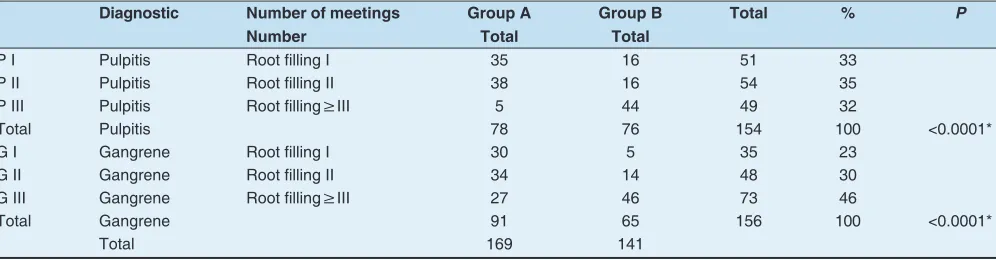
The research was conducted on a sample of 310 dental elements (named patients or cases) in a private practice during a period of 2 years. Patients were divided into two groups. In all cases, it was found contamination with microbial germs and the pulp chamber opened. The calibration of the personal examiner has been made according to protocols on ten precedent cases, which were not introduced in this study. Some patients have experienced acute stage - pulpitis or periodontitis, but most were in the chronic stage. The data obtained by analyzing the quality of root canals, the success rate after 6 and 12 months and the number of treatment sessions required to complete treatment were compared and the results analyzed statistically [Table 1 and Figure 1].
The instrumentation consists of manual endodontic instruments combined in all cases: Tire-nerfs, the primary channel Kerr S-file and Hedstroem type using the classic technique step back and step down depending on the diagnosis. Very rarely they were
used in rotary-type reamers files; Glenn-Glides; nickel-titanium rotary instruments – (RaCe). The difference between the tools and techniques did not alter the validity of this study. Sterile paper cones were used after the root canal cleaning before filling. As a filling material was used in all cases endomethasone paste (Septodont), covered with temporary cement (Provis). In all the cases, control X-rays were executed before and after the filling and controlled after 6 and 12 months. The only differences between the two groups were used in irrigation canals solutions, as follows: Group A received 0.2% CHX wash (GUM PAROEX - Sun Star Suisse SA, Chlorhexamed - Glaxo SmithKline) followed by hydrogen peroxide before clogging, Group II solution 3% NaOCl, followed by hydrogen peroxide. Part of Group A patients have benefited from additional intraductal application of CHX gel 1% (CHLORHEXAMED) for a period of 3-5 min. If multiple sessions were necessary, it has been used an antiseptic solution Rockles’s IV (Septodont) as intracanal antiseptic. Instrumentation and technique were similar to that applied in Group A for the Group B without using CHX.
Other irrigation solutions were not used in this study. There are no notable differences between the two
P I, 35
P II, 38
P III, 5 G I, 30
G II, 34 G III, 27
Total GROUP A
P I, 16
P II, 16
P III, 44
G I, 5 G II, 14 G III, 46
Total GROUP B
Figure 1: The distribution of the studied patients between the two groups
Table 1: The distribution between groups
Diagnostic Number of meetings Group A Group B Total % P
Number Total Total
P I Pulpitis Root fi lling I 35 16 51 33
P II Pulpitis Root fi lling II 38 16 54 35
P III Pulpitis Root fi lling≥III 5 44 49 32
Total Pulpitis 78 76 154 100 <0.0001*
G I Gangrene Root fi lling I 30 5 35 23
G II Gangrene Root fi lling II 34 14 48 30
G III Gangrene Root fi lling≥III 27 46 73 46
Total Gangrene 91 65 156 100 <0.0001*
groups in terms of biological features, health status, social status, diet, and lifestyle, etc., which significantly could influence the results of this study.
The results were collected in a Microsoft Office – Excel 2007 spreadsheet and statistically compared using the biostatistics data program SPSS from IBM version No. 22.0, using t-test in order to find the statistic relevance of the analyzed cases. According to scientific protocols, the statistic results were considered valid if P < 0.05. As variables were classified the case diagnosis at first presentation and number of sessions required endodontic treatment until the end of the same type of root canal in both groups compared aiming at a positive or negative result after treatment.
RESULTS
Using similar techniques of root canal maneuvers, different results were obtained using two irrigation canals solutions to a group of 310 treated dental elements
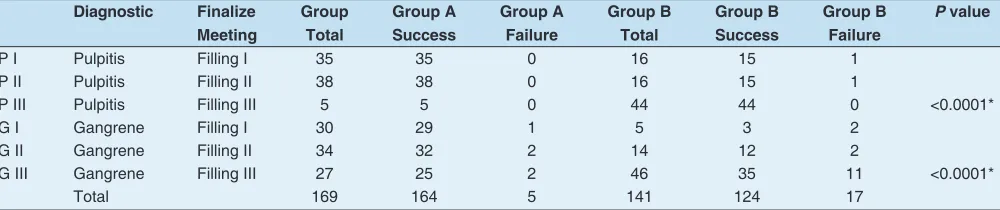
In the first group of patients, Group A, during the review period of 2 years, it was found a number of 14 treatment failures at the initial checking, after analyzing dental radiography control root canals, as presented in Table 2. From the total amount of 141 cases, the total number of failures was 17, from which 10 being fully restated, as no failure suspicion outcome after checking at agreed intervals. Only 7 cases were considered complete failures at the end of the study [Figure 2].
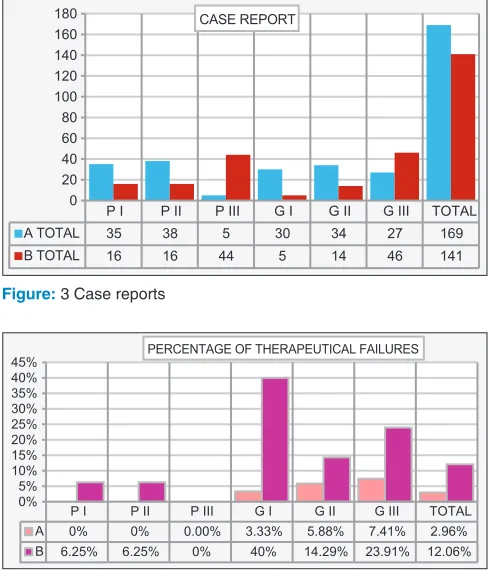
Should be noted that the period of treatment was significantly longer in Group B, requiring more than three sessions in 64% of cases, only 15% were completed in the first session. Group A had a significantly better completion rate; 40% of cases were completed in the first or second session, only 18% in more than three sessions. This resulted in shortening treatment cabinet business efficiency by shortening the number
of sessions and bringing great benefit to patient solved with a high rate of success in less time and with fewer presentations at the dental office [Figure 3].
Significantly better outcomes: A success rate of treatment of 3.5 times or higher – in case of using CHX and a shorter treatment time - 80% of cases being completed in the first or second treatment session. This brings great benefits for both patients and dentists.
Statistical results are relevant: In Group A, we obtained 100% success in the case of pulpitis and 97.18% success in the case of gangrene. Meanwhile the average success rate of Group B was 88%, as seen on Table 3.
Taking into account the dental elements recovered after treatment failure by apicectomy actually results a success rate of treatment for Group A of 98.92% - from 161 dental elements only two teeth were extracted, compared with Group B with a final percentage of 92.8%, of the total 141 teeth 11 should be withdrawn after less than 2 years of treatment.
Noteworthy is the very good percentage of success of treatment when irrigated with CHX. The treatment success percentage is 100% in case of pulpitis and in case of gangrene is more than 97%. Group B is included in the overall statistics of successful endodontic treatment with an average success rate of 88% of that after pulpectomy 94% and 75% after septic gangrene. Some of the dental treatments considered were however recovered after apicoectomy - 3 cases in Group A mean 1.7% and in Group B 6 cases = 4.25%. It notes, however, a failure rate of 3.5 times higher in Group B than in Group A as presented in Figure 4.
DISCUSSION
The comparative studies between CHX and NaOCl are not a usual topic in the research articles. The Endodontics textbooks give a relative small importance
Table 2: Success and failure of the analyzed groups of patients
Diagnostic Finalize Group Group A Group A Group B Group B Group B P value Meeting Total Success Failure Total Success Failure
P I Pulpitis Filling I 35 35 0 16 15 1
P II Pulpitis Filling II 38 38 0 16 15 1
P III Pulpitis Filling III 5 5 0 44 44 0 <0.0001*
G I Gangrene Filling I 30 29 1 5 3 2
G II Gangrene Filling II 34 32 2 14 12 2
G III Gangrene Filling III 27 25 2 46 35 11 <0.0001*
to CHX compared to NaOCl.[9,3] Recent studies in vitro have shown that CHX antiseptic effects are at least similar to NaOCl.[4,8]
In the present study, there were not considered previously treated cases of teeth or dental abnormalities channel as cases that would have changed the results of the study without the relevant importance of the cleaning agent. Groups were approximately equal in terms of statistical results. The root canal treatment was assessed radiographically and clinically in the same way. A big importance has been given to the tightness of root canals and how dry the root canal experienced before filling it.[14-16]
Pair irrigation canals solutions was made very rarely and only between CHX and EDTA or NaOCl and EDTA because it is known that the association of NaOCl with CHX dental precipitate within the channel, which may lead to failure and root canals tightness irreversible change tooth color.[10,17]
In literature, studies show a similar effect washing dental canal with NaOCl or CHX.[3,17] In microbiological analyses, cultures taken from endodontic canals, it seems that the two solutions have antimicrobial effects, similar to the superiority of CHX, the higher antimicrobial effect, reducing the level of contamination of the dental canal by 83%, compared to only 50% for NaOCL).[16]
Benefit to both the patient and the medical team the time savings and increased efficiency of the root canal after the first session was statistically analyzed in a recent study published in August 2013 in the Journal of Endodontics.[18,19] In this study, based on microbiological cultures taken from the dental canal, canal sterilization efficiency was high (85%) after the first session regardless of the canal irrigant used and after
P I P II P III G I G II G III
B TOTAL 16 16 44 5 14 46
B ESECURI 1 1 0 2 2 11
0 5 10 15 20 25 30 35 40 45 50 Group B
P I P II P III G I G II G III
A TOTAL 35 38 5 30 34 27
A ESECURI 0 0 0 1 2 2
0 5 10 15 20 25 30 35 40 Group A
Figure 2: Comparative column charts for the both groups
P I P II P III G I G II G III TOTAL A TOTAL 35 38 5 30 34 27 169 B TOTAL 16 16 44 5 14 46 141
0 20 40 60 80 100 120 140 160
180 CASE REPORT
Figure: 3 Case reports
P I P II P III G I G II G III TOTAL
A 0% 0% 0.00% 3.33% 5.88% 7.41% 2.96%
B 6.25% 6.25% 0% 40% 14.29% 23.91% 12.06%
0% 5% 10% 15% 20% 25% 30% 35% 40%
45% PERCENTAGE OF THERAPEUTICAL FAILURES
Figure 4: Percentage of therapeutically failures
Table 3: Treatment failure rate between studied groups
Failure Group A Group B Percent
between groups No Failure
rate (%)
No Failure rate (%)
Lost teeth 2 1.18 11 7.80 550.00
Resecated
teeth 3 1.70 6 4.25 200.00
the second reaching up to 99%. In the present study, it was found that CHX is more efficient and produces a sufficient sterilizing dental canal to be blocked after the first session where both the pulpitis and gangrene and in one-third of cases, while using NaOCl requires a minimum of three treatment sessions. Failure rates were five times higher in the group using NaOCl. These issues should be investigated using microbiological tools on an extended study.
CHX has been used in various concentrations (0.002-2%) with different periods of contact time between the disinfectant and various microorganisms.[20] As per these results, 2% CHX solution was far more efficient in the shortest period of time than were all other concentrations tested[21] and with a relative absence of toxicity,[22] CHX binds to the hydroxyapatite component of the dentine tissue,[23] and gradually releases bound CHX, which protects the canal against microbial colonization beyond the actual medication period.
CONCLUSIONS
This study demonstrates that the solution of CHX could be successfully used in treating microbial contaminated root canals with a success rate superior to conventional NaOCl solution, providing sufficient sterilization to dental canal in fewer treatment sessions.
The use of CHX solution in place of NaOCl as the irrigating root canal during endodontic treatment brings time benefits and significantly better results for both patient and dentist.
REFFERENCES
1. Dănilă I, Evghenikos A, Petersen PE, Sălăvăstru C. Oral health – Teachers behavior change – A major factor of progress. J Prev Med 2005;13:108-15.
2. Rhodes JS. Clinical retreatment and surgery. Advanced Endodontics. London: Taylor & Francis; 2006. p. 124-35.
3. Surender S. Pharmacology for Dentististry. New Delhi: New Age International; 2007. p. 304.
4. Mitchell DA, Mitchell L. Oxford Handbook of Clinical Dentistry. 4th ed. Oxford: Oxford Medical Publications; 2005. p. 8.
5. Stoll R. Endodontics in the new age and new trends. Zahnarzt
Praxis 2008;11:171-6.
6. Ingle JI, Bakland LK, Loma L. Endodontics. 5th ed. London:
University of Washington, BC Decker Inc.; 2002. p. 251-456. 7. Estrela C, Estrela CR, Decurcio DA, Hollanda AC, Silva JA.
Antimicrobial effi cacy of ozonated water, gaseous ozone, sodium hypochlorite and chlorhexidine in infected human root canals. Int Endod J 2007;40:85-93.
8. Sunde PT, Olsen I, Debelian GJ, Tronstad L. Microbiota of periapical lesions refractory to endodontic therapy. J Endod 2002;28:304-10.
9. Hauman CH, Love RM. Biocompatibility of dental materials used in contemporary endodontic therapy: A review. Part 1. Intracanal drugs and substances. Int Endod J 2003;36:75-85.
10. Mohammadi Z, Abbott PV. The properties and applications of chlorhexidine in endodontics. Int Endod J 2009;42:288-302. 11. Garg N, Garg A. Textbook of Endodontics. New Delhi, India:
Jaypee Publishers Inc.; 2000. p. 256-66. Available from: http:// www.jaypeeonline.in.
12. Castelucci I. Endodontics. Editia a II-a. Trieste, Italy: Il tridente; 2002. p. 127-8.
13. Dametto FR, Ferraz CC, Gomes BP, Zaia AA, Teixeira FB, de Souza-Filho FJ. In vitro assessment of the immediate and prolonged antimicrobial action of chlorhexidine gel as an endodontic irrigant against Enterococcus faecalis. Oral Surg Oral Med Oral Pathol Oral Radiol Endod 2005;99:768-72.
14. Carrotte P. Endodontics – a series overview. Br Dent J 2004;197:179.
15. Preben FR, Førsted-Bindslev, Reit C. Textbook of Endodontology. 2nd ed. Ontario: Blackwell Publishing; 2010. p. 235-351.
16. Sonis TS. Dental Secrets. Philadelphia: Hanley & Belfus, Inc.; 1999. p. 140.
17. Jeansonne MJ, White RR. A comparison of 2.0% chlorhexidine gluconate and 5.25% sodium hypochlorite as antimicrobial endodontic irrigants. J Endod 1994;20:276-8.
18. Roophasheree MS. Evaluation of the effect of chlorhexidine gluconate as an endodontic irrigant on the appical seal – An in vitro study. Endodontology 2005;17:24-31.
19. Xavier AC, Martinho FC, Chung A, Oliveira LD, Jorge AO, Valera MC, et al. One-visit versus two-visit root canal treatment: effectiveness in the removal of endotoxins and cultivable bacteria. J Endod 2013;39:959-64.
20. Estrela C, Ribeiro RG, Estrela CR, Pécora JD, Sousa-Neto MD. Antimicrobial effect of 2% sodium hypochlorite and 2% chlorhexidine tested by different methods. Braz Dent J 2003;14:58-62.
21. Schafer E, Bossmann K. Antimicrobial effects of chloroxylenol and chlorhexidine in the treatment of infected root canals. Dtsch Zahnarztl Z 2000;55:671-9.
22. Lee LW, Lan WH, Wang GY. A evaluation of chlorhexidine as an endosonic irrigan. J Formos Med Assoc 1990;89:491-7.
23. Harrison JW, Hand RE. The effect of dilution and organic matter on the anti-bacterial property of 5.25% sodium hypochlorite. J Endod 1981;7:128-32.
How to cite this article: Eugeniu MC, Radu C, Vlad P. Chlorhexidine as Endodontic Cleaning Solution Compared to Sodium Hypochlorite: An In Vivo
Study. Int J Dent Med Spec 2015;2(1):2-6.