http://www.ijcmph.com pISSN 2394-6032 | eISSN 2394-6040
Original Research Article
Doctor becomes a patient: a qualitative study of health care work place
violence related perception among junior doctors working
in a teaching hospital in India
Sudhir Chandra Joshi
1*, Rita Joshi
2INTRODUCTION
Work place violence (WPV) has been defined as ―violent acts, including physical assaults and threats of assault, directed toward persons at work or on duty‖.1
Health care work place violence (HCWPV) has emerged as a serious threat to the doctor-patient mutual relationship all over the world during the recent decades. Health care providers (HCPs) have long been facing and tackling the
problem of violent behavior of some mentally affected patients, yet aggression and violence against doctors and other HCPs by patients‘ relatives is a recent phenomenon. Annual incidence of WPV is four times more in healthcare and social assistance (8 serious cases per 10,000 full time employees) as compared to all other professions (2 per 10,000).1,2 Actual extent of the problem is estimated to be substantially bigger as HCWPV remains grossly neglected and under-reported.
ABSTRACT
Background: Health care work place violence (HCWPV) is four times higher compared to violence against other professions. The problem remains under-reported and under-researched. Qualitative perception studies among junior doctors have not been paid due attention hitherto.
Methods: Six individual face-to-face-indepth-interviews and six focus-group-discussions were conducted during December 2017 and January 2018 among 41 young doctors (interns, resident doctors i.e. post graduate students and young clinical faculty members). Thematic (content) analysis method was used for analysis of the data (texts). Results: Relevance, causes as well as consequences of HCWPV and measures for its prevention and control were brought up and discussed. Four themes emerged in thematic analysis. Almost all of the participants believed that it is an extremely important topic. Causation is multifactorial whereby all stakeholders are responsible. Consequences are affecting the whole society not merely the victims. Measures suggested were related to - in view of the causes - medical profession; patients and society; behavior and process; system and administration.
Conclusions: Increasing materialism and eclipse of humanitarian values, media-created-violence, negative image of medical profession, patient-physician-distrust, zero-protection for doctors, apathetic governments and deficiencies in the process of justice are among the main causes of HCWPV. Junior doctors were not much optimistic of any improvement in near future in their safety and security as this would require more probity and unity among doctors and a clientele, a Health Care Delivery System, the Governments and a Judiciary much different from what it is today. Keywords: Violence against doctors, Health care work place violence, Perception, Qualitative study, Junior doctors, India
1Department of
Community Medicine, 2Department of Microbiology, R.D. Gardi Medical College, Ujjain, Madhya Pradesh, India
Received: 05 March 2018 Accepted: 20 March 2018 *Correspondence: Dr. Sudhir Chandra Joshi, E-mail: [email protected]
Copyright: © the author(s), publisher and licensee Medip Academy. This is an open-access article distributed under the terms of the Creative Commons Attribution Non-Commercial License, which permits unrestricted non-commercial use, distribution, and reproduction in any medium, provided the original work is properly cited.
Approximately 70 to 80% of incidences are never reported.2
Lethal attacks and rape give rise to immediate attention and sensational publicity. These are only a fraction of much more common milder types of HCWPV which comprise of verbal abuse, bullying, intimidation, mental harassment, sexual harassment, and such physical assaults which involve manhandling and beating.1-6 An analysis of data for more than 1,50,000 nurses drawn from 160 global samples has revealed that two third have experienced nonphysical assault while a third were physically assaulted.2 Physical violence was reported to be more common in the ―Anglo‖ and ―Anglicized‖ regions i.e. in UK, Ireland, Australia, New Zealand, US and Canada; whereas bullying has been highest in the Middle East.2 Earliest studies and economic boom took place in these regions and socio-economic, socio-cultural causes of violence also played their role.7-9
Recently several studies have been performed globally. In Asia, quite a few studies have taken place in the countries of the Indian subcontinent too.10-15 Considerably greater number of recent research studies on HCWPV belongs to China.16-30 Inother parts of the world also, several studies have been conducted.31-37 By means of their all India surveys, Indian Medical Association (IMA) have reported that 75% doctors had experienced violence and 82.7% felt stressed out.3,5,10 Nonetheless, there exits a dearth of qualitative studies on this problem. Thus a very important aspect, perception of the HCPs particularly that of the young doctors regarding HCWPV remains grossly under-researched.
Present study is part of a research project aiming at exploration of perception of doctors regarding various changes and challenges in their profession. HCWPV is one among several changes and challenges being explored. Present paper is focused on the perception about HCWPV among Junior Doctors of a teaching hospital located in the center of central India. Narratives of situations and suggestions emerging from this exploration are significant in developing strategies for prevention and control of HCWPV. These are relevant for a wide variety of health care institutions as well as for the government, the judiciary and the society in general.
METHODS
For this exploration, face to face in-depth interviews (FFIDIs) and focus group discussions (FGDs) were performed, during December 2017 and January 2018, in R.D. Gardi Medical College Ujjain and its Rural Health Training and Demonstration Centre (RHTC).
The sampling frame comprised of all junior doctors and young (under 40 years) teachers belonging to clinical branches. Out of this multilevel sampling frame, the study participants (key informants) were selected by purposive sampling method. The participants or
interviewees were recruited from three strata comprising of the interns, the post graduate students and the young faculty members. From each group one male and one female participant was selected for the in depth interviews. (FFIDI No. 1 to 6). Additionally six FGDs (FGD No 1 to 6) were also conducted. Four FGDs (No. 1 to 4) were carried out among the interns (one among the boys exclusively, one among the girls exclusively and two FGDs were performed among a mixed group of boys and girls). After these, one FGD was carried out in each of the remaining strata (FGD No. 5 and 6).
In all 41 participants were interviewed which included 28 interns, 7 resident doctors (post graduate students) and 6 young clinical faculty members. Average age of the 6 participants of the FFIDIs was 23 (interns) 37 (resident doctors) and 38 years (young clinical faculty); age range being 23-40 years. Average age of the 35 participants of FGDs was 24.5 (interns) 30 (resident doctors) and 37.5 years (young clinical faculty); age range being 23-27, 26-36 and 34-40 years respectively. Among the 3 male and 3 female FFIDI participants, 4 were from urban and 2 from rural background. Among the 35 FGD participants, there were 23 males and 12 females while 27 had an urban background. FGD wise female male ratio was 3:2 and 2:7 in the two mixed-participant-FGDs among interns, 2:3 in the resident doctors‘ FGD and 0:4 in the young clinical faculty members‘ FGD. In two more FGDs conducted among the interns, 5 females and 7 males participated separately.
All the interviews were audio recorded and the MP3 sound files were transcribed verbatim. For data analysis, thematic (content) analysis method was used.38 In this process, entire text was first divided into ‗meaning units‘ out of which ‗condensed meaning units‘ (CMUs) were developed. As the CMUs were classified, the codes emerged which were independently identified manually by both the authors. The codes were then grouped and classified and thus categories were identified, some of which contained subcategories too. As the categories converged, the subthemes and subsequently the themes emerged.39,40
RESULTS
Four themes emerged in the process of thematic (content) analysis
Theme 1: Healthcare workplace violence (HCWPV) as a prominent change and challenge
Theme 2: As a consequence of HCWPV doctor becomes patient and the whole society is at a loss.
Theme 3: Multifactorial causation of HCWPV.
Theme 4: Expectations of DOs and DON‘Ts from various
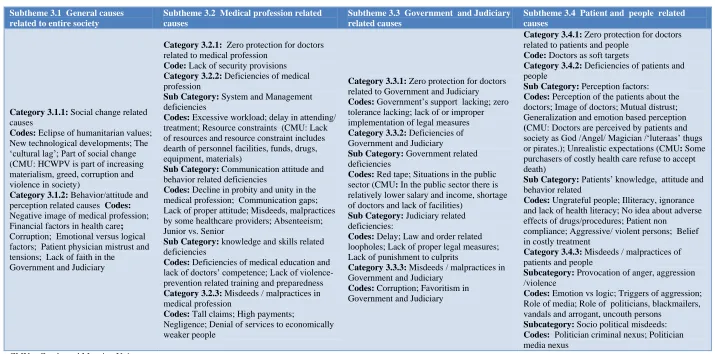
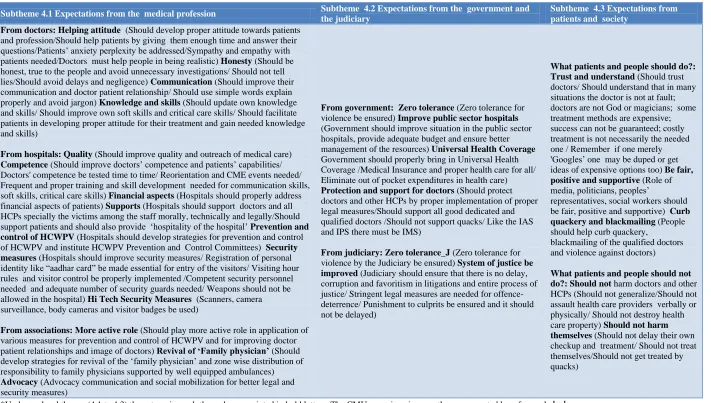
All the themes and their subthemes are shown in Table 1. For further details, as examples, theme 3 has been presented in the form of Table 2 which is exhibiting analysis strata down up to the level of codes whereas theme 4 is given in still greater detail further down up to the level of Condensed Meaning Units (CMUs).
Theme 1: HCWPV as a prominent change and challenge
This theme has emerged from two subthemes 1.1 ‗Initial general comments‘ and 1.2 ‗Perception of HCWPV as a prominent change and challenge‘ (Table 1). Almost all the study participants (interviewees) were of the opinion that HCWPV is a prominent change and challenge in medical profession and this topic is extremely important. They emphasized that violence is not the way; it is cruelty with doctors and other HCPs; a heinous crime for which there should be zero tolerance universally.
“Definitely this topic is very much important it is extremely important in fact it is important regarding better management of our health care system our hospitals and for ensuring a feeling of satisfactory outcome and well-being among the patients. In short, this issue is very much relevant for improvising and making our hospitals good respectable workplaces.” Resident Doctor Female.
Theme 2: As a consequence of aggression and violence, doctor becomes patient and the whole society is at a loss
This theme contains the consequences of HCWPV consist of broad groups forming two subthemes 2.1 ‗Physical and psychological effects on the doctors and other HCPs‘ and 2.2 ‗Social consequences of the ill effects on the health care system‘ (Table 1). Several psychological effects were enumerated during the interviews. These included stress, sleep disturbances, demoralization, fear, anxiety, depression, change in attitude toward patients and profession and post traumatic problems. Among the physical effects, trauma and its physical and mental consequences were brought up. Consequences for patients and society were also discussed. These were described as an effect on the society of change in perception and attitude of doctors consequent to HCWPV. Doctors avoid taking any risk, more frequently refer the patients, refrain from working alone in rural and slum areas and do not advice and encourage their children to join medical profession.
“Healthcare workplace violence badly affects the health of the doctors and their interest in the profession besides having adverse consequences on the expected outcome for the patients. As it badly affects attitude and decision of doctors regarding patients, they [the patients] cannot be treated properly. Doctors are often inclined to refer the patients to higher centers.” Resident Doctor Male.
“Doctor becomes a patient.” Intern Female.
“From government and judiciary not much hope, even the bodies like IMA [Indian Medical Association] are not taking any solid action. Most of the doctors in a recent TV interview said that they don‟t want their children to join medical profession. Society will have to pay the price as good and intelligent people will stop entering the medical profession.” Young Clinical Faculty Male.
Theme 3: Multifactorial causation of HCWPV
In all the interviews, the participants were of the opinion that violence under exploration is multifactorial in origin and all the stakeholders are responsible. Study participants frequently said that emotional factors overpower logical ones. Several deficiencies, misdeeds and malpractices on the part of various stakeholders, including the medical profession, were brought up as causative factors. Out of the categories about causation of HCWPV, four subthemes have emerged. These are 3.1 ‗General causes related to entire society‘ 3.2 ‗Medical Profession related causes‘ 3.3 ‗Government and Judiciary related causes‘ and 3.4 ‗Patient and People related causes‘ (Table 2).
Various aspects of provocation of anger, aggression/violence were also discussed threadbare. In this context, certain objectionable practices and negative roles were specially narrated. Important among them were the ‗commercialized-health-care‘ related financial factors and negative roles of media, politicians, blackmailers, vandals, ungrateful and arrogant persons etc. Pointing to the other side of the coin, one participant also added that media gives us feedback but we are slow in improvising and improving. In the narratives, the issue of patient-doctor distrust and mutual tension was predominantly raised up. Socio-cultural, socio-economic and socio-political factors were discussed in great details.
“A person was arrested as he was involved in more than 150 cases of inflicting violence against doctors for about two years. He had good backing from the ruling party. He used to take a significant amount from the total hospital bill which he would get reduced by arm-twisting, blackmailing using threats or resorting to actual violence.” Young Clinical Faculty Male.
Theme 4: Expectations of DOs and DON‟Ts from various stakeholders for prevention/control of HCWPV
Table 1: Themes and subthemes.
Themes
Theme 1: Healthcare workplace violence (HCWPV) as a prominent change and challenge
Theme 2: As a consequence of aggression and violence doctor becomes a patient and the whole society is at a loss
Theme 3: Multifactorial causation of HCWPV
Theme 4: Expectations of DOs and DON’Ts from various stakeholders for prevention/control of HCWPV
Subthemes
1.1 1.2 2.1 2.2 3.1 3.2 3.3 3.4 4.1 4.2 4.3
Initial general comments
Perception of HCWPV as a prominent change and challenge
Physical and psychological effects on the doctors and other HCPs
Social
consequences of the ill effects on the health care system
General causes related to entire society
Medical profession related causes
Government and judiciary related causes
Patient and people related causes
From the Medical Profession
From the Government and the Judiciary
Table 2: Theme 3: Multifactorial causation of HCWPV.
Subtheme 3.1 General causes related to entire society
Subtheme 3.2 Medical profession related causes
Subtheme 3.3 Government and Judiciary related causes
Subtheme 3.4 Patient and people related causes
Category 3.1.1: Social change related causes
Codes: Eclipse of humanitarian values; New technological developments; The ‗cultural lag‘; Part of social change (CMU: HCWPV is part of increasing materialism, greed, corruption and violence in society)
Category 3.1.2: Behavior/attitude and perception related causes Codes:
Negative image of medical profession; Financial factors in health care;
Corruption; Emotional versus logical factors; Patient physician mistrust and tensions; Lack of faith in the
Government and Judiciary
Category 3.2.1: Zero protection for doctors related to medical profession
Code: Lack of security provisions
Category 3.2.2: Deficiencies of medical profession
Sub Category: System and Management deficiencies
Codes: Excessive workload; delay in attending/ treatment; Resource constraints (CMU: Lack of resources and resource constraint includes dearth of personnel facilities, funds, drugs, equipment, materials)
Sub Category: Communication attitude and behavior related deficiencies
Codes: Decline in probity and unity in the medical profession; Communication gaps; Lack of proper attitude; Misdeeds, malpractices by some healthcare providers; Absenteeism; Junior vs. Senior
Sub Category: knowledge and skills related deficiencies
Codes: Deficiencies of medical education and lack of doctors‘ competence; Lack of violence-prevention related training and preparedness
Category 3.2.3: Misdeeds / malpractices in medical profession
Codes: Tall claims; High payments;
Negligence; Denial of services to economically weaker people
Category 3.3.1: Zero protection for doctors related to Government and Judiciary
Codes: Government‘s support lacking;zero tolerance lacking; lack of or improper implementation of legal measures
Category 3.3.2: Deficiencies of Government and Judiciary
Sub Category: Government related deficiencies
Codes: Red tape;Situations in the public sector (CMU: In the public sector there is relatively lower salary and income, shortage of doctors and lack of facilities)
Sub Category: Judiciary related deficiencies:
Codes: Delay;Law and order related loopholes; Lack of proper legal measures; Lack of punishment to culprits
Category 3.3.3: Misdeeds / malpractices in Government and Judiciary
Codes: Corruption; Favoritism in Government and Judiciary
Category 3.4.1: Zero protection for doctors related to patients and people
Code: Doctors as soft targets
Category 3.4.2: Deficiencies of patients and people
Sub Category: Perception factors: Codes: Perception of the patients about the doctors; Image of doctors; Mutual distrust; Generalization and emotion based perception
(CMU: Doctors are perceived by patients and society as God /Angel/ Magician /‗luteraas‘ thugs or pirates.); Unrealistic expectations (CMU: Some purchasers of costly health care refuse to accept death)
Sub Category: Patients‘ knowledge, attitude and behavior related
Codes: Ungrateful people; Illiteracy, ignorance and lack of health literacy; No idea about adverse effects of drugs/procedures; Patient non
compliance; Aggressive/ violent persons; Belief in costly treatment
Category 3.4.3: Misdeeds / malpractices of patients and people
Subcategory: Provocation of anger, aggression /violence
Codes: Emotion vs logic; Triggers of aggression; Role of media; Role of politicians, blackmailers, vandals and arrogant, uncouth persons
Subcategory: Socio political misdeeds:
Codes: Politician criminal nexus; Politician media nexus
Table 3: Theme 4 at a glance* Expectations of do’s and don’ts from various stakeholders for prevention/control of health care work place violence.
Subtheme 4.1 Expectations from the medical profession Subtheme 4.2 Expectations from the government and
the judiciary
Subtheme 4.3 Expectations from patients and society
From doctors: Helping attitude (Should develop proper attitude towards patients and profession/Should help patients by giving them enough time and answer their questions/Patients‘ anxiety perplexity be addressed/Sympathy and empathy with patients needed/Doctors must help people in being realistic) Honesty (Should be honest, true to the people and avoid unnecessary investigations/ Should not tell lies/Should avoid delays and negligence) Communication (Should improve their communication and doctor patient relationship/ Should use simple words explain properly and avoid jargon) Knowledge and skills (Should update own knowledge and skills/ Should improve own soft skills and critical care skills/ Should facilitate patients in developing proper attitude for their treatment and gain needed knowledge and skills)
From hospitals: Quality (Should improve quality and outreach of medical care)
Competence (Should improve doctors‘ competence and patients‘ capabilities/ Doctors' competence be tested time to time/ Reorientation and CME events needed/ Frequent and proper training and skill development needed for communication skills, soft skills, critical care skills) Financial aspects (Hospitals should properly address financial aspects of patients) Supports (Hospitals should support doctors and all HCPs specially the victims among the staff morally, technically and legally/Should support patients and should also provide ‗hospitality of the hospital‘ Prevention and control of HCWPV (Hospitals should develop strategies for prevention and control of HCWPV and institute HCWPV Prevention and Control Committees) Security measures (Hospitals should improve security measures/ Registration of personal identity like ―aadhar card‖ be made essential for entry of the visitors/ Visiting hour rules and visitor control be properly implemented /Competent security personnel needed and adequate number of security guards needed/ Weapons should not be allowed in the hospital) Hi Tech Security Measures (Scanners, camera surveillance, body cameras and visitor badges be used)
From associations: More active role (Should play more active role in application of various measures for prevention and control of HCWPV and for improving doctor patient relationships and image of doctors) Revival of ‘Family physician’ (Should develop strategies for revival of the ‗family physician‘ and zone wise distribution of responsibility to family physicians supported by well equipped ambulances)
Advocacy (Advocacy communication and social mobilization for better legal and security measures)
From government: Zero tolerance (Zero tolerance for violence be ensured) Improve public sector hospitals
(Government should improve situation in the public sector hospitals, provide adequate budget and ensure better management of the resources) Universal Health Coverage
Government should properly bring in Universal Health Coverage /Medical Insurance and proper health care for all/ Eliminate out of pocket expenditures in health care)
Protection and support for doctors (Should protect doctors and other HCPs by proper implementation of proper legal measures/Should support all good dedicated and qualified doctors /Should not support quacks/ Like the IAS and IPS there must be IMS)
From judiciary: Zero tolerance_J (Zero tolerance for violence by the Judiciary be ensured) System of justice be improved (Judiciary should ensure that there is no delay, corruption and favoritism in litigations and entire process of justice/ Stringent legal measures are needed for offence-deterrence/ Punishment to culprits be ensured and it should not be delayed)
What patients and people should do?: Trust and understand (Should trust doctors/ Should understand that in many situations the doctor is not at fault; doctors are not God or magicians; some treatment methods are expensive; success can not be guaranteed; costly treatment is not necessarily the needed one / Remember if one merely 'Googles‘ one may be duped or get ideas of expensive options too) Be fair, positive and supportive (Role of media, politicians, peoples‘
representatives, social workers should be fair, positive and supportive) Curb quackery and blackmailing (People should help curb quackery,
blackmailing of the qualified doctors and violence against doctors)
What patients and people should not do?:Should not harm doctors and other HCPs (Should not generalize/Should not assault health care providers verbally or physically/ Should not destroy health care property) Should not harm themselves (Should not delay their own checkup and treatment/ Should not treat themselves/Should not get treated by quacks)
“For prevention and control [of healthcare workplace violence] we can upload videos aimed at increasing awareness of the politicians, media and public.”Intern Male.
It was also suggested that hospital violence prevention and control committees should be instituted and empowered by law as an entry point for the process of justice and as a measure for offense-deterrence.
“These committees will help improve. These committees should be multidisciplinary and empowered. There must be three tier system. Hospital Violence Prevention and Control Committees should be the primary level, the courts should be the secondary level and at the last point media the politicians the public should form the tertiary level only to be allowed to come in at last. Today it is just the opposite and we do not have the primary level at all.”
Intern Female.
DISCUSSION
In spite of the fact that HCWPV is an extremely important concern in medical profession, much remains to be done for its proper reporting, documentation and prevention/control.2 Research on the problem has been scanty. Several cross sectional surveys have been conducted in various parts of the world, but surprisingly, qualitative (perception) studies have scarcely been performed.32,33,41-43 The perception of young doctors has remained almost unexplored hitherto. To our knowledge this is the first qualitative study in India which has explored the perception of young (junior) doctors regarding health care work place violence.
In the present study we have found that the participants in the study: (1) were aware and concerned about violence against doctors and other HCPs and some of them though quite young had seen/experienced it, (2) almost all participants thought that HCWPV is an extremely important topic for them, (3) there was a consensus regarding the consequences, causes and most of the remedial measures ; yet the study participants were sharply divided in their views about the soft (non violent) versus harsh and hard (avoidable, too stringent and even violent) measures. (4) Many a male participant felt more insecure, unsupported and unprotected with lesser faith in the socio-political system and values of non-violence. (5) Quite a few among them - both male and female - were pessimistic about any initiatives or supports from the hospital administrations, government, judiciary, politicians, media etc. These findings are alarming.
Consequences
Several consequences of HCWPV were described and discussed by the participants (Theme 2). The younger were perceived to be more vulnerable to violence and its consequences. In a study conducted in Pakistan junior
trainee physicians were found to be more likely to report impairment in job performance compared to their senior colleagues.15 A good number of previous publications have mentioned the consequences of HCWPV which is coming up as a new occupational health hazard and has significant long-lasting effect on HCPs.1,3,11,13,22-26 Some of these are lower morale, anger, loss of confidence, burnout, time off work, disability and change in job status etc.44 Each incident affects a number of staff members.44 Participants in our study were of the view that doctors and other HCPs have to suffer as victims while the society as whole has to pay the cost of HCWPV. According to them, change in the attitude of doctors toward medical profession and patients gets transmitted horizontally and vertically. Previous studies have also documented that exposure to violence damages the health of the victim in the long run via psychological stress. This stress leads to sleep disturbances which affect health adversely and ultimately damages the health of the health care provider.23 Amidst strained doctor-patient relationships, doctors have to put in more ―emotional labor‖.This leads to resource depletion which is closely related to stress, burnout and depression.23 HCWPV has been reported to result in emotional exhaustion (EE) and significantly affects job satisfaction (JS) and intention to leave (IL).25
Fear is one of the several psychological effects; another being anxiety.22,24,26 There is a circular relationship between psychological stress and HCWPV; violence causes anxiety and stress; anxious and stressed HCPs are prone to exposure to violence.22-24 Fear, anxiety and agony undoubtedly have profound physical mental and social consequencesas these can impair victims‘ quality of life, influence their job performance, affect patient safety, and lead to changes in immune system functioning. Other serious consequences for HCPs are increased occupational strain, need for medical treatment, lost workdays and absenteeism, employment termination or turnover, disability and even death.22
become major challenges for the Chinese healthcare system.20 Similar problem is being encountered in the health care sector of India too.11,45
Causes
A plethora of causes of HCWPV came up in our study. These can be divided in two broad groups. First group includes causes pertaining to the entire society. It comprises of social change, behavior and ethos related mostly sociocultural causes, the technological progress and the gap between this progress and culture (Table 2; Subtheme 3.1). Second group contains several causes related to deficiencies, misdeeds and malpractices of various stakeholders namely the medical profession, the government, the judiciary, the patients and the people in general (Subthemes 3.2 to 3.4). Increase in violence in society and eclipse of humanitarian values were mentioned in our study as important causative factors. Study participants believed that we are living in a time of increase in greed, corruption and violence in a society influenced by materialism. In the course of economic ‗progress‘ of modern capitalistic societies, as growth takes place and materialism advances, dominance of material over other human values and the asymmetry between these value systems predisposes the society to violence.9
The causative factors are thus external and internal to the medical profession. Among the external factors negative roles of various components of society particularly the influence of materialism on the media and media created violence were brought up in our study. A meta-analysis by Paik and Comstock has revealed that consistently viewing media violence is associated with higher levels of antisocial behavior.46 Whether electronic or print media on account of their competition they contribute to increase in the violence in the society and they also create negative image of the medical profession. It has been widely documented that media reports have further aggravated the conflict between doctors and patients.18,22,23,47 Continuous negative reporting will eventually go against the healthcare of the patients whose interest the media claims to safeguard.48 Already healthcare professionals are reluctant to handle serious cases with the result that many precious lives which they could have saved are being lost.48 Media needs to curtail greed and recruit well educated personnel who owe a responsibility to society.46 Films should also be similarly socially responsible. At the same time, as the participants in our study have suggested that improvements should promptly take place in the medical profession, based on both introspection and media feedback. In a recent publication ―self-administered self reflection‖ has been recommended as a ―self-prescription which the medical profession needs‖.49
Misuse of liberty and democracy and newly developed ‗criminal vocation‘ of blackmailing doctors and hospitals by some antisocial elements also emerged as an important
causative factor. Politician-criminal-nexus and politician-media-nexus were also brought up. Earlier publications (viewpoints) have also raised this issue.10,47 Individuals or gangs thriving on arm-twisting for reducing the health care costs and obtaining commission from the patients are known as ―Yi Nao‖ in China (literally meaning
hospital-disturbance).20,22,26,28 A 2006 survey of 270 tertiary hospitals reported that over 73% of the participating hospitals had experienced Yi Nao gangs which consist largely of unemployed people with a designated leader. These incidences had nearly doubled from 9831 in 2006 to 17,243 in 2010.20Yi Nao- gangs threaten and assault hospital personnel, damage facilities and equipment, and prevent the normal activities of the hospital. Patients and their relatives may use illegal organizations in order to arm-twist the hospitals for compensation, rather than use the normal legal procedures.26,28
Zero protection for doctors and lack of security provisions was yet another important concern. A descriptive cross sectional study on security related perceptions of HCPs in a district hospital of South Africa has highlighted the following causes of HCWPV: inadequate security staff, poorly equipped security personnel, deficient screening of visitors and lack of confidence in the capacity and ability of security staff to ensure a safe environment.31
Participants in our study believed that recent decline in probity and unity in medical profession and increase in patient physician distrust and mutual tensions are also important factors in the causation of HCWPV. According to them, several deficiencies, misdeeds and malpractices on the part of both patients and service providers work together and escalate doctor-patient-distrust; for example tall claims, high payments, high expectations, negligence, denial of services to non paying people, refusal to accept death by the buyer of costly health care. Mutual trust between patients and health care providers has earlier been described as an implicit fundamental building block of clinical medicine and is believed to be a means of bridging the vulnerability, uncertainty, and unpredictability of healthcare.41,49
the senior participants told that doctors are being perceived by patients and society as „luteraas‟ (thugs, pirates). Recently several editorials/ viewpoints published in the medical journals on this issue have also highlighted misdeeds malpractices and corruption in medical profession.4,11,12,47-55 Ironically the statutory bodies meant to control corruption and unethical practices in medical profession have themselves become dens of corruption.10,47,50
Following causative factors of HCWPV were identified by a previous study performed in China: defects in healthcare system (deficiencies regarding important factors like communication skills, service attitude, and management of hospitals, medical procedures and the layout of departments) and defects in systems related to justice, law and order and supervision of public opinion.27 In a nationwide cross-sectional study conducted in Pakistan covering nine major tertiary care hospitals major causes identified were overcrowding and lack of education (among patients and security staff).15 In our study theses causes were expressed as excessive workload, illiteracy and lack of health literacy among patients and people in general. In a flowchart based study conducted in China, two most important causes were found to be poor quality of medical services and legal consciousness with increased awareness about their own rights among the patients. Most of the causes mentioned in their study were system related and mainly financial factors (commercialization of health services, high medical fees, profit driven services, catastrophic out of pocket expenditure, poor government investment). Inadequate legal systems, negative media reports and absence of humanities were also enumerated in their study. Some of the causes were doctor and other HCP related (lack of clinical skills, lack of supervision of hospitals, lack of communication with patients, bad attitude of service providers) and one patient related causative factor was also identified: lack of trust in doctors and hospitals.16 According to a viewpoint published from India some of the main causes of HCWPV have been role of media, financial factors, poor image of doctors, poor quality of health care, poor communication, lack of faith in the judicial system and mob mentality.5 A mixed method study from China has reported three main causes: financial burdens, treatment outcomes and miscommunication.26 Similar triggers of violence have been found by most of the studies performed.48 Our findings regarding causation (Table 2) are also consistent with these.
Remedial measures
In our study several remedial measures also came up which constitute the fourth theme (Table 3). It is evident that the measures which have been suggested were mostly DOs and DON‘Ts expected from the various stakeholders. Hi tech security measures such as body camera surveillance, CCTV surveillance, ‗Aadhaar Card‘ based surveillance and visitor badges were brought up
and discussed among several other measures. However, most of the participants did not have much enthusiasm about these. Many participants were skeptic of arrival in their lifetime of new technology based measures in the small and middle level hospitals existing for general public in India. It was argued by them that this type of protection requires political will, proper implementation of law, fairness in the process of justice and above all too much capital investment. Frequently there arose a question as to who would be doing it for the poor health care providers who provide their services for the poor and happened to be the most vulnerable. It has been documented earlier too that healthcare providers received little support from the organisations in which they worked.17 Relatively more enthusiasm was found among the more junior participants in responding to the question ‗how would you like to contribute?‘ In this context, they emphasized on developing and applying their communication skills and critical care skills.
It has been suggested by the previous studies that strategies should be developed for prevention and control and collaboration from various sectors is needed.21,34 When appropriate strategies are applied properly these are effective for example the change brought about in Norway in the domain of psychiatry during 1993-2014.36 More attention than at present should be directed toward reducing anxiety caused by HCWPV among the HCPs.22 Medical education and Continuing Medical Education (CME) should include this topic giving appropriate emphasis.34 In the rare previous qualitative studies conducted abroad, training, capacity building and urgent actionhave been emphasized.33,43 Critical challenges for the health care system will persist or become worse if no effective measures are implemented to prevent hospital violence.43 A retrospective cross sectional survey study conducted in China which has suggested three types of remedial measures - individual, organizational and social has concluded that training combined with legal and security measures plays an important role.17 In another study, three levels of interventions suggested were labelled as measures before during and after violence.22 In the studies previously conducted in India, legal measures, security beef up and increasing the number of doctors and other staff have been recommended.13,14 In addition to these, a good number of editorials and viewpoints published earlier have also suggested and discussed various remedial measures.10-12,45,47-57
CONCLUSION
deficiencies in the process of justice were among the main causes brought up. Remedial measures suggested were largely expectations from various stakeholders of Dos and Don‘ts and included various measures such as uploading videos for public education; forming and empowering hospital violence prevention and control committees; improving doctor patient mutual relations improving security and using Hi Tech security measures. The participant young doctors were not much optimistic of any improvement in near future in their safety and security as this would require more probity and unity among doctors which is being fast eroded under materialistic influences and a clientele, a Health Care Delivery System, a government-machinery and a judicial system much different from what it is today. This pessimism and reluctance toward soft skills is alarming. The profession, the society and the nation need to wake up timely in order to avoid the grave consequences of this kind of perception.
ACKNOWLEDGEMENTS
We would like to thank Medical Director RDGMC Ujjain, all the participants and the staff working at the Health Communication Centre CRG Hospital and RHTC, RDGMC Ujjain.
Funding: No funding sources Conflict of interest: None declared
Ethical approval: The study was approved by the Institutional Ethics Committee
REFERENCES
1. Occupational Safety and Health Administration (OSHA) US Dept of Labour. Fact sheet: workplace violence in healthcare, 2015. Available at: https://www.osha.gov/dsg/hospitals/workplace violence.html. Accessed on 4 December 2017. 2. Nelson R. Tackling violence against health-care
workers. Lancet. 2014;383(9926):1373-4.
3. Indian Medical Association Press Release. Majority of doctors fear violence and are stressed out reveals IMA study. 2017. Available at: http://emedinews.in/ ima/Press_Release/2017/July/1.pdf. Accessed on 4 December 2017.
4. Gates D. The epidemic of violence against healthcare workers. Occupational and Environmental Medicine. 2004;61(8):649-50. 5. Nagpal N. Incidents of violence against doctors in
India: Can these be prevented? Natl Med J India. 2017; 30:97-100.Nagpal N. Incidents of violence against doctors in India: Can these be prevented? Natl Med J India. 2017;30:97-100.
6. Ahmed F, Khizar Memon M, Memon S. Violence against doctors, a serious concern for healthcare organizations to ponder about. Annals of Medicine and Surgery. 2018;25:3-5.
7. Hobbs FD, Keane UM. Aggression against doctors: a review. Journal of the Royal Society of Medicine. 1996;89(2):69-72.
8. Hobbs FD. Violence in general practice: a survey of general practitioners‘ views. Br Med J.1991;302(6772):329-32.
9. Jones A. The violence of materialism in advanced industrial society: an eco-sociological approach. The Sociological Rev. 1987;35:19–47.
10. Ambesh P. Violence against doctors in the Indian subcontinent: A rising bane. Indian Heart J. 2016;68(5):749-50.
11. Kapoor MC. Violence against the medical profession. J Anaesthesiol, Clin Pharmacol. 2017;33(2):145-7.
12. Syed MMA. Violence against healthcare professionals: are we looking for the peaceful truce? Int J Stud Res. 2016;6(1):1-2.
13. Anand T, Grover S, Kumar R, Kumar M, Ingle GK. Workplace violence against resident doctors in a tertiary care hospital in Delhi. Natl Med J India. 2016;29(6):344-8.
14. Kumar M, Verma M, Das T, Pardeshi G, Kishore J, Padmanandan A. A Study of Workplace Violence Experienced by Doctors and Associated Risk Factors in a Tertiary Care Hospital of South Delhi, India. J Clin Diagnos Res. 2016;10(11):6-0
15. Mirza NM, Amjad AI, Bhatti AB, tuz Zahra Mirza F, Shaikh KS, et al. Violence and abuse faced by junior physicians in the emergency department from patients and their caretakers: A nationwide study from Pakistan. J Emerg Med. 2012;42:727–33. 16. Yu H, Hu Z, Zhang X, Li B, Zhou S. How to
overcome violence against Healthcare professionals, reduce medical disputes and ensure patient safety. Pakistan J Med Sci. 2015;31(1):4-8.
17. Zhao S, Liu H, Ma H, Jiao M, Li Y, Hao Y, et al.Coping with Workplace Violence in Healthcare Settings: Social Support and Strategies. Watterson A, ed. Int J Environ Res Public Health. 2015;12(11):14429-44.
18. Chinese doctors are under threat. Lancet. 2010;376(9742):657.
19. Violence against doctors: Why China? Why now? What next? Lancet. 2014;383(9922):1013.
20. Wu D, Wang Y, Lam KF, Hesketh T. Health system reforms, violence against doctors and job satisfaction in the medical profession: a cross-sectional survey in Zhejiang Province, Eastern China. BMJ Open. 2014;4:e006431.
21. Z Chen, C Peek-Asa, G Yang. Prevalence of and risk factors associated with workplace violence: a cross-sectional study in 7026 health staff in South China. Inj Prev. 2010;16:4.
23. Sun T, Gao L, Li F, Shi Y, Xie F, Wang J, et al. Workplace violence, psychological stress, sleep quality and subjective health in Chinese doctors: a large cross sectional study. BMJ Open. 2017;7:e017182.
24. Sun P, Zhang X, Sun Y, Ma H, Jiao M, Xing K, et al. Workplace Violence against Health Care Workers in North Chinese Hospitals: A Cross-Sectional Survey. Mawson AR, ed. Int J Environ Res Public Health. 2017;14(1):96.
25. Shi J, Wang S, Zhou P, Shi L, Zhang Y, Bai F, et al. The Frequency of Patient-Initiated Violence and Its Psychological Impact on Physicians in China: A Cross-Sectional Study. PLoS ONE. 2015;10(6):e0128394.
26. Jiao M, Ning N, Li Y, Gao L, Cui Y, Sun H, et al. Workplace violence against nurses in Chinese hospitals: a cross-sectional survey. BMJ Open 2015;5:e006719.
27. Zhou C, Mou H, Xu W, Li Z, Liu X, Shi L, et al. Study on factors inducing workplace violence in Chinese hospitals based on the broken window theory: a cross sectional study. BMJ Open. 2017;7:e016290.
28. Shi L, Zhang D, Zhou C, Yang L, Sun T, Hao T, et al. A cross–sectional study on the prevalence and associated risk factors for workplace violence against Chinese nurses. BMJ Open. 2017;7:e013105.
29. Cheung T, Lee PH, Yip PSF. Workplace Violence toward Physicians and Nurses: Prevalence and Correlates in Macau. International J Environmental Res Public Health. 2017;14(8):879.
30. Li Z, Yan C-m, Shi L, Mu H-t, Li X, Li A-q, et al. Workplace violence against medical staff of Chinese children's hospitals: A cross- sectional study. PLoS ONE. 2017;12(6):e0179373.
31. Okeke SO, Mabuza LH. Perceptions of health care professionals on the safety and security at Odi District Hospital, Gauteng, South Africa. African J Primary Health Care Family Med. 2017;9(1):1441. 32. Sisawo EJ, Ouédraogo SYYA, Huang S-L.
Workplace violence against nurses in the Gambia: mixed methods design. BMC Health Services Res. 2017;17:311.
33. Terry D, Lê Q, Nguyen U, Hoang H. Workplace health and safety issues among community nurses: a study regarding the impact on providing care to rural consumers. BMJ Open. 2015;5(8):e008306. 34. Vorderwülbecke F, Feistle M, Mehring M,
Schneider A, Linde K. Aggression and Violence Against Primary Care Physicians—a Nationwide Questionnaire Survey. Deutsches Ärzteblatt Int. 2015;112(10):159-65.
35. Schablon A, Zeh A, Wendeler D, Peters C, Wohlert C, Harling M, Nienhaus A, et al. Frequency and consequences of violence and aggression towards employees in the German healthcare and welfare system: a cross sectional study. BMJ Open. 2012;2(5):e001420.
36. Johansen IH, Baste V, Rosta J, Aasland OG, Morken T. Changes in prevalence of workplace violence against doctors in all medical specialties in Norway between 1993 and 2014: a repeated cross sectional survey. BMJ Open. 2017;7:e017757. 37. Bayram B, Çetin M, Çolak Oray N, Can İÖ.
Workplace violence against physicians in Turkey‘s emergency departments: a cross sectional survey. BMJ Open. 2017;7:e013568.
38. Graneheim UH, Lundman B. Qualitative content analysis in nursing research: concepts, procedures and measures to achieve trustworthiness. Nurse Educ Today. 2004;24(2):105–12.
39. Joshi SC, Diwan V, Tamhankar AJ, Joshi R, Shah H, Sharma M, et al Qualitative study on perceptions of hand hygiene among hospital staff in a rural teaching hospital in India. J Hosp Infect. 2012;80(4):340-4.
40. Joshi SC, Diwan V, Tamhankar AJ, Joshi R, Shah H, Sharma M, et al. Staff Perception on Biomedical or Health Care Waste Management: A Qualitative Study in a Rural Tertiary Care Hospital in India. Griffiths UK, ed. PLoS ONE. 2015;10(5):e0128383. 41. Tucker JD, Cheng Y, Wong B, Gong N, Nie JB,
Zhu W, et al. Patient physician mistrust and violence against physicians in Guangdong Province, China: a qualitative study. BMJ Open. 2015;5(10):e008221.
42. Morken T, Johansen IH, Alsaker K. Dealing with workplace violence in emergency primary health care: a focus group study. BMC Family Practice. 2015;16:51.
43. Tian J, Du L. Microblogging violent attacks on medical staff in China: a case study of the Longmen County People‘s Hospital incident. BMC Health Services Res. 2017;17:363.
44. Fernandes CM, Raboud JM, Christenson JM, Bouthillette F, Bullock L, Ouellet L, et al. Violence in the Emergency Department Study (VITES) Group. The effect of an education program on violence in the emergency department. Ann Emerg Med. 2002;39(1):47-55.
45. Bawaskar HS. Violence against doctors in India. Lancet. 2014;384(9947):955 6.
46. Begum S, Khowaja SS, Ali G. Media created violence: a social determinant of mental health J Pak Med Assoc. 2012;62(12):1338-40.
47. Khawaja A, Irfan H.Violence against doctors in government hospitals and the role of media. J Pak Med Assoc. 2011;61(11):1163-4.
48. Jawaid SA. Prevention and intervention strategies to check increasing violence against Healthcare Facilities and Healthcare Professionals. Pak J Med Sci. 2016;32(1):1-2.
49. Kane S, Calnan M. Erosion of Trust in the Medical Profession in India: Time for Doctors to Act. International J Health Policy Management. 2017;6(1):5-8.
51. Pai SA. Violence against doctors on the increase in India. Natl Med J India. 2015;28(4):214-5.
52. Nagral S. Doctors and violence. Indian J Med Ethics. 2001;9(4):107.
53. Supe A. Violence against doctors cannot be tolerated. BMJ opinion. March 29, 2017. Available at: http://blogs.bmj.com/bmj/2017/03/29/avinash-supe-violence-against-doctors-cannot-be-tolerated/. Accessed on 4 December 2017.
54. Mishra S. What ails the practice of medicine: The Atlas has shrugged. Indian Heart J. 2015;67(1):1-7. 55. Mishra S. Violence against Doctors: The Class
Wars. Indian Heart J. 2015;67(4):289-92.
56. Kar SP. Addressing underlying causes of violence against doctors in India. Lancet. 2017;389(10083):1979-80.
57. Mohamed R. Violence against healthcare personnel in Libya. Ibnosina J Med Biomedical Sci. 2014;6(1):44-6.