DEVELOPMENT AND VALIDATION OF RP-HPLC
METHOD FOR SIMULTANEOUS ESTIMATION OF
RISPERIDONE AND HALOPERIDOL IN TABLET
DOSAGE FORMS
1
G.K.Anthony*, 2Ramya Sri.S
1. Department of pharmaceutical analysis, Near Ramoji Film City, Hayathnagar (M), Ranga Reddy (Dist.) - 501 512.Telangana. (State).India.
2. SURA PHARMA LABS, 4th floor -S.S.Towers, Beside Chandana Brothers, Dilsukhnagar-Hyderabad-500060- Telangana (State), India.
Date Received:
11-Aug-2014
Date of Accepted:
21-Aug-2014
Date Published:
03-Sep-2014
666
Abstract:
A new, simple and sensitive reverse phase high performance liquid chromatographic (RP-HPLC) method has been developed for the separation and quantification of Risperidone(RIS) and haloperidol (HPD) in tablet dosage form. The determination was carried out using XBridge C18 [4.6 x 150 mm] column as a stationary phase and mobile phase comprised of Methanol: triethyl amine Buffer(60::40) and the pH of triethylamine adjusted to pH2.5 using orthophosphoric acid. The flow rate was maintained at 1.0 ml/min and the eluent was monitored at 260nm.The retention time of RIS and HPD were 1.82 min and 4.42min respectively. The method was validated in terms of linearity, precision, accuracy, specificity and robustness. The method was linear and for precision studies; RSD for RIS AND HPD were 0.02 and 0.04 respectively. The percentage recoveries for both drugs from their tablets were 100.80 and 99.76 % respectively.
Keywords:
Risperidone, Trihexyphenidyl hydrochloride, RP-HPLC. ;Tablet dosage forms.
Introduction
Risperidone (RIS) is a psychotropic agent belonging to the chemical class of benzisoxazole derivatives. Chemically it is 3-[2-[4-(6-fluoro-1, benzisoxazol-3-yl)-1-piperidinyl] ethyl]-6, 7, 8, 9-tetrahydro- 2-methyl-4H-pyrido [1, 2-a] pyrimidin-4-one1-2. It is indicated for the acute and maintenance treatment of schizophrenia in adolescents aged 13-17 years and also it is indicated for the shortterm treatment of acute manic or mixed episodes associated with Bipolar Disorder in adults and in children and adolescents aged 10-17 years3-4. Haloperidol (HPD) is an antidyskinetic and antipsycotic drug whose IUPAC name is 1-cyclohexyl-1-phenyl-3-(1-piperidyl)-1-propanol1. HPD is official in IP. IP suggest a titrimetric assay method for HPD.
Fig.No.1.chemical structure of Risperdone. 2. Haloperidol: is an Antipsycotic drug.The Chemical
Abstracts name of 4-[4-(4-chlorophenyl)
hydroxypiperidin-1-yl]-1-(4-fluorophenyl)butan
The molecular formula is C21H23ClFNO2; the molecular weight is 375.864; the structural formula is shown below.
Fig.No.2.chemical structure of haloperidol A literature survey reveals that there are few analytical methods reported for the estimation of Risperdone alone and in combination with Haloperidol [11, 12] or in combination with other antihypertensive drugs. However the reported methods have several limitations. In one of the reported method retention time for HPD was not found to be significant which limits its use and in another; flow rate for separation of both the drugs found to be >1ml/min which means excess of solvent is required throughout the analysis compared to u
rates (1±0.2ml/min) which is ideal for good column performance. Therefore in order to overcome the drawbacks of the reported methods; need arise to develop a new method which should be suitable for routine analysis of these drugs in combination. present study is able to overcome the drawbacks in the sense of being economical and with significant retention time for both the drugs which proves that present method is perfect compared to reported methods.
2. EXPERIMENTAL
2.1 MATERIALS AND METHODS Reagents and chemicals
Methanol HPLC grade was procured from E.Merck Ltd, Mumbai. Methanol, orthophosphoric acid, Triethyl amine buffer AR grade were procured from S.D. fine chemicals, Hyderabad. Water HPLC grade was prepared using Millipore purification system. Risperdone and Haloperidol reference standards procured fro m Dr.Reddy’s laboratories, Hyderabad.
Instrumentation
The HPLC system consists of water Empower 2695 having photodiode array detector system, which was
Fig.No.1.chemical structure of Risperdone. : is an Antipsycotic drug.The Chemical
chlorophenyl)-4-fluorophenyl)butan-1-one.
the molecular ; the structural formula is shown
haloperidol reveals that there are few analytical methods reported for the estimation of Risperdone alone and in combination with Haloperidol [11, 12] or in combination with other antihypertensive drugs. However the reported methods have several limitations. In one of the reported method retention time for HPD was not found to be significant which limits its use and in another; flow rate for separation of both the drugs found to be >1ml/min which means excess of solvent is required throughout the analysis compared to usual flow rates (1±0.2ml/min) which is ideal for good column performance. Therefore in order to overcome the drawbacks of the reported methods; need arise to develop a new method which should be suitable for routine analysis of these drugs in combination. The present study is able to overcome the drawbacks in the sense of being economical and with significant retention time for both the drugs which proves that present method
Methanol HPLC grade was procured from E.Merck Ltd, Mumbai. Methanol, orthophosphoric acid, Triethyl amine buffer AR grade were procured from S.D. fine chemicals, Hyderabad. Water HPLC grade was prepared Millipore purification system. Risperdone and Haloperidol reference standards procured fro m
The HPLC system consists of water Empower 2695 having photodiode array detector system, which was
connected with the help of Empower integration and processing. Xbridge ODS mm) 5µ column was used for the analysis. 2.2 HPLC conditions
The contents of the mobile phase were Methanol and Triethyl amine buffer (adjusted t
orthophosphoric acid) in the ratio of 60:40. These were filtered through 0.45µ membrane filter and degassed by sonication before use. The flow rate of mobile phase was optimized to 1.0 ml / min. The run time was set at 10 min and column temperature was maintained at ambient. The volume of injection was 10
detected at 248nm. Each of standard and test preparations was injected into the column and the responses recorded (Figure 3 and 4).
2.3 Optimized Chromatographic
A Xbrdge C18 [4.6 x 150 mm] column was used for the
separation of drugs. The mobile phase comprised of Methanol: Buffer(60:40) with pH of phosphate buffer
adjusted to (2.5) using orthophosphoric acid. Injection
volume was 20µl and run time was
1.0 ml/min. The column was maintained at ambient temperature and the eluent was detected at 248nm. The separation of RIS and HPD under optimized condition is shown in Figure II.
Method:
The RP-HPLC Method of Risperidone and Haloperid were achieved by isocratic elution technique with UV VIS Detector. RIS and HPD were determined at 248nm respectively with the concentration range of 5
for FBT and 10-60 g/ml for KTC respectively.fig.03 &04. For analysis of tablet formulat ion,
powder equivalent to 25 mg was taken, dissolved in 25 ml volumetric flask and made up to 25ml with Methanol. The solution was sonicated for 15min, centrifuged at 100 rpm for 15 min and filtered through Whatmann filter paper No.41. From clear solution, further dilutions were made to get 10 g/ml of FBT and KTC theoretically.
2.4 Preparation of Standard solution: RIS stock and working solution:
Standard stock solution (100µg/ml) of RIS was prepared by dissolving in methanol. The working standard solutions were prepared to get various concentrations of RIS ranging from 2-10 µg/ml.
HPD stock and working solution:
Standard stock solution (100µg/ml) of HPD was prepared by dissolving in methanol. The working standard solutions were prepared to get
concentrations of HPD ranging from 8
2.5 Preparation of Sample solution:
Twenty tablets were weighed and content emptied. The average weight determined. It was finely powdered and
667
connected with the help of Empower-2 software for dataintegration and processing. Xbridge ODS‐3V (250 X 4.6
column was used for the analysis.
he contents of the mobile phase were Methanol and Triethyl amine buffer (adjusted to pH 2.5 with 1% orthophosphoric acid) in the ratio of 60:40. These were
µ membrane filter and degassed by sonication before use. The flow rate of mobile phase was optimized to 1.0 ml / min. The run time was set at 10 mperature was maintained at ambient. The volume of injection was 10µl, and the eluent was detected at 248nm. Each of standard and test preparations was injected into the column and the responses recorded (Figure 3 and 4).
Optimized Chromatographic Conditions:
[4.6 x 150 mm] column was used for the separation of drugs. The mobile phase comprised of 40) with pH of phosphate buffer adjusted to (2.5) using orthophosphoric acid. Injection l and run time was 15min and flow rate 1.0 ml/min. The column was maintained at ambient temperature and the eluent was detected at 248nm. The separation of RIS and HPD under optimized condition
Risperidone and Haloperidol. were achieved by isocratic elution technique with UV – VIS Detector. RIS and HPD were determined at 248nm respectively with the concentration range of 5-30 g/ml 60 g/ml for KTC respectively.fig.03 &04. For analysis of tablet formulat ion, the tablet powder equivalent to 25 mg was taken, dissolved in 25 ml volumetric flask and made up to 25ml with Methanol. The solution was sonicated for 15min, centrifuged at 100 rpm for 15 min and filtered through Whatmann filter lution, further dilutions were made to get 10 g/ml of FBT and KTC theoretically.
2.4 Preparation of Standard solution: RIS stock and working solution:
Standard stock solution (100µg/ml) of RIS was prepared by dissolving in methanol. The working standard solutions were prepared to get various concentrations of
HPD stock and working solution:
Standard stock solution (100µg/ml) of HPD was prepared by dissolving in methanol. The working standard solutions were prepared to get various concentrations of HPD ranging from 8-40 µg/ml.
2.5 Preparation of Sample solution:
668
mixed thoroughly. Accurately weighed tablet powderequivalent to 12.5 mg of RISand 50 mg HPD was transferred in a 100 ml volumetric flask and methanol was added. It was shaken vigorously for 5 to 10 minutes. Later the volume was made up to mark with methanol. The solution was filtered through whatman filter paper No.42. Further dilution was done with methanol to get concentration of 12.5 µg/ml of RISand 50 µg/ml of HPD.
2.6 System suitability
System suitability is a pharmacopoeial requirement and is used to verify, whether the resolution and reproducibility of the chromatographic system are adequate for analysis to be done. The tests were performed by collecting data from 5 replicate injections of standard solutions. The values obtained demonstrated the suitability of the system for the analysis of this drug combination and the system suitability parameters fall within ±2% standard deviation range during performance of the method. Here tailing factor for peaks of RIS AND HPD was less than 2% and resolution was satisfactory. The results of system suitability tests are shown in Table I
3. Results and Discussion
The chromatographic conditions were optimized to
develop RP-HPLC method for simultaneous
determination of RIS and HPD with adequate resolution and rapid analysis time.
3.1 Method Validation
The developed chromatographic method for
simultaneous estimation of MET and RIS was validated according ICH guidelines for linearity, accuracy, precision, specificity, robustness and ruggedness.
3.1.1 Linearity
According to USP; tablet powder equivalent to 60, 70, 80, 90, and 100% of label claim was taken and dissolved in Methanol diluted appropriately with Methanol to obtain a concentration in the range of 60%-100% of the test concentration. Each of this concentration was injected to get reproducible response. The calibration curve was plotted as concentration of the respective drug versus the response at each level. The proposed method was evaluated by its correlation coefficient and intercept value calculated in the statistical study. The results of the linearity studies are shown in Table II.
3.1.2 Recovery
The accuracy of the method was determined by recovery experiments. The recovery studies were carried out using standard addition method at 50, 100 and 150 % level; known amount of standards was added to reanalyzed sample and subjected them to the proposed HPLC method. Percentage recovery was calculated from the
recovery is within acceptable limits which indicate that the method is accurate .The results of recovery studies are shown in Table III
3.1.3 Precision
The precision of an analytical method is expressed in terms of SD or RSD of series of measurements. It was ascertained by replicate estimation of RIS and HPD by proposed method. Percentage relative standard deviation (%RSD) was found to be less than 2% which proves that method is precise. The results of precision study are shown in Table IV.
Preparation of standard stock solution
Standard stock solutions Risperidone and Haloperidol of strength 1mg/ml were prepared using dichloromethane. Appropriate amounts of these stock solutions were then further diluted to get the required concentrations of standard stock solutions.
System suitability studies
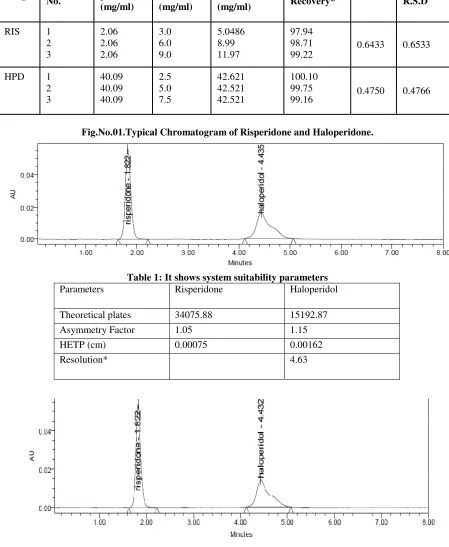
The resolution, number of theoretical plates, retention time and peak asymmetry were calculated for the working standard solutions and is as shown in Table 1. The values obtained demonstrated the suitability of the system for the analysis of these drugs in combination. The typical chromatogram of standard solution is as shown in Figure 3.
ASSAY
Preparation of sample solutions
Twenty tablets were weighed and powdered. Powder equivalent to 10 mg of Risperidone was weighed and transferred to 10 ml volumetric flask. Risperidone about 8 ml was added and sonicated for 10 min, volume was made up with the same solvent. This solution was then filtered through membrane filter paper. Further dilutions were made in dichloromethane to get concentrations in Beers law range. The retention times of Risperidone and Haloperidol were found to be 2.62 ± 0.02 and 3.96 ± 0.03 respectively. The assay was calculated from the equation of regression line for each drug. The percentage assay of individual drug was calculated and presented in Table 2.
CONCLUSION
The results of the analysis of pharmaceutical dosage forms by the proposed methods are highly reproducible, reliable, and are in good agreement with the label claims of the drug. The additives usually present in the pharmaceutical formulations of the assayed samples did not interfere with Risperidone and Haloperidol. It may be said that the proposed methods are precise, sensitive, and accurate, so that these can be used as standard
pharmacopoeial methods for the simultaneous
amount found and actual amount added. The mean
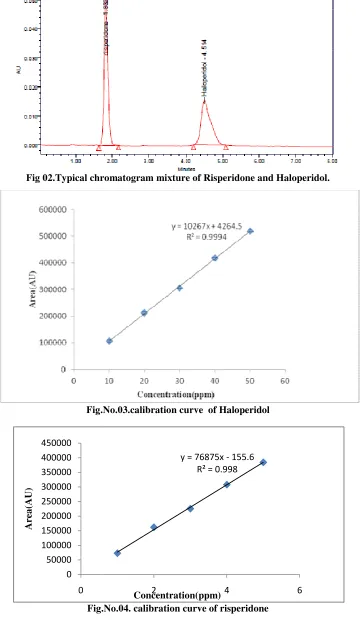
Fig 02.Typical chromatogram mixture of Risperidone and Haloperidol.
Fig.No.03.calibration curve of
Fig.No.04. calibration curve of risperidone 0
50000 100000 150000 200000 250000 300000 350000 400000 450000
0
A
re
a
(A
U
)
amount found and actual amount added. The mean
Fig 02.Typical chromatogram mixture of Risperidone and Haloperidol.
Fig.No.03.calibration curve of Haloperidol
Fig.No.04. calibration curve of risperidone y = 76875x - 155.6
R² = 0.998
2 4 6
Concentration(ppm)
669
670
Fig.No.01.Typical Chromatogram of Risperidone and Haloperidone.
Table 1: It shows system suitability parameters
Parameters Risperidone Haloperidol
Theoretical plates 34075.88 15192.87
Asymmetry Factor 1.05 1.15
HETP (cm) 0.00075 0.00162
Resolution* 4.63
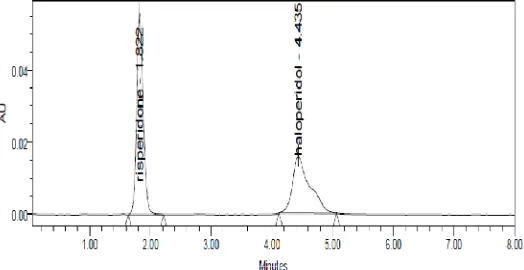
Figure 3: Typical chromatogram of Risperidone and Risperidone Drug Sample
No.
Amount present (mg/ml)
Amount added (mg/ml)
Amount estimated* (mg/ml)
%
Recovery* S.D
% R.S.D
RIS 1
2 3
2.06 2.06 2.06
3.0 6.0 9.0
5.0486 8.99 11.97
97.94 98.71 99.22
0.6433 0.6533
HPD 1
2 3
40.09 40.09 40.09
2.5 5.0 7.5
42.621 42.521 42.521
100.10 99.75
671
Figure 4: Typical chromatograms for recovery studies
proposed method involve a simple procedure for sample preparation and relatively short time of analysis. Apart from this, it can be used for assays of Risperidone and Haloperidol in biological fluids or in pharmacokinetic investigations.
ACKNOWLEDGEMENTS:
The authors would like to thank Ms sura Labs pvt., Dilsukhnagar, Hyderabad, for providing the gift samples of Risperidone and Haloperidol for the project work. The authors are thankful to principal & Chairman of KVK College of Pharmacy-Hyderabad for their kind help and providing all necessary facilities.
References:
1. S. L. Baldania,* K. K. Bhatt,1 R. S. Mehta,1 and D.
A. Shah .RP-HPLC Estimation of Risperidone in Tablet Dosage Forms. Indian J Pharm Sci. 2008 Jul-Aug; 70(4): 494–497.
2. Komossa K, Rummel-Kluge C, Schwarz S, Schmid
F, Hunger H, Kissling W, Leucht S, M. Sravan kumar. (2009). "Risperidone Versus Other Atypical Antipsychotics For Schizophrenia".
3. Zarna R. Dedania, Ronak R. Dedania, Navin R.
Sheth, Jigar B. Patel, and Bhavna Patel. International Journal of Analytical Chemistry. Volume 2011 (2011)Stability Indicating HPLC Determination of Risperidone in Bulk Drug and Pharmaceutical Formulations, Article ID 124917, 6 pages.
4. Angela Avenoso, Gabriella Facciolà, Monica
Salemi, Edoardo Spina. Journal of Chromatography
B: Biomedical Sciences and Applications.
Determination of risperidone and its major metabolite 9-hydroxyrisperidone in human plasma by reversed-phase liquid chromatography with ultraviolet detection. Volume 746, Issue 2, 15 September 2000, Pages 173–181.
5. Takako Nagasaki Determination of risperidone and 9-hydroxyrisperidone in human plasma by high-performance liquid chromatography: application to therapeutic drug monitoring in Japanese patients with schizophrenia. Journal of Pharmaceutical and Biomedical Analysis.Volume 19, Issues 3–4, 1 March 1999, Pages 595–601.
6. Silke Walter, Steffen Bauer, Ivar Roots, Jürgen Brockmöller.Quantification of the antipsychotics flupentixol and haloperidol in human serum by high-performance liquid chromatography with ultraviolet detection. Journal of Chromatography B: Biomedical Sciences and Applications Volume 720, Issues 1–2, 11 December 1998, Pages 231–237.
7. Angelo, Helle R.; Petersen, Andreas. Simultaneous determination of the antipsychotic drugs develop haloperidol, perphenazine, and zuclopenthixol an automated high-performance liquid chromatography (HPLC) method. Journal of Chromatography B: Biomedical Sciences and Applications. page no.71.
8. S. Nassra, m. Bruneta, p. Lavoie & j. L. Braziera.. Hplc–dad method for studying the stability of solutions containing morphine, dexamethasone,
haloperidol, midazolam, famotidine,
metoclopramide, and dimenhydrinate. Pages 265-281
9. Kyoung Ho Park, Min Hwa Lee, Myung Gull Lee.
Simultaneous determination of haloperidol and its metabolite, reduced haloperidol, in plasma, blood, urine and tissue homogenates by high-performance
liquid chromatography.Journal of Chromatography