Early Explorations On The Automatic Evolution Of
Printable 3D Objects
Jia Hui Ong, Jason Teo
Faculty of Computing and Informatics, Universiti Malaysia Sabah, Kota Kinabalu, Malaysia Faculty of Computing and Informatics, Universiti Malaysia Sabah, Kota Kinabalu, Malaysia Email: [email protected]; [email protected]
ABSTRACT : Designing a 3D object is a very laborious process that usually involves expertise and time using various 3D design software. Numerous researchers have proposed mathematical formulas to automatically design in 2D space and has led to recent efforts being done on studies which use mathematical formulas to create objects in 3D space. Johan Gielis’s Superformula that was generalized from the Supereclipse formula was able to gen-erate 3D shapes by extending the spherical product of the Superformula. In this research, the Superformula is use to automatically gengen-erate 3D object shapes through Evolutionary Programming that are free-form evolution and non target-based evolution as in most existing studies on automatic evolu-tion of 3D shapes. A novel fitness funcevolu-tion was designed to evaluate the shapes generated by Superformula that serve as a part of the parent selecevolu-tion process in Evolutionary Programming. Through five experiments, the final objects generated from each run were selected to be printed out using 3D printing. Three out of five objects were successfully printed out from this automatic 3D object generationprocess. However, two objects were printed with deformation due to the thin layer of the object. From the observation gainedin the first five runs, the fitness function was then fine-tuned in order to evolve a more printable 3D object. From the fine-tuning another five runs were tested and the results show all five final objects from the evolution process were successfully printed out using a 3D printer with significantly less deformation due to thin layers.
Keywords:Automatic 3D shape evolution; Evolutionary art; Superformula; Evolutionary Programming (EP); Evolutionary Algorithm (EA); 3D printing
1
I
NTRODUCTIONDESIGNING 3D objects is a complex and time consuming process. It involves significant skill in using 3D-object design software in order to create a certain 3D object. Even with the help of the available software, designing a 3D object is not a trivial task when it comes to the creation of complex shapes. This has led numerous researchers attempting studies on ge-nerating 2D and 3D objects through computational methods. A number of studies have been done on evolving geometrical objects in 3D-environments. Polygonal sequencing operators [1] by McGuire and Exploration of the lattice deformation [2] by Watabe and Okino were some of the early works done on geometrical modelling evolution in a 3D environment. More research work were done using different encoding such as the work by Sims [3] using directed graph encoding in morphology and behavior evolution of virtual creatures in a 3D environ-ment. While Jacob and Hushlak [4] used L-system encodings for their work in creating virtual sculptures and furniture de-signs. Exploration of evolutionary variable and fixed length direct encoding on solid objects such as tables, cars, boat and even a the layout of a hospital department were done by Bent-ley [5]. Barr introduce the use of Superquadrics equation in representing geometric shapes. It has been used as quantita-tive models for diverse applications in computer environments [6], [7] such as computer graphics as well as in computer vi-sions [8]. Since then Superquadrics has been extended in lo-cal and global deformations to be able to model natural and considerable precision of synthetic shapes. By generalizing the Superellipses and Superquadric formula, Gielis was able to come up with another equation which is the Superformula equation to describe shapes by its internal symmetry and in-ternal metrics [9]. Superformula equation is then further used to represent shapes in various fields such as engineering [10] and it has been used together with EA to achieve a certain target shapes [11]. The emergence of 3D printer is getting popular with its ability to print out a 3D object. 3D printer en-able the possibility of producing goods at a low cost in small quantity [12] hence it has been recognised as the next big in-dustrial revolution [12]. EAs are inspired by natural selection of
the fittest and it has been used as an optimization technique to solve engineering, mathematical, computational and many more complex problems. EAs main genetic operators com-prise population, parent, recombination, mutation, offspring, and survivor selection. It has four different classes, which are Genetic Algorithms, Evolutionary Programming (EP), Evolution Strategies (ES), and Genetic programming [14]. Each class utilizes different approaches in solving complex problem while maintaining the main genetic operators. In this paper, we in-troduce the approach of using Superformula to create non-target based 3D shapes through EP. The main purpose of this paper is to investigate whether or not these shapes evolve from Superformula can be printed out using a 3D printer. The results from the investigations can be use to determine that shapes evolved from Superformula are appealing in a simula-tion environment andyet it can be bring forward into real world as well. The next section of this paper will discuss the fore-ground of Superformula and how it is able to generate 3D shapes from generalizing from Superellipses and Superquad-ric equations. It will be followed by another section on the flow of Evolutionary Programming. Experimental setup section will be next and follow by results section. The last section will be conclusion and future work.
2
M
ETHOD2.1 Superformula
Superformula is simple geometric equation form from gener-alisation of a hyper-ellipse. It was found to be able to model forms of a large variety of plants and other living organisms [13]. The generalization of Superellipse equation is as follows:
(1)
m∈ 𝑅+; a, b∈ 𝑅
0+; a > 0, b > 0 are responsible for the size of
the supershapes with the usual value of equals to one. Sym-metry number is control by m while the shape coefficients are control by n1, n2 and n3 with real valued parameters. From equation (1) forms the superecllipse 2D shapes henceby mul-tiplying 2 superecllipse equations together it allows the exten-tion towards 3D shapes:
𝑥 = 𝑟1 𝜃 . cos 𝜃 . 𝑟2 𝜑 . cos 𝜑 2 𝑦 = 𝑟1 𝜃 . sin 𝜃 . 𝑟2 𝜑 . cos 𝜑 3 𝑧 = 𝑟2 𝜑 . sin 𝜑 4
θ, denotes longitude with-π ≤ θ ≤ π ,
φ, denotes latitude with -π/2 ≤ φ ≤ π/2
As such, more complex 3D shapes can be generated. Preen [10] has shown more complex shapes such as mobius strip, shell and even torus shapes can be generated with Superfor-mula.
2.2 Evolutionary Programming
Evolutionary Programming serves as the EA method in this study. EP is one of the four major EA methods. It was first in-troduced by Fogel [15] to simulate learning processing aiming to generate artificial intelligence. Adaptive behavior is the key to EP and by using real-value parameters it can be integrated to the problem domain. The real-value parameters of Super-formula are used as the representation in EP for this study. Below is the pseudocode for EP in this study:
1. Generate initial population
2. Test each individual solution in the population
3. Parent selection
4. Mutation process
5. Offspring generation
6. Repeat step 2 to 5 until reach termination criteria
2.3 Evaluation Function
Evaluation Function serves as a representation of requirement for a solution to adapt to. It is the basis of selection to aid im-provements of the individual solution. From the perspective of problem-solving, it is the representation to the task to be solved in evolutionary background [14]. Basically it serves as a quality measurement of the individual solution presented in the population pool. In this study, the evaluation function is design to calculate the value obtain from the 3D object as well as from the Superformula.
(5)
In equation (5), it was intended to find the spread of point x, y, and z over the symmetry number of any given object. A pen-alty will be imposed to the score if the dimension of the objects were too big and out of the boundary set. The reason for the penalty imposed is to maintain a reasonable dimension size. The values for 𝑚1 and 𝑚2 are responsible to the symmetry of
the 3D object, both the values of 𝑚1 and 𝑚2 are added
to-gether with a constant of 1. The constant is used to counter the division by zero error in case the addition between 𝑚1 and 𝑚2 results in zero.
(6)
In equation (6), a similar fitness function is used but the divi-dend is then power to the difference of 𝑛2,2and 𝑛2,3. In Super-formula, the value of 𝑛2,2 and 𝑛2,3 is to control the thickness of each of the layers generated.
3
Experimental Setup
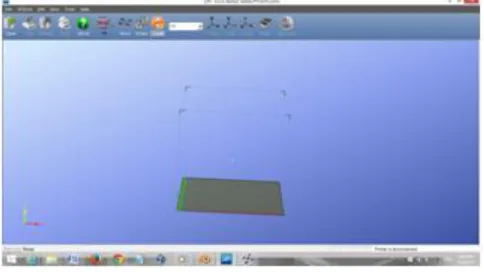
The population size model used is µ+λ with both parameters set to a size of 1 and 100 respectively which means the popu-lation size model will include the parent plus 100 offspring. Each individual in the population pool will be evaluated using the fitness function in equation (5) and hence the fittest indi-viduals will be selected to seed the next generations. The number of generations set for this experiment is 10. There will be five runs and after the end of each run the final evolved object will be printed out using a 3D printer. The fitness func-tion is then replaced with equafunc-tion (6) and run for five more times and the final evolved object of each run will be at-tempted to be printed out from a 3D printer. Object evolved are first save into Autocad file format (.dxf) and later convert into a STereoLithography (.stl) format. With .stl format the object are then brought into the UP! Print preview as shown in Fig. 1.
Fig. 1. UP! 3D Printer interface
4 Experimental Results
Results obtain from the experiment are shown in the following table. There are a total of five runs with 10 generations each. With each generation consist of hundred individuals that yield a total of 1000 3D objects evolved for one whole run. Table 1 showsthe final evolved objectfrom each run as well as its pa-rameter.
1
V)
ˆ
-(200000
2 1
m
m
z y x
TABLE 1
Final Evolved Object for First Five Runs
R
un Parameters Evolved 3D object
1
𝑚1 =24 , 𝑚2=16 , 𝑛1,1=39.6 , 𝑛1,2
=32.8 , 𝑛1,3
=5.1 , 𝑛2,1= 4.4,
𝑛2,2= 5.9,
𝑛2,3=37.8
2
𝑚1 =42 , 𝑚2=5 , 𝑛1,1=58.2, 𝑛1,2
=34.7, 𝑛1,3
=59.2, 𝑛2,1=
36.0, 𝑛2,2= 39.9,
𝑛2,3=29.5
3
𝑚1 =14 , 𝑚2= 3 , 𝑛1,1=41.8, 𝑛1,2
=48.6, 𝑛1,3
=29.8,
𝑛2,1=57.1, 𝑛2,2=42.0, 𝑛2,3=40.7
4
𝑚1 =57 ,
𝑚2=56 ,
𝑛1,1=37.9, 𝑛1,2
=32.8, 𝑛1,3
=28.2,
𝑛2,1=17.7, 𝑛2,2=13.7, 𝑛2,3=21.2
5
𝑚1 =33 , 𝑚2= 28 , 𝑛1,1=33.5, 𝑛1,2 =57.1, 𝑛1,3
=21.5,𝑛2,1=35.2, 𝑛2,2=35.6,
𝑛2,3=5.7
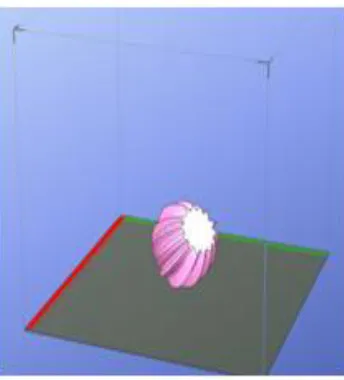
Fig. 2. Final evolved object for run no. 1 print preview from
up! 3d printer
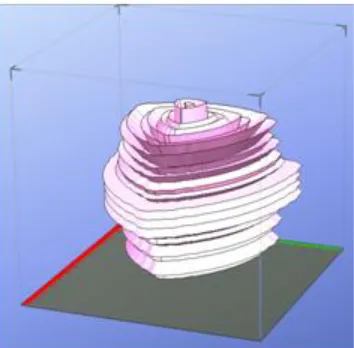
Fig. 3. Final evolved object for run no. 2 print preview from up!
3d printer
Fig. 4. Final evolved object for run no. 3 print preview from up!
Fig. 5. Final evolved object for run no. 4 print preview from up! 3d printer
Fig. 6. Final evolved object for run no. 5 print preview from
up! 3d printer
Table 1 shows the final object for all five runs while Fig 2 to Fig 6 shows the print preview from the UP! 3D printer’s print pre-view. Object from run no.1 and no.4 exhibit thin layers from the 3D environment. A total of eight thin layers were clearly seen from run no.1 where else there is a numerous number of thin layer exhibit by object from run no.4. As we proceed onto the printing, object from run no.4 shows deformation where layers of the object were printed out uniformly and thus sticking to-gether with the support layers as shown in Fig 7. Object from run no.5 and no.2 shows a very spiky outline which we deduce the reason is due to the big difference between 𝑛2,2and 𝑛2,3.
While object from run no.3 outline were spiky as well but the top and bottom of the object exhibit curve line that makes it looks unique that will be tedious work if it were to be designed by hand. Fig 8 shows the actual object after it has been printed out.
Fig. 7. Printed 3d object for run no. 4.
Fig. 8. Printed 3d object for run no. 3
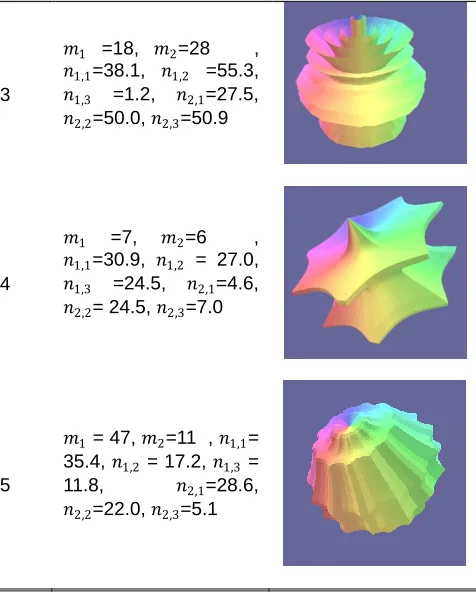
A deduction was made by observing the entire populations evolved, it was found that a lot of the individuals exhibit very thin layers in the 3D environment. As such it will encounter problems if it were to be printed out. Hence to counter this problem, equation (6) were used in place of equation (5) as the fitness function. Equation (6) would penalize the score if the difference between n2,2 and n2,3 were too big. The results from this improved fitness function are shown in table 2.
Table 2
Final Evolved Object for Runs Using Equation (6) as Fitness Function.
Run Parameter 3D object
1
𝑚1 =52, 𝑚2=43 , 𝑛1,1=40.0, 𝑛1,2 =57.7,
𝑛1,3 =25.6, 𝑛2,1=21.6, 𝑛2,2=35.9, 𝑛2,3=7.5
2
𝑚1 =38, 𝑚2= 6 , 𝑛1,1=53.2, 𝑛1,2 =58.3, 𝑛1,3 =15.3, 𝑛2,1=59.9,
3
𝑚1 =18, 𝑚2=28 , 𝑛1,1=38.1, 𝑛1,2 =55.3,
𝑛1,3 =1.2, 𝑛2,1=27.5,
𝑛2,2=50.0, 𝑛2,3=50.9
4
𝑚1 =7, 𝑚2=6 ,
𝑛1,1=30.9, 𝑛1,2 = 27.0,
𝑛1,3 =24.5, 𝑛2,1=4.6, 𝑛2,2= 24.5, 𝑛2,3=7.0
5
𝑚1 = 47, 𝑚2=11 , 𝑛1,1=
35.4, 𝑛1,2 = 17.2, 𝑛1,3 =
11.8, 𝑛2,1=28.6,
𝑛2,2=22.0, 𝑛2,3=5.1
From the results obtain, all five runs’ final objects were able to be printed out by a 3D printer with no defects or deformations. Form Table 2, all final objects evolved are more solid and have lesser thin layers as compared to the previous five runs. Ob-ject from run no.3 looks similar to previous obOb-ject evolved, but the layers from object run no.3 shows thicker layers as op-posed to the initial runs. It is observed that in these runs, less spiky edged were formed, instead forming edges that looks more rounded and curvy. Object from run no.4 shows a unique evolved shape and the actual object is shown is Fig 9. While the actual object for run no. 2 and 5 are shown in Fig 10 and 11 respectively.
Fig 9: Printed 3D Object for Run No. 4.
Fig 10: Printed 3D Object for Run No. 2.
Fig 11: Printed 3D Object for Run No. 5.
5 C
ONCLUSION ANDF
UTUREW
ORKSIn this study, the automatic evolution of printable 3D objects was achieved by using the fitness function designed. By utiliz-ing the combination of Superformula together with the novel fitness function, unique and novel 3D object shapes were ob-tained through the evolution process. With this finding, the laborious work of designing 3D objects can be scaled down and it can be used to serve as an inspiration for designing purposes. As seen from the results obtained, some unique shapes were evolved and if these shape were to be designed by hand, it would involved a significant amount of designing time where a lot of manual effort would be required. Future work should be focused on finding more ideal parametric val-ues for the Superformula. Other types of evolutionary algo-rithms could also be investigated for more diverse shape gen-erations.
A
CKNOWLEDGMENTThis research is funded by the ERGS Research project ERGS0043-ICT-1/2013granted by the Ministry of Science, Technology and Innovation, Malaysia.
R
EFERENCES[2] H. Watabe, and N. Okino, ―A study on genetic shape de-sign‖. In: Proceedings of the 5th
International Conference on Genetic Algorithms. pp. 445–451. ICGA ’93, Morgan Kaufmann Publishers Inc. (1993)
[3] K. Sims, ―Evolving 3D morphology and behavior by com-petition. Artificial Life‖ 1, 353–372 (1994)
[4] C.J. Jacob, and G. Hushlak ―Evolutionary and swarm de-sign in science, art, and music‖. In: The Art of Artificial Evolution: A Handbook on Evolutionary Art and Music, pp. 145–166. Springer (2007)
[5] P. Bentley, ―Generic Evolutionary Design of Solid Objects using a Genetic Algorithm‖. Ph.D. thesis, University of Huddersfield (1996)
[6] A.H. Barr, ―Superquadrics and angle preserving transfor-mations‖. IEEE Computer graphics applications 1: 11-23, (1981).
[7] A.H. Barr, ―Global and local deformations of solid primi-tives‖. Computer Graphics, 18(3): 21-30, (1984).
[8] A. Jaklic, and F. Solina, ―Superellipsoids gaining momen-tum‖. In: Proceedings of 7th Computer Vision Winter Workshop CVWW'02,, Bad Aussee (2002)
[9] J. Gielis, B. Beirinckx, and E. Bastiaens, ― Superquadrics with rational and irrational symmetry‖. In: Proceedings of the eighth ACM symposium on Solid modeling and appli-cations. pp. 262–265. SM ’03, ACM (2003)
[10]R.J. Preen, L. Bull, ―Evolution of Supershapes for the Generation of Three-Dimensional Designs‖. In Evolutio-nary Computing 20 Symposium: Proceedings of the 50th Anniversary Convention of the AISB 2014, Goldsmiths, University of London, pages 15-22.The Society for the Study of Artificial Intelligence and Simulation of Behaviour (2012).
[11]R.J. Preen, and L. Bull ―Towards the evolution of vertical-axis wind turbines using supershapes", Proc. 50th Anniv. Conv. AISB Evol.Comput. 20 Symp., pp.15 -22 (2014)
[12]B. Barry, ―3-D printing: The new industrial revolution‖. In: Business Horizons 55, 155—162(2012)
[13]J. Gielis, ―A generic geometric transformation that unifies a wide range of natural and abstract shapes‖. American Journal of Botany 90, 333–338 (2003)
[14]A.E.Eiben, and J.E.Smith.Introduction to Evolutionary Computing. (2003).