_________________________________ Author for Correspondence:
Ananda Thangadurai S,
Department of Pharmaceutical Analysis, Swamy Vivekanandha College of Pharmacy,
Research Article
ISSN: - 2306–6091
Available Online at: www.ijphr.com
ANALYTICAL METHOD DEVELOPMENT AND VALIDATION FOR
ESTIMATION OF SILDENAFIL CITRATE IN TABLET
DOSAGE FORM USING RP-HPLC
Supraja D, *Ananda Thangadurai S, Jambulingam M, Kamalakannan D
Department of Pharmaceutical Analysis, Swamy Vivekanandha College of Pharmacy,
Elayampalayam - 637205, Tamilnadu, India.
___________________________________________________________________________
Abstract
A simple, precise, accurate, reproducible and robust HPLC method was developed for the estimation of sildenafil citrate in pharmaceutical dosage forms. This method was validated as per ICH guidelines. Analysis of drug was performed on Waters X Terra C18column (250 mm × 4.6 mm × 5µ), consisting of mobile phase,
employing Phosphate buffer and Acetonitrile (40:60 V/V) as the mobile phase at a flow rate of 1 mL/min. The estimation of drug was carried out at 231 nm using UV detector. The retention time of the sildenafil citrate was found to be 12.38 min. The method produced good linear responses in the concentration range of 2.5 µg to 37.5 µg /mL. The % RSD values for system precision and method precision were found to be 0.2 and 0.07 respectively. The proposed method was found to be applicable for determination of the drug in tablet dosage form.
Keywords:
Sildenafil citrate, HPLC, Validation.___________________________________________________________________________
Introduction
Sildenafil citrate (Viagra) was patented in1996 and launched in May 1998 as first oral drug approved by Food and Drug Administration (FDA) to treat erectile dysfunction (ED) in the United States. The penile prostheses, vacuum constriction devices, penile injection therapy, transurethral suppositories and professional counseling were primary alternatives prescription treatment for ED. It is also effective for treatment of pulmonary arterial hypertension (PAH)1. It is good for treatment of high altitude pulmonary edema. Recreational use and misuse of this drug is also common. More than $400 million worth of Sildenafil citrate was sold in
its first quarter on the U.S. market. More than 300,000 total prescriptions were written for Viagra in the first month after launching in USA (IMS, 1998, and National Prescription Audit, 1998). It is now being sold in more than fifty countries but not registered in Pakistan until today2.
Sildenafil citrate is a white to off-white crystalline powder with solubility in water and a molecular weight of 666.7 Dalton. Molecular formula is C22H30N6O4S. .Chemically, designated as 1-
[[3-
(6,7-dihydro-1-methyl-7-oxo-3-propyl-1Hpyrazolo[4,3-d]pyrimidin-5-yl)-4-ethoxyphenyl] sulfonyl]-4methylpiperazine citrate3. Its structural formula is given below in the fig.1 (Internet drug index 2010). The structural formula of sildenafil citrate The parasympathetic nerves are stimulated when man arouses sexually, leading to penile erection as result of release nitric oxide (NO) which works by activation of the enzyme guanylatecyclase responsible for converting guanosine triphosphate (GTP) to 3,5, cyclic guanosine monophosphate (cGMP). The cGMP is a potent vasodilator vital erection of the penis.4 Sildenafil citrate selectively inhibits the enzyme PDE-5A (phosphodiesterase-5A) that hydrolyzes cGMP. Thus it increases level of cGMP by preventing it from breaking down. Consequently smooth muscle relaxation leads to vasodilation and increased inflow of blood into the spongy tissue of the penis causing an erection by fascinating the signaling actions of nitric oxide (NO) in penile smooth muscle (Rafael et al., 2001). The most common side effects of Sildenafil citrate are headache, facial flushing, and upset stomach. Less commonly cyanopsia (bluish vision), blurred vision, or sensitivity to light may briefly occur, It is contra- indicated in patients receiving nitrates, in patients in whom vasodilation or sexual activity are inadvisable, or in patients with a previous history of non-arteritic anterior ischaemic optic neuropathy. It is also contraindicated in severe hepatic impairment. As a result of post marketing reports5. In October 2007, The FDA announced that the labeling for all PDE5 inhibitors, including sildenafil, required a more prominent warning of the potential risk of sudden hearing loss (FDA Updates Labeling for Viagra 2005, Viagra prescribing information 2010). Some HPLC methods for determination of sildenafil citrate in pharmaceutical formulations and plasma have been reported6. The basic aim of the present was to develop and validate a specific, precise accurate, reproducible, robust, efficient, economical and quicker HPLC method for measurement of sildenafil citrate in different formulation including products sold fraudulently in Pakistan, under the cover of alternate system of medicine and neutron cuticles. The HPLC method described below was
different because high speed vortex mixing of the samples as well as mobile phase had done filtered
through 0.45μm filter and better ultra sonication.
Materials and methods
Chemicals and reagentsSildenafil citrate was procured from SMS Pharmaceutical industry, Hyderabad. As a gift of sample, sildenafil citrate working standard, used from PPIM (Pharmaceutical product of India management) which is having % purity 99.99% for the estimation of Sildenafil citrate in bulk and commercial formulations 0f Sildenafil brand (Carvetra-25) were obtained from the local pharmacies. Each tablet was labeled contain 25 mg of Sildenafil citrate. HPLC grade methanol, acetonitrile, triethylamine, phosphoric acid procured from Merck, India highly purified water prepared by using Millipore Mille Q purification system.
Instrumentation and software
HPLC analysis was performed using Agilent 1200 series pumps combined with a UV detector. The column waters X Terra, RP-C18 (250 mm ×4.6 mm×5µ).Analytical weighing, for preparation of calibration standards and quality controls, was done on a microbalance Mettle-Toledo AT 261. And degassed ultra sonically by Enertech sonicator before use. The HPLC system was controlled by a workstation using EZ chrome elite software installed on it.
Preparation of Mobile phase
Buffer: Dissolve 7.8 gm of sodium di hydrogen orthophosphate dehydrate in and acetonitrile in the ratio of 40:60 in 1000ml of Milli–Q water adjust to pH 5.6 ± 0.1 with tri ethylamine. Filter through 0.45µ membrane and degas.
Mobile phase A: Mix the buffer and acetonitrile in the ratio of (70:30 V/V).
Mobile phase B: Mix the buffer and acetonitrile in the ratio of (40:60. V/V).
Chromatographic conditions
Preparation of stock solution
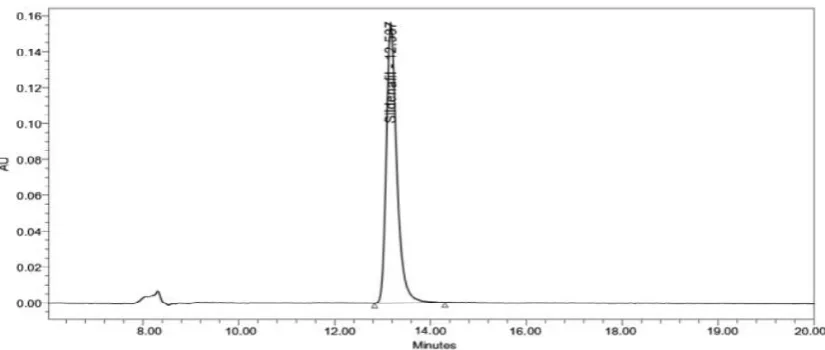
Accurately 25 mg sildenafil citrate was weighed and transfers into a 100 ml volumetric flask, add 15 ml of acetonitrile dissolve and make up with diluent. (Mix water and acetonitrile in the ratio of 75:25) pipette out 1ml from the above stock solution into 10 ml volumetric flask and made up with diluent to give 25µg/ml concentration of sildenafil citrate and it was used for chromatographic analysis. The developed chromatograph of standard solution is shown in Fig. 2.
Preparation of sample solution
The marketed formulation was prepared by dissolving the required quantity of crushed powder of 20 tablets to make a concentration approx.25µg/ mL in diluent. After this suspension formed by excipients in market formulations was filtered and the filtrate was collected and it was sonicated and degassed. Test solution of market formulation was prepared by diluting required quantity of supernatant stock solution of with mobile phase. 1ml of solution was taken and made up to with 10 ml. It was used for chromatographic analysis. The developed chromatograph of sample solution is shown in Fig. 3.
Optimization of chromatographic conditions Effect of different chromatographic conditions on the instrumental responses creates a situation where one has to compromise between different experimental variables in order to achieve the best chromatographic separation. Chromatographic separations are significantly affected by the mobile phase composition, pH and flow rate. Therefore before selecting the conditions for the optimization, preliminary trails were conducted with different combinations of different organic solvents and buffer at various compositions, and flow rate to check the retention time, shape, resolution, and other chromatographic parameters. Various factors such as mobile phase composition, mobile phase, ratio and flow rate. All mobile phases used in optimization study were prepared by mixing the buffer system with organic solvents in the desired proportions. The apparent pH of the mixture was adjusted to desired value using triethylamime mobile phase was filtered through 0.45µ m membrane filter and Sonicated before being used for chromatography.
Validation
Validation of an analytical method is a process to establish that the performance characteristics of the developed method meet the requirement of the intended analytical application.
Estimation of sildenafil citrate Estimation of sildenafil citrate
Equal volume (25µg), of the standard preparations and the assay preparations that contain SC in mobile phase were injected into the chromatograph and the chromatograms were recorded. The responses (peak area) for the major peaks were measured and the quantity of SC in the assay solution was calculated.
Estimation of sildenafil citrate in market formulation
Equal volumes (25µg), of the standard preparations and the assay preparations to be assayed containing sildenafil citrate in the mobile phase were injected into the chromatograph and the chromatograms recorded. The responses (peak area) for the major peaks were measured and the quantity of SC was calculated.
Validation of proposed method
Once the chromatographic method had been developed and optimized, it must be validated of an analytical method verifies that the characteristics of the method satisfy the requirements of the application domain. The proposed method was validated in the light of ICH guidelines for linearity, precision, sensitivity, and recovery. Consequently, the following were performed.
Calibration curve (linearity curve)
Accuracy
For studying the accuracy of the proposed analytical method, and for checking the interference from excipients used in the dosage from excipients used in pure form. Recovery experiments were carried out by the standard addition method. This study was performed by the addition of known amounts of SC to a known concentration of the sample. For the determination of accuracy of the analytical procedures three identical dilutions of sample were spiked with different concentrations of standard solution i.e., 50%, 100%, 150%.AUC of these solutions were then observed and plotted into calibration curve, concentrations and accuracies were calculated. The results were shown in Table 2.
Precision
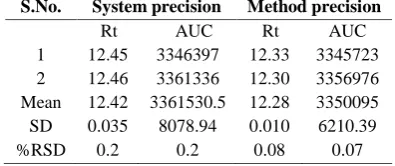
The precision of analytical procedures expresses the closeness of agreement (degree of scatter) between a series of measurements obtained from multiple sampling of the same homogenous sample under the prescribed conditions. The results were shown in Table 3.
System precision
The type of precision study is instrument precision or injection repeatability. Standard solution (25µg) was injected in six replicate injections to check the relative standard deviation (%RSD) for finding the precision of the system to be used for validation.
Method precision
Method precision of intra assay precision data are obtained by repeatability analyzing , in one laboratory on day, aliquots of homogenous sample, each of independltly prepared according to method
procedure. Six times sample were prepared and each of those solutions were injected. Mean of these values give rise to the assay value obtained from method precision.
Robustness
Robustness is a capacity of the method to remain unaffected by small deliberate variation in method parameters in the case of liquid chromatography, examples of typical variations in flow rate ( + /-5%), influence of variation in temperature all observed results are summarized in Table 4.
Results and discussion
Optimization of chromatographic conditions All mobile phases used in optimization study were prepared by mixing the buffer system with the organic solvent in the desired proportions. The apparent pH of the mixtures was adjusted to desired value using trimethylamine. Mobile phase was then filtered through 0.45µ m membrane filter and sonicated before being used for chromatography. Looking at the different chromatographic parameters during the method development, the finally recommended of Mobile phase A Was used as Mix the buffer and acetonitrile in the ratio of 70:30,Mobile phase B was Mix used as the buffer and acetonitrile in the ratio of 40:60.and pH adjusted at 5.6 ± 0.1 with triethylamine. Flow rate of 1.0ml/min. The elution was monitored at 231nm and mobile phase flow rate of 1ml/ min. Typical chromatogram at the optimized condition gave sharp and symmetric peak with retention time of 12.507 min for SC thus with in short period the system became ready for next sample injection without need for additional wash time .The chromatogram of SC is given below.
Validation of proposed method Calibration curve (linearity curve)
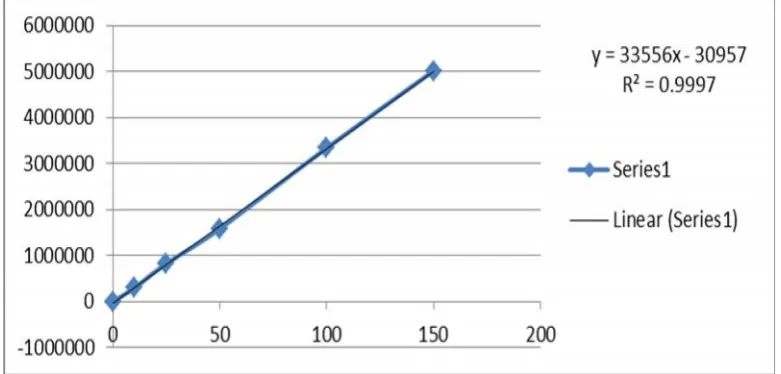
Calibration curve (peak area of SC) of analytical method was constructed by injecting five different concentrations of SC. The chromatographic responses were found to be linear over an
analytical range 2.5µg/ml, 5 µg/ml, 12.5 µg/ml, 25 µg/ml, 37.5 µg/ml respectively found to be quite satisfactory and reproducible with time. The linear regression equation was calculated by the least squares method using Microsoft excel program. The calibration curve for linearity is given below.
Fig. No. 03: Calibration curve for linearity of SC for developed analytical method Percent purity& percent recovery
For the determination of percentage purity of analytical method, approx. 25µg /ml concentration of market formulation was injected and observed
area was plotted into the linearity curve and the equation of line to calculate the concentration. The observed % purity was obtained 99.88%.
Fig. No. 04: Chromatogram of SC in marketed formulation Table No. 01: Percentage recovery of SC in market formulation
Commercial formulation ingredients Labeled amount(mg) Amountfound(mg) % found
Carvetra 25 Sildenafil citrate 25 0.024 99.88%
Cidafil 25 Sildenafil citrate 25 0.025 99.90%
Accuracy
Table No. 02: Accuracy of developed analytical method.
S.No Concentration Accuracy
1 12.5 100.17%
2 25 99.99%
3 37.5 98.86%
Precision
The concentration values for both system precision and method precision of analytical method were calculated six times (n=6) separately and percent relative standard deviation were calculated.
Table No. 03: Precision of developed analytical method S.No. System precision Method precision
Rt AUC Rt AUC
1 12.45 3346397 12.33 3345723 2 12.46 3361336 12.30 3356976 Mean 12.42 3361530.5 12.28 3350095 SD 0.035 8078.94 0.010 6210.39
%RSD 0.2 0.2 0.08 0.07
Robustness
To verify the robustness of the method, the analysis was done under variable flow rates. The flow rate as per the developed method is 1.0 ml/ min. This has been purposely changed to 0.9 ml/min and 1.1
ml/min and the chromatogram was developed, Temperature as per the developed method is 300c. This has been purposely changed to 250c and 350c and the chromatogram was developed and results were shown in Table no 4.
Table No. 04: Study of Robustness
Flowrate(ml/min) Temperature
0.9 1.0 1.1 250c 300c 350c
Peak area Peak area Peak area Peak area Peakarea Peak area 3349362 3349362 3342776 3536058 3561562 3345776 3442761 3356976 3342767 3536329 3561456 3342765 Avg 3396061.5 3351349.5 3344267 3436193.5 3561509 3344270.5
SD 66043.07 7957.07 2121.32 191.625 74.95 2129.099
%RSD 1.9 0.23 0.06 0.005 0.002 0.006
Conclusion
In the present work, a new rapid, simple and sensitive reversed phase HPLC method has been developed, optimized and validated for the estimation of SC in market formulation and SC pure form using UV detector and isocratic elution. Optimization showed that the mobile phase pH and composition are more crucial parameters to be controlled than flow rate for reproducible and quantitative estimation of the SC. The short peak retention time of 12.507 min cuts down overall time of sample analysis and thereby makes the method more cost effective. Methods were found to be linear over an analytical range of 2.5µg/ml, 5 µg/ml, 12.5 µg/ml,25 µg/ml,37.5 µg/ml respectively the linearity co efficient and percentage curve fitted was found to be 0.9997and 99.88% for sildenafil citrate. Accuracy of the method was determined through the recovery studies of the drugs. The recovery of drugs was well within the acceptance limit(99% -101%).
precision of the method was determined by analyzing the drug formulation by replicate injections and precision of the system was determined by mixed standard solutions % RSD of the analyte was found to be with in the limit of 2%. Thus the developed method was found to provide high degree of precision and reproducibility.
References
1. Boolell MS, gepi-Attee, JC, Allen MJ, Urol J. 78. 1996, 257.
2. Brock G. Sildenafil citrate (Viagra) drugs today. 36, 2000, 125-134.
3. Copper JDH, Muirhead DC, Taylor JE, Baker PR. Journal of chromatograph. 701, 1997, 87-95.
5. Shesha Reddy T, Shiva Reddy A, Sita Devi P. Quantitative determination of Sildenafil Citrate in herbal medicine formulations by High-performance thin layer chromatography, Journal of JPC.19, 2006, 427-443.
6. Pistos C, Papoutsis I, Artemis D, Maris S, Sotiris A, Constantinous P. Off –line HPLC method combined to LC-MS for the determination of Sildenafil and its active metabolite in post-mortem human blood according to confirmation criteria. Forensic Sci Int.78 (3), 2012, 192-198.
7. Rafael S, Ortiz.K, Mariott C, Werickson FC, Eustáquio VR. Fingerprinting of Sildenafil citrate and Tadalafil tablets in pharmaceutical formulations via X-ray fluorescence (XRF) spectrometry. J Pharm Biomed Anal. 58, 2012, 7-11.
8. Nithin S, Praveen R, Artithakkarand GS. RP-HPLC method development For estimation of sildenafil citrate in tablets and in seminal fluid, JAPS. 2(5), 2012, 172-178.
9. Prasannareddy Y, Ramanjaneyareddy Y. Validation and stability indicating RP-HPLC method for the determination of Sildenafil citrate in pharmaceutical formulations. IJABT. 1(1), 2010, 104-111.