Modeling and Simulating of Intake Pipe Fuel
Film Dynamic Characteristic in Gasoline Engine
Start Process
Zhi-xiang Hou, Yi-hu Wu, Huanchun Gong
School of Automotive and Mechanical Engineering, Changsha University of Science and Technology, China; ST 410076; PH (86-0731-85258630);
Email: [email protected]
Abstract—During the gasoline engine start process, both fuel quantity and fuel film parameter change, fuel film dynamics in intake pipe is not balance, which makes the fuel quantity from nozzle and fuel quantity into the cylinder not be equaled. In order to control the air fuel ratio accurately in gasoline engine start process, fuel film model of intake pipe need to be established accurately. The costumed fuel film model by Aquino is introduced in detail, and the characteristic of Aquino model used in gasoline engine start process is also analyzed. Based on Aquino fuel film model, a new dynamic fuel film model is presented, in which the change of intake parameters is consider. The air fuel ratio variable by presented model and by Aquino model is simulated by using SIMULINK in gasoline engine start condition, and the simulated result is compared with experiment data. The result shows that the intake pipe fuel film dynamic characteristic is accurately described by the presented model, and the accuracy by presented model is higher than that by Aquino model. The provide model is very important to accurately control air fuel ratio in order to decrease the emission during start process of gasoline engine.
I. INTRODUCTION
In the last years, we observed an increasing attention to ward problems related to the environment with a particular focus on pollutants generated by vehicles in industrialized countries. Since1970, the European community has set strict requirements on the maximum exhaust emissions tolerated for a vehicle hence forcing the automotive industries toward the zero emission vehicle(ZEV)target. The state of Californian government has required that by 2004 10% of vehicles must be ZEV, while the others must reduce exhaust emission of 60– 84% with respect to actual values. These strong constraints pushed the research toward the development of suitable electronics, embedded systems, and mechanical and chemical devices to reduce noxious emissions. A different approach attempts to reduce pollutants by processing the exhaust gases. Catalytic converters follow this direction by accelerating the chemical process of oxidation for HCs and CO to H2 O
and CO2 and reduction of NOx to N2. To this end, it has
been proved that maximal efficiency of the catalyst can be obtained by keeping AF within a very strict band
around, its stoichiometric value AFs=14.64. A
1%discrepancy in AF with respect to the stoichiometric value may cause up to a 50% reduction of the catalytic
converter efficiency in reducing pollutants. Controlling AF so that it equalizes is a difficult task. This is due to the nonlinear behavior and the cyclic nature of the engine within a wide operating range, the presence of uncertainties and unpredictable disturbances in the process, and the great difficulties in inferring relevant variables from imprecise or difficulty measurable ones. Unleaded fuel, catalytic converters, and an accurate control of the variables involved in the fuel combustion process are relevant ingredients to rearch such a goal.
Automobile gasoline engine operates mostly under transient condition, the working parameter of gasoline engine such as throttle degree; engine rotate speed and engine load during the actual operating process are variable. The air-fuel ratio control is especially difficult to be carried out in throttle transients because of the complexity of relevant air flow and fuel flow evaporation dynamics and the time delay of form fuel film.
balance by the fuel liquidity and air mass of intake port increasing gasoline engine operates start process. In this paper, the costumed dynamic fuel film model of Aquino is introduced in detail, and the characteristic of Aquino dynamic fuel film model is also analyzed. To describe the intake pipe fuel film dynamic characteristic in gasoline engine operates start process, a new dynamic fuel film model is presented based on Aquino fuel film model, in which the change of intake parameters is consider. The air fuel ratio variable by presented model and by Aquino model is simulated by using SIMULINK, and the result is compared with experiment data. The result shows that, in gasoline engine operates start process, the intake pipe fuel film dynamic characteristic is accurately described by the presented model.
II. FUEL FILM DYNAMIC MODEL
A. Aquino fuel film model
The Aquino fuel film model is described that fuel mass
inj
m
injected, of which a part enters the cylinder directlyin the fuel vapor form; another part deposits on the intake manifold wall to form fuel film, at the same time, fuel film evaporates at 1 /τf speed ratio, and evaporative fuel
vapor and the directly fuel vapor enter cylinder together. Fuel film dynamic model of gasoline engine may be described by the follow mathematical formula:
(1 ) ff
in inj
f m
m = −x m + τ (1)
ff inj ff
f m
m = xm − τ (2)
Where,
m
injis the mass flow of injector injecting fuel,ff
m respectively is the intake fuel mass flow and mffis
the change rate of fuel film evaporating, minis the mass
flow of the fuel entering into cylinder, τf is the time
constant of fuel evaporating, x is the fuel distribution coefficient.
Another popular model for the fuel flow dynamics is presented by Hendricks [2] and its describing equations are:
min= −(1 x m)inj +mff (3)
1 ( )
ff ff inj
f
m =τ −m +xm (4)
Where, mff respectively is the mass flow ratio, and
ff
m is the change rate of fuel film evaporation.
The different between Hendricks model and Aquino model is in the description of fuel film. In Aquino model, proportional of the fuel mass in the liquid film (mff), can
be considered as a first order delay process. However, the fuel mass flow ratio of tip in and tip out fuel film (mff) is
regarded as a first order delay process in Hendricks model. The physical meaning of Hendricks model is that the unbalance fuel film is to be reached a new balance state after τf time. Due to the variable of tip in and tip
out the fuel film mass flow, Hendricks model described
in some time, although Hendricks model is a linear mode in form, but the physical essence is nonlinear. If the
x and τf of fuel film model is treated as constant,
equation (1) and equation (2) will be made in Laplace transform, and the signal diagram of Aquino model is the same as the Hendricks model [3].So, the Aquino model is analyzed in detail in this paper.
B. Aquino model analysis
The dynamics balance of fuel film formation rate and evaporation rate is built up by Aquino model in stable condition. In gasoline engine operates start process, The Aquino model will produce tremendous error because of the time constant (τf ) of fuel evaporating and the fuel
distribution coefficient (x) is hardly accurate identified. According to [4], fuel distribution coefficient (x ) is directly related to throttle position because fuel is immediately injected on the throttle valve, and it is regarded as an approximate constant when the variable of throttle angle is not fast and the time of this variable process is short. Besides, the relationship between time constant ( τf ) of fuel evaporating and intake port
temperature is intimate so that intake port temperature and time constant of fuel evaporating is invariable when gasoline engine operates in start process. It is nonlinearity function relationship between time constant coefficient of fuel distribution and intake port pressure, intake port temperature and engine rotate speed. Moreover, this relationship is very complexity and the physical model is also hardly established. During start process, throttle position, engine load and condition parameters works in a large range, which will increase the variable range of time constant( τf ) of fuel evaporating and fuel
distribution coefficient( x ). If time constant of fuel evaporating and fuel distribution coefficient is calculated according to reference [4], the great error of injected fuel
in the cylinder is produced by Aquino model.
C. A new fuel film model
Because of the extraordinary simple of Aquino model, it is easy to use for air fuel ratio control and engine real time control. However, in gasoline engine operates start process, intake pipe fuel film dynamics is not balance, and the dynamic process of fuel film is hardly described by a simple model such as Aquino model. A new kind of fuel film model is improved in order to describe the dynamic characteristic of fuel film more accurately. The improved model is shown as follows:
1
τ
= +
in fv ff
f
m m m (5)
1 [ (1 ) ]
=τ − + −
fv fv inj v
m m x m (6)
1
τ
=− +
ff ff inj f
m m xm (7)
Whereτvis the time constant of fuel film transiting condition[5],mfvrespectively is the mass flow of fuel film
of fuel film evaporating in the intake pipe of gasoline engine.
The most different between new model and Aquino model is that injected fuel, of which a part enters the cylinder directly in the fuel vapor form, and evaporative fuel vapor and the above fuel vapor enter cylinder together need to be entered in the cylinder after τvtime,
v
τ can be shown by the induction air flow equation of intake port [6].
c v
ac lA m =ρ
τ (8)
Where,ρ is gas density of intake manifold; l is the
distance between fuel nozzle and intake valve; macis the air flow in the cylinder; Acis the section area of intake manifold. The section area of intake manifold and the distance of nozzle and intake valve is a very little constant, so τvis approximately treated as zero in the
light of equation (8). Consequently, mfv is equal to zero
and the new model presented in this paper is to become A model. In addition, τvshould be calculated according to equation (9) in this paper.
a v
ac m m =
τ (9)
Where mais the air flow of intake pipe; Injected fuel which a part enters the cylinder directly in the fuel vapor form; the other part deposits on the intake manifold wall to form fuel film. In fuel film, of which a part enters in the cylinder in means of evaporating with air flow, the other part enters in the cylinder by flowing, therefore, the intake port is full of fuel evaporation, and fuel evaporation of intake port is variable. The constant of τv is described as the time of fuel evaporating form to enter in the cylinder, which the variable range is increasing when the liquidity fuel evaporation of intake port is strengthened. Therefore, it is reasonable for equation (9) to calculate τvconstant.ma andmac is computed by the method of speed and density according to[7].The constant ofτv is shown as follows.
120 m
v
d v V nV =
τ η (10)
Where Vm is intake pipe volume; n is the engine
rotate speed; Vd is the engine displacement; ηv is charge efficiency.
It is an important parameter for τf and x to affect the
accuracy of fuel film model of gasoline engine during transient conditions. Many scholars make an intensive study on it. The variable discipline of fuel film parameter is obtained by lots of gasoline engine condition experiments according to [8, 9]. Seen from [8, 9], x is
mainly related to engine rotate speed and intake pipe wall temperature. Fuel and air mix is promoted by the rotate speed increasing, and contribute to fuel and air vaporize. Moreover, it is very useful for the vaporization of fuel and the increase of intake air temperature to the raise of intake pipe wall temperature, which makes the fuel into fuel film declineduring transient conditions.
The constant of τf is also related to engine speed and
intake pipe wall temperature. The velocity variable of fuel film surface is attracted by the variable of engine rotate speed, τf is affected by the velocity of airflow
behaving in two part. On the one hand, when the velocity of airflow accelerates, which makes fuel film evaporation is quickly moved and contributes to the fuel film evaporate. On the other hand, airflow makes fuel film expand to liquidity direction, increases the area of fuel film and makes for fuel film evaporate, τf is affected by
intake pipe wall also behaving in two section. The heat transfer of fuel film is strengthened by the raise of intake pipe wall temperature, which makes the increase of fuel film temperature. On the second place, the raise of wall temperature promotes the viscosity of fuel film to decline, which makes fuel film expand easily and increase the surface area of fuel film. So the evaporation of fuel film is strengthened by the two factors.
The variable of fuel film parameter is closely related to gasoline engine rotate speed and intake pipe wall temperature. According to [10], the affected fuel film parameter factors are simplified. The intake pipe wall temperature is stable when engine works in a period of time. Therefore, engine rotate speed is the main factor of fuel film parameter, which can be calculated by the gasoline engine operating condition point. It is shown as follows.
4
10− 0.42
= +
x n (11)
0.65
7.27
τf = n− Where n is engine rotate speed (rad/s).
III. SIMULATION RESULT ANALYSIS OF DYNAMIC FUEL FILM
The mean value engine model is established in this paper, which mainly consists of three subsystems such as the air-flow dynamics, the fuel-flow dynamics and the crankshaft dynamics. The costumed fuel film model is particularly introduced in section two of this paper and a new fuel film model is also advanced. The detailed modeling process of air-flow dynamics and the crankshafts dynamic is shown in [6][12][13]. Under the environment of SIMULINK, a simulation model of mean value engine model is built up, which takes HL495Q [11] engine as simulation engine in this paper.
Table1 HL495Q engine parameter Engine
displacement(L)
Intake pipe volume
Charge efficiency
Air pressure (bar)
Intake pipe temperature
(K)
Ignition advance angle
Two kind variable of throttle position is used to simulating and the air fuel ratio variable of two fuel film model is compared with experiment data, which is adapted to decide the accuracy of fuel film model.
A. The simulation of throttle angle changing from 10 percent to 30 percent
The variable of throttle position is shown on Fig 1. The simulation result with air fuel ratio variable of two fuel film models is shown on Fig2.
The variable of throttle degree is displayed on Fig 1 such as the initial degree is 10 percent, and the throttle degree is turned on 30 percent from 2 second to 8 second, and the throttle degree is closed to 10 percent until 10 second. The time of simulation is 10 second.
Figure 1. The variable of throttle degree
(a) The variable of air fuel ratio from 10 percent to 30 percent of throttle
degree in 2 second
(b) The variable of air fuel ratio from 30 percent to 10 percent of throttle degree in 8 second
Figure 2. Compared to the air fuel ratio simulation result of two fuel film model and experiment data
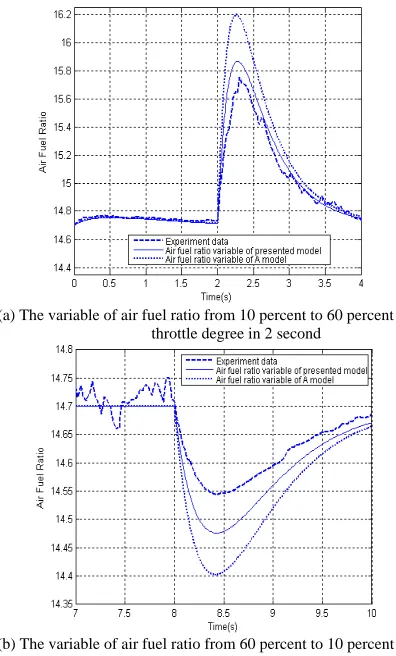
When throttle degree is invariable, the fact air fuel ratio is near to the theoretical air fuel ratio. When throttle degree is variable intensively, the fact air fuel ratio departs greatly from the theoretical air fuel ratio. The variable of air fuel ratio in mutation point of throttle degree is mainly shown in Fig2. Seen from Fig 2, the error between air fuel ratio variable of two fuel film model and experiment data is very small because the time constant of fuel film transiting is in a narrow range when the variable of throttle degree is in stable condition. Although the variable of τvconstant is neglected in a model, which can accurately approximate the variable of actual air fuel ratio. The accuracy of fuel film model presented in this paper is a little superior to a model. During the narrow variable range of throttle degree, τvis in a narrow range, which can not be neglected in stable condition and affected by the variable of airflow in the intake pipe and airflow into the cylinder. Therefore, τvis considered as a very small constant in the narrow variable of throttle degree. The fuel quantity of injected fuel into the cylinder is close to testing data by using the new fuel film model presented in this paper. It is show that the air fuel ratio variable of new model presented in this paper is identical with experiment data in Fig2.
B. The simulation of throttle angle changing from 10 percent to 60 percent
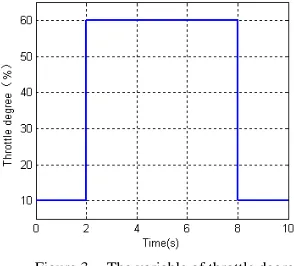
The variable of throttle position is shown on Fig 3. The simulation result with air fuel ratio variable of two fuel film models is shown on Fig4.
The variable of throttle degree is displayed on Fig 3 such as the initial degree is 10 percent, and the throttle degree is turned on 60 percent from 2 second to 8 second, and the throttle degree is closed to 10 percent until 10 second. The time of simulation is 10 second.
Figure 3. The variable of throttle degree
cylinder is calculated according to A model, the result is that the last time fuel quantity of entering in the cylinder, which is adapted to calculate the fuel quantity of entering in the cylinder will lead to the great error of air fuel ratio is produced. The accuracy of new fuel film model presented in this paper is superior to A model, which is compared to the stable condition the variable error of air fuel ratio with new model established in this paper and experiment data is intensive due to fuel film parameter is hardly identified. During transient condition, throttle position, engine load and condition parameter works in a large range, which will cause the variable range of time constant of fuel evaporating and fuel distribution coefficient to be increased. If time constant of fuel evaporating and fuel distribution coefficient is calculated according to the method of equation (11) and equation (12), the great error of injected fuel in the cylinder is produced, which will result in the variable error of air fuel ratio with new fuel film model and testing data is larger than stable condition. Consequently, it is great important that fuel film parameter is accurately identified,
which can improve the precision of fuel film model. From Fig2 (b) and Fig4 (b), when throttle degree
is closed in suddenly, the fact air fuel ratio departs from the theoretical air fuel ratio, and the dense of air fuel ratio is in a small scope because the method of closed loop is applied to control the air fuel ratio in gasoline engine, and the effect of closed loop is strengthened when throttle degree is in a small range.
(a) The variable of air fuel ratio from 10 percent to 60 percent of throttle degree in 2 second
(b) The variable of air fuel ratio from 60 percent to 10 percent of throttle degree in 8 second
Figure 4. Compared to the air fuel ratio simulation result of two fuel film model and experiment data
IV. CONCLUSIONS
The costumed dynamic fuel film model of Aquino is introduced in detail, and the characteristic of Aquino’s dynamic fuel film model is also analyzed in this paper. Based on Aquino fuel film model, a new kind of dynamic fuel film model is presented in this paper. The fuel film dynamic characteristic of intake pipe is sufficiently described by this new model and the relation expression of τvconstant affected the injected fuel of entering in the
cylinder is also added in this new model, which can improve the accuracy of this new model. The air fuel ratio variable of two fuel film model is simulated by using SIMULINK based on mean value engine model and the result is compared with experiment data. The result shows that the intake pipe fuel film dynamic characteristic is accurately described by the new model. The new model accuracy is higher than Aquino model.
V. ACKNOWLEDGEMENT
The authors would like to thank the anonymous reviewers for their useful comments. This work was partially supported by a grant from the National Natural Science Foundation (NSF) of China (50846055 and 51046004), and a grant from Basic Research Program of Hunan Provence (2008FJ2009), and a grant from young foundation of Hunan province Education Department(No 09B003).
REFERENCES
[1] Aquino C F. Transient A/F Control Characteristics of 5 Liter central fuel Injection Engine. SAE Paper[C]. USA: Society of Automotive Engineers Inc, 1981: 682-694. [2] Hendricks E, Vesterholm T, Jensen M, Nonlinear
Transient Fuel Film Compensation. SAE Technical Paper , 1993:767~775.
[3] Chevalier A, Hendricks E. On the Validity of Mean Values Engine Models during Transient Operation [C]. Washington: SAE Paper 2000011261, 2000:457-464. [4] Moskwa, J.J., Estimation of Dynamic Fuel Parameters in
Automotive Engines. ASME Journal of Dynamic Systems, Measurement and Control, December 1994.
[5] Hendricks E. The Analysis of Mean Value SI Engine Models [C]. SAE Paper, 1992:682~690.
[6] I.Arsie, C Pianese, G Rico, etc. An Adaptive Estimator of Fuel Film Dynamics in the Intake Port of a Spark Ignition Engine. Control Engineering Practice, 2003(11): 303~309. [7] Hendricks E. Mean Value Modeling of Spark Ignition
Engines[C]. SAE Paper, 1996:616-630.
[8] Manzie C, Palaniswami M, Watson H. Gaussian Networks for Fuel Inject Control[C]. Proc instn Mech Engrs, 2001,215 partD:1053~1068.
[9] Zhu Hang, Wang Shaoguang. Calibration for Characteristic Parameters of Fuel Film in Intake Duct of EFI Gasoline Engine [J]. Automotive Engineering, 2004,26(2):127-130.
Proceedings of Seventh IEEE Mediterranean Conference on Control and Automation, Haifa, Israel, 2003:184~199. [11] Hou Zhi-xiang, Wu Yi-hu, Deng Hua et al. Air Fuel Ratio
Control of Gasoline Engine under Transient Condition Based on Neural Networks[J]. Chinese Internal Combustion Engine Engineering. 2007, 27(5): 33-36. [12] Cesare Alippi and Cosimo de Russis, and Vincenzo Piuri.
A Neural Network Based Control Solution to Air-Fuel Ratio Control for Automotive Fuel-Injection Systems. IEEE Transactions on Systems, Man, And Cybernetics— Part C: Applications And Reviews, Vol. 33, No.2, May 2003
[13] K. S. Narendra and K. Parthasarathy, Identification and control of dynamical systems using neural networks, IEEE Trans. Neural Networks, Vol. 1, pp. 4–27, Jan. 1990.
Zhixiang HOU (China, 1971) received his bachelor degree in 1993 and master degree in 2002, PHD in 2006, respectively from Central South University, Changsha University of Science and Technology and Central South University, both in control theory and engineering. Currently he is a teacher of Changsha University of Science and Technology His main research interests focus on automobile electric control. He is responsible for more 10 foundation works in the past 10 year including 3 Nature Science Foundation of China. He published more 40 papers. He has act as the publish chair and organization chair of 5 international conferences cosponsored by IEEE.