• No results found

Sensitivity Analysis of LRB Isolator for RC Shear Frame

N/A
N/A
Protected

Academic year: 2020

Share "Sensitivity Analysis of LRB Isolator for RC Shear Frame"

Copied!
8
0
0

Loading.... (view fulltext now)

Full text

(1)

Amrutharani H R Jagadeesh B N

Assistant Professor Assistant Professor Department of Civil Engineering Department of Civil Engineering

Akshaya Institute of Technology, Tumkur-572106 (India) Akshaya Institute of Technology, Tumkur-572106 (India)

Abstract

In the past due to earthquakes many concrete structures are severely damaged. This has indicated the need for evaluating the seismic adequacy of existing buildings. In particular, the seismic rehabilitation of aged concrete structures in high seismic areas is a matter of growing concern, since structures vulnerable to damage must be identified and an acceptable level of safety must be determined. Sensitivity analysis plays a critical role in inverse and identification studies, as well as numerical optimization and reliability analyses for the structural engineers. Sensitivity analysis of structures to dynamic loads is essential for the structural engineers to identify the response variables that are important to the response of the system. Then it is essential to understand any change in the physically identifiable design variable of the structural system affect the response variable. When the structural engineer studies the relationship between the response variables and the design variables, it is possible to achieve the value of response variable toward a desired value. This analysis to understand the relationship between stiffness (k), mass (m), and damping co-efficient (c) is termed as the sensitivity analysis. The present work focuses on determining the effectiveness of lead rubber bearing isolator by determining the parameters like displacement, storey drift, frequency, base shear force, mass and stiffness for various frames with fixed base (without base isolation) and with base isolation. The performance of Lead Rubber Bearings(LRB) is check by sensitivity of stiffness, mass & natural frequency.

Keywords: LRB; Stiffness; Mass; Natural Frequency

________________________________________________________________________________________________________

I.

INTRODUCTION

(2)

Fig. 1: Behavior Change While Using Isolator. (A) Conventional Structure (B) Base –Isolated Structure

II.

BASE ISOLATION

Seismic Isolation increases the fundamental period of vibration so that the structure is subjected to lower earthquake forces. However, the reduction in force is accompanied by an increase in displacement demand which must be accommodated within the flexible mount, Furthermore, longer period frames can be lively under service loads. The following are three basic elements in any practical isolation system (Skinner et al., 1993), they are:

1) A flexible mounting so that the period of vibration of the frame is lengthened sufficiently to reduce the force response. 2) A damper of energy dissipater so that the relative deflections across the flexible mounting can be limited to a practical

design level.

3) A means of providing rigidity under low (service) load levels such as wind and braking force.

The present study is to check the performance of a base isolated structure with LRB isolator by sensitivity approach.

Lead Rubber Bearing: A.

This type of elastomeric bearings consist of thin layers of low damping natural rubber and steel plates built in alternate layers and a lead cylinder plug firmly fitted in a hole at its center to deform in pure shear as shown in below figure. The LRB was invented in New Zealand in 1975 and has been used extensively in New Zealand, Japan and United States. The steel plates in the bearing force the lead plug to deform in shear. This bearing provides an elastic restoring force and also, by selection of the appropriate size of lead plug, produces required amount of damping. The force deformation behavior of the bearing is shown in below figure. Performance of LRB is maintained during repeated strong earthquakes, with proper durability and reliability.

Fig. 2: Geometry, Schematic Diagram and Ideal Force –Deformation Behaviour of LRB

III.

MODELLING AND ANALYSIS

For time history analyses, earthquake ground acceleration in each direction is given as a digitized response spectrum curve of pseudo-spectral acceleration response versus period of the structure. This approach seeks to determine the likely maximum response rather than the full time history.

Earthquake Detail: A.

Peak Ground Acceleration = 0.106g Frequency = 3.65 Hz

(3)

Fig. 3: Input Time History Acceleration of a Bhuj Earthquake (0.1g).

For time history analysis it is need to give the input data in terms of transient data. In Etabs the previous earthquake data recorded can be input in terms of acceleration (m/s2). For the present study the data taken is Bhurj Earthquake of January 26, 2001 at 08:46:42.9 I.S.T. Mag: 7.0 Mb, 7.6 Ms .Station: Ahmadabad Lat& Long 23 02 N, 72 38 E Comp: N 78 E.

Now find out the response of the RC frames by time history analysis using finite element based software ETABS.

Time history analysis is carried out for one, five& ten storey single bays & two bay 3D frames-off without base isolation(fixed base) and with base isolation (by using LRB). The effect due to LRB isolator has been studied Using ETABS software with & without base isolated symmetric frames are analyzed.

(4)

Fig. 5: 10 Storey 1-Bay Plan View and Elevation View of With Base Isolation

Fig. 6: 10 Storey 2-Bay Plan View and Elevation View of Without Base Isolation

(5)

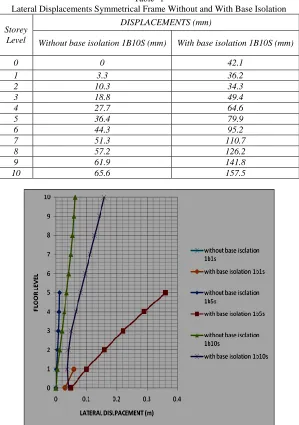
Table -1

Lateral Displacements Symmetrical Frame Without and With Base Isolation Storey

Level

DISPLACEMENTS (mm)

Without base isolation 1B10S (mm) With base isolation 1B10S (mm)

0 0 42.1

1 3.3 36.2

2 10.3 34.3

3 18.8 49.4

4 27.7 64.6

5 36.4 79.9

6 44.3 95.2

7 51.3 110.7

8 57.2 126.2

9 61.9 141.8

10 65.6 157.5

Fig. 8: Lateral Displacement V/S Floor Level For1 BAY Frame

(6)

Sensitivity of Mass and Stiffness of the Frame: B.

Table -2

Stiffness of the Frame V/S Mass of the Frame (Without Base Isolation) Type of Frame Mass of Frame Stiffness of Frame

1B1S 351.2 87.67

1B5S 2018.95 5.57

1B10S 4103.63 0.868

2B1S 682.22 160.4

2B5S 3917.14 13.07

2B10S 7801.94 1.76

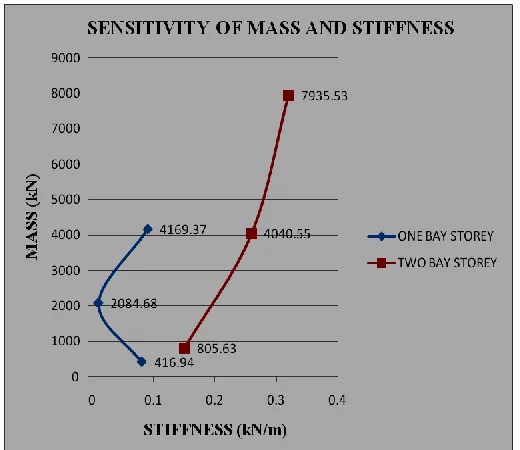
Fig. 9: Mass of Frame V/S Stiffness of the Frame (Without Base Isolation)

Fig. 10: Mass of Frame V/S Stiffness of the Frame (Without Base Isolation)

The stiffness of 2B1S, 2B5S&2B10S frames is higher than 1B1S, 1B5S &1B10S frames. When we compare the stiffness of two bay frames much stiffer than one bay frames. Comparison of two bay 2B1S, 2B5S& 2B10S frame is 2.3times stiffer than one bay 1B1S, 1B5S & 1B10S.

(7)

Sensitivity of Natural Frequency and Stiffness of the Frame: C.

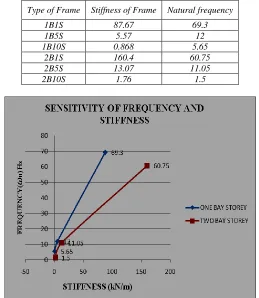
Table -4

Stiffness of the Frame V/S Natural Frequency (Without Base Isolation)

Type of Frame Stiffness of Frame Natural frequency

1B1S 87.67 69.3

1B5S 5.57 12

1B10S 0.868 5.65

2B1S 160.4 60.75

2B5S 13.07 11.05

2B10S 1.76 1.5

Fig. 11: Stiffness of Frame V/S Natural Frequency (Without Base Isolation)

The stiffness of 2B1S, 2B5S & 2B10S frames is higher than 1B1S, 1B5S&1B10S frames. Comparison of two bay 2B1S, 2B5S & 2B10S frame is 3.55 times stiffer than one bay 1B1S, 1B5S&1B10S. The natural frequency of the frame two bay 1B1S, 1B5S & 1B10S frames is higherthan2B1S, 2B5S&2B10S frames. When we compare the natural frequency of one bay frames have more natural frequency than two bay frames. Comparison of two bay1B1S, 1B5S & 1B10S frame have more natural frequency than one bay 2B1S, 2B5S & 2B10S.

Table -4

Stiffness of the Frame V/S Natural Frequency (With Base Isolation) Type of Frame Stiffness of Frame Natural frequency

1B1S 0.08 4.58

1B5S 0.01 0.816

1B10S 0.09 0.314

2B1S 0.15 3.95

2B5S 0.26 0.6911

(8)

Fig. 12: Stiffness of Frame V/S Natural Frequency (With Base Isolation)

The stiffness of 2B1S, 2B5S&2B10S frames is higher than 1B1S, 1B5S&1B10S frames. When we compare the stiffness of two bay frames much stiffer than one bay frames. Comparison of two bay 2B1S,2B5S & 2B10S frame is 3.55 times stiffer than one bay 1B1S,1B5S &1B10S. The natural frequency of the frame two bay 1B1S, 1B5S& 1B10S frames is lower than2B1S, 2B5S & 2B10S frames. When we compare the natural frequency of one bay frames have more natural frequency than two bay frames. Comparison of two bay 1B1S, 1B5S & 1B10S frame have more natural frequency than one bay 2B1S, 2B5S & 2B10S.

V.

CONCLUSIONS

Conclusions can be made from the analysis from the following cases:

The Performance of Base Isolated Structure with Fixed Base: A.

1) It has been observed that as the floor height increases, lateral displacement increases drastically in fixed base frame. . 2) It is observed that the storey drift varies for the fixed base (without base isolation) at different storey levels but it remains

same for isolated frame this show that the effectiveness of base isolated structure against the P-Δ effect.

3) With the incorporation of isolated system reduces the base shear and natural frequency of the frame hence it is more effective in earthquake resistant design of structure.

Sensitivity Analysis: B.

This analysis gives us a clear idea of the variation to be made whether in stiffness or mass of the given structure.

1) For two bay frames the mass and the stiffness is more with lower frequency when compared with one bay frames. 2) The flexibility of the structure increases by providing base isolation to the structure which increases the time period of the

structure. Hence by providing base isolation system it is more effectiveness in earthquake resistance design.

ACKNOWLEDGMENT

The success associated with the accomplishment of any task would be incomplete without acknowledging the people who made it possible. I am immensely and sincerely thankful to The HOD, Dean, Principal and Management of Acharya Institute of Technology, Bangalore, under whose constant support and encouragement this paper has been accomplished flawlessly.

REFERENCES

[1] Assankareem (1997), “Modeling of base- isolated frame with passive dampers under winds, Journal of wind engineering and industrial aerodynamics. [2] Hadj Mohamed ounis (2011), “Effect of the damping on the seismic response of a base isolated frame”, world young researches.

[3] Julie. S(2012), “Performance of base isolator and tuned mass damper in vibration control of a multistoried frame”, IOSR Journal of Mechanical and Civil engineering.

[4] Kelly JM(1998). “Base Isolation: Origins and Development” A Paper submitted in National Information Services for Earthquake Engineering (NISEE), University of California, Berkeley.

[5] Kelly TE(2001). Base isolation of structures: design guidelines. Auckland: Holmes Consulting Group Ltd. available from www.holmesgroup.com, 2001. [6] A.B.M.Saifulislam,Mohamedjameeland Mohdzaminjumaat (2011), “Seismic isolation in frame to be practical reality: Behavior of structure and installation

technique, Journal of engineering and technology research.

[7] Shirulepravin Ashok, Niraj Mehta, Rahul wagh, Mayer padhijas, Ankesh samara and Yogeshpatil (2012), “Base response spectrum analysis of multistoried base-isolated frame”, IJCSIERD.

[8] Skinner RI, Robinson WH, Mcverry GH (1993). An Introduction to Seismic Isolation. John Wiley and Sons Ltd.

Figure

Table -1 Lateral Displacements Symmetrical Frame Without and With Base Isolation
Table -2 Stiffness of the Frame V/S Mass of the Frame (Without Base Isolation)
Table -4 Stiffness of the Frame V/S Natural Frequency (Without Base Isolation)

References

Related documents

As noted in the Literature Review, above, scholarship on the determinants of foreign direct investment (FDI) variously argue the influence of GDP growth, the openness of a

A study on drug related problems in chronic kidney disease patients of a tertiary care teaching hospital in south India. DRUG-REAX® System: Greenwood Village,

Field experiments were conducted at Ebonyi State University Research Farm during 2009 and 2010 farming seasons to evaluate the effect of intercropping maize with

In contrast to other seawater bodies with 3.5% salinity, the recreational waters in the southern coast of the Caspian Sea possess its own salinity (about 1% w/v) and thus

There are two schools of thought about the etiology of liver enlargement in acute rheumatic fever, You all are familiar with the fact that a picture which appears to be right

Is use of the human papillomavi- rus vaccine among female college students related to human papillomavirus knowledge and risk perception. Sexually Transmitted Infections,

Keywords: Computer forensics, digital computer forensic science, electronic investigation, forensics techniques, imaging, investigation, law enforcement techniques, legal use