International Journal of Pharmaceutical Sciences and Drug Research 2014; 6(3): 183-188
183
Research Article
ISSN 0975-248X
Formulation, Optimization and In vitro Characterization of Letrozole
Loaded Solid Lipid Nanoparticles
Archana Nerella
*, Basava Raju D, Aruna Devi M
Shri Vishnu College of Pharmacy, Vishnupur, Bhimavaram, West Godavari -534202, Andhra Pradesh, India
ABSTRACT
Letrozole (LTZ) is an oral non-steroidal aromatase inhibitor for the treatment of hormonally responsive breast cancer after surgery. The objective of the current study is to prepare and evaluate Solid lipid nanoparticles (SLN) of LTZ. SLNs were prepared by hot homogenization followed by ultrasonication. Trimyristin was used as solid lipid core, Soyphosphatidyl choline, Tween 80 as surfactant mixture. Process and formulation variables were studied and optimized. LTZ-SLN were characterized for mean particle size, polydispersity index (PDI) and zeta potential for all the formulations. The mean particles size, PDI, zeta potential and entrapment efficiency of optimized LTZ-SLN optimized formulation was found to be
28.54 nm, 0.162, 11.80 mV, 85.64 %, respectively. In vitro release profiles are performed in 0.1N HCl using modified franz
diffusion cell showed controlled drug release behavior over a period of 24h. LTZ-SLN formulations are subjected to stability study over a period of 1 month in terms of particle size, zeta potential, PDI, entrapment efficiency and are found to be stable. Differential scanning calorimetry (DSC) and transmission electron microscopy (TEM) analysis was performed to characterize the state of drug, lipid modification, shape and surface morphology of prepared LTZ-SLN formulations.
Keywords: Letrozole, Solid lipid Nanoparticles, Trimyristin, stability, DSC, TEM.
INTRODUCTION
Solid lipid nanoparticles (SLNs) were developed as an interesting carrier system in the middle of 1990s. SLN combines the advantages of polymeric nanoparticles such as controlled drug release, cytotoxicity and avoiding drug leakage, and the advantages of emulsion and liposome such as low toxicity, good biocompatibility and higher bioavailability. [1-2] Moreover, compared with the traditional polymeric nanoparticles, an outstanding advantage of solid lipid nanoparticles (SLNs) is that the lipid matrix is composed of physiologically tolerated lipid components, which decreases the potential for acute and chronic toxicity.
[3] However, there were some disadvantages for SLN namely
limitation in drug loading capacity, risk of gelation and drug leakage during storage caused by lipid polymorphism, high water content of SLN dispersions (70-95%). [4-5] SLN consist of pure solid lipids. Due to presence of suitable lipid in SLN led to improved properties for drug loading, modulation of the drug release profile and stable drug incorporation during storage.
Depending on the productive method and the composition of
*Corresponding author: Mrs. Archana Nerella,
Department of Pharmaceutics, Shri Vishnu College of Pharmacy, Vishnupur, Bhimavaram, West Godavari -534202, Andhra Pradesh, India;
E-mail: [email protected]
lipid blend, different types of SLNs were obtained, i.e., the
imperfect, amorphous and multiple components. [5]
Crystalline of SLN, thereby lead to ‘highest incompatibility’ and higher drug loading. [6] SLNs are colloidal lipidic systems that have been proposed for several administration routes, such as parenteral, oral, ocular and topical [6] route and providing controlled release profiles for many substances. These carriers are composed of physiological and biodegradable lipids exhibiting low systemic toxicity and low cytotoxicity. Nanoparticles are produced by one of the following techniques, namely, high pressure homogenization
[7], microemulsion template technique [8-9], Cold
homogenization technique, solvent emulsification technique
[10], solvent diffusion technique [11], reverse micelle-double
emulsion technique [12], homogenization followed by
ultrasonication technique, Solvent Injection technique [13], and a very recently introduced membrane contractor technique. [14]
Int. J. Pharm. Sci. Drug Res. July-September, 2014, Vol 6, Issue 3 (183-188)
slowly to an inactive metabolite resulting that absolute bio-availability of oral letrozole is low. Therefore, the development of novel types of delivery systems which increases the oral bioavailability could lead to significant advantages in the clinical use of the drug.
The aim of the present study was to assess the feasibility of preparing SLNs loading LTZ by homogenization followed by ultrasonication technique and the physicochemical properties of obtained LTZ loaded SLN, such as mean particle size, zeta potential, drug entrapment efficiency, in vitro drug release behavior. The effects of composition of lipid materials and surfactant mixture on particle size, zeta potential, drug entrapment efficiency, and in vitro drug release behavior were investigated in detail. Differential scanning calorimetry (DSC) analyses were performed to investigate the status of the lipid and the drug. Shape and surface morphology was determined by TEM.
MATERIALS AND METHODS Materials
LTZ was a kind gift from NATCO PHARMA Pvt. Ltd; Hyderabad, trimyristin (TM) (Dynasan 114) was generously
supplied by Sasol (Witten, Germany); Soy
phosphatidylcholine 99% (Epikuron 200) was donated by Degussa Texturant Systems (Deutschland, Hamburg). Tween 80 and dialysis membrane-70 were purchased from Hi-Media (Mumbai, India). Centrisart filters (molecular weight cutoff 20,000) were purchased from Sartorius (Goettingen, Germany). The other chemicals were of analytical reagent grade.
Preparation of LTZ loaded solid lipid nanoparticles
LTZ, trimyristin, and soy phosphatidylcholine 99% were dissolved in mixture of chloroform and methanol (1:1). Organic solvents were completely removed using a rotaevaporator (Laborota 4000, Heidolph, Germany). Drug-embedded lipid layer was melted by heating at 5°C above melting point of the lipid. An aqueous phase was prepared by dissolving polysorbate 80 in double distilled water (sufficient to produce 10 ml of preparation) and heated to same temperature of oil phase. Hot aqueous phase was added to the oil phase, and homogenization was carried out (at 12,000 rpm) using a Diax 900 homogenizer (Heidolph, Germany) for 3 min. Obtained hot oil in water coarse emulsion was ultrasonicated using Sonoplus ultrahomogenizer (Bandelin, Germany) for 15-20 min and allowed to cool to room temperature to get LTZ loaded SLNs and was stored at 4-8ºC for further analysis.
Characterization of LTZ loaded Solid Lipid Nanoparticles
Measurement of particle Size and zeta potential
The size and zeta potential of SLN were measured by photon correlation spectroscopy using a Zetasizer 3000 HSA (Malvern, UK). Zeta potential was carried out at room temperature and the electric field strength was around 23.4 V/cm. Samples were diluted appropriately with the aqueous phase of the formulation to get optimum kilo counts per second (Kcps) of 50-200 for measurements, and the pH of diluted samples ranged from 7.0 ± 0.2.
Determination of drug content
Drug content was estimated in the form of assay, 50µL of SLN formulation was diluted to 1 mL with chloroform: methanol (1:1). The final dilution was made with the mobile phase, and LTZ content was determined by HPLC.
HPLC methodology for Letrozole
HPLC determination of LTZ was performed using Shimadzu LC 20AT solvent delivery pump equipped with a 20µL loop and rheodyne sample injector UV-Visible detector at 230nm. Samples were chromatographed on a stainless steel C-18 reverse phase column (250 × 4.25 mm) packed with 5μm particle (phenomenex column).
Determination of entrapment efficiency
Entrapment efficiency (EE%) was determined by measuring the concentration of free drug (unentrapped) in aqueous medium as reported previously Venkateswarlu et al., 2004.
[15] The aqueous medium was separated by ultra-filtration
using centrisart tubes (Sartorius, USA), which consists of filter membrane (M.wt. cut off 20,000 Da) at the base of the sample recovery chamber. About 1ml of the formulation was placed in the outer chamber and sample recovery chamber placed on top of the sample and centrifuged at 4000 rpm for 15 min. The SLN along with encapsulated drug remained in the outer chamber and aqueous phase moved into the sample recovery chamber through filter membrane. The amount of LTZ in the aqueous phase was estimated by HPLC method and the entrapment efficiency was calculated by the equation: Drug entrapment efficiency (%) = analyzed weight of drug in SLNs / theoretical weight of drug loaded in system × 100.
In vitro release Study
In vitro release studies were performed in 0.1N HCl (pH 1.2) using modified franz diffusion cell and dialysis membrane having pore size 2.4 nm, molecular weight cut-off between 12,000-14,000 was used. Membrane was soaked in double distilled water for 12 h. SLN dispersion (2 mL) was placed in the donor compartment and the receptor compartment was filled with 50 mL of release media. During the experiments, the solution in receptor side was maintained at 37°C ± 0.5°C and stirred at 800 rpm with magnetic stirring bars. At 0.5, 1, 2, 3, 4, 6, 8, 12, and 24 h time points, samples were withdrawn and analyzed by HPLC. Data obtained from in vitro release studies were fitted to various kinetic equations to find out the mechanism of LTZ release from SLN.
Stability Studies
LTZ loaded SLN was stored at room temperature (25°C) and at refrigerator temperature (2-80C) for 1 month and average particle size, zeta potential, PDI were determined. LTZ loaded SLNs were stored at room temperature for 30 days and entrapment efficiency is calculated.
Differential scanning calorimetry (DSC)
DSC analysis of LTZ, TM, physical mixture (PM), and lyophilized LTZ-SLN was performed using Mettler DSC (Mettler-Toledo, Viroflay, France). The instrument was calibrated with indium. All the samples (~5 mg) were heated in aluminum pans using dry nitrogen as the effluent gas. The analysis was performed with a heating range of 30-200°C and at a rate of 10°C/min. Analysis was performed under a nitrogen purge (50 mL/min).
Transmission Electron Micrographic studies
Images were recorded on a Transmission Electron Micrograph (Hitachi, Japan, Model Model H. 7500 ID) with magnification: 179000x. LTZ loaded SLN was diluted appropriately with 0.1 M phosphate buffer and centrifuged at 4000 rpm for 5 min. Few drops of the diluted emulsion was placed on grid and stained with 2 % uranyl acetate, and then the image was captured.
Table 1: Composition of the investigated LTZ-SLN formulations
Formulations Letrozole (mg) Trimyristin (% w/v) Soyphosphatidylcholine (% w/v) Tween 80 in 20 mL Water (%w/v)
Solvent system (mL) (Chloroform & Methanol, 1:1)
SLN 1 2.5 1.5 0.75 1.5 10
SLN 2 2.5 1.5 0.75 1.25 10
SLN 3 2.5 1.5 0.5 1.0 10
SLN 4 2.5 1.5 0.5 0.75 10
SLN 5 2.5 1.25 0.75 1.5 10
SLN 6 2.5 1.25 0.75 1.25 10
SLN 7 2.5 1.25 0.5 1.0 10
SLN 8 2.5 1.25 0.5 0.75 10
Table 2: Mean particle size, PDI, zeta potential and entrapment efficiency (EE%) of investigated LTZ-SLN formulations (mean ± SD, n = 3) Formulation Mean particle size (nm) Zeta potential (mV) PDI Entrapment efficiency (%)
SLN 1 28.54 ± 4.23 11.8 ± 6.62 0.162 ± 0.09 85.64 ± 6.50 SLN 2 30.36 ± 4.95 11.4 ± 6.68 0.158 ± 0.012 84.32 ± 6.13 SLN 3 33.86 ± 8.91 8.26 ± 6.11 0.201 ± 0.008 83.15 ± 4.96 SLN 4 32.45 ± 4.29 7.28 ± 5.58 0.185 ± 0.021 81.74 ± 6.22 SLN 5 32.71 ± 3.53 7.86 ± 5.61 0.189 ± 0.011 85.07 ± 5.48 SLN 6 34.36 ± 4.47 7.44 ± 4.48 0.212 ± 0.016 84.85 ± 5.78 SLN 7 37.10 ± 5.12 6.98 ± 3.15 0.209 ± 0.014 82.69 ± 7.66 SLN 8 37.64 ± 7.66 6.24 ± 2.12 0.196 ± 0.025 80.97 ± 8.71
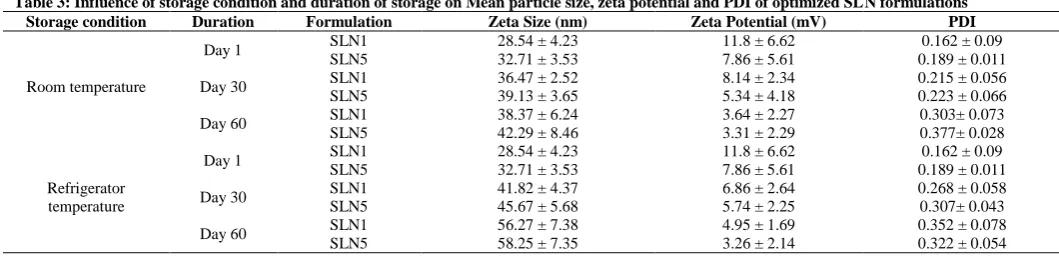
Table 3: Influence of storage condition and duration of storage on Mean particle size, zeta potential and PDI of optimized SLN formulations Storage condition Duration Formulation Zeta Size (nm) Zeta Potential (mV) PDI
Room temperature
Day 1 SLN1 28.54 ± 4.23 11.8 ± 6.62 0.162 ± 0.09 SLN5 32.71 ± 3.53 7.86 ± 5.61 0.189 ± 0.011 Day 30 SLN1 36.47 ± 2.52 8.14 ± 2.34 0.215 ± 0.056 SLN5 39.13 ± 3.65 5.34 ± 4.18 0.223 ± 0.066 Day 60 SLN1 38.37 ± 6.24 3.64 ± 2.27 0.303± 0.073 SLN5 42.29 ± 8.46 3.31 ± 2.29 0.377± 0.028
Refrigerator temperature
Day 1 SLN1 28.54 ± 4.23 11.8 ± 6.62 0.162 ± 0.09 SLN5 32.71 ± 3.53 7.86 ± 5.61 0.189 ± 0.011 Day 30 SLN1 41.82 ± 4.37 6.86 ± 2.64 0.268 ± 0.058 SLN5 45.67 ± 5.68 5.74 ± 2.25 0.307± 0.043 Day 60 SLN1 56.27 ± 7.38 4.95 ± 1.69 0.352 ± 0.078 SLN5 58.25 ± 7.35 3.26 ± 2.14 0.322 ± 0.054
Preparation of LTZ loaded SLN
Homogenization followed by ultrasonication is a reliable, simple and reproducible method for preparing SLN. [15-16]
Trimyristin as solid lipid, a mixture of Soy
phosphatidylcholine 99%, and tween 80 as surfactants were used in the formulation. It is known that the employ of two surfactants, respectively of lipophilic and hydrophilic nature, yields a better stabilization of the disperse system. The solvent mixture of chloroform and methanol (1:1) was found to be effective in homogenously dispersing the drug in the lipid phase. Rota evaporation at 5°C above the melting point of lipid and ensured the complete removal of the traces of organic solvents. Homogenization of the lipid phase with hot aqueous tween 80 solution for 3-4 min was sufficient to produce a coarse emulsion with average particle size between 2.58 and 2.96µ. Further increase in homogenization time did not show any significant decrease in the particle size. Thus a homogenization time of 3-4 min was selected for all the formulations and further reduction of size was preceded with sonication. Sonicating the coarse emulsion for 20 min resulted in particles between 28 and 38 nm with narrow size distribution. In order to optimize the lipid to drug ratio, different amounts of trimyristin (250 and 300 mg) were tried
with fixed amount of LTZ (2.5 mg) and soy
phosphatidylcholine 99% (100 mg & 75 mg). The final compositions of the investigated SLN dispersions were given in Table 1.
Particle sizes and zeta potentials
All the prepared samples were analyzed in order to determine their particle size distributions and zeta potential values. The results obtained after particle size analysis are shown in Table 2. In all formulations, the particle sizes ranged from 28
to 38 nm, and zeta potentials were about +6.2 mV to +11.8 mV. The increasing of surfactant content in SLNs formulations could reduce the interface tension between lipid matrix and dispersion medium (aqueous phase), consequently favor the formation of SLNs with smaller particle size. Tween 80 also provides a steric stability for maintaining the stability of SLN (15). To obtain stable and smaller SLN, tween 80 concentrations were varied from 1.5 % to 0.75 % (300 to 150 mg). It is evident from the table 2, that tween 80 concentration of 1.5% was effective in producing smaller particle size.
Zeta potential is a key factor to evaluate the stability of colloidal dispersion. It was currently admitted that zeta potentials above 30mV were required for full electrostatic stabilization. However, many experiments demonstrated that not only electrostatic repulsion dominated the stability of nanoparticles, the use of steric stabilizer also favored the formation of stable nanoparticle dispersion. [17-18] In these studies, it seemed that the value of zeta potential of LTZ loaded SLNs was not sufficient to keep the particles dispersing stably. However, the particle size did not change significantly within 30 days, which should contribute to the following point. High surfactant mixture can easily compensate for missing electrostatic repulsion to stabilize the dispersion for long time. Tween 80 provides a steric stability for maintaining the stability of SLN.
Entrapment efficiency
Int. J. Pharm. Sci. Drug Res. July-September, 2014, Vol 6, Issue 3 (183-188)
lipids are used. The high purity lipid matrix of these particles solidifies upon cooling but does not recrystallize and remains in the amorphous state. A second type of SLN is formed when the lipid molecules are chemically very different, resulting in a structure with many imperfections to accommodate the drug and thus higher loading capacity. About 87 % of entrapment efficiency is seen in SLN 1 formulation. As the surfactant concentration is increased in the formulation increase in entrapment efficiency of the SLN formulations were observed. Entrapment efficiency of SLN formulations are shown in Table 2.
Effect of amount of surfactant mixture on particle size, zeta potential and PDI
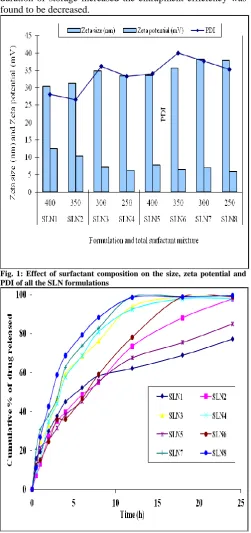
The surfactant amount in SLN is an important factor determining the physicochemical characteristics due to the surface-active properties. Whether the increase in the surfactant amount influenced the zeta potential, particle size and PDI of LTZ-SLN was investigated. As expected, the zeta potential of SLNs tended to decrease with decrease in the total amount of surfactant mixture (soy phosphatidylcholine + tween 80). As the amount of surfactant mixture is increasing there is a little decrease in the particle size value. The effect of surfactant composition on the size, zeta potential and PDI of SLN are presented in figure 1.
In vitro release Study
In order to evaluate the controlled release potential of the investigated formulations, the diffusion of LTZ from the lipid particles was investigated over 24 h. In vitro drug release profile of LTZ loaded SLN formulations are presented in figure 2. SLN formulations, SLN 4 and 8 showed maximum drug release in 12 h, SLN 3 and 7 in 18 h.
Due to low content of lipid in formulations SLN 5 to SLN 8 showed more drug release compared to SLN formulations 1 to 4. As the surfactant concentration is decreasing from 1.5% to 0.75% there is decrease in controlled release properties of the SLN formulations. There is high amount of drug release in the formulation SLN 3, 4, 7, and 8 than SLN 1, 2, 5, and 6 due to decrease in amount of lipid concentration from 1.5 to 1.25. In vitro drug release profile of SLN formulations in 0.1N HCl were shown in figure 2. The drug release data of most of the SLN formulations fitted well into the Higuchi square root release kinetics (r2 values ranging from 0.92 to 0.99). This indicates that the test product follows matrix diffusion based release kinetics.
Stability study
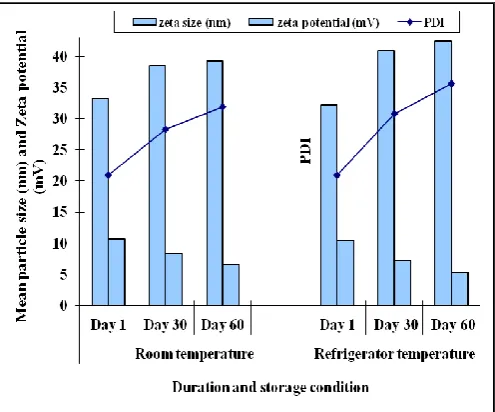
All the formulations are stored in amber colored bottles at room temperature and refrigerator temperature. As SLN 3, 4, 7, and 8 formulations are not stable, so rest of formulations that is SLN 1, 2, 5 and 6 are analyzed for particle size, zeta potential and PDI on initial, 15 days and 1 month of preparation which are stored at room temperature and refrigerator temperature. SLN 1, 2, 5, 6 are analyzed for entrapment efficiency on initial, 15 days and 1 month of preparation which are stored at room temperature. The effect of duration of storage and storage condition on particle size, zeta potential and PDI of SLN are presented in figure 3 and Table 3.
There is no significant difference in particle size, zeta potential, and PDI between SLN on the day of preparation but as the duration of storage increases up to one month the SLN formulation found to be stable. The good stability might derive from the slow transition of lipid in nano formulations, low particles size and the steric effect of Tween 80. These
results clearly suggest that an optimum tween 80 concentration of 1.5% was sufficient to cover the surface of nanoparticles effectively and prevent agglomeration during the homogenization process. During long-term storage, triglycerides undergo degradation to fatty acids and mono- and diglycerides, which could compete with formulation surfactants for positioning on the surface. Fatty acids and monoglycerides can form mixed micelles that might enhance the partitioning of hydrophobic drug out of the nanoparticle. Therefore, the concentration of excipients and possible degradation products need to be determined to understand the stability of nanoparticles. The effect of duration of storage and storage condition at room temperature on entrapment efficiency of LTZ-SLN is presented in figure 4. As the duration of storage increased the entrapment efficiency was found to be decreased.
Fig. 1: Effect of surfactant composition on the size, zeta potential and PDI of all the SLN formulations
Fig. 3: Influence of storage condition and duration of storage on size and zeta potential and PDI of optimized SLN (SLN1) formulation
Fig. 4: Influence of duration of storage and storage condition at room temperature on entrapment efficiency of optimized SLN (SLN1, 2, 5 & 6) formulations
Fig. 5: DSC thermograms of LTZ (A), trimyristin (B), physical mixture of LTZ and TM (C), and lyophilized LTZ-SLN (D)
Fig. 6: Transmission electron microscope image of optimized LTZ loaded SLN
DSC Analysis
DSC thermograms of LTZ, trimyristin, physical mixture of drug and lipid, LTZ-SLN optimized formulation are shown in figure 5. The melting endotherm of the drug was completely absent in the thermograms of LTZ loaded SLN, which indicates that LTZ was completely solubilized inside the lipid matrix of the SLN. Incorporation of LTZ inside the lipid matrix results in an increase in the number of defects in the lipid crystal lattice, and hence causes a decrease in the melting point of the lipid in the final SLN formulations. LTZ-SLN was prepared and characterized for comparison with physical mixture and individual excipients. Bulk trimyristin showed a sharp endothermic event, ascribing to the melting, (minimum) around 58.68°C with an extrapolated onset of the melting peak 53.28°C (the difference between onset and minimum can be taken as a measure for the width of the peak). When the raw material was formulated as nanoparticles, the endothermic happened at a slightly lower temperature. These differences are generally ascribed to the nanometric size of the particles, having then a high specific surface area. [19] A certain effect due to the surfactant should be taken into account as well in the formulation. [20]
Visualization by Transmission Electron Microscopy (TEM)
The result of TEM imaging of LTZ loaded SLN are shown in figure 6 indicating that the particles are nanometer in size, spherical shapes and no drug crystal (irregular crystallization with the vast majority of needle or rod crystal in the length range from 10 micron to a few dozen microns) was visible. The average particle size of optimized LTZ loaded SLN was found to be 28.45 nm.
Int. J. Pharm. Sci. Drug Res. July-September, 2014, Vol 6, Issue 3 (183-188)
nanoparticles. Fairly spherical shaped, stable and controlled release LTZ loaded SLN could be prepared by hot homogenization followed by ultrasonication technique.
ACKNOWLEDGMENTS
The author acknowledge M/s NATCO PHARMA Pvt. Ltd., India for providing LTZ, M/s. Sasol, Witten Germany for providing trimyristin and M/s Degussa Texturant Systems Deutschland Hamburg for providing soy phosphatidylcholine 99%.
REFERENCES
1. YiFan L, DaWei C, LiXiang R, XiuLi Zhao, Jing Qin. Solid lipid nanoparticles for enhancing vinpocetine's oral bioavailability. J Contr. Rel. 2006; 114:53-59.
2. Dingler A, Gohla S. Production of solid lipid nanoparticles (SLN): scaling up feasibilities. J Microencapsul. 2002;19:11-16.
3. Mehnert W, Mader K. Solid lipid nanoparticles: Production, characterization and applications. Adv. Drug Deliv. Rev. 2001; 47:165-174.
4. Müller RH, Radtke M, Wissing SA. Nanostructured lipid matrices for improved microencapsulation of drugs. Int. J. Pharm. 2002; 242:121-129.
5. Shahgaldian P, Silva ED, Coleman AW, Rather B, Zaworotko MJ. Para-acyl-calix-arene based solid lipid nanoparticles (SLNs): a detailed study of preparation and stability parameters. Int. J. Pharm.
2003; 253:23-32.
6. Suresh G, Manjunath, K, Venkateswarlu V, Satyanarayana V. Preparation, Characterization, and In Vitro and In Vivo Evaluation of Lovastatin Solid Lipid Nanoparticles. AAPS PharmSciTech.
2007;8(1): E162–E170.
7. Yang SC., Lu LF, Cai Y, Zhu JB, Liang BW, Yang CZ. Body distribution in mice of intravenously injected camptothecin solid lipid nanoparticles and targeting effect on brain.J Contr Rel.1999; 59:299-307.
8. Xiang Li, Shu-fang Nie, Jun Kongb, Ning Li, Cheng-yi Ju, Wei-san Pan. A controlled-release ocular delivery system for ibuprofen based on nanostructured lipid carriers. Int. J. Pharm. 2008; 363:177-182.
9. Zara GP, Cavalli R, Fundaro A, Bargoni A, Caputo O, Gasco MR. Pharmacokinetics of doxorubicin incorporated in solid lipid nanospheres (SLN). Pharm Res. 1999; 40:281-286.
10. Yi Fan Luo, DaWei Chen, LiXiang Ren, XiuLi Zhao, Jing Qin. Solid lipid nanoparticles for enhancing vinpocetine's oral bioavailability. J Contr Rel. 2006; 114: 53-59.
11. Hong Yuan, Jing Miao, Yong-Zhong Du, Jian You, Fu-Qiang Hu, Su Zeng. Cellular uptake of solid lipid nanoparticles and cytotoxicity of encapsulated paclitaxel in A549 cancer cells. Int. J. Pharm. 2008;348:137-145.
12. Jores, K, Mehenert W, Mader K. Physicochemical investigations on solid lipid nanoparticles and on oil-loaded solid lipid nanoparticles: A nuclear magnetic resonance study 2003; 20(8):1274-1283. 13. Schubert MA, Muller-Goymann CC. Solvent injection as a new
approach for manufacturing lipid Nanoparticles-Evaluation of the method and process parameters. Eur. J. Pharm Biopharm. 2003; 55(1):125-131.
14. Catherine Charcosset, Assma El-Harati, Hatem Fessi. Preparation of solid lipid nanoparticles using a membrane contactor. J. Contr. Rel.2005; 108:112-120.
15. Venkateswarlu V, Manjunath K. Preparation, characterization and
in vitro release kinetics of clozapine solid lipid nanoparticles. J Contr. Rel. 2004; 95:627-638.
16. Manjunath K, Venkateswarlu V. Pharmacokinetics, tissue distribution and bioavailability of clozapine solid lipid nanoparticles after intravenous and intraduodenal administration. J Contr Rel. 2005; 107:215-228.
17. Cavalli R., Caputo O, Gasco MR. Preparation and characterization of solid lipid nanospheres containing paclitaxel. Eur. J. Pharm. Sci. 2000;10:305-309.
18. Heurtault B, Saulnier P, Pech B. Physico-chemical stability of colloidal lipid particles. Biomaterials2003; 24:4283-4300. 19. Westesen K, Bunjes H. Do nanoparticles prepared from lipids solid
at room temperature always possess a solid lipid matrix? Int. J. Pharm. 1995; 115:129-131.