ISSN (Online): 2320-9364, ISSN (Print): 2320-9356
www.ijres.org Volume 3 Issue 11 ǁ November. 2015 ǁ PP.40-48
Evaluation of Two-Set Algorithm in Embedding a Watermark
into an Audio Signal
C. Aquino
1,E. Perez
2, C. Aguilar
3 1esime Culhuacan, National Polytechnic Institute. 2esime Culhuacan, National Polytechnic Institute. 3esime Culhuacan, National Polytechnic Institute.
Abstract:
The protection of multimedia data has become a necessity due to the generation of illegal copies, thus, the purpose of this article was to analyze and evaluate the algorithm of two-set in embedding a watermark into an audio signal. Metrics were analyzed as the Perceptual Evaluation of Audio Quality (PEAQ) by calculating the Objective Difference Grade (ODG) to verify the inaudibility of the watermark and the robustness of it against attacks from resampling and Additive White Gaussian Noise (AWGN) by estimating the Bit Error Rate (BER). The process was applied to hundred Waveform Audio Format (WAV) clips classifieds in five musical genders and we obtained an ODG value average of -0.83045 that according to the International Telecommunication Union (ITU), the watermark is slightly perceptible if you listen with extreme care.I.
Introduction
Digital media has become a daily task, since these are new services required by people today, due to the exchange of audio, images, text and video. The problem lies when these files are copied anddistributed without permission of the author. To solve this problem there is digital watermarking, a technique to embed data in the signal to be protected (in this case audio) as an identifier. There are several algorithms to insert watermarks for images and video, however, few algorithms are dedicated to audio files because of the complexity of the Human Auditory System (HAS)[1], hence the purpose of this research is to insert a watermark into audio signals, interpret and evaluate the Two-Set algorithm using modified patchwork and verify the inaudibility and robustness of the watermark to be used as an identifier of the copyright.
Figure1. Watermark embedding and detecting scheme
The embedding process is performed by the Modified Patchwork technique3] equations derived from the original Patchwork method to increase the robustness (but it should be emphasized that this derivation is not enough to be resistant to many attacks, so it should be possible to combine different watermarking methods), working in the frequency domain under the Discrete Cosine Transform (DCT) and the detection process by Inverse Discrete Cosine Transform (IDCT) and it is possible with a secret key.
Section 2 shows the mathematical development of the algorithm, divided in the embedding process, metrics evaluation and detection process. In Section 3, the method is implemented, it shows the initial parameters and comparing the original signal and the watermarked and checking the results of the PEAQ between different types of audio files tagged and thus verify the inaudibility of the watermark embedded in them, furthermore, it shows the attacks that the watermark survives and its corresponding BER. The conclusions are in Section 4 and finally in Section 5 of the references consulted.
II.
Development
The evaluation of the method was built of three parts: the first is the embedding of the watermark in the audio signal; the second part is inaudibility tests and robustness to audio clips marked, finally it detects the embedded watermark after attacks.
The authors of [3] proposed watermark embedding method is known as Two-Set, based on modified patchwork algorithm. It works in the frequency domain and is based on the calculation of the DCT.
2.1. Watermark embedding
The watermark insertion steps[4] are summarized below:
The secret key and the digital watermark are associated to the seed of a random number generatorDivides the audio file into blocks of size Nand DCT is applied to each block.
We define two subsets of the set processing, one called A and another B
(1)
(2)
(3)
(4)
(5)
The embeddingfunctions presented below introduce the watermark:
(6)
(7)
Where C is a constant and sign is the sign function what makes large values larger and small values smaller. Finally, replace the selected itemsandrespectively apply the IDCT in theFrequency domain
2.2. Metrics evaluation
The evaluation metrics are to test the inaudibility of the watermark embedded in the audio clips and check the robustness of it against attacks from resampling and AWGN.
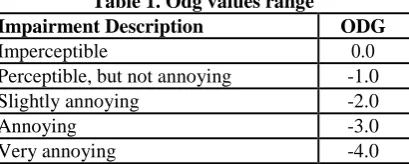
Inaudibility test should evaluate the quality of the audio clips watermarked with the standard ITU BS.1387-1[7] established by ITU for PEAQ provides accurate estimates of audio quality degradation occurring in the watermarked signal compared with the original. This is based on the properties of the human auditory system, modeling the psychoacoustic effects and is verified by calculating the Objective Difference Grade (ODG). The ODG ranges from 0 to -4 and is defined as Table 1
Table 1. Odg values range
Impairment Description ODG
Imperceptible 0.0
Perceptible, but not annoying -1.0
Slightly annoying -2.0
Annoying -3.0
Very annoying -4.0
For robustness tests we resampled the signals watermarked by different sampling rates. This process was done by changing the sampling frequency of thesignal watermarked and checking that the embedded bits were the same in the detection process, it was calculated how many erroneous bits exist in the watermarked audio clip, it is the number of bit errors divided by the total number of transferred bits during a studied time interval and its correspondent BER [6] as a unit less performance measure, often expressed as a percentage.
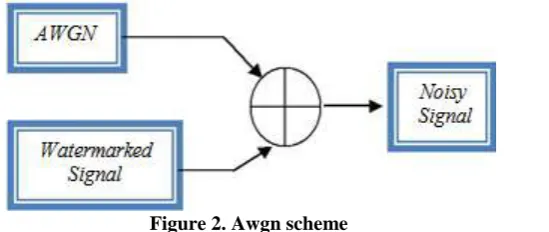
Also, it was added an AWGN to the watermarked clips. The AWGN term refers to the fact that eventually the noise is combined with the desired signal. As the noise gets added (and not multiplied) to the received signal, the spectrum noise if flat for all frequencies and the values of the noise follows the Gaussian probability distribution function:
(8) Where;
(9)
obtain the number of erroneous bits that exist in different intensities of Signal to Noise Ratio (SNR) of the AWGN. Figure 2 shows the general outline of the AWGN, note that it is additive and not multiplicative
Figure 2. Awgn scheme
2.3. Watermark detection
The following algorithm[4] was used to verify whether the embedded watermark was the same in the discovery process after the attacks. The decoding steps were as follows:
The secret key and the digital watermark are associated to the seed of a random number generator.
Obtain subsets y for bit insertion 0 and thesubsets
y for bit insertion 1.
Averages are calculated for each sample subsets and standard errors for 0 y 1. We calculate test statistics S (see equation 7) andT2
(11)
T2is defined as the highest values of the statisticsobtained.
The seed detected will be that for the parameter T2 is maximum.
The process was to watermark audio clips;subject to attacks and to detect the survival of the watermark. Below are the results of the evaluation algorithm.
III.
Results
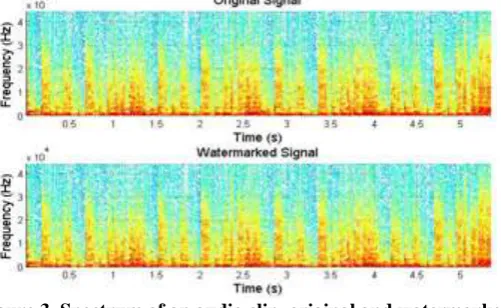
The algorithm was applied to a hundred audio clips of music (of which only twenty are reported) divided in five categories, these files were WAV, the watermark embedded was W=[1 0 0 0 0 1 1 0]. First we compared the original signals with the watermarked to verify that no significant alteration in the watermarked clips. Figure 3 shows the spectrum of an audio signal(watermarked and un-watermarked) and we notice a slight difference between the two graphs.
Figure 3. Spectrum of an audio clip, original and watermarked
The red color in the first graph shows the original signal and the second graph the red representswatermarked signal, note a difference between the two tones.
Figure 4 plots the difference between the originalsignal and the watermarked signal.
Figure 4. Difference watermarked and un-watermarked signals
Note that the difference between the two signals is the order of 10-5.
Table 2. Odg of the audio clips
Category Track name ODG
Dopamina (by Belinda) -0.753
Contigo (by Yuridia) -0.895
Pop
Nada puede cambiarme
(by Paulina Rubio) -0.101
MentirasPiadosas
(by Alejandra Guzmán) -0.832
Las pequeñas
-2.761 cosas (by Jot Dog)
Lentamente (Fey) -1.676 Electronic Nada de más (by Belanova) -2.183
Provócame (by Fey) -1.752
Y tú (by Julión Álvarez) -0.166
Mujeresdivinas (by Vicente
Banda Fernández) -0.108
No me quedamás(by Selena) -0.126
Ya no (by Limon) -0.178
Note that the difference between the two signals is the order of 10-5.
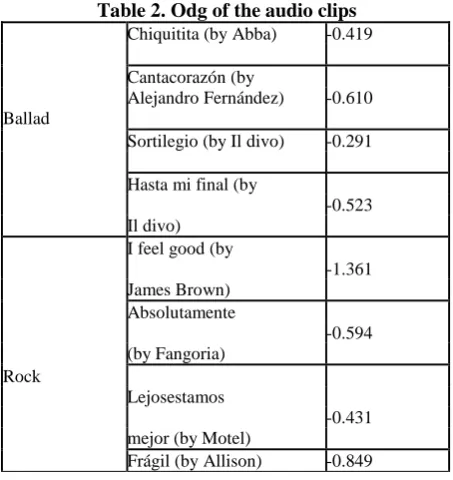
To demonstrate the inaudibility of the embedded watermark, we performed the calculation of ODG for each audio clip, which are shown in Table 2.
Table 2. Odg of the audio clips Chiquitita (by Abba) -0.419
Cantacorazón (by
Alejandro Fernández) -0.610 Ballad
Sortilegio (by Il divo) -0.291
Hasta mi final (by
-0.523 Il divo)
I feel good (by
-1.361 James Brown)
Absolutamente
-0.594 (by Fangoria)
Rock
Lejosestamos
-0.431 mejor (by Motel)
Frágil (by Allison) -0.849
Comparing the hundred ODG values with Table 1 we obtain Table 3 shows the percentage obtained for each impairment established by the ITU.
Table 3. Obtained percent of the odg
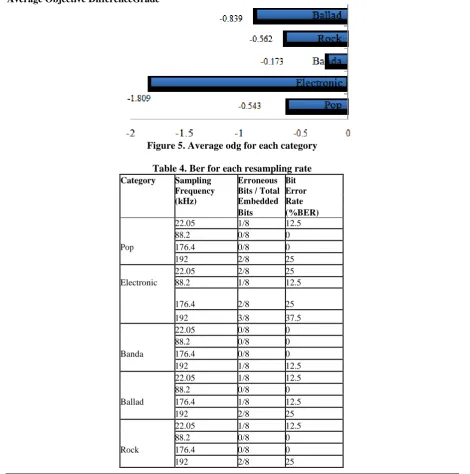
We could see that most of the embedded watermarks are to be imperceptible. Figure 5 shows the average ODG for each musical category
Average Objective DifferenceGrade
Figure 5. Average odg for each category
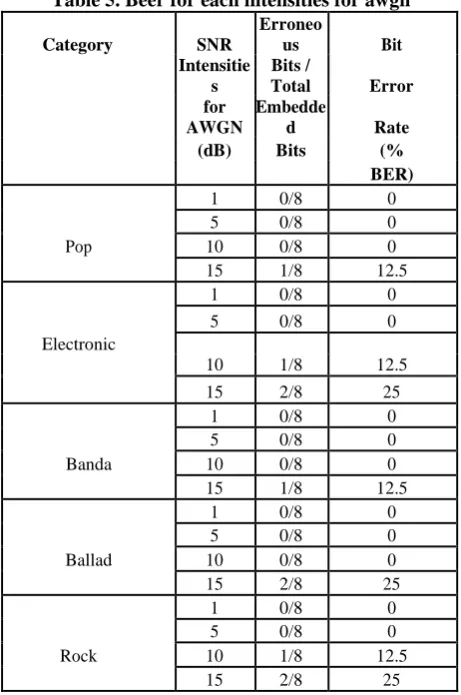
Table 4. Ber for each resampling rate
Category Sampling Erroneous Bit
Frequency Bits / Total Error
(kHz) Embedded Rate
Bits (%BER)
22.05 1/8 12.5
88.2 0/8 0
Pop 176.4 0/8 0
192 2/8 25
22.05 2/8 25
Electronic 88.2 1/8 12.5
176.4 2/8 25
192 3/8 37.5
22.05 0/8 0
88.2 0/8 0
Banda 176.4 0/8 0
192 1/8 12.5
22.05 1/8 12.5
88.2 0/8 0
Ballad 176.4 1/8 12.5
192 2/8 25
22.05 1/8 12.5
88.2 0/8 0
Rock 176.4 0/8 0
192 2/8 25
Impairment Obtained
Description Percent (%)
Imperceptible 52.5 Perceptible, but not
23 annoying
Slightly annoying 19.5
Annoying 5
The watermark is more perceptible in the electronic music (Figure 5).
To check the robustness of the watermark[5], we subjected the processed signal to an attack by changing the resampling rate as shown in Table 4 and AWGN attack with different intensities of Signal to Noise Ratio (SNR) showing the results Table 5.
Table 4 shows that most of the clips watermarkedsuffer a distortion in the embedded watermark when resampled to 192kHz and we said that the larger the resampling rate, the greater the distortion of the watermark embed it on audio clips.
The watermark, subject to resampling, was more robust in banda music, pop and rock, and less robust in electronic music and ballads.
In the following table we can see the number of bit errors and their respective BER for different intensities of SNR applied to AWGN was attached to each signal and in which we also see that while the intensity increases the distortion is most noticeable in the watermark as it also increases the power of AWGN. It is noted that for an AWGN signal strength of 1dB and 5dB the watermark is not distorted, instead to an intensity of 10dB and 15dB are a number of erroneous bits.
Being more resistant to resampling the musical categories of pop and band (see Table 5).
Table 5. Beer for each intensities for awgn
Category SNR Erroneo us Bit Intensitie s Bits / Total Error for AWGN Embedde d Rate
(dB) Bits (%
BER)
1 0/8 0
5 0/8 0
Pop 10 0/8 0
15 1/8 12.5
1 0/8 0
5 0/8 0
Electronic
10 1/8 12.5
15 2/8 25
1 0/8 0
5 0/8 0
Banda 10 0/8 0
15 1/8 12.5
1 0/8 0
5 0/8 0
Ballad 10 0/8 0
15 2/8 25
1 0/8 0
5 0/8 0
Rock 10 1/8 12.5
15 2/8 25
Compare the original signal with the watermarked signal, and it was subjected to attacks by resampling and AWGN attacks. The following are conclusions.
IV.
Conclusions
A comparison of the signal before being processed and the signal after being processed to verify the visual difference between them.
We tested the ITU BS.1387-1 standard established inaudibility standards applied in this case, to the watermark, checking that it is slightly perceptible, if and only if, listening with dedicated attention.
Also verify the behavior of the watermark against the addition of AWGN with different SNR intensities. It is recommended that the watermark is inserted into the top of each block, because if not done in this way, the watermark will be easy to detect and extract.
Below are the references consulted, among the items displayed, a book and a standard ITU.
References
[1] M. Hrncar, J. Krajcovic, “Principles of Audio Watermarking”, BytcickaZilina, Slovak Republic, 2005, pp. 1-3.
[2] Nedeljko, C., T. Seppanen, Digital Audio WatermarkingTechniquesand Technologies: Applications andBenchmarks, Information
Science Reference, Hershey NewYork, 2007.
[3] I.K. Yeo, H.J. Kim, “Modified Patchwork Algorithm: A Novel Audio Watermarking Scheme”, IEEE, Transactions on Speech
and Audio Proceesing, Korea, July 2003, pp. 1-6.
[4] D.G. Hong, S.H. Park, and J. Shin, “A Public Key Audio Watermarking using Patchwork Algorithm”, Department of Electronic
Engineering, Dongguk University, Seoul Korea, 2004, pp. 3-4.
[5] H.J. Kim, S. Xiang, and S. Maitra, “Robustness Analysis of Patchwork Watermarking Schemes”, IEEE, Transactions on Speech
and Audio Proceesing, Seoul Korea, 2001, pp. 1-2.
[6] J.E. Gilley, “Bit Error Rate Simulation using Matlab”,Transcrypt International, Inc., August 2003, pp. 1-7.
[7] Recommendation ITU-R BS.1387-1 Method for objective measurements of perceived audio quality, 2001.
AUTHOR PROFILE:
Carlos Aquino Ruiz was born in Mexico on April 2, 1973 is in Communications and Electronics Engineering from the National Polytechnic Institute IPN, a research professor and areas of development are applied computing, data networking and security.
Eduardo Pérez Orta. He is a methodological research and has master's. Nowadays it is a research professor at the School of Mechanical and Electrical Engineering (ESIME) in Mexico. Her areas of development are assessment and project development, scientific writing and methodology of science