Volume 4, Issue 3 (2015):100-108
International Journal of Pharmaceutical Research &
Allied Sciences
100
Bioanalytical Method Development and Validation of
Metaxalone in Human Plasma by LC-MS/MS
Nirav R Soni *, Dr .Mandev B.Patel
A-One Pharmacy College, Anasan, Ahmedabad Gujrat India *Email: [email protected]
Subject: Analytical Chemistry
Abstract
A simple, rapid, sensitive, and selective liquid chromatography-tandem mass spectrometry (MS) method was developed and validated for the quantification of Metaxalone, a skeletal muscle relaxant, in human plasma using Metaxalone –D6 as Internal Standard (IS). Following Liquid-Liquid Extraction (LLE) , the analytes were separated using an isocratic mobile phase on a reverse phase C18 column (Chromatopak peerless basic 50
×
4.6mm×
3.0µm ) and analyzed by MS in the multiple reaction monitoring mode using the respective [M+H]+ ions, m/z 222.14 / 160.98 for Metaxalone and m/z 228.25 /167.02 for the IS. The assay exhibited a linear dynamic range of 25.19 -2521.313 ng/mL for metaxalone in human plasma. The goodness of fit was consistently greater than 0.98 during the course of validation. The range of accuracy and precision of the back-calculated concentrations of the standard curve points was from 94.1 % to 104.4 % and 0.3 % to 5.6 % for metaxalone A run time of 2.0 min for each sample and injection volume is 5 µl . The validated method has been successfully used to analyze human plasma samples for application in pharmacokinetic, bioavailability, or bioequivalence studies.Keywords: Metaxalone, Human Plasma, LC-MS-MS, Method Development, Validation.
Introduction
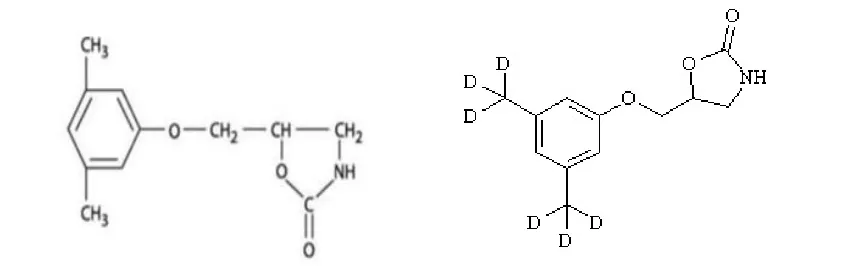
Metaxalone (Skelaxin), see Figure 1, is a centrally acting skeletal muscle relaxant [1,2] .It was approved by the Food and Drug Administration (FDA) in 1964 as an adjuvant therapy to rest, physical therapy, and other measures for the relief of discomforts associated with acute, painful musculoskeletal conditions. Metaxalone has no direct relaxant effect on the "tense" skeletal muscles in humans or on the contractile mechanism of striated muscle, the motor endplate or the nerve fiber [3, 4].Although its exact mechanism of action has not been identified, it may be a general depression of the central nervous system (sedation)[3] or modification of signals conducted through polysynaptic fibers controlling passive stretch [5]. The recommended dosage for adults and children over 12 years of age is two 400-mg tablets or one 800-mg tablet three or four times a day [3].
In a clinical study, mean peak plasma concentrations (Cmax) of 865.6 ~g/L were achieved within 3.3 ± 1.2 h after dosing (Tmax)a single 400-mg metaxalone tablet under fasted condi- tions. Metaxalone concentrations declined with a mean ter- minal half-life (t1/2)of 9.2 ± 4.8 h. In the same study, following a standardized high fat meal, food statistically increased the rate (Cmax) and extent of absorption (AUC 0-t,AUCO-infinite) of
LC-101
electrospray ionization (ESI)-MS has been demonstrated for a wide range of applications in the bioanalytical, environmental, and pharmaceutical fields [9-11]. This powerful separation and detection technique is widely used for the quantification of drugs in biological fluids. The purpose of this work was to explore the high selectivity and sensitivity of a triple-quadrupole MS system operated in MS-MS mode with an ESI interface for the development and validation of a robust
reversed-phase LC-MS-MS method in multiple reaction monitoring (MRM) mode for the quantification of metaxalone in human plasma. It was essential to establish an assay capable of quantifying metaxalone at concentrations down to 25 ng/mL. At the same time, it was expected that this method would be efficient in analyzing large numbers of plasma samples obtained for pharmacokinetic, bioavailability, or bioequivalence studies after therapeutic doses of metaxalone.
Fig.1: Chemical structures for Metaxalon & Metaxalone D6 (Internal Standard)
Experimental
Table 1:-Working Standard (WS) and Reference Standard (RS)
Sr No. Name of Standard Batch no. Assay Name of manufacturer
1. Working Standard Metaxalone VL/S-MT-011/c 98.84 % VIVAN Life Sciences Pvt.Limited
2. Metaxalone D6 VL/D-MX-230/b 98.91 % VIVAN Life Sciences
Pvt.Limited
Table 2:- Chemicals and Reagents
Sr.No Name of chemical/Manufacturer Name Grade
1. Metaxalone /Metaxalone D6 Working/Reference Standard
2. Methanol/ (J.T.Baker) HPLC
3. Ammonium Acetate / (Merck) GR
4. Methyl-tert Butyl ether-TBME/ (J.T.Baker) HPLC
5. Water (Rankem/Milli-Q) HPLC
6. Human Plasma K3EDTA
7. Human Whole blood K3EDTA
LC-MS/MS Instrument and Conditions
LC-MS/MS Instrumentation:UPLC-MS/MS
system was from Waters Acquity (USA) and consisted of a triple quadrupole Quattro premier and Quattro Premier XE mass spectrometer detector from Waters corp. (USA). Mass lynx version 4.1 software was used for data acquisition and processing.
Chromatographic Conditions: The
chromatographic separation was performed on a Peerless Basic C18 3µ m [Chromatopack] (50×4.6 mm, Thermo Scientific, USA) at
ambient temperature using an Acquity UPLC system (waters corp, Milford, MA, USA). The column temperature was maintained at 45oC. The mobile phase consisted of composition of [Methanol 650 ml, Acetonitrile 150 ml and 10 mM Ammonium acetate buffer] at a flow rate of 0.700 ml/minute. The injection volume was 30 µl, and the analysis time was 2.0 min per sample.
Sample Processing
102
Take out the required number of CC/QC samples along with the subject samples from the deep freezer and allow them to thaw at room temperature. Vortex the thawed samples to ensure complete mixing of contents. Transfer the required quantit y of CC/QC samples (0.100ml) along with the subject samples and add 50µ l ISTD [˜1300ng/ml] and vortex to mix it. Add 2.5ml of Methyl-Tert Butyl ether and vortex for 10 minutes. Centrifuge samples for 5 minutes at 10°C at 2000 rpm to separate the
two layers. Take out organic layer in to Evaporation Test Tube. Evaporate to dryness At 40°C. Reconstitute the dried samples with 200 µ l of Mobile Phase and vortex for30 seconds. Transfer into pre labeled auto sampler vials; inject 5µl of sample by using UPLC-MS/MS.
Preparation of Aqueous Sample Processing: Take 1480µl of Mobile Phase + 500µ l of internal standard + 20µ l of respective Spiking solution, vortex it for proper mixing
Table 3: Mass Tune Parameter
Sr.No Parameters Drug (Metaxalone) ISTD (Metaxalone D6)
1. Capillary (kV) 3.00 3.00
2. Source Temperature 100oC 100oC
3. Desolvation Temperature 250oC 250oC
4. Cone (V) 25 25
5. LM Resolution 1 16.5 16.5
6. HM Resolution 1 16.5 16.5
7. Collision Energy (eV) 15 15
8. Entrance 2 2
9. Exit 2 2
10. LM Resolution 2 15.0 15.0
11. HM Resolution 2 15.0 15.0
12. Detection ~ 224.14>160.98 ~228.25>167.02
13. Dwell time 0.200 sec 0.200 sec
14. Desolvation Gas Flow 750 750
15. Cone Gas Flow 20 20
16. Ion Energy 1 0.5 0.5
17. Ion Energy 2 1.5 1.5
Scanning profile of Drug and IS
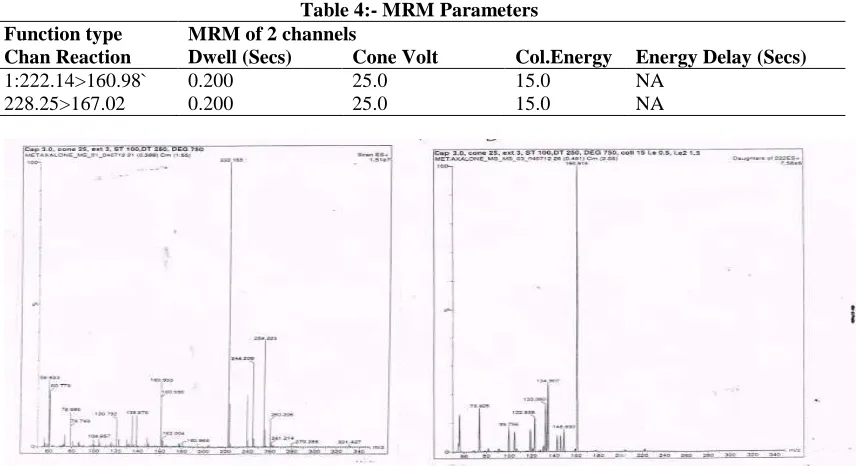
Table 4:- MRM Parameters
Function type MRM of 2 channels
Chan Reaction Dwell (Secs) Cone Volt Col.Energy Energy Delay (Secs)
1:222.14>160.98` 0.200 25.0 15.0 NA
228.25>167.02 0.200 25.0 15.0 NA
Figure 2:- Metaxalone Parent and Daughter Ion Scanning
103
Table 5: MRM File of Metaxalone Parent and Daughter Ion Scanning
Parents (m/z) Daughter (m/z) Dwell (secs) Cone volt Cell energy
222.14 160.98 0.200 25.0 15.0
Figure 3:- Metaxalone D6 Parent and Daughter Ion Scanning
Conclusion: we have added trance of ISTD which we found from scanning and Generated MRM file which content following parameters of parent & daughters
Table 6: MRM File of Metaxalone D6 Parent and Daughter Ion Scanning
Parents (m/z) Daughter (m/z) Dwell (secs) Cone volt Cell energy
228.25 167.02 0.200 250 15.0
Table 7: Chromatographic condition
HPLC Waters Acquity UPLC
Column Chromatopak ,Peerless Basic C18 (50 *4.6 mm) 3.0 µm
Column oven 400C ± 50C
Mobile Phase Methanol :5mM Ammonium Acetate (85 :15 v/v)
Needle Wash Strong Wash:-Methanol
Weak Wash:-Mobile Phase
Flow rate 0.500mL/minute
Detection
Q3 [Quattro premier XE,Waters ,USA]
Ion Mode Positive
Injection volume 5µl (Partial Loop With Needle overfill) Sample Cooler temp 50C ± 50C
Retention Time Metaxalone around 1.51 min,Metaxalone D6 around 1.49 min
Run Time 2.2 min
Injection volume 5µl (Partial Loop With Needle overfill) Bioanalytical Method Development [13-18]
The process by which a specific bioanalytical method is developed,validated and used in routine sample analysis can be divided into 1. Reference standard preparation 2.
Bioanalytical method development and
establishment of assay procedure 3 Application of validated bioanalytical method to routine drug
104
Optimization of column
Optimization of flow rate of mobile phase Optimization of column oven temperature Optimization of Mass Detector parameters Bioanalytical Method Validation Parameter (BMVP) : Preparation of Calibration Curve
Standards: Preparation of Spiking Solution of Metaxalone:-Calibration curve range is prepared from ~2521 ng/ml to 25 ng/ml. Prepare the following spiking solution with diluent as per example given below:
Table 8: Spiking Solution with Diluents
Stock Conc. (ng/ml)
Stock Volume (ml)
Total Volume after addition of Diluent. (ml)
Spiking Conc. (ng/ml)
Batch No.
750390 4.90 25.00 126065 STD 1 SS
126065 9.00 10.00 113459 STD 2 SS
113459 8.33 10.00 94511 STD 3 SS
94511 6.66 10.00 63039 STD 4 SS
63039 3.00 10.00 18911 STD 5 SS
18911 3.33 10.00 6297 STD 6 SS
6297 4.00 10.00 2519 STD 7 SS
2519 5.00 10.00 1259 STD 8 SS
Spiking of Metaxalone in Human Plasma:
Spike above spiking solution in Human Plasma as per example given in below: Table 9: Spiking of Meatxalone
Spiking conc. (ng/ml) Volume of Spiking solutions
(ml)
Total Volume after addition of Human Plasma (ml)
Final Conc.In Human Plasma
(ng/ml)
Batch No.
126065 0.02 1.00 2521 STD 1 SM
113459 0.02 1.00 2269 STD 2 SM
94511 0.02 1.00 1890 STD 3 SM
63039 0.02 1.00 1260 STD 4 SM
18911 0.02 1.00 378 STD 5 SM
6297 0.02 1.00 125 STD 6 SM
2519 0.02 1.00 50 STD 7 SM
1259 0.02 1.00 25 STD 8 SM
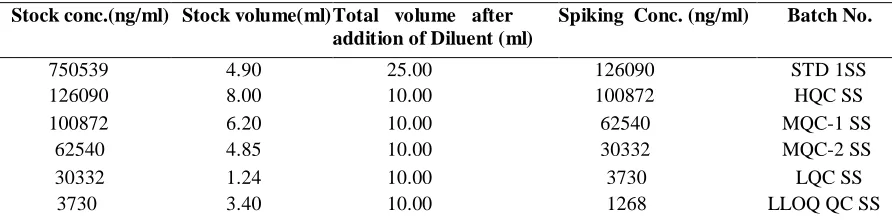
Quality Control Samples: Prepare Quality Control samples from different stock solution. Use highest standard for preparing Quality Control samples. Prepare QC samples according to Calibration Curve Standards and Quality Control Samples Specification and Acceptance Criteria).
Storage Details for Dilutions and Aliquots: All spiking solutions and dilutions are stored at approximately below 8°C. Aliquot 200µ l of each spiked calibration standards and Quality control samples into different polypropylene-capped tubes and store at 20°C until analysis.
Preparation of Quality Control Standards:
Table 10:- Preparation of spiking solution of Metaxalone
Stock conc.(ng/ml) Stock volume(ml) Total volume after addition of Diluent (ml)
Spiking Conc. (ng/ml) Batch No.
750539 4.90 25.00 126090 STD 1SS
126090 8.00 10.00 100872 HQC SS
100872 6.20 10.00 62540 MQC-1 SS
62540 4.85 10.00 30332 MQC-2 SS
30332 1.24 10.00 3730 LQC SS
105
Table 11: Spiking of Metaxalone in Human Plasma: Spike above spiking solution in human plasma as given in below table 11: Spiking of QC Sample in Human Plasma
SpikingCon c. (ng/ml)
Volume of spiking solutions (ml)
Total volume after addition of human
plasma (ml)
Final conc. In human plasma
(ng/ml)
Batch No.
126090 0.02 1.00 2521 STD 1 SS
100872 0.02 1.00 2017 HQC SS
62540 0.02 1.00 1250 MQC-1 SS
30332 0.02 1.00 606 MQC-2 SS
3730 0.02 1.00 74 LQC SS
1268 0.02 1.00 25 LLOQ QC SS
Calibration Curve:
Linearity and Regression: Linearity and Goodness-of-fit
Assay performance and validation The eight-point calibration curve was linear over the concentration range 2521.313 ng/ml to 25.19 ng/ml..The calibration model was selected based on the analysis of the data by linear regression with or without intercepts and weighting factors (l/x, 1/x 2, and A linear equation was judged to produce the best fit for the concentration/response relationship. The regression type was 1/ (concentration) 2 and peak area ratio for 8-point calibration curve of human Plasma was found to be linear from 2521.313 ng/ml to 25.19 ng/ml for Metaxalone. The goodness of fit was consistently greater than 0.98 during the course of validation. The range of accuracy and precision of the back-calculated concentrations of the standard curve points was from 94.1% to 104.4 % and 0.3 % to 5.6% for Metaxalone.
Weighting factor :-
To determine weighting factor for Metaxalone calibration standards accuracy results were calculated for three P&A batches with linear regression using weighting factors as 1/X, 1/X2 and no weighting. The percent relative error(%RE) were calculated for each standards level as percent difference between the observed value of all %RE are summed for each weighting factor in three calibration standards. The weighting factor that gives the smallest values of the sum of %RE is taken as concentration response relationship for Metaxalone. The sum of %RE for weighting factor none , 1/X and 1/X2 For Metaxalone is 156.1 % ,56.0 % and 53.1 % Respectively
Fig.4: A Representative Regression Analysis of a Calibration curve
Validation parameters at the LLOQ: The LLOQ was defined as the lowest concentration in the standard curve that can be measured with acceptable accuracy and precision and was found to be 25.19 ng/ml in human plasma..According to global data % accuracy of LQC is 97.5 % and LLOQ was 98.0%, and LQC Intraday accuracy was 98.5 % and LLOQ QC the accuracy was 99.1% for metaxalone.
Validation parameters at the middle and upper concentrations: The middle and upper quantification levels of metaxalone ranged from 500 to 2500 ng/mL in human plasma. For the intra day experiments the % CV ranged from 1.1 % to 2.5 % and the accuracy from 95.2 % to 101.6% For the inter day (Global data ) experiments the precision and accuracy for the analyte met the acceptance criteria (= < + 15%).Recoveries of the analyte and IS were high, and it was consistent, precise, and reproducible. Therefore, the assay has proved to be robust in high throughput bioanalysis
106
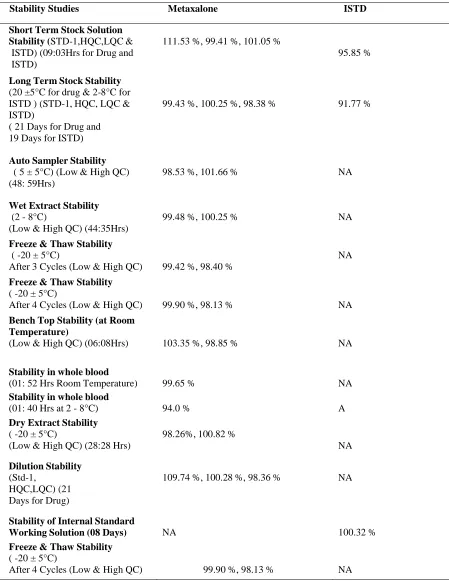
Table 12: Stability Studies
Stability Studies Metaxalone ISTD
Short Term Stock Solution Stability (STD-1,HQC,LQC &
ISTD) (09:03Hrs for Drug and ISTD)
111.53 %, 99.41 %, 101.05 %
95.85 %
Long Term Stock Stability (20 ±5°C for drug & 2-8°C for ISTD ) (STD-1, HQC, LQC & ISTD)
( 21 Days for Drug and 19 Days for ISTD)
99.43 %, 100.25 %, 98.38 % 91.77 %
Auto Sampler Stability ( 5 ± 5°C) (Low & High QC) (48: 59Hrs)
98.53 %, 101.66 % NA
Wet Extract Stability (2 - 8°C)
(Low & High QC) (44:35Hrs)
99.48 %, 100.25 % NA
Freeze & Thaw Stability ( -20 ± 5°C)
After 3 Cycles (Low & High QC) 99.42 %, 98.40 %
NA
Freeze & Thaw Stability ( -20 ± 5°C)
After 4 Cycles (Low & High QC) 99.90 %, 98.13 % NA Bench Top Stability (at Room
Temperature)
(Low & High QC) (06:08Hrs) 103.35 %, 98.85 % NA
Stability in whole blood
(01: 52 Hrs Room Temperature) 99.65 % NA
Stability in whole blood
(01: 40 Hrs at 2 - 8°C) 94.0 % A
Dry Extract Stability ( -20 ± 5°C)
(Low & High QC) (28:28 Hrs)
98.26%, 100.82 %
NA Dilution Stability
(Std-1,
HQC,LQC) (21 Days for Drug)
109.74 %, 100.28 %, 98.36 % NA
Stability of Internal Standard
Working Solution (08 Days) NA 100.32 %
Freeze & Thaw Stability ( -20 ± 5°C)
After 4 Cycles (Low & High QC) 99.90 %, 98.13 % NA
107
Figure 5: Mean plasma concentration –time profiles of six healthy subjects after the administration of a single oral dose of 800 mg of metaxalone under both fasted and fed
conditions,
Conclusions:
In summary, a method is described for the quantification of metaxalone from human plasma by LC-MS-MS in positive ionization mode using MRM. The current method has shown acceptable precision and adequate sensitivity for the quantification of metaxalone in human plasma samples obtained for pharmacokinetic, bioavailability, or bioequivalence studies. Furthermore, it was utilized for the analysis of hundreds of subject's samples. The method described is simple, rapid, sensitive, selective, and fully validated according to commonly accepted criteria [13] .The simplicity of the assay and rapid LLE and sample turnover rate of 2.0 min per sample make it an attractive procedure in high-throughput bioanalysis of metaxalone. The validated method allows quantification of metaxalone in the 2521.313 ng/ml to 25.19 ng/ml range.
Acknowledgments
The authors wish to acknowledge the support received from Dr .Dharmesh Parmar, HOD of Bio analytical Department, Synchron research services Pvt.Ltd.
“Cite this Article”
NR Soni, MB.Patel “Bioanalytical Method Development and Validation of Metaxalone in Human Plasma by LC-MS/MS” Int. J. of Pharm. Res. & All. Sci. 2015;4(3):100-108
Reference
[1]. J.K. Elenbass. Centrally acting oral skeletal muscle relaxants. Am. J. Hosp. Pharm. 37:1313-1323 (1980).
[2]. R.N. Harden and C. Argoff. A review of three commonly prescribed skeletal muscle relaxants. J. Back Musculoskeletal Rehabilitation 15:63-66 (2000).
[3]. Physicians' Desk Reference, 58th ed. Thomson PDR, Montvale, NJ, 2004. [4]. P.P. Toth and J. Urtis. Commonly used
muscle relaxant therapies for acute low back pain. Clin. Ther. 26:1355-1367 (2004).
[5]. T. Bosworth. Special report. The proper use of muscle relaxants in musculoskeletal pain management. Prim. Care Spec. Ed. 6:1-8 (2002).
[6]. K.A. Moore, B. Levine, and D. Fowler. A fatality involving metaxalone. Forensic Sci. Int. 149:249-251 (2005).
[7]. J.L. Poklis, J.D. Ropero-Miller, D. Garside, and R.E. Winecker. Metaxalone (Skelaxin) related death. J. Anal. Toxicol. 28:537-541 (2004).
[8]. A.C. Gruszecki, S. Kloda, G.T. Simmons, T.M. Daly, R.W. Hardy, and C.A. Robinson. Polydrug fatality involving metaxalone. J. Forensic Sci. 48:432-434 (2003).
[9]. M. Jemal. High throughput quantitative bioanalysis by LC-MS/MS. Biomed. Chromatogr. 14:422-429 (2000).
[10]. N.V.S. Ramakrishna, K.N.
Vishwottam, S. Man@ M. Koteshwara,J. Chidambara, and D.P. Varma. Validation and application of a high-performance liquid chromatography-tandem mass spectrometry assay for mosapride in human plasma. Biomed. Chromatogr. 19" 539-548 (2005).
[11]. R.V.S. Nirogi, V.N. Kandikere, M. Shukla, K. Mudigonda, S. Maurya, R. Boosi, and A. Yerramilli. Sensitive and selective liquid chromatography/tandem mass spectrometry method for the quantification of azithromycin in human plasma. Anal. Chim. Acta 553:1-8 (2005). [12]. G.S.J. Mannens, C.A.W. Snel, J.
Hendrickx, T. Verhaeghe, L. Le Jeune, W. Bode, L. Van Beijsterveldt, K. Lavrijsen, J. Leempoels, N. Van Osselaer, A. Van Peer, and W. Meuldermans. The metabolism and excretion of galantamine in rats, dogs and humans. Drug Metab. Dispos. 30:553-563 (2002).
108
August 31,2005; revision received December 1,2005. 251
[14]. Murugan S, Pravallika N, Sirisha P, Chandrakala K “A Review On Bioanalytical Method Development And Validation By Using Lc-Ms/Ms” Journal of Chemical and Pharmaceutical Sciences,Volume-6,Issue-1,March 2013 ,pg:40-45
http://jchps.com/pdf/v6/is1/jchps%206( 1)%207%20page%2041-45.pdf
[15]. Eric Reid, Ian D. Wilson,
Methodological Survey in Biochemistry and Analysis Volume 20: Analysis for Drug and Metabolites, Including Antiinfective Agents, 1990,pg:1-57 [16]. U.S .Department of Health and
Human Services, Food and Drug Administration., Guidance for Industry, Bioanalytical Method Validation, May2001
[17]. Kees Frieder, Jehnich Doris, Grobecker Horst, Simultaneous determination of acetylsalicylic acid and salicylic acid in human plasma by high-performance liquid chromatography, Journal of Chromatography B, 677, 1996,pg: 172-177
[18]. Xu Raymond Naxing, Fan Leimin, Rieser Matthew J., Tawakol A. El- Shourbagy,Recent advances in high-throughput quantitative bioanalysis by LC–MS/MS, Journal of Pharmaceutical and Biomedical Analysis ,44,2007,pg: 342–355