Neural Network Approach For Condition Monitoring of Traction Transformer oil
*Department of Power Electronics, NRI Bhopal. M.P. India
1 Professor, Department of Electrical and Electronics
As the development of high speed railway, it call for higher reliability of traction power supply system and traction transformer. However compared with pow
transformer, on which the impulse load caused by sort circuit is continually applied, is ever worse. This bring 'Cumulative effect' which will give rise to different kind of transformer faults including hea discharged faults.. Hydro carbon gases and water are created in this course. By implementing correct operational and maintenance strategies the insulation aging/degradation process can be controlled and the traction transformer life can be extended effectively .A new approach has been presented in this paper based on an index which could be computed online to monitor the status of traction transformer.
Keywords: Condition Monitoring, DGA, Traction Transformer.
1. INTRODUCTION
As the development of high speed railway, it calls
for higher reliability of traction power supply
system and traction transformer power supply
system and traction transformer. However
compared with power transformer, the running
condition of traction transformer, on which t
impulse load caused by sort circuit is continually
applied, is ever worse. This brings 'Cumulative
effect' which will give rise to different kind of
transformer faults including heat faults and
discharged faults. [1]. Hydro carbon gases and
water are created in this course. Transformers
inner part, gases including H2, CH4, C2
Vol. 1(1) Sept-Dec (2011)
Neural Network Approach For Condition Monitoring of Traction Transformer oil
M.Yadav*, Dr. A. Mahar1
*Department of Power Electronics, NRI Bhopal. M.P. India
Professor, Department of Electrical and Electronics Engineering, NRI Bhopal, M.P. India *Corresponding Author
E-mail: [email protected]
Abstract
As the development of high speed railway, it call for higher reliability of traction power supply system and traction transformer. However compared with power transformer, the running condition of traction
transformer, on which the impulse load caused by sort circuit is continually applied, is ever worse. This bring 'Cumulative effect' which will give rise to different kind of transformer faults including hea discharged faults.. Hydro carbon gases and water are created in this course. By implementing correct operational and maintenance strategies the insulation aging/degradation process can be controlled and the
ended effectively .A new approach has been presented in this paper based on an index which could be computed online to monitor the status of traction transformer.
Condition Monitoring, DGA, Traction Transformer.
of high speed railway, it calls
for higher reliability of traction power supply
system and traction transformer power supply
system and traction transformer. However
compared with power transformer, the running
condition of traction transformer, on which the
impulse load caused by sort circuit is continually
applied, is ever worse. This brings 'Cumulative
effect' which will give rise to different kind of
transformer faults including heat faults and
discharged faults. [1]. Hydro carbon gases and
Transformers
2H6, C2H4,
C2H2, Co and Co2 Will appear along with
insulation materials aging and decoration. As
these gases appearance are accompany with all
kinds of transformer faults, monitoring
concentrations is very helpful to identify
transformers running state. [2]
Transforms can be considered from the most important equipments in the distribution system. As any transform outage affect the system as a whole. One method for predict
transformers major faults and increasing life time is the use of condition monitoring (CM)
techniques. CM concerns the application and Neural Network Approach For Condition Monitoring of Traction Transformer oil
Engineering, NRI Bhopal, M.P. India
As the development of high speed railway, it call for higher reliability of traction power supply system and er transformer, the running condition of traction
transformer, on which the impulse load caused by sort circuit is continually applied, is ever worse. This bring 'Cumulative effect' which will give rise to different kind of transformer faults including heat faults and discharged faults.. Hydro carbon gases and water are created in this course. By implementing correct
operational and maintenance strategies the insulation aging/degradation process can be controlled and the ended effectively .A new approach has been presented in this paper based on an index which could be computed online to monitor the status of traction transformer.
ill appear along with
insulation materials aging and decoration. As
these gases appearance are accompany with all
kinds of transformer faults, monitoring of gas
concentrations is very helpful to identify
transformers running state. [2]-[5].
Transforms can be considered from the most important equipments in the distribution system. As any transform outage affect the system as a whole. One method for predicting the
transformers major faults and increasing life time is the use of condition monitoring (CM)
development of special purpose equipments that
have the function of acquiring the data and the
development of new techniques to analyse these
data to predict the trend of the monitored
equipment and evaluate its current operating
status. [6].
CM is the technique served for condition
Maintenance (CBM). Traditionally, time based
maintenance had been the main ma
strategy for a long time. Time based maintenance
may prevent many failures CBM will let operators
know more about the traction transformer and
indicate clearly when and what maintenance in
needed clearly when and what maintenance in
needed so that money and manpower could be
saved and shutdown can be reduced [7]
Transformers are generally reliable pieces of the
system. However, the faults are often difficult to
diagnose or locate in the transformer due to
complicated winding structures, but a mult
meter CM approach gives valuable data to
diagnose the fault and suggest its location CM can
prevent transformer unplanned outages and
catastrophic failures cause by faults. It allows
aging of the system to the monitored and therefore
controlled and predicted and extended [5].
Accounting to old and recent research in the field of transformer condition monitoring, it can be divided into five main categories-
Vol. 1(1) Sept-Dec (2011)
development of special purpose equipments that
have the function of acquiring the data and the
w techniques to analyse these
data to predict the trend of the monitored
equipment and evaluate its current operating
CM is the technique served for condition-Basic
Maintenance (CBM). Traditionally, time based
maintenance had been the main maintenance
strategy for a long time. Time based maintenance
may prevent many failures CBM will let operators
know more about the traction transformer and
indicate clearly when and what maintenance in
needed clearly when and what maintenance in
t money and manpower could be
Transformers are generally reliable pieces of the
system. However, the faults are often difficult to
diagnose or locate in the transformer due to
complicated winding structures, but a multipara
meter CM approach gives valuable data to
diagnose the fault and suggest its location CM can
prevent transformer unplanned outages and
catastrophic failures cause by faults. It allows
aging of the system to the monitored and therefore
redicted and extended [5].
Accounting to old and recent research in the field of transformer condition monitoring, it can be
(1) Thermal Analysis
(2) Vibration Analysis
(3) Dissolved gas Analysis (DGA)
(4) PD Analysis
(5) Frequency response analysis (FRA)
The insulting of power transformers is generally
very reliable. Insulation aging is transformers are
most commonly associated with long term effect
of the operating temperature, moistures and air.
Since a significant proportion of transformers on
the distribution network is old, it is necessary to
assess the "Chemical" age of their insulations,
and, if possible, to predict their rates of ageing
relative to their present and future loading
conditions. Dissolved Gas Analysi
researchers sees that electrical measurements
(Partial discharge, dielectric loss, dc resistance,
dielectric strength) have no clear and strong
correlation between electrical properties and the
physical and chemical states of the oil
insulation [8], [9]. The thermal degradation of oil
results in the production of hydrogen methane,
ethane, ethylene, acetylene,
products on oil breakdown include alcohols,
organic acids, aldehydes, peroxides etc.
For any given oil sample, the abs
concentrations of fault gas can be used to indicate the type, intensity and location of the fault. A variety of methods are available to achieves this,
Dissolved gas Analysis (DGA)
Frequency response analysis (FRA)
The insulting of power transformers is generally
very reliable. Insulation aging is transformers are
most commonly associated with long term effect
of the operating temperature, moistures and air.
portion of transformers on
the distribution network is old, it is necessary to
assess the "Chemical" age of their insulations,
and, if possible, to predict their rates of ageing
relative to their present and future loading
conditions. Dissolved Gas Analysis (DGA)
researchers sees that electrical measurements
(Partial discharge, dielectric loss, dc resistance,
dielectric strength) have no clear and strong
correlation between electrical properties and the
physical and chemical states of the oil-paper
on [8], [9]. The thermal degradation of oil
results in the production of hydrogen methane,
ethane, ethylene, acetylene, Co, Co2 and other
products on oil breakdown include alcohols,
organic acids, aldehydes, peroxides etc.
laboratories may rely upon defined critical levels
of gases, rates increase in gas level (on a year by
year basis), or one of the various methodologies
associated with Rogers, Davd or Domberg. The
recommended practice for oil sampling extraction
of gases and methods of analyst’s are detailed in
IEC 567 [10] After analysing the gas
concentrations and using the gases with the defect.
Some artificial intelligent agents can be trained on
the DGA ratio codes to classify some incipient
faults with have some irregular gas ratios that
can't be interpreted [11, 12]
However in the recent years consistent methods
have been developed in DGA interpretation based
on a large number of expert systems, data and
failure history of transformers. DGA data could be
used along with fuzzy logic and to design an
expert system [13]. Transformer Diagnostic
Monitoring (TDM) system is used for continuous
monitoring and analysis of power transformers
technical condition [14].
Frequency response analysis method is one of the
most frequently used diagnostic tools for investing
transformer coil deformation A new technique f
on-line transfer function monitoring through its
bushing taps or capacitive sensors installed on the
surface is presented [16] via transfer functions.
For condition assessment of power transformer, it
is recommendable to use a modern monitoring
Vol. 1(1) Sept-Dec (2011)
laboratories may rely upon defined critical levels
vel (on a year by
year basis), or one of the various methodologies
associated with Rogers, Davd or Domberg. The
recommended practice for oil sampling extraction
of gases and methods of analyst’s are detailed in
IEC 567 [10] After analysing the gas
ations and using the gases with the defect.
Some artificial intelligent agents can be trained on
the DGA ratio codes to classify some incipient
faults with have some irregular gas ratios that
tent methods
have been developed in DGA interpretation based
on a large number of expert systems, data and
DGA data could be
used along with fuzzy logic and to design an
Transformer Diagnostic
(TDM) system is used for continuous
monitoring and analysis of power transformers
Frequency response analysis method is one of the
most frequently used diagnostic tools for investing
transformer coil deformation A new technique for
line transfer function monitoring through its
bushing taps or capacitive sensors installed on the
surface is presented [16] via transfer functions.
For condition assessment of power transformer, it
is recommendable to use a modern monitoring
system. With such a system, a more safe, reliable
and cost optimized operation of the transformer is
possible. State of the art monitoring systems
feature supervision of all main components of
traction transformers. Condition Monitoring
involves monitoring of cert
traction transformer. Based on the prescribed
parameter values certain maintenance can be
decided and carried out.
Normally, any equipment is maintained in three ways viz.
(a) Routine Maintenance
(b) Periodic Maintenance
(c) Condition based Maintenance.
In Routine maintenance, activities involved which
are essential for day-to-day working like checking
of oil level, colour of silica Gel in Breather etc.
In Periodic maintenance, activities involved are
that type of maintenance activiti
necessary to be done so frequently and ensures the
working of the transformer over a longer period
such as oil testing, measuring IR value etc.
It is established that over maintenance of any equipment leads to more number of failures. Hence the present trend is to minimize the maintenance, which can be achieved through condition based monitoring. Failure of a transformer leads to lot of inconvenience and
With such a system, a more safe, reliable
and cost optimized operation of the transformer is
possible. State of the art monitoring systems
feature supervision of all main components of
Condition Monitoring
involves monitoring of certain parameters of
traction transformer. Based on the prescribed
parameter values certain maintenance can be
Normally, any equipment is maintained in three
based Maintenance.
In Routine maintenance, activities involved which
day working like checking
of oil level, colour of silica Gel in Breather etc.
In Periodic maintenance, activities involved are
that type of maintenance activities which are not
necessary to be done so frequently and ensures the
working of the transformer over a longer period
such as oil testing, measuring IR value etc.
It is established that over maintenance of any equipment leads to more number of failures.
anxiety which can be avoided if proper measures
are taken before its failure takes pl
transformer never fails all of a sudden except due
to short circuit or lighting surges. Always a fault
is developed gradually and may lead to its failure
and consequently to be shut down for repairs if
not detected in its incipient stage. Such fault
be of following nature.
(i) A local fault developing over days and weeks.
(ii) Deterioration of insulation comparatively over a longer period.
When such faults are detected and diagnosed at
the early stage, necessary steps can be taken to
plan the shutdown of the transformer conveniently
for its repairs and procurement of the necessary
spares.
2. Methodology
The reliability of the ANN will be is tested on
standard 70 samples for different gage as shown in
appendix 1. Block diagram of the methodology
adopted is given in following figure.
Vol. 1(1) Sept-Dec (2011)
anxiety which can be avoided if proper measures
are taken before its failure takes place. A
transformer never fails all of a sudden except due
to short circuit or lighting surges. Always a fault
is developed gradually and may lead to its failure
and consequently to be shut down for repairs if
not detected in its incipient stage. Such faults can
(i) A local fault developing over days and weeks.
(ii) Deterioration of insulation comparatively over
When such faults are detected and diagnosed at
the early stage, necessary steps can be taken to
shutdown of the transformer conveniently
for its repairs and procurement of the necessary
The reliability of the ANN will be is tested on
standard 70 samples for different gage as shown in
Block diagram of the methodology
Fig 5.1 Block diagram of the methodology adopted
Transformer of gases takes place in oil filled
transformer due to the following reasons
1. Oxidation
2. Vaporization
3. Insulation Decomposition
4. Oil Breakdown
5. Electrolytic Action
For DGA, generally Roger’s method is used
which analyses proportion of one gas w.r.t. the
other gas. The gases involved are:
1. Methane (CHସ) } at 120º
2. Ethane (CଶH) } at 120º
3. Ethylene (CଶHସ) } at 150º
4. Acetylene (CଶHଶ) } at very high temp.
Result in
term of error Programming for
the Mat lab with
ANN Samples
of DGA
Fig 5.1 Block diagram of the methodology adopted
Transformer of gases takes place in oil filled
transformer due to the following reasons-
For DGA, generally Roger’s method is used
which analyses proportion of one gas w.r.t. the
other gas. The gases involved are:
) } at 120º
) } at 120º
) } at 150º
) } at very high temp.
Result
Testing
of ANN Result in
term of error Programming for
the Mat lab with
ANN
Train of
The absolute condition of the fault gases gives the
status of the transformer insulation whereas the
relative concentration these gases provide an idea
of the type of the fault. The concentrations of fault
gases are measured in ppm. Normal gas levels
0.2ଶ 20
ଶ 0.8
ସ 10 ଶ 0
0.01ଶ
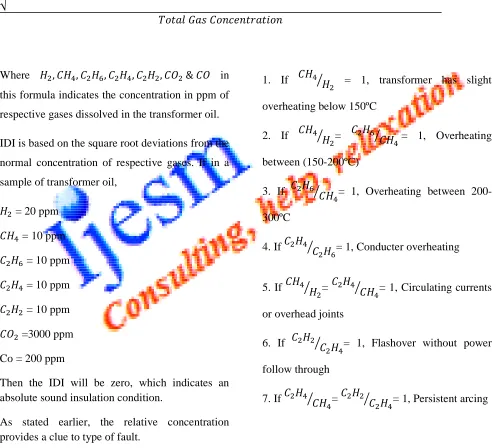
Where ଶ, ସ, ଶ, ଶସ, ଶଶ, ଶ
this formula indicates the concentration in ppm of
respective gases dissolved in the transformer oil.
IDI is based on the square root deviations from the
normal concentration of respective gases. If in a
sample of transformer oil,
ଶ = 20 ppm
ସ = 10 ppm
ଶ = 10 ppm
ଶସ = 10 ppm
ଶଶ = 10 ppm
ଶ =3000 ppm
Co = 200 ppm
Then the IDI will be zero, which indicates an absolute sound insulation condition.
As stated earlier, the relative concentration provides a clue to type of fault.
Vol. 1(1) Sept-Dec (2011)
The absolute condition of the fault gases gives the
status of the transformer insulation whereas the
relative concentration these gases provide an idea
entrations of fault
Normal gas levels
considering the aging effect are as shown below in
Table 1. Based on statistical data; one indicator is
proposed for the insulation status of the
transformer. The Insulation Deterioration Ind
(IDI) is expressed as-
0.7ଶ 10
ଶ 0.8
ଶସ 10
ଶ 0.8 ଶ
ଶ 3000ଶ 0.1 200ଶ
ଶ & in
this formula indicates the concentration in ppm of
respective gases dissolved in the transformer oil.
IDI is based on the square root deviations from the
e gases. If in a
Then the IDI will be zero, which indicates an
As stated earlier, the relative concentration
1. If ସ
ଶ
= 1, transformer has slight
overheating below 150ºC
2. If ସ
ଶ
= ଶ
ସ
between (150-200ºC)
3. If ଶ
ସ
= 1, Overheating between 200
300ºC
4. If ଶସ
ଶ
= 1, Conducter overheating
5. If ସ
ଶ
= ଶସ
ସ
= 1, Circulating currents
or overhead joints
6. If ଶଶ
ଶସ
= 1, Flashover wi
follow through
7. If ଶସ
ସ
= ଶଶ
ଶସ
= 1, Persistent arcing
considering the aging effect are as shown below in
Based on statistical data; one indicator is
proposed for the insulation status of the
The Insulation Deterioration Index
ଶ 10ଶ
= 1, transformer has slight
ସ
= 1, Overheating
= 1, Overheating between
200-= 1, Conducter overheating
= 1, Circulating currents
= 1, Flashover without power
Hence DGA is a very powerful tool for condition
monitoring of traction transformers. In this
dissertation; an algorithm is proposed for a
comprehensive condition monitoring of traction
transformer as given below:
3. Implementation and Results
Sample
No.
Concentration in ppm
CH4 C2H6 C2H4 C2H2
1 40 40 40 18
2 550 20 50 20
3 80 80 30 40
4 50 70 35 35
5 50 50 52 19.2
6 172 75 75 38.7
7 110 97 110 37.8
8 197 60 192 196
9 82 97.2 86 32.4
Vol. 1(1) Sept-Dec (2011)
Hence DGA is a very powerful tool for condition
monitoring of traction transformers. In this
dissertation; an algorithm is proposed for a
sive condition monitoring of traction
The Insulation Deterioration Index (IDI) as
proposed is calculated based on the data of DGA
for various samples. The condition of the
transformer and assessment of
done as per the algorithm proposed.
Concentration in ppm TGC IDI Condition
CO2 CO H2
4000 210 100 4448 0.026 Sound
3000 300 40 8428 0.0576
3000 400 60 3690 0.0598
3720 500 50 4460 0.0315 Gradual
Overheating
3672 552 50 4445.2 0.4716 Gradual O/H
(200
5223 372 72 6027.7 0.0471 Conductor
overheating
4228 421 110 5113.2 0.0407 Circulating
Current or Joint
Heating
3212 614 52 4523 0.0705 Persistent
Arcing
3220 256 55 3828.6 0.0325
The Insulation Deterioration Index (IDI) as
proposed is calculated based on the data of DGA
for various samples. The condition of the
transformer and assessment of the fault type is
done as per the algorithm proposed.
Condition
Sound
Gradual
Overheating
Gradual O/H
(200-300ºC)
Conductor
overheating
Circulating
Current or Joint
Heating
Persistent
10 62 48.2 40 19
11 87 80 44 25
12 41 57 62 32
13 47 50 57 27
14 52.4 63 42 19
15 55.4 42 30 16
16 47.8 60 35 19
17 42 48 52 25
Table1: DGA data of oil samples for Traction
Transformer
With these results, it is observed that the value of
IDI could be a better index as compared with the
individual gas concentration observations. It also
gives comprehensive information about the aging
of transformer oil. Samples 4, 5, 6, 7 & 8 indicate
Year of
service
CH4 C2H6 C2H4
Fresh 12 10 14
1 14 13 17
2 18 19 21
Vol. 1(1) Sept-Dec (2011)
3000 250 35 3454.2 0.0189
3227 270 47 3780 0.0295
3332 215 50 3789 0.0204
4200 218 56 4485 0.268
3100 215 25 3553.4 0.0216
3200 250 27 3620.4 0.0160
3710 220 20 4111.8 0.0333
4130 210 40 45.47 0.0280
1: DGA data of oil samples for Traction
With these results, it is observed that the value of
IDI could be a better index as compared with the
individual gas concentration observations. It also
gives comprehensive information about the aging
transformer oil. Samples 4, 5, 6, 7 & 8 indicate
typical faults that are developing inside the tank.
Whereas some samples have low values of IDI
which reflect sound conditions of traction
transformer.
Transformer oil also deteriorates with aging.
Following observations are illustrated from the
test data’s available to check the behaviour of the
proposed index. The effect of aging on a sample
of transformer is as shown in Table 4:
C2H2 CO2 CO H2 TGC
11 3000 210 20 3277
12 3130 220 50 3456
14 3424 260 80 3836
typical faults that are developing inside the tank.
Whereas some samples have low values of IDI
which reflect sound conditions of traction
Transformer oil also deteriorates with aging.
observations are illustrated from the
test data’s available to check the behaviour of the
proposed index. The effect of aging on a sample
of transformer is as shown in Table 4:
TGC IDI
3277 1.57*10-3
3456 6.14*10-3
3 24 26 24
4 30 28 27
5 50 40 40
6 80 60 65
7 98 75 82
8 102 82 110
9 119 99 130
10 130 110 150
4. Graph of Year v/s IDI
The results clearly reflect the variation of
Insulation Deterioration Index with aging and the
typical values over 10 year of service of
transformer oil. As discussed in chapter 4, ANN is
a powerful tool for predicting the output with the
given set of inputs. Hence in this part, feed
forward neural network with seven input neurons
and one output neuron is selected. The idea behind
this is to get clear cut information about the
0 5 10
1 2 3 4 5 6 7 8 9
Year of
service Fresh
1
IDI 1.57*10
6.14*10
Vol. 1(1) Sept-Dec (2011)
15 3700 280 120 4189
16 4000 300 150 4551
20 5000 370 200 5720
25 6000 410 240 7530
30 7000 500 290 8075
32 8000 582 340 9248
38 9000 635 418 10439
40 10000 700 500 11630
The results clearly reflect the variation of
Insulation Deterioration Index with aging and the
typical values over 10 year of service of
As discussed in chapter 4, ANN is
a powerful tool for predicting the output with the
given set of inputs. Hence in this part, feed
etwork with seven input neurons
and one output neuron is selected. The idea behind
this is to get clear cut information about the
existing insulating properties of transformer oil in
service with the help of artificial intelligence. The
output of the proposed ANN model is IDI as
defined previously and the inputs are gas
concentration.
MATLAB 7.0 is used for the purpose which
provides platform for the proposed ANN Model.
As discussed earlier ANN is a powerful tool for
simulation of Nonlinear problems as t
presented. Gas concentrations obtained in ppm are
selected as inputs. ANN model gives output IDI.
service Fresh
IDI 1.57*10-3 6.14*10-3
4189 0.02142
4551 0.02707
5720 0.0398
30 0.0445
8075 0.05499
9248 0.0653
10439 0.06338
11630 0.0663
existing insulating properties of transformer oil in
service with the help of artificial intelligence. The
sed ANN model is IDI as
defined previously and the inputs are gas
MATLAB 7.0 is used for the purpose which
provides platform for the proposed ANN Model.
As discussed earlier ANN is a powerful tool for
simulation of Nonlinear problems as the case
presented. Gas concentrations obtained in ppm are
propagation algorithm is used to train the network. Feed forward neural network has been selected with seven input neurons, three hidden layer neurons and
Sample
No.
CH4 C2H6
1 30 30
2 275 10
3 40 40
4 25 35
5 25 25
6 86 37.5
7 55 48.5
8 98.5 30
9 41 48.6
10 31 24.1
11 43.5 40
12 20.5 28.5
13 23.5 25
14 26.2 31.5
15 27.7 21
16 23.9 30
Vol. 1(1) Sept-Dec (2011)
propagation algorithm is used to train the network.
Feed forward neural network has been selected with
urons and
one output neurons. The training data for the ANN
were selected as follows:
Concentration in ppm
C2H4 C2H2 CO2 CO H2
30 8 3000 110 50
25 10 1500 150 20
15 20 1500 200 30
17.5 17.5 1860 250 25
26 9.6 1836 276 25
37.5 19.35 2611.5 186 36
55 18.9 2114 210.5 55
96 98 1606 307 26
43 16.2 1610 128 27.5
20 9.5 1500 125 17.5
22 12.5 1663.5 135 23.5
31 16 1666 107.5 25
28.5 13.5 2100 109 28
21 9.5 1550 107.5 12.5
15 8 1600 125 13.5
17.5 9.5 1855 110 10
The training data for the ANN
IDI
0.0288
0.0299
0.01575
0.2358
0.02355
0.02035
0.03525
0.6125
0.00945
0.01475
0.0102
0.134
0.0108
0.008
0.01665
17 21 24
18 20 20
19 173.33 6.66
20 26.66 26.66
21 16.666 23.33
22 16.666 16.666
23 57.333 25
24 36.666 32.333
25 65.666 20
26 17.333 32.4
27 20.66 16.066
28 29 26.666
29 13.66 19
30 15.6666 16.666
31 17.466 21
32 18.466 14
33 15.93 20
34 14 16
35 110 140
36 84 96
Vol. 1(1) Sept-Dec (2011)
26 12.5 2065 105 20
20 9 2000 105 50
16.666 6.66 1000 100 13.333
10 13.333 1000 133.333 20
11.666 11.666 1240 166.66 16.666
17.333 6.4 1224 184 16.33
25 12.9 1741 124 24
36.67 12.6 1409.33 140.333 36.67
64 65.333 1070.66 204.666 17.333
28.666 10.8 1073.33 85.33 18.333
13.333 6.333 1000 83.333 11.6666
14.666 8.333 1075.66 90 15.666
20.666 10.66 1110.67 71.666 16.666
19 9 1400 72.666 18.666
14 6.333 1033.33 71.666 8.333
10 5.333 1066.67 71.666 8.333
11.666 6.333 1236.66 73.333 6.666
17.333 8.333 1376.66 70 13.333
70 70 7440 1000 100
104 50 8260 420 80
0.013
0.0192
13.333 0.01993
0.0105
16.666 0.1572
0.0157
0.01356
0.0235
17.333 0.01083
18.333 0.0063
11.6666 0.00983
15.666 0.0068
16.666 0.0893
18.666 0.0072
0.0072
0.0111
0.00933
13.333 0.063
0.056
37 124 96.4
38 220 194
39 275 10
40 40 40
41 25 35
42 25 25
43 86 37.5
44 55 48.5
45 98.5 30
46 41 48.6
47 31 24.1
48 43.5 40
49 20.5 28.5
50 23.5 25
51 26.2 31.5
52 27.7 21
53 23.9 30
54 21 24
55 20 20
56 173.33 6.66
Vol. 1(1) Sept-Dec (2011)
80 38 6000 500 70
220 75.66 8456 842 220
25 10 1500 150 20
15 20 1500 200 30
17.5 17.5 1860 250 25
26 9.6 1836 276 25
37.5 19.35 2611.5 186 36
55 18.9 2114 210.5 55
96 98 1606 307 26
43 16.2 1610 128 27.5
20 9.5 1500 125 17.5
22 12.5 1663.5 135 23.5
31 16 1666 107.5 25
28.5 13.5 2100 109 28
21 9.5 1550 107.5 12.5
15 8 1600 125 13.5
17.5 9.5 1855 110 10
26 12.5 2065 105 20
20 9 2000 105 50
16.666 6.66 1000 100 13.333
0.0814
0.0814
0.0288
0.0299
0.01575
0.2358
0.02355
0.02035
0.03525
0.6125
0.00945
0.01475
0.0102
0.134
0.0108
0.008
0.01665
0.014
0.013
57 26.66 26.66
58 16.666 23.33
59 16.666 16.666
60 57.333 25
61 36.666 32.333
62 65.666 20
63 17.333 32.4
64 20.66 16.066
65 29 26.666
66 13.66 19
67 15.6666 16.666
68 17.466 21
69 18.466 14
70 15.93 20
71 14 16
72 110 140
73 84 96
74 124 96.4
75 220 194
Vol. 1(1) Sept-Dec (2011)
10 13.333 1000 133.333 20
11.666 11.666 1240 166.66 16.666
17.333 6.4 1224 184 16.33
25 12.9 1741 124 24
36.67 12.6 1409.33 140.333 36.67
64 65.333 1070.66 204.666 17.333
28.666 10.8 1073.33 85.33 18.333
13.333 6.333 1000 83.333 11.6666
14.666 8.333 1075.66 90 15.666
20.666 10.66 1110.67 71.666 16.666
19 9 1400 72.666 18.666
14 6.333 1033.33 71.666 8.333
10 5.333 1066.67 71.666 8.333
11.666 6.333 1236.66 73.333 6.666
17.333 8.333 1376.66 70 13.333
70 70 7440 1000 100
104 50 8260 420 80
80 38 6000 500 70
220 75.66 8456 842 220
0.01993
16.666 0.0105
0.1572
0.0157
0.01356
17.333 0.0235
18.333 0.01083
11.6666 0.0063
15.666 0.00983
16.666 0.0068
18.666 0.0893
0.0072
0.0072
0.0111
13.333 0.00933
0.063
0.056
0.0378
Back Propagation Algorithm has been us
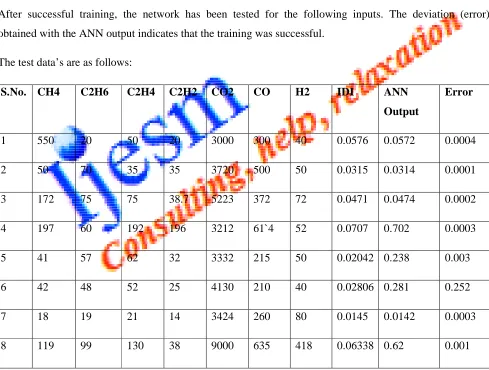
After successful training, the network has been tested for the following inputs. Th
obtained with the ANN output indicates that the training was successful.
The test data’s are as follows:
S.No. CH4 C2H6 C2H4 C2H2
1 550 20 50 20
2 50 70 35 35
3 172 75 75 38.7
4 197 60 192 196
5 41 57 62 32
6 42 48 52 25
7 18 19 21 14
8 119 99 130 38
Vol. 1(1) Sept-Dec (2011)
Back Propagation Algorithm has been used to train the network. The network has been trained in
Fig (a) and (b) output of ANN
After successful training, the network has been tested for the following inputs. Th
obtained with the ANN output indicates that the training was successful.
C2H2 CO2 CO H2 IDI ANN
Output
20 3000 300 40 0.0576 0.0572
35 3720 500 50 0.0315 0.0314
38.7 5223 372 72 0.0471 0.0474
196 3212 61`4 52 0.0707 0.702
32 3332 215 50 0.02042 0.238
25 4130 210 40 0.02806 0.281
14 3424 260 80 0.0145 0.01
38 9000 635 418 0.06338 0.62
ed to train the network. The network has been trained in 24 epoch.
After successful training, the network has been tested for the following inputs. The deviation (error)
ANN
Output
Error
0.0572 0.0004
0.0314 0.0001
0.0474 0.0002
0.702 0.0003
0.238 0.003
0.281 0.252
0.0142 0.0003
The graph of error v/s output as obtained from MATLAB is as shown in fig.
5. Conclusion
Dissolved gas analysis is a very powerful tool to
monitor the conditions inside the traction transformer.
The knowledge of absolute concentration of fault gas
indicates status of insulation whereas relative
concentration provides a clue to the type of fault.
Results show that the proposed index IDI gives a
fearsome idea about the insulating property of
transformer oil. The relative concentration of fault
gases gives the clue about the characteristics of the fault
that is developing inside the tank. Another important
feature of IDI is that it can give an idea about the aging
of insulating oil. Table4 shows the variation of IDI with
aging.
Artificial Neural Network can be trained for the various
conditions from the gas concentrations to access
directly the insulating quality in terms of IDI. Once
trained, a numeric relay could be used for alarming
conditions based on IDI.
Vol. 1(1) Sept-Dec (2011)
The graph of error v/s output as obtained from MATLAB is as shown in fig.
Dissolved gas analysis is a very powerful tool to
monitor the conditions inside the traction transformer.
The knowledge of absolute concentration of fault gas
indicates status of insulation whereas relative
concentration provides a clue to the type of fault.
Results show that the proposed index IDI gives a
fearsome idea about the insulating property of
rmer oil. The relative concentration of fault
gases gives the clue about the characteristics of the fault
that is developing inside the tank. Another important
feature of IDI is that it can give an idea about the aging
ariation of IDI with
Artificial Neural Network can be trained for the various
conditions from the gas concentrations to access
directly the insulating quality in terms of IDI. Once
trained, a numeric relay could be used for alarming
6. References
[1] Hao.Tang, Jianbin Fan,Guangning Wu and Jinzhong
Li “ The Design of circuit in Online Monitoring system
For Traction Transformer Insulation” in IEEE,2007.
[2] John C Steed “ Condition Monitoring applied to
power transformers-an REC view” in proc.Second
International Conference on the Reliability of
Transmission and distribution equipment,
29-31 March 1995.
[3] D.Harris,M.P.Saravolac “Condition Monitoring in
Power Transformers” in proc. IEEE colloquium on
Condition Monitoring of Large Machines and Power
Transformers, 19 June 1997
[4] W. Young, “ Transformer Life Management
Condition Monitoring in proc. Iee colloquium on
Transformer Life management, London , UK 22 Oct
1998.
[5] C. Myers “ Transformer Condition
oil Analysis Large or small , contaminant or 0
1
1 3 5 7
AN N Out put
[1] Hao.Tang, Jianbin Fan,Guangning Wu and Jinzhong
Li “ The Design of circuit in Online Monitoring system
For Traction Transformer Insulation” in IEEE,2007.
[2] John C Steed “ Condition Monitoring applied to
an REC view” in proc.Second
International Conference on the Reliability of
Transmission and distribution equipment, Coventry,UK
[3] D.Harris,M.P.Saravolac “Condition Monitoring in
Power Transformers” in proc. IEEE colloquium on
tion Monitoring of Large Machines and Power
[4] W. Young, “ Transformer Life Management –
Condition Monitoring in proc. Iee colloquium on
Transformer Life management, London , UK 22 Oct
[5] C. Myers “ Transformer Condition Monitoring by
catastrophe” in proc. First IEE International Conference
on power station Maintenance Edinburgh UK 30 mar
April 1998
[6] Ahmed E.B. Abu Elanien and M.M.A. Salama “
survey on the transformer Condition Monitoring “IEEE
trans. 2007, pp 187-191”
[7] M.Arshad , S. M. Islam and Abdul Khaliq ,” Power
Transformer Assest Management ,“ in proc.
International Confrence on Power System Technology
PowerCon 2004, Vol.2, pp 1395-1398 Nov. 2004
[8] M. Domun “Oil analysis as a Condition Monitoring
Technique “ in proc. IEEE colloquium on Monitoring
Technologies for Plant Insulation, 22 Nov. 1994
[9] M. Domun , “ Condition Monitoring of Power
Transformer by oil analysis technique” in proc. IEEE
colloquium on Condition Monitoring and Remant Life
Assessment in Transformer, 1994
[10] B. Pahlavanpour and A. Wilson. “ Analysis of
Transformer oil for transformer condition monitoring”
in proc. IEEE colloquium on an Engineering Review of
Liquid Insulation , 7 Jan 1997.
[11] D.V.S.S. Sira Sarma , G.N.S. Kalyani “ ANN
approach for condition monitoring of power
transformer using DGA” in proc, IEEE region 10
Conference TENCON 21-24 Nov. 2004.
[12]Y.C.Huang and C.M.Huang ,”Evolving Wavelet
Networks for Power Transformer Condition
Vol. 1(1) Sept-Dec (2011)
catastrophe” in proc. First IEE International Conference
on power station Maintenance Edinburgh UK 30 mar- 1
[6] Ahmed E.B. Abu Elanien and M.M.A. Salama “
ition Monitoring “IEEE
[7] M.Arshad , S. M. Islam and Abdul Khaliq ,” Power
Transformer Assest Management ,“ in proc.
International Confrence on Power System Technology
1398 Nov. 2004
l analysis as a Condition Monitoring
Technique “ in proc. IEEE colloquium on Monitoring
Technologies for Plant Insulation, 22 Nov. 1994
[9] M. Domun , “ Condition Monitoring of Power
Transformer by oil analysis technique” in proc. IEEE
ion Monitoring and Remant Life
[10] B. Pahlavanpour and A. Wilson. “ Analysis of
Transformer oil for transformer condition monitoring”
in proc. IEEE colloquium on an Engineering Review of
D.V.S.S. Sira Sarma , G.N.S. Kalyani “ ANN
approach for condition monitoring of power
transformer using DGA” in proc, IEEE region 10
24 Nov. 2004.
[12]Y.C.Huang and C.M.Huang ,”Evolving Wavelet
Networks for Power Transformer Condition
Monitoring” IEEE Trans. Power Del., vol 17,no
2,Apr.2002.
[13] Yishan Liang and Zhenyuan Wang, “ Power
Transformer DGA Data Processing and Alarming Tool
for On-Line Monitors” IEEE PES Power Systems
Conference& Exposition 2009.
[14] V.Rusov and S.Zhivodern
Condition Monitoring” International Conference on
Condition Monitoring and Diagnosis,Beijing,China.
April 21-24,2008.
[15] P.M. Nirgude, B. Gunasekaran, Channakeshava ,
A.D. Rajkumar and B.P. Singh, “ Frequency Response
Analysis Approach For Condition Monitoring of
Transformer,”in proc. Annual ReportConference on
Electrical Insulation and DielectricPhenomena, 2004
[16] A. Setayeshmehr,H.Borsi,E.Gockenbach and I.Fofana,”:On-line Monitoring of Transformer via Transfer Function” IEEE Electr
Conference,Montreal,Canada 31 May 2009.
Monitoring” IEEE Trans. Power Del., vol 17,no
[13] Yishan Liang and Zhenyuan Wang, “ Power
Transformer DGA Data Processing and Alarming Tool
Line Monitors” IEEE PES Power Systems
Conference& Exposition 2009.
[14] V.Rusov and S.Zhivodernikov, “ Transformer
Condition Monitoring” International Conference on
Condition Monitoring and Diagnosis,Beijing,China.
[15] P.M. Nirgude, B. Gunasekaran, Channakeshava ,
A.D. Rajkumar and B.P. Singh, “ Frequency Response
h For Condition Monitoring of
Transformer,”in proc. Annual ReportConference on
Electrical Insulation and DielectricPhenomena, 2004