ISSN (e): 2250-3021, ISSN (p): 2278-8719
Vol. 08, Issue 9 (September. 2018), ||V (V) || PP 01-06
CubeSat Design and Manufacturing Technique Analysis
Nickolay Zosimovych
1, Zhiyong Chen
21
Shantou University, China, Professor; 1Shantou University, China, Researcher Corresponding Author: Nickolay Zosimovych
Abstract: -
The CubeSat design process is comprised of choice of its trajectory, determination of components and main parameters of its systems, development of external and internal layouts, determination of the number of satellite-born antennas and their main characteristics. The potential of CubeSat has prompted the scientific community to rethink the existing spacecraft technologies, and think about how to make them suitable for CubeSats.In terms of specialization of engineering works during SmallSats development, was formulated concept of the design process and recognized physical relationships to find some optimal design solution about compatibility of basic parameters and characteristics.
The purpose of SmallSats rational design is to create a project of a vehicle for which the value of the selected criterion is close to the maximum or minimum value. As a result, the design algorithm version was making.
Keywords: -
SmallSat, spacecraft, design, structure, weight, power system (PS).--- Date of Submission: 13-09-2018 Date of acceptance: 29-09-2018 --- ---
I.
INTRODUCTION
The size and cost of modern spacecraft vary depending on the application. Some you can hold in your hand while others like Hubble are as big as a school bus. Small Spacecraft (SmallSats) focus on spacecraft with the mass less than 180 kilograms and about the size of a large kitchen fridge. Even with small space-craft, there is a large variety of size and mass that can be differentiated [1]: 1) Minisatellite, 100-180 kilograms; 2) Microsatellite, 10-100 kilograms; 3) Nanosatellite, 1-10 kilograms; 4) Picosatellite, 0.01-1 kilograms; 5) Femtosatellite, 0.001-0.01 kilograms.
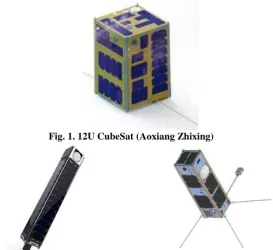
Fig. 1. 12U CubeSat (Aoxiang Zhixing)
The SmallSat design process is comprised of choice of its trajectory, determination of components and main parameters of its systems, development of external and internal layouts, determination of the number of satellite-borne antennas and their main characteristics, making programs: general one and for separate sessions (Fig. 1-3). Furthermore, since it is not possible to determine any basic parameters for the systems and the requirements for the control system, and to program the work without understanding the behavior of the individual systems and their interaction, these problems must be solving in the design process.
II.
CONCEPT
OF
THE
DESIGN
PROCESS
In terms of specialization of engineering works in the process of SmallSats development, design and calculation works, development of logical and electric diagrams and improvement of computation programs, modelling and computer analyses shall be done. The calculation and the modelling process include among others [2-5]:
1) design and strength checking calculations;
2) mass, momentum of inertia calculations, the center of mass position and positions of the main inertia axes; 3) thermal calculations;
4) calculations of internal and external disturbing moments influencing SmallSat; 5) gas environment calculations for hermetic compartments;
6) estimation of probability of meteorite impact and erosion of external surfaces, determining whether special protection measures (additional screens, thicker shells, more resistant coatings, etc.) should be applied; 7) estimation of radiation exposure for devices, glass, coatings and structural non-metallic elements;
8) dynamic analysis purposed to determine requirements or to check stiffness of the structure to eliminate mutual undesirable influence of mechanical and mechatronic devices and systems, and operation of the orientation system;
9) ballistic design;
10) power supply system calculations, orientation system and other system calculations.
The spacecraft center of mass movement stabilization system in the normal (lateral) plane applied in the trajectory correction phases shall be the subject of research. Either a high-thrust sustainer PS provided with deviating or linearly moving combustion chamber shall be using in the correction phase to control motions of the spacecraft [5].
If we bind the design process with the development stages typical for any product [6, 7], then this process should cover development and agreement of the technical specification for the SmallSat concerned, development of draft proposal, conceptual and technical design. It is obvious that in the process of SmallSat design the basic parameters of separate systems, trajectory characteristics, operation program and the spacecraft design should be putting into line.
III.
PHYSICAL
RELATIONSHIPS
IN
THE
DESIGN
PROCESS
The study of physical relationships in the design process is necessary, first, to find some optimal design solutions about compatibility of basic parameters and characteristics of SmallSat. The first task is to be certainly solving in the development of any project [8, 9]. Taking into consideration relatively low cost of modern SmallSats and the current methods of test and control it is difficult to imagine that the parameters of any systems could be incompatible in an orbiting SmallSat, or that its design could not provide for the operation of its devices [10-12].
The second of the tasks set is the search for optimal combinations of parameters and characteristics. It is much more difficult than the first one and is not always solving. This is mainly due to the complexity of studies of this sort of tasks [13-16]. In the simplest case, the trajectory and the orbit injection launch vehicle shall be set. They shall determine the overall weight M0 of the spacecraft to be injecting on the specified
trajectory. In this case the weight of the equipment MSc will be
,
0 SS
Sc M M
M (1)
whereMSS is the total weight of the service systems, frame and on-board cable network necessary to ensure
the operation of the spacecraft.
Thus, in the simplest case, when the trajectory, or rather narrow range of trajectories, and the launcher are specifying, the task of rational design is reducing to minimization of the total weight of service systems, the frame and the on-board cable network. In this case, the initial weight of the vehicle M0 can be considering as
design value.
For the cases when the value MSS in the expression (1) cannot be considering independent the value
, Sc
, 0
0 Sc
Sc SS
Sc f M M M
M (2)
instead of the specified expression, where 0
Sc
M is the total weight of the service systems and the frame
independent of the weight of the scientific equipment; fSSMSc is an additional weight of the service systems
and the frame, necessary for operation of the scientific equipment depending on its weight, composition and operation program.
If the function fSSMSc is quite simple, the expression (2) can be solving relative to the value MSc, i.e. find the expression
). ,
( 0
0 SS
Sc F M M
M (3)
In this case, we can search for the maximum value directly MSc.
If we seek a minimum of the value 0
SS
M in the expression (3), i.e. neglect the weight of the scientific equipment, it also can be approximate, as the versions of the service systems disregarded in the design process can provide a smaller value fSSMScthan the chosen versions [17]. If we indicate the probability of flawless
operation of the spacecraft within a specified time t0asB, we can write
m n, ,
i ,
j ,0 ,B BC T P t (4)
where
n m
C , is the finite set of basic parameters of systems; mis the system number; nis a parameter
number;
i
T is a parameters set determining the trajectory of the spacecraft;
Pj parameter set determiningthe operation program.
The probability of SmallSat's flawless operation shall be determining by the reliability of its individual systems. We shall note that the minimum number of SmallSats corresponds to the minimum cost of solving the problem or the minimum time to complete the entire program. These expressions will include some constants. These equations and inequalities shall be writing as follows
, 0 , 0 , ,,n i j
m
r C T P
(5)
where n1,2,...,Nm;Nmis the number of basic parameters of the mth system; m1,2,...,M;Mis a number of on-board systems; i1,2,...,I;r1,2,...,R; j1,2,...,J.
If all the expressions (5) are equations andRN,then the task of seeking for optimal parameter values
is confining to finding a constrained extrema of the many variables function. The relations of type (5) are simultaneously the constraint equations [18].
The purpose of rational design is to create a project of a vehicle for which the value of the selected criterion is close to the maximum or minimum value. In this case, different configuration diagrams, different orientation schemes and different methods of creating control and corrective forces, etc. [18] should be considering. Depending on the versions of design solutions the functions Kand will change. Consequently, the rational design shall be confining to the investigation of the functionKin the constraint equations (5) for different versions of the newly designed SmallSat.
IV.
DESIGNALGORITHMVERSIONFig. 4. Some collected CubeSat structures [16]-[18]
Fig. 4 (b) shows us a clearly advanced design [17], this structure’s side panel can be separating from base detachable, and this method has the following advantages:
1. The removable side panel means that we can placed internal circuit board and satellite payload easily. 2. Owing to the side panel and the base is not a whole, we can use different materials. For example, the base,
which with the high strength requirement, we could use a metal or a composite material; and for side panel part whose strength requirement is not high, we can use some lightweight materials (aluminum or plastic) to achieve the purpose of saving weight.
Part (c) and (d) of Fig. 4 are two pictures of the same CubeSat [18]. From the pictures given above, we can observe that this is a structure without using lateral plate, and the whole material lightweight merged materials, which means this structure can ensure the strength requirement and minimize the mass of it, thus we can achieve the purpose of carrying more payload.
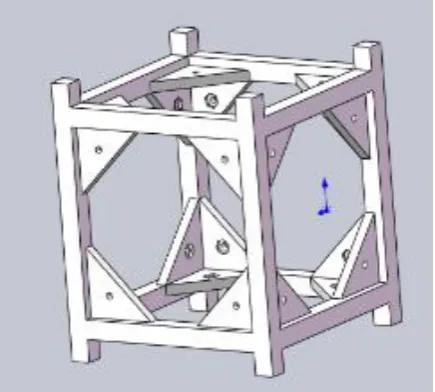
After summarizing all the structures investigated, we propose the following structural design (Fig. 5). This is a structure consisting of two identical top and bottom plates, four equal sides, and eight identical bases. Such of design would greatly simplify the manufacturing process of the structure.
Moreover, such design idea is conducive to the installation and disassembly of the whole structure. At the same time, we make the interior of the structure as large as possible to carry more payload. The design of the side panel is to reduce the quality under the premise of ensuring the structural strength.
During design process of the whole structure, we also come up with another alternative design. We call it the plan B structure (Fig. 6).
Compared with the structure we choose above, one of the biggest differences is that it is composed of a whole formed by one base (Fig. 6) plus side plates. However, this plan B structure has some redundant parts; it also takes up the CubeSat payload quality. In addition, all six of its sides are just bolting in the base, rather than embedded as the design we chose, which means the design intensity is significantly worse. Therefore, we can use the plan B structure as a backup.
Fig. 6. The base of the plan B structure
V.
CONCLUSION
This publication summarizes CubeSat technology, provides examples of their scientific impact, and describes the design and the manufacturing of a CubeSat platform. The SmallSat design process is comprised of choice of its trajectory, determination of components and main parameters, systems, development of external and internal layouts, determination of the number of satellite-born antennas and their main characteristics. Proposed paper will focus on estimating a concept and physical relationships in the design process, and on the rational design algorithm version. In terms of specialization of engineering works during SmallSats development, was formulated concept of the design process and established physical relationships to find some optimal design solution about compatibility of basic parameters and characteristics.
REFERENCES
[1]. Gao S, Clark K, Unwin M, Zackrisson J, Shiroma W A, Akagi J M, Maynard K, Garner P, Boccia L, Amendola G, Massa G, Underwood C, Brenchley M, Pointer M, Sweeting M N. Antennas for modern small satellites, IEEE Antennas Propag. Mag., Vol. 51, No. 4; 2009. p. 40-56.
[2]. Swartwout M A. CubeSat database, Aug.; 2016. [online] Available: https://sites.google.com/a/slu.edu/swartwout/home/cubesat-database .
[3]. Small spacecraft technology state of the art. Tech. Rep. NASA/TP-2014-216648/REV1; 2014.
[4]. Lee S, Hutputanasin A, Toorian A, Lan W, Munakata R, Carnahan J, Pignatelli D, Mehrparvar A. CubeSat design specification, Rev. 13: The CubeSat program, San Luis Obispo: California Polytechnic State Univ.; 2014, [online] Available: http://cubesat.calpoly.edu/images/developers/cds_rev13_final.pdf. [5]. Kitts C, Hines J, Agasid E, Ricco A, Yost B, Ronzano K, Puig-Suar J. The Gene-Sat-1 microsatellite
mission: A challenge in small satellite design, Proc. 20th Annu. American Inst. Aeronautics and Astronautics / Utah State University Conf. Small Satellites; 2006. p. 1-6.
[6]. Reising S C, Gaier T C, Kummerow C D, Chandrasekar V, Brown S T, Pad-Manabhan S, Lim B H, Van den Heever S C, L'Ecuyer T S, Ruf C S, Haddad Z S, Luo Z J, Munchak S J, Berg G, Koch T C, Boukabara S A. Overview of Temporal Experiment for Storms and Tropical Systems (TEMPEST) CubeSat constellation mission, Proc. IEEE Microwave Theory and Tech. Society Int. Microwave Symp. Digest; 2015. p. 1-4, May.
[8]. Rahmat-Samii Y, Manohar V, Kovitz J M. For Satellites, Think Small, Dream Big: A review of recent antenna developments for CubeSats. Applied IEEE Antennas and Propagation Magazine, Vol. 59, Is. 2; 2017. April.
[9]. Mehrparvar A. CubeSat Design Specification (PDF). The CubeSat Program, CalPoly SLO. The CubeSat Program, CalPoly SLO; 2017. Retrieved March 25.
[10]. AeroCube 6A, 6B (CubeRad A, B); 2015. [online] Available: www.space.skyrocket.de, Retrieved 2015-10-18.
[11]. Mehrparvar A. CubeSat Design Specification (PDF); 2014. MarCO: Planetary CubeSats Become Real, [online] Available: www.planetary.org , Retrieved 2016-02-23.
[12]. Clark S. Launch of NASA’s next Mars mission delayed until at least 2018. Spaceflight Now, Retrieved 2016-02-23.
[13]. CubeSat. Space. Skyrocket.de. Retrieved 2015-10-18.
[14]. Athirah N, Mohd A, Ku H, Amin N A M, Majid M S A. Stress and Thermal Analysis of CubeSat Structure. Applied Mech. and Materials. 554: 426–430. Doi: 10.4028/www.scientific.net/amm.554.426. [15]. Woellert K, Ehrenfreund P, Ricco A J, Hertzfeld Р. Cubesats: Cost-effective science and technology
platforms for emerging and developing nations, 2011. Applied Science Direct. 47: 663.
[16]. Piattoni J, Candini G P, Pezzi G, Santoni F, Piergentili F; Plastic Cubesat: An innovative and low-cost way to perform applied space research and hands-on education. Applied Elsevier; 2012. 81: 420. [17]. Zosimovych N. Functional Simulation of the Integrated Onboard System for a Commercial Launch
Vehicle, Int. Ref. Journ. of Eng. and Sc. (IRJES), 3(11); 2014. p. 92-106.
[18]. Zosimovych N, Zosimovych D. Simulation of the Dynamic Characteristics of Launch Vehicle Stabilization During Longitudinal Oscillations. IOSR Journ. of Eng. (IOSRJEN), 6(1); 2016. p. 1-9.
![Fig. 4. Some collected CubeSat structures [16]-[18]](https://thumb-us.123doks.com/thumbv2/123dok_us/7808557.1662163/4.595.176.427.83.296/fig-collected-cubesat-structures.webp)