0095-1137/05/$08.00
⫹
0
doi:10.1128/JCM.43.12.5860–5864.2005
Copyright © 2005, American Society for Microbiology. All Rights Reserved.
Analysis of a Uropathogenic
Escherichia coli
Clonal Group by
Multilocus Sequence Typing
Sara Y. Tartof,
1,4Owen D. Solberg,
2Amee R. Manges,
3and Lee W. Riley
1,4*
Division of Infectious Diseases and Immunity, University of California at Berkeley, Berkeley, California
1; Department of
Integrative Biology, University of California at Berkeley, Berkeley, California
2; Department of Epidemiology,
Biostatistics, and Occupational Health, McGill University, Montreal, Quebec, Canada
3; and Division of
Epidemiology, School of Public Health, University of California at Berkeley, Berkeley, California
4Received 11 May 2005/Returned for modification 8 August 2005/Accepted 26 September 2005
Although many strain typing methods exist for pathogenic
Escherichia coli
, most have drawbacks in terms of
resolving power, interpretability, or scalability. For this reason, multilocus sequence typing (MLST) is an appealing
alternative. However, its applicability to different pathogens in specific epidemiologic contexts is not well
under-stood. Here, we applied a previously established MLST method based on housekeeping genes to a well-characterized
collection of uropathogenic
E. coli
isolates to compare the discriminatory ability of this procedure with that of
enterobacterial repeat intergenic consensus (ERIC2) PCR, serogrouping, and pulsed-field gel electrophoresis
(PFGE). Among 45
E. coli
isolates studied, 17 different multilocus sequence types (ST) were identified. One MLST
group (designated ST69 complex) was comprised of 22 isolates, all belonging to uropathogenic and bacteremic
E.
coli
strains previously defined as clonal group A (CgA) by ERIC2 PCR. The ST69 strains contained five different
serogroups and 14 PFGE types. ERIC2 PCR CgA strains belonging to different MLST groups were also identified.
Interestingly, one cow
E. coli
isolate, previously shown by PFGE to be closely related to a human uropathogenic CgA
strain, was found to cluster with the ST69 strains. All of the other animal and environmental CgA isolates had
different MLST profiles. The discriminatory power of this MLST method based on housekeeping genes appears to
be higher than that of ERIC2 PCR but lower than that of PFGE for epidemiologic study of uropathogenic
E. coli
.
The morbidity and financial burden associated with urinary
tract infections (UTIs) is substantial: almost half of all women
experience at least one UTI in their lifetime, and overall
ex-penditures for UTI treatment in women in the United States
was approximately $2.47 billion in 2000 (3, 5). The primary
etiologic agent of UTI is
Escherichia coli
, accounting for as
much as 90% of all UTIs seen among ambulatory care patients
(23). Antimicrobial resistance among uropathogenic
E. coli
continues to rise in the United States, contributing to greater
difficulty in the management of UTI (6, 7).
The genotypic characterization of pathogens has become an
important objective in epidemiologic investigations of infectious
agents. Genotyping tools are amenable to validation when the
diseases in question occur as recognizable outbreaks, such as
those caused by
E. coli
O157:H7 or
Salmonella
spp. The problem
arises in characterizing organisms that cause diseases that are not
usually thought of as causing outbreaks, such as
E. coli
associated
with community-acquired UTI. Recent studies that applied
geno-typing methods to differentiate uropathogenic
E. coli
suggest that
community-acquired UTIs could occur as outbreaks.
Manges et al. reported in 2001 that a single clonal group of
E.
coli
, designated clonal group A (CgA), based on a characteristic
enterobacterial repeat intergenic consensus (ERIC2) PCR
finger-print pattern, was responsible for nearly half of
trimethoprim-sulfamethoxazole-resistant
E. coli
isolates from 47 women with
UTIs diagnosed at a California university health clinic between
October 1999 and January 2000 (13). Human UTI isolates
be-longing to CgA were also found to share a random amplified
polymorphic DNA PCR fingerprint, virulence factor profile,
sim-ilar antimicrobial resistance phenotype, O antigen groups (O11,
O17, O73, and O77), and indistinguishable or closely related
pulsed-field gel electrophoresis (PFGE) patterns (9), suggesting
that they caused an outbreak in this California community. Most
recently, a gene-specific PCR was devised to identify CgA based
on a single-nucleotide polymorphism (SNP) (C288T) identified
within the
fumC
housekeeping gene (11).
Certain genotyping methods (PCR-based methods and
PFGE) rely on comparison of banding patterns generated by
gel electrophoresis. Such techniques are condition dependent
and therefore can suffer from interlaboratory variability (20).
Furthermore, visual inspection remains integral to their
inter-pretation, introducing subjectivity and greater potential for
error (22). While PFGE does offer superior reproducibility and
discriminating power and remains the method most commonly
used to identify food-borne outbreaks of
E. coli
O157:H7 at
reference laboratories, it is labor intensive and technically
de-manding (8, 13, 21). Although gene-specific PCR is highly
reproducible, a recent study evaluating 45 isolates exhibiting
an ERIC2 PCR CgA pattern found that only 16 isolates
con-tained the C288T SNP (4). Thus, a more reliable, relevant, and
consistent typing method for investigating the clonal
distribu-tion of uropathogenic
E. coli
strains, such as CgA isolates, is
needed for epidemiologic investigations. The availability of a
large, well-characterized, and population-based collection of
uropathogenic
E. coli
isolates provided us with an opportunity
to evaluate another genotyping method.
Multilocus sequence typing (MLST) uses nucleotide
se-quences of internal fragments of selected genes as the unit of
* Corresponding author. Mailing address: Divisions of
Epidemiol-ogy and Infectious Diseases and Immunity, 140 Warren Hall, School of
Public Health, University of California at Berkeley, Berkeley, CA
94720. Phone: (510) 642-9200. Fax: (510) 642-6350. E-mail: lwriley
@berkeley.edu.
5860
on May 15, 2020 by guest
http://jcm.asm.org/
comparison and, therefore, does not suffer from the drawbacks
of gel-based fingerprinting methods. Sequence data are easily
comparable and transferable between laboratories and are
highly reproducible (2, 12). Furthermore, the digital format of
MLST data has facilitated the establishment of global,
web-accessible databases for a variety of organisms and is rapidly
contributing to our understanding of the clonal distribution of
infectious disease agents. The most commonly used MLST
schemes index the neutral genetic variation in housekeeping
genes, which are believed to evolve slowly because they are
under stabilizing, and not directional, selective pressure. The
SNPs observed across several different MLST loci represent
neutral genetic variation and presumably exhibit minimal
au-tocorrelation, which could confound epidemiologic
conclu-sions. MLST is thus a powerful tool for global and long-term
surveillance.
In this study, we evaluated an MLST protocol standardized
for
E. coli
maintained at the Max-Planck Institut fuer
Infek-tionsbiologie website (http://web.mpiib-berlin.mpg.de) using a
well-characterized population-based collection of CgA and
other
E. coli
strains and compared its discriminatory power
with that based on PFGE, ERIC2, and serogroup analyses.
MATERIALS AND METHODS
Bacterial isolates.A total of 45E. coliisolates were studied: 29 were previously identified as CgA (23 human and 6 animal and environmental) and 16 were identified as human non-CgA strains, defined by ERIC2 PCR (13, 19). Isolates were selected to include groups of strains from various geographic and host sources to investigate potential groupings by these factors. Dates of collection of isolates ranged from 1988 to 2003.
Isolates included strains from the following sources: (i) UTI isolates from California (n⫽15) women with symptoms of UTI who were seen at a university health service (they were consecutively enrolled into a study between 11 October 1999 and 31 January 2000) and UTI-causing, trimethoprim-sulfamethoxazole-resistantE. coliisolates (n⫽6) from Minnesota (obtained from students who were seen at university health services with uncomplicated cystitis and were enrolled in a study between June 1998 and August 1999); (ii) animal and envi-ronmental isolates (n⫽6) provided by the Gastroenteric Disease Center at Pennsylvania State University (University Park, PA); (iii) human bacteremia isolates (n⫽12) from San Francisco General Hospital provided by Francoise Perdreau-Remington; and (iv) other geographic comparison isolates recovered from humans (n⫽6) provided by James R. Johnson of the Minneapolis VA Medical Center, University of Minnesota.
Serotyping.Serotyping was performed onE. coliisolates at theE. coli Refer-ence Center in University Park, Pennsylvania.
Molecular strain typing analyses.AllE. coliisolates were initially typed by the ERIC2 PCR fingerprinting assay, as described elsewhere (10, 13). The CgA ERIC2 PCR electrophoretic pattern was defined by 4 predominant bands of approximately 1,145, 1,029, 908, and 720 bp; isolates exhibiting this pattern were considered to be members of CgA. A pyelonephritogenic isolate, CFT073 (pro-vided by Harry Mobley, University of Maryland, Baltimore), was used as a reference strain for each ERIC2 PCR run.
PFGE.The standardized protocol for subtypingE. coliO157:H7 by PFGE, as established by the Centers for Disease Control and Prevention (Atlanta, GA), was used (1). XbaI-digested DNA was electrophoresed in the CHEF DR-II apparatus (Bio-Rad, Hercules, CA). Images of PFGE and ERIC2 PCR electrophoretic pat-terns were imported and analyzed with GelCompar II, version 2.0 (Applied Maths, Kortrijk, Belgium), with the pattern of the prototype CgA strain (SEQ102, deposited in the American Type Culture Collection as ATCC BAA-457) used as a reference, as previously described (19). To minimize gel-to-gel banding pattern variation, we used the autosearch band calling function of GelCompar with the following param-eters: minimum profiling, 5%; gray zone, 0%; minimum area, 1%; shoulder sensi-tivity, 1. A distance matrix was calculated by GelCompar’s Dice algorithm with a band position tolerance of 1%. A dendrogram was generated from the distance matrix by the neighbor-joining method.
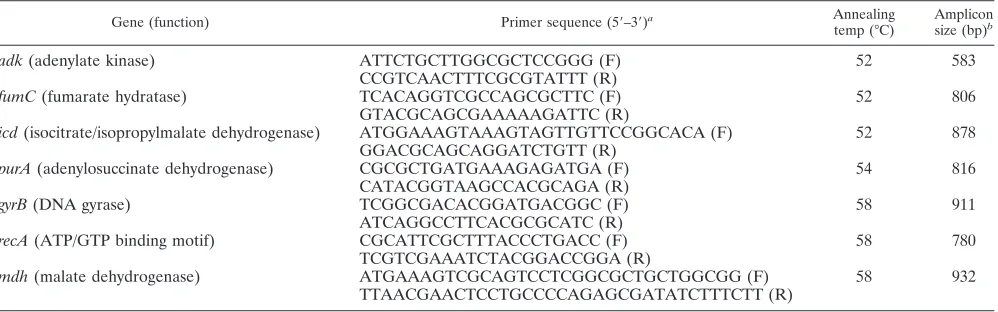
MLST. (i) Allele templates selected.Housekeeping genes for typing were selected from theE. colidatabase at the MLST website maintained at the Max-Planck Institut fuer Infektionsbiologie (http://web.mpiib-berlin.mpg.de) (Table 1). The genes were shown to be unlinked on anE. coliK-12 genome map. Product lengths varied from 583 to 932 bp (Table 1). Allele templates, included on the website, were based on the genome sequence ofE. colistrain MG1655. (ii) DNA isolation.E. coliisolates were obtained from a collection of strains stored in 15% glycerol at⫺80°C. Isolates were incubated at 37°C on LB agar plates overnight. Single colonies were picked and inoculated into 2 ml LB media and further incubated in a shaking incubator for 12 to 15 h at 37°C. A 1-ml suspension of bacteria was centrifuged, and DNA was extracted from the bac-terial pellet with the QIAGEN DNeasy tissue kit (QIAGEN, Valencia, CA).
PCR.Amplifications were carried out in a total volume of 50l with 2l of template DNA, 4l of each 10 mM primer (Sigma, Genosys, The Woodlands, TX), 5l 10⫻buffer, 15 mM MgCl2(Applied Biosystems, Foster City, CA), 5l
2 mM deoxynucleoside triphosphate mix (Invitrogen, Carlsbad, CA), and 0.5 U AmpliTaqGold (Applied Biosystems). Reaction conditions used were: 2 min of denaturation at 95°C; 30 cycles of 1 min of denaturation at 95°C, 1 min of annealing at specific temperature (Table 1), 2 min of extension at 72°C; and a final additional 5 min at 72°C in an Applied Biosystems GeneAmp PCR System 2400 thermocycler.
Sequencing.PCR products were purified for sequencing with the QIAGEN QIAquick PCR purification kit. Both the forward and reverse strands were sequenced with the PCR primer set, with the exception ofmdh, which was sequenced by the forward primer 5⬘-TCTGGTGAAGATGCGACTCC-3⬘and reverse primer 5⬘-CCCAGGGCGATATCTTTCTT-3⬘. Sequencing was
per-TABLE 1. Forward and reverse sequences of primers
cGene (function) Primer sequence (5⬘–3⬘)a Annealing
temp (°C)
Amplicon size (bp)b
adk
(adenylate kinase)
ATTCTGCTTGGCGCTCCGGG (F)
52
583
CCGTCAACTTTCGCGTATTT (R)
fumC
(fumarate hydratase)
TCACAGGTCGCCAGCGCTTC (F)
52
806
GTACGCAGCGAAAAAGATTC (R)
icd
(isocitrate/isopropylmalate dehydrogenase)
ATGGAAAGTAAAGTAGTTGTTCCGGCACA (F)
52
878
GGACGCAGCAGGATCTGTT (R)
purA
(adenylosuccinate dehydrogenase)
CGCGCTGATGAAAGAGATGA (F)
54
816
CATACGGTAAGCCACGCAGA (R)
gyrB
(DNA gyrase)
TCGGCGACACGGATGACGGC (F)
58
911
ATCAGGCCTTCACGCGCATC (R)
recA
(ATP/GTP binding motif)
CGCATTCGCTTTACCCTGACC (F)
58
780
TCGTCGAAATCTACGGACCGGA (R)
mdh
(malate dehydrogenase)
ATGAAAGTCGCAGTCCTCGGCGCTGCTGGCGG (F)
58
932
TTAACGAACTCCTGCCCCAGAGCGATATCTTTCTT (R)
aF, forward; R, reverse.bThe sequenced DNA strands were shorter than the original PCR amplicon. cPrimers are maintained at http://web.mpiib-berlin.mpg.de and http://www.mlst.net.
on May 15, 2020 by guest
http://jcm.asm.org/
[image:2.585.44.543.81.237.2]formed at the University of California at Berkeley Sequencing Facility, which is equipped with an Applied Biosystems 48 capillary 3730 and two Applied Bio-systems 16 capillary 3100 genetic analyzer Bio-systems. A Perkin Elmer (Wellesley, MA) 9600, an Eppendorf (Hamburg, Germany) Mastercycler, and three MJ Research (Bio-Rad, Hercules, CA) PTC-200s were used for cycle sequencing. The facility runs a 25-cycle sequencing reaction with the following program: 96°C for 10 s plus 50°C for 5 s plus 60°C for 4 min.
Sequence analysis.Raw sequences were reviewed by visual inspection with Chromas, version 1.45 (32-bit) (Technelysium Pty. Ltd., Tewantin Qld 4565, Australia). DNA sequences were aligned by the neighbor-joining method with 1,000 bootstrap iterations in ClustalW (Hinxton, England). Forward and reverse sequences were aligned for each strain for comparison and editing purposes. Alignments were edited to equally sized fragments and aligned against allele templates based onE. colistrain MG1655, provided at http://www.mlst.net. Sequence editing was conducted with BioEdit (Carlsbad, CA), version 7.0.1. Sequences for the seven genes of each strain were concatenated to produce an alignment sequence of 3,423 bp. A dendrogram of SNP groupings based on these alignments was then constructed by the Phylip programs (Seattle, WA) DNA DIST and NEIGHBOR, and the final dendrogram was visualized with the soft-ware TreeView (Win32) (Glasgow, Scotland), version 1.6.6.
ST designation.Gene sequences were submitted to the curator of the MLST
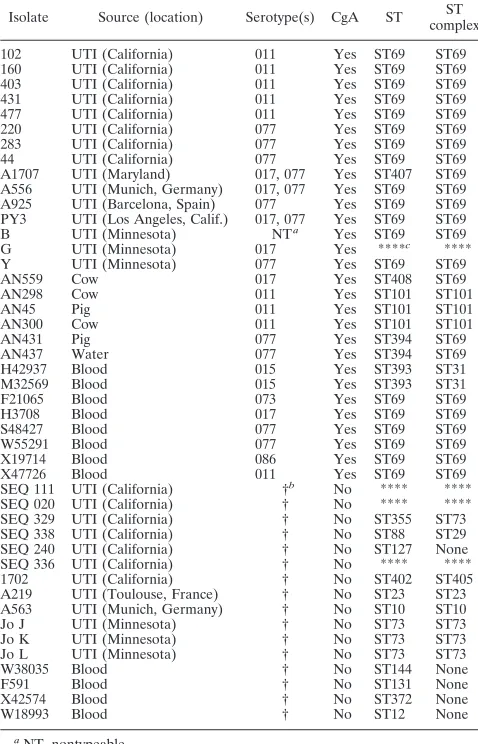
E. colisubmission page maintained at http://web.mpiib-berlin.mpg.de. Sequence types (STs) and sequence complexes were designated by the curator of the MLST database for sequence submissions that contained tracings found to be accept-able by the curator (Taccept-able 2). ST complexes were defined as STs that are linked by distances of one to two allelic differences.
RESULTS
Of 45
E. coli
isolates analyzed by MLST, 41 generated
se-quence tracings acceptable for an ST number assignment. The
41 isolates were grouped into 17 distinct STs (Table 2). Of the
17 STs, 12 were already included in the
E. coli
MLST website
database. Of the 23 human isolates defined by ERIC2 PCR as
CgA, one MLST cluster comprised of 21 human isolates,
des-ignated ST69 complex, was observed (Table 2; Fig. 1). Of
these, 19 showed identical sequences in all seven genes
regard-less of geographic or clinical sources. One isolate from
Mary-land (A1707) and one isolate from Minnesota (G) differed by
one single-nucleotide polymorphism each, in the
fumC
gene
and the
gyrB
gene, respectively. Of the 8 human bacteremia
CgA isolates, two isolates (H42937 and M32569) fell outside
cluster ST69 and shared exact sequence identity. The non-CgA
bacteremia isolates (
n
⫽
4) each belonged to a distinct MLST
type (Fig. 1). Five of the six animal/environmental CgA isolates
(AN300, AN298, AN45, AN431, and AN437) fell outside the
ST69 grouping. The 21 human strains in the ST69 complex
were composed of five serogroups (O11, O77, O17, O73, and
O86). The non-ST69 complex CgA isolates that belonged to
serogroups O77, O11, and O15 fell into three clusters in which
serogroup and sequence type were shared among the isolates
in that branch.
One CgA animal (cow) isolate (AN559) was found to belong
to the MLST complex ST69, which included only human UTI
and bacteremia CgA isolates (Fig. 1). None of the strains
previously identified as non-CgA fell into this ST69 complex.
Of the non-CgA strains, the three UTI isolates from
Minne-sota all belonged to another MLST complex (Fig. 1). These
isolates were indistinguishable by ERIC2 PCR and were the
only clustered non-CgA isolates.
Of 22 ST69 complex isolates, 19 had identical sequences in
all 7 gene templates. These 19 ST69 strains were further
sep-arated into 14 subtypes by PFGE (Fig. 1, inset).
DISCUSSION
The evaluation of new molecular strain typing techniques with
well-characterized isolates and previously established typing
methods is an important component of infectious disease
epide-miologic research. Although the limitations of ERIC2 PCR have
been reported (14), it was demonstrated here that an MLST
scheme based on housekeeping genes revealed highly similar
clus-tering of human isolates previously defined as CgA by ERIC2
PCR (13). However, this MLST method was able to further
dis-criminate human and animal/environmental CgA strains. Five of
six animal/environmental isolates defined as CgA did not cluster
with human CgA isolates, whereas one did. Thus, while ERIC2
PCR is not as discriminating as the MLST based on housekeeping
genes, the observations made in this study suggest that it is still a
reliable screening tool that can be used to rapidly separate a large
collection of uropathogenic
E. coli
isolates into groups that have
possible epidemiologic relationships.
[image:3.585.301.540.83.455.2]Interestingly, strain AN559, isolated from a cow in 1988 that
was previously shown to be 94% similar by PFGE to a human
UTI-causing CgA
E. coli
isolate (19), was found to occur within
TABLE 2. STs and ST complexes
Isolate Source (location) Serotype(s) CgA ST ST
complex
102 UTI (California) 011 Yes ST69 ST69
160 UTI (California) 011 Yes ST69 ST69
403 UTI (California) 011 Yes ST69 ST69
431 UTI (California) 011 Yes ST69 ST69
477 UTI (California) 011 Yes ST69 ST69
220 UTI (California) 077 Yes ST69 ST69
283 UTI (California) 077 Yes ST69 ST69
44 UTI (California) 077 Yes ST69 ST69
A1707 UTI (Maryland) 017, 077 Yes ST407 ST69
A556 UTI (Munich, Germany) 017, 077 Yes ST69 ST69
A925 UTI (Barcelona, Spain) 077 Yes ST69 ST69
PY3 UTI (Los Angeles, Calif.) 017, 077 Yes ST69 ST69
B UTI (Minnesota) NTa Yes ST69 ST69
G UTI (Minnesota) 017 Yes ****c ****
Y UTI (Minnesota) 077 Yes ST69 ST69
AN559 Cow 017 Yes ST408 ST69
AN298 Cow 011 Yes ST101 ST101
AN45 Pig 011 Yes ST101 ST101
AN300 Cow 011 Yes ST101 ST101
AN431 Pig 077 Yes ST394 ST69
AN437 Water 077 Yes ST394 ST69
H42937 Blood 015 Yes ST393 ST31
M32569 Blood 015 Yes ST393 ST31
F21065 Blood 073 Yes ST69 ST69
H3708 Blood 017 Yes ST69 ST69
S48427 Blood 077 Yes ST69 ST69
W55291 Blood 077 Yes ST69 ST69
X19714 Blood 086 Yes ST69 ST69
X47726 Blood 011 Yes ST69 ST69
SEQ 111 UTI (California) †b No **** ****
SEQ 020 UTI (California) † No **** ****
SEQ 329 UTI (California) † No ST355 ST73
SEQ 338 UTI (California) † No ST88 ST29
SEQ 240 UTI (California) † No ST127 None
SEQ 336 UTI (California) † No **** ****
1702 UTI (California) † No ST402 ST405
A219 UTI (Toulouse, France) † No ST23 ST23
A563 UTI (Munich, Germany) † No ST10 ST10
Jo J UTI (Minnesota) † No ST73 ST73
Jo K UTI (Minnesota) † No ST73 ST73
Jo L UTI (Minnesota) † No ST73 ST73
W38035 Blood † No ST144 None
F591 Blood † No ST131 None
X42574 Blood † No ST372 None
W18993 Blood † No ST12 None
aNT, nontypeable. b†, serotype not available.
c****, MLST designation not yet available.
on May 15, 2020 by guest
http://jcm.asm.org/
the ST69 complex. This was the only animal strain to cluster
within this group, differing by a single nucleotide in the
adk
gene.
Recently, CgA isolates shown to be highly similar by
multi-ple techniques, including C288T SNP analysis, drug
suscepti-bility testing, presence of the 1.8-kb class I integron bearing the
dfrA17
gene, and virulence gene profile analysis, were each
shown to be distinct by PFGE profile (4). Our investigation of
the 21 CgA strains evaluated by PFGE showed that there was
no difference in clustering by MLST among the strains that
shared PFGE types and the strains that were unique by PFGE.
Thus, PFGE still has superior discriminatory ability for
uro-pathogenic
E. coli
than any of the other methods, including this
MLST scheme. A similar observation was made by Noller
et al., who compared PFGE and MLST for their discriminatory
ability using a collection of diarrheagenic
E. coli
serotype
O157:H7 (16). In one study, MLST was found to be more
discriminatory than PFGE only if gene templates in addition to
the 7 housekeeping genes were included (15).
ST69 belongs to ECOR D group. A previous study of CgA
strains by virulence factor profile analysis found them to have
a profile similar to that of the O15:K52:H1 clonal group that
was reported to be responsible for community outbreaks of
UTI and bacteremia in Europe (8, 17, 18).
Ultimately, the appropriate level of discriminatory power of
any strain typing test is determined by the epidemiologic question
of interest. Just as highly discriminatory typing methods can
ob-scure important epidemiologic relationships between related
strains, typing schemes with low discriminatory power can
ob-scure important epidemiologic associations. Uropathogenic CgA
E. coli
strains clearly include multiple subtypes, as was shown by
the present MLST technique, PFGE analysis, and analysis by
France et al. (4). Here, a housekeeping gene-based MLST
ap-plied to a well-characterized CgA collection demonstrated
dis-criminatory power that fell between ERIC2 PCR and PFGE.
Therefore, for an MLST scheme to be applicable for
community-based microepidemiologic studies of uropathogenic
E. coli
, it will
have to be based on allelic templates that show a greater degree
of variation.
ACKNOWLEDGMENTS
[image:4.585.112.474.69.434.2]We thank the staff of Tang Health Center, James R. Johnson,
Francoise Perdreau-Remington, and Chitrita DebRoy for providing
FIG. 1. Neighbor-joining tree constructed from the concatenated sequences of the 7 MLST genes described in the text. The 29 previously
identified CgA isolates are shown with shaded backgrounds. Serogroups are indicated for the CgA isolates. The inset shows a dendrogram based
on Dice distance coefficient measurements of PFGE banding patterns among the 21 isolates belonging to the ST69 complex.
ⴱ
, no PFGE data
available;
ⴱⴱ
, ST69 complex members, not ST69 (see Table 2); †, prototype human uropathogenic CgA strain ATCC BAA-457.
on May 15, 2020 by guest
http://jcm.asm.org/
isolates; Sherry Smith for editorial input; Amy White for logistical
support; Mark Achtman for advice in executing this MLST analysis;
and Linda and David Tartof for general support.
This work was supported by NIH grant RO1 AI059523.
REFERENCES
1.Bender, J. B., C. W. Hedberg, J. M. Besser, D. J. Boxrud, K. L. MacDonald, and M. T. Osterholm.1997. Surveillance by molecular subtype for Esche-richia coliO157:H7 infections in Minnesota by molecular subtyping. N. Engl. J. Med.337:388–394.
2.Enright, M. C., and B. G. Spratt.1999. Multilocus sequence typing. Trends Microbiol.7:482–487.
3.Foxman, B.2003. Epidemiology of urinary tract infections: incidence, mor-bidity, and economic costs. Dis. Mon.49:53–70.
4.France, A. M., K. M. Kugeler, A. Freeman, C. A. Zalewski, M. Blahna, L. Zhang, C. F. Marrs, and B. Foxman.2005. Clonal groups and the spread of resistance to trimethoprim-sulfamethoxazole in uropathogenicEscherichia coli. Clin. Infect. Dis.40:1101–1107.
5.Griebling, T. L.2005. Urologic diseases in America project: trends in re-source use for urinary tract infections in women. J. Urol.173:1281–1287. 6.Gupta, K.2003. Addressing antibiotic resistance. Dis. Mon.49:99–110. 7.Gupta, K., D. F. Sahm, D. Mayfield, and W. E. Stamm.2001. Antimicrobial
resistance among uropathogens that cause community-acquired urinary tract infections in women: a nationwide analysis. Clin. Infect. Dis.33:89–94. 8.Johnson, J. R., A. R. Manges, T. T. O’Bryan, and L. W. Riley.2002. A
disseminated multidrug-resistant clonal group of uropathogenicEscherichia coliin pyelonephritis. Lancet359:2249–2251.
9.Johnson, J. R., A. C. Murray, M. A. Kuskowski, S. Schubert, M. F. Prere, B. Picard, R. Colodner, and R. Raz.2005. Distribution and characteristics of
Escherichia coliclonal group A. Emerg. Infect. Dis.11:141–145.
10.Johnson, J. R., and T. T. O’Bryan.2000. Improved repetitive-element PCR fingerprinting for resolving pathogenic and nonpathogenic phylogenetic groups withinEscherichia coli. Clin. Diagn. Lab. Immunol.7:265–273. 11.Johnson, J. R., K. Owens, A. R. Manges, and L. W. Riley.2004. Rapid and
specific detection ofEscherichia coliclonal group A by gene-specific PCR. J. Clin. Microbiol.42:2618–2622.
12.Maiden, M. C., J. A. Bygraves, E. Feil, G. Morelli, J. E. Russell, R. Urwin, Q. Zhang, J. Zhou, K. Zurth, D. A. Caugant, I. M. Feavers, M. Achtman, and B. G. Spratt.1998. Multilocus sequence typing: a portable approach to the identification of clones within populations of pathogenic microorganisms. Proc. Natl. Acad. Sci. USA95:3140–3145.
13.Manges, A. R., J. R. Johnson, B. Foxman, T. T. O’Bryan, K. E. Fullerton, and L. W. Riley.2001. Widespread distribution of urinary tract infections caused by a multidrug-resistantEscherichia coli clonal group. N. Engl. J. Med. 345:1007–1013.
14.Meacham, K. J., L. Zhang, B. Foxman, R. J. Bauer, and C. F. Marrs.2003. Evaluation of genotyping large numbers ofEscherichia coliisolates by en-terobacterial repetitive intergenic consensus-PCR. J. Clin. Microbiol. 41: 5224–5226.
15.Nemoy, L. L., M. Kotetishvili, J. Tigno, A. Keefer-Norris, A. D. Harris, E. N. Perencevich, J. A. Johnson, D. Torpey, A. Sulakvelidze, J. G. Morris, Jr., and O. C. Stine.2005. Multilocus sequence typing versus pulsed-field gel elec-trophoresis for characterization of extended-spectrum beta-lactamase-pro-ducingEscherichia coliisolates. J. Clin. Microbiol.43:1776–1781. 16.Noller, A. C., M. C. McEllistrem, O. C. Stine, J. G. Morris, Jr., D. J. Boxrud,
B. Dixon, and L. H. Harrison.2003. Multilocus sequence typing reveals a lack of diversity amongEscherichia coliO157:H7 isolates that are distinct by pulsed-field gel electrophoresis. J. Clin. Microbiol.41:675–679.
17.Phillips, I., S. Eykyn, A. King, W. R. Gransden, B. Rowe, J. A. Frost, and R. J. Gross.1988. Epidemic multiresistantEscherichia coliinfection in West Lambeth Health District. Lanceti:1038–1041.
18.Prats, G., F. Navarro, B. Mirelis, D. Dalmau, N. Margall, P. Coll, A. Stell, and J. R. Johnson.2000.Escherichia coliserotype O15:K52:H1 as a uro-pathogenic clone. J. Clin. Microbiol.38:201–209.
19.Ramchandani, M., A. R. Manges, C. DebRoy, S. P. Smith, J. R. Johnson, and L. W. Riley.2005. Possible animal origin of human-associated, multidrug-resistant, uropathogenicEscherichia coli. Clin. Infect. Dis.40:251–257. 20.Riley, L. W.2004. Molecular epidemiology of infectious diseases: principles
and practices. ASM Press, Washington, D.C.
21.Swaminathan, B., T. J. Barrett, S. B. Hunter, and R. V. Tauxe. 2001. PulseNet: the molecular subtyping network for foodborne bacterial disease surveillance, United States. Emerg. Infect. Dis.7:382–389.
22.van Belkum, A., W. van Leeuwen, M. E. Kaufmann, B. Cookson, F. Forey, J. Etienne, R. Goering, F. Tenover, C. Steward, F. O’Brien, W. Grubb, P. Tassios, N. Legakis, A. Morvan, N. El Solh, R. de Ryck, M. Struelens, S. Salmenlinna, J. Vuopio-Varkila, M. Kooistra, A. Talens, W. Witte, and H. Verbrugh.1998. Assessment of resolution and intercenter reproducibility of results of genotypingStaphylococcus aureusby pulsed-field gel electrophore-sis of SmaI macrorestriction fragments: a multicenter study. J. Clin. Micro-biol.36:1653–1659.
23.Zhang, L., and B. Foxman.2003. Molecular epidemiology ofEscherichia coli
mediated urinary tract infections. Front. Biosci.8:e235–e244.