Technology (IJRASET)
Characterization and Optimization of CRN
Coating on Tool Steel (6559)
DhineshKumar. K1, C. K. Murugesan2 1
PG Scholar, 2AP, Department of Mechanical Engineering
Mahendra Engineering College Namakkal, TN,India
Abstract –The Surface alteration by means of thin film deposition is an main industrial process used to protect base materials against wear, fatigue, corrosion and other surface related damage constarints. Thin hard coatings such as TiN, CrN, and TiAlN have been accepted specially in the cutting and forming tool industries. TiN and TiAlN coating widely used for dry cutting operations due to its high hardness, CrN coatings have been used to forming tool dies for its hardness and corrosion resistance. The Tool steels are delivered with heat treated state, commonly hardened and tempered to provide for particularapplication. The Tool dies are precision products that are final shape and dimensions are important in micron level accurat in production of parts. The tool steels have different machinability which varies with the chemical composition and microstructure of steels.The objective of this project is to coat CrN on 6959 steel die components. It is very essential to substantiate the role of different sputtering conditions for achieve desired microstructural properties. The microstructural characteristics of thin film are effectively governed by sputtering parameters.The present work is to evaluate the effect of process parameters on properties of coated surface and focused to optimize the CrN thin film coating on plastic mould tool steels using RSM. The behaviour of coating is to be tested by using - XRD, scratch tester, pin on disc , micro hardness tester.
Keywords—RSM,XRD,CrN, TiN ,TiAlN.
I. INTRODUCTION
Surface engineering is an economic method for the production of material, tools and machine parts with required surface properties, such as wear and corrosion resistance when two surface contact, wear occur on both surface
A. Vapour Deposition
There are two types of methods for thin film deposition, chemical vapour deposition (CVD) and physical vapour deposition (PVD). As the methods for producing the films in this work were PVD methods, the CVD is explained only briefly in the beginning of this section. Chemical vapour deposition is a technique where a solid film is deposited via chemical reactions at an expanded temperature. The reactants are gaseous and any other reaction products than the film must be gases. The reaction isothermally activated, i.e. heated to a temperature often exceeding 1000 ºC, what many substrates cannot endure. Note that there is possible to ignore external heating of substrates in CVD methods assisted or induced by plasma. Advantages of CVD are the possibility for batch processing and mostly a very good film adhesion and the step coverage, i.e. the ability to cover substrates with complicated shapes.
B. Physical Vapour Deposition
Technology (IJRASET)
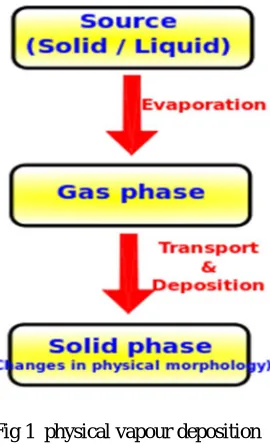
Fig 1 physical vapour deposition
II. TOOL STEEL AND TYPE OF COATING- SELECTION
A. Tool Steels
The tool steels used for rubber or plastic moulds normally classified or supplied with a) Pre-hardened steels b) annealed steels c) age hardening steels
B. Pre-Hardened Steels
The pre hardened steel are supplied in hardened and tempered condition and straightly goes to production processes with no need of immediate heat treatment processes.
Advantage: Less time in manufacturing cycle ,No cracking during heat treatment.
Disadvantage: The machining requires more time than annealed steel which has lower hardness.
C. Annealed Steels
Theses steels can be put into production only after a further heat treatment since these are supplied in low hardness values. The manufacturing cycle of these steels are
1) Purchase of steel block
2) Pre machining
3) Heat Treatment : hardenening followed by tempering
4) Futher Working: photo engraving, polishing
5) Put into service.
Advantage: Short machining time due to annealed condition. Disadvantage: Occurrence of crack during heat treatment.
D. Age Hardening Steels
They are supplied with solution condition with a hardness value similar to pre- hardened steels that can be further increased by heat treatment. The steels used for plastic moulds are SS420, 2316, 2738, 6959. The composition and properties of these steels are shown in table.
III. [CRN] DEPOSITION MATERIAL
Technology (IJRASET)
resistance but significantly higher hardness and better coating adhesion. For coating CrN in DC Magnetron sputtering Deposition 99.99 % of pure chromium target was selected.
A. Characteristics of CrN Coating
1) The coated metal is hard and extremely resistant abrasion. It has High Corrosion resistance and surface finish.
2) CrN has higher oxidation temperature 650 ºC than TiN.
3) CrN has relatively higher thermal stability, low deposition temperature, superior wear and corrosion resistance than TiN.
B. Application
Metal cutting application, Dieproduct, Oil expellers, pulleys, Conveyor, Screws, Decorative applications.
IV. PROCEDURE FOR EXPERIMENT
A. Specimen Preparation
1) The specimens are prepared from the AISI 6959 grade steel.
2) Parts are cleaned in a multi-stage cleaning process to remove soils, oils, fingerprints and produce an oxide free surface.
3) The specimens are cleaned on the stage of ultrasonic effect for removing oil and other contamination and liquid honing for surface roughness by using fine adhesive powder
4) The surface of specimens has been coated by using PVD techniques.
5) The CrN have been used for surface coating material on substrate by PVD method.
6) The specimens have been prepared for the dimensions of 50 x25 x 2 mm.
7) The surface of specimens has been hard coated CrN by DC Magnetron sputtering deposition process.
B. Coating Method Deposition
1) Hard coating is the process in which a coating is applied to a substrate
2) The main purpose is to reduce wear or loss of material by abrasion ,impact,, erosion, galling, and cavitation. 3) The production of a hardware resistant surface layer on metals by coating is known as hard coating.
4) The hard face materials are usually more wear, heat & corrosion resistant.
5) Here the coating technique used is PVD process- DC magnetron sputtering deposition.
C. Dc Magnetron Sputtering Deposition Technique
1) The equipment required for hard coating is used for DC Magnetron sputtering deposition process (PVD).
2) The surface of hard face is thoroughly cleaned for the stage of ultrasonic effect for removing oil , other contamination and foreign particles and liquid honing for surface roughness by using fine adhesive powder.
3) The air in the chamber is pumped out, leaving a high vacuum environment.
4) Substrate parts are pre-heated to process temperature
5) Substrates are ion-cleaned to remove the final atomic contaminants from the surface.
6) The plasma is formed by magnetic field, argon ions in the Plasma impact on the target (Cr) and causes sputtering of atoms by
momentum transfer, unlike other vapour phase techniques there is no melting of materials.
7) Argon gas is introduced in the chamber plasma generation.
V. RESULTS AND DISCUSSION
The XRD patterns at different N2 flow rates, that indicates that the crystallography structure of sputter-deposited CrN thin films depending the nitrogen content in sputtering process. In the thin films deposited at 5 sccm mixed phases of CrN, Cr2N and Cr2O3 is observed. At 10 sccm the film contains mainly CrN with low intensity of Cr2O3 as reported in the literature (B.Subramanian et al). Not purely single phase CrN films were obtained when the flow rate is raised. This is due to unbalanced growing conditions of magnetron sputtering, The decrease of mean free path also means less energy and momentum delivery on substrate by ion impingement. This leads to lesser extent of surface damage and fewer nucleation sites, which may result in larger grain size.
Technology (IJRASET)
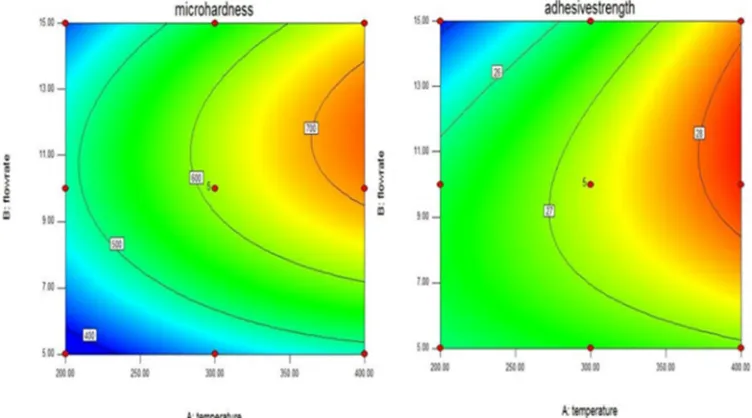
[image:5.612.107.483.153.362.2]measured by using Mitutoya HM113 machine. Vickers hardness is preferred to find the thin film micro hardness. The indenter made up use of diamond . Adhesive strength of thin films was finded using scratch tester .Here diamond indenter of 210µm is used. The initial load of 12N is given first and it is made to increase 2N for every 1mm Pile. On the testing, there is an occurrence of change in acoustic emission curve and corresponding to that change the change in traction force curve is noted. From that the load that completely scratched the thin film was calculated.
Fig 2 Contour Plot Of Micro Harness, Adhesive Strength Vs Flow Rate,Temp
VI. CONCLUSION
The CrN thin films deposited on 6959 grade steel by magnetron sputtering process has been investigated in present work. The effect of substrate temperature and nitrogen gas flow rate on adhesive strength and microhardness were analyzed. From the results it is found that the micro hardness and adhesive strength of the thin film shows increasing trend with increase in substrate temperature and decrease in nitrogen flow rate. The higher adhesive strength is due to the grain size effect and highly textured grains.From the literature review it is concluded that the influencing variables of microstructural characteristics of CrN coating are substrate temperature, working pressure and reactive gas flow rate, thickness of the film and power of sputtering process.working pressure and reactive gas flow rate.It is concluded that 6959 grade steel has been selected as a substrate material because of its moderate properties of hardness strength and its higher coefficient of thermal expansion when compared with other two types of steels (2316, 2738) .Its purchasing and machining cost is low. Hence, it is selected as a substrate material for this work.
REFERENCES
[1] Hetal N Shah, VipinChawla, R Jayaganthan and DavinderKaur “Microstructural characterizations and hardness evaluation of d.c.reactive magnetron sputtered CrN thin films on stainless steel Substrate " Bulletein of material sciences. Vol. 33, Issue 2.
[2] B Subramanian, K Prabakaran and M Jayachandran “Influence of nitrogen flow rates on materials properties of CrNx films grown by reactive magnetron sputtering “Bull. Mater. Sci., Vol. 35, Issue 4.
[3] Yucong Wang “A study of PVD coatings and die materials for extended die-casting die life” surface and coating technology 94-95, (1997).
[4] S. Ortmann, A. Savan, Y. Gerbig, H. Haefke ”In-process structuring of CrN coatings, and its influence on friction in dry and lubricated sliding” Wear, 254, (2003), 1099–1105.
[5] J.-D. Kammingaa, P. van Essena, R. Hoya and G.C.A.M. Janssen.“Substrate dependence of the scratch resistance of CrNx coatings on steel” Tribology Letters, Vol. 19, Issue 2, June (2005).
[6] J.C. Avelar-Batista, E. Spain, J. Housden, G.G. Fuentes , R. Rodriguez ,F. Montala´ , L.J. Carreras , T.J. Tate “Effect of coating thickness and deposition methods on the stripping rate of Cr–N coatings” Surface & Coatings Technology 200, (2005), 1842 – 1848.