6
I
January 2018
EER Algorithms for Wireless Sensor Networks
Jitendra Bahadur Singh1 R.C.Tripathi2 1
Electronics Engineering Dept. NGBU, Allahabad (India)
2
Dean Research, NGBU, Allahabad (India)
Abstract: A shortest-path algorithm finds a path that tend to minimize the cost of transfer from one point to another and also high speed more important in a process transferring from source node to destination node . This paper focuses mainly on the energy consumption with ignoring traffic congestion, Only routing simulations developed in C++ code and compared using generic metrics for assumptions on power such as amount of time transmitting a signal and whether or not a node utilized for data transmission. In this paper proposes algorithms that find shortest loop free paths from a source node to destination node, and distributes communication data on different paths based on traffic to minimize power consumption at all nodes on the whole. Simulate some conditions to analyze algorithm and compare with algorithms addressing the same issue. The first algorithm involves the standard Dijkstra algorithm used in most networking algorithm which involves weighted structures (such as ad hoc). This algorithm determines the shortest possible path between 2points given hops throughout a network. For our purposes, we plan to instead utilize a metric which involves a function of the distance but also incorporates the battery life remaining on the node.
Keywords: Interconnection networks, Routing protocols, performance comparison, Wireless Sensor Networks.
I. INTRODUCTION
WSN include low-power, light-weighted, small size of sensor nodes. The applications of sensor networks varies in various field like military, civil, healthcare, environmental etc. including forest fire detection, inventory control, energy management, surveillance. Due to the low-cost, the deployment may be in order of million nodes. The nodes can be deployed either in random fashion or a pre-engineered way. The sensor nodes perform desired measurements, process the measured data and transmit it to the sink node, over a wireless channel. The sink node collects data from all the nodes, and analyzes this data to draw conclusions about the activity in the area of interest. Current routing protocols are inefficient for Wireless Sensor Networks due to undistributed and excessive power consumption and lack of fault tolerance. Much research is being done to develop a more efficient and optimized protocol utilizing routing, but no conclusive evidence has determined which protocol is best for minimized power utilization.
A. Aim
To derive an algorithm intended to minimize energy consumption in wireless sensor networks.
B. Background and literature review
Present network systems use single path routing, using a single line of communication to transmit data over network. This results in an inefficient use of network resources. Also exhausting few nodes of power. Multipath routing on the other hand may help to distribute data across multiple lines of communication limiting power use on each node. Research into improving routing algorithms using multiple paths is in its the early stage in the development, but suitably extensive, with a broad range of areas of improvement. Below are just a few of the protocols proposed in recent few years which emphasize power efficiency.
1) Eendmpr (energy efficient node disjoint mpr)
2) Aomdv (ad hoc on demand mobile distance vector)
3) Dd (direct diffusion)
4) Hreemr (highly resilient energy efficient mpr)
5) Liemro (low interference energy efficient mpr)
6) Rftm (reliable fault tolerant multipath)
7) Eeca (energy efficient collision aware)
8) Eeqsr (energy efficient and qos aware)
9) Rebmr (rumor as an energy balancing mpr)
10) Reer (robust and energy efficient mpr)
11) Bpcmpr (band width powerAware Cooperative MPR
13) RELAX
14) DSR (Dynamic Source Routing)
15) OSPF (Open Shortest Path First)
Most of the research is fairly recent and relevant to today’s real world design applications. They also directly emphasize our interest of energy conservation and apply quite well to this project topic. Unfortunately since most of the research is new and not well established yet, while many protocols have been proposed, very few reference other proposals or compare to more well knownide as. This makes for difficulties in drawing comparisons between the numerous proposals given that there is no basic foundation from which they are all built off of (Although most doutilize the Dijkstra algorithm for shortest path delay).
II. PROPOSED WORK
In this paper proposed two algorithms that finds shortest loopfreepaths from a source to a target node, and send transfer data on different paths based on traffic to minimize power consumption at all nodes on the network. Simulate some conditions to analyze algorithm and compare with other algorithms addressing the same issue.
The first algorithm involves the standard Dijkstra algorithm used in most networking communication algorithm which involves Ad hoc structures.
This algorithm determines the shortest possible path between 2points given hops throughout a network. Proposed two algorithms also incorporates the battery life remaining on the node with the distance of path. This is essential since because aims are not only for the shortest time, but, as the node loses battery life, to extend the battery life by.
The metric is evaluated : metric = Pt/f(A)
Where, A is the remaining battery on a given node and Ptis the transmit power for the node to its parent. f(A) is a function of A as yet undetermined. A approaches 0 (battery drains) and to approach 1 for larger values of A (full battery).
The second algorithm we plan to analyze is more basic, and involves simply alternating parent nodes in the Dijkstra algorithm. In hopes of greater spreading of the routing paths across nodes while still maintaining the simplicity that each node retains little information, we would assign each node 2 parents instead of 1, and allow the node to alternate between the 2 as it transmitted data; first sending info to parent 1, then transmitting to parent 2 next time it sensed data. Ideally this would produce greater distribution (if only slightly) due to greater spreading out of the path routes.
A comparison of each algorithm drawn given identical simulation characteristics based on the energy efficiency metric such that the most optimized protocol can be concluded. We choose to simulate two programs to compare the results of two different approaches. In the first program, we modified Dijkstra’s algorithm to improve the performance of single shortest path algorithm in wireless sensor network. In the second program, we try to implement a multipath routing algorithm which distributes information uniformly over network. The two approaches are discussed below in detail.
A. Algorithm design
1) DMA DijkstraModified Algorithm: As detailed above, this algorithm involves modifying the general Dijkstra algorithm such that instead of incorporating just the distance of the router, a metric will be used developed as a function of the transmit power and the remaining battery life on the node. The metric can be defined as:
metric = transmit power/f(battery life) = c * d 2/ √3 A/Pi
Where c is a constant we defined, d is the separation between the nodes, and A is the remaining battery life of the transmitting node and Pi is the initial power of the node. The denominator will vary from 0 to 1 such that for smaller values of A, the metric will appear large, and for larger values of A the metric will appear relatively small. This will have the effect of causing the distance as considered in the Dijkstra algorithm as appearing further away for nodes with less battery, thus reducing the likelihood of selecting that node.
III. DATA ANALYSIS AND DISCUSSION
A. Output Generation
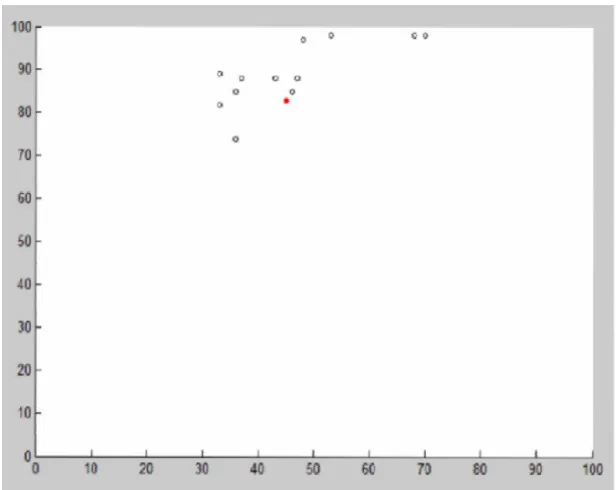
[image:4.612.153.461.452.697.2]Figure 1: Typical graph of random node placement and gateway given 100 x 100 area
A. Output Analysis
For the DMA, results were inconclusive given the lack of variation between the algorithm and the standard Dijkstra algorithm. Using a metric of distance (as in the Dijkstra algorithm) or just remaining battery life generally results in similar selections for the parent node at each node due to the duality between distance and power consumption.
Since transmit power is already a function of the distance, and battery is obviously related to transmit power, the result is a metric very similar to the already used distance metric. For the majority of cases, the same parent node is selected and only a few times is a different node chosen.
Ultimately this difference is insignificant and does not show any trend in either direction. A TCL script was created to run numerous simulations comparing the DMA to the original algorithm for various seed values (such that a new random number sequence is used). After running this script for 100+ simulations, we observed a close match between the two algorithms. We also observed the rate of success for one as compared to the other alternated between the two; when one algorithm performed slightly better one time, the other may perform better another time.
As for Multipath Routing, the results were not helpful in deriving any conclusion. First of all, the multiple paths generated from a node to gateway were not disjoint. Secondly, the assumptions made in the simulation, where all the nodes near an event will report to the gateway node, turned out to cause duplications of same message causing the network to fail soon before valuable number of events could be reported. Also there were many nodes which drained out of battery sooner than others causing the network to fail well before the network was efficiently used.
Hence it could be analyzed that a better multipath routing algorithm needs to be developed to improve the efficiency of the network. The multiple paths generated must be as disjoint as they can be. And also, the duplication of transmitted messages should be efficiently handled.
IV. CONCLUSIONS
Improving upon the typical single path routing algorithm for the growing system of wireless networks is a formidable field with many challenges. The algorithm, though seemingly complex, can have a great deal of variation and alternate factors which may weigh heavily on results. Node position, transmission power, event location, gateway location, node data storage, node data updating; all these points can be very relevant and greatly affect the outcome of the system if not taken into consideration properly. For our simulations, considering the node as ‘unintelligent’ and knowing only the parent to whom it is assigned to communicate with was a major factor in determining an effective algorithm which adhered to this reality of WSNs. Because of this, the complexity of coding greatly increased and many more considerations emerged.
The result was the DMA and Multipath algorithms; both proposed as tools to improve power distribution given the limited knowledge of the sensor nodes. Unfortunately each algorithm had its issues with performance and neither produced particularly favorable results. The DMA seemed reasonable but was too similar in practice to the actual Dijkstra algorithm. The Multipath algorithm suffered from an inherent assumption made in the Dijkstra algorithm which prevented it from being used for the case of alternate paths properly. Instead the algorithm suffered from longwinded routes and failed connections.
The results tell us, similar to the vast array of research currently being conducted, that there is a great deal of research and understanding still to be performed about these networks. There are many seemingly rationale and mathematically plausible suggestions which may fail when actually implemented or simulated. The high variability and large number of factors can results in an easily unstable system. As such, an optimized algorithm will need to consider all these factors appropriately and will need a great deal of simulations to ensure successful results.
BIBLIOGRAPHY
[1] Li Lan; Li Li; Chen Jianya, "A Multipath Routing Algorithm Based on OSPF Routing Protocol," Semantics, Knowledge and Grids (SKG), 2012 Eighth
International Conference on , vol., no., pp.269,272, 2224 Oct. 2012
[2] Yaqing Li; Layuan Li; Chunyan Wang, "A Multipath Routing Algorithm Based on Link Multimetrics for Wireless Sensor Networks," Computing,
Communication, Control, and Management, 2008. CCCM '08. ISECS International Colloquium on , vol.2, no., pp.567,571, 34 Aug. 2008
[3] Yahya, B.; BenOthman, J., "REER: Robust and Energy Efficient Multipath Routing Protocol for Wireless Sensor Networks," Global Telecommunications
Conference, 2009. GLOBECOM 2009. IEEE , vol., no., pp.1,7, Nov. 30 2009Dec. 4 2009
[4] Yahya, B.; BenOthman, J., "RELAX: An Energy Efficient Multipath Routing Protocol for Wireless Sensor Networks,"
[5] Communications (ICC), 2010 IEEE International Conference on , vol., no., pp.1,6, 2327 May 2010
[6] Radi, M.; Dezfouli, B.; Razak, S.A.; Bakar, K.A., "LIEMRO: A LowInterferenceEnergyEfficient Multipath Routing Protocol for Improving QoS in
EventBased Wireless Sensor Networks," Sensor Technologies and Applications (SENSORCOMM), 2010 Fourth International Conference on , vol., no.,
[7] Ye Ming Lu; Wong, V.W.S., "An EnergyEfficient Multipath Routing Protocol for Wireless Sensor Networks," Vehicular Technology Conference, 2006.
VTC2006 Fall. 2006 IEEE 64th , vol., no., pp.1,5, 2528 Sept. 2006
[8] Yahya, B.; Benothman, J., "An energy efficient and QoS aware multipath routing protocol for wireless sensor networks," Local Computer Networks, 2009.
LCN 2009. IEEE 34th Conference on , vol., no., pp.93,100, 2023 Oct. 2009
[9] Jie Chen; Benshun Yi, "An EnergyEfficient Optimal Multipath Routing Protocol for Wireless Sensor Networks,"
[10] Wireless Communications, Networking and Mobile Computing, 2008. WiCOM '08. 4th InternationalConference on , vol., no., pp.1,4, 1214 Oct. 2008
[11] Kavitha, C.; Viswanatha, K. V., "An Energy Efficient Fault Tolerant Multipath (EEFTM) Routing Protocol for Wireless Sensor Networks," Advance
Computing Conference, 2009. IACC 2009. IEEE International , vol., no., pp.746,751, 67 March 2009
[12] Zijian Wang; Bulut, E.; Szymanski, B.K., "Energy Efficient Collision Aware Multipath Routing for Wireless Sensor Networks," Communications, 2009. ICC
'09. IEEE International Conference on , vol., no., pp.1,5, 1418 June 2009
[13] HongliXu; Liusheng Huang; ChunmingQiao; Yindong Zhang; Quan Sun, "BandwidthPower Aware Cooperative Multipath Routing for Wireless Multimedia
Sensor Networks," Wireless Communications, IEEE Transactions on , vol.11, no.4, pp.1532,1543, April 2012
[14] Semong, T.; Anokye, S.; Qiaoliang Li; Qiang Hu, "Rumor as an EnergyBalancing Multipath Routing Protocol for Wireless Sensor Networks," New Trends in
Information and Service Science, 2009. NISS '09. International Conference on , vol., no., pp.754,759, June 30 2009July 2 2009
[15] Sangeetha, R.; Yuvaraju, M., "Secure energyaware multipath routing protocol with transmission range adjustment for wireless sensor networks,"
Computational Intelligence & Computing Research (ICCIC), 2012 IEEE International Conference on , vol., no., pp.1,4, 1820 Dec. 2012