Technology (IJRASET)
A Routing Scheme for Delay Tolerant Network
Using Geographic Based Spray and Focus Method
P. Kathirvel 1, T. Parameswaran 2
1
PG Scholar, Department of CSE, Anna University Regional Centre, Coimbatore, India
2
Assistant Professor, Department of CSE, Anna University Regional Centre, Coimbatore, India
Abstract— Intermittently connected mobile networks are wireless networks where most of the time there does not exist a complete path from the source to the destination. There are many real networks that follow this model, for example, wildlife tracking sensor networks, military networks, delay/disruption-tolerant networks (DTNs), etc. To deal with such networks researchers have suggested to use controlled replication or “spraying” methods that can reduce the overhead of flooding-based schemes by distributing a small number of copies to only a few relays. These relays then “focus” for the destination in parallel as they move into the net- work. Although such schemes can perform well in scenarios with high mobility (e.g. DTNs), they struggle in situations where mobility is slow and correlated in space and/or time. To route messages efficiently in such networks, the propose a scheme that also distributes a small number of copies to few relays. However, each relay can then forward its copy further using a single-copy utility-based scheme, instead of naively waiting to deliver it to the destination itself. This scheme exploits all the advantages of controlled replication, but is also able to identify appropriate forwarding opportunities that could deliver the message faster. Simulation results for traditional mobility models, as well as for a more realistic “community-based” model, indicate that our scheme can reduce the delay of existing spraying techniques up to 20 times in some scenarios.
Keywords— Delay tolerant networks, Mobility Model, Routing, Store and carry Forward
I. INTRODUCTION
Traditionally, wireless ad hoc networks have been viewed as a connected graph over which end-to-end paths need to be established. Although this model has been quite successful in the wired world (telephone network, Internet, etc.), its shortcomings for the wireless environment have recently started to be recognized. Wireless propagation phenomena power requirements, and a number of other operational or economic factors indicate that wireless links may be short-lived and end-to-end connectivity more often than not intermittent.
Delay Tolerant Networks have overcome the problems associated with the conventional protocols in terms of lack of connectivity, irregular delays, asymmetric bidirectional data rates etc. using the concept of store and forward. The method of store and forward is very analogous to the real life postal service. Every letter has to pass through a set of post offices, where it is processed and forwarded, before reaching the destination. Here the complete message or a chunk of it is transferred and stored in nodes successively until it reaches the destination. Many Approaches have been adopted to achieve a reliable communication between the source and the destination. The proposed approaches have focused on a number of problems like improving the delivery ratio, optimizing the usage of available resources like buffer space, battery etc., increasing the scalability. Mobility of nodes was seen as an obstacle to routing, but some approaches have used this very mobility in order to face the problem of discontinuity. The most recent approach is in the area of exploiting the social interaction of humans, so as to improve the delivery rates of messages.
Intermittently connected mobile networks are wireless networks where most of the time there does not exist a complete path from the source to the destination. There are many real networks that follow this model, for example, wildlife tracking sensor networks, military networks, Delay/disruption-tolerant networks (DTNs), etc. To deal with such networks researchers have suggested to use controlled replication or “spraying” methods that can reduce the overhead of flooding-based schemes by distributing a small number of copies to only a few relays. These relays then “look” for the destination in parallel as they move into the network. Although such schemes can perform well in scenarios with high mobility (e.g. DTNs), they struggle in situations where mobility is slow and correlated in space and/or time.
Technology (IJRASET)
are two key requirements: (a) to create enough diversity between the copy-bearing relays that will look for the destination in parallel, and (b) that each relay moves relatively quickly and frequently around the network, in order to carry a message through disconnected parts.
Although such desirable mobility characteristics could, to an extent, be found in some applications like, for example, DTN], in many other scenarios, especially those involving human interactions, mobility is strongly correlated in both time and space. In such situations, the performance of simple spraying schemes can suffer, as they don’t take advantage of existing transmission opportunities that could potentially forward the message closer to the destination over a partial path, or to a node more “socially” related to the destination [9, 13]. For this reason, we propose a novel protocol, called Spray and Focus, that overcomes the shortcomings of simple spraying algorithms, and outperforms both existing flooding-based schemes as well as existing spraying algorithms by up to 20×, under realistic mobility scenarios.
II. RELATEDWORK
The schemes in this branch do not limit the number of copies of each message that can be replicated in the network. The benchmark scheme, namely, Epidemic, floods message copies to any node in the network. In spite that Epidemic achieves the highest delivery ratio, a huge network resource including bandwidth and buffer space are wasted for replication redundancy. Here, using the utility metric to qualify the nodal delivery potential for controlling replication has been studied by previous works.
A. Replication-Based Routing Schemes
In Probabilistic Routing Protocol using History of Encounters and Transitivity (PROPHET), the utility metric is based on an encounter probability. The powerful Resource Allocation Protocol for Intentional DTN (RAPID) treats the routing problem as a resource allocation aspect, where the utility metric is estimated as the remaining delivery delay. To reduce replication redundancy, DF is proposed to optimize the candidate node selection, using the topology-based utility metric.
B. Spray-Based Routing Schemes
The schemes in this branch limit the replication redundancy by an initialized defined copy ticket value L, where L implies that only (L − 1) copies of a message can be replicated in the network. Here, the binary version of spray-and-wait (SaW) has been proven
effective in fast distributing (L − 1) message copies, by using a binary-tree-based distribution mechanism. Historical Encounter
Information: Previous works further spray message copies to a better qualified candidate node based on the utility metric. Borrowing from the utility metric adopted, spray-and-focus (SaF) adopts the focus phase instead of the wait phase, decreasing the delivery delay via a utility forwarding approach. Here, the focus phase relies on forwarding message copies in a multi-hop way via the last encounter time. This is different from binary SaW in which the message with one remaining copy ticket is only relayed to its destination. Furthermore, region-based takes into account the region concept, enabling message forwarding within a region and message spraying between regions.
III. PROPOSEDSYSTEM
Replicating message copies is effective in increasing the delivery ratio in DTN networks, for which these replicated message copies increase the diffusion speed and the possibility that one of them would be delivered. This approach that has shown good potential in this context is that of controlled replication or spraying. There, a small, fixed number of copies are generated and distributed (“sprayed”) to different relays, each of which then carries its copy until it encounters the destination. The proposed Spray and Focus protocols and calculate the packet TTL value. Create enough diversity to “explore” the network efficiently, while keeping resource usage per message low. However, for this scheme to achieve good performance there are two key requirements: (a) to create enough diversity between the copy-bearing relays that will look for the destination in parallel, and (b) that each relay moves relatively quickly and frequently around the network, in order to carry a message through disconnected parts.
A. Topology Creation
Technology (IJRASET)
or a part of the Helsinki city area (for map-based movement). In addition to normal roads, several tram routes to the map is added. By choosing three different scanning intervals: 0 s which means that nodes are always on, 60 s and 300 s which mean that a node sleeps for the respective interval after losing contact with other nodes.
B. Mobility model
Node movement capabilities are implemented through mobility models. Mobility models define the algorithms and rules that generate the node movement paths. The simulator includes a framework for creating movement models as well as interfaces for loading external movement data. Implementations of popular Random Walk (RW) and Random Waypoint (RWP). While these models are popular due to their simplicity, they have various known shortcomings. It is also possible to completely omit mobility modelling and construct topologies based on static nodes. To better model real-world mobility, map-based mobility constrains node movement to predefined paths and routes derived from real map data. Further realism is added by the Working Day Movement (WDM) model that attempts to model typical human movement patters during working weeks.
C. Map-Based Mobility
Map-based movement models constrain the node movement to paths defined in map data. The simulator includes three map-based movement models: 1) Random Map-Based Movement (MBM), 2) Shortest Path Map-Based Movement (SPMBM), and 3) Routed Map-Based Movement (RMBM). Furthermore, the release contains map data of the Helsinki downtown area (roads and pedestrian walkways) that the map-based movement models can use. However, the movement models understand arbitrary map data defined in (a subset of) well known Text (WKT). Such data is typically converted from real world map data or created manually using Geographic Information System (GIS) programs such as OpenJUMP.7 In the simplest map-based model, MBM, nodes move randomly but always follow the paths defined by the map data. These results in a random walk of the network defined by the map data and thus may not be a very accurate approximation of real human mobility. A more realistic model is the SPMBM where, instead of a completely random walk, the nodes choose a random point on the map and then follow the shortest route to that point from their current location.
The points may be chosen completely randomly or from a list of Points of Interest (POI). These POIs may be chosen to match popular real-world destinations such as tourist attractions, shops or restaurants. Finally, nodes may have pre-determined routes that they follow, resulting in the RMBM model. Such routes may be constructed to match, e.g., bus, tram or train routes.
Working Day Movement Model (WDM)
While high-level movement models such as RWP, MBM, and SPMBM are simple to understand and efficient to use in simulations they do not generate inter-contact time and contact time distributions that match real-world traces, especially when the number of nodes in the simulation is small. In order to increase the reality of (human) node mobility, the Working Day Movement (WDM) model has been developed. The WDM model brings more reality to the node movement by modeling three major activities typically performed by humans during a working week: 1) sleeping at home, 2) working at the office, and 3) going out with friends in the evening. These three activities are divided into corresponding sub-models between which the simulated nodes transition depending on the node type and the time of the day the nodes can move alone or in groups by walking, driving or riding a bus. The ability to move alone or in groups at different speeds increases the heterogeneity of movement which has impact on the performance.
Finally, WDM introduces communities and social relationships which are not captured by simpler models such as RWP. The communities are composed from nodes which work in the same office, spend time in the same evening activity spots or live together. It has been shown that the inter-contact time and contact time distributions generated by the WDM model follow closely the ones found in the traces from real-world measurements.
D. Routing Spray Phase
Technology (IJRASET)
message, it spawns and forwards a copy of that message to the 2nd node; it also hands over n/2 forwarding toke ns and keeps n/2 for itself. when a node has a message copy but only one forwarding token for this message, then it can only forward this message further according to the rules of the “Focus phase” (more about this later).
This could be performed by replacing α and the number of nodes M in the following equation, and
where Harmonic number of order r.
E. Routing Focus Phase
When a relay for a given message has only one forwarding token left for that message, it switches to the “Focus phase”. Unlike Spray and Wait, where in the Wait phase messages are routed using Direct Transmission (i.e. forwarded only to their destination), in the Focus phase a message can be forwarded to a different relay according to a given forwarding criterion. Specifically, these forwarding decisions are taken based on a set of timers that record the time since two nodes last saw each other. Although the use of last encounter timers has been proposed in the past, here argue that any scheme that takes advantage of these timers needs to be carefully designed for the specific environment in hand (e.g. sparse networks with stochastic mobility) in order to achieve good performance.
When a relay for a given message has only one forwarding token left for that message, it switches to the “Focus phase”. Unlike Spray and Wait, where in the Wait phase messages are routed using Direct Transmission (i.e. forwarded only to their destination), in the Focus phase a message can be forwarded to a different relay according to a given forwarding criterion. Specifically, these forwarding decisions are taken based on a set of timers that record the time since two nodes last saw each other. Although the use of last encounter timers has been proposed in the past, here argue that any scheme that takes advantage of these timers needs to be carefully designed for the specific environment in hand (e.g. sparse networks with stochastic mobility) in order to achieve good performance. Age of last encounter timers with transitivity: Let’s assume that each node i maintains a timer τi(j) for every other node j in the network, which records the time elapsed since the two nodes last encountered each other as follows:
initially set τi(i) = 0 and τi(j) = ∞, ∀i, j; whenever I encounter j, set τi(j) = τj(i) = 0; at every clock tick, increase each timer by 12. Position information regarding different nodes gets indirectly logged in the last encounter timers, and gets diffused through the mobility process of other nodes. Therefore, here can define a utility function, based on these timers, that indicates how “useful” a node might be in delivering a message to another node.
IV. EXPERIMENTALRESULTS
The simulations, use a mobility model: all nodes have unit radio range; two nodes can communicate if and only if they are within radio range of each other and if their line-of-sight does not intersect an obstacle. Wireless losses are not simulated since our goal is to compare the basic algorithmic behavior of Opportunistic spray and focus to other spray routing algorithms. The performance is evaluated using the Opportunistic Network Environment (ONE), which is a well-known Java-based simulator that particularly contributes to the research on DTN routing. Considering that the map route has an effect on the performance of geographic routing assuming the continuous moving direction for prediction, we select other two city scenarios.
Technology (IJRASET)
distributed over the given area. The initial distribution of mobile nodes under all scenarios varies based on the corresponding simulation speed.
The communication technique8 is configured as 2-Mb/s bandwidth and 10-m transmission range considering the communication between those short range devices, e.g., people with mobile phones in vehicles. Note that the network is sparse and highly dynamic, since the number of connectivity’s is small as compared with network area, considering the given speed configuration and transmission range. Messages are propagated via opportunistic behavior, as bridged by the lightweight mobile nodes via Bluetooth. In our simulations, the message size is set to a large value, envisioned for large file transmission in DTNs. Messages are set with 90-min lifetime, 30-s generation interval, and 500-KB size, generated before 27 000 s with additional 90 × 60 = 5400 s to consume the unexpired messages.
TABLEI
COMPARISON OF DUPLICATE RATIO PROPOSED WITH EXISTING ROUTING
Techniques No of nodes
5 10 15 20 25 30 35 40 45
GSaR-Existing
94 85 74 61 68 54 47 42 39
GSaF-Proposed
78 64 52 47 41 36 29 25 20
0
20
40
60
80
100
5
10
15
20
25
30
35
40
45
No of Nodes
Duplicate
Ratio(%)
GSaR-Existing
GSaF-Proposed
Fig. 1 Duplicate ratio proposed with existing routing
TABLEII
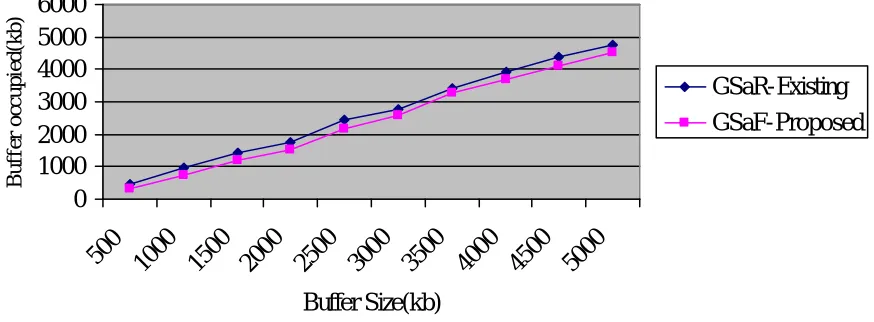
COMPARISON OF BUFFER MANAGEMENT PROPOSED WITH EXISTING ROUTING TOTAL =5MB
Technique s
Buffer size (KB-MB)
500 100
0 150 0 200 0 250 0 300 0 350 0 400 0 45 00 500 0 GSaR-Existing
454 965 143
2 176 9 243 2 276 9 343 5 391 7 43 68 476 8 GSaF-Proposed
341 754 122
Technology (IJRASET)
0
1000
2000
3000
4000
5000
6000
50
0
10
00
15
00
20
00
25
00
30
00
35
00
40
00
45
00
50
00
Buffer Size(kb)
B
u
ff
er
o
cc
u
p
ie
d
(k
b
)
GSaR-Existing
[image:7.612.97.534.96.257.2]GSaF-Proposed
Fig. 2 Buffer management proposed with existing routing total =5MB
TABLEIII
COMPARISON OF CONNECTION SPEED RATIO PROPOSED SYSTEM CONNECTION SPEED HIGH RANGE=15KBPS
Techniques No of nodes
5 10 15 20 25 30 35 40 45
Down Connection
0.27 0.65 1.32 2.47 2.98 3.32 3.76 4.23 4.65
Up Connection
1.45 3.32 4.32 5.43 7.98 8.32 9.45 11.7
6
13.3 2
0
2
4
6
8
10
12
14
5
10 15 20 25 30 35 40 45
No of nodes
Connection
Speed (Kbps)
Down Connection
Up Connection
Fig. 3 Connection speed of proposed system
V. CONCLUSIONS
Technology (IJRASET)
traces, show that Spray and Focus not only outperforms all existing mobility-assisted protocols in terms of both number of transmissions and delivery delay, but also reduces the delay of simple controlled replication algorithms by up to 20 times in some scenarios. This method believe, clearly identifies controlled replication and utility-based forwarding as a valuable combination for efficient routing in challenged networks.
Future, the proposed structure can be analyzed with some other advanced security mechanisms and utilize the best resulting security mechanism to protect the network from black hole attacks. The future, here plan to explore other trust - based DTN applications with which we could further demonstrate the utility of our dynamic trust management protocol design. It also plans to implement our proposed dynamic trust management protocol on top of a real DTN architecture to further validate the protocol design, as well as to quantify the protocol overhead.
REFERENCES
[1] K. Wei, X. Liang, and K. Xu, “A survey of social-aware routing protocols in delay tolerant networks: Applications, taxonomy and design-related issues,” IEEE Commun. Surveys Tuts., vol. 6, no. 1, pp. 556–578, 2014.
[2] Y. Cao, Z. Sun, H. Cruickshank, and F. Yao, “Approach-and-roam: A geographic routing scheme for delay/disruption-tolerant networks,” IEEE Trans. Veh.
Technol., vol. 63, no. 1, pp. 266–281, Jan. 2014.
[3] Y. Cao, Z. Sun, N. Wang, F. Yao, and H. Cruickshank, “Converge-anddiverge: A geographic routing for delay/disruption-tolerant networks using a delegation
replication approach,” IEEE Trans. Veh. Technol., vol. 62, no. 5, pp. 2339–2343, Jun. 2013.
[4] X. Li,W. Shu, M. Li, H. Huang, andM.-Y.Wu, “DTN routing in vehicular sensor networks,” in Proc. IEEE GLOBECOM, New Orleans, LA, USA, Dec. 2008,
pp. 1–5.
[5] V. Soares, J. Rodrigues, and F. Farahmand, “GeoSpray: A geographic routing protocol for vehicular delay-tolerant networks,” Inf. Fusion, vol. 15, pp. 102–
113, Jan. 2014.
[6] A. Lindgren, A. Doria, and O. Schelén, “Probabilistic routing in intermittently connected networks,” ACM SIGMOBILE Mobile Comput. Commun. Rev., vol.
7, no. 3, pp. 19–20, Jul. 2003.
[7] A. Balasubramanian, B. Levine, and A. Venkataramani, “Replication routing in DTNs: A resource allocation approach,” IEEE/ACM Trans. Netw., vol. 18, no.
2, pp. 596–609, Apr. 2010.
[8] Y. Cao, Z. Sun, N. Wang, H. Cruickshank, and N. Ahmad, “A reliable and efficient geographic routing scheme for delay/disruption tolerant networks,” IEEE
Wireless Commun. Lett., vol. 2, no. 6, pp. 603–606, Dec. 2013.
[9] I. Leontiadis and C. Mascolo, “GeOpps: Geographical opportunistic routing for vehicular networks,” in Proc. IEEE WoWMoM, Helsinki, Finland, Feb. 2007,
pp. 1–6.