Design and Implementation of a Protocol in
Mobile AD-HOC Network
Farheen Zeba1, S. R. Biradar2
Department of Information Science, ISE Department/ SDMCET/ VTU, Dhavalgiri, Dharwad – 580002 India
Abstract— MANET consists of many routing protocols. Ad-Hoc on Demand Vector routing protocol is one among them, which establishes the route only when required. In AODV protocol link breakages and rediscovery of routes are very often because of high mobility of nodes in the network. In Modified Ad-Hoc On Demand Vector (M-AODV) instead of establishing reverse path it broadcasts route reply back to the source which lower the rediscovery of routes, and hence the packet delivery ratio will therefore be increased when there are low link breakages.
Keywords— MANET Mobile Ad-Hoc Network, AODV Ad-Hoc On Demand Vector, M-AODV Modified Ad-Hoc On Demand Vector, RREP Route Reply, RREQ Route Request, PDR Packet Delivery Ratio etc.
I. INTRODUCTION
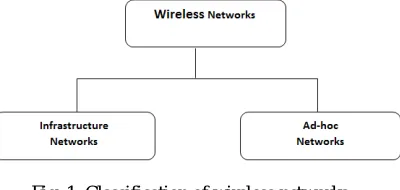
[image:2.612.211.411.374.469.2]Wireless networks can be divided into two, infrastructure networks and Ad-Hoc networks as shown in figure 1. Infrastructure networks are centralized type of network. Where the base station acts as a coordinator in communication between two nodes. Whereas, in Ad-hoc networks, each node has transmitter and receiver built-in. So when two nodes want to communicate with each other can directly contact if both are in range of each other. And each node is allowed to move anywhere. Now suppose two nodes want to communicate and both are not in range of each other, then with the help of intermediate nodes two nodes can communicate.
Fig. 1 Classification of wireless networks
AODV routing protocol is initiated by the source. When some data has to be sent, the source node first broadcasts the Route Request until it reaches the destination. Once the RREQ is reached to the destination. This destination node replies back the Route Reply packet to the source by reversing the direction of the same path by which RREQ is received. The source node after receiving RREP, it starts transmitting of packets. If any link breakages are occurred, the intermediate node notifies upstream by Route Error packet (RERR). Then that path is completely removed from the table. And a new path is rediscovered by the source node to transmit the packets.
II. MOTIVATION
Fig. 2 Problem with AODV
III.PROPOSEDPROTOCOL
In this section we present an overview and purpose of proposed new protocol.
A. Protocol Overview
As we have seen in the previous example, the high mobility leads to re discovery of routes by broadcasting of RREQ. So to overcome this, the broadcasting of RREP is done. The proposed new protocol broadcasts the route reply in AODV so that there are lower possibilities of broadcasting route requests i.e., re-discovery of path. So here, the destination broadcasts RREP until it reaches source. Once source receives RREP, it starts transmitting data packets to the destination.
B. Route Discovery In M-Aodv
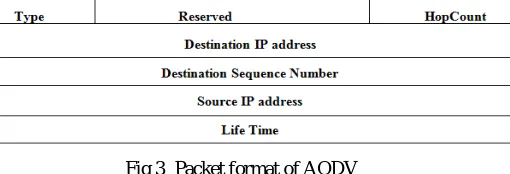
[image:3.612.185.440.405.492.2]Since M-AODV is on demand routing protocol there are no routes stored in the routing table. Broadcasting of RREQ is always done to find the path to the destination. And this is initiated by the source node. The RREQ message contains following information as shown in figure 3 message type, source address, destination address, broadcast ID, hop count, source sequence number, destination sequence number, request time.
Fig 3 Packet format of AODV
[image:3.612.204.408.586.665.2]Each time broadcast ID is incremented whenever a new RREQ is issued by source node. Thus RREQ is uniquely identified by its broadcast ID, source address and destination address. Initially source node broadcasts RREQ to the node which is in its own range. Once the neighboring nodes receive RREQ it rebroadcasts again until it reaches the destination. Whenever an intermediate node receives RREQ. It first checks whether it has already received the same RREQ i.e., with same broadcast ID and address of source and destination. If yes, then it discards otherwise it simply forwards the RREQ if the current node is not the destination. Once the RREQ reaches the destination, it broadcasts back the RREP the same way as RREQ was done. RREP format is as shown in figure 4. This also checks whether the RREP is repeatedly sent then discards.
Fig 4 Modified packet format
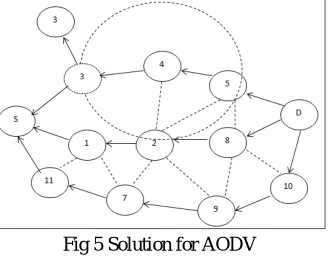
and S->11->7->9->10->D. So packet delivery ratio is greater in modified protocol compared to the existing one, because it maintains stable routes by providing alternative routes compared to AODV protocol.
Fig 5 Solution for AODV
C. Route Update And Maintenance
The best path in the modified protocol is chosen based on its sequence number. Higher the sequence number latest is the route. And suppose now the sequence number is equal so now the hops are considered. Lesser number of hops is considered to be the shortest and best path. When a node notices that the downstream link of the respective node is out of its range, the node generates RERR to its upstream node.
D. Algorithm For Selection Of Path In M-Aodv
If SequenceNum(existing) < SequenceNum(new) Select new path
Else if SequenceNum(existing) == SequenceNum(new) If HopCount(existing) < HopCount(new)
Select existing path
Else
Select new path
Else
Select existing path
IV.PERFORMANCERESULTS
[image:4.612.216.395.484.683.2]The parameters used for simulation are shown in Table I.
TABLE I
Parameter Value
Protocols AODV, M-AODV
No of nodes 25
Traffic Type CBR
Queue length 50
Pause Time 0, 50, 100, 500, 900.
Mobility Model Random Way Point
Packet Delivery Ratio :
Random way point is a type of mobility model, where each node selects a velocity between [0,Vmax], and a random node and moves towards it. It waits for a period of time; this time is “pause time” and continues same.
A. Results
[image:5.612.201.422.199.327.2]Packet Delivery Ratio is plotted AODV against M-AODV. For 0 pause time AODV works well. But when pause time increases M-AODV starts working better than AODV. So M-AODV works well when there is high mobility in the network. The Fig 6 illustrates the same.
Fig 6 PDR Vs Pause Time for 1 connection
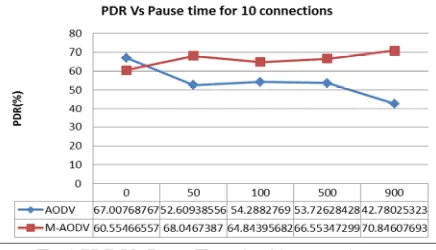
[image:5.612.184.424.379.498.2]In Fig 7 with 5 connections M-AODV mainly concentrates on the link breakages. So when mobility is high it starts working better than AODV. For 50 pause time M-AODV outperforms AODV. Also with 100 pause time. When the connections are increased, even AODV works well for 0 pause time. And gradually decreases the performance when the pause time is increased.
Fig 7 PDR Vs Pause Time for 5 connections
[image:5.612.202.420.578.703.2]more mobile.
Fig 9 PDR Vs Pause Time for 20 connections
V. APPLICATIONS
Ad-Hoc networks are used in Tactical Networks such as Military communication and operations and Automated battlefields. Also it can be used ain Virtual Classrooms, Ad hoc communications during meetings and lectures and Universities and campus settings. Also used as search and rescue operations and disaster recovery. Also used in hospitals for emergency cases, this will be helpful for doctors and nurses to monitor the patient.
VI.CONCLUSIONS
The comparison of the AODV with M-AODV is done. The modified protocol works well when there is high mobility this is because, in normal AODV link breakages are very often this is because the nodes are so mobile that they can move anywhere and rediscovery of routes are very often. And to avoid this link breakages and rediscovery of paths M-AODV broadcasts RREP. And this leads to high packet delivery Ratio compared to the normal AODV
REFERENCES
[1] S. Das, C. Perkins, C Royer, Ad-Hoc On Demand Distance Vector Routing (AODV), Internet Draft, draft-ietf-manet-aodv-11.txt, work in progress 2002. [2] M. Abolhasan, T Wysocki, E Dutkiewiz, A rieview of routing proocols in ad-hoc networks, Elsevier by science direct S. Zhang, C. Zhu, J. K. O. Sin, and
P. K. T. Mok, “A novel ultrathin elevated channel low-temperature poly-Si TFT,” IEEE Electron Device Lett., vol. 20, pp. 569–571, Nov. 1999. [3] C. E. Perkins and E. M. Royer. The Ad hoc On-Demand Distance Vector Protocol. In C. E. Perkins, editor, Ad hoc Networking, pages 173–219.
Addison-Wesley, 2000.
[4] S. R. Biradar, Hiren H D Sharma, Kalpana Shrama and Subir Kumar Sarkar, “Performance Comparison of Reactive Routing Protocols of MANETs using Group Mobility Model”, IEEE International Conference on Signal Processing Systems, pages 192-195 2009.
[5] Ha Duyen Trung, ait benjapokul, Phan, “Performance eveluation and comparison of different ad hoc routing protocols”, Elsevier, May 2007. [6] Nitin H Vaidya, Performance comparison of DSR and AODV Assignment 7, Spring 2007, www.ece.illinois.edu/assignment7.
[7] Josh Broch, David A. Maltz, David B Johnson, Yih-Chun Hu, Jorjeta Jetcheva, A performance Comparison of Multi-Hop Wireless Ad Hoc Network Routing Protocols, Fouth Annual ACM/IEEE International Conference on Mobile Computing and Networking, 1998.
[8] G. Jayakumar and G. Ganapathy, “Performance Comparison of Mobile Ad-hoc Network Routing Protocol,” International Journal of Computer Science and Network Security (IJCSNS), vol.7, No.11, pp. 77-84, November 2007.
[9] AmmarOdeh, EmanAbdelFattah and MuneerAlshowkan, Performance Evaluation Of AODV And DSR Routing Protocols In Manet Networks, International Journal of Distributed and Parallel Systems (IJDPS) Vol.3, No.4, July 2012.